LeadGenius Pricing in 2026: Plans, Real Costs, and Alternatives
LeadGenius sells custom B2B data on quote-only annual contracts, so the sticker price is invisible until you sit through a demo. Here is how the pricing model actually works, what buyers report paying, and when a cheaper tool does the same job.
TL;DR
- LeadGenius publishes no prices. Every deal is a custom annual contract quoted after a discovery call, which means you cannot compare it to a self-serve tool without sitting through a demo cycle.
- Publicly reported deal sizes cluster in the low five figures per year, with enterprise engagements running well past that once custom research and headcount-heavy data collection are in scope.
- You are not buying credits. You are buying a managed data operation — human researchers plus ML — that builds datasets no scraper can produce.
- That is worth real money if your ICP needs weird, non-standard fields. It is expensive overkill if you mostly need verified work emails and firmographics.
- For the second case, a self-serve email finder at $49/mo does 80% of the job at roughly 1% of the annual spend.
What is LeadGenius and who actually buys it?#
LeadGenius is a managed B2B data provider, not a lead database you log into and search. The company (formerly MobileWorks, operating since the early 2010s) combines machine learning with a distributed human research team to build custom datasets to spec. You describe the accounts and the attributes you need; they go find them and deliver on a schedule.
That distinction matters more than any number in this post. Most tools in this category sell you access to a pre-built database. LeadGenius sells you a data operation. The pricing model follows directly from that: you are effectively contracting for research capacity, so the cost scales with how hard your request is, not just how many rows you want.
Typical buyers are enterprise RevOps and demand-gen teams at companies where the standard data vendors keep coming up empty — logistics, manufacturing, healthcare, retail ops, industrial distribution — or where the buying signal is something no generic provider tracks. Think "hotels with more than 200 rooms that just installed a specific POS system" or "e-commerce brands whose returns page mentions a specific carrier." The official LeadGenius site leans hard into this custom-signal positioning, and that is an honest description of what you get.
If your requirement is "verified email addresses for marketing directors at SaaS companies with 50–500 employees," you are not the target buyer. You can buy that data ten different ways for a fraction of the price.

How does LeadGenius pricing actually work?#
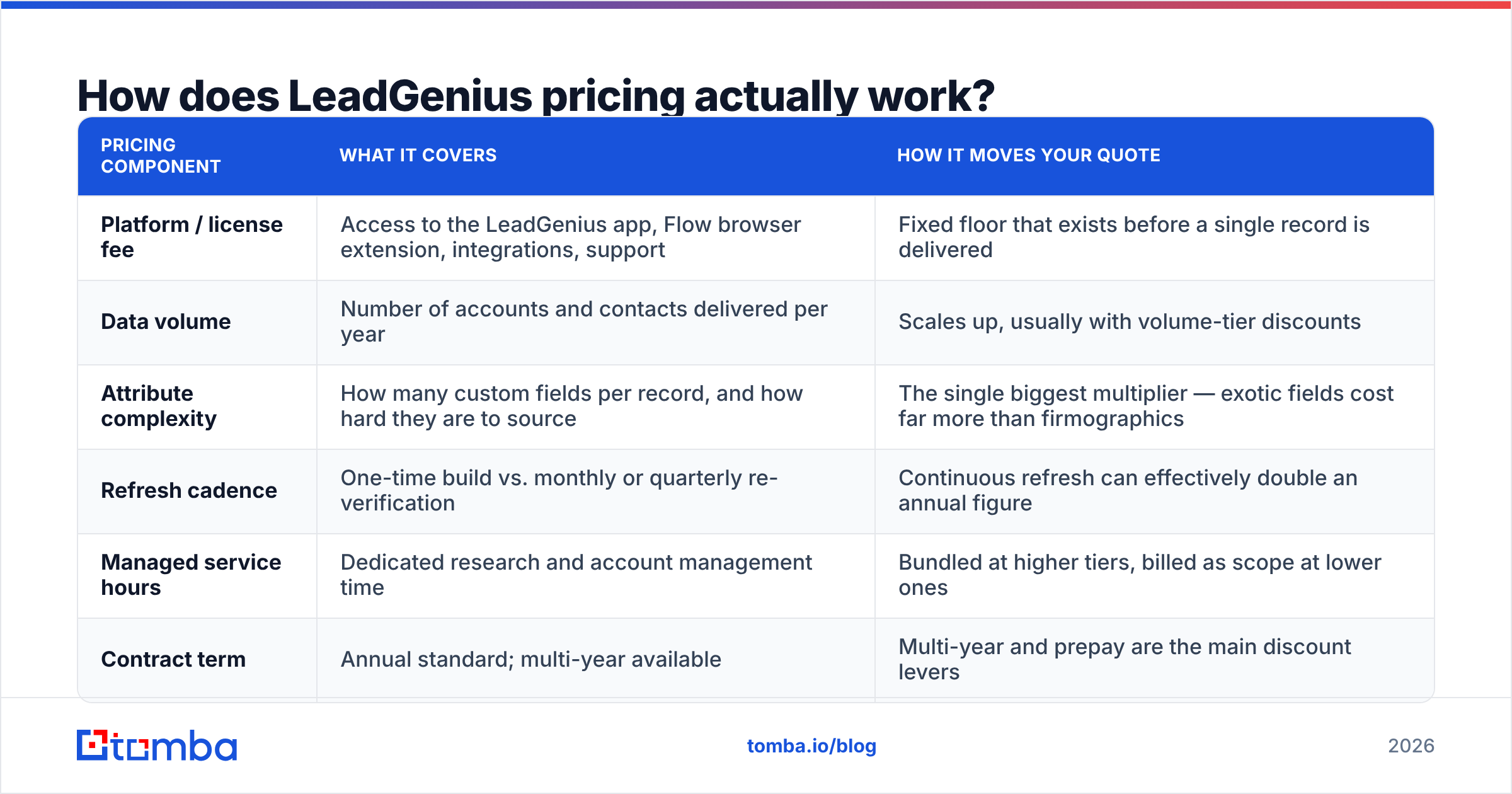
LeadGenius uses quote-only, sales-led pricing. There is no public price page, no free tier, no self-serve checkout, and no month-to-month option in normal circumstances. Contracts are annual, priced on a platform-plus-service basis, and structured around a defined scope of work.
Here is what the quote is actually composed of:
| Pricing component | What it covers | How it moves your quote |
|---|---|---|
| Platform / license fee | Access to the LeadGenius app, Flow browser extension, integrations, support | Fixed floor that exists before a single record is delivered |
| Data volume | Number of accounts and contacts delivered per year | Scales up, usually with volume-tier discounts |
| Attribute complexity | How many custom fields per record, and how hard they are to source | The single biggest multiplier — exotic fields cost far more than firmographics |
| Refresh cadence | One-time build vs. monthly or quarterly re-verification | Continuous refresh can effectively double an annual figure |
| Managed service hours | Dedicated research and account management time | Bundled at higher tiers, billed as scope at lower ones |
| Contract term | Annual standard; multi-year available | Multi-year and prepay are the main discount levers |
The practical consequence: two companies can both "use LeadGenius" and pay wildly different amounts. A team buying 20,000 standard contacts once a year and a team commissioning a monthly-refreshed dataset with twelve custom attributes are running completely different economics.
What does LeadGenius cost in 2026?#
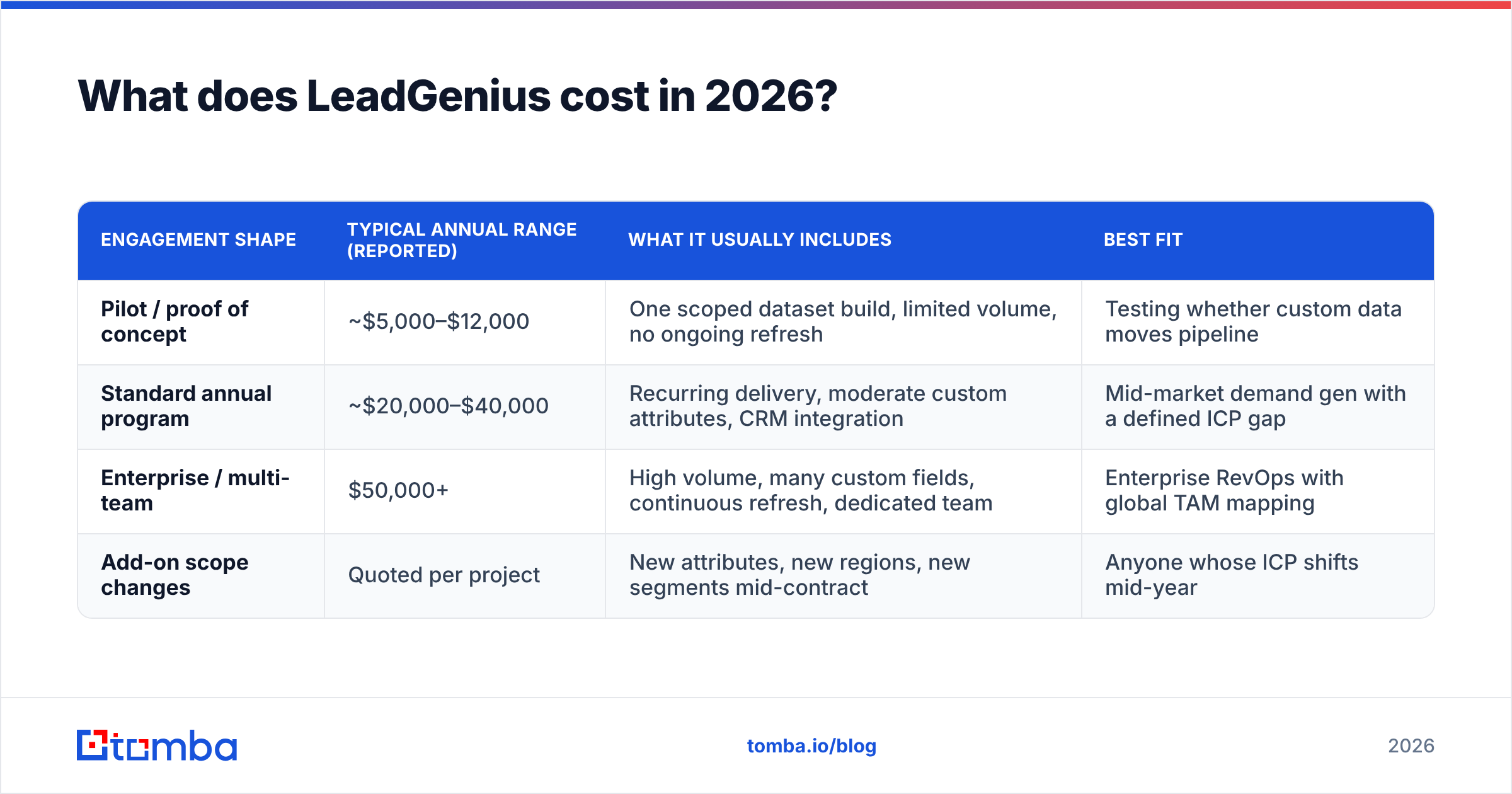
No vendor-published numbers exist, so treat every figure below as a directional range assembled from buyer reports, procurement chatter, and review-site commentary on G2 and Capterra. Confirm anything you plan to budget against directly with the vendor.
| Engagement shape | Typical annual range (reported) | What it usually includes | Best fit |
|---|---|---|---|
| Pilot / proof of concept | ~$5,000–$12,000 | One scoped dataset build, limited volume, no ongoing refresh | Testing whether custom data moves pipeline |
| Standard annual program | ~$20,000–$40,000 | Recurring delivery, moderate custom attributes, CRM integration | Mid-market demand gen with a defined ICP gap |
| Enterprise / multi-team | $50,000+ | High volume, many custom fields, continuous refresh, dedicated team | Enterprise RevOps with global TAM mapping |
| Add-on scope changes | Quoted per project | New attributes, new regions, new segments mid-contract | Anyone whose ICP shifts mid-year |
Two things to flag before you anchor on those numbers. First, the floor is a real floor: this is not a category where you talk your way into a $200/month deal, because the delivery model includes human labor. Second, the spread inside each band is wide, because attribute complexity dominates. A buyer paying $22,000 and a buyer paying $38,000 may be receiving similar row counts with very different field depth.
Where are the hidden costs in a LeadGenius contract?#
The line item is rarely the whole cost. Budget for these five:
- The evaluation cycle itself. Quote-only vendors cost you calendar time. Discovery call, scoping, sample delivery, security review, legal redlines — typically four to eight weeks before the first usable record lands. If your quarter depends on outbound starting next week, that is a real cost.
- Annual commitment risk. You commit for twelve months against an ICP definition you wrote in month zero. If your positioning shifts in month four — and in early-stage GTM it usually does — you are paying for data built to a spec you have abandoned.
- Scope-change fees. Adding attributes or geographies mid-contract is a new scope, and new scope is quoted. The nimble-sounding "just add a field" request is not free.
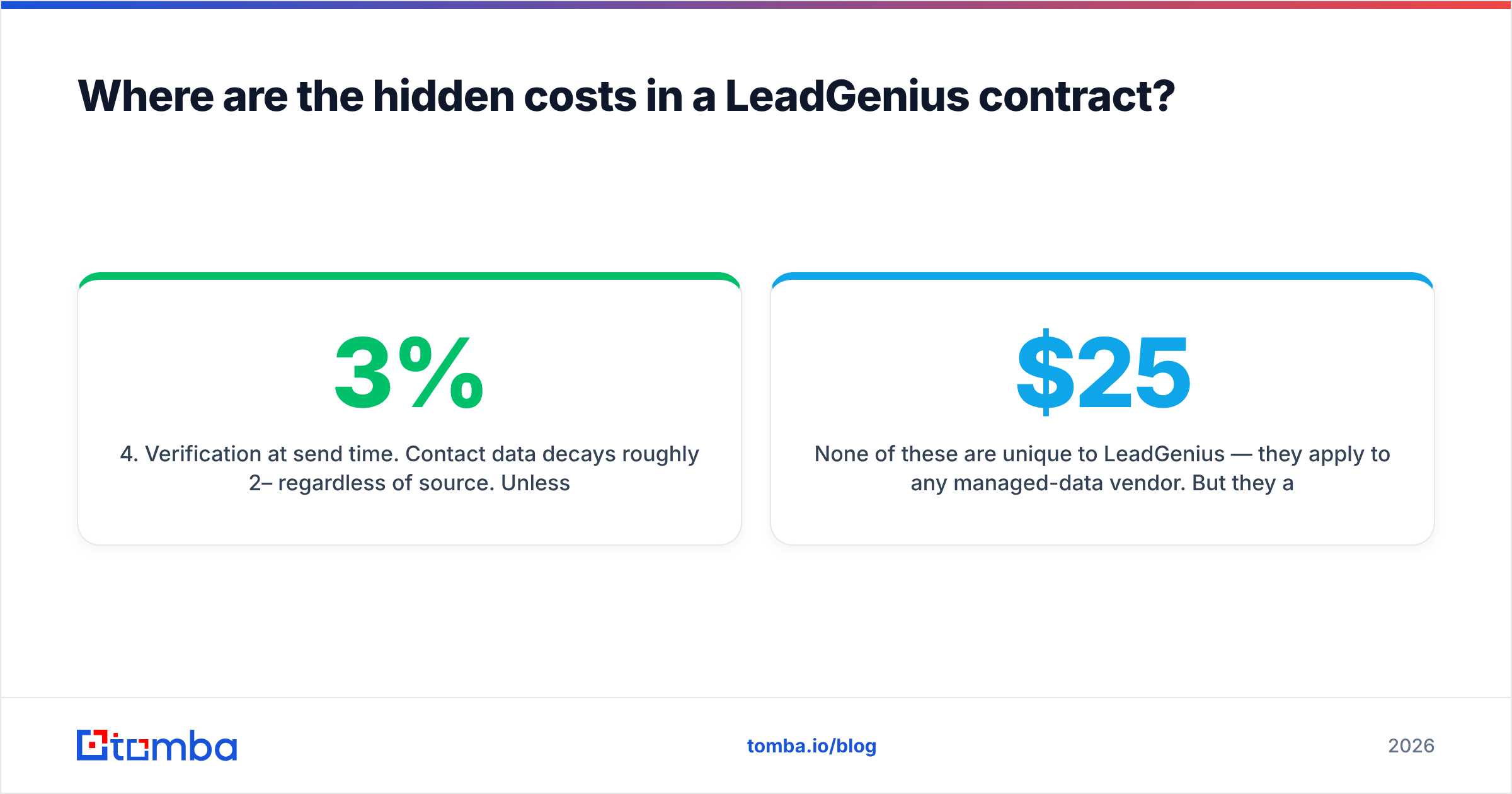
- Verification at send time. Contact data decays roughly 2–3% per month regardless of source. Unless continuous re-verification is written into your contract, you will still want an email verifier in front of your sending tool, which is a separate line item.
- Internal ops time. Custom datasets arrive shaped like your spec, not like your CRM. Mapping, deduping, and routing is engineering or RevOps time nobody puts in the business case.
None of these are unique to LeadGenius — they apply to any managed-data vendor. But they are the difference between a $25,000 contract and a $35,000 true cost of ownership.
How accurate is the data you are paying for?#
This is the crux of the value question, because accuracy is what you are buying at a premium price. Human-verified custom research should — and generally does — beat scraped databases on fields that scrapers cannot reach. Nobody's crawler reliably knows which distribution centers run a specific WMS.
Where the advantage narrows is on ordinary contact data. Work email addresses, job titles, company size, and tech stack are commodity fields in 2026. Every serious provider in the category resolves them at broadly similar rates, and the gap between a $30,000/year managed service and a $49/month self-serve tool on "did you find a valid email for this person" is far smaller than the price gap implies.

The honest framing: you pay LeadGenius for coverage of fields that are otherwise uncoverable, not for a meaningfully better hit rate on standard emails. If your gap is the former, the premium is rational. If it is the latter, you are overpaying for a capability you will not use.
One more accuracy caveat worth knowing regardless of vendor: any dataset delivered against a catch-all domain needs separate handling, because SMTP validation returns "accept" for addresses that do not exist. A catch-all verifier belongs in your stack whether or not you buy managed data.
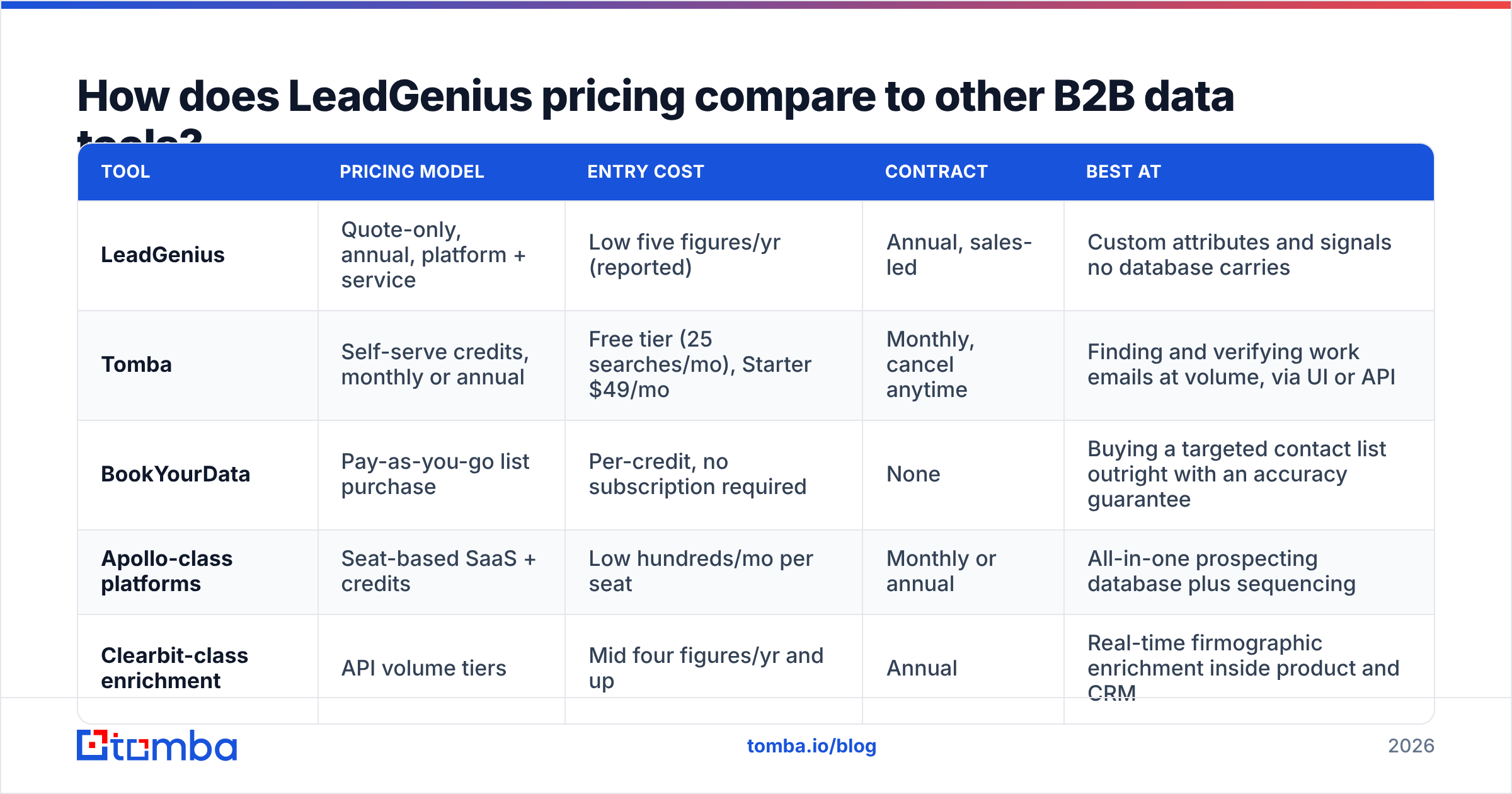
How does LeadGenius pricing compare to other B2B data tools?#
Below is the comparison that actually matters — not feature checklists, but cost structure and what each model is good at.
| Tool | Pricing model | Entry cost | Contract | Best at |
|---|---|---|---|---|
| LeadGenius | Quote-only, annual, platform + service | Low five figures/yr (reported) | Annual, sales-led | Custom attributes and signals no database carries |
| Tomba | Self-serve credits, monthly or annual | Free tier (25 searches/mo), Starter $49/mo | Monthly, cancel anytime | Finding and verifying work emails at volume, via UI or API |
| BookYourData | Pay-as-you-go list purchase | Per-credit, no subscription required | None | Buying a targeted contact list outright with an accuracy guarantee |
| Apollo-class platforms | Seat-based SaaS + credits | Low hundreds/mo per seat | Monthly or annual | All-in-one prospecting database plus sequencing |
| Clearbit-class enrichment | API volume tiers | Mid four figures/yr and up | Annual | Real-time firmographic enrichment inside product and CRM |

Read that table as a spectrum of commitment, not a ranking. BookYourData is genuinely the cleanest option when you know exactly which list you want and do not want a subscription at all — you buy the records, you own them, you move on. Tomba sits at the other end of flexibility, where you are running continuous discovery and want an API you can call from your own pipeline. LeadGenius sits at the far end of depth, where the data has to be manufactured rather than retrieved.

Is LeadGenius worth it for your team?#
Buy it when at least two of these are true:
- Your ICP is defined by an attribute that no commercial database tracks, and you have verified this by testing two or three self-serve tools first.
- You have annual budget authority in the five-figure range and a procurement process that can absorb a six-week evaluation.
- The dataset supports a program, not a campaign — territory planning, TAM mapping, account scoring — where the data lives in your systems for a year.
- You have RevOps capacity to operationalize custom fields once they land.
Skip it when:
- Your core need is work emails and phone numbers for known-title personas. That is a solved, cheap problem.
- You are pre-product-market-fit and your ICP will change twice before the contract ends.
- You need data this week.
- Your total data budget is under roughly $10,000 a year, in which case the platform fee alone eats the budget.
A useful test before you take the demo: pull a sample of 200 target accounts and try to build the dataset yourself with a domain search plus a couple of enrichment calls. If you get to 80% coverage, you have just saved yourself a five-figure contract. If you get to 30%, you have a genuine custom-data problem and LeadGenius is a legitimate answer to it.
How do you negotiate a better LeadGenius quote?#
Quote-only pricing cuts both ways — it is opaque, but it is also negotiable in ways published pricing is not.
- Come in with a scoped spec, not a vague brief. "We need contacts at manufacturers" gets you a defensive, padded quote. A precise attribute list gets you a priced one.
- Ask for the platform fee and the data fee separately. Vendors quote blended totals. Separating them tells you what you are paying for access versus delivery, and it is the number to push on.
- Trade term for price. Multi-year and annual prepay are the strongest levers; mid-contract scope flexibility is the second-strongest and is often free to ask for.
- Start with a paid pilot and a written expansion price. Lock the per-record rate for year two before you sign year one.
- Benchmark against the alternative you actually have. Walking in knowing that standard contact discovery costs you $99/month elsewhere sharpens every conversation about what the premium buys.
Also worth doing: check what percentage of your requested fields are standard firmographics. If it is above half, ask the vendor to price a smaller custom scope and source the commodity fields yourself through a bulk email finder. Splitting the job is usually cheaper than paying managed-service rates for data that is already commoditized.
What should you do next?#
Get the quote — there is no downside to knowing the number — but do the cheap test first. Most teams who think they have a custom-data problem actually have a find-and-verify problem wearing a custom-data costume.
If that is you, start with Tomba Email Finder. The free tier gives you 25 searches a month to sanity-check coverage on your real target list, Starter is $49/mo and Growth is $99/mo, and there is no annual commitment to sign or discovery call to sit through. Everything is available through the Tomba API if you would rather build the workflow into your own stack, and the full Tomba pricing breakdown is public — which is more than most of this category will tell you before a sales call.
Run the 200-account test this week. Then decide whether you have a five-figure problem or a $49 one.
Related guides#
// get started
Find, verify and enrich your first contacts today
Start on the free plan with 25 searches a month, then scale when your team is ready.
Free plan · No credit card required · GDPR & CCPA
// about the author