LeadGenius Pros and Cons: An Honest 2026 Buyer's Review
LeadGenius sells custom, human-verified B2B data that standard databases cannot produce. That strength comes with annual contracts, quote-only pricing, and research lead times. Here is the honest trade-off.
TL;DR
- The short version of the LeadGenius pros and cons: excellent custom data, slow and costly to buy.
- LeadGenius is a managed B2B data service, not a self-serve database. You brief a team. They build datasets your CRM cannot buy off the shelf.
- The biggest pro is custom attributes. Store counts, hiring signals, product SKUs, local headcount — researched to your spec and checked by people.
- The biggest cons are quote-only pricing, annual contracts, and lead times in days or weeks.
- Need 500 emails this afternoon for a standard ICP? A self-serve email finder at $49/mo does that job for about 1% of the cost.
- Most teams run both. A cheap API for volume contact data. A managed vendor for the 5% of attributes nobody else sells.
What Is LeadGenius and Who Actually Uses It?#
LeadGenius is a B2B data company. It pairs automated collection with a global team of human researchers. You do not buy seats in a fixed contact database. You hand over a brief — "every Shopify merchant in DACH with 20+ stores and a named head of retail ops" — and the team builds that list for you.
Think of a supermarket versus a private chef. The supermarket stocks 40,000 items today, and you take what is on the shelf. The chef costs more and needs notice. But you get the exact dish you asked for, including items the supermarket never stocks.
The customer profile follows from that model. LeadGenius shows up in enterprise GTM stacks. Think revenue ops teams with 200+ sellers. Think ABM programs that need signals no vendor publishes. Think data teams piping custom fields into Salesforce or Snowflake. You can read the company's own pitch on leadgenius.com. Buyer reviews cluster on G2 under data intelligence, not under lead gen tools.
What it is not: a Chrome extension you install on Tuesday to hit quota on Friday. Teams that expect self-serve speed write the bad reviews.
What Are the Main LeadGenius Pros?#
Start with the upside half of the LeadGenius pros and cons. The strengths are real, and they are specific. Three stand out first:
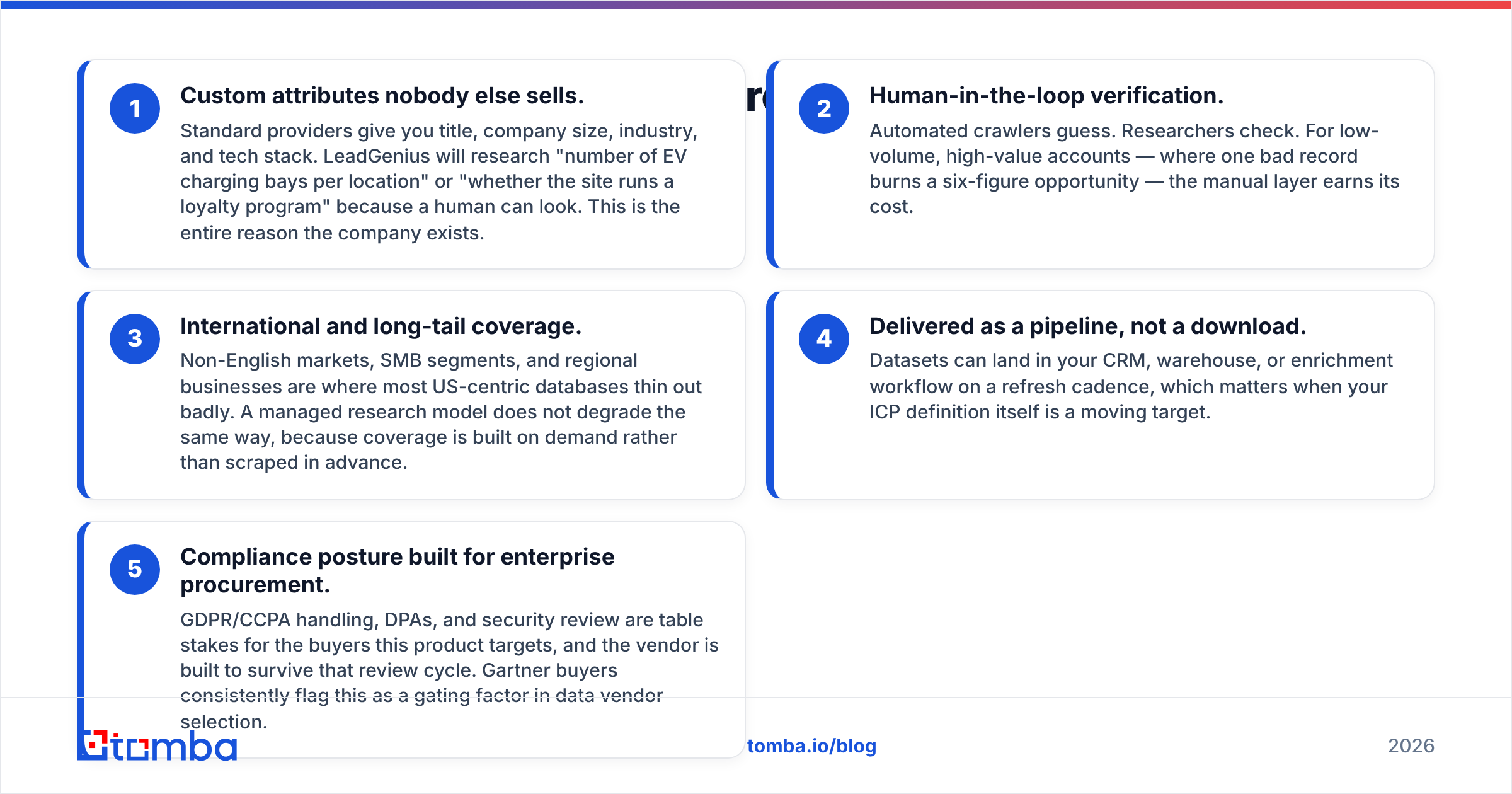
- Custom attributes nobody else sells. Most providers give you title, company size, industry, and tech stack. LeadGenius will research "number of EV charging bays per site" or "whether the store runs a loyalty program" because a person can go and look. That is the whole reason the company exists.
- People check the data. Crawlers guess. Researchers confirm. One bad record can burn a six-figure deal, so that manual layer earns its keep.
- Deep coverage abroad and in the long tail. Most US-centric databases go thin on non-English markets, SMBs, and regional firms. Research on demand does not thin out the same way, because coverage is built when you ask for it.
Two more matter once the data has to run in production:
- It arrives as a pipeline, not a download. Datasets can land in your CRM, warehouse, or enrichment flow on a set cadence. That helps when your ICP keeps moving.
- Built for enterprise buying. GDPR and CCPA handling, DPAs, and security review are table stakes for these buyers. Gartner buyers rank this high when they pick a data vendor.
Is your bottleneck which accounts to target, rather than how to reach them? Then these pros land on your problem.

What Are the Real LeadGenius Cons?#
Now the other side of the LeadGenius pros and cons. None of this is a secret. Each con follows from the managed model.
Pricing is quote-only. There is no public price page. No free tier. No credit card checkout. You book a call, scope a project, and wait for a proposal. Reviewers describe annual deals, not monthly plans, at enterprise rates. If you cannot wait weeks to see a number, that is a hard blocker.
Turnaround runs in days, not milliseconds. A research brief has a lead time. An API call does not. Say a rep finds a prospect on LinkedIn and needs a verified email in 90 seconds. A managed vendor is the wrong tool there. You want a LinkedIn finder or a browser extension.
You have to know what you want. Output quality tracks brief quality. A fuzzy ICP buys expensive fuzzy data. Their solutions engineers will help. They cannot invent your go-to-market plan.
Minimums do not suit small teams. A three-person startup that needs 2,000 contacts this quarter will not clear the floor. That is not a flaw in the product. It is a mismatch of scale.
Re-scoping costs money. Change the ICP mid-contract and you often re-scope a project. You do not just toggle a filter. Self-serve databases let you change your mind for free. That freedom is worth a lot while you are still finding your market.
How Does LeadGenius Compare to Self-Serve Data Tools?#
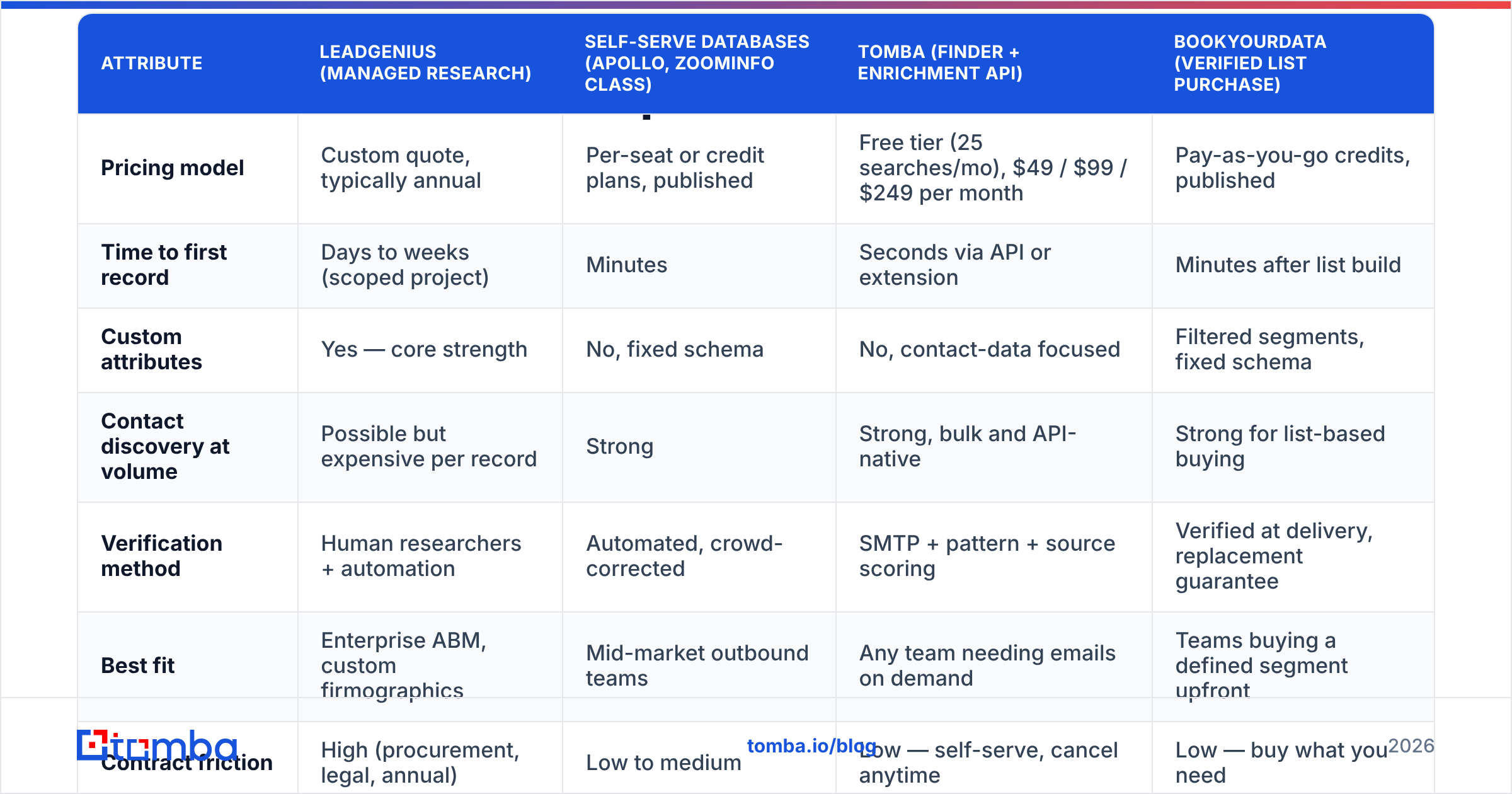
The LeadGenius pros and cons look different depending on which layer of the stack you are buying. So the honest question is not which tool is better. Here is how the categories compare on the points that decide deals:
| Attribute | LeadGenius (managed research) | Self-serve databases (Apollo, ZoomInfo class) | Tomba (finder + enrichment API) | BookYourData (verified list purchase) |
|---|---|---|---|---|
| Pricing model | Custom quote, typically annual | Per-seat or credit plans, published | Free tier (25 searches/mo), $49 / $99 / $249 per month | Pay-as-you-go credits, published |
| Time to first record | Days to weeks (scoped project) | Minutes | Seconds via API or extension | Minutes after list build |
| Custom attributes | Yes — core strength | No, fixed schema | No, contact-data focused | Filtered segments, fixed schema |
| Contact discovery at volume | Possible but expensive per record | Strong | Strong, bulk and API-native | Strong for list-based buying |
| Verification method | Human researchers + automation | Automated, crowd-corrected | SMTP + pattern + source scoring | Verified at delivery, replacement guarantee |
| Best fit | Enterprise ABM, custom firmographics | Mid-market outbound teams | Any team needing emails on demand | Teams buying a defined segment upfront |
| Contract friction | High (procurement, legal, annual) | Low to medium | Low — self-serve, cancel anytime | Low — buy what you need |
Read that table as a stack, not a bracket. BookYourData solves "give me a clean segment now." Tomba solves "turn this person into a verified email, by API, at any hour." LeadGenius solves "nobody sells the attribute I need, so someone has to go find it." Those are three different purchase orders.

How Much Does LeadGenius Cost in 2026?#
Short answer: nobody outside the sales process knows. Any blog that quotes a figure is guessing.
What you can check: no price page, no self-serve signup, no free plan. What buyers report: annual deals scoped by volume, complexity, and refresh rate. The number needs finance approval, not a corporate card.
That silence is a fair choice for custom work. Researching 10,000 records with 4 custom fields costs far less than 500 records with 20 fields. But it has a cost for you as a buyer. You cannot compare LeadGenius with anything else until you enter a sales cycle. Compare that with a public table you can read in 90 seconds, like Tomba pricing: $49/mo Starter, $99/mo Growth, $249/mo Pro, plus a free tier to test accuracy first.
One move before the call: price your baseline. Work out what the same volume of standard contact data would cost from a self-serve provider. Treat the gap as the price of the custom attributes. If those attributes do not change which accounts you chase, the gap is not worth paying.
Is LeadGenius Worth It for Your Team?#
The LeadGenius pros and cons only matter against your own setup. Use this as a filter, not a verdict.
Strong fit if:
- Your ICP hinges on an attribute no database sells, and it really changes who you chase.
- You sell to international, SMB, or long-tail segments where US-centric databases go thin.
- Deal sizes justify a five- or six-figure data spend, and you can run an annual contract.
- A RevOps or data owner can write a tight brief and own the pipeline after delivery.
Weak fit if:
- You mostly need emails and phone numbers for firms you can already name.
- Your ICP still shifts monthly because you are pre-product-market-fit.
- You need results this week, not this quarter.
- Your whole annual tooling budget is smaller than one enterprise data contract.
The costly mistake is buying managed research to fix a contact-data problem. Are your reps stuck because they cannot get a working email? That is a finder-and-verifier problem. Run your account list through a bulk email finder, then verify the results. That clears the block for a fraction of the cost, and you know within an hour whether coverage is good enough.
What Are the Best LeadGenius Alternatives in 2026?#
Weigh the LeadGenius pros and cons against what you are actually replacing. Alternatives split into four buckets.
- Custom research: few direct substitutes exist. Boutique data-as-a-service firms and offshore research teams compete here. You trade process maturity and compliance paperwork for a lower hourly rate.
- Broad contact coverage: self-serve databases cover standard firmographics for far less, with instant access and no scoping call. The catch is a fixed schema.
- List buying: BookYourData works when you know your segment and want verified contacts without a subscription. It is a clean, low-friction buy for a set ICP.
- Contact resolution: an API-first finder plus verifier handles "name + domain to verified email" at machine speed. Tomba's data enrichment and Tomba API do exactly this, including catch-all handling that trips up cheap tools.
Healthy stacks combine layers. A self-serve API for daily contact lookups. A list source for set segments. A managed vendor for the few attributes that justify custom research. Paying research rates for data an API returns in 200 milliseconds is the most common budget leak in RevOps.
What Should You Verify Before Signing?#
Ask these on the scoping call. Then write the answers into the contract.
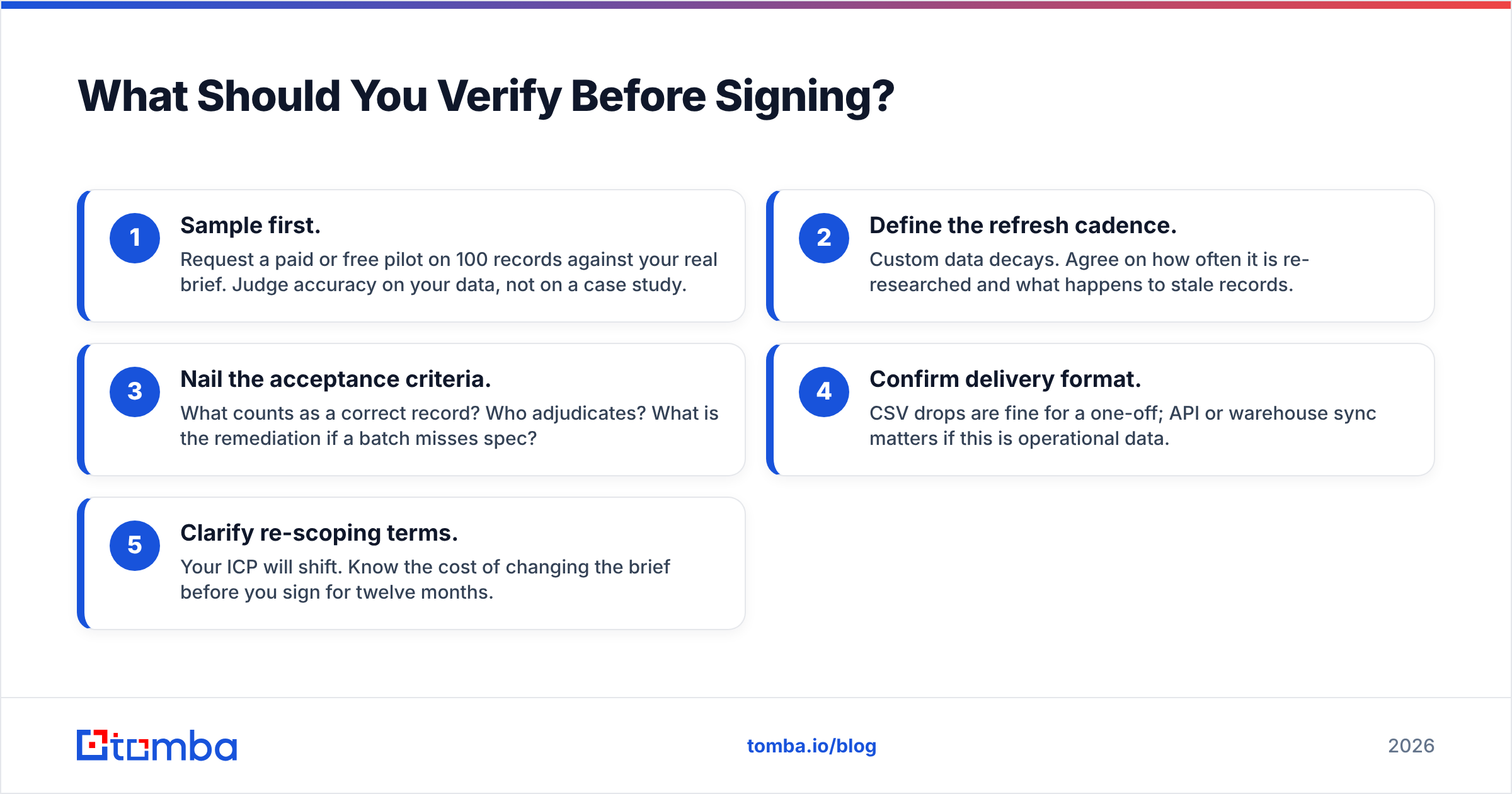
- Sample first. Ask for a pilot on 100 records against your real brief. Judge accuracy on your data, not on a case study.
- Set the refresh cadence. Custom data decays. Agree how often records get re-researched, and what happens to stale ones.
- Nail the acceptance criteria. What counts as a correct record? Who decides? What is the fix if a batch misses spec?
- Confirm the delivery format. A CSV drop is fine for a one-off. API or warehouse sync matters for operational data.
- Clarify re-scoping terms. Your ICP will shift. Learn the cost of changing the brief before you sign for a year.
Any vendor confident in its work answers all five without friction.
LeadGenius Pros and Cons: The Bottom Line#
LeadGenius is a real product with a clear niche. It aims at enterprise teams that have custom data problems. The pros — bespoke attributes, human checks, depth abroad, compliance readiness — are hard to copy with software alone. The cons — quote-only pricing, annual terms, lead times, and a poor fit for small or fast-moving teams — come with that model. They are not bugs anyone can patch.
So diagnose your bottleneck before you judge the vendor. Is the blocker which accounts to chase? Then managed research may pay for itself. Is the blocker reaching people at accounts you already know? That is a much cheaper problem.
For the second case, start with the Tomba Email Finder. Feed it a name and domain, or run a whole account list through it. You get verified work emails back in seconds. The first 25 searches are free, paid plans start at $49/mo, and it ships with an API, CLI, browser extension, and spreadsheet add-ons. Test it on your own ICP today. You will know how much of your data problem is left for a managed vendor to solve.
Related guides#
// get started
Find, verify and enrich your first contacts today
Start on the free plan with 25 searches a month, then scale when your team is ready.
Free plan · No credit card required · GDPR & CCPA
// about the author