LeadGenius Reviews 2026: Pricing, Data Quality, and Limits
LeadGenius sells managed, human-verified B2B data, not a self-serve tool. Here is what buyers say about its pricing, accuracy, and onboarding in 2026 — and when a $49/mo email finder does the same job.
TL;DR
- LeadGenius is a managed B2B data service, not a self-serve database. You brief a team, they build and maintain custom datasets for you. That model is the source of both its best reviews and its worst ones.
- Pricing is not published. Buyers consistently describe annual contracts in the five-figure range, which puts it out of reach for most SMB and solo outbound teams.
- Reviewers praise custom attributes and international coverage — headcount by office, hiring signals, store counts, non-US firmographics — that generic databases simply do not carry.
- The recurring complaints: slow onboarding, turnaround time on custom requests, and rigid contracts. Several reviewers note it takes weeks before data starts flowing.
- If what you actually need is verified work emails at a known list of companies, a self-serve email finder starting at $49/mo covers it without a procurement cycle.
What is LeadGenius and who is it for?#
LeadGenius is a B2B data company that combines machine collection with a distributed human research team to build custom datasets on request. It launched out of UC Berkeley research in the early 2010s (originally as MobileWorks) and has spent the last decade positioning itself away from "buy a list" and toward "we will find the data nobody else has."
The distinction matters more than the marketing copy suggests. Most data vendors sell you access to a pre-built database: you filter, you export, you pay per record or per seat. LeadGenius works closer to a research agency with software attached. You tell them the attributes you need — say, every Shopify Plus merchant in DACH with more than 50 employees and a named head of logistics — and their team goes and assembles it, then keeps it refreshed.
That means the buyer profile skews mid-market to enterprise: RevOps and demand-gen teams at companies selling into narrow, hard-to-segment markets, where the total addressable market cannot be pulled from a standard firmographic filter. You can see the positioning on LeadGenius's own site, which leans heavily on account intelligence and custom signals rather than record counts.
If you are a three-person startup that needs 500 verified emails this week, you are not the customer, and most honest LeadGenius reviews say so directly.
How does LeadGenius actually collect data?#
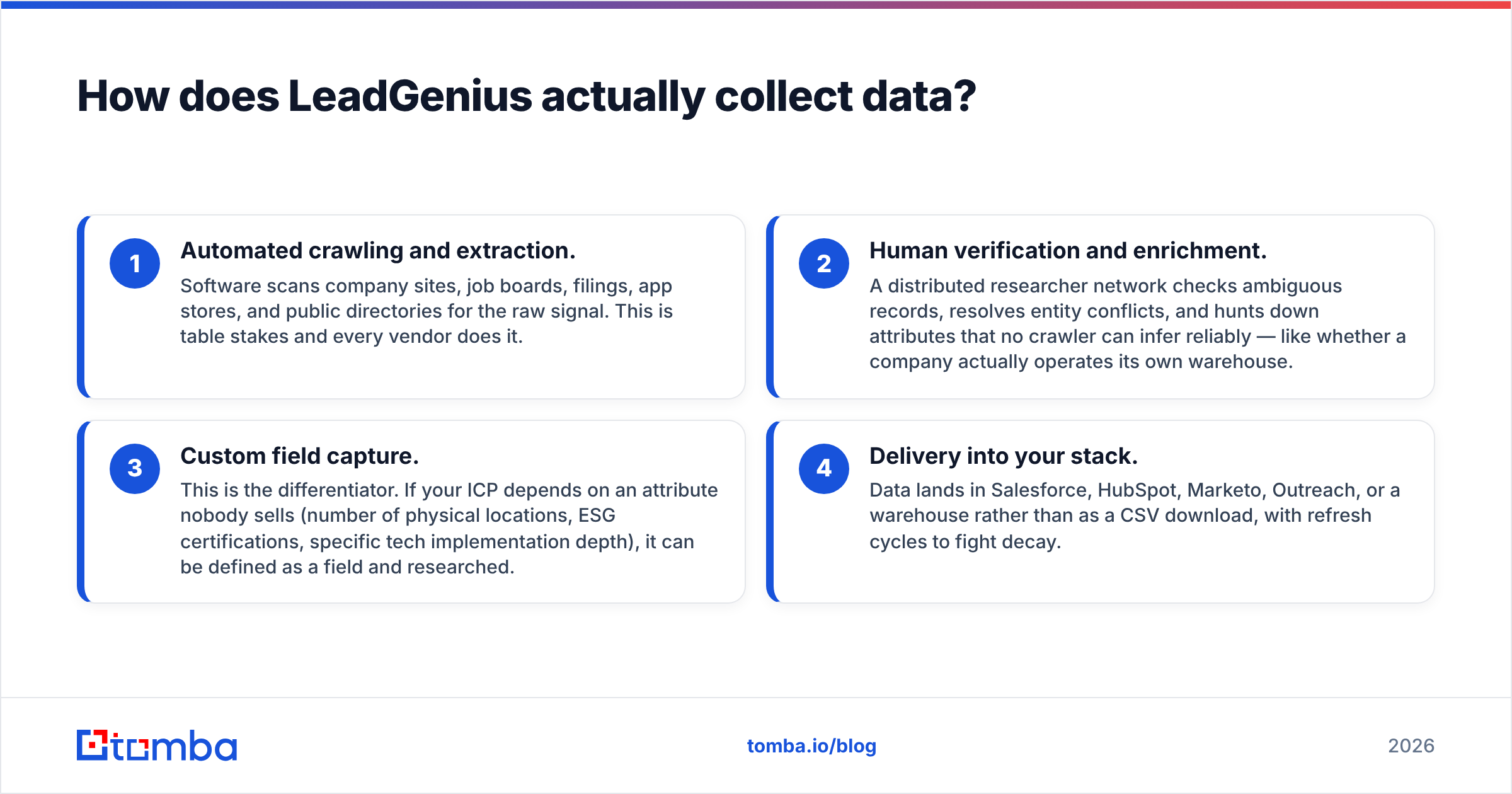
Understanding the collection model explains nearly every review you will read about it. Four layers do the work:
- Automated crawling and extraction. Software scans company sites, job boards, filings, app stores, and public directories for the raw signal. This is table stakes and every vendor does it.
- Human verification and enrichment. A distributed researcher network checks ambiguous records, resolves entity conflicts, and hunts down attributes that no crawler can infer reliably — like whether a company actually operates its own warehouse.
- Custom field capture. This is the differentiator. If your ICP depends on an attribute nobody sells (number of physical locations, ESG certifications, specific tech implementation depth), it can be defined as a field and researched.
- Delivery into your stack. Data lands in Salesforce, HubSpot, Marketo, Outreach, or a warehouse rather than as a CSV download, with refresh cycles to fight decay.
The tradeoff is the obvious one: humans are slower and more expensive than an API call. You get attributes you cannot buy anywhere else, and you wait for them.

What do LeadGenius reviews say about data quality?#
Aggregate sentiment on public review sites is solidly positive — LeadGenius maintains a strong rating across the G2 reviews for the product, with the recurring theme being accuracy on niche attributes rather than raw volume.
Three patterns show up repeatedly in the written reviews:
Custom attributes hold up well. Reviewers who commissioned unusual fields — operating-country lists, franchise counts, department-level headcount — generally report the data was correct and usable. This is the strongest, most consistent praise in the corpus.
International coverage is better than average. Teams selling into EMEA, LATAM, and APAC report fewer blind spots than they hit with US-centric databases. If your pipeline lives outside North America, this is a real, material advantage.
Contact-level freshness is good but not magic. Emails and titles decay regardless of vendor. Industry estimates put B2B contact data decay somewhere in the 25-30% annual range, and human verification slows that curve without stopping it. Reviewers who treat LeadGenius output as permanently clean and skip a verification step before sending still report bounces. Whatever your source, run the list through an email verifier before a campaign — that is true of every vendor on this page, including the good ones.
The fair summary: quality complaints are rare and usually about speed of correction rather than wrongness.
How much does LeadGenius cost in 2026?#
LeadGenius does not publish pricing. Every engagement is quoted after a scoping call, and what you pay depends on the number of custom fields, the size of the universe being maintained, refresh frequency, and contract length.
What buyers report publicly and in procurement discussions is consistent enough to plan around: annual commitments starting in the low five figures, climbing with scope. There is no free tier, no credit-card checkout, and generally no month-to-month option. Treat any specific number you see quoted online as directional — yours will be negotiated.
That structure is not a flaw. It matches the service. But it does mean the real cost question is not "is LeadGenius expensive" — it is "is custom data research the thing I am actually short on?" For a large share of outbound teams, the honest answer is no. They know exactly which 2,000 companies they want. They just need the right person and a deliverable address, which is a solved, cheap, self-serve problem.
How does LeadGenius compare to self-serve alternatives?#
Here is the comparison that matters — a managed research service against tools you can start using in the next ten minutes.
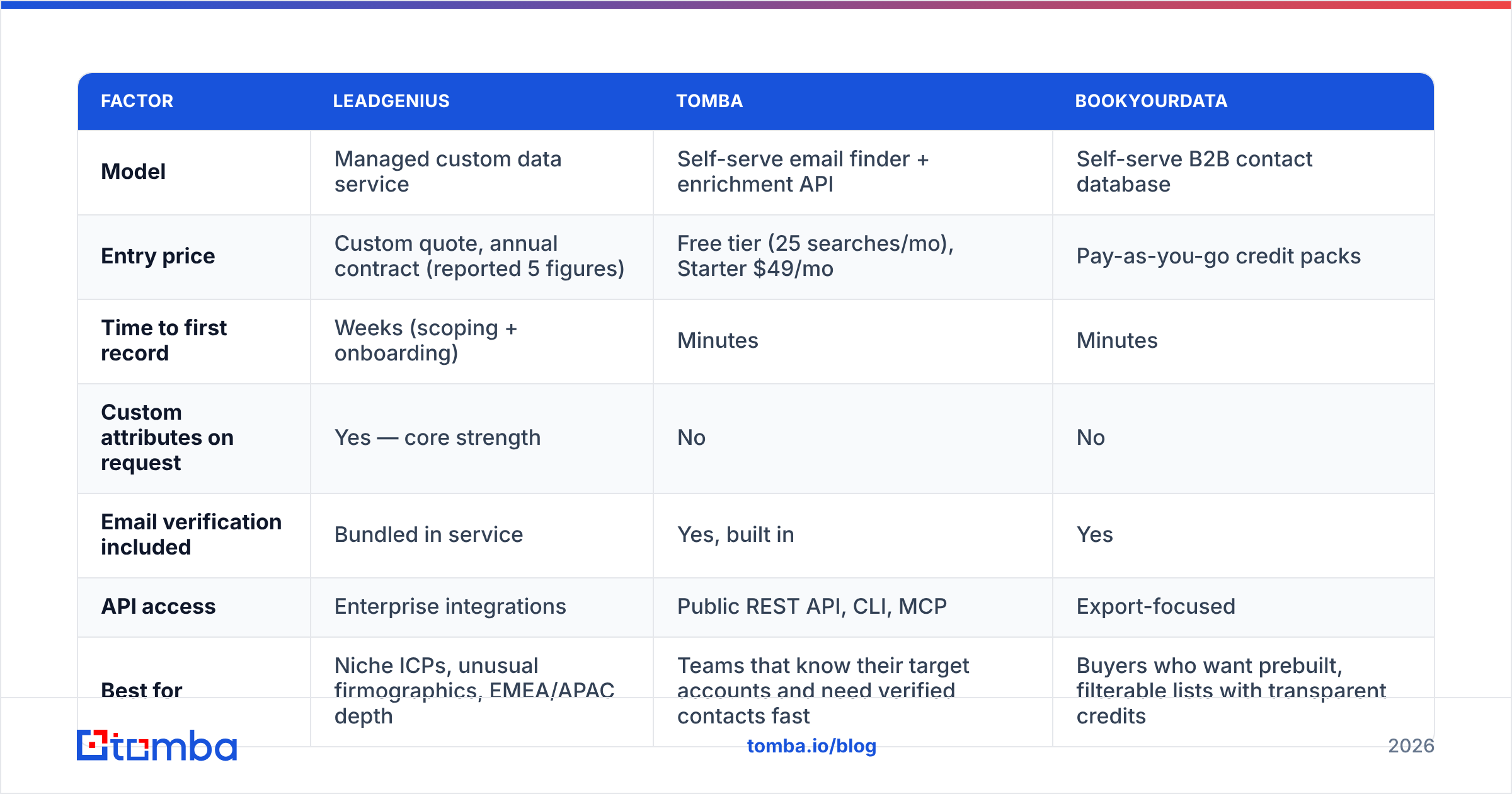
| Factor | LeadGenius | Tomba | BookYourData |
|---|---|---|---|
| Model | Managed custom data service | Self-serve email finder + enrichment API | Self-serve B2B contact database |
| Entry price | Custom quote, annual contract (reported 5 figures) | Free tier (25 searches/mo), Starter $49/mo | Pay-as-you-go credit packs |
| Time to first record | Weeks (scoping + onboarding) | Minutes | Minutes |
| Custom attributes on request | Yes — core strength | No | No |
| Email verification included | Bundled in service | Yes, built in | Yes |
| API access | Enterprise integrations | Public REST API, CLI, MCP | Export-focused |
| Best for | Niche ICPs, unusual firmographics, EMEA/APAC depth | Teams that know their target accounts and need verified contacts fast | Buyers who want prebuilt, filterable lists with transparent credits |
| Contract flexibility | Annual commitment | Monthly, cancel anytime | No subscription required |
Read that table as a fork, not a ranking. LeadGenius wins on a dimension the others do not compete on — bespoke research. BookYourData is a solid pick when you want a clean prebuilt list with no commitment and predictable credit pricing. Tomba wins when the constraint is contact discovery at known companies, at a price that does not require sign-off.
The mistake teams make is buying the expensive option for the cheap problem. If you can name your accounts, you have a lookup problem. Domain search plus verification solves it for $49/mo, and you can pressure-test the whole workflow on the free tier before spending anything — the full breakdown is on the Tomba pricing page.

What are the biggest complaints in LeadGenius reviews?#
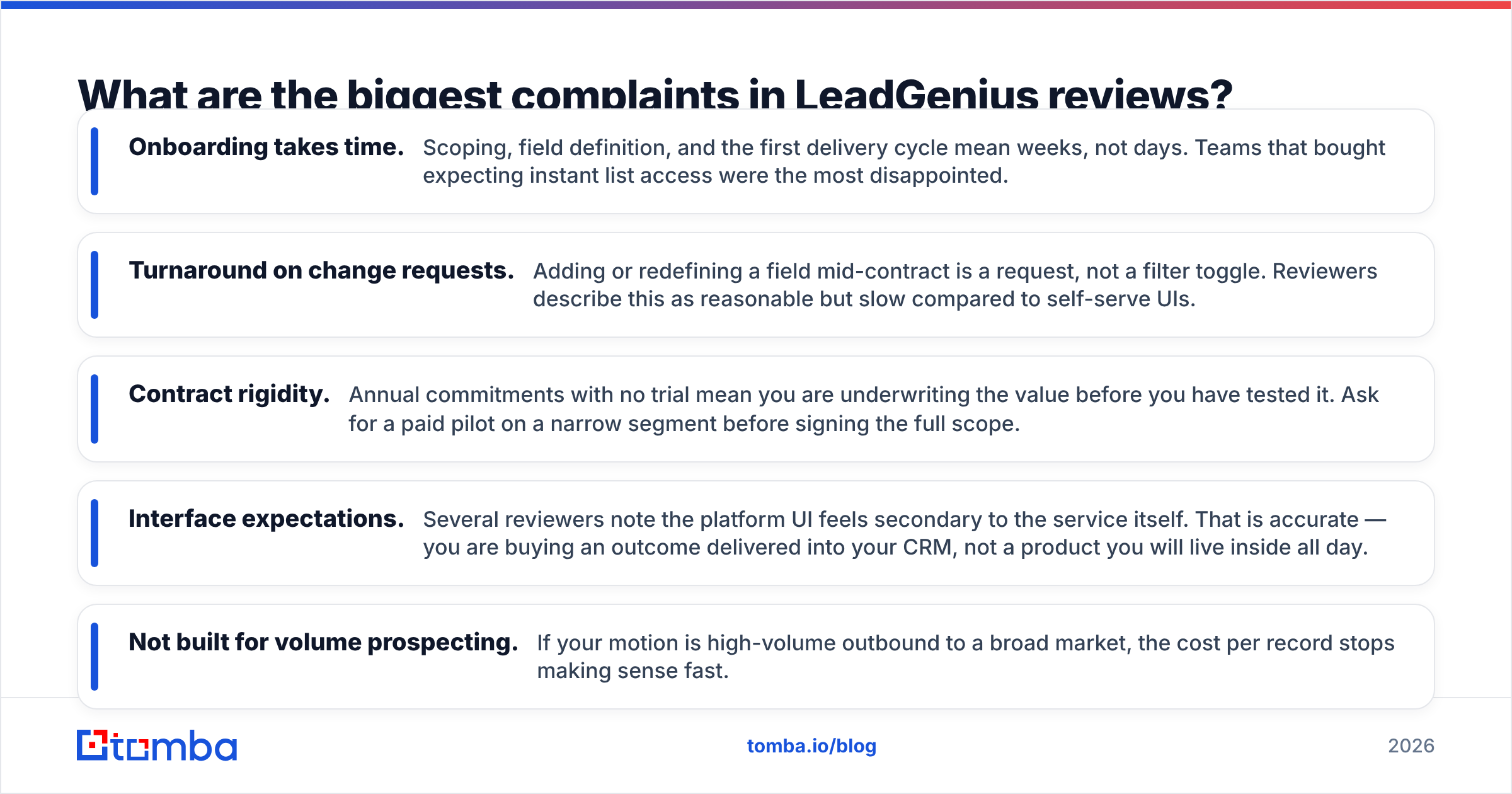
Balanced reviews surface four recurring frictions. None of them are dealbreakers for the right buyer, but all four are predictable consequences of the model.
- Onboarding takes time. Scoping, field definition, and the first delivery cycle mean weeks, not days. Teams that bought expecting instant list access were the most disappointed.
- Turnaround on change requests. Adding or redefining a field mid-contract is a request, not a filter toggle. Reviewers describe this as reasonable but slow compared to self-serve UIs.
- Contract rigidity. Annual commitments with no trial mean you are underwriting the value before you have tested it. Ask for a paid pilot on a narrow segment before signing the full scope.
- Interface expectations. Several reviewers note the platform UI feels secondary to the service itself. That is accurate — you are buying an outcome delivered into your CRM, not a product you will live inside all day.
- Not built for volume prospecting. If your motion is high-volume outbound to a broad market, the cost per record stops making sense fast.
Cross-checking against Capterra's B2B data software category and general buyer sentiment, these critiques are consistent across the managed-service segment as a whole rather than unique to LeadGenius.
Is LeadGenius worth it in 2026?#
Yes — if your bottleneck is data that does not exist in any database you can buy.
Concretely, LeadGenius earns its price when:
- Your ICP is defined by an attribute no vendor sells as a filter.
- You sell internationally and standard databases leave holes in your TAM.
- You have RevOps capacity to own the relationship and a budget cycle that accommodates annual contracts.
- Account coverage accuracy is worth more to you than speed.
It is the wrong purchase when:
- You already know your target accounts and just need people and emails.
- You need to start this week.
- Your ACV cannot absorb a five-figure annual data line.
- You want to test, iterate, and change segments monthly.
That second list describes most outbound teams. Being honest about which list you are on saves a very expensive year.
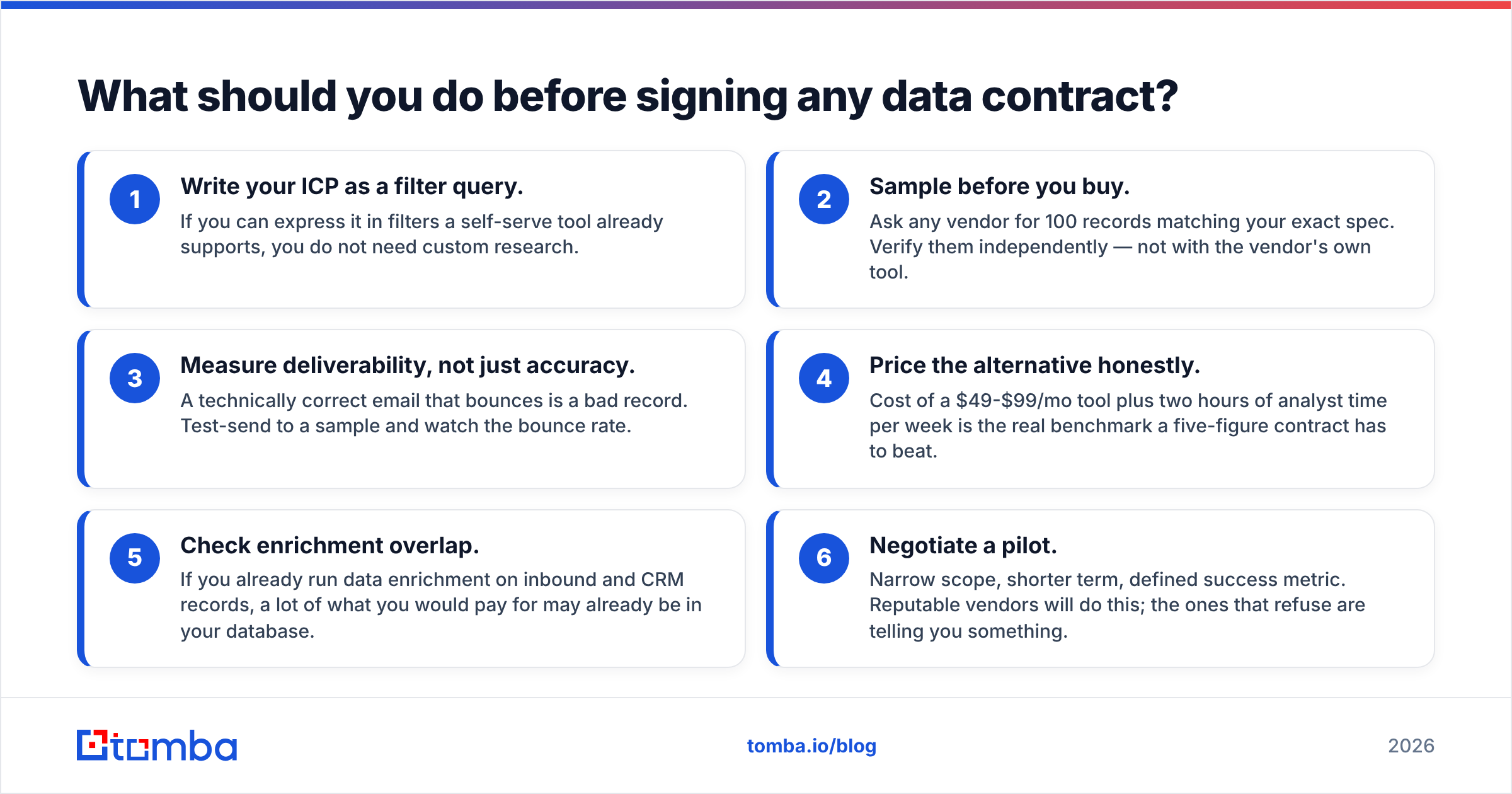
What should you do before signing any data contract?#
Run this sequence regardless of which vendor you are evaluating. It takes a day and it has saved teams six-figure mistakes.
- Write your ICP as a filter query. If you can express it in filters a self-serve tool already supports, you do not need custom research.
- Sample before you buy. Ask any vendor for 100 records matching your exact spec. Verify them independently — not with the vendor's own tool.
- Measure deliverability, not just accuracy. A technically correct email that bounces is a bad record. Test-send to a sample and watch the bounce rate.
- Price the alternative honestly. Cost of a $49-$99/mo tool plus two hours of analyst time per week is the real benchmark a five-figure contract has to beat.
- Check enrichment overlap. If you already run data enrichment on inbound and CRM records, a lot of what you would pay for may already be in your database.
- Negotiate a pilot. Narrow scope, shorter term, defined success metric. Reputable vendors will do this; the ones that refuse are telling you something.
For broader context on how data quality maps to pipeline outcomes, HubSpot's sales research library is a reasonable neutral starting point.
The verdict#
LeadGenius is a legitimately good product for a specific buyer: enterprise and upper-mid-market teams whose go-to-market depends on data that has to be researched rather than queried. The reviews reflect that — strong on accuracy and custom attributes, weak on speed and flexibility. Nothing in the public feedback suggests a bad vendor. It suggests a specialized one.
The failure mode is not buying LeadGenius. It is buying a research service when you have a lookup problem.
If your list of target companies already exists and what you are missing is the right contact with a verified, deliverable address, start with the Tomba Email Finder. The free tier gives you 25 searches a month to test accuracy against your own known-good contacts, Starter is $49/mo when you are ready to scale, and there is no scoping call between you and your first campaign. Prove the workflow works, then decide whether you genuinely need custom research on top of it.
Related guides#
// get started
Find, verify and enrich your first contacts today
Start on the free plan with 25 searches a month, then scale when your team is ready.
Free plan · No credit card required · GDPR & CCPA
// about the author