LeadGenius vs RocketReach: Which B2B Data Tool Wins?
LeadGenius sells managed, human-verified custom datasets. RocketReach sells self-serve contact lookups at scale. They solve different problems — here's which one your team actually needs, and what it really costs.
TL;DR
- LeadGenius is a managed data service: you brief a team, they build custom, human-verified datasets against fields that no database ships out of the box. Annual contracts, five figures, sales-led onboarding.
- RocketReach is a self-serve contact lookup engine: search a person or company, get emails and phone numbers back in seconds. Card-swipe pricing from roughly $39/user/mo, no contract required.
- They are not really competitors. LeadGenius competes with Bombora-style intent vendors and offshore research teams. RocketReach competes with Apollo, Lusha, and ContactOut.
- If your bottleneck is custom attributes (headcount by department, tech migrations, store-level data), LeadGenius wins. If your bottleneck is volume of verified contacts per dollar, RocketReach wins — and cheaper API-first options like Tomba win harder.
- Most teams evaluating these two actually need a third thing: a verification-first email finder wired into their CRM, not a $30K research retainer.
What is LeadGenius and who actually buys it?#
LeadGenius is a managed B2B data provider. Instead of giving you a search bar, it gives you an account team. You describe the accounts you care about and the fields you need — "every Shopify Plus merchant in DACH with an in-house fulfillment team and a named head of logistics" — and LeadGenius combines machine extraction with a distributed human research workforce to build that dataset for you. Output lands in your CRM, warehouse, or a flat file on a recurring refresh cadence.
The buyer is almost always RevOps or a data team at a mid-market or enterprise company, not an SDR. The use case is usually one of three:
- Custom firmographics no vendor sells. Number of retail locations, fleet size, union status, specific ERP in use.
- TAM construction in a weird market. Industries where SIC/NAICS codes are useless and standard databases return garbage.
- Data hygiene at scale. Re-verifying a 200,000-row CRM that has rotted for three years.
What LeadGenius is not: a tool you open on a Tuesday to find one prospect's email. There is no meaningful free tier, no credit-card checkout, and pricing starts in the low five figures annually and climbs based on record volume and field complexity. You can see how the company positions itself on leadgenius.com, and the G2 reviews are consistent on two points: the data quality is genuinely high, and the procurement cycle is genuinely slow.
What is RocketReach and how does it differ?#
RocketReach is the opposite shape. It's a self-serve contact database with a browser extension, a web app, and an API. You search by name, company, or LinkedIn URL, and it returns work emails, personal emails, and phone numbers, each with a confidence indicator. Its marketing claim is coverage of hundreds of millions of professionals — see rocketreach.co for current numbers.
The buying motion is a credit card. An individual rep can be productive inside ten minutes. Plans are per-user and credit-metered: lookups consume credits, and email-only lookups are cheaper than email-plus-phone. Annual billing knocks a meaningful chunk off the monthly rate.
The trade-off is depth. RocketReach will tell you that Jane Doe is VP of Engineering at Acme and give you her email. It will not tell you that Acme runs Workday, has 340 employees in EMEA, and just opened a second warehouse in Rotterdam. For that, you need enrichment layers — or LeadGenius.

LeadGenius vs RocketReach: how do they compare head-to-head?#
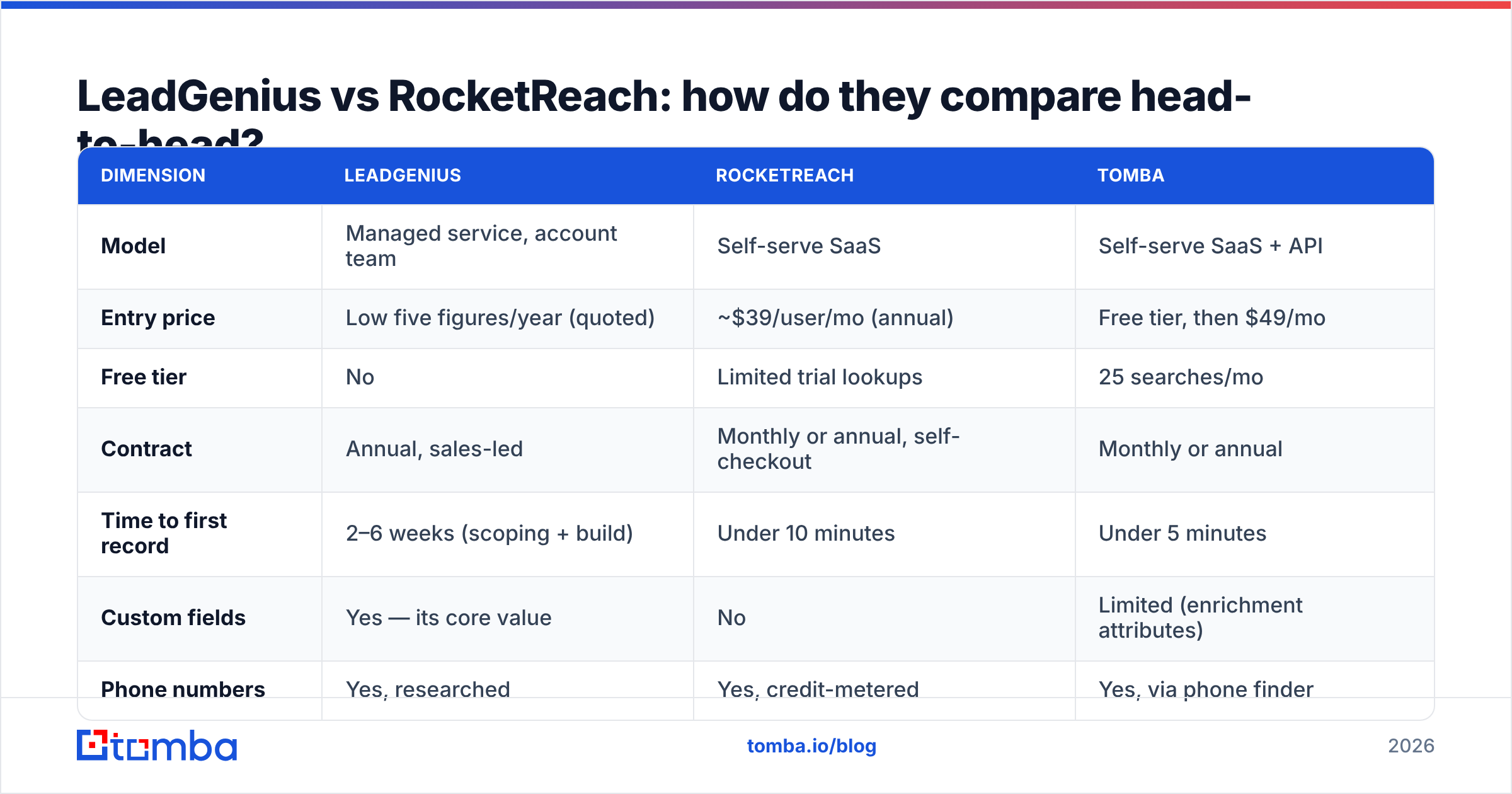
| Dimension | LeadGenius | RocketReach | Tomba |
|---|---|---|---|
| Model | Managed service, account team | Self-serve SaaS | Self-serve SaaS + API |
| Entry price | Low five figures/year (quoted) | ~$39/user/mo (annual) | Free tier, then $49/mo |
| Free tier | No | Limited trial lookups | 25 searches/mo |
| Contract | Annual, sales-led | Monthly or annual, self-checkout | Monthly or annual |
| Time to first record | 2–6 weeks (scoping + build) | Under 10 minutes | Under 5 minutes |
| Custom fields | Yes — its core value | No | Limited (enrichment attributes) |
| Phone numbers | Yes, researched | Yes, credit-metered | Yes, via phone finder |
| Email verification | Human + automated | Automated confidence score | Dedicated verifier + catch-all handling |
| API access | Delivery integrations | Yes, paid tiers | Yes, on all paid plans |
| Best for | Custom TAM, enterprise data ops | Individual reps, small teams | High-volume outbound, developers |
The table makes the real split obvious: these are different categories of purchase. One is a services contract with a data deliverable. The other is a seat license. Comparing their price tags directly is like comparing a general contractor to a hardware store.
Which one has better data accuracy?#
Different definitions of accuracy, so ask a sharper question: accurate about what?
LeadGenius wins on field accuracy. Because humans verify the custom attributes, the "does this company have an in-house design team" column is trustworthy in a way no algorithmic guess is. That's the entire reason it costs what it costs. If your go-to-market thesis depends on a non-standard attribute, LeadGenius is buying you certainty on a field nobody else sells.
RocketReach wins on contact breadth. Its index is enormous, and for a common profile — SaaS director in a major metro, active LinkedIn presence — you'll get a hit more often than not. Where it wears thin is the long tail: small European manufacturers, agencies under 20 people, recently-changed roles. Bounce rates on RocketReach exports tend to climb once you leave well-indexed tech.
The practical move either way is to verify before you send. Neither tool guarantees a live inbox on send day, and an email that was valid in March may be dead by September. Running exports through an email verifier before they hit your sequencer is the single cheapest insurance policy in outbound. Pay particular attention to catch-all domains, which most tools mark "valid" by default and which quietly inflate every accuracy claim in this category — a dedicated catch-all verifier is the only honest way to handle them.
One more accuracy note that applies to both: neither vendor controls your sender reputation. You can buy perfect data and still land in spam because your domain is cold, your SPF is broken, or you're sending 400 emails a day from a two-week-old mailbox. Data quality sets your ceiling; infrastructure sets your floor.
What does each one actually cost in year one?#
Here's where the comparison gets useful, because the sticker prices hide the real numbers.
LeadGenius, realistic year one. Assume a mid-market deal: scoping calls, a pilot dataset, then a production build covering 40,000 accounts with six custom fields on a quarterly refresh. You're looking at a five-figure annual commitment plus internal time — a RevOps owner spending several hours a week on spec, QA, and CRM mapping for the first quarter. The cost per usable record can still be excellent if the custom fields drive real segmentation. It's terrible if you end up using two of the six fields.
RocketReach, realistic year one. Three reps on annual billing at roughly $39–$99 each per month, depending on tier, plus credit top-ups when someone burns their allotment in week two of the quarter. Call it $2,000–$5,000 for a small team. The hidden cost is credit anxiety: reps start rationing lookups, which is the opposite of the behavior you want.
The third path. A lot of teams land in this comparison because they need reliable work emails at volume and assumed they had to pick between a research retainer and a per-seat lookup tool. Tomba pricing starts free at 25 searches a month, moves to $49/mo on Starter, $99/mo on Growth, and $249/mo on Pro — with API access on every paid tier rather than gated behind an enterprise conversation. For a team running programmatic outbound, the email finder API removes the seat-license math entirely: you pay for lookups, not chairs.
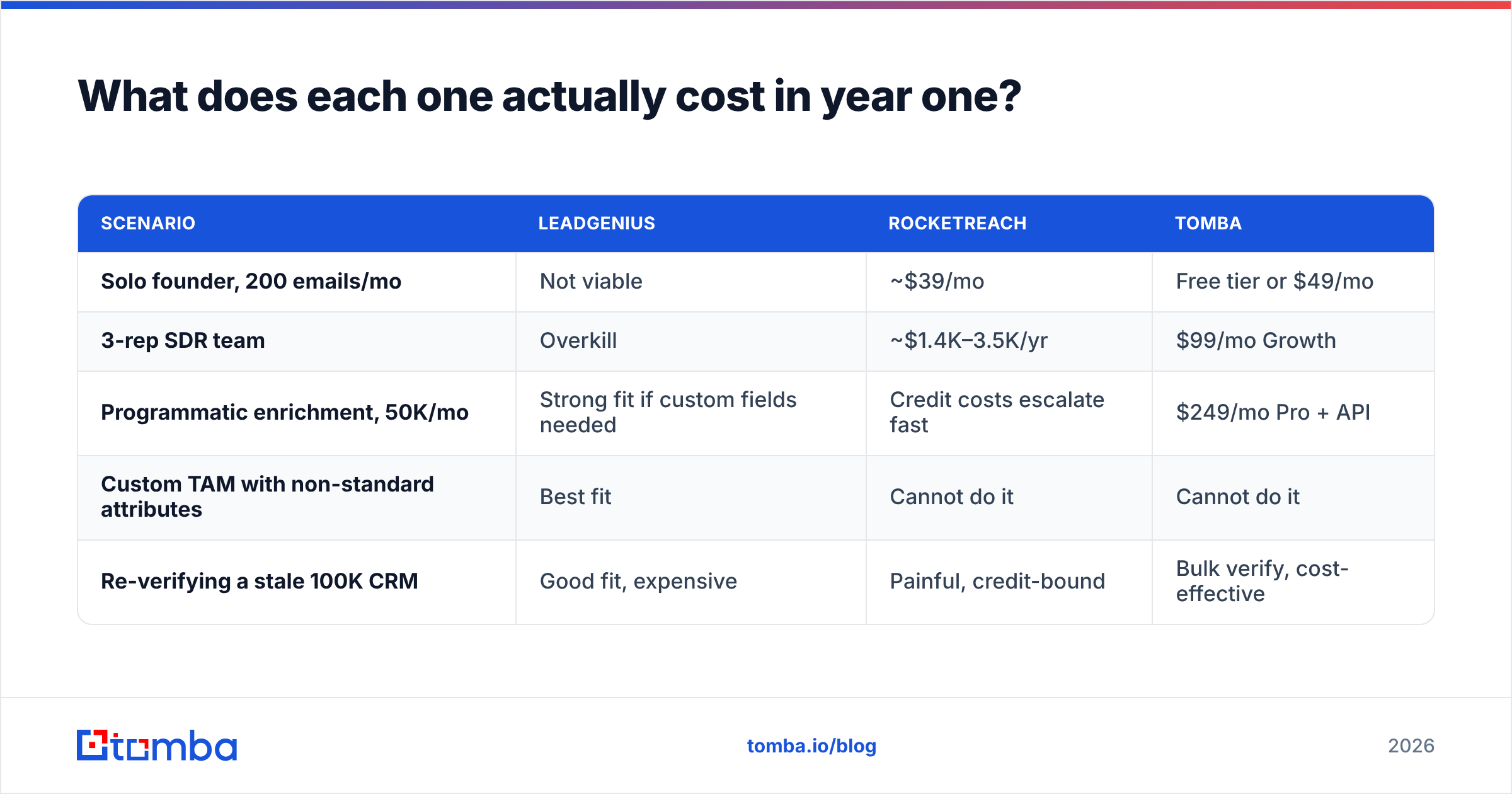
| Scenario | LeadGenius | RocketReach | Tomba |
|---|---|---|---|
| Solo founder, 200 emails/mo | Not viable | ~$39/mo | Free tier or $49/mo |
| 3-rep SDR team | Overkill | ~$1.4K–3.5K/yr | $99/mo Growth |
| Programmatic enrichment, 50K/mo | Strong fit if custom fields needed | Credit costs escalate fast | $249/mo Pro + API |
| Custom TAM with non-standard attributes | Best fit | Cannot do it | Cannot do it |
| Re-verifying a stale 100K CRM | Good fit, expensive | Painful, credit-bound | Bulk verify, cost-effective |
Which should you choose for cold outbound specifically?#
For pure outbound — you know your ICP, you need contacts, you're sending sequences — RocketReach is the more sensible of the two, and Tomba is more sensible than RocketReach.
Here's the reasoning. Outbound economics are governed by cost per delivered, correct contact, not cost per row. A managed dataset that takes six weeks to build cannot respond to a campaign that needs 2,000 new contacts on Monday. And a per-seat tool with credit caps forces your best rep to stop prospecting on the 22nd of the month.
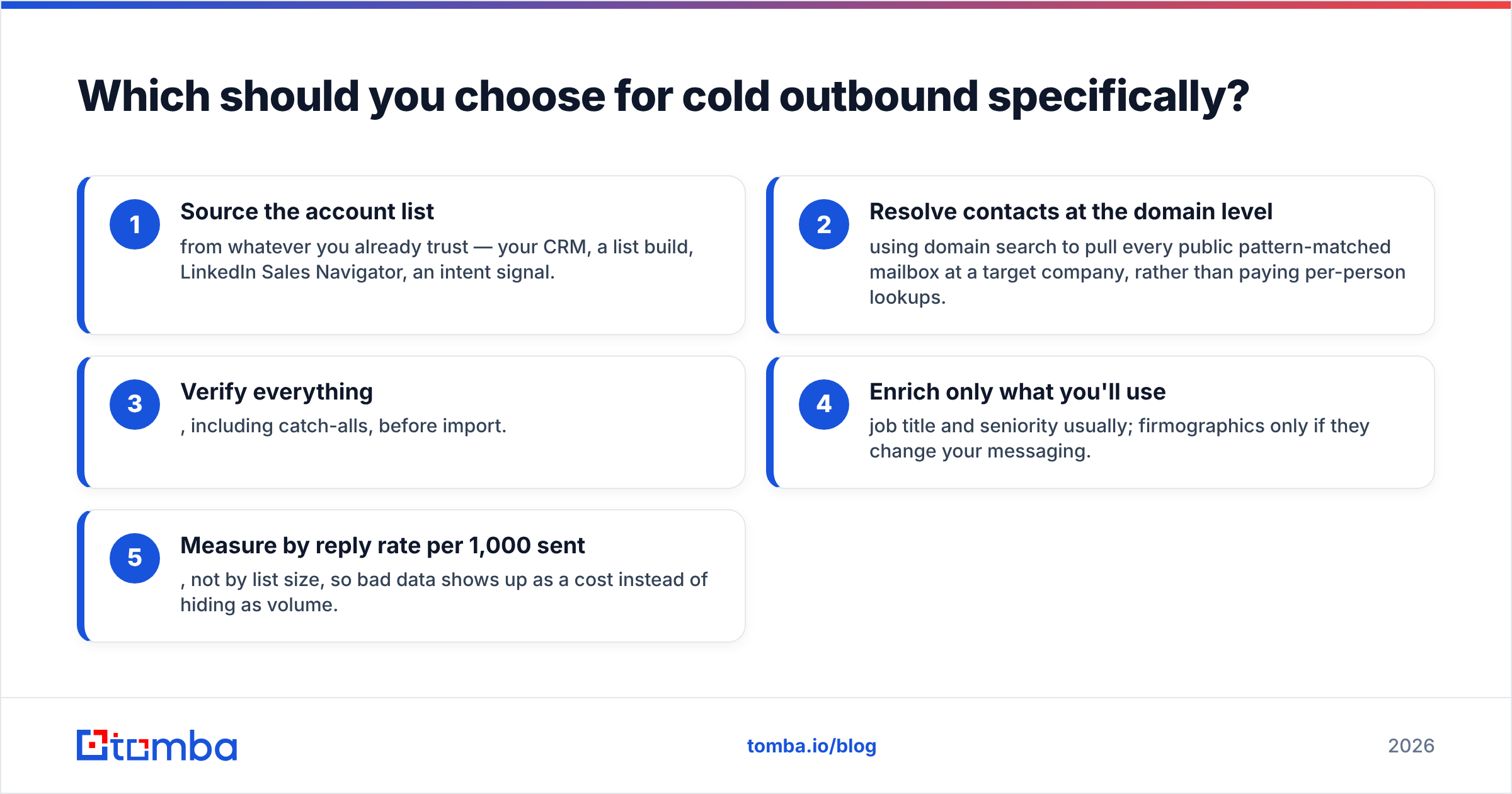
What actually works for outbound teams:
- Source the account list from whatever you already trust — your CRM, a list build, LinkedIn Sales Navigator, an intent signal.
- Resolve contacts at the domain level using domain search to pull every public pattern-matched mailbox at a target company, rather than paying per-person lookups.
- Verify everything, including catch-alls, before import.
- Enrich only what you'll use — job title and seniority usually; firmographics only if they change your messaging.
- Measure by reply rate per 1,000 sent, not by list size, so bad data shows up as a cost instead of hiding as volume.
That fifth point is where most evaluations go wrong. Teams buy data tools on coverage claims and never instrument the downstream response rate. Six months later nobody can say whether the expensive dataset outperformed the cheap one.

What are the honest alternatives to both?#
Neither LeadGenius nor RocketReach is the only option, and the alternative set differs depending on which problem you actually have.
If you need custom, human-verified attributes: the realistic alternatives are enterprise data vendors with research arms, or building an internal research function with offshore analysts and a scraping stack. Both are slower and usually more expensive than LeadGenius once you count management overhead. LeadGenius's pitch holds up here.
If you need contact lookups at volume: the field is crowded and competitive. Apollo bundles data with sequencing. Lusha leans on its extension. ContactOut is LinkedIn-native. BookYourData takes a different approach worth a look — pay-as-you-go, verified B2B lists with no subscription commitment, which suits teams doing periodic campaigns rather than continuous prospecting. Tomba competes on verification depth and API-first pricing, with a RocketReach alternative breakdown if you want the direct feature-by-feature view.
If you need both: run them in layers. Use a cheap, high-coverage finder for contact resolution, and reserve managed research budget for the handful of attributes that genuinely differentiate your segmentation. Paying enterprise research rates to discover someone's work email is the most common budget mistake in this category.
A note on switching costs: LeadGenius contracts are annual and the deliverable is a dataset you keep, so churn risk is mostly opportunity cost. RocketReach is month-to-month at the low end, but your team's workflow habits — extension muscle memory, saved searches — create real friction. Pilot before you standardize, and pilot with a list you can independently verify.
How do you actually run the evaluation?#
Don't take anyone's accuracy claim, including this post's. Run a controlled bake-off. It takes an afternoon.
- Build a ground-truth list of 100 contacts you already have confirmed emails for — past customers, conference contacts, inbound leads. Strip the emails out.
- Run the same 100 through each tool. Record hit rate (did it return anything?) and match rate (did it return the right address?).
- Send a verification pass through an independent verifier so you're not grading a tool with its own answer key.
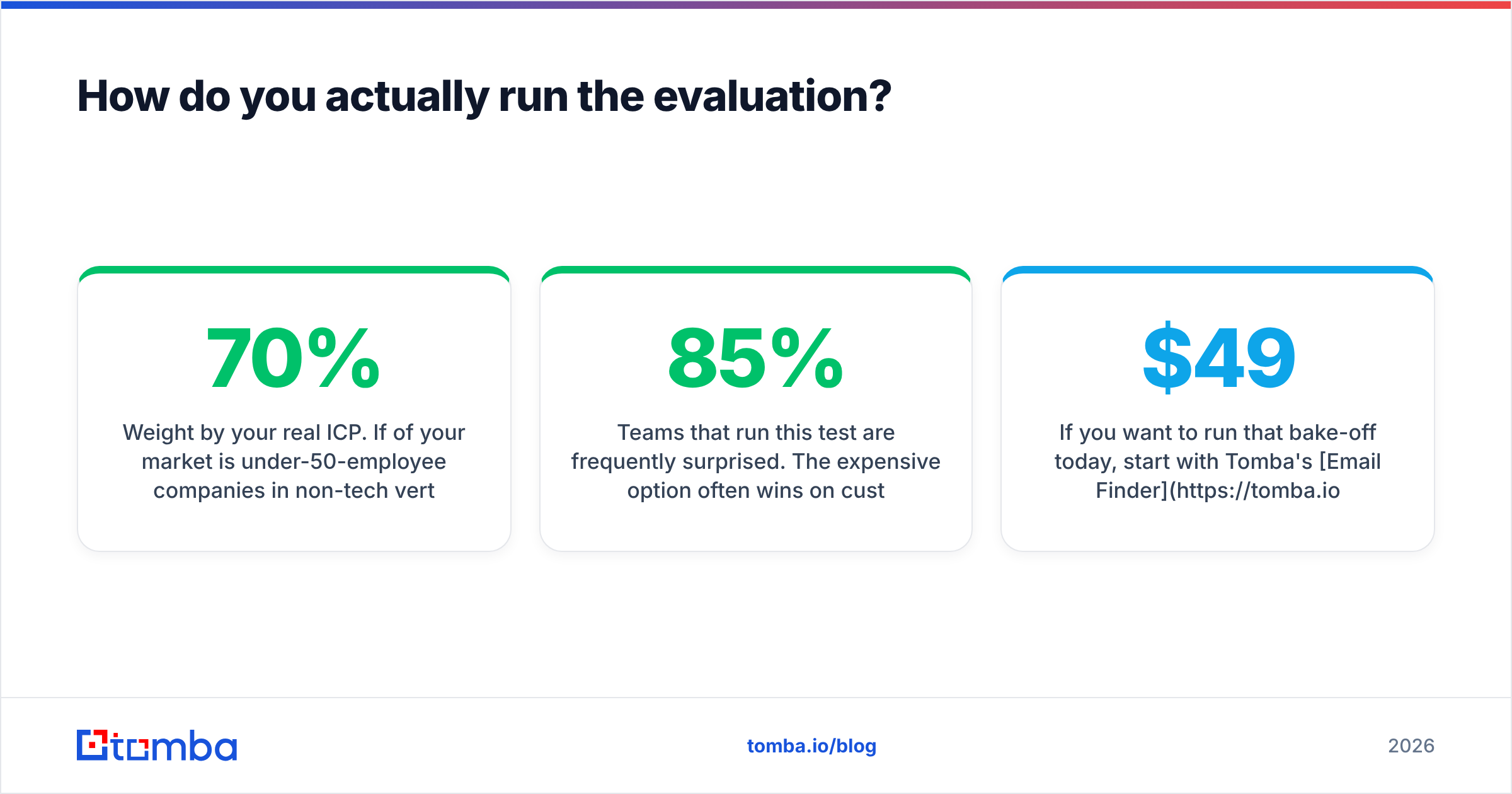
- Weight by your real ICP. If 70% of your market is under-50-employee companies in non-tech verticals, don't test on Fortune 500 VPs — that's where every vendor looks great.
- Add a cost column. Divide total spend by correct matches. That number, not the marketing coverage figure, is your real price per contact.
Teams that run this test are frequently surprised. The expensive option often wins on custom fields and loses badly on cost per verified email. The cheap option often covers 85% of what you needed at 10% of the price, and the missing 15% turns out not to matter.
If you want to run that bake-off today, start with Tomba's Email Finder — the free tier gives you 25 searches a month, enough to test a sample list against whatever RocketReach or LeadGenius quotes you, and paid plans start at $49/mo with API access included rather than gated behind a sales call. Verify the results, compare cost per correct contact, and let the numbers pick your vendor instead of a demo deck.
Related guides#
// get started
Find, verify and enrich your first contacts today
Start on the free plan with 25 searches a month, then scale when your team is ready.
Free plan · No credit card required · GDPR & CCPA
// about the author