LeadGenius vs SMARTe: Which B2B Data Provider Wins in 2026?
LeadGenius sells managed, custom-built B2B datasets. SMARTe sells self-serve contact data with strong international coverage. Here is how they actually differ on accuracy, coverage, pricing and speed — plus when neither is the right buy.
LeadGenius vs SMARTe is really a choice between two shapes of product. One builds the data for you. The other lets you search for it yourself. Here is how the two differ on accuracy, coverage, price and speed.
TL;DR
- LeadGenius is a managed data service, not a database you log into. You brief a team. They build a custom dataset with researchers plus ML. You get the fields you asked for, on an annual contract.
- SMARTe is a self-serve contact database. It has a Chrome extension and credit-based access. Coverage outside North America is strong, and EMEA and APAC mobile numbers are its calling card.
- Pick LeadGenius when your ICP needs custom fields nobody sells off the shelf: store counts, equipment installed, hiring signals by location.
- Pick SMARTe when you need contact data fast for reps who live in LinkedIn and your CRM.
- Neither is cheap for one-off email lookups. For that job, an email finder like Tomba ($49/mo Starter, free tier included) costs a fraction of either contract.
What are LeadGenius and SMARTe, actually?#
They get compared because both sell B2B contact and company data. That is where the likeness ends. The two are built on opposite ideas.
LeadGenius is a human-in-the-loop data operation. You define the dataset you want. Say: every Shopify Plus merchant in DACH with 50+ staff, plus their head of ecommerce, plus whether they run a loyalty program. Trained researchers and automated collection go and build it. The output lands in your CRM, your warehouse, or a flat file on a set schedule. There is a Chrome extension for reps, but the real product is the data team behind it.
SMARTe is a GTM data platform in the Apollo or ZoomInfo shape. You search, filter and export from a database. A browser extension shows emails and mobile numbers while you are on LinkedIn or a company site. Its edge is depth outside the US. It was built with heavy EMEA and APAC coverage from day one, not as an afterthought.
The short version: LeadGenius answers questions your filters cannot ask. SMARTe answers "who works here and what is their mobile number" at scale.
LeadGenius vs SMARTe: how do they compare head-to-head?#
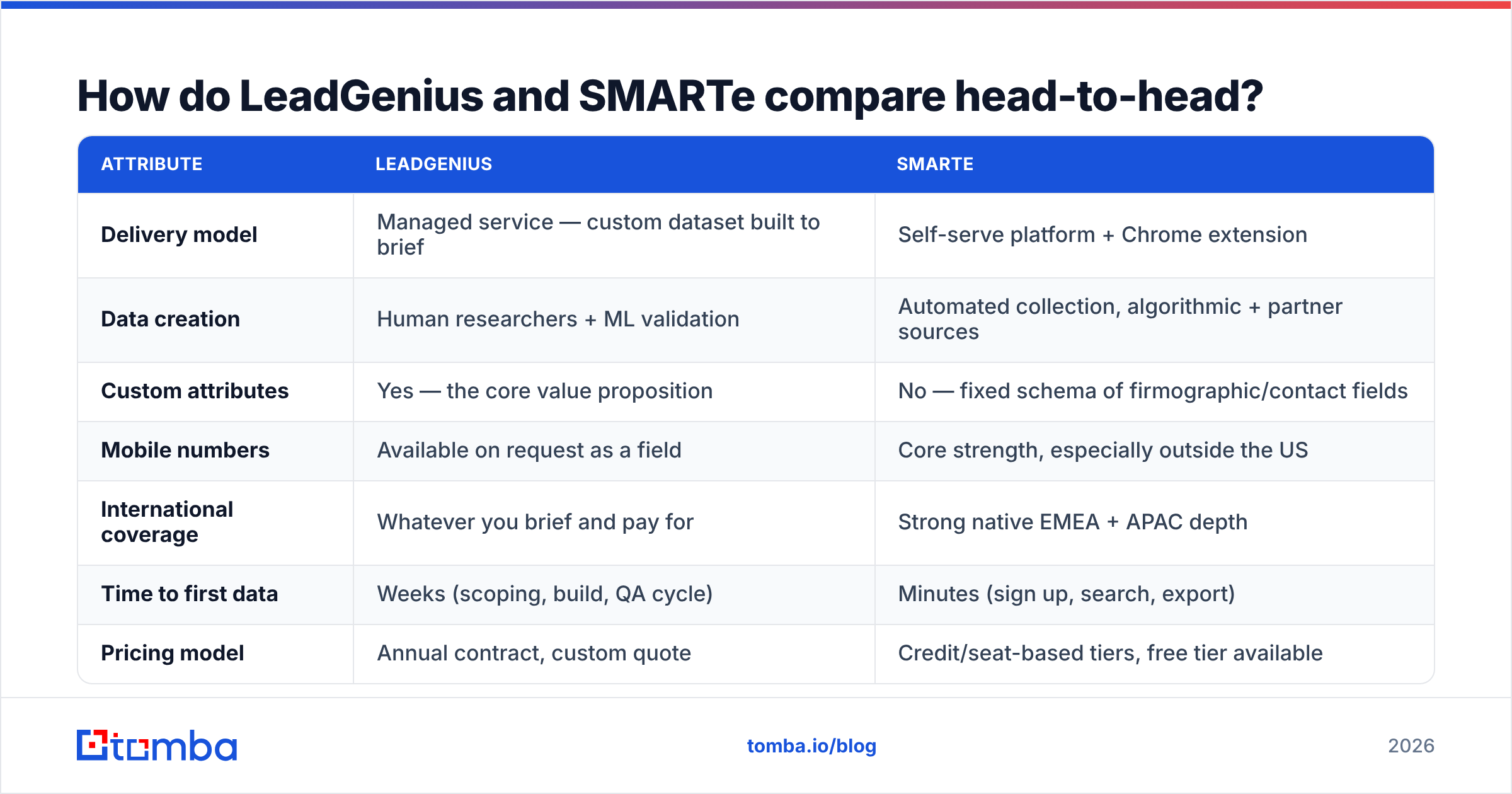
| Attribute | LeadGenius | SMARTe |
|---|---|---|
| Delivery model | Managed service — custom dataset built to brief | Self-serve platform + Chrome extension |
| Data creation | Human researchers + ML validation | Automated collection, algorithmic + partner sources |
| Custom attributes | Yes — the core value proposition | No — fixed schema of firmographic/contact fields |
| Mobile numbers | Available on request as a field | Core strength, especially outside the US |
| International coverage | Whatever you brief and pay for | Strong native EMEA + APAC depth |
| Time to first data | Weeks (scoping, build, QA cycle) | Minutes (sign up, search, export) |
| Pricing model | Annual contract, custom quote | Credit/seat-based tiers, free tier available |
| Best fit team size | RevOps at mid-market and enterprise | SDR teams and founder-led sales |
| API access | Yes, delivery-oriented | Yes, enrichment-oriented |
| Contract friction | High — procurement, legal, annual commit | Low — self-serve signup |
Two rows matter more than the other eight: custom fields and time to first data. That is the axis this choice turns on. If you do not need custom fields, LeadGenius is a costly way to buy standard contact data. If you cannot wait weeks for a build cycle, LeadGenius is the wrong shape, however good the data is.
Which one has better data accuracy?#
Accuracy is the wrong single question. Ask instead: accurate on which field, in which region, and how fresh?

Here is how the two tend to break down in practice:
- Custom or obscure fields — LeadGenius wins by default, because nobody else sells them. A person checking a store locator page beats an algorithm guessing. But human-checked data is a snapshot, and snapshots decay.
- Standard email addresses — roughly a tie. Both sit in the same band as most mid-tier vendors. Verify before you send either way.
- Mobile numbers outside North America — SMARTe is the stronger bet. This is why most buyers shortlist it at all.
- Freshness on job changes — SMARTe refreshes all the time. A LeadGenius file is only as fresh as your last delivery.
- Catch-all domains — both struggle, as does everyone. Catch-all servers accept every address, so no vendor can prove a mailbox exists. Run a catch-all verifier on those domains first.
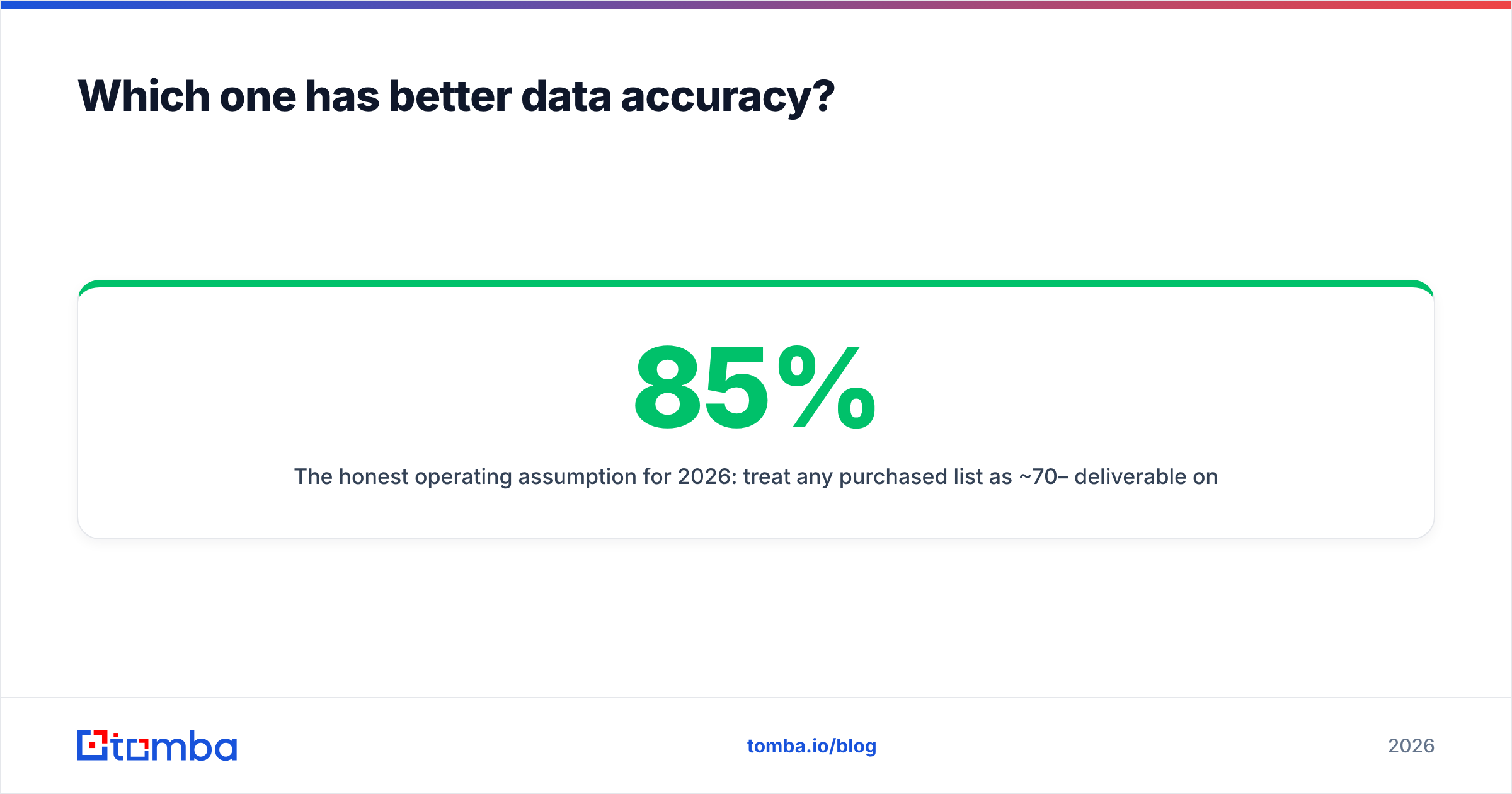
A safe operating rule for 2026: treat any bought list as 70–85% deliverable on arrival, and verify the rest yourself. That is not a knock on either vendor. Contact data decays about 2–2.5% a month as people change jobs, and no static file escapes that. Vendors who claim 95%+ accuracy are usually measuring "valid format, matched to a real person," not "will land in an inbox today."
User reviews on G2 are the closest thing to a neutral read, and they tell a steady story. LeadGenius reviewers praise the custom research and flag the cost and the wait. SMARTe reviewers praise international mobile coverage and flag patchy depth in some verticals.
How do they handle international coverage and compliance?#
If your ICP is US-only, skip this section. If it is not, this may decide the whole thing.
SMARTe built international coverage from the start. It markets GDPR and CCPA alignment up front, including notice and opt-out steps for EU contacts. For a team calling into Germany, France or Singapore, that is the gap between a usable list and a list of holes.
LeadGenius covers other regions by building the data for you. That can beat any database, since researchers read local-language sources. But you pay for every row, and you pay again for each refresh. Compliance also moves into contract talks instead of a settings toggle.
One thing neither solves: your own sending setup. Compliant EU data does not make cold outreach lawful everywhere. It will not protect your domain either, if you blast an unverified list. Get your SPF record and the rest of your auth in place before you send to anything you bought.
What does each one cost in 2026?#
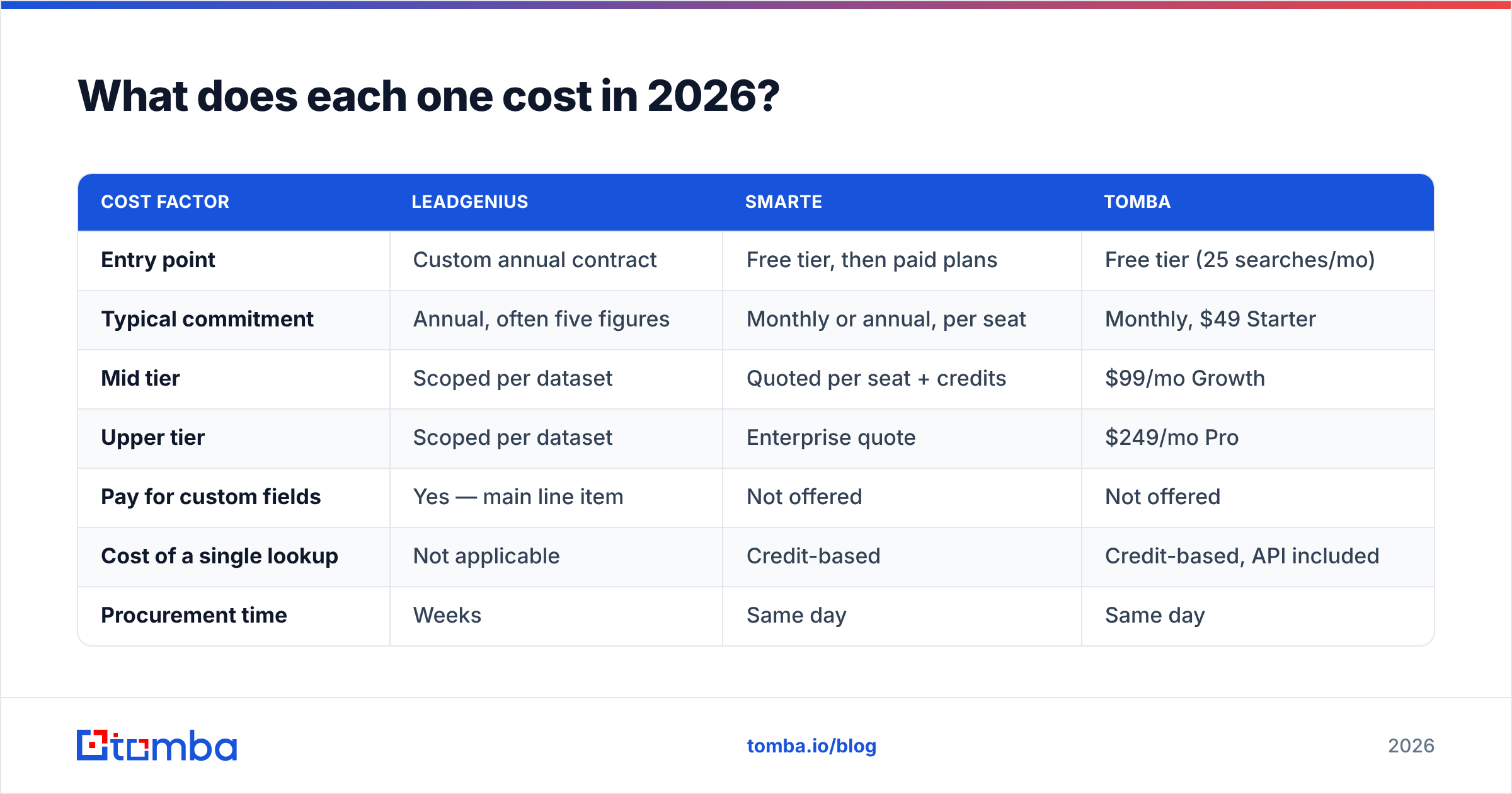
Neither vendor posts a simple price page, which tells you something. Here is the real shape of each deal. Quotes vary a lot by volume and region, so confirm current numbers with the vendors.

| Cost factor | LeadGenius | SMARTe | Tomba |
|---|---|---|---|
| Entry point | Custom annual contract | Free tier, then paid plans | Free tier (25 searches/mo) |
| Typical commitment | Annual, often five figures | Monthly or annual, per seat | Monthly, $49 Starter |
| Mid tier | Scoped per dataset | Quoted per seat + credits | $99/mo Growth |
| Upper tier | Scoped per dataset | Enterprise quote | $249/mo Pro |
| Pay for custom fields | Yes — main line item | Not offered | Not offered |
| Cost of a single lookup | Not applicable | Credit-based | Credit-based, API included |
| Procurement time | Weeks | Same day | Same day |
The buying lesson: LeadGenius is a budget line, SMARTe is a tool expense, and an email finder is a utility bill. They are not swaps at the same price point. They are three purchase types that happen to overlap on one field: the email address.
Want a public baseline to anchor both quotes against? Tomba pricing is flat and listed, which makes it easy to compare.

Who should pick LeadGenius?#
Buy LeadGenius when all three are true:
- Your ICP is defined by a field no database sells. Number of delivery vans. Whether the site runs a certain checkout. Whether a clinic takes a certain insurer. If your filters exist as a dropdown nowhere, custom research is the only path.
- You have RevOps capacity to own the relationship. Managed data is a project: scoping calls, sample QA, field mapping, delivery cadence. Someone has to own it, or the data rots in a bucket.
- Your ACV justifies the spend. At a $2K contract value, a five-figure data deal never pays back. At $80K ACV with a 200-account TAM, one extra closed deal covers the year.
Skip it if you mostly need more of the contacts you already get. You would be paying research prices for database output.
Who should pick SMARTe?#
Buy SMARTe when:
- Your reps need self-serve speed. Extension on LinkedIn, contact revealed, pushed to CRM, sequence started. No ticket to data ops.
- You sell into EMEA or APAC. This is the single best reason to pick SMARTe over a US-first rival. Mobile coverage in those regions is better than most.
- You want to start small. A free tier and self-serve signup mean you can test coverage against 50 known accounts before anyone signs. Always run that test. Pull 50 contacts you have already verified and measure the match rate. That number beats every case study.
- Phone is part of your motion. If cold calling matters, depth on direct dials outweighs small gaps in email accuracy.
Where does a dedicated email finder fit in this stack?#
Most teams comparing LeadGenius vs SMARTe are solving two problems at once, and only notice one.
Problem one is discovery: who should we talk to? That is a database or research question, and it is where both vendors earn their money.
Problem two is resolution and hygiene: I have a name and a company. Give me the working email, and tell me before I send whether it bounces. That job is far narrower and far cheaper. Paying enterprise database prices for it is how data budgets quietly triple.
A focused stack often looks like this:
- Discovery layer — SMARTe, LeadGenius, or your CRM and inbound signals.
- Resolution layer — an email finder API that turns a name plus a domain into an address, plus domain search when you want every reachable contact at an account.
- Hygiene layer — an email verifier run right before send, not at import. A list verified 30 days ago is a list you have not verified.
- Enrichment layer — data enrichment to fill gaps on records you already own, instead of buying them again.
Split these layers and you can swap one vendor without rebuilding the whole motion. It also stops you buying 40,000 records when you needed 4,000 verified ones.
Is LeadGenius better than SMARTe?#
For custom-built datasets, yes. For self-serve volume and international mobile coverage, no. There SMARTe is the better tool and the faster path.
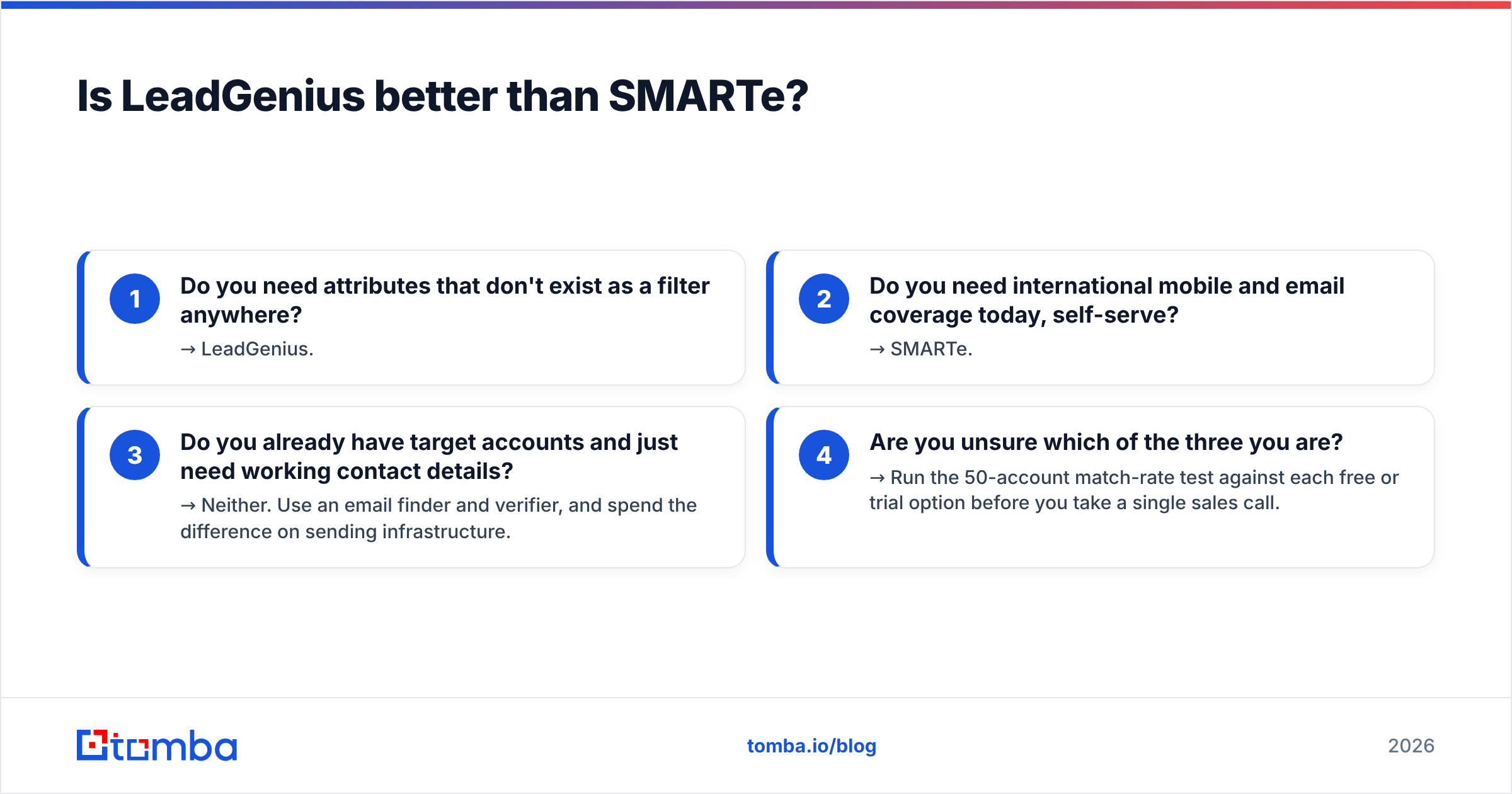
The decision tree, compressed:
- Need fields that exist as a filter nowhere? → LeadGenius.
- Need international mobile and email coverage today, self-serve? → SMARTe.
- Already have target accounts and just need contact details? → Neither. Use an email finder and verifier, and spend the difference on sending setup.
- Not sure which of the three you are? → Run the 50-account match-rate test on each free or trial option before you take a sales call.
One more note: whichever you pick, negotiate the refresh, not just the volume. Data decay is the real cost. A cheap file delivered once costs more per usable contact than a pricier one refreshed each quarter.
The verdict#
LeadGenius and SMARTe rarely lose to each other in a real evaluation. They lose to a mismatch between the buyer's problem and the vendor's shape. LeadGenius is the right call when your go-to-market depends on knowing something rivals cannot filter for, and you have the budget and ops maturity to run a managed data relationship. SMARTe is the right call when you need reps productive this week in markets where US-first databases go thin.
Did you read this far mainly because you need working email addresses for accounts you already know? Then you do not have a database problem. You have a resolution problem, and it is the cheapest one on this page to fix.
Start there. Tomba Email Finder turns a name and a domain into a verified, deliverable address. There is a free tier at 25 searches a month, and flat $49/mo Starter pricing when you outgrow it. No annual commit, no procurement cycle, and an API you can wire into whichever database you end up choosing.
Related guides#
// get started
Find, verify and enrich your first contacts today
Start on the free plan with 25 searches a month, then scale when your team is ready.
Free plan · No credit card required · GDPR & CCPA
Get the Tomba newsletter
Product and data updates
// about the author