LeadGenius vs SphereScout: Which B2B Data Tool Wins in 2026
One is a managed, human-verified data service built for enterprise research. The other is a lighter, AI-first prospecting scout. Here is how LeadGenius and SphereScout actually differ on data sourcing, pricing model, and time-to-first-list.
TL;DR
- LeadGenius is a managed, human-in-the-loop B2B data service. You brief a research team, they build custom datasets and hard-to-find attributes, and you pay enterprise contract prices for it.
- SphereScout sits at the other end: a lighter, AI-first prospecting layer aimed at self-serve teams who want lists fast without a procurement cycle.
- The real decision is not "which tool is better" — it is custom research vs. speed. If your ICP can be described with standard firmographics, managed research is overkill. If it can't, no self-serve tool will find it.
- Neither vendor publishes transparent per-credit pricing at the time of writing. Expect a demo-and-quote motion from LeadGenius and limited public documentation from SphereScout. Budget for a paid pilot before you commit annually.
- For most teams, the cheapest path is a self-serve finder plus a strict verification step — which is why we cover a third option below at $49/mo instead of $2,000/mo.
What are LeadGenius and SphereScout?#
Short version: LeadGenius sells research, SphereScout sells reach.
LeadGenius has been in the B2B data market since the mid-2010s and built its reputation on something most data vendors avoid — humans. Instead of shipping you a static database and hoping your filters match reality, LeadGenius pairs machine collection with a distributed team of researchers who verify records and chase custom attributes. If you need "SaaS companies in DACH that just hired a first RevOps lead and run Snowflake," a database query won't return that. A research workflow will.
SphereScout is the newer, lighter profile of the two. It positions as an AI-assisted prospecting scout: describe an ICP in plain language, let the system sweep public sources, and get a contact list without a sales call. That category has exploded since 2024, and the appeal is obvious — no annual contract, no onboarding call, no minimum seats.
The catch is that these two products barely compete on the same axis. Comparing them on "accuracy" alone misses the point. One is a service with software attached. The other is software with a scraper attached.

How do LeadGenius and SphereScout source their data?#
This is where the two diverge hardest, and it explains every downstream difference in price, speed, and coverage.
LeadGenius: collect, then verify with people. Machine collection handles volume; researchers handle the long tail — the custom fields, the ambiguous company matches, the "is this person still in that role" checks. That's expensive and slow, but it's the only realistic way to build attributes that don't exist in any commercial database. It also means coverage is demand-driven: LeadGenius can go find data that doesn't exist yet, rather than only filtering data it already has.
SphereScout: collect, then infer with models. AI-first tools lean on pattern recognition across public sources — company sites, job boards, social profiles, public filings. Inference is fast and nearly free at the margin. It is also probabilistic. A model that guesses first.last@domain.com from a naming pattern is right most of the time and confidently wrong the rest of the time, and the two outcomes look identical in your CSV.
That's the trap most buyers walk into. A list of 5,000 "found" emails is worthless if 18% of them bounce, because bounce rate is what wrecks email deliverability — and a damaged sending domain costs more to repair than the list cost to buy. Whatever you pick, put a real email verifier between the export and your sequencer. Inferred data is a hypothesis, not a contact.
How do LeadGenius and SphereScout compare feature by feature?#
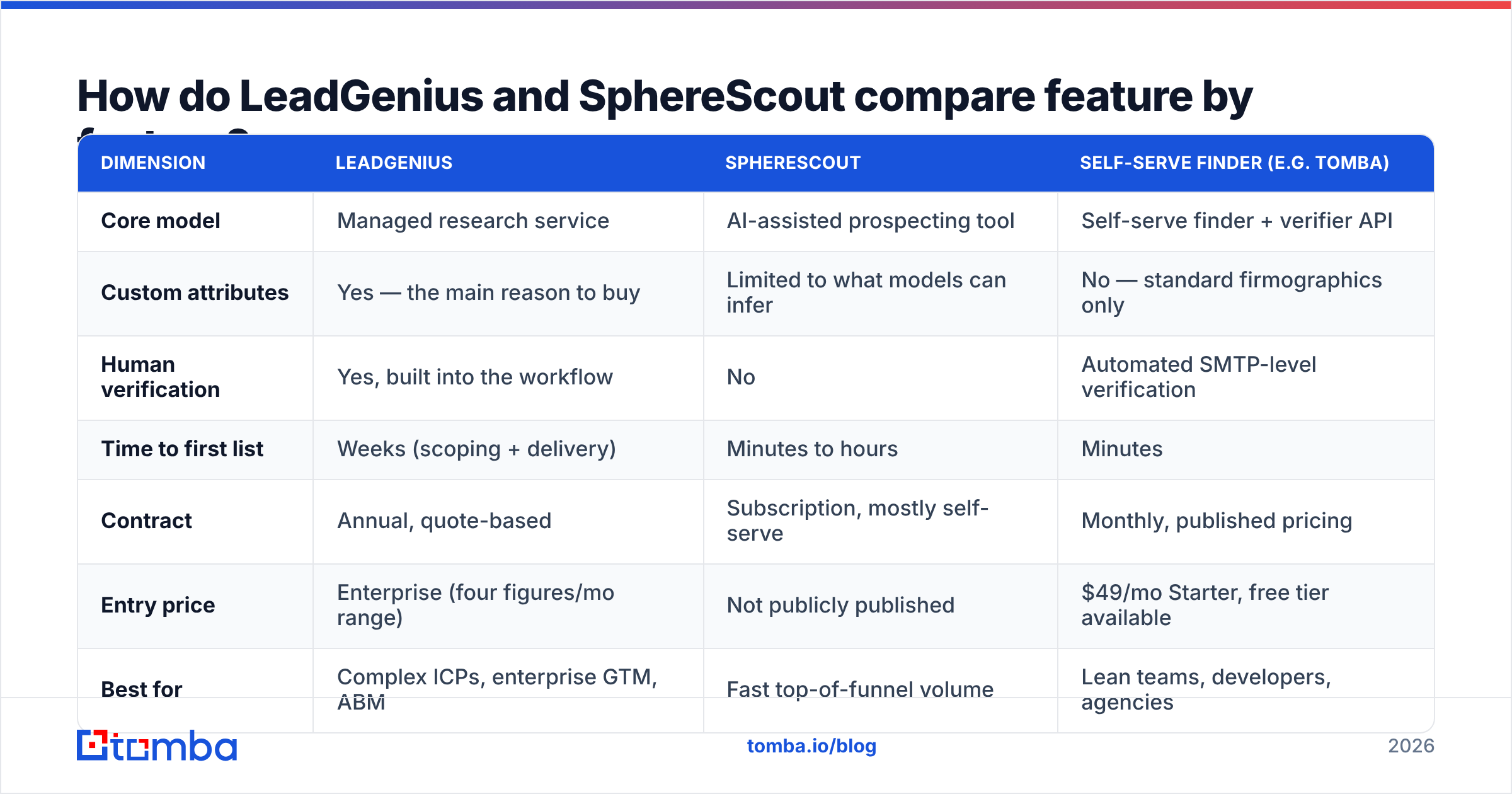
| Dimension | LeadGenius | SphereScout | Self-serve finder (e.g. Tomba) |
|---|---|---|---|
| Core model | Managed research service | AI-assisted prospecting tool | Self-serve finder + verifier API |
| Custom attributes | Yes — the main reason to buy | Limited to what models can infer | No — standard firmographics only |
| Human verification | Yes, built into the workflow | No | Automated SMTP-level verification |
| Time to first list | Weeks (scoping + delivery) | Minutes to hours | Minutes |
| Contract | Annual, quote-based | Subscription, mostly self-serve | Monthly, published pricing |
| Entry price | Enterprise (four figures/mo range) | Not publicly published | $49/mo Starter, free tier available |
| Best for | Complex ICPs, enterprise GTM, ABM | Fast top-of-funnel volume | Lean teams, developers, agencies |
| Worst for | Small teams testing a market | Regulated or niche ICPs | Custom research needs |
| API access | Available via contract | Varies | Public email finder API |
| Compliance posture | Enterprise DPAs, GDPR workflows | Verify before buying | Published data sources |
Two things to read out of that table.
First, the "Time to first list" row is not a minor operational detail — it is the whole trade. A managed vendor that takes six weeks to deliver a great dataset is the wrong choice for a team that needs to test three ICPs this quarter. Conversely, a tool that returns a list in four minutes is the wrong choice when the list has to be right the first time because you only get one shot at 200 enterprise accounts.
Second, notice how little of the LeadGenius value shows up in a feature checklist. You're buying a research team. Checklists don't price labor well, which is why side-by-side grids consistently flatter the cheaper tool.
Which one is actually more accurate?#
Accuracy claims in this market are close to meaningless without a definition, and every vendor picks the definition that flatters them.
Three numbers get conflated constantly:
- Match rate — of the contacts you asked for, how many did the tool return anything for? High match rates are easy to fake by returning guesses.
- Deliverability rate — of what it returned, how many emails accept mail? This is the only number your sending domain cares about.
- Accuracy rate — of the deliverable emails, how many belong to the right person in the right role right now? This is the only number your reply rate cares about.
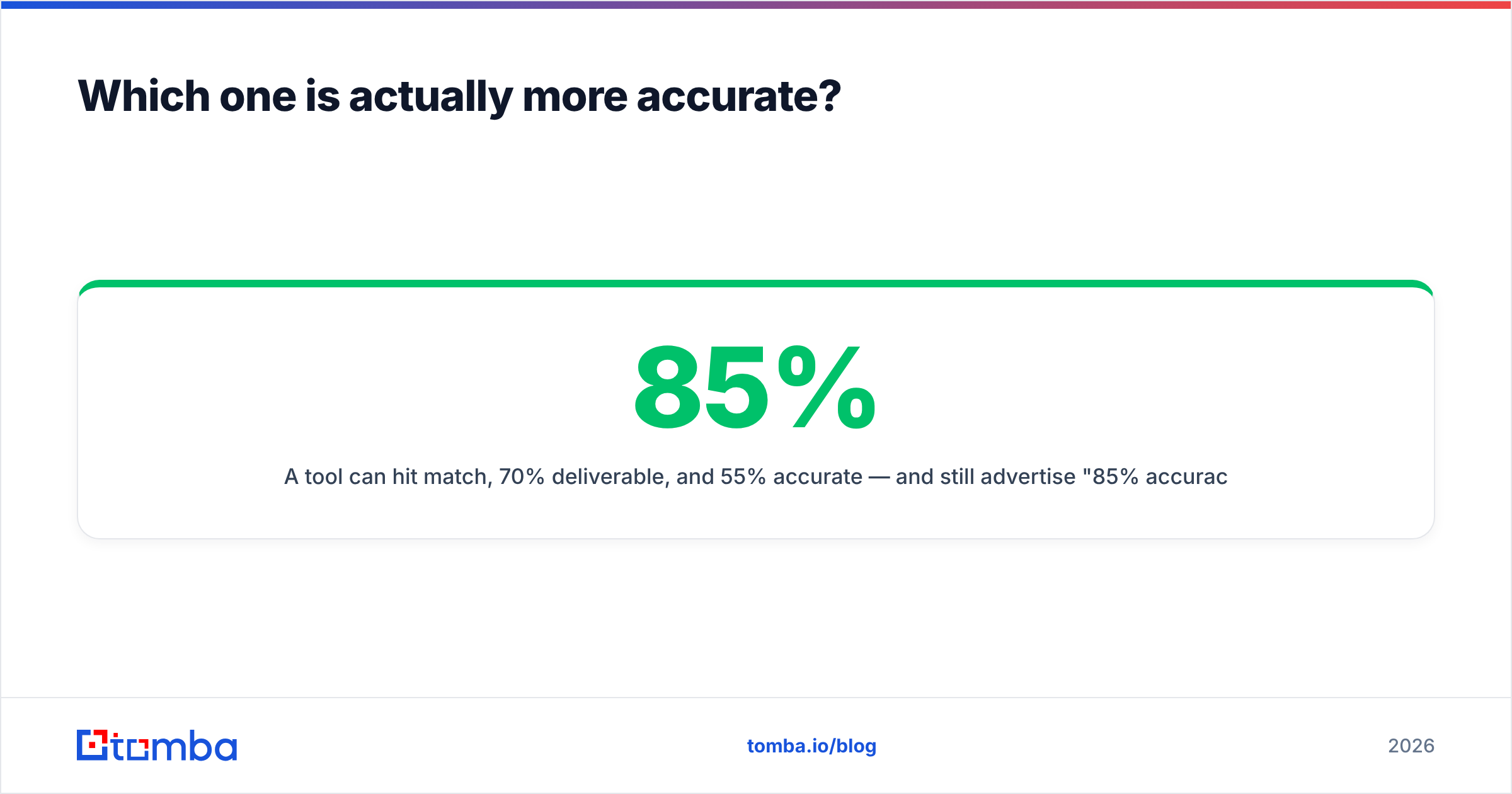
A tool can hit 85% match, 70% deliverable, and 55% accurate — and still advertise "85% accuracy." Ask every vendor, in writing, which of the three they're quoting and how it was measured.
In practice, human-verified services like LeadGenius win on point 3 and lose on cost per record. AI-first tools win on cost and speed and lose on point 3, particularly for job titles below director level and at companies under 50 employees, where public signals are thin and role churn is high. Independent buyer reviews on G2 are more useful than vendor benchmarks here, though read the date on every review — data quality in this category shifts a lot year to year.
The practical defense is the same regardless of vendor: verify on ingest, re-verify anything older than 90 days, and track bounce rate per source so you know which supplier is quietly degrading. Running exports through a bulk verify step before they touch your sequencer turns an accuracy argument into a measurable one.
What do LeadGenius and SphereScout cost in 2026?#
Neither publishes a transparent price list, so treat any number you see quoted online as a data point, not a rate card. What you can plan around is the shape of the cost.
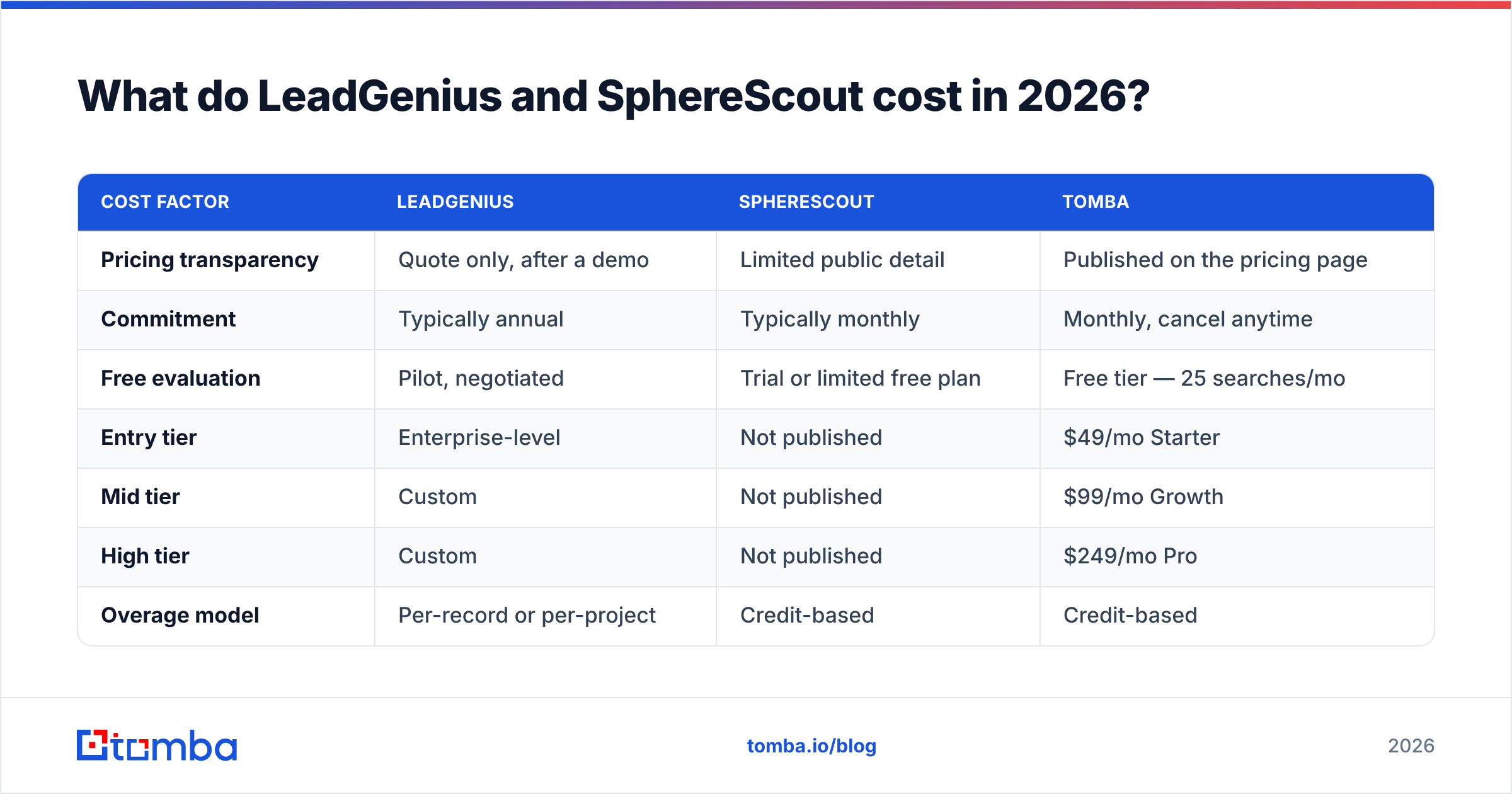
| Cost factor | LeadGenius | SphereScout | Tomba |
|---|---|---|---|
| Pricing transparency | Quote only, after a demo | Limited public detail | Published on the pricing page |
| Commitment | Typically annual | Typically monthly | Monthly, cancel anytime |
| Free evaluation | Pilot, negotiated | Trial or limited free plan | Free tier — 25 searches/mo |
| Entry tier | Enterprise-level | Not published | $49/mo Starter |
| Mid tier | Custom | Not published | $99/mo Growth |
| High tier | Custom | Not published | $249/mo Pro |
| Overage model | Per-record or per-project | Credit-based | Credit-based |
| Hidden cost to watch | Scoping time, minimum commit | Bounce cleanup, re-verification | Credits burned on catch-all domains |
The hidden costs matter more than the sticker price. With managed research, the hidden cost is calendar time — three weeks of scoping is three weeks your reps aren't calling anyone. With AI-first tools, the hidden cost is cleanup: bounce handling, deliverability recovery, and rep time wasted on contacts who left the company in 2024.
Do the arithmetic on cost-per-meeting, not cost-per-record. A $0.05 record that converts at half the rate of a $0.40 record is the more expensive one.
/blog/generated/memes/2026-09-22/leadgenius-vs-spherescout-meme-2.png
Who should choose LeadGenius?#
Pick the managed route when at least two of these are true:
- Your ICP needs attributes no database sells. Hiring signals, tech-stack combinations, regulatory status, store counts, fleet size, physical footprint — if you can't express your filter in a standard platform's UI, you need researchers.
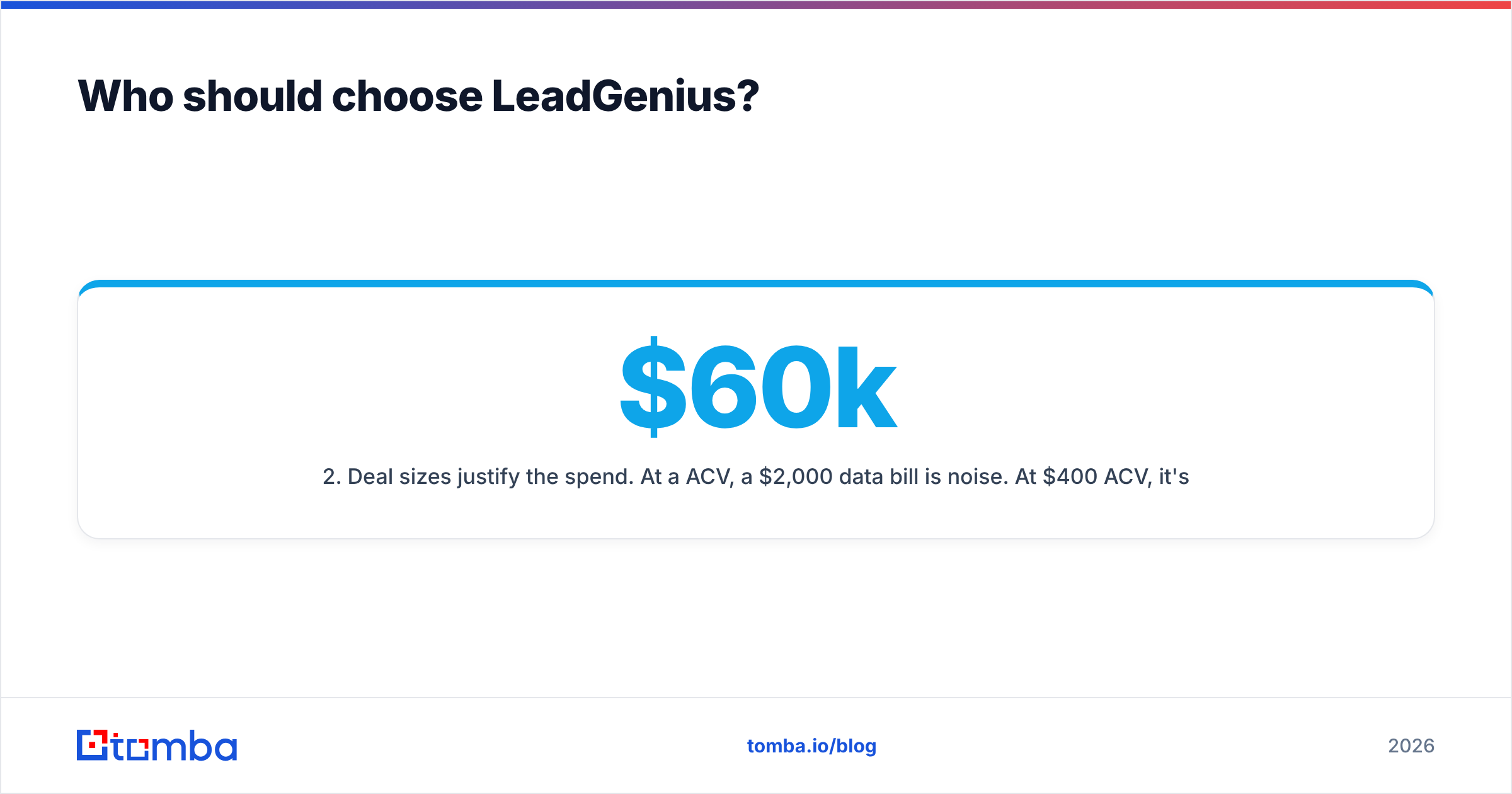
- Deal sizes justify the spend. At a $60k ACV, a $2,000/mo data bill is noise. At $400 ACV, it's your entire margin.
- You're running account-based motions. ABM lives or dies on a precisely bounded account list. Precision beats volume, and human verification buys precision.
- Procurement and compliance are gates. Enterprise buyers need DPAs, defined data provenance, and someone to call. Self-serve tools rarely clear a security review at that level.
- You have someone to own the relationship. Managed services degrade without an internal owner writing good briefs. Budget the headcount, not just the contract.
If fewer than two apply, you're buying a Ferrari to do grocery runs.
Who should choose SphereScout — or a self-serve tool generally?#
The self-serve lane wins when speed and iteration matter more than precision:
- You're still finding product-market fit. You need to test six ICPs cheaply, not perfect one.
- Your ICP is describable in plain firmographics. Industry, headcount, geography, maybe a tech tag. Standard filters cover it.
- Volume is the strategy. High-velocity outbound, agency work, or event-driven campaigns where a 5% data miss is survivable.
- You want an API, not a vendor relationship. Developers building enrichment into a product care about latency, docs, and rate limits far more than about a quarterly business review.
- Budget is real. Under $500/mo, enterprise data services aren't in the conversation.
The honest caveat about SphereScout specifically: it has a much thinner public track record than LeadGenius. Fewer third-party reviews, less documentation, less independent benchmarking. That isn't a knock on the product — every vendor starts there — but it does mean you should run your own test rather than trusting a comparison article, including this one. Buy a small credit pack, sample 200 contacts in your actual ICP, and measure.
How do you run a fair 30-day bake-off?#
Do not evaluate data vendors by browsing their websites. Run this instead:
- Freeze one target segment. Same industry, same headcount band, same geography, same 5 job titles. Both vendors get the identical brief. Changing the brief mid-test invalidates everything.
- Pull 250 records from each. That's enough to be statistically meaningful and small enough to buy on a trial. Keep them in separate, tagged lists forever.
- Verify both lists with the same neutral verifier. Never let a vendor grade its own homework. Run both exports through one independent email verification pass and record valid / invalid / catch-all / unknown counts per source.
- Spot-check 30 records by hand. Open LinkedIn, confirm the person still holds that title at that company. This catches the failure that verification can't — a deliverable email for someone who left eight months ago.
- Send the same sequence to both. Same copy, same cadence, same sending domain, split evenly. Track bounce rate, reply rate, and positive-reply rate by source.
- Score on cost per positive reply. Not cost per record, not match rate, not any vendor-supplied metric. The list that produces cheaper qualified conversations wins, and the answer is frequently not the one that looked better in the demo.
Most teams skip steps 4 and 6, which is exactly why they end up re-buying data eighteen months later. The methodology is boring and it costs about a week of analyst time. It also routinely saves five figures a year — the same discipline every mature RevOps playbook, from HubSpot's own data hygiene guidance onward, ends up recommending.
Is there a middle option between the two?#
Yes, and for most teams reading a LeadGenius vs SphereScout comparison, it's the right answer: a transparent self-serve finder with real verification underneath, plus a light data enrichment layer for the attributes you actually filter on.
That combination covers the 80% case — standard firmographics, verified deliverable emails, API access, predictable pricing — at a fraction of managed-service cost. You keep the option to bring in a research vendor later for the one segment that genuinely needs custom attributes, instead of paying enterprise rates for every record you touch.
The failure mode to avoid is paying for research you don't need and skipping verification you do need. That's the worst of both worlds, and it's surprisingly common.
The practical next step#
If your ICP is genuinely exotic — custom signals, physical-world attributes, regulatory filters — talk to LeadGenius and budget for a managed engagement. If you need lists this week and your ICP fits standard filters, test a self-serve tool with your own 250-record bake-off before signing anything annual.
And if you want to skip the procurement cycle entirely: Tomba Email Finder gives you verified professional emails by domain, name, or company, with a free tier of 25 searches a month to run the test above before you spend a dollar. Paid plans start at $49/mo, pricing is public, and verification is built in rather than sold as an upsell. Run your bake-off, compare the numbers to any quote you're holding, and let cost per positive reply settle the argument.
Related guides#
// get started
Find, verify and enrich your first contacts today
Start on the free plan with 25 searches a month, then scale when your team is ready.
Free plan · No credit card required · GDPR & CCPA
Get the Tomba newsletter
Product and data updates
// about the author