LeadGenius vs Techsalerator: B2B Data Compared (2026)
LeadGenius sells human-verified custom datasets. Techsalerator sells licensed bulk data files. They solve different problems at very different prices — here's which one actually fits your GTM motion.
TL;DR
- LeadGenius is a managed, human-in-the-loop data service: you describe the accounts and attributes you need, and a research team plus automation builds a custom dataset. Strong for hard-to-find, non-standard fields. Priced as an annual contract, typically five figures.
- Techsalerator is a bulk data licensing vendor: you buy large B2B/consumer files by country, industry, or attribute, often as a one-off delivery or feed. Strong for volume and geographic breadth, weaker on freshness guarantees per record.
- Neither is a self-serve tool. Both involve sales calls, custom quotes, and contract minimums. If you want to run a search today and export 500 verified emails, neither is the right shape.
- Pick LeadGenius when your ICP depends on attributes no database sells off the shelf. Pick Techsalerator when you need a lot of records across many markets and can do your own verification.
- For most teams doing outbound at normal scale, a per-record email finder plus a verifier covers 80% of the need at 5% of the cost.
Buying B2B data in 2026 means choosing between three shapes: a self-serve tool, a licensed file, or a managed research service. LeadGenius and Techsalerator sit in the second and third categories, which is why head-to-head comparisons of them tend to go sideways — reviewers compare record counts when the real difference is the operating model.
This breakdown covers what each company actually sells, how pricing works, where each one breaks, and what a realistic alternative stack looks like if both quotes come back higher than your annual tooling budget.
What is LeadGenius and who is it for?#
LeadGenius is a data-as-a-service company that combines machine extraction with a distributed human research workforce. Instead of querying a fixed database, you submit a specification: "companies in North America running Shopify Plus, with a director-level ecommerce owner, where the site has added a subscription product in the last 12 months." A team then builds that list and enriches it with the attributes you asked for.
The differentiator is custom attributes. Standard providers sell you firmographics (size, industry, revenue), technographics (installed software), and contact data. LeadGenius will go after things that only exist in unstructured places — job posting language, pricing page changes, partner directory listings, store counts, regulatory filings.
Who actually buys it:
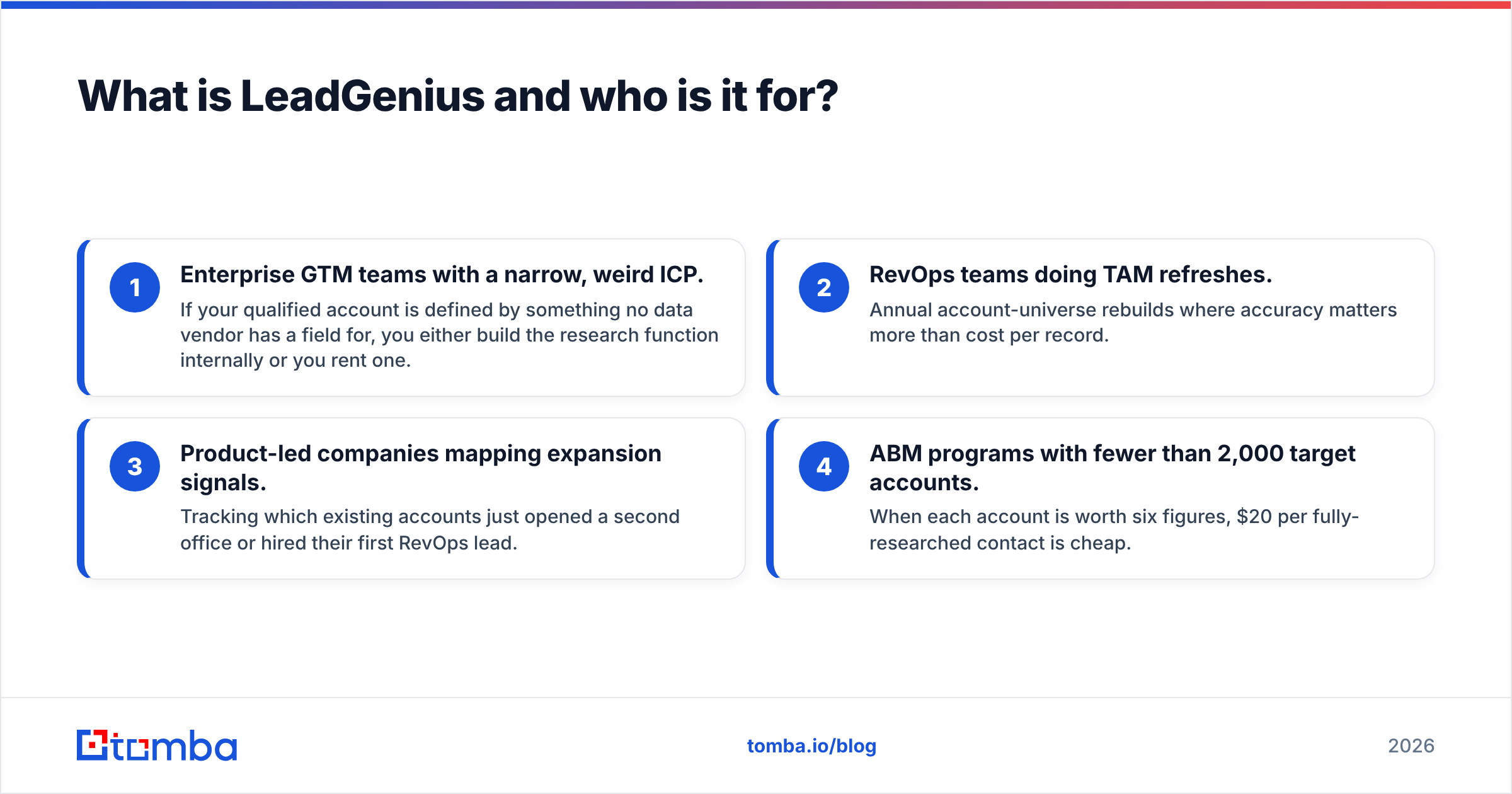
- Enterprise GTM teams with a narrow, weird ICP. If your qualified account is defined by something no data vendor has a field for, you either build the research function internally or you rent one.
- RevOps teams doing TAM refreshes. Annual account-universe rebuilds where accuracy matters more than cost per record.
- Product-led companies mapping expansion signals. Tracking which existing accounts just opened a second office or hired their first RevOps lead.
- ABM programs with fewer than 2,000 target accounts. When each account is worth six figures, $20 per fully-researched contact is cheap.
The trade-off is speed and price. A custom build has a lead time measured in weeks, and the commercial model is an annual subscription with a defined record or "refresh" volume. You can see the company's own positioning at leadgenius.com.
What is Techsalerator and how does its data model differ?#
Techsalerator is a data reseller and aggregator. It licenses and packages datasets — B2B company files, consumer records, mobile identifiers, email lists, point-of-interest data — and sells them by segment, country, or vertical. The catalog is broad: the company markets coverage across a very large number of countries, and it sells both business and consumer data, which matters for compliance reasons we'll get to.
The mental model is closer to buying a database dump than subscribing to a platform. You tell them the segment ("all manufacturing companies in Southeast Asia with 50+ employees"), they quote a file, you receive it as CSV, a feed, or through a delivery integration. Some datasets are available as one-time purchases rather than annual commitments, which is genuinely different from most enterprise data vendors.
Where this works well:
- Market entry research. You need to know how many plausible accounts exist in Poland or Vietnam before you hire there.
- Data enrichment backfills. You have 200,000 company records missing industry codes and want a matching file.
- Volume-first outbound. Some teams genuinely want raw quantity and have their own verification and filtering layer.
- Non-standard data types. Location data, app data, and POI files that classic sales-intelligence vendors don't touch.
Where it gets uncomfortable: bulk licensed files are a snapshot. B2B contact data decays at roughly 25-30% per year — people change jobs, companies rebrand, domains get consolidated. A file bought in January is measurably worse in September unless there's a refresh clause. Always ask what the collection date is, not just the delivery date. Independent user reviews on G2 and Capterra are thin for both vendors, which itself tells you something about how these deals get done: privately, via sales, not through self-serve trials.
LeadGenius vs Techsalerator: how do they compare directly?#
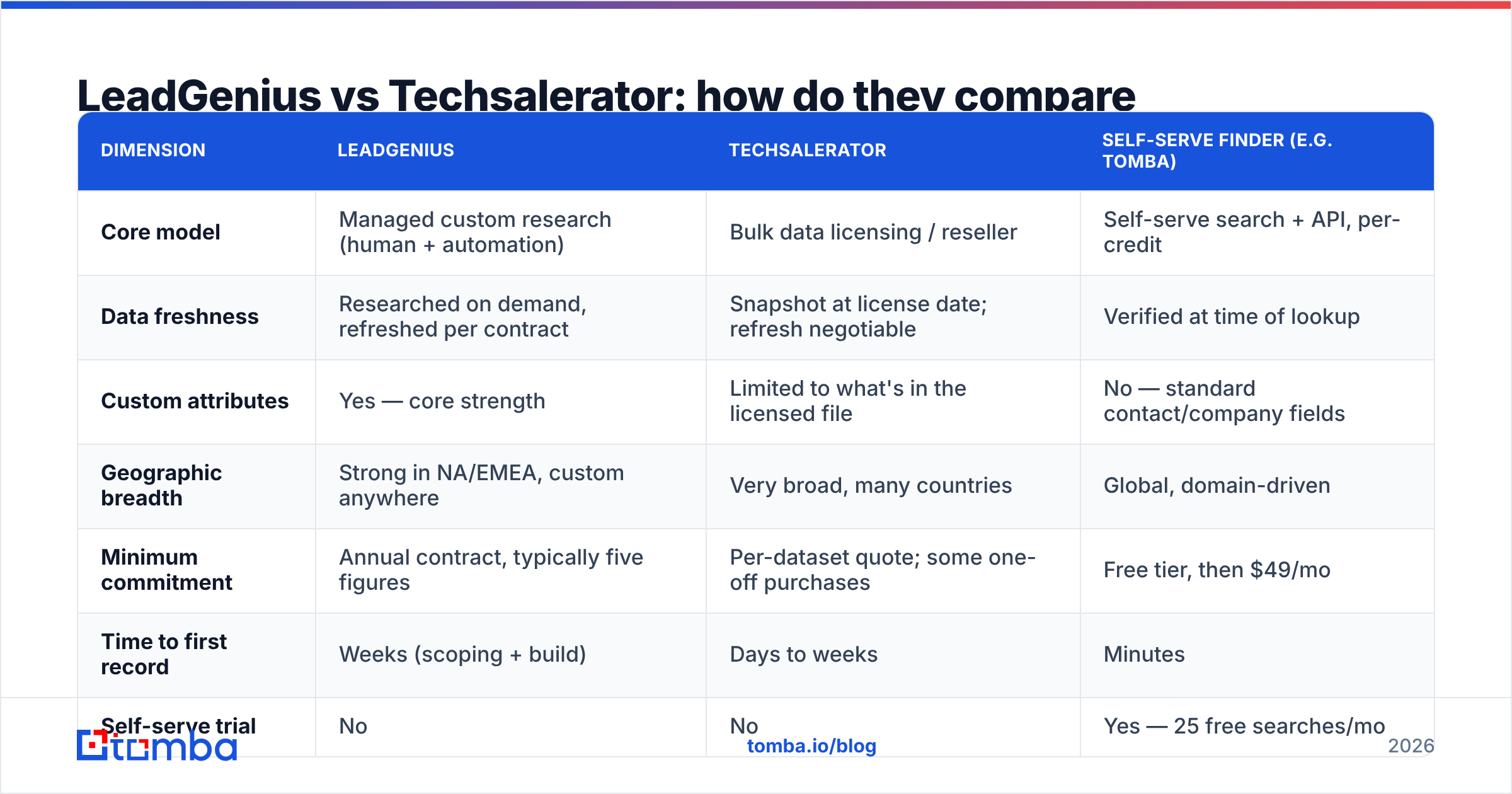
| Dimension | LeadGenius | Techsalerator | Self-serve finder (e.g. Tomba) |
|---|---|---|---|
| Core model | Managed custom research (human + automation) | Bulk data licensing / reseller | Self-serve search + API, per-credit |
| Data freshness | Researched on demand, refreshed per contract | Snapshot at license date; refresh negotiable | Verified at time of lookup |
| Custom attributes | Yes — core strength | Limited to what's in the licensed file | No — standard contact/company fields |
| Geographic breadth | Strong in NA/EMEA, custom anywhere | Very broad, many countries | Global, domain-driven |
| Minimum commitment | Annual contract, typically five figures | Per-dataset quote; some one-off purchases | Free tier, then $49/mo |
| Time to first record | Weeks (scoping + build) | Days to weeks | Minutes |
| Self-serve trial | No | No | Yes — 25 free searches/mo |
| Verification included | Yes, human-verified | Varies by dataset — verify yourself | Yes, SMTP-level verification |
| Best for | Narrow ICP, custom fields, ABM | Volume, new markets, backfills | Everyday outbound and enrichment |
| Worst for | Fast, cheap, small lists | Freshness-critical campaigns | Exotic custom attributes |
The honest framing: these two are not really competitors. LeadGenius competes with hiring two offshore researchers and a data engineer. Techsalerator competes with buying a file from a regional list broker or licensing from a data marketplace. They end up on the same shortlist mostly because both are "call us for a quote" B2B data vendors that appear in the same searches.
How do pricing models actually compare?#
Neither publishes a price list, which is standard for this tier. Here's what the commercial shape looks like based on how each company sells.
LeadGenius operates on annual subscriptions scoped to volume and complexity. The variables are number of accounts, number of contacts per account, number of custom attributes, and refresh cadence. Custom attributes are the expensive part — each new field you request is effectively a new research workflow. Expect a floor well into five figures annually, and expect the quote to move significantly if you add "and also track whether they use a specific payment processor."
Techsalerator quotes per dataset. Price drives off record count, attribute depth, geography, and whether you want one-time delivery or an ongoing feed. Because some purchases can be one-off, the entry cost can be lower than an annual DaaS contract — but the per-record cost-of-truth can be higher once you account for the verification pass you'll need to run yourself.
The hidden third cost is what nobody quotes: cleanup. A licensed file of 80,000 contacts will contain duplicates, role accounts, dead domains, and catch-all servers. If you send to it raw, you'll burn your sending domain. Budget for a verification pass — either as a line item with the vendor, or via your own email verifier. Running a catch-all verifier on the ambiguous slice is the difference between a 2% bounce rate and a 12% one, and Google and Microsoft both enforce bounce thresholds now.

Which one should you choose for your use case?#
Work backwards from the question you're trying to answer, not from the vendor.
Choose LeadGenius if:
- Your ICP definition includes at least one attribute that doesn't exist as a filter in any standard database.
- You're running ABM against fewer than ~2,000 accounts where per-account research pays for itself.
- You have budget approval for an annual six-to-twelve-month commitment and a stakeholder who owns data quality.
- You've already tried building this internally and the maintenance burden killed it.
Choose Techsalerator if:
- You need breadth across markets that US-centric vendors cover poorly.
- You want a dataset you own outright rather than a seat-based subscription.
- You have (or can build) a verification and normalization pipeline before anything touches a sending domain.
- You're doing analysis — TAM sizing, territory planning — more than direct outreach.
Choose neither if:
- Your list is under 10,000 contacts a year. The contract overhead alone exceeds the value.
- You need records today, not after a scoping call.
- Your ICP is definable with standard filters: industry, headcount, role, location, tech stack.
That last case is most teams. If you can describe your target as "heads of marketing at 50-500 person SaaS companies in the UK," you don't need a research service — you need a domain search and a verification step. Pull the company list from wherever you already have it (CRM, LinkedIn exports, a conference attendee page), find the contacts by domain, verify, and go.
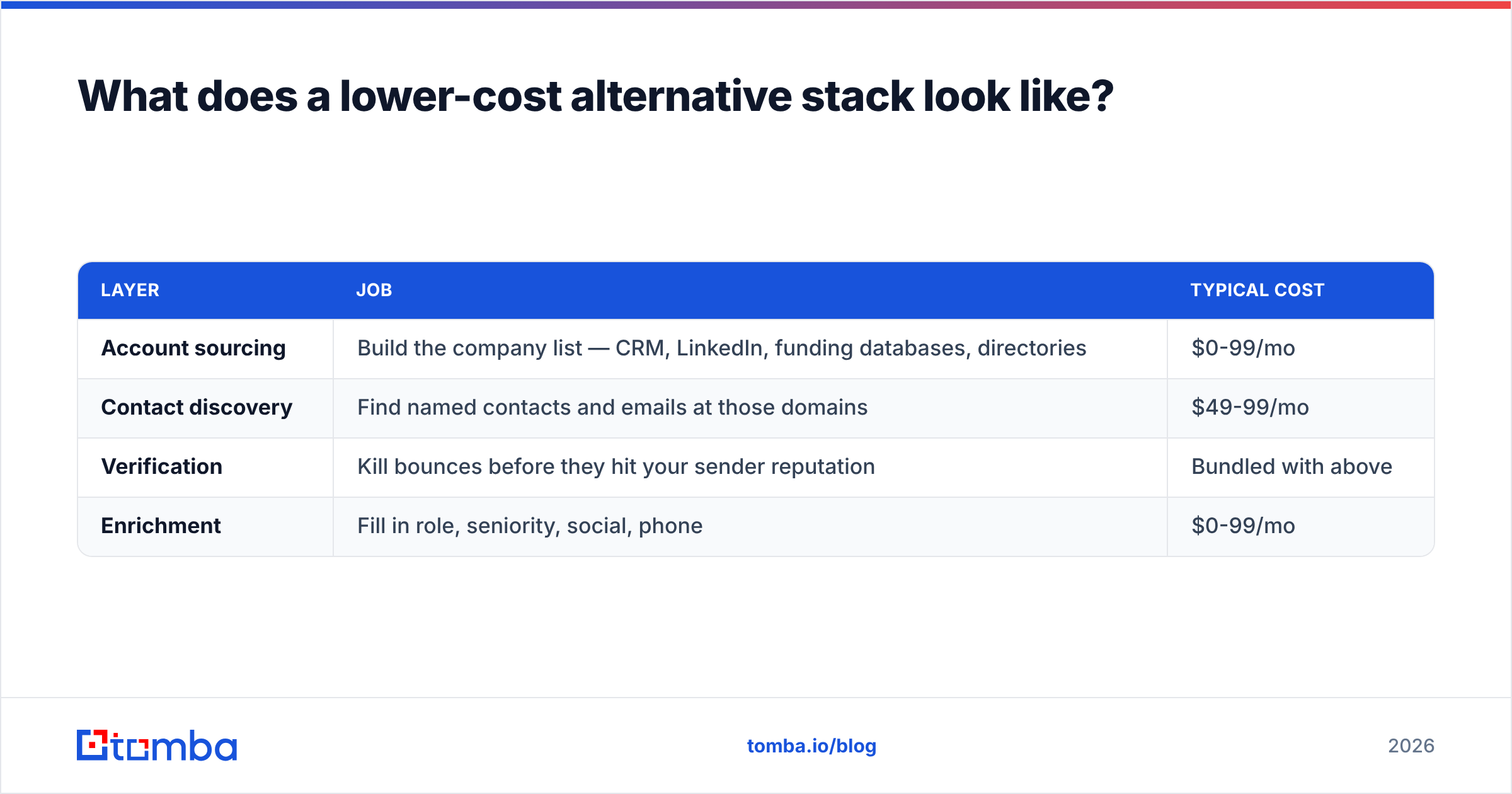
What does a lower-cost alternative stack look like?#
Here's a concrete, three-layer alternative that handles the common case without a procurement cycle.
| Layer | Job | Typical cost |
|---|---|---|
| Account sourcing | Build the company list — CRM, LinkedIn, funding databases, directories | $0-99/mo |
| Contact discovery | Find named contacts and emails at those domains | $49-99/mo |
| Verification | Kill bounces before they hit your sender reputation | Bundled with above |
| Enrichment | Fill in role, seniority, social, phone | $0-99/mo |
In practice: you run domain search across your account list to pull every published address pattern and named contact at each company, feed the ambiguous ones through verification, and enrich the survivors. Tomba's pricing starts with a free tier at 25 searches per month, Starter at $49/mo, Growth at $99/mo, and Pro at $249/mo — no annual commitment, no scoping call. The Tomba API handles the same workflow programmatically if you'd rather wire it into your CRM than work in a UI.
This stack does not replace LeadGenius for genuinely custom research. It does replace both vendors for the 80% of outbound work that's actually "find me the right person at these 3,000 companies and make sure the address is real."
It's worth noting that other players occupy the middle ground between bulk files and managed research. BookYourData, for example, sells pay-as-you-go verified B2B contact lists with no subscription — a reasonable option when you want file-style buying without an annual contract, and a genuinely different commercial model from either vendor here.
What questions should you ask before signing either contract?#
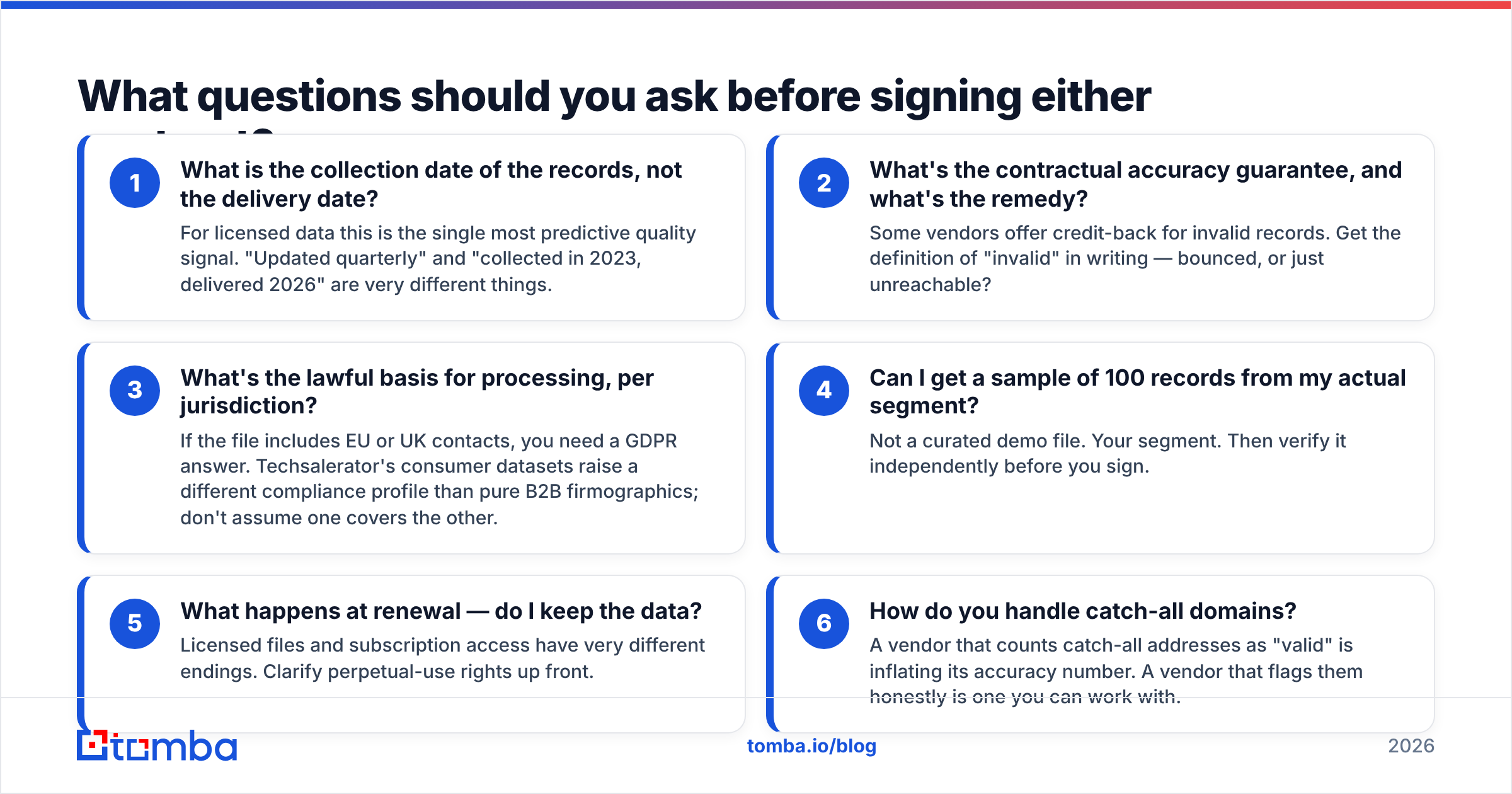
Take this list into the demo. The answers separate serious vendors from resellers with a good landing page.
- What is the collection date of the records, not the delivery date? For licensed data this is the single most predictive quality signal. "Updated quarterly" and "collected in 2023, delivered 2026" are very different things.
- What's the contractual accuracy guarantee, and what's the remedy? Some vendors offer credit-back for invalid records. Get the definition of "invalid" in writing — bounced, or just unreachable?
- What's the lawful basis for processing, per jurisdiction? If the file includes EU or UK contacts, you need a GDPR answer. Techsalerator's consumer datasets raise a different compliance profile than pure B2B firmographics; don't assume one covers the other.
- Can I get a sample of 100 records from my actual segment? Not a curated demo file. Your segment. Then verify it independently before you sign.
- What happens at renewal — do I keep the data? Licensed files and subscription access have very different endings. Clarify perpetual-use rights up front.
- How do you handle catch-all domains? A vendor that counts catch-all addresses as "valid" is inflating its accuracy number. A vendor that flags them honestly is one you can work with.
On question four: always run the sample through your own verification before you believe the vendor's accuracy claim. Vendor-reported accuracy is measured against the vendor's own definition. Independent verification is measured against your bounce rate, which is the number your deliverability actually depends on. Industry guidance from HubSpot and others consistently points to list hygiene as the dominant variable in cold outbound performance — ahead of copy, ahead of timing.
Is either vendor worth it in 2026?#
Yes — for the specific jobs they're built for, and no for everything else.
LeadGenius earns its price when the research is genuinely hard and the accounts are genuinely valuable. If you're spending an analyst's week per month manually compiling a list from job boards and press releases, outsourcing that is rational economics. If you're using it to find marketing directors at SaaS companies, you're paying custom-research rates for commodity data.
Techsalerator earns its price when breadth beats freshness — market sizing, geographic expansion, enrichment backfills, analytical work. It struggles as a primary source for active sending campaigns unless you own the verification layer, because no snapshot survives contact with a nine-month-old file.
And both are the wrong answer if your real problem is "I have a list of companies and I need the right person's email." That's a $49/mo problem, not a $50,000/yr problem. The mistake teams make isn't picking the wrong vendor — it's buying an enterprise data contract to solve a tooling problem, then discovering the contract doesn't include the one workflow they run daily.
Ready to test the cheaper path first?#
Before you book a scoping call with either vendor, spend twenty minutes finding out whether you actually need one. Take 50 accounts from your target list, run them through the Tomba Email Finder, and check the hit rate and the verification results against what you'd expect from a custom build. If you get the contacts you need at $49/mo, you've just saved a procurement cycle and a five-figure line item. If the attributes you need genuinely aren't there, you'll walk into that LeadGenius call with a precise, defensible spec — which is exactly how you get a better quote anyway. Start with the free tier at 25 searches a month; no call required.
Related guides#
Ready to find emails that actually work?
Join 150,000+ professionals who stopped guessing and started sending. Free credits on signup — no credit card required.
Get the Tomba newsletter
Practical outbound tactics and product updates — once every two weeks.
About the author