LeadGenius vs The Data City (2026): Which B2B Data Wins?
LeadGenius sells human-verified custom contact data. The Data City maps UK companies by what they actually do. They rarely compete for the same budget — here's how to tell which one your pipeline needs, and when neither is the answer.
LeadGenius vs The Data City is a match-up most buyers get wrong. One sells you a research team. The other sells you a map of the UK economy. Here is how to pick — and when to buy neither.
TL;DR
- These two are not real rivals. LeadGenius builds custom contact lists with human researchers. The Data City sorts UK firms by what their websites say they do.
- Pick LeadGenius when you need named people plus odd traits nobody sells off the shelf. Think enterprise budget and a 4–8 week wait.
- Pick The Data City for market sizing, sector maps, or territory design in the UK. It will not help you email 3,000 people next Tuesday.
- Neither shows a price. Both are annual, quote-only, sales-led deals.
- Most outbound teams need a third thing. A fast, self-serve way to find and verify work emails. That tool costs far less.
LeadGenius vs The Data City: what are they, actually?#
Both show up under "B2B data provider." That is where the likeness ends.
LeadGenius launched in the early 2010s. It mixes machine crawling with a global team of human researchers. Those people verify records and fill the gaps.
The pitch is custom data on demand. You do not filter a fixed database. You describe the accounts you want and the fields you wish existed. LeadGenius then builds that dataset and refreshes it on a set cadence. Emails, phone numbers, and rare account traits all come with it.
The Data City is a Leeds-based UK company intelligence platform. Its founding idea is simple. Standard industry codes — SIC in the UK, NAICS in the US — are stale and self-reported.
A firm that registered in 2009 as "other business support activities" may now sell carbon-accounting software. The Data City reads company websites instead. It applies Real-Time Industrial Classifications, or RTICs, to sort firms by what they do today. It then adds Companies House filings, headcount, funding, patents, and job posts.
So one sells you a research team. The other sells you a lens on a national economy. Different problems.
LeadGenius vs The Data City: head-to-head comparison#
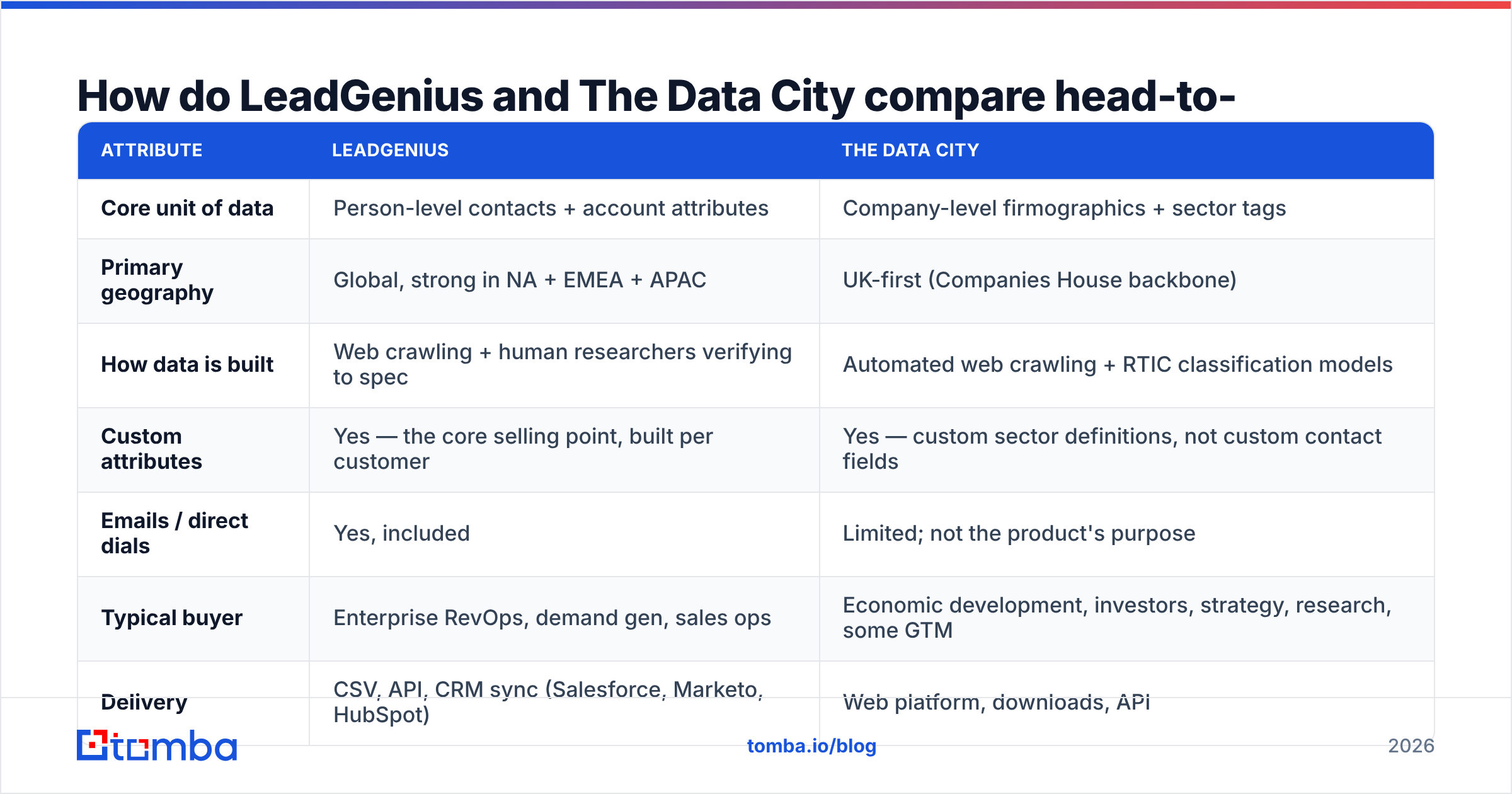
| Attribute | LeadGenius | The Data City |
|---|---|---|
| Core unit of data | Person-level contacts + account attributes | Company-level firmographics + sector tags |
| Primary geography | Global, strong in NA + EMEA + APAC | UK-first (Companies House backbone) |
| How data is built | Web crawling + human researchers verifying to spec | Automated web crawling + RTIC classification models |
| Custom attributes | Yes — the core selling point, built per customer | Yes — custom sector definitions, not custom contact fields |
| Emails / direct dials | Yes, included | Limited; not the product's purpose |
| Typical buyer | Enterprise RevOps, demand gen, sales ops | Economic development, investors, strategy, research, some GTM |
| Delivery | CSV, API, CRM sync (Salesforce, Marketo, HubSpot) | Web platform, downloads, API |
| Speed to first usable list | Weeks (scoping + build cycle) | Days (self-directed inside the platform) |
| Pricing | Quote only, annual contract | Quote only, annual subscription |
| Free trial | Sales-led pilot | Demo / limited trial on request |
The table makes the split clear. Need 5,000 verified director-level contacts across six countries? The Data City will not get you there. Need to know how many UK firms work on industrial heat, and where they cluster? LeadGenius is a slow, costly way to find out.

How do the two platforms source their data?#
This is where the real gap in LeadGenius vs The Data City lives. Learn it before you sit through either demo.
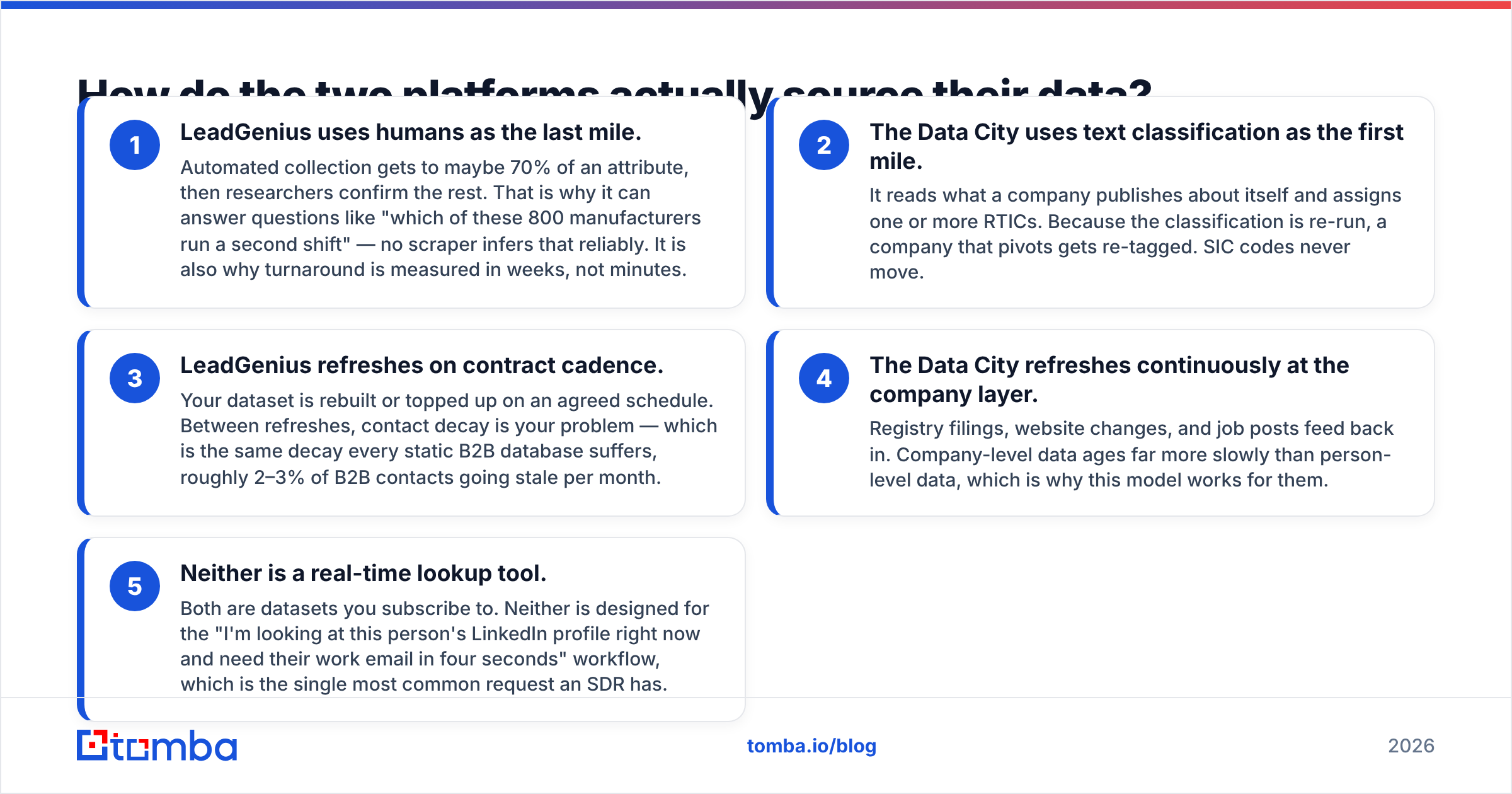
- LeadGenius uses people as the last mile. Software gets maybe 70% of a field. Researchers confirm the rest. That is how it answers questions no scraper can guess. It is also why the wait runs in weeks.
- The Data City uses text sorting as the first mile. It reads what a firm says about itself and tags it with RTICs. Re-run the tagging and a firm that pivots gets re-tagged. SIC codes never move.
- LeadGenius refreshes on contract cadence. Your file is rebuilt on an agreed date. Between runs, decay is your problem. Roughly 2–3% of B2B contacts go stale each month.
- The Data City refreshes all the time. Filings, site changes, and job posts feed back in. Company data ages far slower than person data.
- Neither is a live lookup tool. Both are datasets you rent. Neither fits the "I need this email now" moment.
That last point is the one buyers miss. Enrichment cadence and moment-of-need lookup are two jobs. Most stacks need both. To solve the second one cheaply, park a dedicated email finder next to your CRM. It costs a fraction of an enterprise data contract.
What is LeadGenius genuinely best at?#
Custom fields. That is the honest answer.
Any big vendor can give you headcount, revenue band, and tech stack. None can tell you if a hospital group runs its own pharmacy. Or if a restaurant chain franchises. Or if a maker holds a given ISO badge. Those fields make a niche ICP targetable. They rarely exist in any dataset you can buy.
LeadGenius pays a team to go find them. That is the right call when:
- Your ICP rests on a trait no vendor sells.
- Your deal sizes are big, so 500 sharp accounts beat 50,000 loose ones.
- You sell in regions where US-centric databases fall apart.
- You need GDPR lineage and consent records that a scraped list cannot give.
The trade-off is built in. You buy a service, not a self-serve tool. Expect scoping calls, sample files, and revision rounds. Teams that want to move this week find that painful. Teams building a two-year ABM plan find it worth the wait.
Maybe you just need contact data and they seem to have it. Check reviews on G2 first. Then compare against self-serve tools. You may be buying a Ferrari for the school run.
What is The Data City genuinely best at?#
Finding firms that cannot describe themselves — and finding all of them.
Say you sell compliance software to UK medical device makers. Filter by SIC code and you get dormant shells and mislabelled distributors. Real device firms filed under "scientific research" stay hidden.
The Data City reads the websites instead. It returns the firms that truly build devices. That includes the one set up last year under a vague code.
That makes it strong for:
- Market sizing you can defend, not a guess times a guess.
- Territory design based on real cluster density, not postcode maths.
- Emerging sector hunting — net zero, quantum, AI infrastructure, advanced materials.
- Investor and economic research, a large part of its customer base.
The limit is just as clear. It is a company data product with a UK spine. If your pipeline is North American, look elsewhere. If you need named people with verified emails, look elsewhere too.
Many teams buy it for strategy. Then they need a second layer to turn a company list into an outreach list. That usually means domain search to pull the people at each firm.

LeadGenius vs The Data City pricing in 2026#
Neither firm posts a price. Treat any blog post that quotes a hard number with doubt.
Here is what holds true:
- Both sell annual, sales-led contracts. You get a scoping call before a number.
- LeadGenius pricing tracks record volume plus custom field complexity. Research is labour, and labour prices like labour.
- The Data City pricing tracks seats and access depth — platform, bulk export, or API.
- Expect enterprise friction either way: security review, DPA, and weeks of legal.
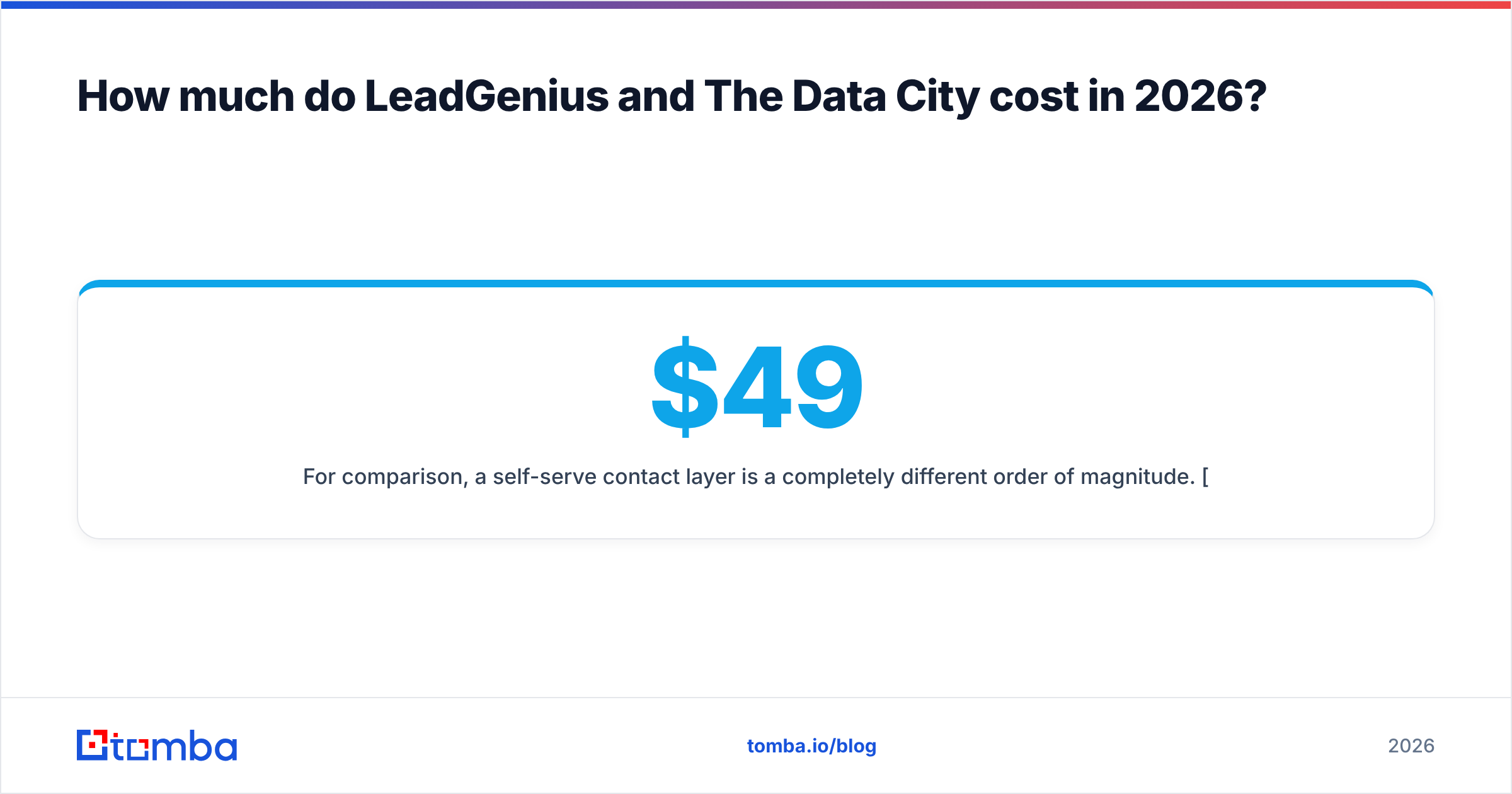
A self-serve contact layer sits in a different price bracket. Tomba pricing is public. It starts free at 25 searches a month. Starter is $49/mo, Growth $99/mo, Pro $249/mo, with custom terms above that.
That is not a fair match on capability. It is a fair match on how fast you can start. Most buyers admit that speed matters when the quarter ends in three weeks.
Which one wins for an outbound sales team?#
In a straight LeadGenius vs The Data City run-off for outbound, LeadGenius wins. But the caveat is big. Many teams should buy neither.
LeadGenius wins because outbound eats named people at qualified accounts with working addresses. The Data City hands you a map, not a call list. You can start from a sector export and work outward. You will still have to source and verify the contacts yourself. That is half a solution.
Now the caveat. LeadGenius is built for programmes, not sprints. An SDR team that needs 200 fresh contacts by Thursday cannot use it. A demand gen team building a 12-month ABM motion across 2,000 accounts can.
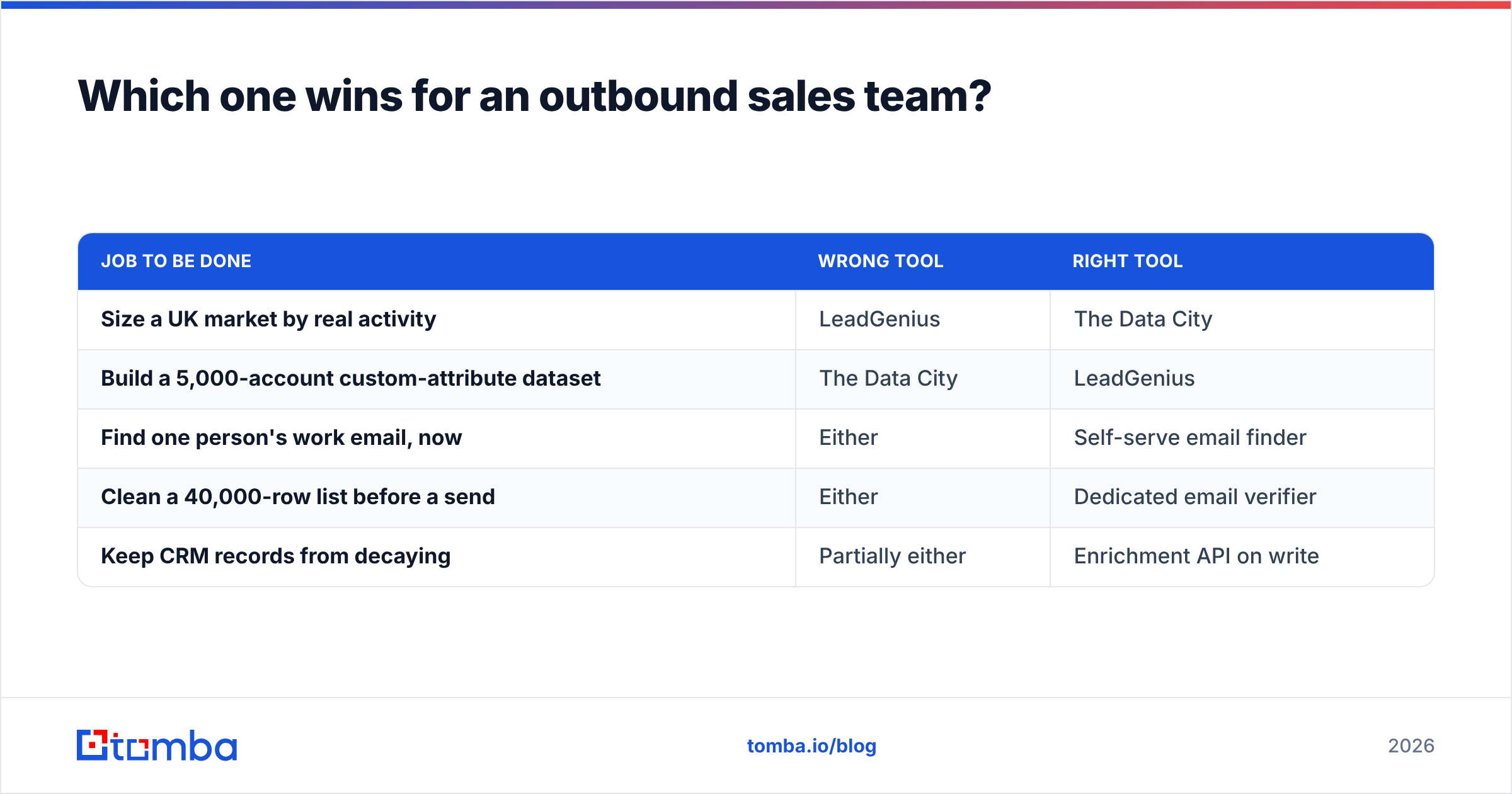
Most mid-market teams land on a stack like this:
| Job to be done | Wrong tool | Right tool |
|---|---|---|
| Size a UK market by real activity | LeadGenius | The Data City |
| Build a 5,000-account custom-attribute dataset | The Data City | LeadGenius |
| Find one person's work email, now | Either | Self-serve email finder |
| Clean a 40,000-row list before a send | Either | Dedicated email verifier |
| Keep CRM records from decaying | Partially either | Enrichment API on write |
Rows three and four are where budget leaks. Teams pay enterprise data rates for work a bulk email finder and an email verifier finish in an afternoon. Then they wonder why the contract felt steep.
When should you buy neither?#
Be honest about which line below sounds like you.
"I don't know who to sell to." That is a research problem. Use The Data City, an analyst, or three weeks of customer calls. Do not buy contact data yet. You will burn it on the wrong accounts.
"I know exactly who to sell to, and nobody sells that list." That is LeadGenius ground. Budget for it, scope it well, and ask for a sample before you sign.
"I know who to sell to, and I just need their emails." Buy neither. You need lookup and verification, not a data operation. Pull contacts by domain, verify before you send, and push them into your CRM with an email finder API. Spend the rest on sequencing and copy.
Most people reading a LeadGenius vs The Data City comparison sit in this third bucket. Few of them know it.
What's the final verdict on LeadGenius vs The Data City?#
There is no single winner. They answer different questions.
Choose The Data City to map the UK economy, size a market, design territories, or hunt firms in sectors the official codes have missed. Nobody else re-sorts UK companies from live web evidence at that scale.
Choose LeadGenius when your ICP rests on traits you cannot buy, you sell worldwide, your deal sizes justify bespoke research, and you can wait weeks for delivery. It leads the custom-data-as-a-service pack.
Choose neither when you already know the companies and just need contacts. That is a cheap, solved problem. Paying enterprise rates for it is the most common overspend in B2B go-to-market.
Want to test the third option before you sit through two demos? Start with the Tomba Email Finder. Drop in a domain and a name. Get the verified work email back. You will see how much of your "we need a data vendor" problem was really a lookup problem. The free tier gives 25 searches a month with no card. Starter is $49/mo if it earns its spot.
Related guides#
// get started
Find, verify and enrich your first contacts today
Start on the free plan with 25 searches a month, then scale when your team is ready.
Free plan · No credit card required · GDPR & CCPA
// about the author