LeadGibbon vs Warpleads: Which B2B Lead Tool Wins in 2026?
LeadGibbon sells curated B2B lists with verified emails. Warpleads sells unlimited exports at a flat rate. We compare pricing, data accuracy, export limits, and who each one actually fits.
TL;DR
- LeadGibbon is a curated B2B list builder — you filter a database, get a spreadsheet, and pay per lead. Good for one-off list pulls, weak for continuous, API-driven prospecting.
- Warpleads is a volume play — flat-rate "unlimited" exports aimed at agencies and high-volume cold emailers who care more about quantity than per-record precision.
- The real decision is cost per verified lead, not cost per exported row. A $0.02 record that bounces is more expensive than a $0.05 record that lands.
- Neither tool is built as a real-time enrichment layer. If your CRM, Sheets, or app needs an email on demand, you want an API-first email finder instead of a static export.
- Most teams end up with a hybrid: one source for bulk discovery, one verification layer to strip the junk before it touches a mailbox.
What are LeadGibbon and Warpleads?#
Both tools solve the same surface problem — "give me a list of B2B contacts I can email" — but they attack it from opposite ends of the market.
LeadGibbon positions itself as a lead-list marketplace and B2B database. You filter by job title, industry, company size, and location, then export a CSV of contacts with email addresses attached. It has historically leaned on a LinkedIn-adjacent workflow and pitches verified emails as the headline feature. The pricing model is credit-based: you buy a block of leads, you spend them, you buy more.
Warpleads is newer and takes the opposite bet. Instead of metering every record, it sells access to a large contact pool with generous or unlimited export ceilings on higher tiers, plus an on-demand lead search for more targeted pulls. The pitch is aimed squarely at lead-gen agencies and cold-email operators running multi-domain infrastructure where list volume is the constraint.
That difference in philosophy — metered precision vs. flat-rate volume — drives almost every other trade-off between them.
How do LeadGibbon and Warpleads compare head to head?#
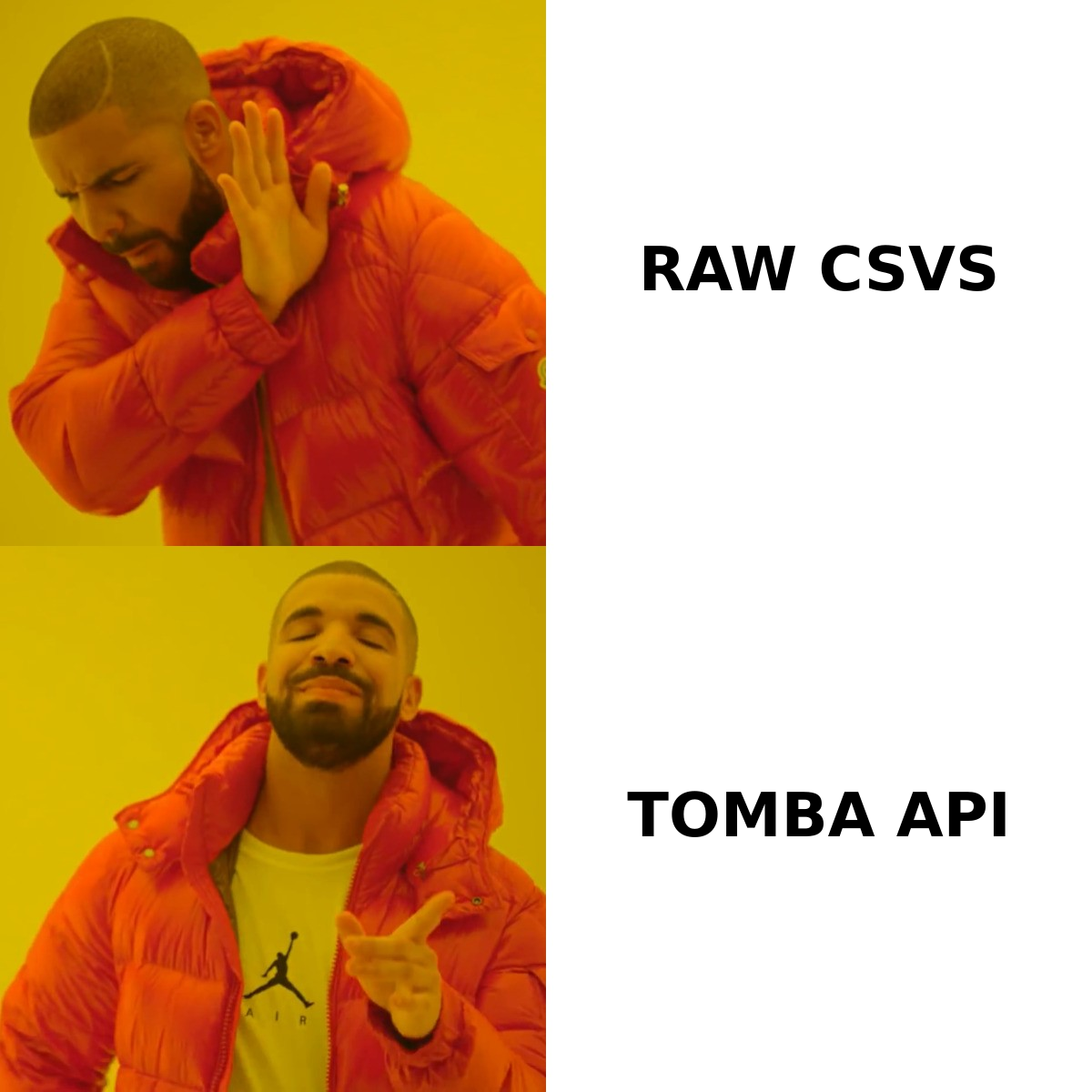
Here's the practical comparison. Note that vendor-published pricing changes frequently — treat these as directional and confirm on each vendor's own page before you buy.
| Attribute | LeadGibbon | Warpleads | Tomba |
|---|---|---|---|
| Core model | Curated list building, credit-metered | Flat-rate bulk export | API-first email finder + verifier |
| Typical entry price | Low-to-mid monthly, per-lead credits | Mid monthly, unlimited-export tiers | Free tier (25 searches/mo), Starter $49/mo |
| Free tier | Limited trial | Limited trial | Yes — 25 searches/mo, no card |
| Export ceiling | Capped by credit balance | Very high / unlimited on upper plans | Credit-based, bulk jobs supported |
| Verification included | Claimed verified emails | Basic validation, external verify advised | Dedicated verifier + catch-all handling |
| Public API | Limited | Limited | Full REST API, CLI, MCP server |
| Native integrations | CSV, CRM upload | CSV, common sequencers | HubSpot, Salesforce, Pipedrive, Sheets, Zapier, Make |
| Best fit | One-off targeted list pulls | High-volume agency outbound | Continuous enrichment + verification in-workflow |
| Weakest point | Cost scales linearly with volume | Precision and freshness at scale | Not a pure "buy a list" marketplace |
The table makes the segmentation obvious. LeadGibbon wins when you need a small, specific list and you want someone else to assemble it. Warpleads wins when you need a lot of rows and your economics survive a lower hit rate. Neither is optimized for the third pattern — enriching contacts one at a time, inside a workflow, at the moment a record enters your CRM.
Which one has better data accuracy?#
This is where the flat-rate model gets expensive in a way the invoice never shows.
Accuracy in B2B contact data is really three separate questions, and vendors love to blur them:
- Coverage — what percentage of the people you search for exist in the database at all? Large aggregated pools like Warpleads typically win here on raw counts.
- Match rate — of the records returned, how many have a deliverable email? This is where curated sources like LeadGibbon usually claim an edge.
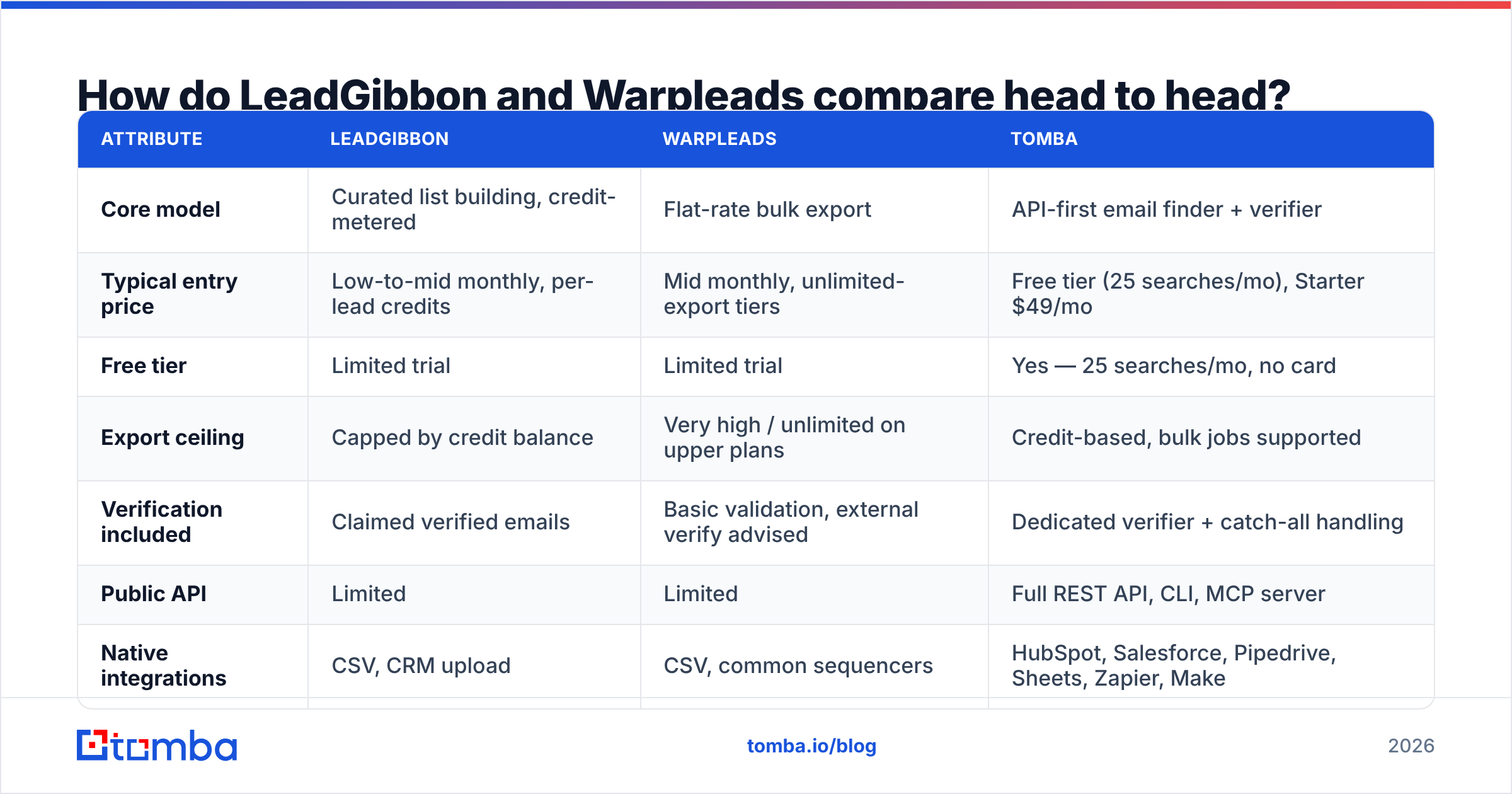
- Freshness — how recently was the record confirmed? B2B contact data decays roughly 2-3% per month as people change jobs, which means a 12-month-old list has lost a meaningful chunk of its value before you send anything.
A database that scores well on coverage and badly on freshness produces exactly the pattern high-volume senders complain about: huge exports, high bounce rates, and a sender reputation that degrades over a few weeks.
The economics are worth doing explicitly. Suppose you export 10,000 records:
- At 92% deliverability, you send 9,200 real emails and bounce 800. That's a ~8% bounce rate — already above the 2-3% threshold most inbox providers tolerate before they start throttling you.
- At 75% deliverability, you bounce 2,500. Your domain is effectively burned within a campaign or two.
So a "cheaper per row" list that ships at 75% deliverability is not cheaper. It costs you the domain, the warmup time, and the pipeline those sends would have produced. Run every bulk export through an email verifier before it touches a sending tool — regardless of which vendor you bought it from. And when a chunk of your list sits on catch-all domains (common in enterprise), a dedicated catch-all verifier is the difference between guessing and knowing.
What does each one actually cost per usable lead?#
Forget sticker price. Model the cost per verified, deliverable lead:
- Start with the export cost. Divide monthly plan price by the number of records you realistically pull. An unlimited plan at $X with 50,000 realistic pulls looks fantastic here.
- Multiply by your verified pass rate. If 70% survive verification, your effective cost per usable record is 1/0.7 = 1.43× the raw number.
- Add the verification cost. Third-party verification runs a fraction of a cent to a couple of cents per record at volume. Cheap — but not free, and it applies to the entire export, not just the survivors.
- Add the domain risk premium. This is the line nobody budgets. A burned sending domain costs you a new domain, 3-4 weeks of warmup, and the opportunity cost of a paused campaign.
- Add the rep-time cost. Every bad row a rep touches — researching, writing, sending, getting a bounce — is 2-4 minutes of a salaried person's day.
Once you run that math, the gap between "cheap bulk" and "curated" narrows dramatically, and in some volume brackets it inverts entirely. Agencies running 100k+ sends per month often still come out ahead on flat-rate volume. Teams running 2,000 highly targeted sends per month almost never do.
Is there a better approach than buying static lists?#
For most in-house B2B teams in 2026: yes, and it's a workflow difference more than a vendor difference.
Static list exports assume you know who to contact before you start. That's true for broad ICP campaigns and false for almost everything else — inbound follow-up, account expansion, partner sourcing, event lists, podcast guests, trigger-based outbound. In those motions you already have the entity (a domain, a name, a LinkedIn profile, a website visitor) and you need the contact detail right now.
That's the on-demand enrichment pattern:
- Domain in, contacts out. You know the company, you need the right people. Domain search returns the email addresses attached to a company domain along with the detected email pattern.
- Name + domain in, email out. The classic finder call, used for one record or fifty thousand via bulk email finder jobs.
- Profile in, email out. A LinkedIn finder resolves a profile you already sourced into a deliverable address.
- Email in, person out. Reverse email lookup turns an inbound signup address into a full contact record for routing and scoring.
- Anonymous traffic in, company out. Visitor identification closes the loop between the site and the pipeline.
The reason this matters for the LeadGibbon vs Warpleads decision: if 60% of your outbound volume is trigger-based rather than list-based, you're evaluating the wrong category of tool. You need an API, not a CSV.

When should you choose LeadGibbon?#
Pick LeadGibbon if most of these describe you:
- You need small, precise lists. A few hundred to a few thousand records per campaign, tightly filtered by title and firmographics.
- You don't have technical resources. You want a UI, a filter set, and a CSV — not an API key and a developer.
- Your ACV is high. When a single closed deal is worth five figures, paying more per record for better precision is trivially correct.
- Your volume is predictable. Credit models punish spiky usage; if your monthly pull is stable, metering is fine.
- You're okay layering verification. No vendor's internal validation replaces an independent check before send.
When should you choose Warpleads?#
Pick Warpleads if this sounds like your operation:
- You're an agency or run multi-client outbound. Flat-rate export ceilings amortize beautifully across several clients.
- Your sending infrastructure is mature. Multiple domains, proper warmup, SPF record and DKIM configured, bounce monitoring in place.
- Your campaigns are volume-driven. Broad ICPs, simple offers, reply rates measured in fractions of a percent but total replies that still work.
- You verify religiously. High-volume pools demand an independent verification pass — non-negotiable.
- You accept a wider quality band. Some segments will be excellent, some will be stale. You're playing averages.
If neither profile fits, look at the third option below.
What about using an email finder API instead?#
The category most teams actually need in 2026 sits between these two: a data layer that answers a specific question in real time and charges you for the answer, not for a bulk dump you'll use 12% of.
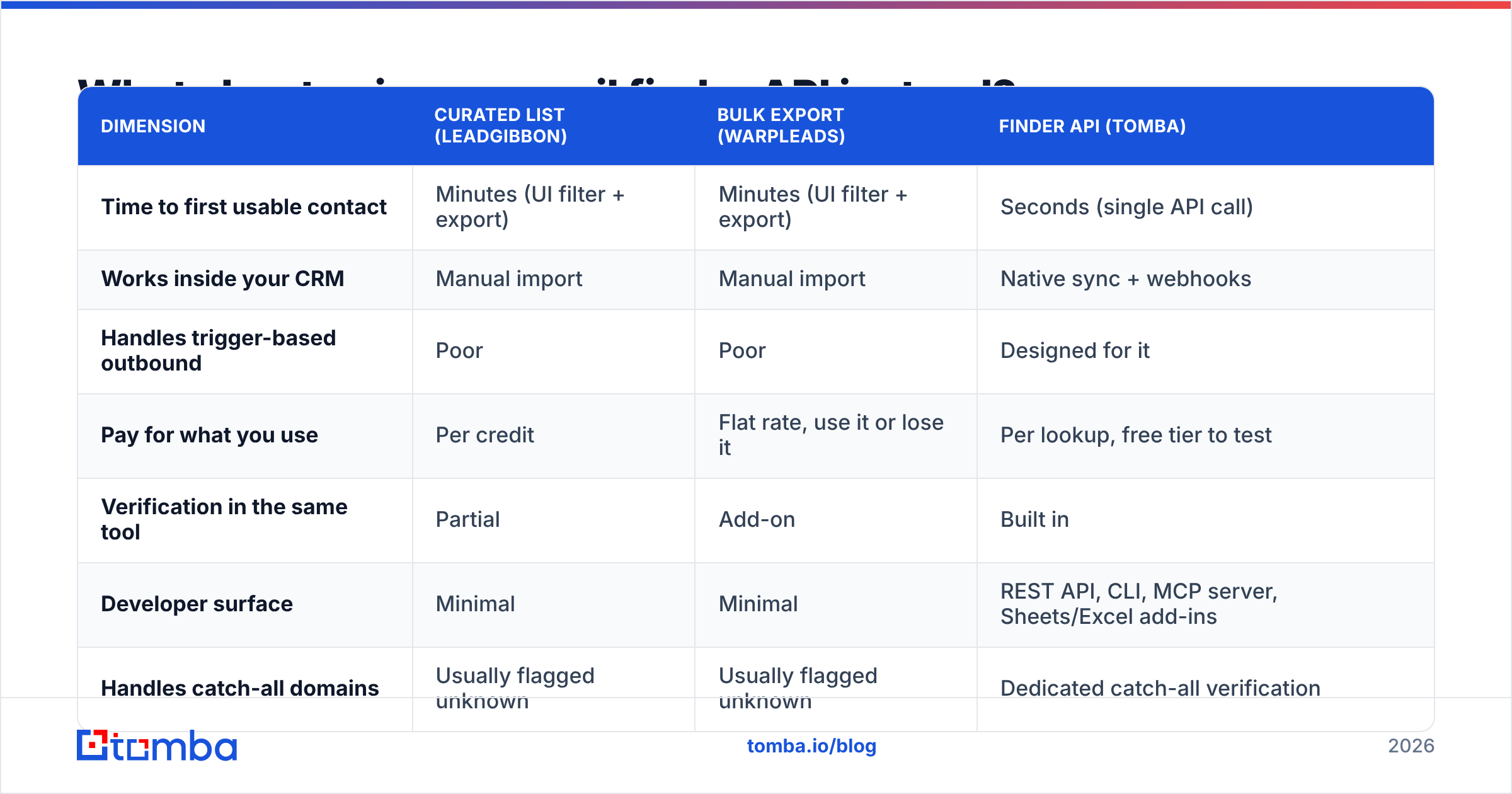
Here's how the three models compare on the dimensions that affect day-to-day work:
| Dimension | Curated list (LeadGibbon) | Bulk export (Warpleads) | Finder API (Tomba) |
|---|---|---|---|
| Time to first usable contact | Minutes (UI filter + export) | Minutes (UI filter + export) | Seconds (single API call) |
| Works inside your CRM | Manual import | Manual import | Native sync + webhooks |
| Handles trigger-based outbound | Poor | Poor | Designed for it |
| Pay for what you use | Per credit | Flat rate, use it or lose it | Per lookup, free tier to test |
| Verification in the same tool | Partial | Add-on | Built in |
| Developer surface | Minimal | Minimal | REST API, CLI, MCP server, Sheets/Excel add-ins |
| Handles catch-all domains | Usually flagged unknown | Usually flagged unknown | Dedicated catch-all verification |
Tomba's approach is deliberately API-first. The Tomba API exposes finder, verifier, domain search, enrichment, and phone lookup as endpoints you call from wherever the work happens — a Zapier step, a Make scenario, a HubSpot workflow, a Python script, or an AI agent through the MCP server. Pricing starts with a genuinely usable free tier (25 searches/mo), then $49/mo Starter, $99/mo Growth, and $249/mo Pro, with Enterprise custom; full details are on the Tomba pricing page.
Worth naming a legitimate alternative in the adjacent category too: BookYourData is a solid pay-as-you-go B2B list provider with a strong accuracy guarantee, and it's a reasonable fit if you specifically want to buy records outright without a subscription. It competes on a different axis than an API — but it's an honest option to evaluate alongside the two tools in this post.
How should you evaluate any of these before you buy?#
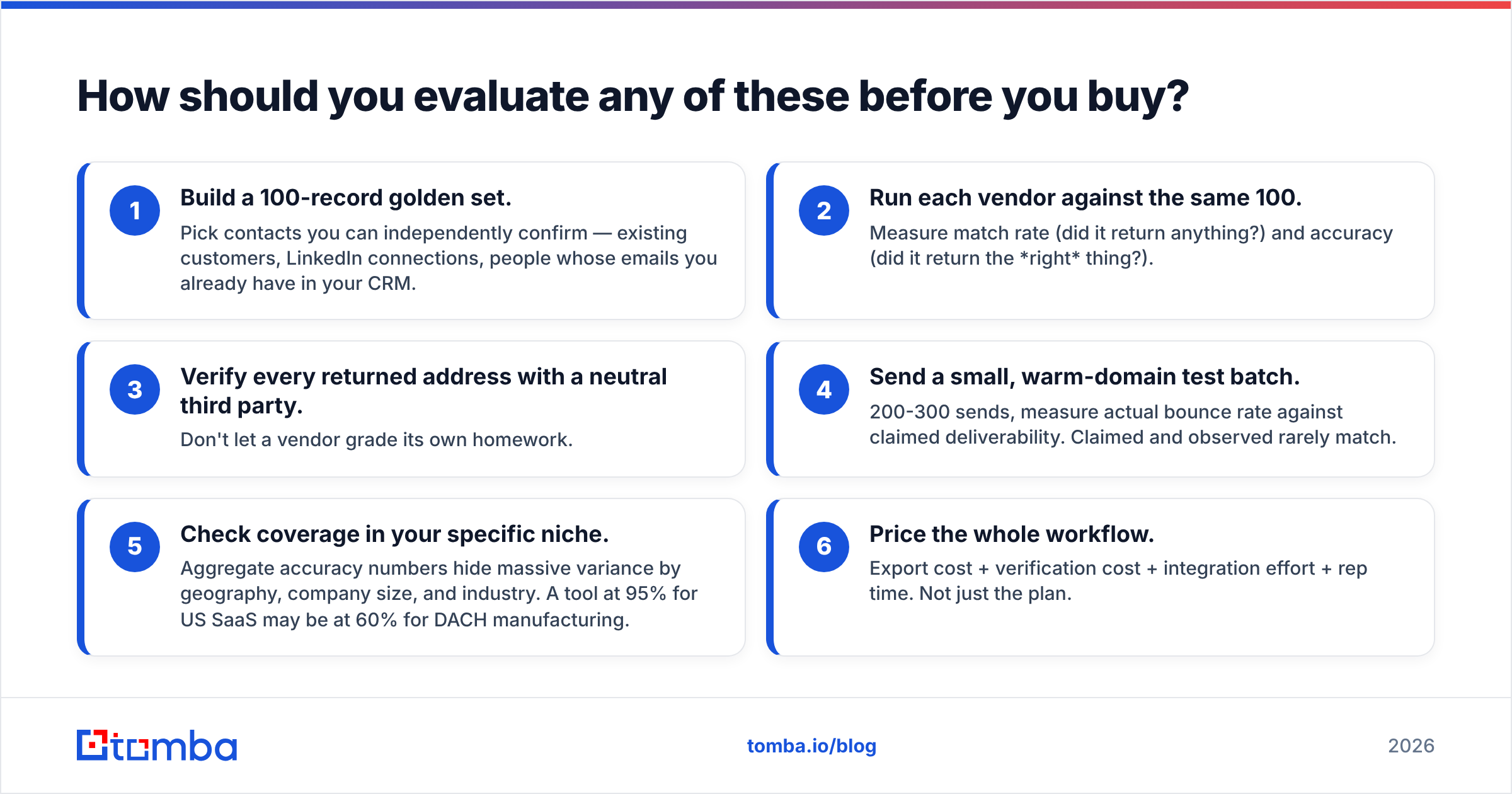
Run the same test on all three. It takes an afternoon and saves months.
- Build a 100-record golden set. Pick contacts you can independently confirm — existing customers, LinkedIn connections, people whose emails you already have in your CRM.
- Run each vendor against the same 100. Measure match rate (did it return anything?) and accuracy (did it return the right thing?).
- Verify every returned address with a neutral third party. Don't let a vendor grade its own homework.
- Send a small, warm-domain test batch. 200-300 sends, measure actual bounce rate against claimed deliverability. Claimed and observed rarely match.
- Check coverage in your specific niche. Aggregate accuracy numbers hide massive variance by geography, company size, and industry. A tool at 95% for US SaaS may be at 60% for DACH manufacturing.
- Price the whole workflow. Export cost + verification cost + integration effort + rep time. Not just the plan.
Industry reviews on G2 and Capterra are useful for spotting support and billing complaints that never appear on a vendor page — but treat headline accuracy claims there with the same skepticism you'd apply to the vendor's own site. And if you're building the outbound motion from scratch, HubSpot's sales prospecting guidance is a reasonable free baseline for the process layer that sits on top of whichever data source you choose.
What's the verdict on LeadGibbon vs Warpleads?#
Short answer: LeadGibbon for precision at low volume, Warpleads for volume at lower precision — and an API if your outbound is triggered rather than list-driven.
- Running 500-3,000 targeted sends per month with a high ACV? LeadGibbon's metered, curated model is the cleaner fit.
- Running an agency with multi-domain infrastructure and 50,000+ monthly sends? Warpleads' flat-rate ceiling is hard to beat on unit economics — provided you verify every export.
- Enriching records as they arrive, syncing to a CRM, or building anything programmatic? Neither list tool is the right shape. You want a finder and verifier behind an API.
The failure mode to avoid is treating any of these as a complete system. A contact database is one input. Verification, sending infrastructure, sequencing, and reply handling are the rest of it — and the best list in the world still bounces off a domain with no sender reputation.
Start with the finder, not the list#
If you want to test whether on-demand enrichment beats static exports for your team, the cheapest possible experiment is a free account. The Tomba Email Finder gives you 25 searches per month with no card required — enough to run the 100-record golden-set test above on a real slice of your ICP and see your actual match rate instead of a vendor's claimed one. Add the verifier on the same key, point it at whatever list you already own, and find out how many of those rows would have bounced. If the numbers hold up, Starter is $49/mo and the API is the same one you tested on.
Related guides#
Ready to find emails that actually work?
Join 150,000+ professionals who stopped guessing and started sending. Free credits on signup — no credit card required.
Get the Tomba newsletter
Practical outbound tactics and product updates — once every two weeks.
About the author