9 Best Leadinfo Alternatives for Website Visitor ID in 2026
Leadinfo is solid at naming the companies on your site — but it stops short of the contact data you need to actually reach them. Here are 9 alternatives, what each really costs, and which one fits your motion.

TL;DR
- Leadinfo does one job well: it turns anonymous B2B traffic into company names, firmographics, and a page-by-page visit trail. It is priced per identified company, starting around €59/month for small volumes.
- The limits people actually hit: EU-heavy data coverage, weak US/APAC match rates, contact-level data that is directory-grade rather than verified, and pricing that scales with traffic instead of with pipeline.
- The alternatives split into three groups — visitor-ID native (Lead Forensics, Albacross, Dealfront, RB2B), ABM platforms with visitor ID bolted on (6sense, Demandbase), and contact-data engines that finish the job visitor ID starts (Tomba, Clearbit/Breeze, BookYourData).
- Almost nobody needs "a Leadinfo replacement." They need company identification plus a verified contact layer. Budgeting for both is usually cheaper than paying one vendor to do both badly.
- Fastest path: keep a cheap identification tool, then resolve the buying committee with a dedicated email finder and verify before you send.
What does Leadinfo actually do?#
Leadinfo is a website visitor identification tool. It matches the IP addresses hitting your site against a business IP database, then tells you which companies visited, which pages they read, how long they stayed, and how often they came back. It pushes that into your CRM, Slack, or an email alert, and it layers in some contact suggestions per company.
Think of it like a doorbell camera for your website. It tells you a delivery van from Siemens pulled into the driveway three times this week. What it does not do is tell you which person got out of the van, what their email address is, or whether that address still works.
That distinction matters more than any feature list, because it explains why most teams searching for Leadinfo alternatives are not unhappy with Leadinfo's core function. They are unhappy that the function alone does not produce meetings.
Leadinfo is Netherlands-based and its strongest coverage is Benelux, DACH, and broader Western Europe. Its own product site is upfront about the model: pricing tiers are based on the number of companies identified per month, not seats.
Why do teams look for Leadinfo alternatives?#
Five reasons come up repeatedly in G2 reviews and in conversations with outbound teams:
- Geographic match rate. IP-to-company matching depends on the density of the vendor's IP database. Leadinfo is dense in Europe and thinner in North America and APAC. If 60% of your traffic is US-based, you may see identification rates under 20%.
- Remote work erosion. Residential IPs do not map to companies. Since 2020 the overall identifiable share of B2B traffic has dropped industry-wide — no vendor is immune, but some (like RB2B's cookie-and-pixel approach) chase it differently than pure IP lookup.
- Contact data depth. Knowing "Acme visited your pricing page" is a signal, not a lead. Leadinfo surfaces some contacts per company, but they are often stale, role-mismatched, or missing entirely for mid-market accounts.
- Price scaling against traffic, not value. A content-marketing spike inflates identified-company counts and your bill, without adding a single qualified account.
- GDPR nervousness. Person-level identification in the EU is legally fraught. Company-level IP matching is generally defensible; person-level pixel tracking is a conversation with your DPO. Vendors differ sharply here.
Which Leadinfo alternatives are worth comparing in 2026?#
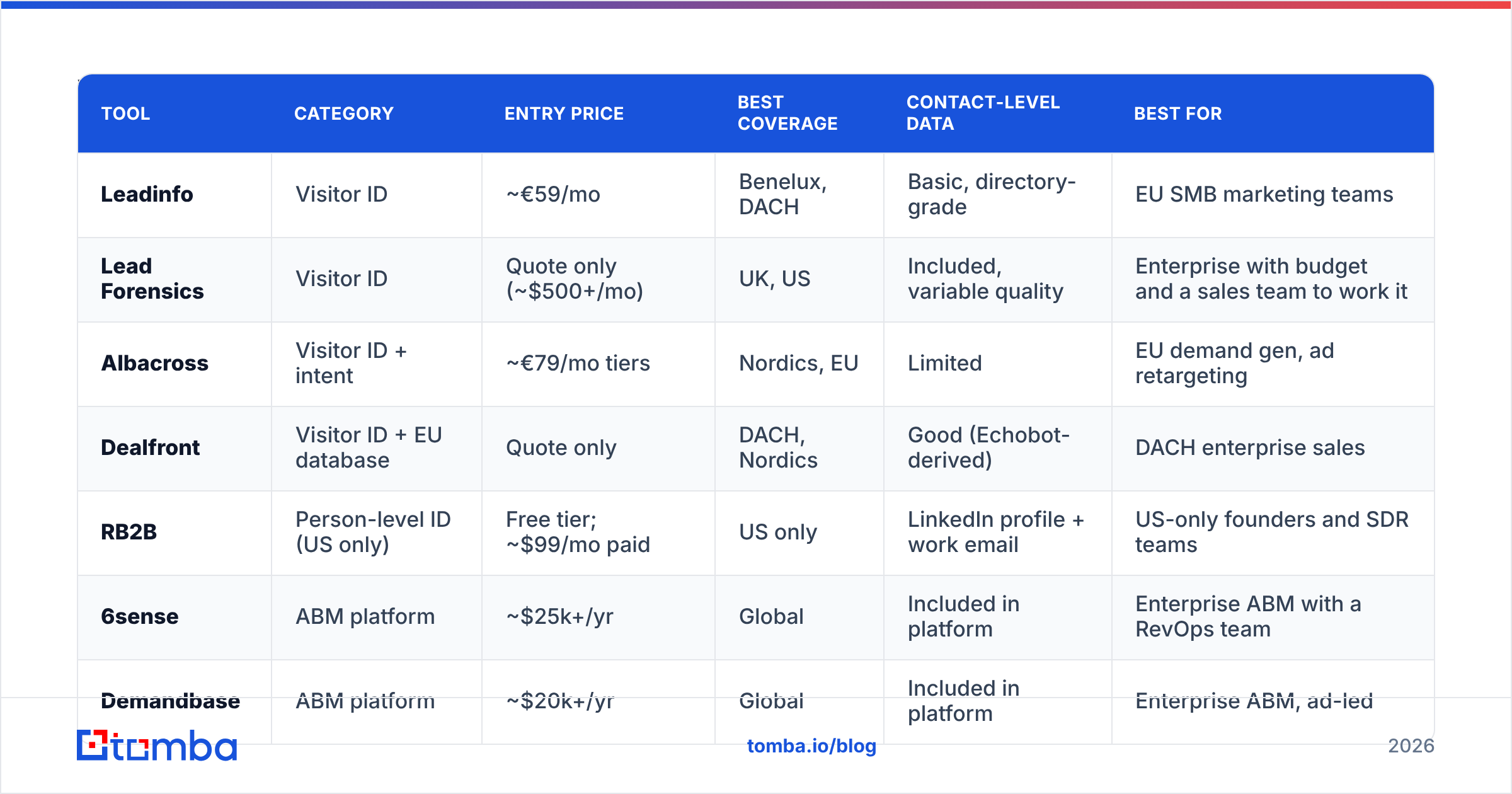
Here is the honest landscape. Prices are list prices as published or commonly quoted in 2026; enterprise deals vary, and several vendors quote only on request.
| Tool | Category | Entry price | Best coverage | Contact-level data | Best for |
|---|---|---|---|---|---|
| Leadinfo | Visitor ID | ~€59/mo | Benelux, DACH | Basic, directory-grade | EU SMB marketing teams |
| Lead Forensics | Visitor ID | Quote only (~$500+/mo) | UK, US | Included, variable quality | Enterprise with budget and a sales team to work it |
| Albacross | Visitor ID + intent | ~€79/mo tiers | Nordics, EU | Limited | EU demand gen, ad retargeting |
| Dealfront | Visitor ID + EU database | Quote only | DACH, Nordics | Good (Echobot-derived) | DACH enterprise sales |
| RB2B | Person-level ID (US only) | Free tier; ~$99/mo paid | US only | LinkedIn profile + work email | US-only founders and SDR teams |
| 6sense | ABM platform | ~$25k+/yr | Global | Included in platform | Enterprise ABM with a RevOps team |
| Demandbase | ABM platform | ~$20k+/yr | Global | Included in platform | Enterprise ABM, ad-led |
| Tomba | Contact data / email finder | Free (25/mo), $49/mo Starter | Global | Verified emails, phones, enrichment | Turning identified accounts into reachable people |
| BookYourData | Prebuilt B2B contact lists | Pay-as-you-go credits | Global, strong US | Verified, list-based | Teams that want vetted lists without a scraping workflow |
Read that table as three columns of jobs, not nine competing products. Visitor-ID tools answer who showed up. ABM platforms answer which accounts to prioritize. Contact-data tools answer who do I email, and will it bounce. Paying a visitor-ID vendor to do the third job is where most of the disappointment comes from.
Which alternative fits which situation?#
1. Lead Forensics — the enterprise incumbent. The oldest name in the category, strongest in the UK and US, and the most aggressive sales process in the category. Match rates are genuinely good. The catch is opaque pricing (expect four figures monthly, annual contract) and a hard-sell motion that puts off smaller teams. Worth it only if you have SDR capacity to work every identified account within 24 hours.
2. Albacross — the EU ad-native option. Albacross leans into the advertising side: identify companies, then build retargeting audiences from them. Good Nordic and EU coverage, reasonable entry pricing, clean UI. Contact data is thin, so pair it with an enrichment layer. If Leadinfo's appeal to you was "cheap EU visitor ID," Albacross is the closest like-for-like swap. See a fuller breakdown in our Albacross alternative comparison.
3. Dealfront — Leadfeeder plus Echobot. Dealfront is the merged entity of Leadfeeder (visitor ID) and Echobot (European B2B database). That combination makes it the most complete European answer on this list: you get the visit signal and a genuinely deep DACH company database in one place. Pricing is quote-only and lands well above Leadinfo. If your ICP is German-speaking mid-market, this is the strongest single-vendor option.
4. RB2B — person-level, US-only, controversial. RB2B identifies individual visitors (name, LinkedIn profile, sometimes work email) rather than just companies, in the US only. The free tier made it popular with founders. It is also the option most likely to get a question from your legal team — person-level identification without consent is not a GDPR-friendly posture, which is why they geo-fence to the US. Useful, narrow, and best treated as a supplement.
5. 6sense and Demandbase — the platform answer. Both are intent-data and ABM orchestration platforms where visitor identification is a small module inside a much larger product. You are buying predictive account scoring, advertising orchestration, and a data warehouse integration. Budget starts in the low-to-mid five figures annually and implementation takes a quarter. Do not buy these as a Leadinfo replacement — buy them when your problem is account prioritization across a large TAM. Our 6sense alternative page covers where a lighter stack does the same job.
6. BookYourData — when you would rather buy the list. A different philosophy entirely: instead of waiting for accounts to visit your site, build a targeted contact list up front from a vetted database with pay-as-you-go credits and an accuracy guarantee. Strong US coverage and no subscription lock-in. Teams often run this alongside visitor ID rather than instead of it — inbound signal for warm accounts, purchased lists for cold TAM coverage.
7. Tomba — the contact layer under all of the above. Tomba is not a visitor-identification tool and should not be sold as one. It is the piece that runs after identification: you have a company domain, you need the right people and addresses at that company. Domain search returns the verified email addresses at a domain with role and department context; the email verifier confirms deliverability before send. Free tier is 25 searches/month, Starter is $49/month, Growth $99/month, Pro $249/month.
How do you actually convert an identified company into a conversation?#
This is the workflow gap that no visitor-ID vendor solves cleanly. Here is the sequence that works:
- Identify the account. Visitor-ID tool fires; Acme GmbH read your pricing page twice this week.
- Qualify the signal. Not every visit is intent. Multiple sessions, multiple people, pricing or docs pages — that is a signal. One bounce from an organic blog post is not.
- Resolve the buying committee. Take the domain and pull the relevant roles. This is where a domain search beats guessing from LinkedIn, because it returns the actual email pattern the company uses plus the people who match it.
- Verify before you send. A stale address on a warm account is worse than no outreach — it costs you sender reputation on the exact domain you most want to reach.
- Enrich for context. Company size, tech stack, funding. Data enrichment turns a name into a reason to write.
- Reference the visit carefully. "I saw you looking at our pricing page" is creepy. "Teams evaluating us usually ask about X" is not. Same signal, different framing.
Steps 3 through 5 are where teams that bought only a visitor-ID tool stall out — they end the month with 400 identified companies and 40 contacted ones.

How do the pricing models really compare?#
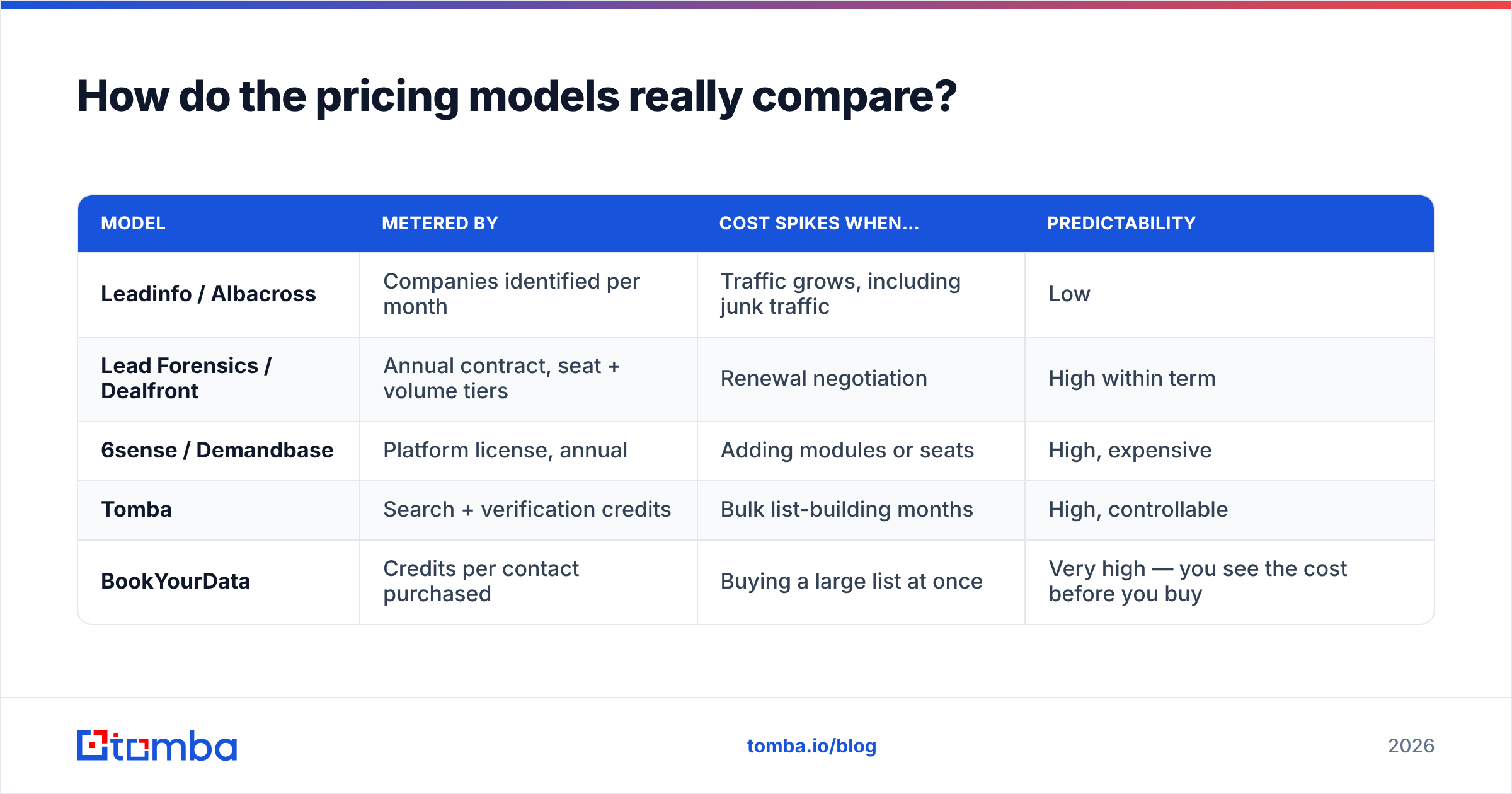
The pricing models are not comparable on sticker price, because they meter different things.
| Model | Metered by | Cost spikes when… | Predictability |
|---|---|---|---|
| Leadinfo / Albacross | Companies identified per month | Traffic grows, including junk traffic | Low |
| Lead Forensics / Dealfront | Annual contract, seat + volume tiers | Renewal negotiation | High within term |
| 6sense / Demandbase | Platform license, annual | Adding modules or seats | High, expensive |
| Tomba | Search + verification credits | Bulk list-building months | High, controllable |
| BookYourData | Credits per contact purchased | Buying a large list at once | Very high — you see the cost before you buy |
The practical implication: a traffic-metered tool punishes you for content marketing success. If you publish a post that goes wide on Hacker News or LinkedIn, your identification count — and your invoice — jumps without a single extra qualified account. Credit-metered contact tools do not have this failure mode, because you spend credits only on accounts you have already decided to pursue.
For a full breakdown of what credits cost at each tier, see Tomba pricing.
Is any single tool a true Leadinfo replacement?#
Honestly, no — and treating the question that way is how teams overspend.
If you want a like-for-like swap on features and geography, Dealfront is the closest, with Albacross as the cheaper EU option and Lead Forensics as the enterprise one. If you are US-only and want person-level resolution, RB2B is the different-shaped answer. If your real problem is account prioritization at scale, you are shopping for 6sense or Demandbase, and this article is the wrong list.
But the most common honest answer is a two-tool stack:
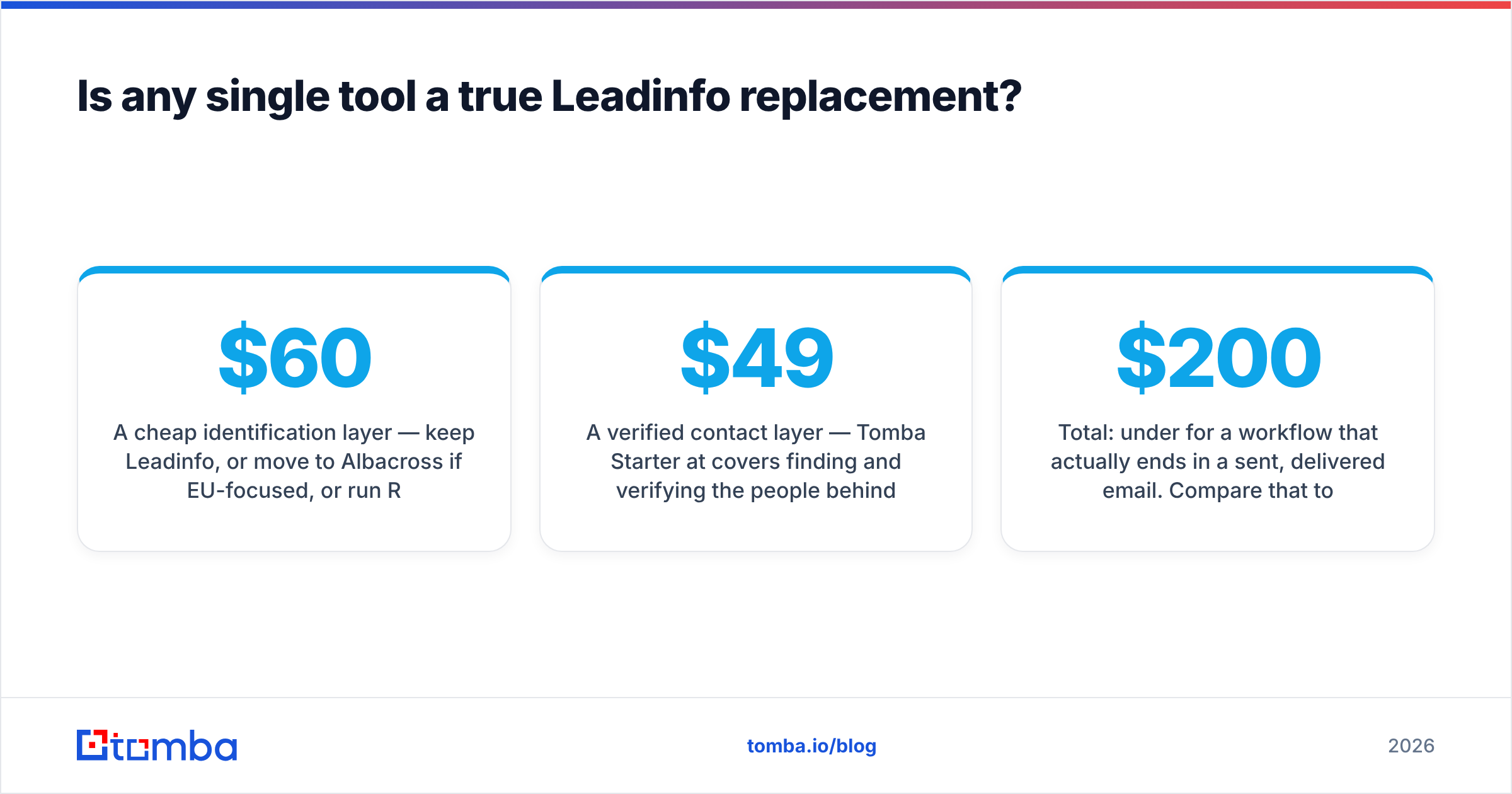
- A cheap identification layer — keep Leadinfo, or move to Albacross if EU-focused, or run RB2B's free tier if US-only. This costs $60–$150/month for most SMB traffic volumes.
- A verified contact layer — Tomba Starter at $49/month covers finding and verifying the people behind those domains, with a Chrome extension, Google Sheets add-on, and an email finder API if you want the whole thing automated inside your CRM.
Total: under $200/month for a workflow that actually ends in a sent, delivered email. Compare that to a single vendor quoting $800/month to do both jobs, one of them badly.
What should you check before you switch?#
Run these five checks on any vendor you shortlist. Most of them can be answered in a trial.
- Match rate on your traffic, not their average. Ask for a 14-day trial and measure identified companies as a percentage of business-hours, non-bot sessions. Vendor-published match rates are averages across their best markets.
- Geographic overlap with your ICP. A vendor with 92% EU coverage and 30% US coverage is worthless to a US-focused team, regardless of price.
- Contact data freshness. Ask when the contact records were last verified. "Sourced in 2023" and "verified this quarter" are different products. Independent review data on G2 is more useful here than vendor claims.
- CRM write behavior. Does it create records, or just notify? Uncontrolled record creation will pollute your CRM with hundreds of unqualified companies a month.
- Contract term and overage policy. Traffic-metered tools with annual contracts and hard overage fees are the worst combination. Get the overage rate in writing.
What about GDPR and the legal side?#
Company-level IP identification is generally treated as processing business data rather than personal data, which is why the EU vendors on this list operate the way they do. Person-level identification is a different legal category — it involves personal data and typically requires a lawful basis, which for cold outreach usually means legitimate interest plus a documented balancing test.
Two practical rules:
- If you operate in the EU, prefer company-level identification and resolve contacts through a provider with documented, compliant data sources.
- Never reference an individual's browsing behavior in outreach. Reference the company's category of interest instead. The legal exposure and the creepiness factor both drop to near zero.
The ICO's guidance on legitimate interests is the clearest free reference if you are building the internal policy yourself.
The bottom line#
Leadinfo is a good tool that only solves half a problem. The alternatives that look cheaper usually solve the same half; the alternatives that look complete usually cost ten times more. Before you sign anything, separate the two jobs — identify the account and reach the human — and price them independently. In most stacks the identification layer can stay cheap and the contact layer is what deserves the investment, because that is the step that produces a reply.
Start there with the Tomba Email Finder: drop in a domain from your visitor-ID report and get verified, deliverable addresses for the people who actually make the decision. The free tier gives you 25 searches a month to test it against accounts you already know, and Starter is $49/month when you are ready to run it at volume.
Related guides#
// get started
Find, verify and enrich your first contacts today
Start on the free plan with 25 searches a month, then scale when your team is ready.
Free plan · No credit card required · GDPR & CCPA
Get the Tomba newsletter
Product and data updates
// about the author