LeadIQ vs Ocean.io (2026): Prospecting vs Lookalike Search
LeadIQ captures contacts inside your sales workflow. Ocean.io finds companies that look like your best customers. Here's how they differ on data, pricing, and fit, and which one your team should buy first.
TL;DR
- LeadIQ helps reps capture contacts. You find a person on LinkedIn or Sales Navigator, grab their verified email and mobile number, and send them straight into your CRM or sequencer.
- Ocean.io helps you find accounts. You give it a few of your best customers and it returns lookalike companies, with contacts added on top.
- They solve different problems. LeadIQ answers "how do I reach this person?" and Ocean.io answers "which companies should I go after next?"
- LeadIQ has self-serve per-seat plans. Ocean.io is mostly sold through annual contracts, so expect a sales call and a bigger upfront commitment.
- If what you actually need is verified work emails at a predictable price, a dedicated email finder like Tomba ($49/mo Starter) may cover it without either platform.
What is the real difference between LeadIQ and Ocean.io?#
The short answer: LeadIQ works at the contact level and Ocean.io works at the account level. Most "LeadIQ vs Ocean.io" searches come from teams who haven't decided which of those problems they have.
Think of it as fishing. Ocean.io tells you where the fish are: which waters, which schools, which ones look like your last big catch. LeadIQ is the rod and reel. It helps you land the specific fish you've already spotted and put it in the cooler (your CRM) without dropping it.
- LeadIQ (leadiq.com) is a prospecting and contact-capture platform built for SDRs and AEs. Its Chrome extension sits on LinkedIn, Sales Navigator, and company websites. It returns work emails and phone numbers and pushes records into Salesforce, HubSpot, Outreach, and Salesloft. It also includes job-change tracking and an AI message writer.
- Ocean.io (ocean.io) is an account discovery platform built around lookalike search. You enter seed domains, usually your best customers, and its model returns similar companies ranked by similarity. You can then filter by headcount, tech stack, geography, and other signals, and pull decision-maker contacts.
So the question is less "which is better?" and more "is your bottleneck finding the right accounts or reaching the right people?"
How do LeadIQ and Ocean.io compare feature by feature?#
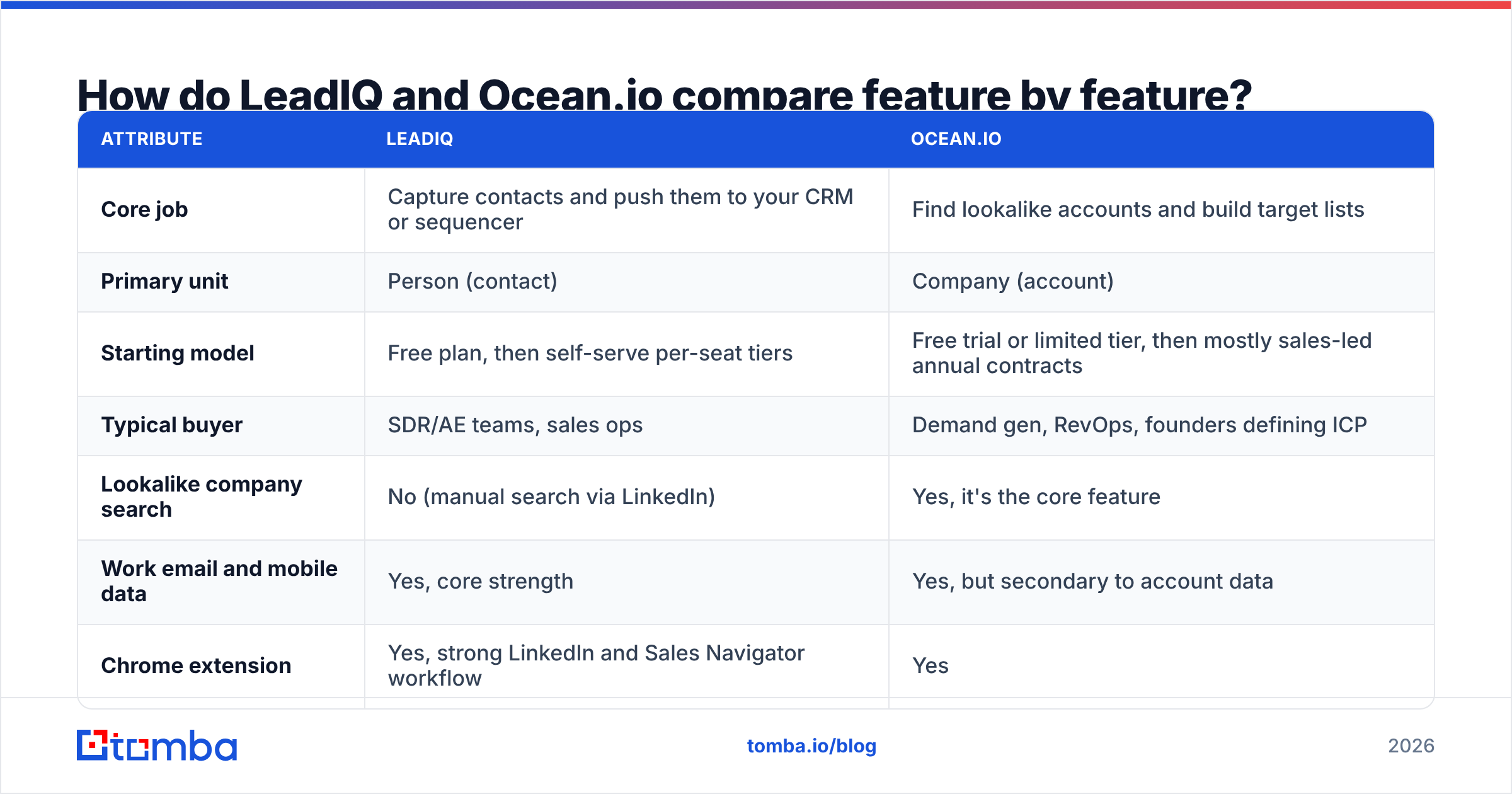
Here's a side-by-side view of the attributes that matter most when you're evaluating either tool. Pricing and credit limits change often, so check each vendor's live pricing page before you sign anything.
| Attribute | LeadIQ | Ocean.io |
|---|---|---|
| Core job | Capture contacts and push them to your CRM or sequencer | Find lookalike accounts and build target lists |
| Primary unit | Person (contact) | Company (account) |
| Starting model | Free plan, then self-serve per-seat tiers | Free trial or limited tier, then mostly sales-led annual contracts |
| Typical buyer | SDR/AE teams, sales ops | Demand gen, RevOps, founders defining ICP |
| Lookalike company search | No (manual search via LinkedIn) | Yes, it's the core feature |
| Work email and mobile data | Yes, core strength | Yes, but secondary to account data |
| Chrome extension | Yes, strong LinkedIn and Sales Navigator workflow | Yes |
| CRM sync | Salesforce, HubSpot, plus Outreach and Salesloft | Salesforce, HubSpot, with enrichment and export |
| Job-change tracking | Yes | Not a core focus |
| AI writing | Yes (AI message drafting) | Limited, since it's focused on list building |
| Best for | High-volume rep-led prospecting | Account-based and ICP-driven targeting |
The table shows the split clearly. LeadIQ puts almost all of its effort into making a rep's click-to-CRM flow fast. Ocean.io puts its effort into the step before that: deciding which accounts belong on the list in the first place.
What does each tool do best?#
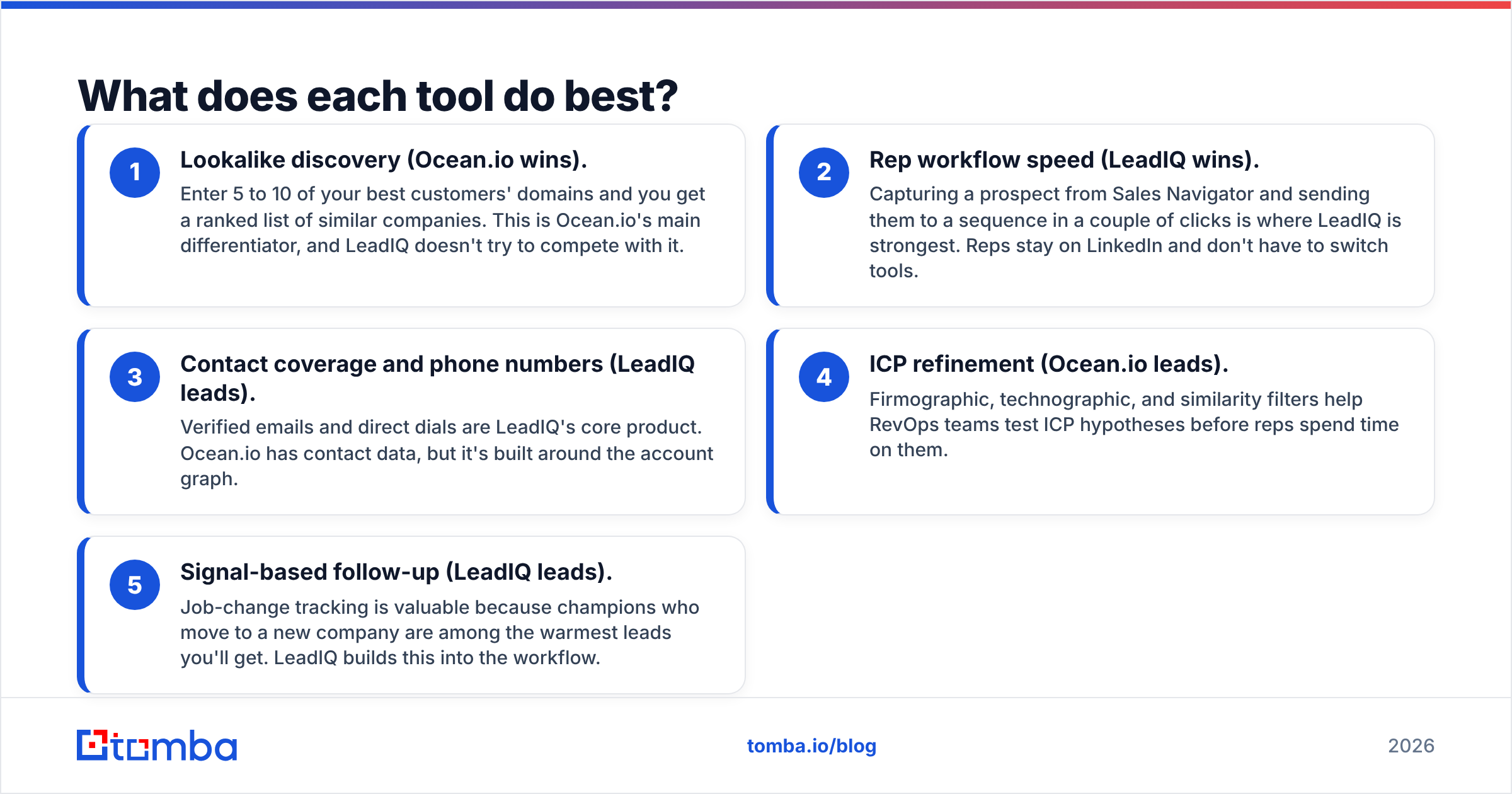
These are the five things that most separate the two platforms in day-to-day use.
- Lookalike discovery (Ocean.io wins). Enter 5 to 10 of your best customers' domains and you get a ranked list of similar companies. This is Ocean.io's main differentiator, and LeadIQ doesn't try to compete with it.
- Rep workflow speed (LeadIQ wins). Capturing a prospect from Sales Navigator and sending them to a sequence in a couple of clicks is where LeadIQ is strongest. Reps stay on LinkedIn and don't have to switch tools.
- Contact coverage and phone numbers (LeadIQ leads). Verified emails and direct dials are LeadIQ's core product. Ocean.io has contact data, but it's built around the account graph.
- ICP refinement (Ocean.io leads). Firmographic, technographic, and similarity filters help RevOps teams test ICP hypotheses before reps spend time on them.
- Signal-based follow-up (LeadIQ leads). Job-change tracking is valuable because champions who move to a new company are among the warmest leads you'll get. LeadIQ builds this into the workflow.

How much do LeadIQ and Ocean.io cost?#
The pricing models differ more than the headline numbers do.
LeadIQ follows a self-serve SaaS model. There's a free plan with a small weekly allowance of email and mobile credits, followed by paid per-seat tiers. Historically these have started at a few dozen dollars per user per month and moved up to a higher "Pro" tier, with Enterprise quoted separately. The per-seat model is the key point. A 10-rep SDR team pays roughly ten times the single-seat price, and mobile-number credits usually run out faster than email credits.
Ocean.io is mostly sold directly. You can explore the product with a trial or a limited tier, but serious use (large exports, CRM enrichment, API access) generally requires an annual contract negotiated with sales. That fits the buyer, who is usually a RevOps or demand-gen lead building the account universe for the whole team rather than a single rep with a credit card.
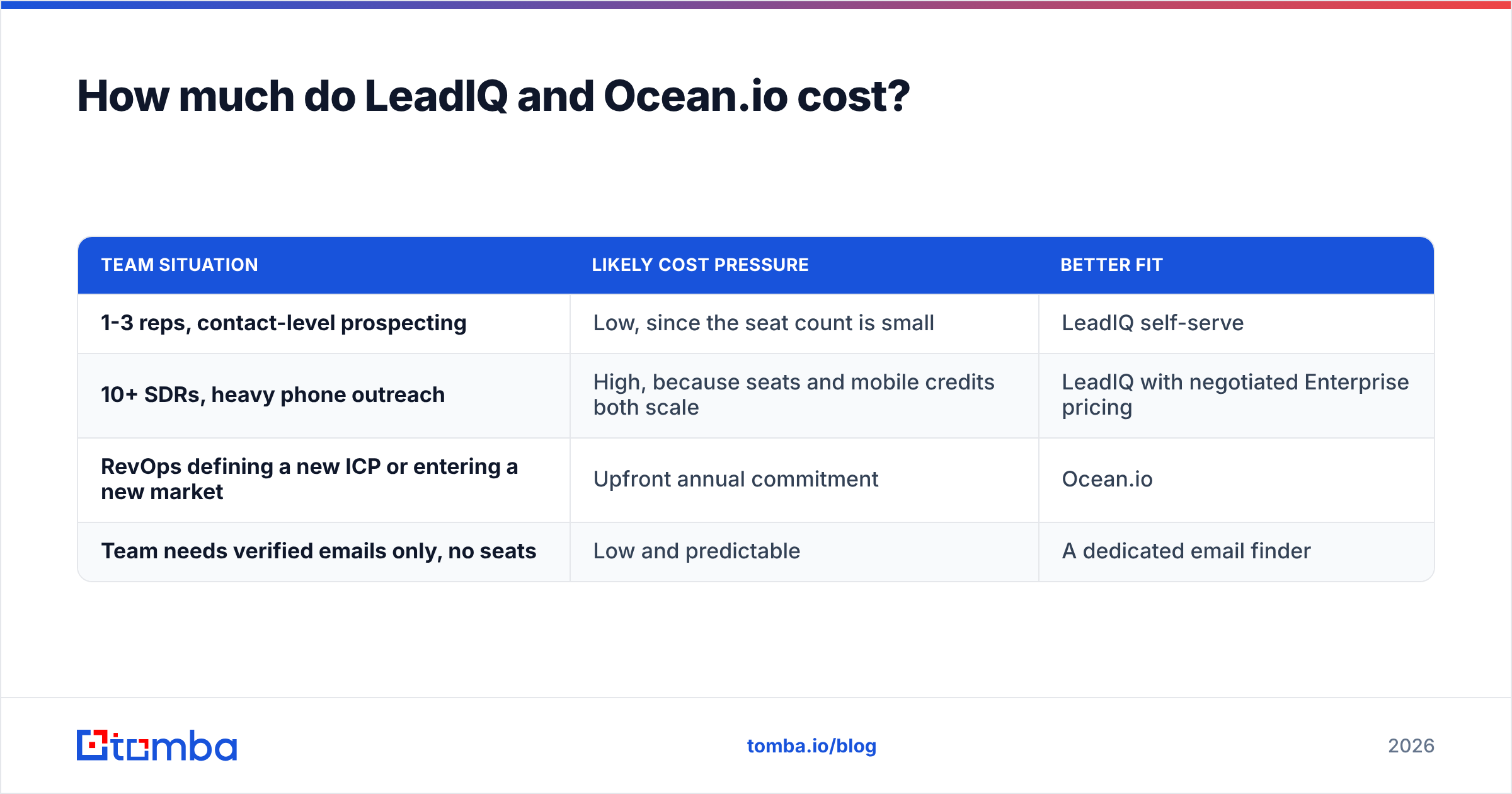
A practical way to think about budget:
| Team situation | Likely cost pressure | Better fit |
|---|---|---|
| 1-3 reps, contact-level prospecting | Low, since the seat count is small | LeadIQ self-serve |
| 10+ SDRs, heavy phone outreach | High, because seats and mobile credits both scale | LeadIQ with negotiated Enterprise pricing |
| RevOps defining a new ICP or entering a new market | Upfront annual commitment | Ocean.io |
| Team needs verified emails only, no seats | Low and predictable | A dedicated email finder |
For verified business emails with no per-seat multiplier, compare against Tomba pricing. It runs from a free tier (25 searches/mo) through Starter at $49/mo, Growth at $99/mo, and Pro at $249/mo. Neither LeadIQ nor Ocean.io is built mainly as an email finder, so if that's 80% of your need, you may be paying for features you won't use.
How good is the data quality on each?#
Data quality depends heavily on segment and geography, so be skeptical of any blanket accuracy claim, including the vendors' own.
LeadIQ verifies emails at the point of capture and flags confidence levels. Its coverage is strongest for North American tech and SaaS contacts, which are the people SDRs most often prospect through Sales Navigator. Phone coverage is good but uneven, as it is with every provider. Mobile numbers are the hardest data point in B2B.
Ocean.io has particularly strong company data. Its lookalike model depends on rich firmographic and technographic signals, and that shows in how precisely it matches accounts. It's also a European company (Copenhagen), which some buyers find helpful for EU coverage and GDPR posture. Its contact layer is useful but shouldn't be the only thing you rely on for high-volume cold email.
Whichever tool you pick, run your exported list through an independent email verifier before a campaign goes out. Catch-all domains, recent job changes, and stale records hurt bounce rates no matter where the data came from. Keeping bounces low protects your sender reputation and every campaign after the current one.
Before committing, check recent user reviews on G2 for both tools. Filter by company size and region close to yours, since a 5-star review from a US enterprise team tells you little about coverage in the DACH mid-market.
Is LeadIQ better than Ocean.io for SDR teams?#
For most SDR teams, yes, as long as the account list already exists.
SDRs are measured on activity and meetings. What they need most is to get from "this looks like a good person" to "they're in my sequence" with as little friction as possible. LeadIQ is designed around exactly that. The LinkedIn-native capture, the sequencer pushes, and the job-change alerts all save time for a rep working from a territory or a named-account list.
LeadIQ becomes the weaker choice when your SDRs are the ones deciding which accounts to target. Without account-level discovery, reps fall back on manual Sales Navigator searches, which vary a lot from rep to rep. In that setup, pairing an account tool (Ocean.io or similar) with a contact tool works better than stretching LeadIQ to do both.
If you're evaluating LeadIQ against lighter-weight options, our LeadIQ alternative breakdown covers where a pure email finder saves money and where it doesn't.
Is Ocean.io better than LeadIQ for account-based marketing?#
For ABM and ICP work, Ocean.io is the stronger tool. It isn't close.
ABM starts with the account list, and lookalike search is one of the quickest ways to build a data-backed one. Take your 20 best customers, run them through Ocean.io, filter by the tech and headcount signals that predicted those wins, and you have a prioritized target list in an afternoon. Building that manually in LinkedIn could take a quarter. Analyst firms such as Gartner have long treated account selection as the foundation of effective ABM, and this is the step Ocean.io automates.
Where Ocean.io is weaker is last-mile execution. Once the list exists, reps still have to find the right people, verify their contact details, and work them in a sequencer. Ocean.io covers part of that, but it isn't where the product's strength lies.
What are the pros and cons of each?#
LeadIQ pros
- Very fast LinkedIn and Sales Navigator capture workflow
- Strong CRM and sequencer pushes (Salesforce, HubSpot, Outreach, Salesloft)
- Job-change tracking brings in warm pipeline
- Self-serve plans let you start without a sales call
LeadIQ cons
- Per-seat pricing grows quickly with team size
- No lookalike or account-discovery engine
- Mobile credits run out quickly for phone-heavy teams
Ocean.io pros
- Best-in-class lookalike company search
- Rich firmographic and technographic filtering for ICP work
- Useful for entering new markets or verticals
- EU-based, which some European buyers prefer
Ocean.io cons
- Mostly sales-led, so a real trial needs a conversation and often an annual commitment
- Contact data is secondary to account data
- More than a solo rep or small startup usually needs

Can you use LeadIQ and Ocean.io together?#
Yes. In larger outbound organizations they're more often combined than compared.
A common stack looks like this:
- Ocean.io builds the account universe from lookalikes of your closed-won customers.
- Accounts sync into Salesforce or HubSpot and get assigned to reps.
- Reps use LeadIQ to capture the right contacts at those accounts from LinkedIn.
- A verification pass cleans the list before it reaches the sequencer.
- Job-change alerts in LeadIQ re-engage champions who move to new companies.
The downside is cost and overlap. You'll pay for contact data twice, since both tools include some, and you'll manage two vendor relationships. Leaner teams often swap one side for something cheaper. They might keep Ocean.io for account discovery and use a domain search tool to pull every public email at each target company, or keep LeadIQ and build account lists from their CRM's own closed-won data.
Which should you choose in 2026?#
Choose based on your bottleneck, not the feature list.
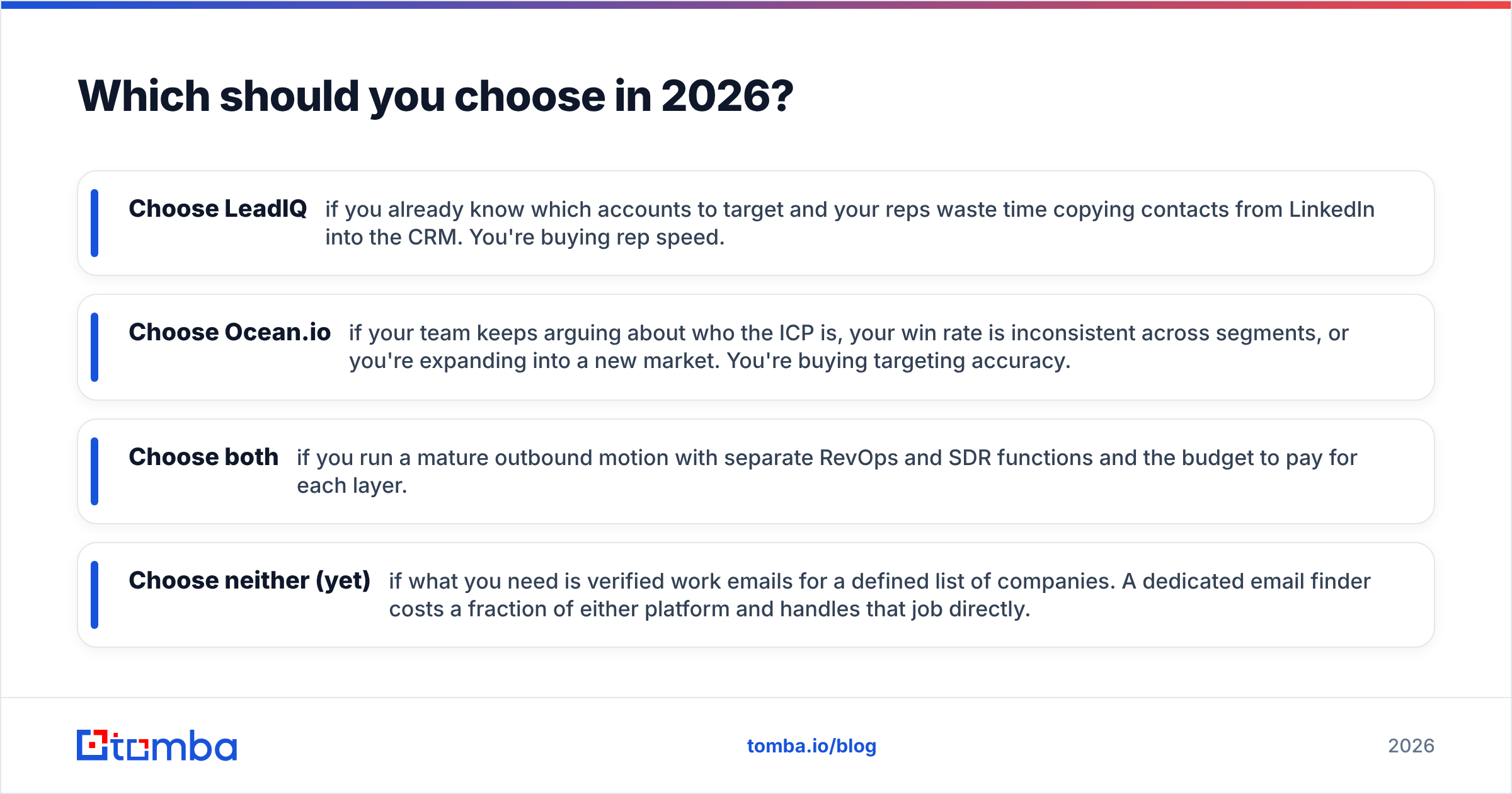
- Choose LeadIQ if you already know which accounts to target and your reps waste time copying contacts from LinkedIn into the CRM. You're buying rep speed.
- Choose Ocean.io if your team keeps arguing about who the ICP is, your win rate is inconsistent across segments, or you're expanding into a new market. You're buying targeting accuracy.
- Choose both if you run a mature outbound motion with separate RevOps and SDR functions and the budget to pay for each layer.
- Choose neither (yet) if what you need is verified work emails for a defined list of companies. A dedicated email finder costs a fraction of either platform and handles that job directly.
The most common mistake is buying Ocean.io expecting a contact tool, or buying LeadIQ expecting it to tell you who to target. Each tool does its own job well and neither does the other's.
Where does Tomba fit in the LeadIQ vs Ocean.io decision?#
If you've read this far and realized your real problem is getting accurate business emails at a predictable monthly cost, not account discovery or rep workflow, you don't need an enterprise platform for it. Tomba Email Finder finds professional email addresses by domain, name, or company, verifies them, and exports cleanly to your CRM or sequencer. It starts with a free tier of 25 searches a month and a $49/mo Starter plan, with no per-seat pricing. It works on its own, and it also works as the email layer under an Ocean.io account list. Try it on your next target account and compare the results with what you're getting now.
Related guides#
// get started
Find, verify and enrich your first contacts today
Start on the free plan with 25 searches a month, then scale when your team is ready.
Free plan · No credit card required · GDPR & CCPA
// about the author