Leadmine vs Salesbot: Email Finder or AI Sales Platform in 2026?
Leadmine is a lean email finder. Salesbot is an AI copilot that builds lead lists and outreach campaigns. Here is how they compare on data, pricing, and workflow, and which one fits your team.
TL;DR
- Leadmine is a lightweight email finder. It has a lead search, name-plus-domain email lookup, a verifier, and a Chrome extension. It suits solo founders and small teams who already have a sending tool.
- Salesbot (salesbot.io) is an AI sales platform. You describe your ideal customer in plain English, and it builds a lead list and an outreach campaign from a database of roughly 655M contacts.
- Pricing models differ. Leadmine sells credits on monthly tiers and has a small free plan. Salesbot bundles email and phone credits into Premium, Professional and Enterprise plans. Its Premium plan includes 1,000 email credits and 75 phone credits a month.
- Pick Leadmine if you need cheap, fast email lookups. Pick Salesbot if you want list building and outreach drafting in one place. Whichever you choose, verify every address before you send.
- Neither tool removes the need for a dedicated verification and catch-all check. That step is what protects your sender reputation.
What are Leadmine and Salesbot, in one sentence each?#
These tools often show up in the same search results, but they are different kinds of product.
Leadmine (leadmine.net) is a B2B lead and email finder. You search for prospects by job title, company, location and industry, look up a person's email from their full name and company domain, and verify addresses before you export them to your CRM. Its Chrome extension pulls names, emails, positions and social profiles from company websites, Google search results and Crunchbase pages.
Salesbot (salesbot.io) launched in November 2024 as an AI sales enablement platform. Instead of starting with filters, you describe your ideal customer profile (ICP) in natural language and link a marketing page. Salesbot then generates a targeted lead list and an outreach campaign. It searches a database of about 655 million contacts by company, job title, predicted revenue, investment stage and demographic attributes.
To put it simply, Leadmine is a very good metal detector: point it at a company and it finds the address. Salesbot is closer to a junior SDR who takes a brief, builds a list and drafts the first emails.
One naming warning before you go further. "Salesbot" is also the name of a chatbot feature inside Kommo CRM, and SalesRobot is a separate LinkedIn automation tool. This comparison covers salesbot.io only.
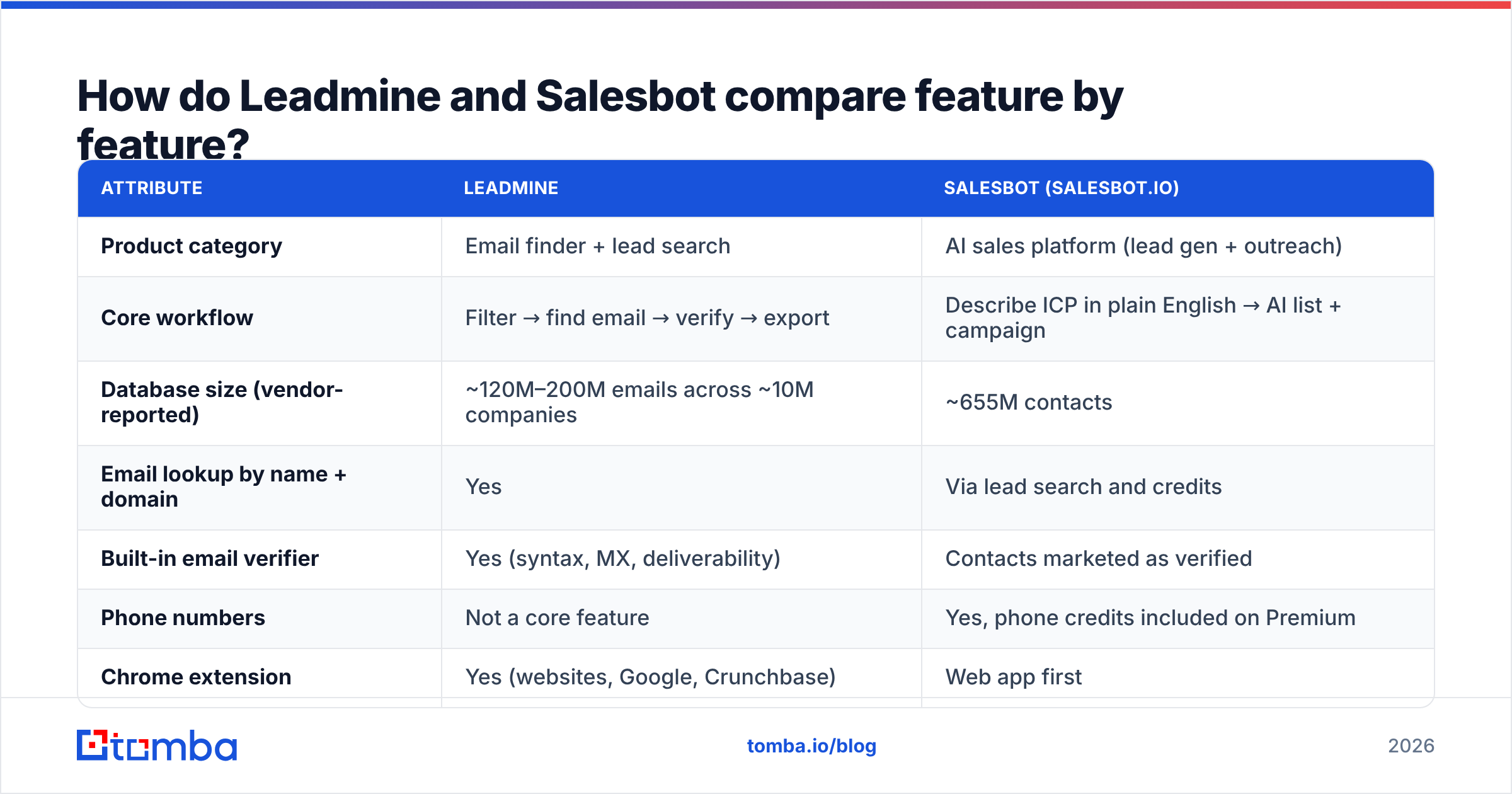
How do Leadmine and Salesbot compare feature by feature?#
The table below is based on the vendors' public product pages and third-party listings as of September 2026. Credit amounts and plan names change often, so check both pricing pages before you commit.
| Attribute | Leadmine | Salesbot (salesbot.io) |
|---|---|---|
| Product category | Email finder + lead search | AI sales platform (lead gen + outreach) |
| Core workflow | Filter → find email → verify → export | Describe ICP in plain English → AI list + campaign |
| Database size (vendor-reported) | ~120M–200M emails across ~10M companies | ~655M contacts |
| Email lookup by name + domain | Yes | Via lead search and credits |
| Built-in email verifier | Yes (syntax, MX, deliverability) | Contacts marketed as verified |
| Phone numbers | Not a core feature | Yes, phone credits included on Premium |
| Chrome extension | Yes (websites, Google, Crunchbase) | Web app first |
| AI-generated outreach | No | Yes, core feature |
| Free option | Free plan, ~10 credits/month | Free trial |
| Entry paid tier | ~$49/mo for ~1,000 credits (current listings) | Premium: 1,000 email + 75 phone credits/mo |
| Upper tiers | Growth and Business, up to ~10,000 credits | Professional and Enterprise, add-on credits |
| Best for | Solo reps, agencies, founders with a sequencer | Small teams that want list building plus copy in one place |
Two points need more context.
Leadmine's pricing has changed over time. Older listings show a $29/month Basic plan with 250 credits and a $99 Essential plan with 1,000 credits. Current listings show Starter at $49 for 1,000 credits, Growth at $99 for 3,000 and Business at $149 for 10,000. Check Leadmine's Capterra listing and its pricing page before you budget.
Salesbot's plan prices aren't published in the help-center article that describes the credits. That article confirms that Premium includes 1,000 email and 75 phone credits a month, and that Professional and Enterprise add analytics and top-up credits. Treat any third-party price you see as indicative until you check it in-app.
Which tool finds more accurate emails?#
Accuracy depends more on how each tool gets and checks its data than on how big the database is.
Leadmine works mainly by lookup. You give it a name and a domain, it predicts and checks the address, and then its verifier tests syntax, MX records and deliverability. Because you check each address at the moment you look it up, the data is usually fresher than a static list. The downside is coverage: an index of 100M–200M emails will miss people at small companies and in less-covered regions.
Salesbot starts with a much larger pool of 655M contacts that combines sources usually kept apart across the web. A bigger pool improves your odds of finding a match. But any large aggregated database has records that go stale as people change jobs. "Verified at ingestion" does not mean "valid today."
Neither tool is fully reliable on catch-all domains. These are company mail servers that accept every address during an SMTP check, so a standard verifier can't tell a real mailbox from a fake one. Catch-all domains are common in mid-market and enterprise companies, which is exactly who most B2B teams target. If you send to unresolved catch-all addresses at volume, your bounce rate goes up and your sender reputation drops.
In practice:
- Pull the contact from whichever tool you use.
- Run it through a separate email verifier right before you add it to a sequence, not weeks earlier.
- Send catch-all results to a catch-all verifier instead of treating them as valid.
- Keep bounces under about 2% per campaign. Pause the list if you go above that.
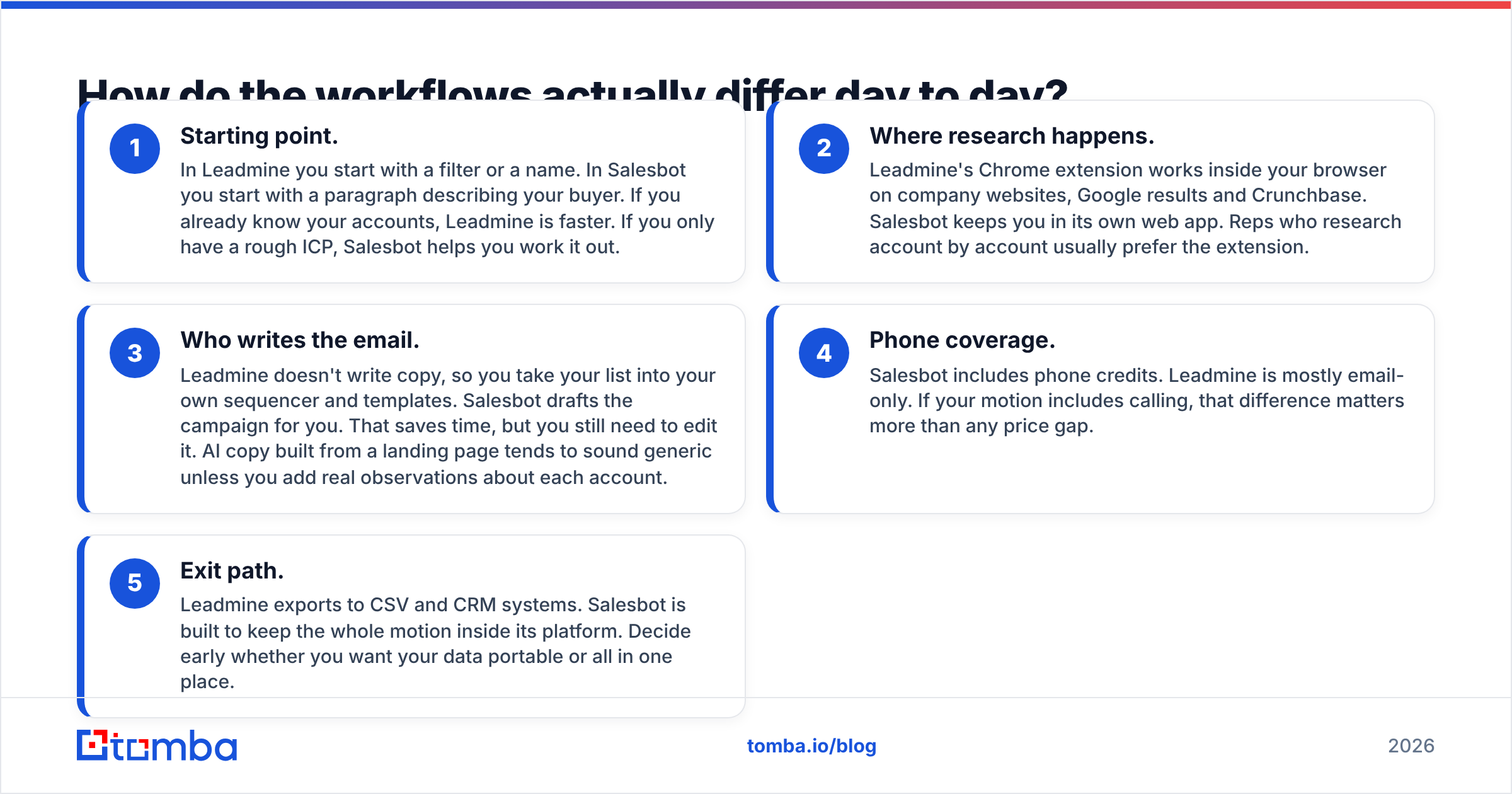
How do the workflows actually differ day to day?#
This is where the choice gets made. Here are the main differences:
- Starting point. In Leadmine you start with a filter or a name. In Salesbot you start with a paragraph describing your buyer. If you already know your accounts, Leadmine is faster. If you only have a rough ICP, Salesbot helps you work it out.
- Where research happens. Leadmine's Chrome extension works inside your browser on company websites, Google results and Crunchbase. Salesbot keeps you in its own web app. Reps who research account by account usually prefer the extension.
- Who writes the email. Leadmine doesn't write copy, so you take your list into your own sequencer and templates. Salesbot drafts the campaign for you. That saves time, but you still need to edit it. AI copy built from a landing page tends to sound generic unless you add real observations about each account.
- Phone coverage. Salesbot includes phone credits. Leadmine is mostly email-only. If your motion includes calling, that difference matters more than any price gap.
- Exit path. Leadmine exports to CSV and CRM systems. Salesbot is built to keep the whole motion inside its platform. Decide early whether you want your data portable or all in one place.
Is Leadmine or Salesbot cheaper?#
It depends on what you count.
If you only count email lookups, Leadmine is usually cheaper per contact. At current listed rates, its entry tier costs around $0.05 per credit, and the Business tier gets that down to about $0.015. You only pay for what you look up, so costs stay predictable for low-volume prospecting.
If you count the whole workflow (list building, copywriting and phone numbers), Salesbot can make more sense. Paying for Leadmine plus a sequencer plus a phone data tool can cost more than one Salesbot seat, and it adds more logins and more CSV imports.
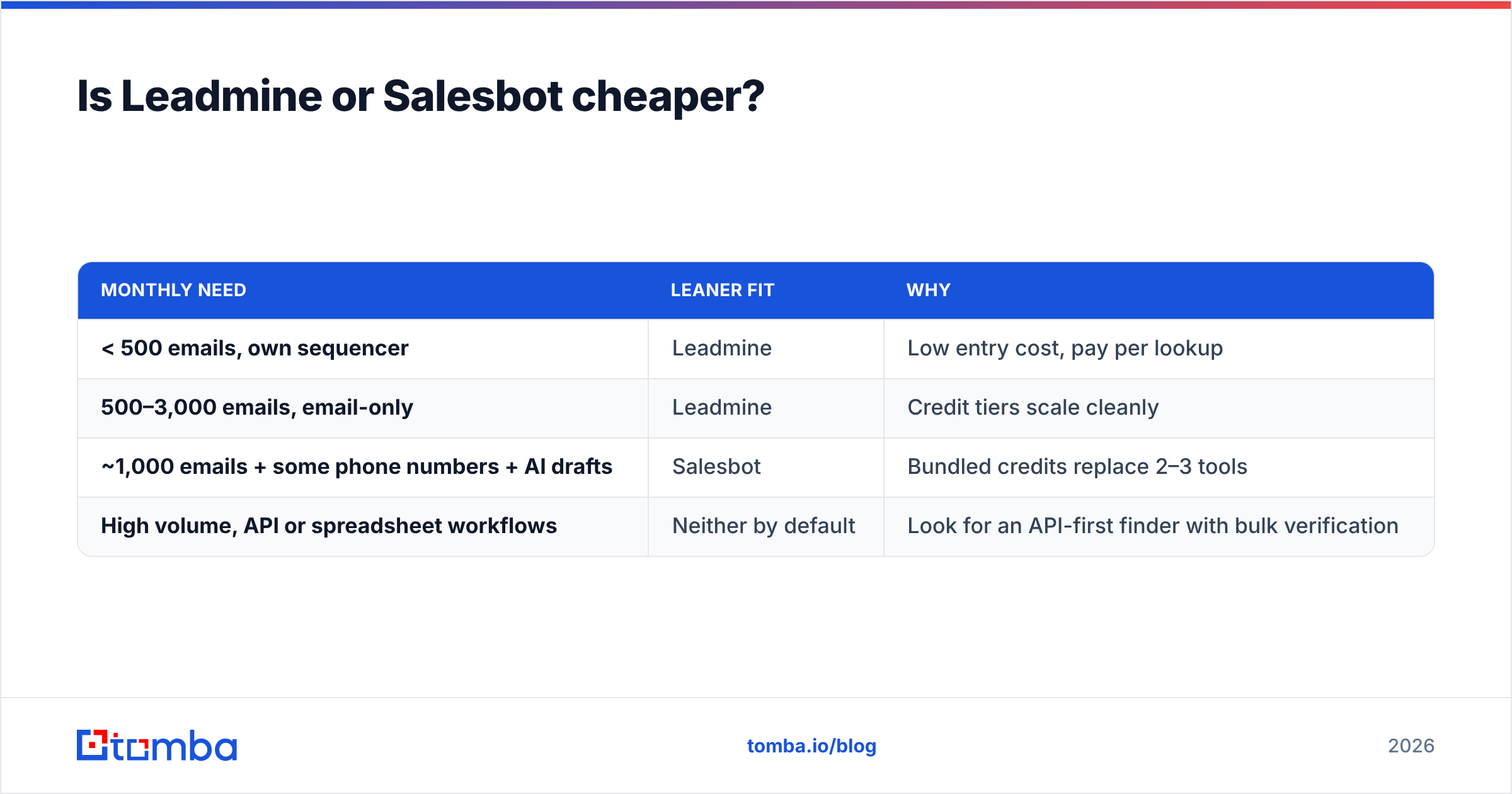
A quick way to model your cost:
| Monthly need | Leaner fit | Why |
|---|---|---|
| < 500 emails, own sequencer | Leadmine | Low entry cost, pay per lookup |
| 500–3,000 emails, email-only | Leadmine | Credit tiers scale cleanly |
| ~1,000 emails + some phone numbers + AI drafts | Salesbot | Bundled credits replace 2–3 tools |
| High volume, API or spreadsheet workflows | Neither by default | Look for an API-first finder with bulk verification |
For reference, Tomba's pricing sits in the same range: a free tier with 25 searches a month, Starter at $49/month, Growth at $99/month, Pro at $249/month, and custom Enterprise plans. Tomba includes an email verifier, domain search, catch-all checks and an API. Full breakdown on Tomba pricing.
What are the pros and cons of each?#
Leadmine#
Pros
- Simple and quick to learn. Most users are looking up emails within minutes.
- Chrome extension works on company websites, Google results and Crunchbase profiles.
- Built-in verification checks syntax, MX records and deliverability.
- Free plan lets you test accuracy on your own targets.
Cons
- Smaller index than the large aggregators, so coverage is thinner at small companies and outside major markets.
- No outreach, sequencing or AI copywriting.
- Limited phone data.
- Published pricing has changed, so confirm current tiers before you budget.
Salesbot#
Pros
- Natural-language ICP input lowers the skill needed to build a list.
- Large contact pool (~655M) with firmographic filters such as predicted revenue and investment stage.
- Email and phone credits bundled in one plan.
- AI-generated outreach campaigns shorten the time to your first send.
Cons
- Newer platform (launched late 2024) with fewer independent reviews than long-established tools.
- AI-drafted copy needs editing before you send it.
- All-in-one design encourages you to keep workflows in the platform, which can make it harder to plug into an existing tool stack.
- Plan prices aren't clearly published up front.
Who should choose Leadmine?#
Choose Leadmine if all of these apply:
- You already use a sequencer such as Instantly, Lemlist or HubSpot sequences, and only need the data layer.
- You prospect account by account and like researching in the browser.
- Your volume is modest and you want to pay per lookup.
- Your targets are mostly companies with a normal website and a standard email format.
Leadmine is a good fit for agencies, founders doing their own outbound, and SDRs whose company hasn't paid for a large data platform.
Who should choose Salesbot?#
Choose Salesbot if these apply:
- You don't have a well-defined target account list yet and want help turning an ICP description into leads.
- You need phone numbers as well as emails.
- You'd rather have one platform than connect three.
- You have someone who will edit the AI drafts before they go out.
Salesbot is a good fit for early-stage sales teams and founders making their first sales hires, where getting started quickly matters more than choosing each tool separately.
Is there a better option than both?#
That depends on how you work. Leadmine and Salesbot are at opposite ends of the market, one a focused finder and the other a bundled platform. Many teams end up wanting something in between: a finder with deeper verification, catch-all handling, bulk processing and an API. They don't necessarily want a platform that also writes their emails.
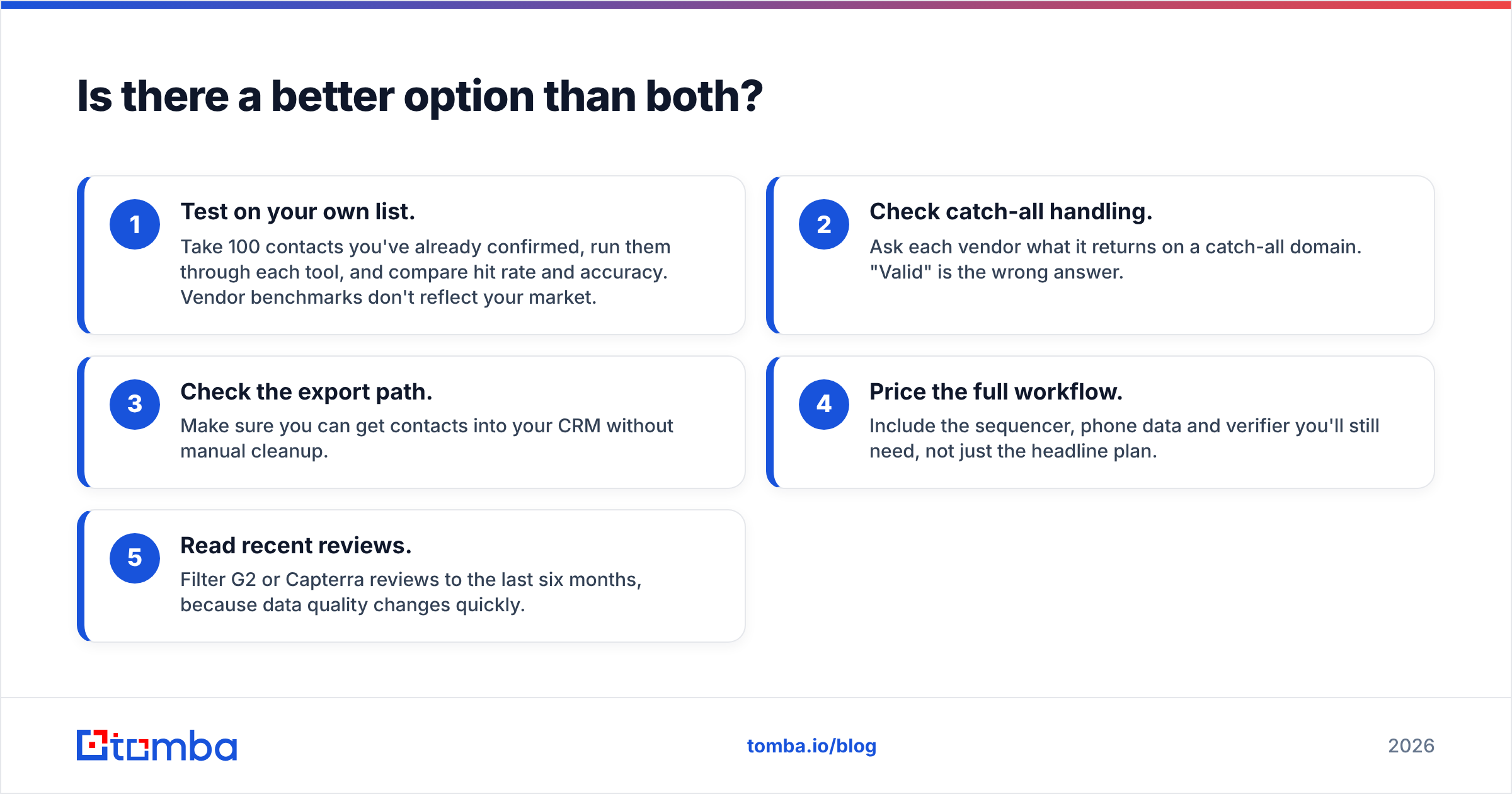
Here's a checklist that works for any tool, including the two in this post:
- Test on your own list. Take 100 contacts you've already confirmed, run them through each tool, and compare hit rate and accuracy. Vendor benchmarks don't reflect your market.
- Check catch-all handling. Ask each vendor what it returns on a catch-all domain. "Valid" is the wrong answer.
- Check the export path. Make sure you can get contacts into your CRM without manual cleanup.
- Price the full workflow. Include the sequencer, phone data and verifier you'll still need, not just the headline plan.
- Read recent reviews. Filter G2 or Capterra reviews to the last six months, because data quality changes quickly.
What is the final verdict on Leadmine vs Salesbot?#
These tools solve different problems, so you'll usually be choosing between them by what you need rather than by which is better overall.
- Leadmine is a reasonable, low-cost email finder for people who already run their own outbound stack and want quick lookups with basic verification.
- Salesbot suits teams that want AI to go from ICP to list to first draft in one place, with phone credits included.
Neither removes the step that has the biggest effect on campaign results: verifying each address, including catch-alls, just before you send. If you skip it, a larger database only means more bounces.
If you want a finder that covers that gap, try the Tomba Email Finder. You can search by domain, name or company, and verification and catch-all checks are part of the same workflow. It also works through the Chrome extension, Google Sheets and the API. Start with the free tier's 25 monthly searches, run the 100-contact test above against Leadmine or Salesbot, and compare the results on your own targets before you pay.
Related guides#
// get started
Find, verify and enrich your first contacts today
Start on the free plan with 25 searches a month, then scale when your team is ready.
Free plan · No credit card required · GDPR & CCPA
Get the Tomba newsletter
Product and data updates
// about the author