Leadpipe Alternatives: 7 Visitor ID Tools Compared for 2026
Leadpipe tells you who is on your site, but match rates, EU coverage and pricing can push teams elsewhere. Here are 7 Leadpipe alternatives, what each does best, and how to choose one.
TL;DR
- Leadpipe is a person-level website visitor identification tool built mainly for US traffic. Teams usually look for Leadpipe alternatives when match rates drop, when they need EU coverage, or when they need emails they can actually send to.
- RB2B is the easiest free starting point for US person-level identification sent to Slack. Dealfront (Leadfeeder) is the safest choice when GDPR-compliant, company-level identification in Europe matters.
- Warmly and Koala fit teams that want signals turned into automated plays. Vector fits teams that want to push identified visitors into ad audiences.
- Tomba Reveal plus Tomba's email finder and verifier suits teams that care more about getting from "someone from Acme visited" to "here is a verified inbox" than about dashboards.
- Whichever tool you pick, verify every email before it goes into a sequence. Identification data goes stale quickly.
What is Leadpipe, and why do teams look for alternatives?#
Leadpipe is an identity-resolution tool. It puts a tracking script on your website and tries to match anonymous visitors to real people: name, job title, company, LinkedIn profile and sometimes an email address. It belongs to the "person-level" identification category, which has grown quickly since the older IP-to-company tools stopped being enough for outbound teams.
When it works, it's useful. A person from a target account looks at your pricing page, and your SDR gets a name within minutes instead of a vague "someone from a 500-person SaaS company."
Teams still switch or add tools. The reasons come up again and again in reviews and sales calls:
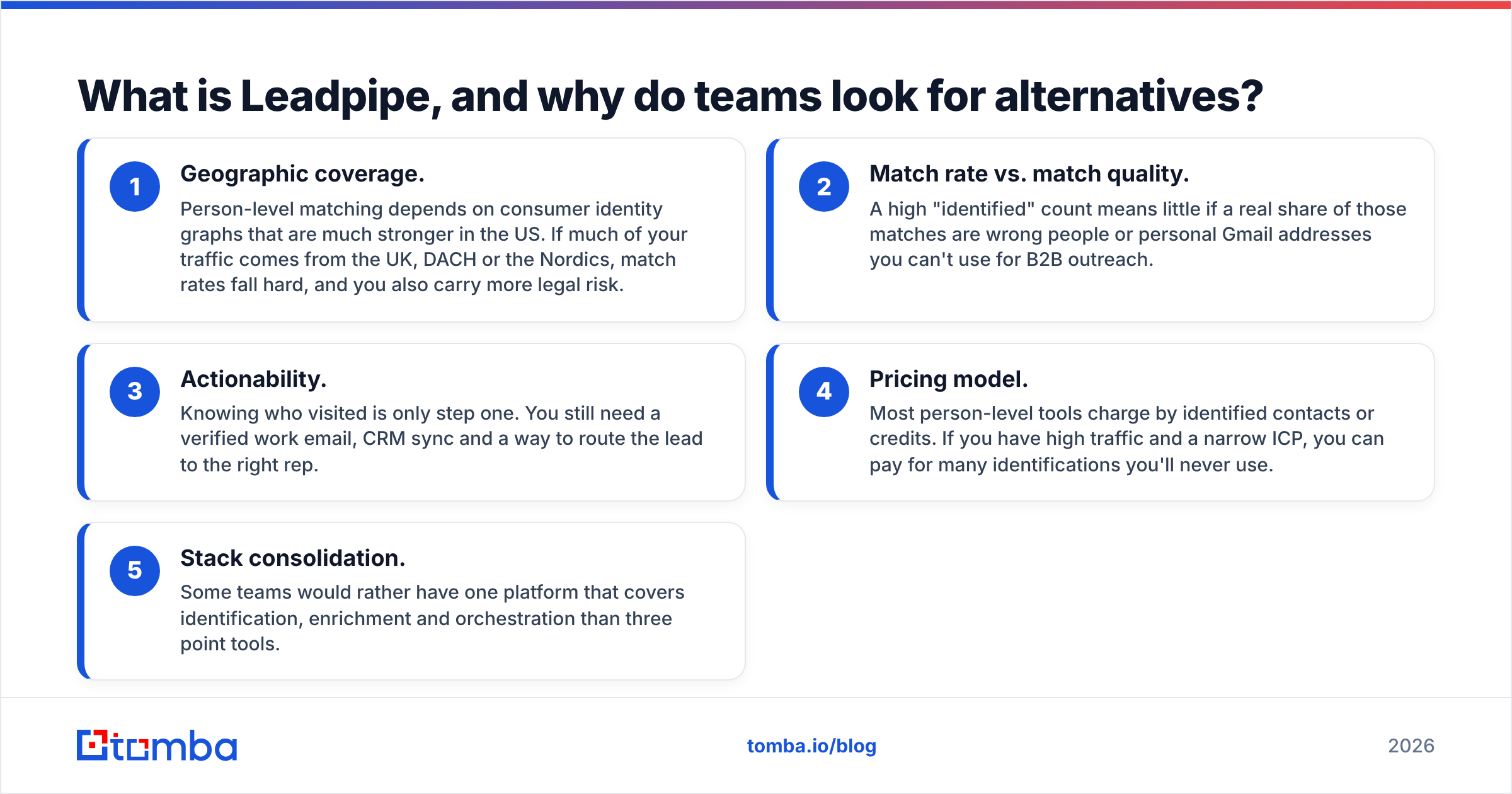
- Geographic coverage. Person-level matching depends on consumer identity graphs that are much stronger in the US. If much of your traffic comes from the UK, DACH or the Nordics, match rates fall hard, and you also carry more legal risk.
- Match rate vs. match quality. A high "identified" count means little if a real share of those matches are wrong people or personal Gmail addresses you can't use for B2B outreach.
- Actionability. Knowing who visited is only step one. You still need a verified work email, CRM sync and a way to route the lead to the right rep.
- Pricing model. Most person-level tools charge by identified contacts or credits. If you have high traffic and a narrow ICP, you can pay for many identifications you'll never use.
- Stack consolidation. Some teams would rather have one platform that covers identification, enrichment and orchestration than three point tools.
None of these points make Leadpipe a bad product. They explain why "best Leadpipe alternative" has no single answer. The right pick depends on which of these five problems is actually hurting you.
How does website visitor identification actually work?#
Think of it like a hotel front desk. Company-level identification is the desk clerk noticing that a guest arrived in a car with a corporate logo on it. You know the company, not the person. Person-level identification is the clerk matching the guest's face to a loyalty-program database. It's more specific, but it depends on that person being in the database and on the match being right.
Technically, the tools use a mix of methods:
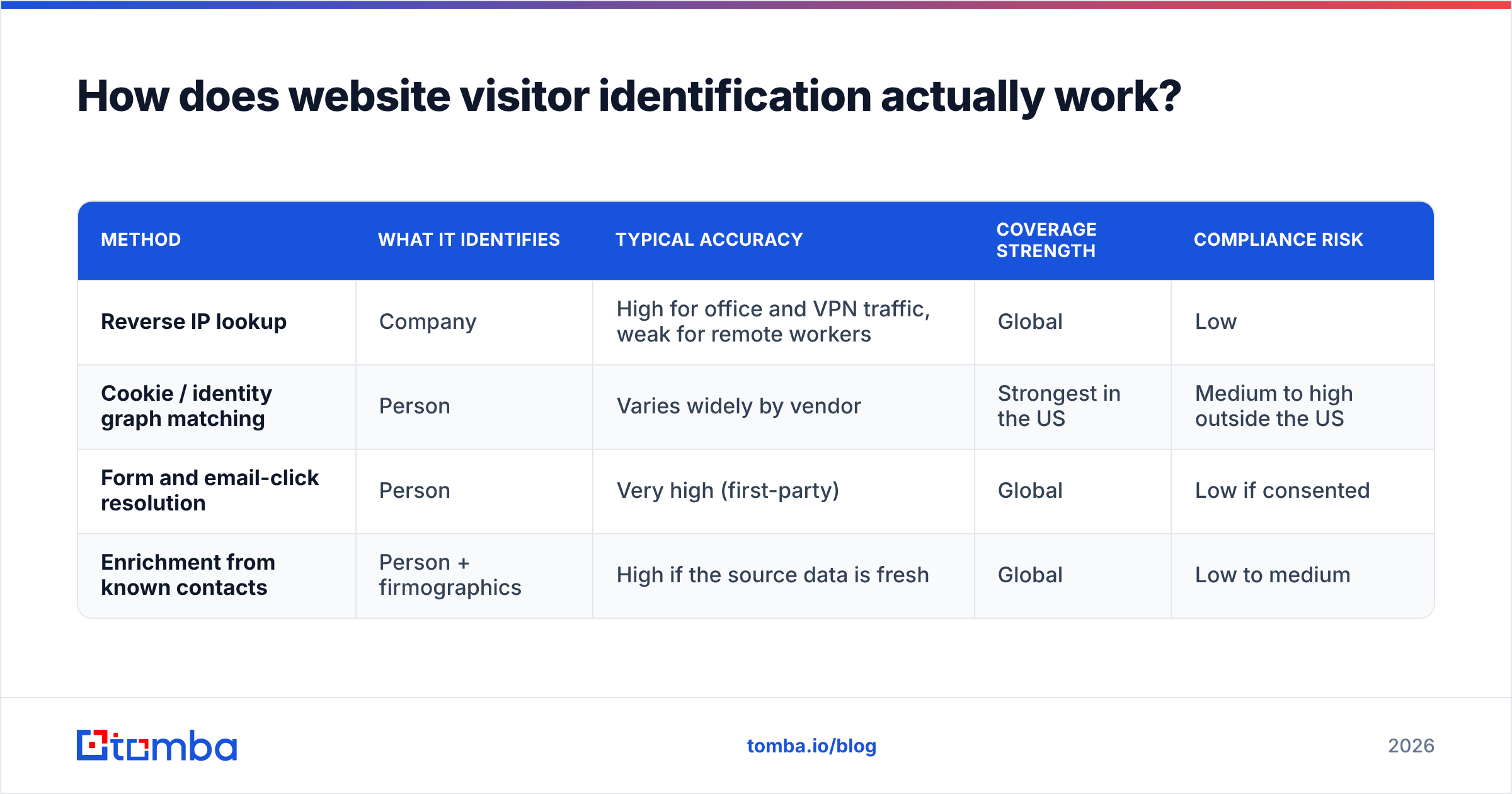
| Method | What it identifies | Typical accuracy | Coverage strength | Compliance risk |
|---|---|---|---|---|
| Reverse IP lookup | Company | High for office and VPN traffic, weak for remote workers | Global | Low |
| Cookie / identity graph matching | Person | Varies widely by vendor | Strongest in the US | Medium to high outside the US |
| Form and email-click resolution | Person | Very high (first-party) | Global | Low if consented |
| Enrichment from known contacts | Person + firmographics | High if the source data is fresh | Global | Low to medium |
The practical takeaway: no vendor has a secret method that identifies 80% of your traffic accurately. Differences come from the quality of the identity graph, how fresh the data is, and what the tool does after the match.

What should you evaluate before replacing Leadpipe?#
Before you book five demos, score each candidate on these points:
- Match rate on your own traffic. Ask for a trial on your real site, not a demo site. Run it for at least two weeks.
- Precision, not just volume. Spot-check 30 identified people by hand. How many actually work at the matched company and fit the matched role?
- Email usability. What share of identified contacts come with a work email that passes verification?
- Regional compliance. If you have EU traffic, find out whether the vendor turns off person-level matching for EU visitors and how it handles consent. The GDPR is not optional just because a tool makes the data available.
- Where the data goes. Slack alerts are nice. Native CRM sync, webhooks and sequencer integrations are what actually save rep time.
- Pricing unit. Per identified visitor, per credit, per seat or flat platform fee. Model it against your real monthly traffic.
What are the best Leadpipe alternatives in 2026?#
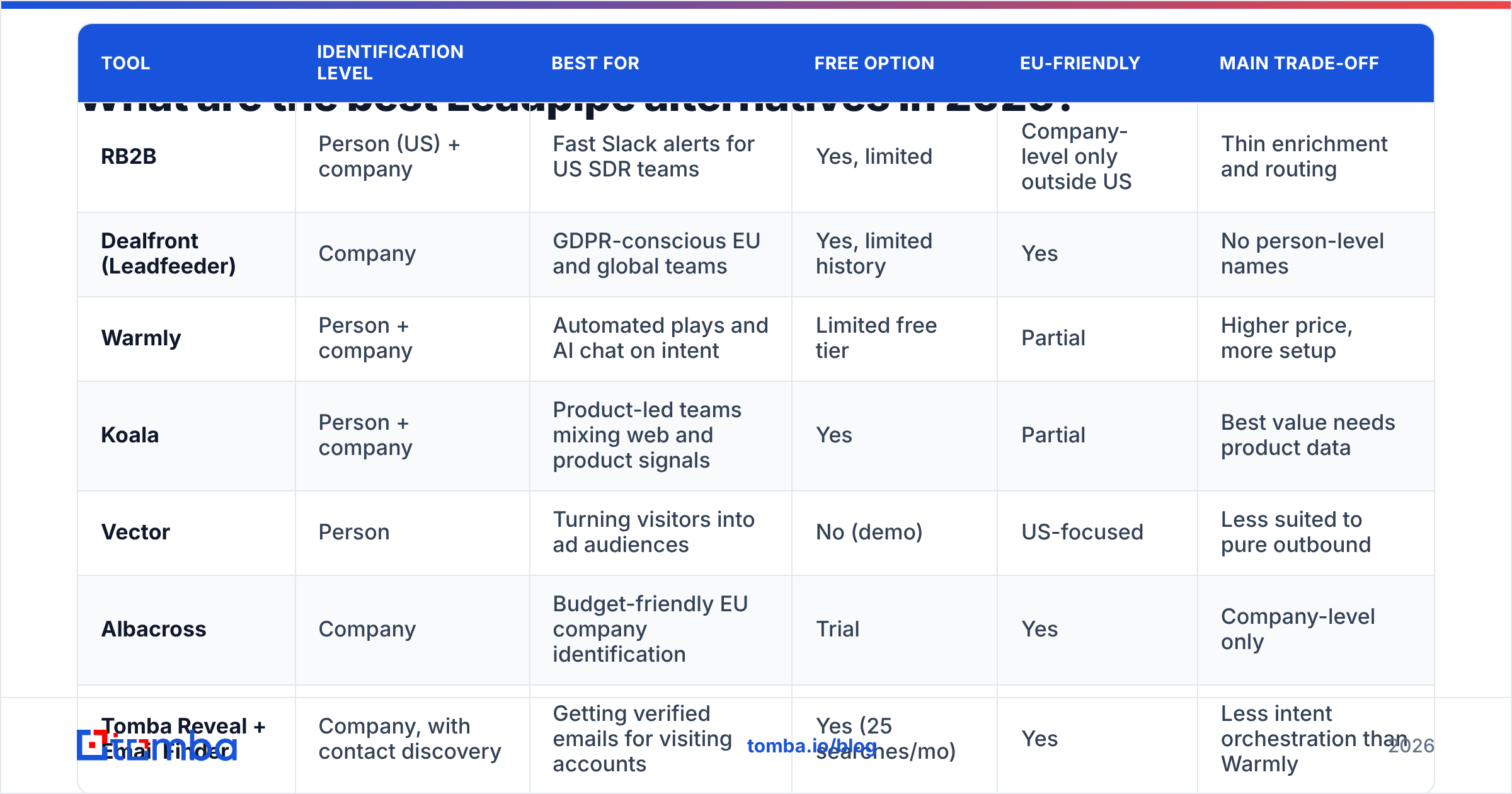
Here's how the main options compare at a glance. Pricing in this category changes often and many vendors quote custom plans, so check each vendor's pricing page before you budget.
| Tool | Identification level | Best for | Free option | EU-friendly | Main trade-off |
|---|---|---|---|---|---|
| RB2B | Person (US) + company | Fast Slack alerts for US SDR teams | Yes, limited | Company-level only outside US | Thin enrichment and routing |
| Dealfront (Leadfeeder) | Company | GDPR-conscious EU and global teams | Yes, limited history | Yes | No person-level names |
| Warmly | Person + company | Automated plays and AI chat on intent | Limited free tier | Partial | Higher price, more setup |
| Koala | Person + company | Product-led teams mixing web and product signals | Yes | Partial | Best value needs product data |
| Vector | Person | Turning visitors into ad audiences | No (demo) | US-focused | Less suited to pure outbound |
| Albacross | Company | Budget-friendly EU company identification | Trial | Yes | Company-level only |
| Tomba Reveal + Email Finder | Company, with contact discovery | Getting verified emails for visiting accounts | Yes (25 searches/mo) | Yes | Less intent orchestration than Warmly |
1. RB2B: the fastest free way to test person-level identification#
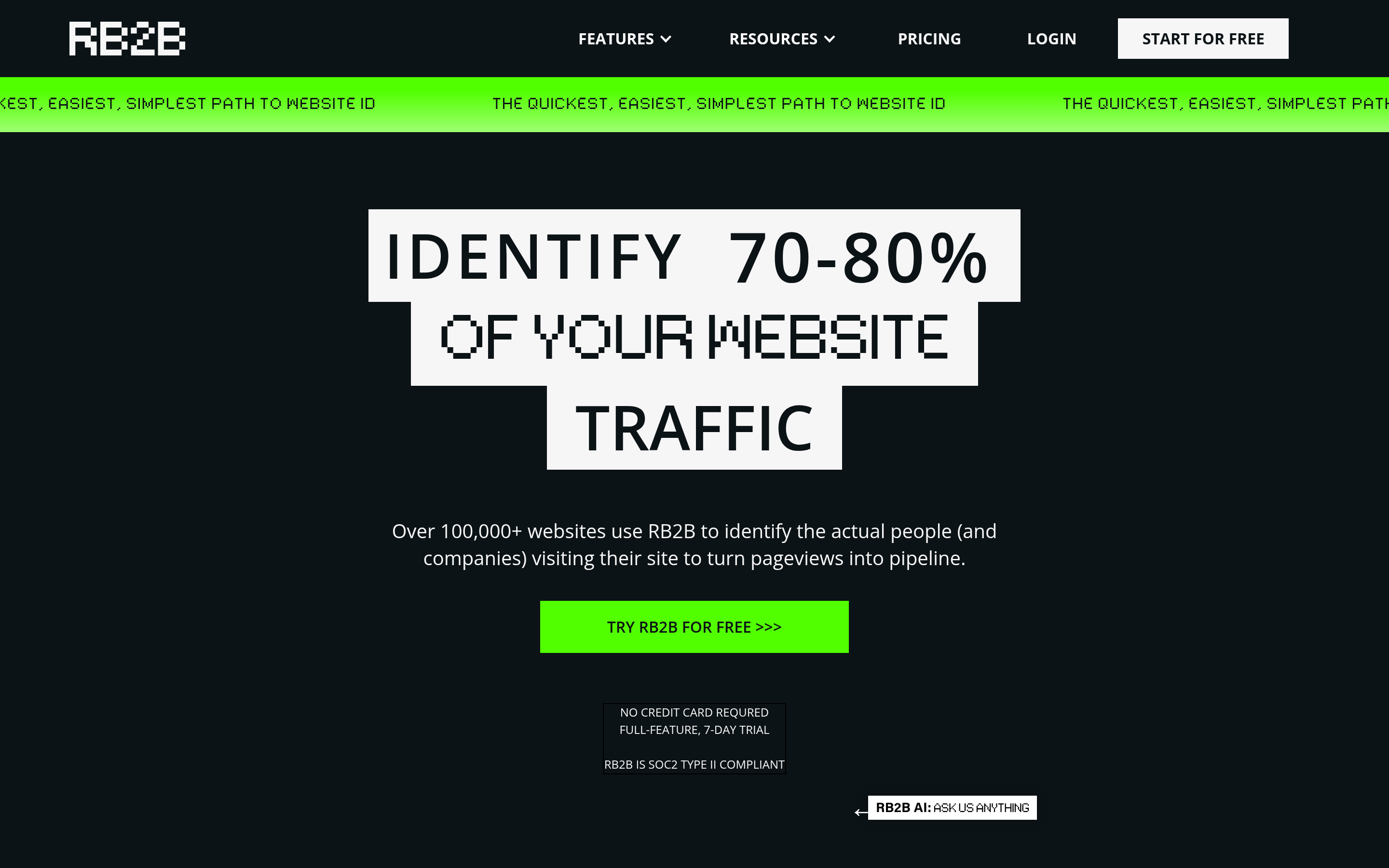
RB2B became popular by making person-level identification easy to try. You install a script, connect Slack, and US visitors start showing up with LinkedIn profiles. The free tier lets you test without procurement, and paid tiers add emails, CRM sync and higher volumes.
Pros: very quick setup, strong US coverage, a large community sharing playbooks. Cons: US-only person-level matching, and the Slack-first workflow gets noisy at volume. You'll still need separate enrichment and verification before sending email. Choose it if: most of your traffic is US-based and you want to know within a week whether person-level data changes your pipeline.
2. Dealfront (Leadfeeder): the compliance-first choice#
Dealfront, which absorbed Leadfeeder, is the default for European teams. It identifies companies, not people, and builds its data with GDPR in mind. You get visit histories, page-level engagement, lead scoring and solid CRM integrations.
Pros: strong EU coverage, mature filtering and scoring, low legal risk. Cons: no names. You have to find the right contacts yourself. Choose it if: your buyers are in Europe or your legal team has already said no to consumer identity graphs.
3. Warmly: identification plus orchestration#
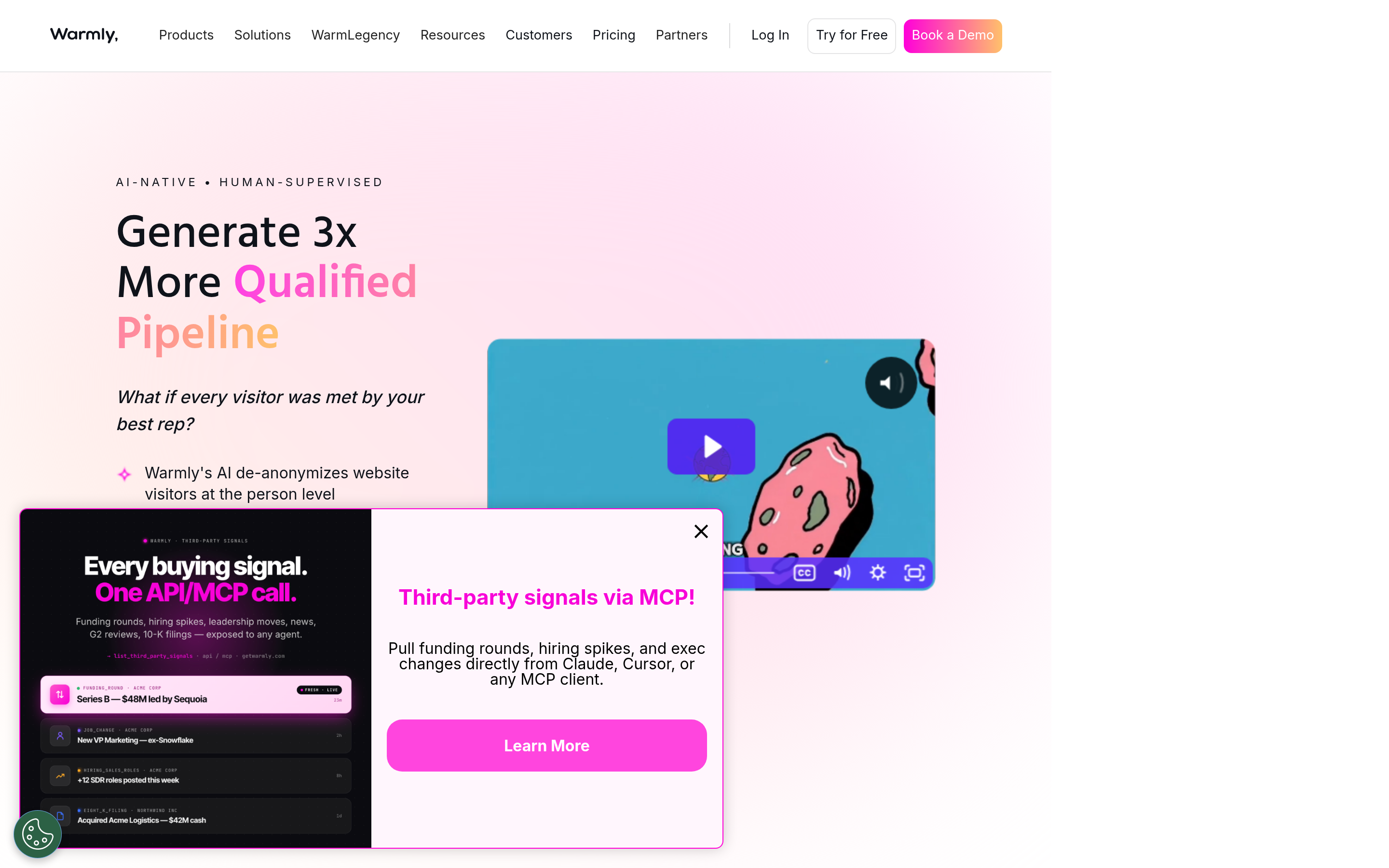
Warmly positions itself as a revenue orchestration platform rather than a pure identification tool. It combines person- and company-level identification with intent signals, AI chat and automated workflows that can enroll visitors in sequences or alert reps in real time.
Pros: it does a lot out of the box, and live-chat outreach to identified visitors can convert well. Cons: meaningfully more expensive than point tools, and you need a clear process before automation helps rather than spams. Choose it if: you have RevOps capacity and want one system making decisions on intent data.
4. Koala: signals for product-led sales#

Koala combines website visits with product usage and other first-party signals to surface accounts that are warming up. It works best for PLG companies, where "visited docs three times and invited two teammates" is a stronger signal than any one page view.
Pros: good at combining signals, a free tier to start, and a UI built for reps. Cons: less differentiated if you don't have product usage data to feed it. Choose it if: you run a free trial or freemium motion and want sales to focus on the right accounts.
5. Vector: identification for paid media#

Vector focuses on identifying website visitors at person level and pushing them into advertising audiences on platforms like LinkedIn and Meta. It covers outbound too, but its strongest use case is retargeting real people rather than cookies.
Pros: closes the loop between site visits and ads, useful for ABM. Cons: US-focused, and pure SDR teams may not use the ad features. Choose it if: marketing owns the budget and paid retargeting is a core channel.
6. Albacross: a budget-friendly EU company-level option#
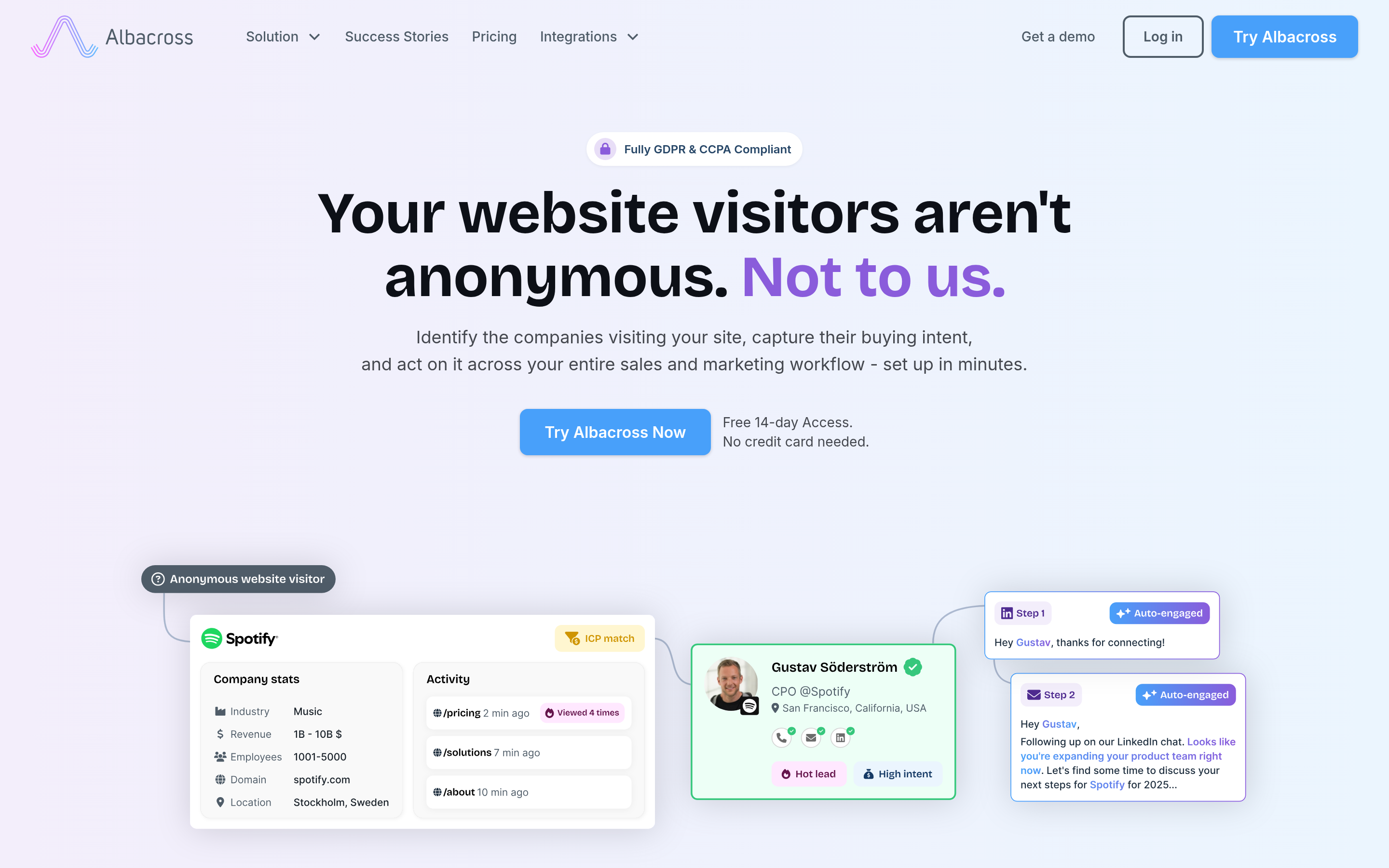
Albacross covers the same ground as Dealfront at the company level, with a GDPR-first approach and a lower entry price for smaller teams. If you're comparing the two, our Albacross alternative breakdown goes deeper.
Pros: accessible pricing, EU compliance, straightforward UI. Cons: company-level only, and enrichment is lighter than enterprise platforms. Choose it if: you want simple, compliant account identification without an enterprise contract.
7. Tomba Reveal + Email Finder: from visiting account to verified inbox#
Tomba's website visitor reveal identifies the companies visiting your site. What sets the workflow apart is what comes next: it runs straight into Tomba's email finder, domain search and verification. You don't stop at "Acme visited the pricing page." You search Acme's domain, filter by role and get deliverable addresses for the actual buying committee, not only whoever happened to be browsing.
Pros: covers identification, contact discovery and email verification in one place, works globally, starts free (25 searches/month), and paid plans run from $49/mo Starter to $99/mo Growth and $249/mo Pro. Cons: less built-in intent orchestration and AI chat than Warmly. If you want automated plays, you'll connect it to your sequencer or CRM. Choose it if: your bottleneck is turning identified accounts into contacts you can email, especially outside the US.
Is person-level identification better than company-level?#
Not automatically. Person-level data feels more actionable, but it has three hidden costs.
First, the visitor often isn't the buyer. The person reading your integration docs may be a developer with no budget. Sending them a demo request is a waste of everyone's time.
Second, accuracy degrades quietly. Identity graphs lean on data that ages, including job changes, shared devices and home IPs. A wrong match that turns into a cold email to the wrong person hurts your domain reputation and your brand.
Third, compliance exposure depends on geography. In the US, person-level matching is common practice. In the EU and UK, processing personal data from anonymous visitors without a lawful basis is a real risk. Most reputable vendors disable person-level matching for EU traffic for exactly this reason.
Company-level identification plus smart contact discovery often reaches the same result more safely. You learn which account is in-market, then choose who to contact based on role, which usually beats contacting whoever clicked. Many mature teams run both: a person-level tool for US traffic and a company-level tool plus contact enrichment for everything else.
How do you turn identified visitors into pipeline?#
The tool matters less than the workflow around it. The teams that get ROI from visitor identification tend to run a version of this:
- Filter hard. Only surface visitors who match your ICP (industry, headcount, geography) and hit high-intent pages like pricing, comparisons and integrations. Leave out blog readers and careers-page visitors.
- Map the buying committee. For each qualified account, find two or three relevant contacts by role, not just the one who visited.
- Verify before you send. Run every address through verification, and handle catch-all domains separately. Identification vendors' emails bounce more often than most teams expect.
- Reference the signal subtly. Don't write "I saw you on our pricing page." Write about the problem the page addresses. Creepy outreach kills reply rates.
- Route by speed. Intent decays within days. Route qualified accounts to a rep the same day, or automate a first touch.
- Measure precision monthly. Track how many identified accounts turned into meetings. If precision drops, tighten filters before you add volume.

Step 3 is where most setups fail. A tool claims 40% identification, the team loads everything into a sequencer, bounce rates spike, and deliverability suffers for months. Verification costs little compared with rebuilding sender reputation.
Which Leadpipe alternative should you choose?#
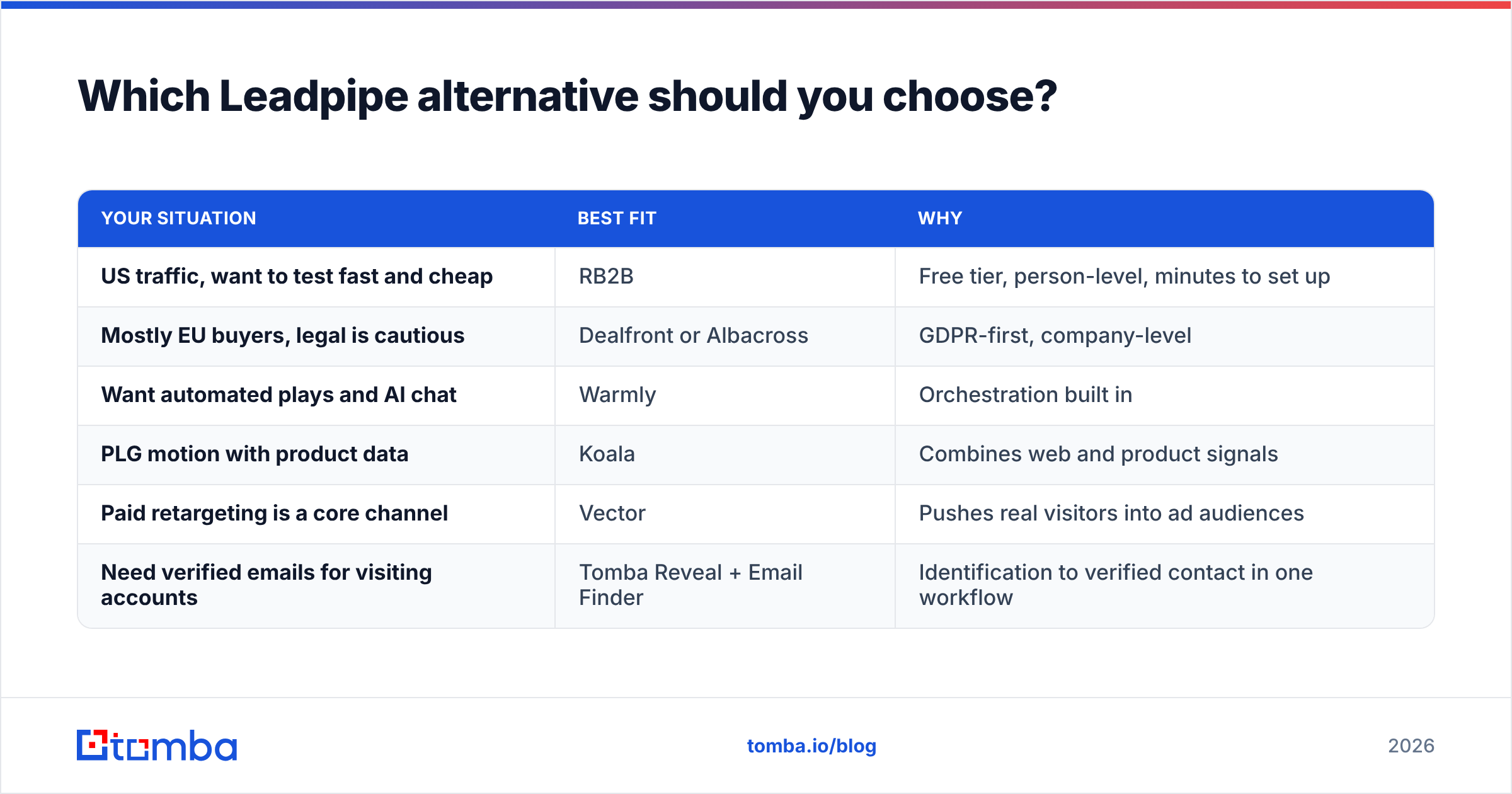
Match the tool to your real constraint:
| Your situation | Best fit | Why |
|---|---|---|
| US traffic, want to test fast and cheap | RB2B | Free tier, person-level, minutes to set up |
| Mostly EU buyers, legal is cautious | Dealfront or Albacross | GDPR-first, company-level |
| Want automated plays and AI chat | Warmly | Orchestration built in |
| PLG motion with product data | Koala | Combines web and product signals |
| Paid retargeting is a core channel | Vector | Pushes real visitors into ad audiences |
| Need verified emails for visiting accounts | Tomba Reveal + Email Finder | Identification to verified contact in one workflow |
If you already use Leadpipe and it works for your US traffic, you may not need to replace it at all. Adding a company-level tool for non-US visitors and a verification layer for every email it returns is often the cheaper fix.
Before you sign anything, run a two-week trial on your own traffic, hand-check 30 identifications, and verify every email. Those numbers are more reliable than any vendor's claimed match rate.
Ready to turn anonymous visitors into verified contacts?#
Identifying the account is only half the job. The other half is reaching the right people at that account with an email that actually lands. Tomba Email Finder lets you search any visiting company's domain, filter contacts by role and seniority, and verify each address before it goes into a sequence. Start on the free plan with 25 searches a month, or see Tomba pricing to scale up from $49/mo once the workflow proves itself.
Related guides#
// get started
Find, verify and enrich your first contacts today
Start on the free plan with 25 searches a month, then scale when your team is ready.
Free plan · No credit card required · GDPR & CCPA
// about the author