Leads for Brokers: Where to Find Them and What They Cost in 2026
Bought lead lists, shared portal leads, referrals, or outbound you build yourself? We look at every source of leads for brokers, with typical costs, exclusivity, and which broker types each one actually suits.
- Lead sources are not all the same. A lead that's shared with five other brokers and a lead you researched yourself might both cost $40, but they close at very different rates.
- Which source fits depends on the broker type. Mortgage and residential brokers get the most from inbound and portal leads. Commercial insurance, business, freight, and commercial real estate brokers get the most from targeted B2B outbound.
- Exclusivity matters more than volume. Five exclusive, verified leads usually bring in more revenue than fifty recycled ones.
- Building your own list is now cheap. With domain search, email finding, and verification tools, a B2B broker can build a verified prospect list for well under $1 per contact.
- Verify everything before you send. Bounced emails from purchased lists are one of the quickest ways to damage the domain you use for outreach.
What counts as a "lead" for a broker?#
A broker lead is a person or company that might need what you arrange, whether that's a policy, a loan, a property, a business sale, or a truckload of freight, and that you have a real way to reach. That second part is where most lead spend goes wrong. A name without a working email or direct phone number is just a record in a database.
The term covers very different things depending on your line of work:
- Residential real estate and mortgage brokers: consumers who filled in a form, asked for a valuation, or requested a rate quote.
- Insurance brokers: consumers shopping for personal lines, or businesses whose commercial policies come up for renewal.
- Business brokers (M&A): owners thinking about selling, plus buyers with money ready to deploy.
- Freight brokers: shippers who manage outbound logistics, usually a logistics manager, supply chain director, or operations lead.
- Commercial real estate brokers: tenants whose leases are ending soon, landlords, and investors.
The first group is mostly B2C and inbound. The other four are mostly B2B. A freight broker's ideal lead is a named shipping manager at a mid-sized manufacturer, and nobody sells that as a "form fill." You find that person and reach out yourself.
Keep this split in mind for the rest of the guide. For background, lead generation splits into inbound (the prospect finds you) and outbound (you find the prospect). Brokers tend to overspend on the first when their market would reward the second.
Where do brokers get leads in 2026?#
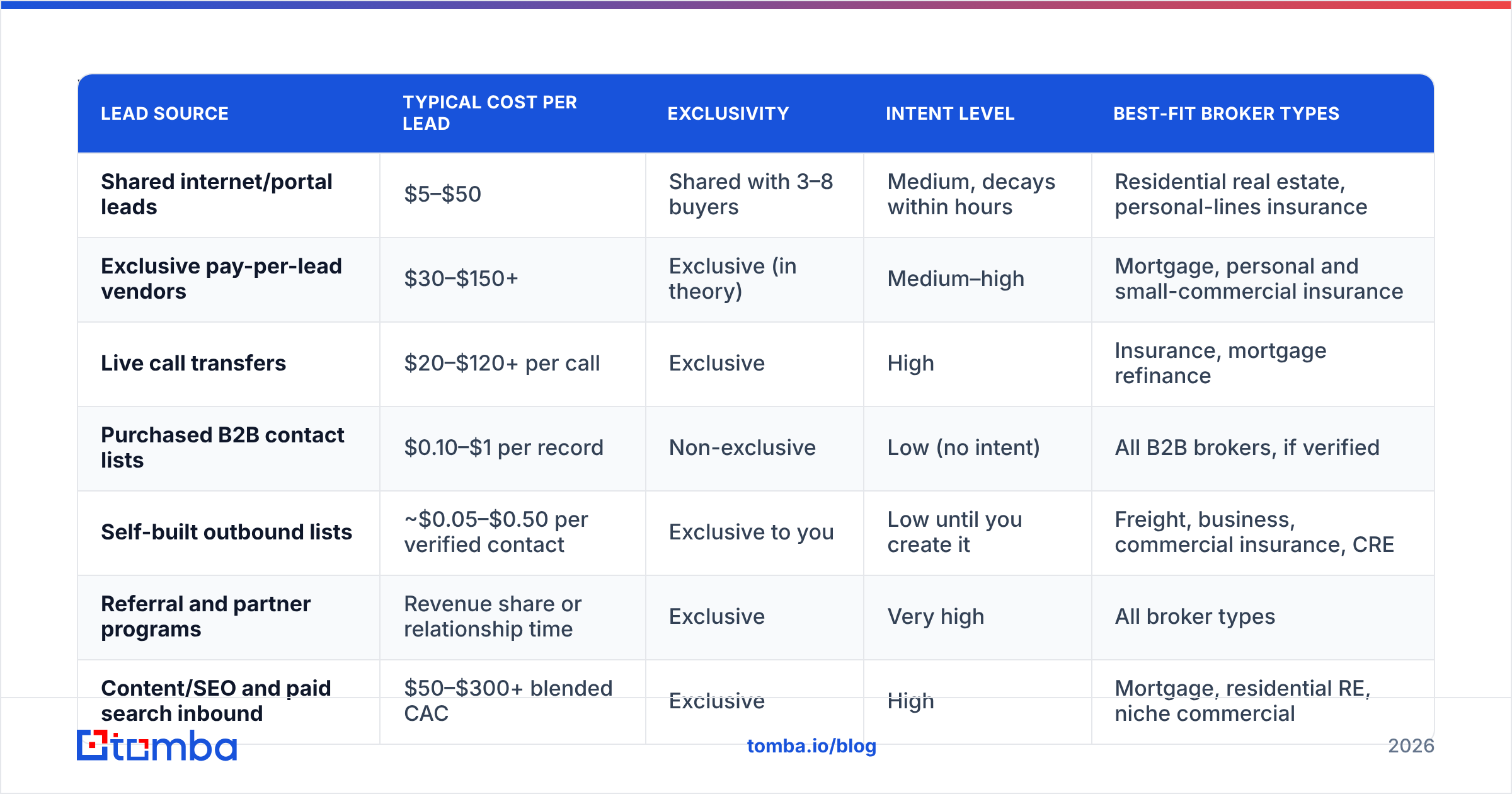
Broadly, there are seven sources. The table below lists typical market ranges. Actual prices depend on vertical, geography, and vendor, so use these as a rough guide, not a quote.
| Lead source | Typical cost per lead | Exclusivity | Intent level | Best-fit broker types |
|---|---|---|---|---|
| Shared internet/portal leads | $5–$50 | Shared with 3–8 buyers | Medium, decays within hours | Residential real estate, personal-lines insurance |
| Exclusive pay-per-lead vendors | $30–$150+ | Exclusive (in theory) | Medium–high | Mortgage, personal and small-commercial insurance |
| Live call transfers | $20–$120+ per call | Exclusive | High | Insurance, mortgage refinance |
| Purchased B2B contact lists | $0.10–$1 per record | Non-exclusive | Low (no intent) | All B2B brokers, if verified |
| Self-built outbound lists | ~$0.05–$0.50 per verified contact | Exclusive to you | Low until you create it | Freight, business, commercial insurance, CRE |
| Referral and partner programs | Revenue share or relationship time | Exclusive | Very high | All broker types |
| Content/SEO and paid search inbound | $50–$300+ blended CAC | Exclusive | High | Mortgage, residential RE, niche commercial |
Two things this table shows:
- Cost per lead and cost per closed deal behave differently. A $10 shared lead that closes 1 time in 100 costs $1,000 per deal. A $0.30 self-built contact that closes 1 time in 400 costs $120 per deal, plus your team's time.
- Nothing at the bottom of the table works without effort. Outbound, referrals, and content are cheap per lead because you put in the work. Paid lead vendors are really charging for that work.
Are paid lead vendors worth it for brokers?#
Sometimes, mostly for consumer-facing brokers who reply fast.
Shared portal leads work on speed. The first broker to call usually wins, and response times of a few minutes decide the deal. If you have an inside sales assistant or an auto-dialer ready to go, shared leads can pay off. A solo broker who checks email twice a day will mostly be paying for leads that someone else already called.
Exclusive pay-per-lead is safer, but read the terms. Look for:
- Return policy: can you return leads with bad numbers or wrong contact details, and within how many days?
- Definition of "exclusive": exclusive for 24 hours, or permanently? Some vendors resell after a set period.
- Source transparency: are leads coming from the vendor's own forms, or from affiliates and co-registration pages?
- Consent records: in the US, calling or texting consumers requires documented consent under telemarketing rules. If the vendor can't show consent records, the legal risk is yours.
Live call transfers cost the most per contact but have the highest intent. They suit insurance and mortgage brokers who can close on the first call.
B2B brokers should treat all of this carefully. Most pay-per-lead marketplaces are built for consumers. A commercial insurance broker who buys "business insurance leads" usually gets sole proprietors looking for the cheapest general liability policy, which is rarely the mid-market book they want. Review sites such as G2's lead generation category help you compare vendors on reported data quality before you commit.
Should brokers buy contact lists or build their own?#
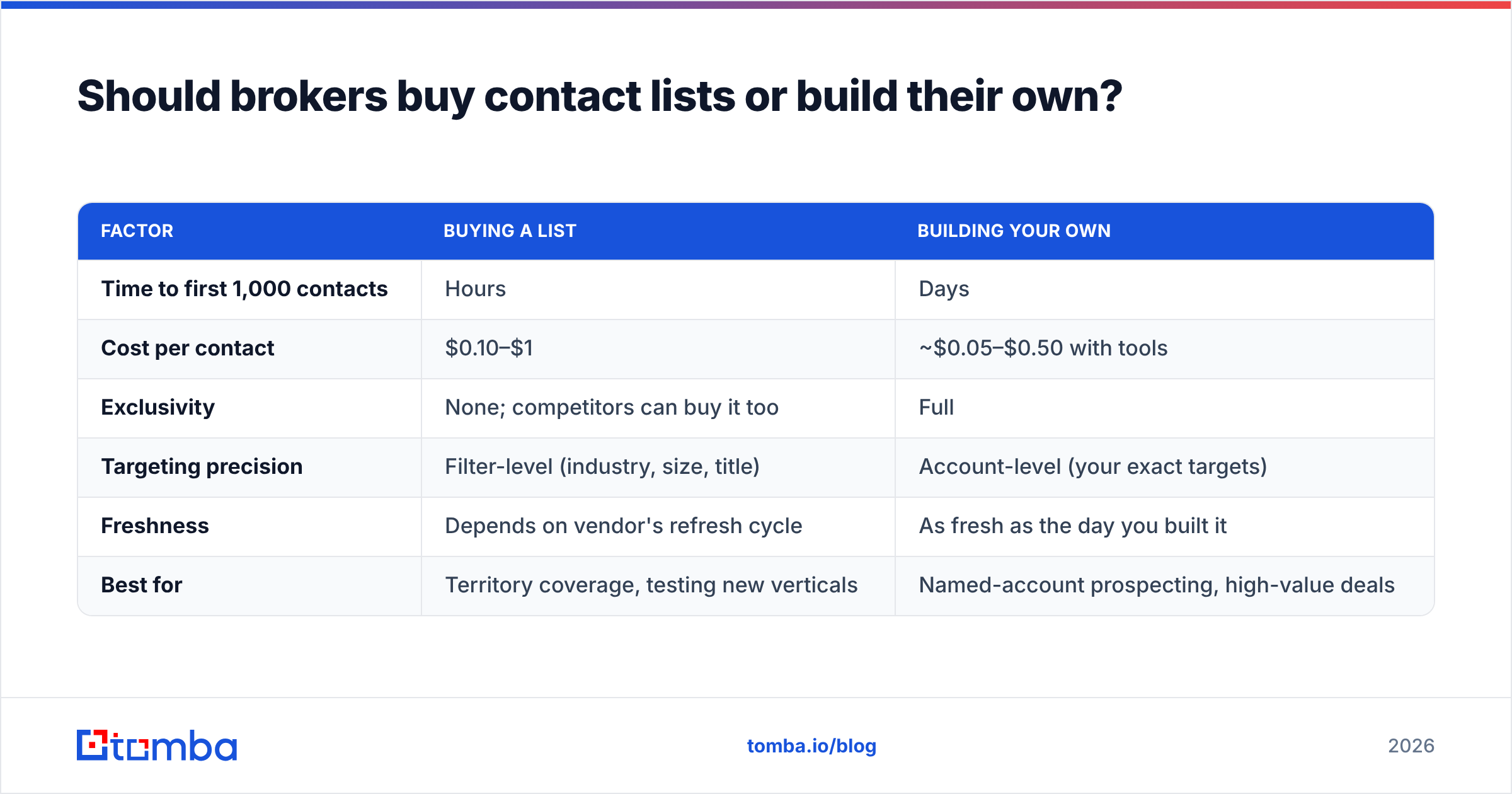
B2B brokers end up choosing between these two, and both are legitimate options.
Buying a list is quick. Established list providers such as BookYourData, ZoomInfo, and others let you filter by industry, headcount, location, and job title, then download thousands of records at once. That works well when you need to cover a large territory fast, for example a new freight broker who needs every logistics manager at food manufacturers in the Midwest by next week. Buy from a provider with clear data-refresh and accuracy policies. Quality varies a lot across this market, and a reputable vendor is worth paying for.
Building your own list is slower to start but tighter. You pick the exact companies you want, find the right decision-maker at each one, and verify each address before sending. The result is exclusive to you by definition. Competitors can't buy the same list.
In practice, most productive B2B brokers do both. They buy or pull a broad list of target accounts (companies), then research the right contacts at the accounts that matter most. Domain-based tools make the second step fast. A domain search returns the known email addresses at a company, so you can pick the logistics director or CFO instead of guessing at info@.
| Factor | Buying a list | Building your own |
|---|---|---|
| Time to first 1,000 contacts | Hours | Days |
| Cost per contact | $0.10–$1 | ~$0.05–$0.50 with tools |
| Exclusivity | None; competitors can buy it too | Full |
| Targeting precision | Filter-level (industry, size, title) | Account-level (your exact targets) |
| Freshness | Depends on vendor's refresh cycle | As fresh as the day you built it |
| Best for | Territory coverage, testing new verticals | Named-account prospecting, high-value deals |
How do different broker types generate leads?#
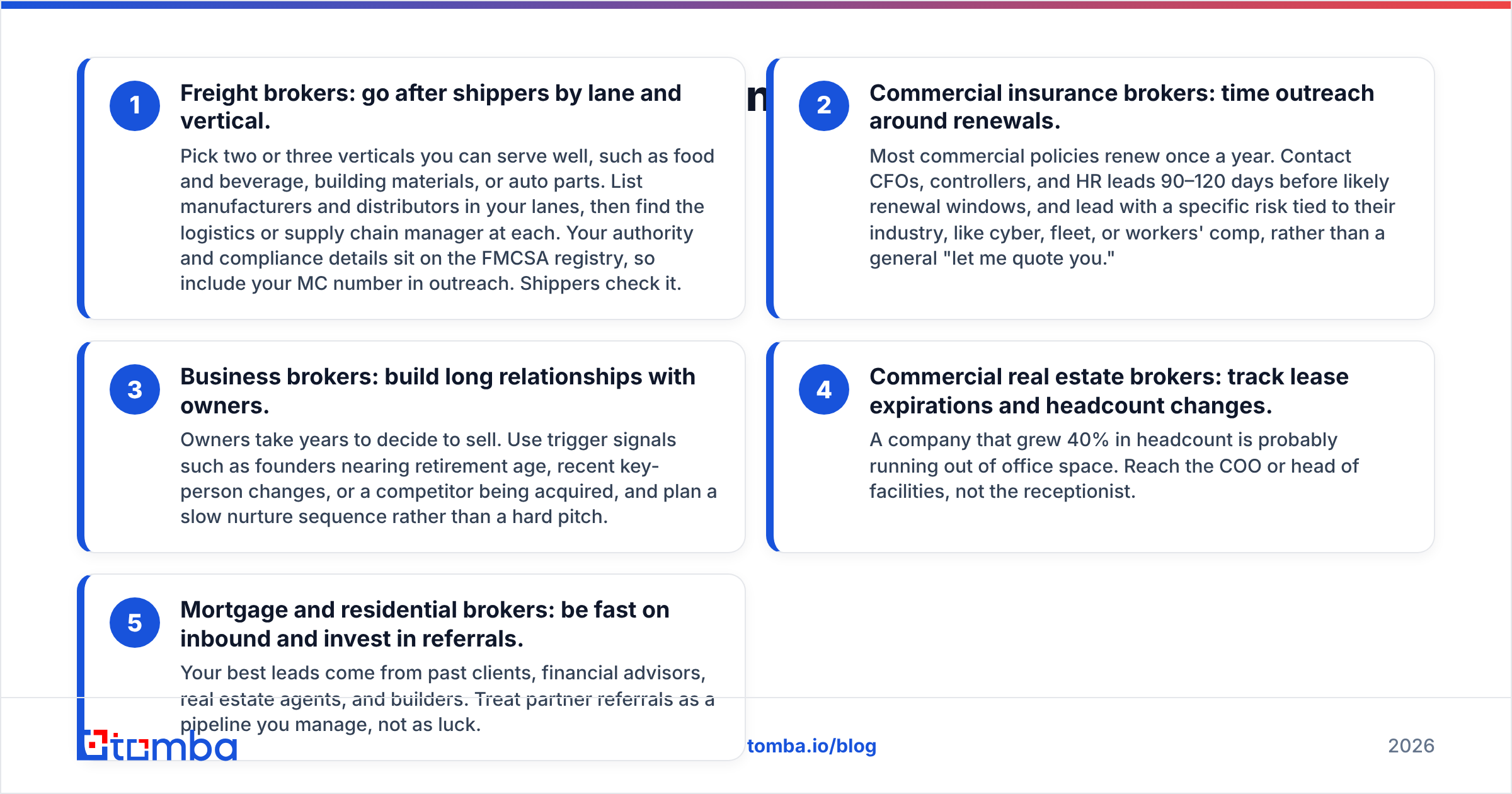
Each broker type has a different buyer, so the approach should change too. Here's what works for each.
- Freight brokers: go after shippers by lane and vertical. Pick two or three verticals you can serve well, such as food and beverage, building materials, or auto parts. List manufacturers and distributors in your lanes, then find the logistics or supply chain manager at each. Your authority and compliance details sit on the FMCSA registry, so include your MC number in outreach. Shippers check it.
- Commercial insurance brokers: time outreach around renewals. Most commercial policies renew once a year. Contact CFOs, controllers, and HR leads 90–120 days before likely renewal windows, and lead with a specific risk tied to their industry, like cyber, fleet, or workers' comp, rather than a general "let me quote you."
- Business brokers: build long relationships with owners. Owners take years to decide to sell. Use trigger signals such as founders nearing retirement age, recent key-person changes, or a competitor being acquired, and plan a slow nurture sequence rather than a hard pitch.
- Commercial real estate brokers: track lease expirations and headcount changes. A company that grew 40% in headcount is probably running out of office space. Reach the COO or head of facilities, not the receptionist.
- Mortgage and residential brokers: be fast on inbound and invest in referrals. Your best leads come from past clients, financial advisors, real estate agents, and builders. Treat partner referrals as a pipeline you manage, not as luck.
For the four B2B broker types, the workflow is the same underneath: pick accounts, find the decision-maker, verify the contact, send something relevant. The tools just make that loop cheaper.
How do you turn a target company into a verified broker lead?#
Here's a practical workflow a one- or two-person brokerage can run every week:
- Define the account list. Start with 100–300 companies that fit your niche. Export from a list provider, a trade association directory, or a load board's shipper list.
- Find the right person. Run each domain through a domain search, or look up a specific name with an email finder. If you already have LinkedIn profiles from Sales Navigator, a LinkedIn email finder speeds this step up.
- Verify before you send. Run every address through an email verifier. Remove invalid addresses and treat catch-all domains carefully. Keep your bounce rate under 2% to protect your sending domain.
- Enrich for relevance. Add company size, industry, location, and phone number so your first line talks about their situation.
- Sequence and follow up. Three to five touches over two to three weeks, mixing email and phone. Most broker deals close after the third or fourth contact, not the first.
This "account first, contact second" workflow is the same one enterprise sales teams run in platforms such as HubSpot. You're just running a smaller version with a tighter focus.
What mistakes waste the most money on broker leads?#
The same five come up again and again:
- Buying volume instead of fit. 5,000 contacts in the wrong verticals is worth less than 200 in the right ones.
- Skipping verification. Purchased and scraped data goes stale. People change jobs, and B2B contact databases lose roughly a fifth to a third of their accuracy each year. Sending to unverified lists leads to bounces, spam-folder placement, and eventually a burned domain.
- Following up too slowly on inbound. A portal lead that waits a day for a callback is usually gone.
- Giving up after one touch. A single cold email with no follow-up is one of the most common reasons brokers decide "outbound doesn't work."
- Not tracking cost per closed deal. Track the full chain for each source: spend, leads, conversations, quotes, closed deals. Without it, you end up renewing the vendor with the best sales pitch instead of the best results.
How much should a broker budget for leads?#
Work backwards from commission instead of starting from a lead budget.
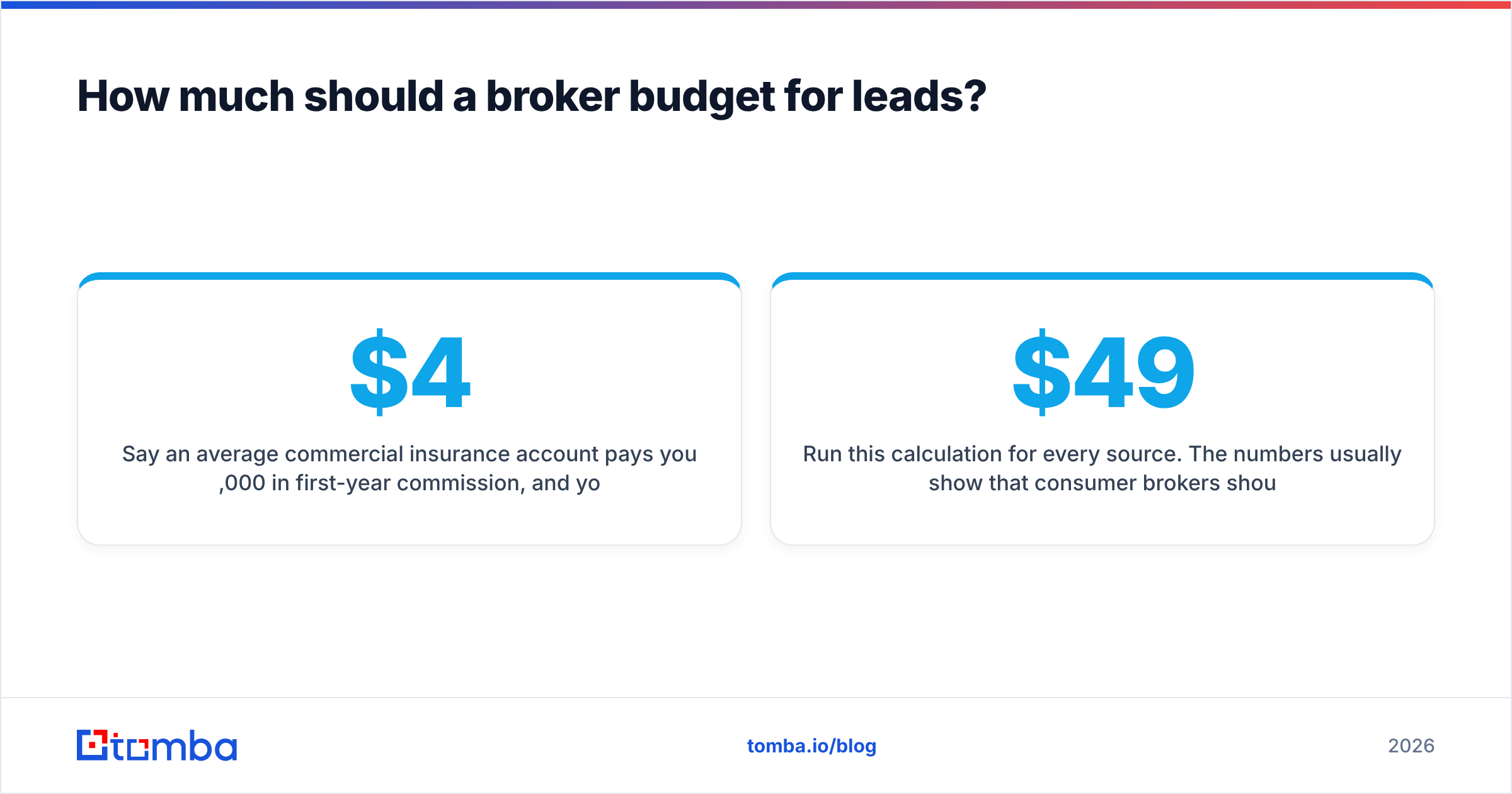
Say an average commercial insurance account pays you $4,000 in first-year commission, and you want to spend no more than 20% of that to acquire it. Your target cost per closed deal is $800. If a paid-lead source closes at 2% and costs $60 per lead, you're paying $3,000 per deal, which fails the test. If a self-built outbound list closes at 0.5% of contacts reached and costs $0.30 per verified contact plus two hours of your time per 100 contacts, you're around $60 in data per deal plus labor, which passes easily.
Run this calculation for every source. The numbers usually show that consumer brokers should put most of their budget into speed-to-lead and referrals, and B2B brokers should put most of theirs into outbound data plus the time to use it well. If you're pricing tools for the outbound side, Tomba pricing starts with a free tier of 25 searches a month, then Starter at $49/mo, Growth at $99/mo, and Pro at $249/mo, which is a useful reference point for your math.
Frequently asked questions about leads for brokers#
Are exclusive leads always better than shared leads? Usually, but not always. Shared leads can work for teams that respond in under five minutes and handle high volume. Exclusive leads win for anyone who can't guarantee that speed.
Is cold emailing businesses legal for brokers? In the US, B2B cold email is generally allowed under CAN-SPAM if you use accurate headers, a real physical address, and a working opt-out. The EU and UK have stricter rules based on legitimate interest. Check your local regulations and your licensing body's marketing rules before scaling up.
How many leads does a broker need per month? Work it out from your close rate. If you close 10% of qualified conversations and need four new clients a month, you need about 40 qualified conversations. At typical outbound reply rates, that often means contacting 800–1,500 verified prospects.
What's the fastest way for a new freight broker to find shippers? Pick one vertical and one region, build a list of 200 shippers, find and verify the logistics decision-maker at each, and start a short multi-touch sequence that mentions your lanes and MC number.
Which lead source should you start with?#
If you're a mortgage or residential broker, fix your speed-to-lead first, then add one exclusive vendor with a clear return policy, and invest steadily in referral partners. If you're a freight, commercial insurance, business, or commercial real estate broker, the best return usually comes from building your own verified prospect list and working it consistently.
For that second group, Tomba Email Finder covers the tedious middle step. Enter a company domain or a decision-maker's name and get a professional email address back, then verify it before it goes into your sequence. Start on the free tier with 25 searches a month to test it on your own target accounts, and move to Starter at $49/mo once your weekly prospecting routine is running.
Related guides#
// get started
Find, verify and enrich your first contacts today
Start on the free plan with 25 searches a month, then scale when your team is ready.
Free plan · No credit card required · GDPR & CCPA
// about the author