Leads for Small Business: 9 Proven Ways to Get Them in 2026
Most lead-gen advice assumes a marketing team and a five-figure budget. Here are nine channels a small business can run, compared by cost, speed, and effort, plus how to pick the two worth starting this week.
TL;DR
- Small businesses rarely lack lead sources. What they lack is focus. Pick one inbound channel and one outbound channel and run both for 90 days before you add anything else.
- Referrals, a Google Business Profile, and targeted cold email are the three cheapest ways for a team under 20 people to get leads. All three can produce results within weeks.
- Paid ads and content marketing can work, but paid ads cost money every month and content takes 6–12 months to build up. Budget for that before you start.
- Write down your ideal customer before you buy a tool. A precise ICP beats a big list every time.
- Verify every email address before you send to it. A bounce rate above 2–3% can quietly wreck your domain's reputation, and a small sending domain recovers slowly.
What counts as a lead for a small business?#
A lead is a person or company that has shown some sign they might buy from you, or that clearly fits the profile of people who already do. Wikipedia's overview of lead generation defines it as starting consumer interest in a product or service. For a small business, the more useful definition is narrower:
A lead is a named person, with a working way to contact them, at an organisation that matches your ideal customer profile.
Three things have to be true in that definition:
- A named person. "Acme Corp" is an account. "Sarah Chen, Operations Manager at Acme Corp" is a lead.
- A working contact method. That means a verified email address, a direct phone number, or an inbound form submission. An email you guessed isn't a contact method until you've checked it.
- ICP fit. A lead who can't afford you, doesn't need you, or can't make the buying decision just takes up your calendar.
This matters because small teams have no spare capacity. At a 200-person company, a bad lead costs an SDR 15 minutes. At a 6-person company, the founder is often the one chasing it, and that time comes out of delivery, hiring, or product work.
How do you define who you're actually looking for?#
Before you open any tool, write a one-page ideal customer profile (ICP). Most small businesses skip this step, and it's the main reason their lead lists convert at 0.5% when they could convert at 5%.
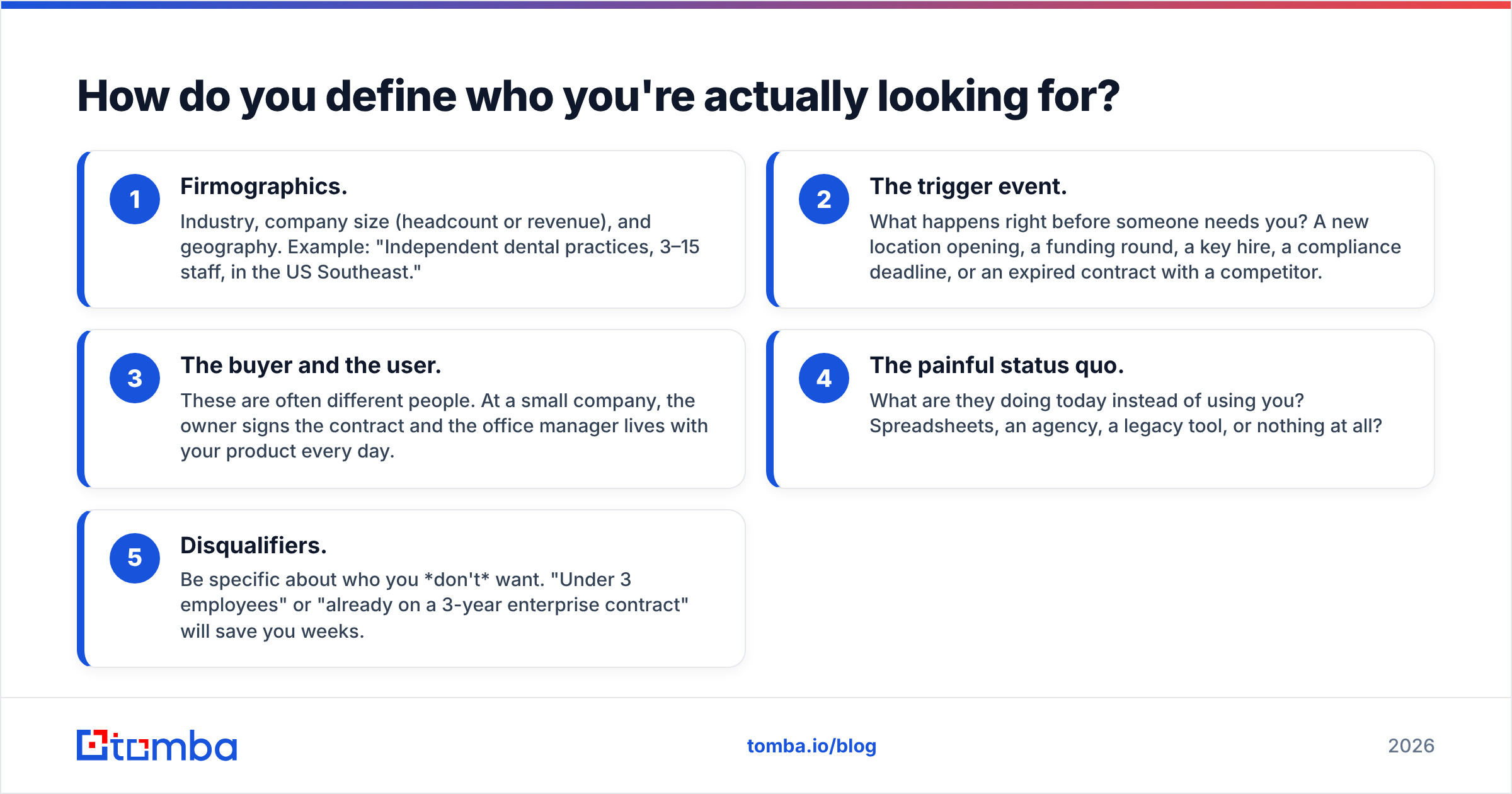
Your ICP should cover five things:
- Firmographics. Industry, company size (headcount or revenue), and geography. Example: "Independent dental practices, 3–15 staff, in the US Southeast."
- The trigger event. What happens right before someone needs you? A new location opening, a funding round, a key hire, a compliance deadline, or an expired contract with a competitor.
- The buyer and the user. These are often different people. At a small company, the owner signs the contract and the office manager lives with your product every day.
- The painful status quo. What are they doing today instead of using you? Spreadsheets, an agency, a legacy tool, or nothing at all?
- Disqualifiers. Be specific about who you don't want. "Under 3 employees" or "already on a 3-year enterprise contract" will save you weeks.
Base it on your best 10 existing customers, not on who you wish would buy. If you have fewer than 10 customers, interview the ones you do have and ask what was happening in their business the week they found you.
Which lead generation channels work best for small businesses?#
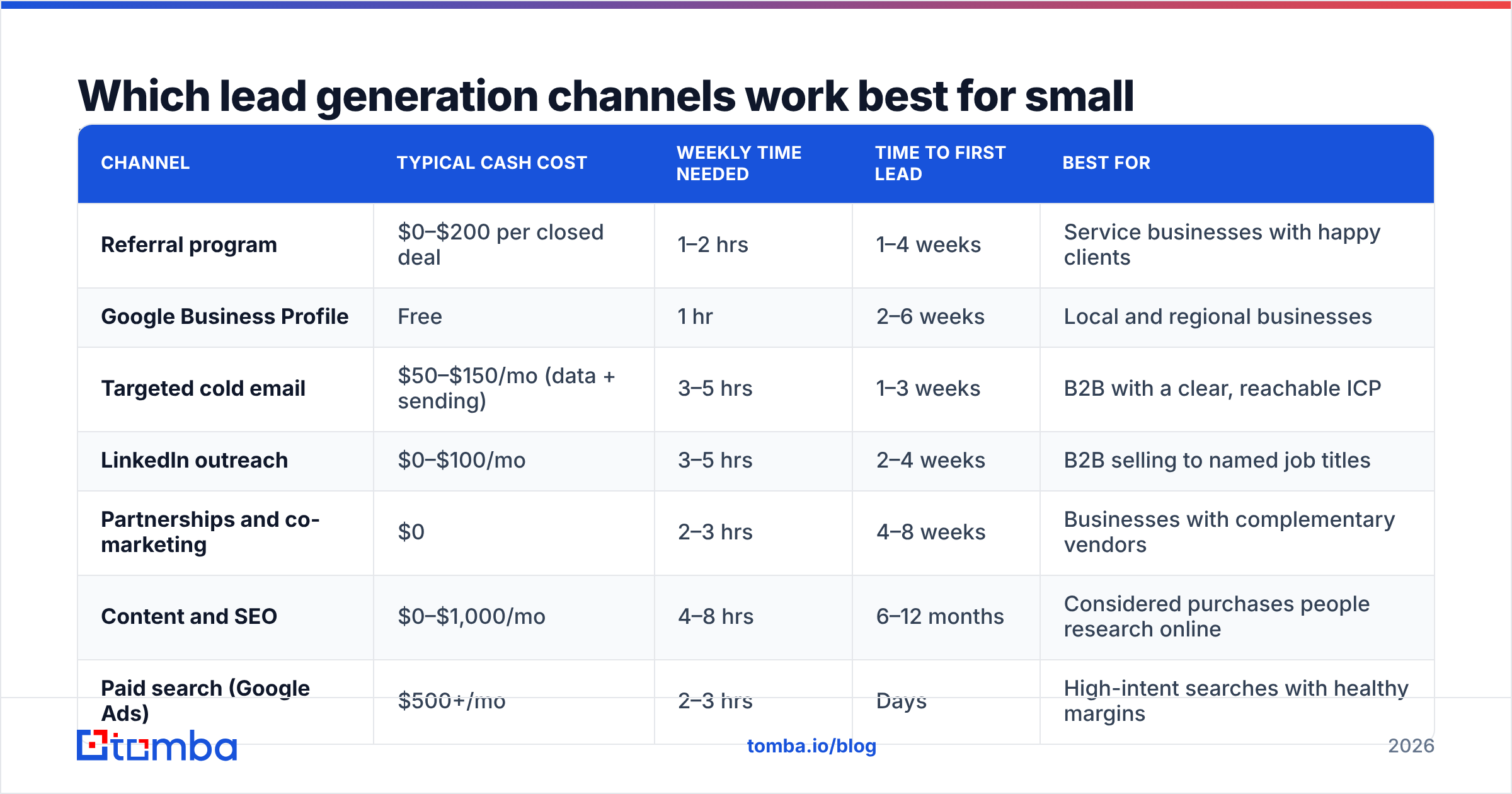
There are dozens of lead generation tactics. These nine work reliably for teams without a dedicated marketing department. The table compares them on what small businesses care about most: cash cost, time cost, and how fast the first lead shows up.
| Channel | Typical cash cost | Weekly time needed | Time to first lead | Best for |
|---|---|---|---|---|
| Referral program | $0–$200 per closed deal | 1–2 hrs | 1–4 weeks | Service businesses with happy clients |
| Google Business Profile | Free | 1 hr | 2–6 weeks | Local and regional businesses |
| Targeted cold email | $50–$150/mo (data + sending) | 3–5 hrs | 1–3 weeks | B2B with a clear, reachable ICP |
| LinkedIn outreach | $0–$100/mo | 3–5 hrs | 2–4 weeks | B2B selling to named job titles |
| Partnerships and co-marketing | $0 | 2–3 hrs | 4–8 weeks | Businesses with complementary vendors |
| Content and SEO | $0–$1,000/mo | 4–8 hrs | 6–12 months | Considered purchases people research online |
| Paid search (Google Ads) | $500+/mo | 2–3 hrs | Days | High-intent searches with healthy margins |
| Paid social (Meta, LinkedIn) | $500+/mo | 2–4 hrs | 1–2 weeks | Visual products, event promotion |
| Industry events and meetups | $0–$2,000 per event | Varies | Immediate but lumpy | Niche verticals with active communities |
Two patterns stand out. The cheapest channels (referrals, your Google profile, partnerships) cost time, not money. The fastest paid channels (search and social ads) stop producing leads the day you stop paying. A healthy small-business pipeline usually pairs one of each.
How do you get more referral leads?#
Referrals convert better than almost any other source because trust is transferred before the first call. Most small businesses still leave them to chance.
To make referrals repeatable:
- Ask at the right moment. Ask right after a win: a project you shipped, a problem you solved, or a renewal. Don't ask in the invoice email.
- Make the ask specific. "Do you know anyone who might need us?" gets a polite no. "Do you know another practice manager who's struggling with patient no-shows?" gets names.
- Give them something to forward. Write a short, three-sentence blurb they can paste into an email or Slack message without editing.
- Reward both sides. A discount for the new customer and a credit or gift for the referrer works better than a one-sided bounty.
Track every referral in your CRM, even if that CRM is a free HubSpot account. Within six months you'll know which clients send you business. Those are the relationships to invest in.
How do local businesses get leads from Google?#
If your customers are within driving distance, your Google Business Profile is probably your highest-ROI lead source, and it's free. It decides whether you show up in the map pack when someone searches "accountant near me" or "commercial cleaning [city]."
What moves the needle:
- Complete every field. That includes categories, service areas, hours, services with descriptions, and attributes.
- Collect reviews steadily. Five reviews a month for a year beats 60 reviews in one week followed by silence. Reply to every review, including the bad ones.
- Post weekly. Short updates, offers, and photos of real work signal to Google that the business is active.
- Track calls and form fills. Use a tracking number or UTM-tagged website link so you can tell profile leads apart from other traffic.
For B2B businesses that sell regionally (IT support, commercial trades, logistics), this channel works much better than most people expect.

How should a small business run cold email without burning its domain?#
Cold email is still the fastest way for a small B2B company to start conversations with people who have never heard of it. It's also the easiest channel to get wrong. The failure is rarely the copy. It's usually the data and the sending setup.
The workflow that works for small teams:
- Build a small, precise list. Start with 100–300 contacts that match your ICP exactly. Use your ICP criteria in a tool like LinkedIn Sales Navigator, an industry directory, or a B2B database. Established list providers such as BookYourData can also be a good starting point if you'd rather buy a segmented list than build one yourself.
- Find the right person's email. If you know the company and the decision-maker's name, an email finder returns their likely professional address. If you only know the company, a domain search lists the publicly associated addresses at that domain so you can pick the right role.
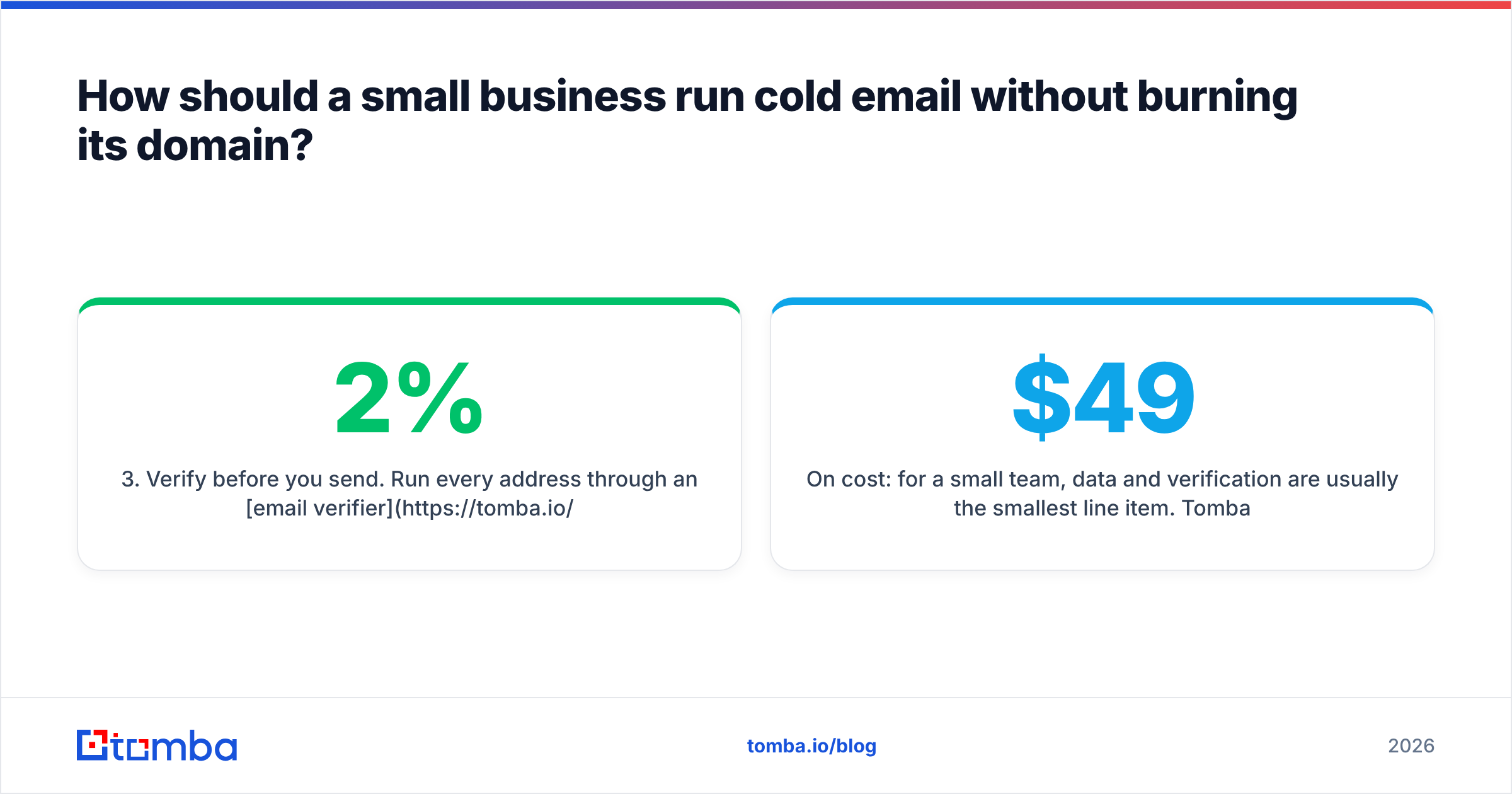
- Verify before you send. Run every address through an email verifier. Remove invalids, and handle catch-all addresses carefully. Keep your bounce rate under 2%.
- Use a secondary sending domain. Send from something like
getyourbrand.comrather than your main domain. Set up SPF, DKIM, and DMARC, and warm the domain up for 2–3 weeks. - Send low volume. Send 20–40 emails per inbox per day. If you need more volume, add more inboxes rather than sending more from one.
- Write short, relevant emails. Three to five sentences. Mention the trigger event, state one clear problem you solve, and ask for a small next step.
On cost: for a small team, data and verification are usually the smallest line item. Tomba, for example, has a free tier with 25 searches a month, which is enough to test your ICP. Paid plans start at $49/mo, with Growth at $99/mo and Pro at $249/mo (Tomba pricing). Other email finders and all-in-one platforms sit at similar price points. Compare them on G2 against your own sample list rather than trusting any vendor's accuracy claims, including Tomba's.
Is LinkedIn worth it for small business lead generation?#
For B2B, yes, if your buyers are active there. LinkedIn works best as a warm-up channel next to email, not as a replacement for it.
A practical rhythm:
- Optimise your profile first. Your headline should say who you help and how, not just your job title.
- Connect without a pitch. Send a short, specific connection note, or none at all. Pitching in the connection request lowers your acceptance rate.
- Engage before you message. Comment thoughtfully on a prospect's posts for a week or two before you reach out.
- Post 2–3 times a week. Write about the problems your ICP has. Posts that teach something consistently outperform product promotion.
Sales Navigator (around $100/mo depending on plan and region) is worth it once you're prospecting several hours a week. Before that point, the free search filters are enough to validate your ICP.
Should small businesses pay for ads to get leads?#
Paid ads are the only channel where you can turn on lead flow the same week. That's their main advantage and also their main risk.
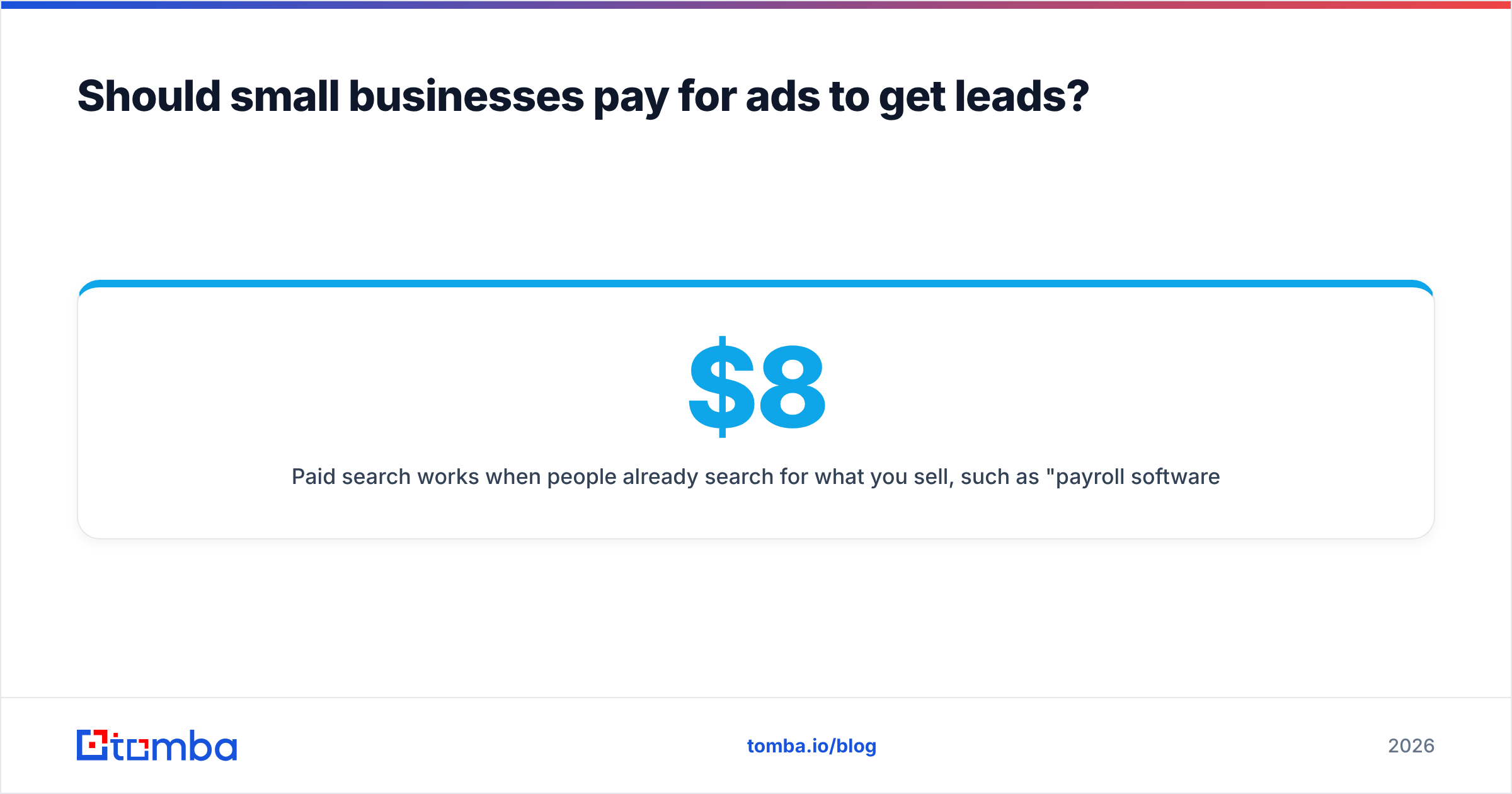
Paid search works when people already search for what you sell, such as "payroll software for restaurants" or "emergency HVAC repair." You're capturing demand that already exists. Check your numbers before you commit: if a click costs $8 and 5% of clicks become leads, each lead costs $160. Your close rate and deal size need to support that.
Paid social creates demand rather than capturing it. It suits products that are easy to understand visually, or offers with a clear hook such as a free audit, a webinar, or a limited promotion.
Rules for small budgets:
- Run one campaign at a time, aimed at one ICP segment, with one offer.
- Send traffic to a dedicated landing page, not your homepage.
- Set a hard monthly cap and a 60-day kill criterion before you launch.
HubSpot's marketing statistics are a useful benchmark for cost-per-lead and conversion-rate ranges by channel. Treat them as rough context, not targets. Your own numbers after 60 days matter more than any industry average.
Is content marketing too slow for a small business?#
For some businesses it is. For others it's the channel that eventually makes all the others cheaper.
Content makes sense if:
- Your buyers research before they buy (software, professional services, high-ticket B2B).
- You or someone on the team can write or record consistently. One good piece a week beats four rushed ones.
- You can wait 6–12 months for compounding results while other channels pay the bills.
Start with bottom-of-funnel topics: comparisons, pricing explainers, "how to choose a [your category]" guides, and answers to the exact questions prospects ask on sales calls. These rank for low-volume, high-intent searches and convert far better than broad thought-leadership posts.
How do you choose the right mix of lead sources?#
Pick two channels. Run them for 90 days. Measure them honestly. Then decide.
A simple way to choose:
- Local or regional customers? Start with your Google Business Profile plus referrals.
- B2B with clearly identifiable decision-makers? Start with targeted cold email plus LinkedIn.
- High-intent search demand and healthy margins? Start with paid search plus referrals.
- Complex purchase with a long research cycle? Start with content plus partnerships, and use cold email to fill the gap while content builds.
Track four numbers per channel: leads generated, cost per lead (include your time at a real hourly rate), lead-to-meeting rate, and meeting-to-close rate. Most small businesses find one channel produces most of their revenue. Once you know which one it is, move time and money toward it.

What mistakes cost small businesses the most leads?#
These come up again and again:
- Buying volume instead of fit. 10,000 loosely targeted contacts will do worse than 300 precise ones, and can damage your sender reputation along the way.
- Sending to unverified data. Every hard bounce tells mailbox providers you don't know who you're emailing. Verify first, every time.
- No follow-up. Most replies to cold outreach come from the second to fourth touch, not the first. A single email isn't really a campaign.
- Switching channels too early. Four weeks isn't enough time to judge SEO or partnerships. Commit to the 90 days.
- Not tracking where leads come from. If you can't tie revenue to a source, you'll keep funding the channel that feels busiest instead of the one that pays.
- Slow response to inbound. An inbound lead contacted within the hour is far more likely to convert than one contacted the next day. Set up an alert and reply quickly.
Where should you start this week?#
Write your ICP on one page. Choose one inbound and one outbound channel from the table above. If outbound B2B email is one of them, build your first list of 100 contacts who exactly match your ICP, and find and verify their addresses before a single email goes out.
That last step is where Tomba Email Finder fits in. Give it a name and a company domain and it returns a verified professional email address, or use domain search to see who's reachable at a target account. You can start on the free tier (25 searches a month) to test your ICP before paying anything, and move to the $49/mo Starter plan once the channel shows results.
Related guides#
// get started
Find, verify and enrich your first contacts today
Start on the free plan with 25 searches a month, then scale when your team is ready.
Free plan · No credit card required · GDPR & CCPA
// about the author