How to Get Leads for Your Business in 2026: 7 Channels Compared
Most businesses don't lack leads. They lack the right ones. Here are 7 lead channels ranked by cost, speed, and quality, plus a 30-day plan to fill your pipeline without burning your budget or your domain.
TL;DR
- Getting more leads for your business starts with a tight ideal customer profile (ICP), not a bigger list. Volume without fit fills your CRM with contacts who never buy.
- Outbound email and LinkedIn bring in leads fastest and cost the least to start. SEO and referrals build the cheapest pipeline over time but take months to show results.
- The fastest channel is only as good as its data. Unverified emails hurt your sender reputation and quietly shut down your whole outbound engine.
- Run two channels together: one fast (outbound) and one that compounds (content or referrals). Give them 30 days of focused work before you judge them.
- Measure cost per qualified lead and pipeline created, not raw lead count.
What does "leads for your business" actually mean?#
A lead is a person or company that has some chance of buying from you. That definition is so loose it causes most of the problems teams run into with lead generation.
For planning, split leads into three buckets:
- Contacts: a name plus a way to reach them, such as an email, a phone number or a LinkedIn profile. They haven't shown any interest yet.
- Engaged leads: someone who replied, downloaded something, attended a webinar or visited your pricing page. Marketing teams often call these a marketing qualified lead (MQL).
- Qualified opportunities: someone who fits your ICP, has the problem you solve, and has agreed to a conversation about solving it.
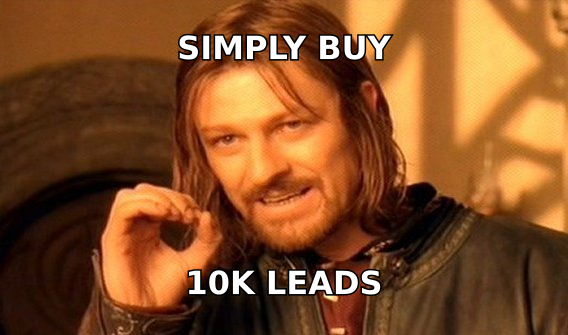
When a founder says "we need more leads," they almost always mean the third bucket. When a vendor sells "10,000 leads," it means the first. That gap explains why so many lead-gen investments feel like they failed.
The Wikipedia entry on lead generation gives the textbook definition. In practice, what counts is how many conversations with qualified buyers you get per dollar and per hour spent.
Why do most businesses struggle to generate quality leads?#
Businesses rarely struggle because they tried too few channels. They struggle because they tried too many at once, with weak targeting and bad data. The pattern usually looks like this:
- No written ICP. "SMBs in the US" is a market, not an ICP. "Series A–C B2B SaaS companies with 50–200 employees that just hired a VP of Sales" is an ICP.
- Buying a list instead of building one. Purchased lists go out of date quickly because people change jobs and domains change owners. Emailing stale contacts gets you bounces.
- Skipping verification. A bounce rate of a few percent is enough for mailbox providers to start sending your emails to spam.
- Judging too early. A channel tested for one week with 50 sends tells you nothing.
- Counting leads, not pipeline. A webinar that produces 400 registrants and zero opportunities looks great on a dashboard.
The fix isn't glamorous. Define who you're selling to, pick two channels, feed them clean data, and track what turns into revenue.
How do you define the right leads before you chase them?#
Everything else depends on this step. Before you open any tool, work through these five items:
- Firmographics. Industry, headcount range, revenue band, geography and funding stage. Be specific enough that you could build a list from these filters alone.
- Trigger events. These are reasons to buy now: a new funding round, a leadership hire, a tech-stack change, expansion into a new region, or a job posting for the role your product supports.
- Buyer and champion roles. Who signs, and who feels the pain every day? These are usually different people, and you need emails for both.
- Disqualifiers. Write down who you won't sell to, such as companies that are too small, the wrong region, or a competitor's locked-in customers. This saves more time than any other item on the list.
- Proof you can show them. A case study, a metric or a customer logo from their segment. If you can't show relevant proof, you're not ready to target that segment at scale.
Once this is written down, every channel below gets cheaper, because you stop paying to reach people who were never going to buy.
Which lead generation channels work best in 2026?#
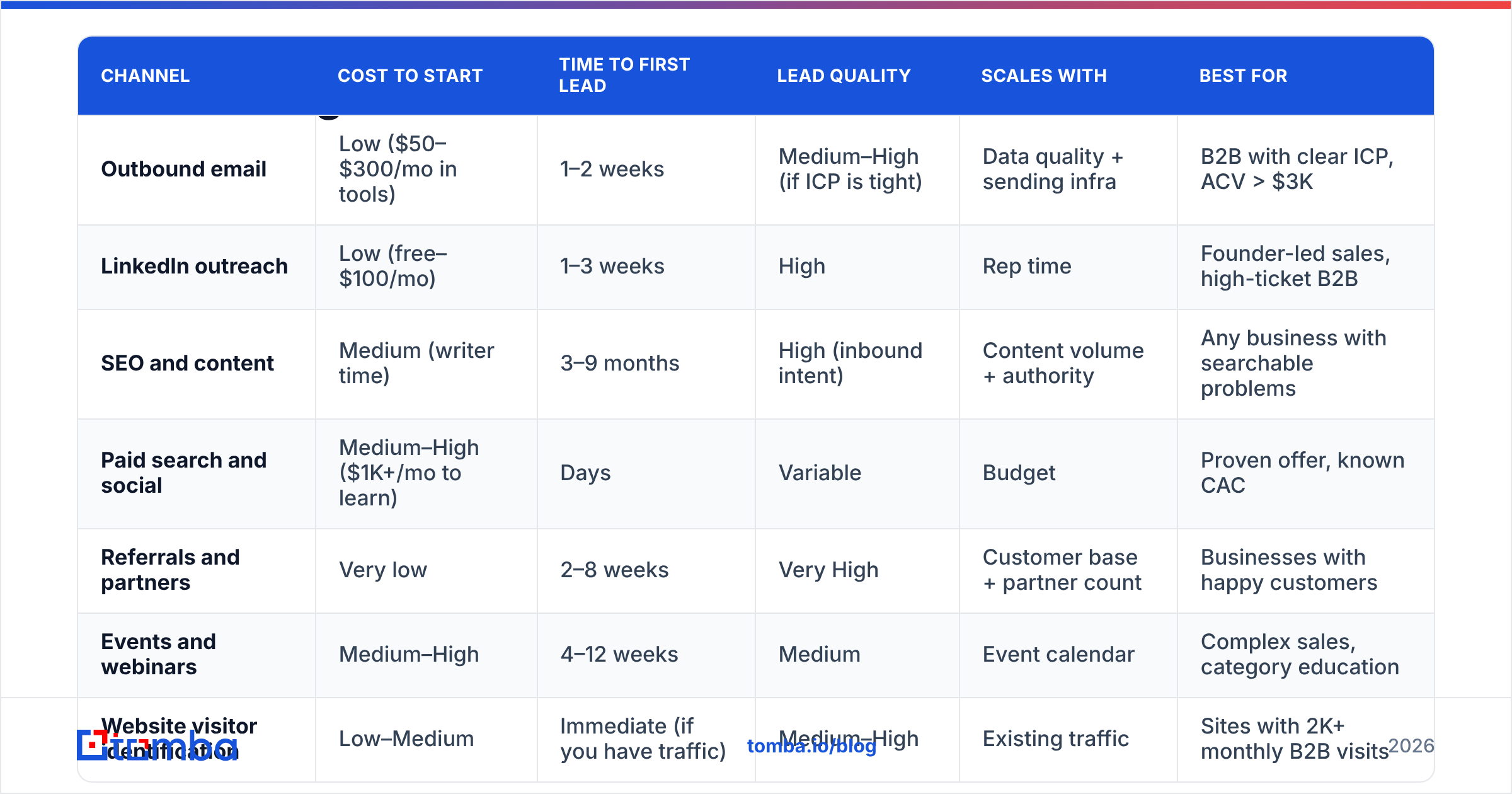
No single channel wins for every business. Each one below is ranked on the things that matter when you're deciding where the next dollar or hour goes.
| Channel | Cost to start | Time to first lead | Lead quality | Scales with | Best for |
|---|---|---|---|---|---|
| Outbound email | Low ($50–$300/mo in tools) | 1–2 weeks | Medium–High (if ICP is tight) | Data quality + sending infra | B2B with clear ICP, ACV > $3K |
| LinkedIn outreach | Low (free–$100/mo) | 1–3 weeks | High | Rep time | Founder-led sales, high-ticket B2B |
| SEO and content | Medium (writer time) | 3–9 months | High (inbound intent) | Content volume + authority | Any business with searchable problems |
| Paid search and social | Medium–High ($1K+/mo to learn) | Days | Variable | Budget | Proven offer, known CAC |
| Referrals and partners | Very low | 2–8 weeks | Very High | Customer base + partner count | Businesses with happy customers |
| Events and webinars | Medium–High | 4–12 weeks | Medium | Event calendar | Complex sales, category education |
| Website visitor identification | Low–Medium | Immediate (if you have traffic) | Medium–High | Existing traffic | Sites with 2K+ monthly B2B visits |
1. Outbound email#
Outbound email is still the most controllable way to get B2B leads. You pick who hears from you, what they hear and when. It depends entirely on two things: accurate contact data and a healthy sending domain.
A typical workflow is to build a target account list and then run a domain search to find the right people at each company. Next, verify every address and send short, specific emails that reference a trigger event. Keep volume per inbox modest and use secondary sending domains so your main domain stays protected.
Watch out for: sending to unverified lists. Checking every address with an email verifier before it goes into a sequence costs very little compared with rebuilding a burned domain.
2. LinkedIn outreach and social selling#
LinkedIn works best when the person reaching out has credibility, like a founder or a senior rep who posts useful material. Connection requests with no note, followed by a pitch, get ignored. Commenting thoughtfully on a prospect's posts for a week before you connect does not.
LinkedIn pairs well with email. Use LinkedIn for warmth and context, and email for the actual ask, since inboxes are easier to work in and easier to track.
3. SEO and content#
This is the slowest channel to start and usually the cheapest over time. A single article that ranks for a problem your buyers search for can bring in inbound leads for years. HubSpot's marketing statistics consistently show inbound content among the channels marketers rely on most for pipeline.
Start with bottom-of-funnel topics: comparisons, "how to solve [specific problem]," and pricing questions. They have lower search volume, but the people searching them are close to buying.
4. Paid search and paid social#
Paid channels are the fastest way to buy attention and the fastest way to lose money if your offer isn't proven. Run ads only after you know which message turns prospects into customers, ideally because outbound or sales calls already showed you. Treat ad spend as a way to scale what already works, not as a way to find out what works.
5. Referrals and partnerships#
Referred leads close faster and churn less than leads from almost any other source, and most businesses barely ask for them. Build a simple routine: ask every customer who gives you a high NPS score, or who just hit a milestone, for one introduction. Then add partners who sell to the same buyer with a non-competing product.
6. Events and webinars#
Events are good for categories that need explaining and for deals that need trust. They're expensive per lead, so the follow-up decides whether they pay off. Your team should contact every attendee within 48 hours, with a message that mentions something specific to them.
7. Website visitor identification#
If your site already gets B2B traffic, many of your warmest leads are visiting your pricing page right now and leaving without filling out a form. Visitor identification tools match that traffic to companies. You can then find the right contact at each account and reach out while the interest is still recent. This is outbound with a built-in intent signal.
Should you buy leads or build your own list?#
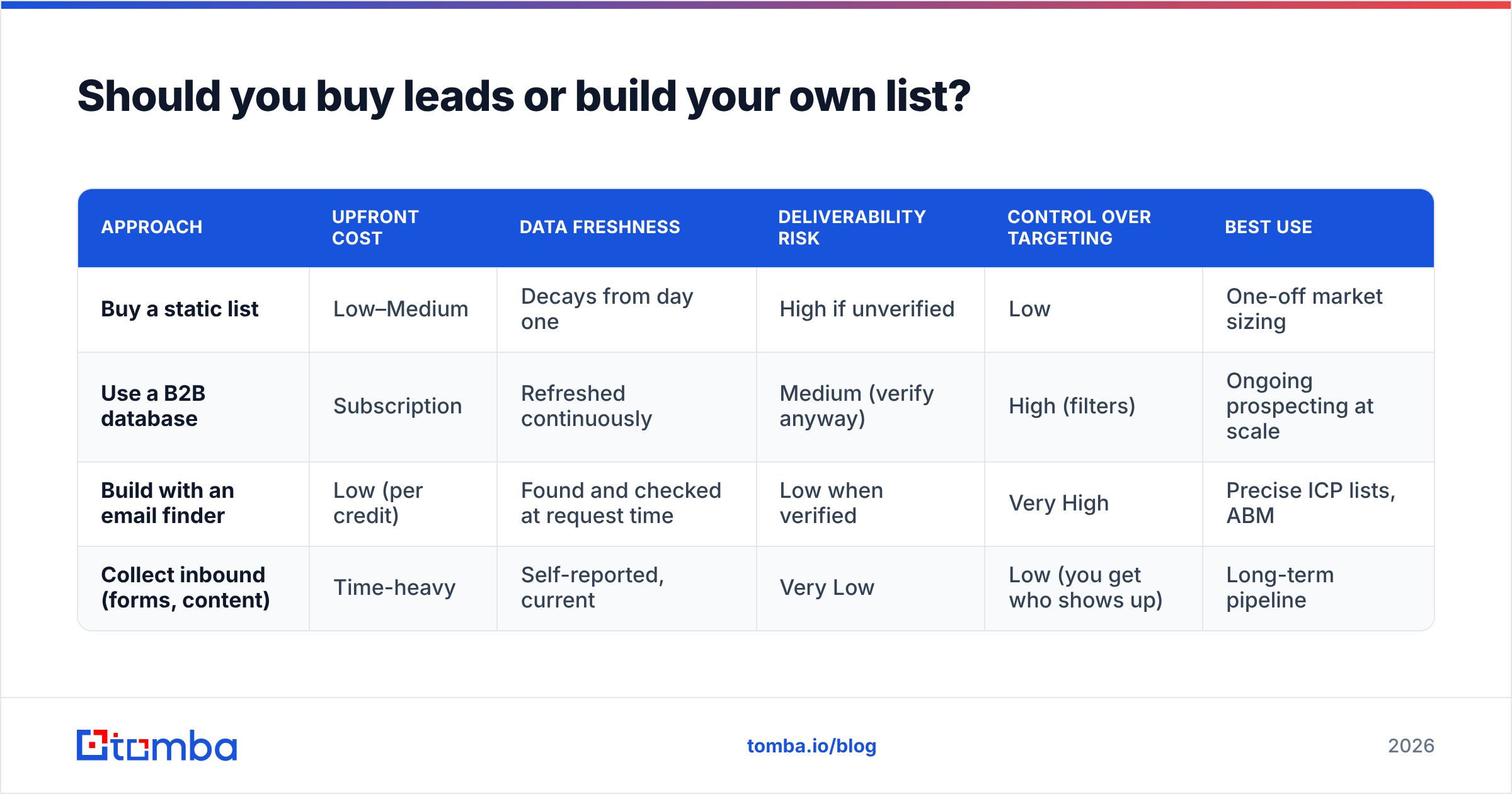
This is the most common question, and the honest answer is that it depends on how you'll use the list.
| Approach | Upfront cost | Data freshness | Deliverability risk | Control over targeting | Best use |
|---|---|---|---|---|---|
| Buy a static list | Low–Medium | Decays from day one | High if unverified | Low | One-off market sizing |
| Use a B2B database | Subscription | Refreshed continuously | Medium (verify anyway) | High (filters) | Ongoing prospecting at scale |
| Build with an email finder | Low (per credit) | Found and checked at request time | Low when verified | Very High | Precise ICP lists, ABM |
| Collect inbound (forms, content) | Time-heavy | Self-reported, current | Very Low | Low (you get who shows up) | Long-term pipeline |
Established data providers such as BookYourData, Apollo, ZoomInfo and Tomba each have a place. A curated database is useful when you need thousands of contacts filtered by industry and title quickly. Building lists account by account works better when your ICP is narrow and every contact has to be relevant. Browse G2's lead generation category to see how buyers review different providers.
Whichever you pick, one rule doesn't change: verify before you send. Data from any source decays, and your domain reputation takes the damage.

How do you turn contacts into qualified leads?#
A contact only becomes a lead when you give them a reason to respond. That reason comes from relevance, not cleverness. Use this simple structure for any first touch, whether by email or LinkedIn:
- Trigger: "Saw you just opened a Berlin office."
- Implication: "Teams expanding into DACH usually hit [specific problem] around month two."
- Proof: "We helped [similar company] cut that from X to Y."
- Low-friction ask: "Worth a 15-minute look, or not a priority right now?"
Keep it under 100 words. Send a second touch with new information three to four days later. Then send a short breakup note. Most replies come from the follow-ups, not the first email.
Qualify quickly on the first call. Confirm the problem, the timeline, and who else is involved. If two of those three are missing, put the lead into a nurture sequence instead of your forecast.
How much should you spend to get leads for your business?#
Work backward from what a customer is worth:
- Customer lifetime value (LTV). Take average contract value times gross margin times expected lifetime.
- Target CAC. A common benchmark is LTV:CAC of 3:1 or better.
- Allowable cost per opportunity. Multiply target CAC by your opportunity-to-close rate.
- Allowable cost per lead. Multiply cost per opportunity by your lead-to-opportunity rate.
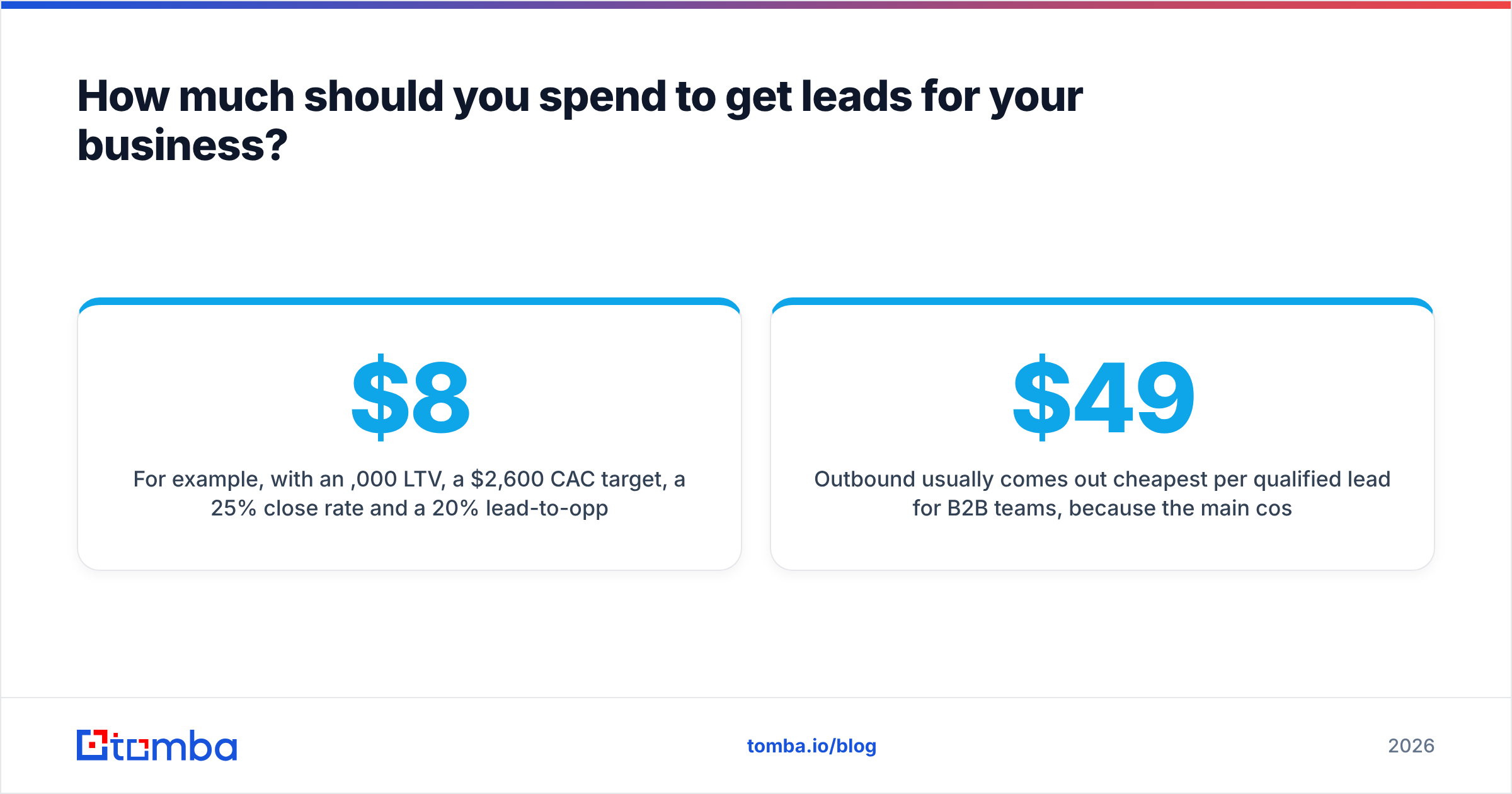
For example, with an $8,000 LTV, a $2,600 CAC target, a 25% close rate and a 20% lead-to-opportunity rate, you can afford about $650 per opportunity and roughly $130 per qualified lead. That number tells you right away whether paid ads, events or outbound fit your economics.
Outbound usually comes out cheapest per qualified lead for B2B teams, because the main costs are data and software. Email finder plans generally range from free tiers to a few hundred dollars a month. Tomba, for example, starts with 25 free searches a month, then $49/mo for Starter and $99/mo for Growth. Most other finders and databases fall in a similar range for small teams.
What does a 30-day plan to generate leads look like?#
If you're starting from scratch, this plan gets you to real data within a month.
Week 1: Foundation
- Write your ICP, including disqualifiers.
- Set up two or three secondary sending domains with SPF, DKIM and DMARC, and start warming them up.
- Pick 100 target accounts that fit your ICP and have a recent trigger event.
Week 2: Build the list
- Find two or three contacts per account: a decision maker and a champion.
- Verify every email and drop invalid and risky results.
- Write one sequence of three emails and one LinkedIn connection note.
Week 3: Launch and learn
- Send to the first 100–150 contacts at a conservative volume per inbox.
- Engage with prospects on LinkedIn at the same time.
- Ask five happy customers for one referral each.
Week 4: Measure and adjust
- Track reply rate, positive reply rate and meetings booked.
- Rewrite the weakest email and test a second trigger event.
- Decide which channel gets more budget next month based on cost per qualified conversation.
Treat a positive reply rate of 2% or more on well-targeted outbound as a starting point. Below 1% usually points to a targeting problem, not a copywriting problem.
Which metrics tell you if your lead generation is working?#
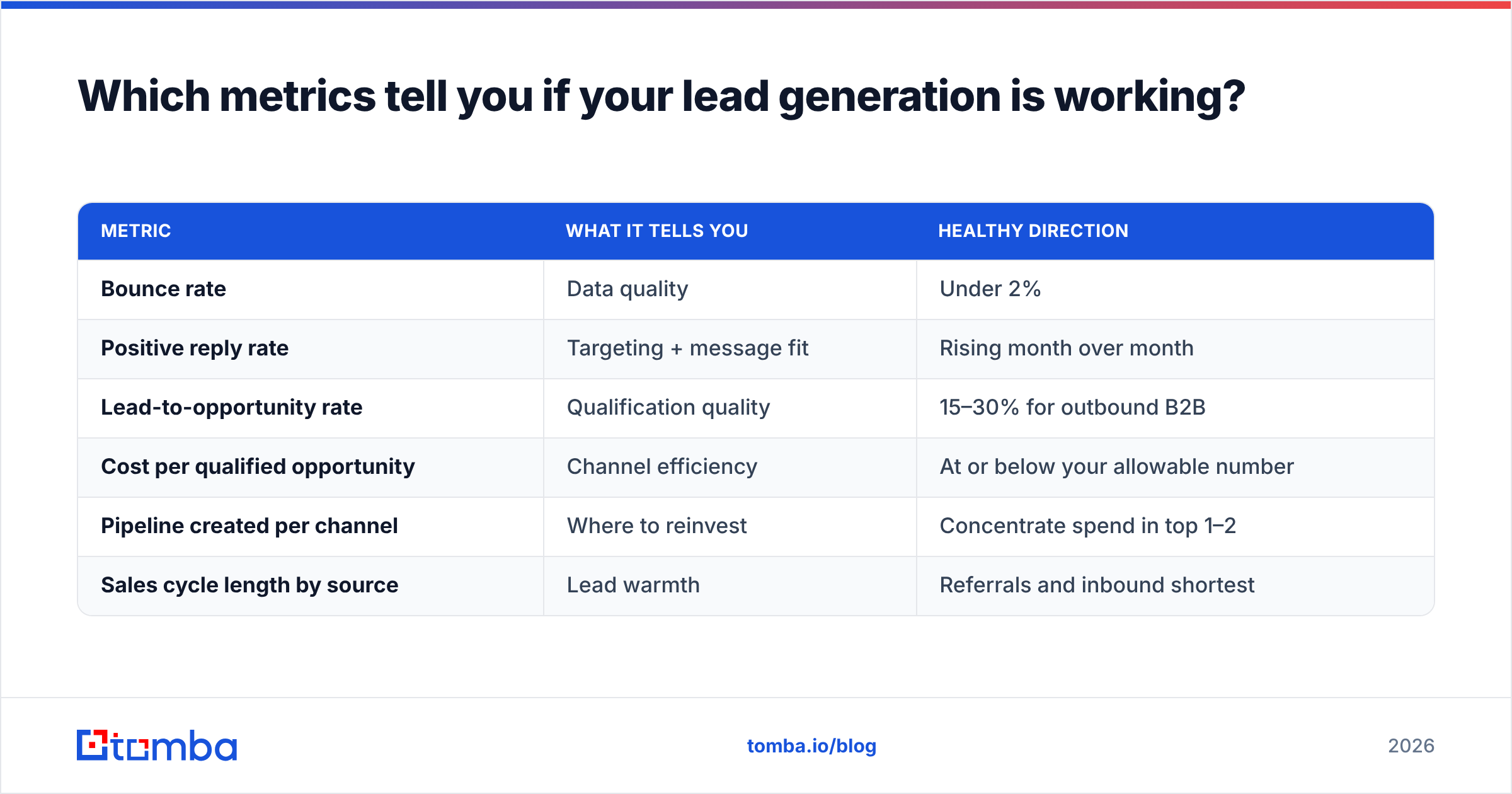
Ignore vanity numbers and track these:
| Metric | What it tells you | Healthy direction |
|---|---|---|
| Bounce rate | Data quality | Under 2% |
| Positive reply rate | Targeting + message fit | Rising month over month |
| Lead-to-opportunity rate | Qualification quality | 15–30% for outbound B2B |
| Cost per qualified opportunity | Channel efficiency | At or below your allowable number |
| Pipeline created per channel | Where to reinvest | Concentrate spend in top 1–2 |
| Sales cycle length by source | Lead warmth | Referrals and inbound shortest |
If a channel's bounce rate goes up, pause it before you scale it. If lead-to-opportunity drops while lead volume rises, you've widened targeting too much.
Get better leads, not just more of them#
The businesses that generate leads consistently aren't using secret channels. They know exactly who they sell to, they reach those people with accurate contact data, and they keep working at the channels that are proven to work. Start with a sharp ICP, pair one fast channel with one that compounds, and verify every address before you hit send.
If outbound is one of your two channels, Tomba Email Finder helps you find the right decision maker at each target account by name, domain or company. It includes built-in verification so your sequences reach real inboxes. You can start on the free tier with 25 searches a month and run your first 30-day test before you spend anything.
Related guides#
Ready to find emails that actually work?
Join 150,000+ professionals who stopped guessing and started sending. Free credits on signup — no credit card required.
Get the Tomba newsletter
Practical outbound tactics and product updates — once every two weeks.
About the author