Leads Phone Number: How to Find and Verify Direct Dials in 2026
Most B2B phone data leads to a switchboard, a voicemail tree, or a disconnected line. Here are seven ways to find the right number for a lead, check that it works, and call it without breaking compliance rules.
TL;DR
- A usable leads phone number is a direct dial or mobile that belongs to your target person. A company switchboard doesn't count.
- The best sources, from highest to lowest yield: phone-finder and enrichment tools, your own CRM and inbound data, company websites and filings, and manual research on LinkedIn and events.
- Validate every number before it goes into a dialer. Disconnected, reassigned, and misclassified lines waste rep time and can create compliance risk.
- Pair phone data with a verified email. Multi-channel sequences get more replies than phone-only or email-only outreach.
- Before you call mobiles, check the rules where your lead is: TCPA and DNC in the US, GDPR and PECR in the UK and EU.
What does "leads phone number" actually mean in B2B?#
When sales teams talk about finding a leads phone number, they mean one of three kinds of number. Only two of them are worth much:
- Direct dial. A landline or VoIP extension that rings at the prospect's desk or in their softphone.
- Mobile number. The prospect's personal or company-issued cell. This has the highest connect rate and the most compliance sensitivity.
- Company HQ / switchboard. The main number on the website. It's easy to find and almost useless for reaching a VP of Operations at a 2,000-person company.
Whether a phone-based outbound motion works depends mostly on the ratio of type 1 and 2 numbers to type 3 in your list. A list of 500 "phone numbers" that turns out to be 400 switchboards is really a list of 100 numbers.
There's a second question behind that one: does the number still belong to that person? B2B contact data decays as people change jobs, companies change phone systems, and mobile numbers get recycled. Industry estimates of annual B2B data decay usually land between 20% and 30%. Phone data is especially fragile because a number can go dead and give no bounce signal the way an email does.
Why is finding a lead's phone number harder than finding their email?#
It helps to think of email as a street address and a phone number as a key. You can often work out someone's street address from the neighborhood's layout: firstname.lastname@company.com follows a predictable pattern, so an email can be inferred and then verified. A phone number has no pattern. It either exists in a data source or it doesn't.
That's why email finders can reach high coverage on almost any domain, while phone coverage varies widely by region, seniority, and industry. In practice:
- North American tech and SaaS contacts have the best phone coverage across most vendors.
- EMEA contacts have thinner mobile coverage. GDPR limits how vendors can collect and resell personal numbers.
- C-suite at enterprise companies often have assistants and gatekeepers. Their direct dials are rarer and go stale faster.
- SMB owners frequently publish a mobile as the business line, which makes them easier to reach.

What are the best ways to find a leads phone number?#
These seven methods are ranked by typical yield per hour of rep time. Most teams that hit their dial targets use a mix, with automated sources doing most of the work and manual research filling gaps on high-value accounts.
- Phone-finder and enrichment tools. Tools like a dedicated phone finder take a name, company, domain, or LinkedIn URL and return any direct dials and mobiles they have on file. This has the highest volume and the least manual effort, and it's the right default for most SDR teams.
- Your own CRM and inbound data. Demo requests, webinar registrations, trial sign-ups, and old deal records often contain phone numbers your team has forgotten about. Re-enriching and deduplicating this data is the cheapest win you have.
- Company websites, press pages, and filings. Contact pages, press releases (look for the "media contact" block), investor-relations pages, and public filings often list direct lines for specific people, especially in PR, IR, and procurement.
- Email signatures from replies. Once a prospect replies to an email, even with an out-of-office, their signature often includes a direct dial and mobile. Capture these systematically instead of letting them sit in inboxes.
- LinkedIn and professional profiles. Some professionals list a phone number in their contact info, particularly in recruiting, real estate, consulting, and small-business roles. It's low volume but high accuracy when it's there.
- Referrals and the switchboard route. Calling the main line and asking for the person by name still works, especially at mid-market companies. Ask the receptionist for their direct extension so you don't have to go through the switchboard next time.
- Events, directories, and associations. Industry association member directories, conference attendee lists (where shared with consent), and chamber-of-commerce listings can surface numbers you won't find in mainstream databases.
Across all seven, the pattern holds: automate the bulk and research by hand only at the top of the funnel. Spending 15 minutes to find the mobile of a Tier-1 account's CFO is a good use of time. Doing it for 300 Tier-3 leads is not.
How do phone-finder tools compare?#
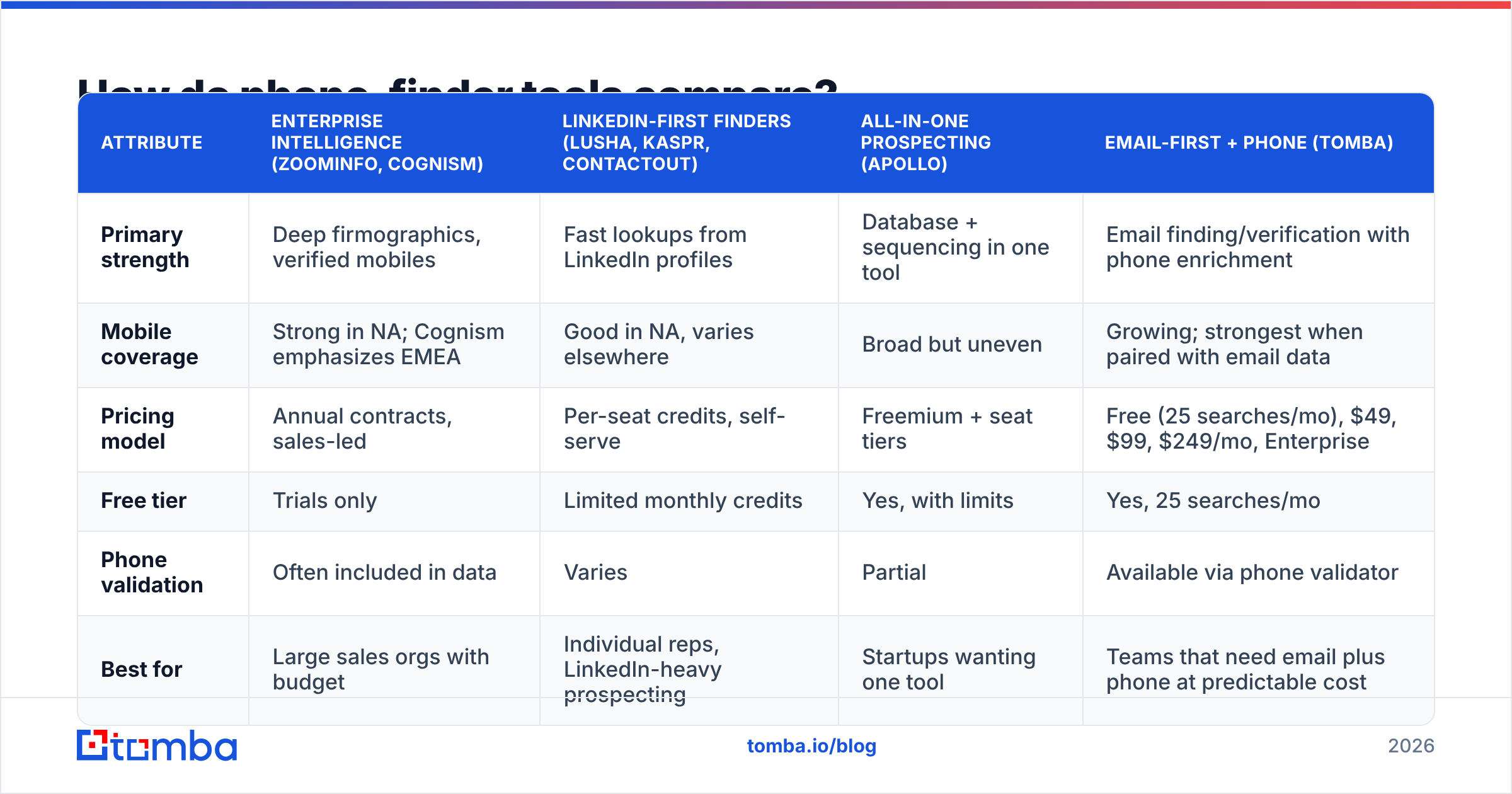
The market splits into three groups: all-in-one sales intelligence platforms, LinkedIn-first contact finders, and email-first platforms that have added phone data. Here's how they compare on the attributes that matter for phone outreach. Vendor pricing changes often, so confirm current tiers on each vendor's site before you buy.
| Attribute | Enterprise intelligence (ZoomInfo, Cognism) | LinkedIn-first finders (Lusha, Kaspr, ContactOut) | All-in-one prospecting (Apollo) | Email-first + phone (Tomba) |
|---|---|---|---|---|
| Primary strength | Deep firmographics, verified mobiles | Fast lookups from LinkedIn profiles | Database + sequencing in one tool | Email finding/verification with phone enrichment |
| Mobile coverage | Strong in NA; Cognism emphasizes EMEA | Good in NA, varies elsewhere | Broad but uneven | Growing; strongest when paired with email data |
| Pricing model | Annual contracts, sales-led | Per-seat credits, self-serve | Freemium + seat tiers | Free (25 searches/mo), $49, $99, $249/mo, Enterprise |
| Free tier | Trials only | Limited monthly credits | Yes, with limits | Yes, 25 searches/mo |
| Phone validation | Often included in data | Varies | Partial | Available via phone validator |
| Best for | Large sales orgs with budget | Individual reps, LinkedIn-heavy prospecting | Startups wanting one tool | Teams that need email plus phone at predictable cost |
A few honest notes on the table:
- Enterprise platforms usually do have the deepest mobile data for large North American accounts. If your ICP is Fortune 1000 and budget isn't a concern, they're hard to beat on coverage. They are also the hardest to leave once you've signed a multi-year contract.
- LinkedIn-first tools are fast for reps who live in Sales Navigator, but credit costs rise quickly when phone reveals cost more than email reveals.
- Email-first platforms like Tomba make sense when email is your main channel and phone is the second touch. You get verified emails and phone data from one account, without an enterprise contract.
For independent user reviews, check the phone-data categories on G2 and compare accuracy complaints for your specific region. Don't rely on headline averages.
How do you verify a lead's phone number before calling?#
Finding a number is half the job. The other half is making sure it's real, current, and the type you think it is. An unvalidated list is like a bag of keys where a third of them fit no lock, and you only find out by trying each door.
A solid validation pass checks four things:
- Is the number valid and active? Format checks catch typos. Carrier lookups catch disconnected lines.
- What line type is it? Mobile, landline, VoIP, or toll-free. This affects both connect rates and compliance, since US auto-dialing rules treat mobiles differently.
- What carrier and region is it on? This helps you schedule calls for the right time zone and spot numbers that don't match the lead's stated location.
- Does it still belong to the person? The hardest check. Recent enrichment dates, multiple matching sources, and a quick confirmation on the first call ("Is this still the best number for you?") are your best signals.
A phone validator handles the first three at scale. For the fourth, set a re-enrichment cadence. Quarterly works for active pipelines, and anything older than 6-12 months should be treated as suspect.
Run the same hygiene on the email side. Before a lead enters a multi-channel sequence, pass the address through an email verifier so bounces don't damage your sender domain while your reps are working the phone.
Is it legal to call a lead's mobile number?#
In most B2B contexts, yes, with conditions. The rules depend on where the lead is, not where you are. This is general guidance, not legal advice, so involve your counsel if phone is a primary channel.
- United States: The Telephone Consumer Protection Act restricts autodialed and prerecorded calls and texts to mobile numbers without prior express consent. Manually dialed B2B calls are generally lower risk, but check numbers against the National Do Not Call Registry and your internal DNC list. The FCC's telemarketing guidance is the authoritative starting point.
- UK: PECR allows B2B cold calls to corporate subscribers unless the number is registered with the Corporate TPS or TPS. Screen your lists before dialing.
- EU: GDPR requires a lawful basis, usually legitimate interest for B2B, plus transparency about where you got the data. Some member states add national opt-out registers.
- Everywhere: Honor opt-outs immediately, log consent sources, and use a data vendor that can explain how its phone numbers were collected.
A practical rule: if your dialer auto-dials or uses parallel dialing, get explicit guidance on mobile numbers. If reps click-to-call one number at a time, your main obligations are DNC screening and opt-out handling.
How should you use a lead's phone number once you have it?#
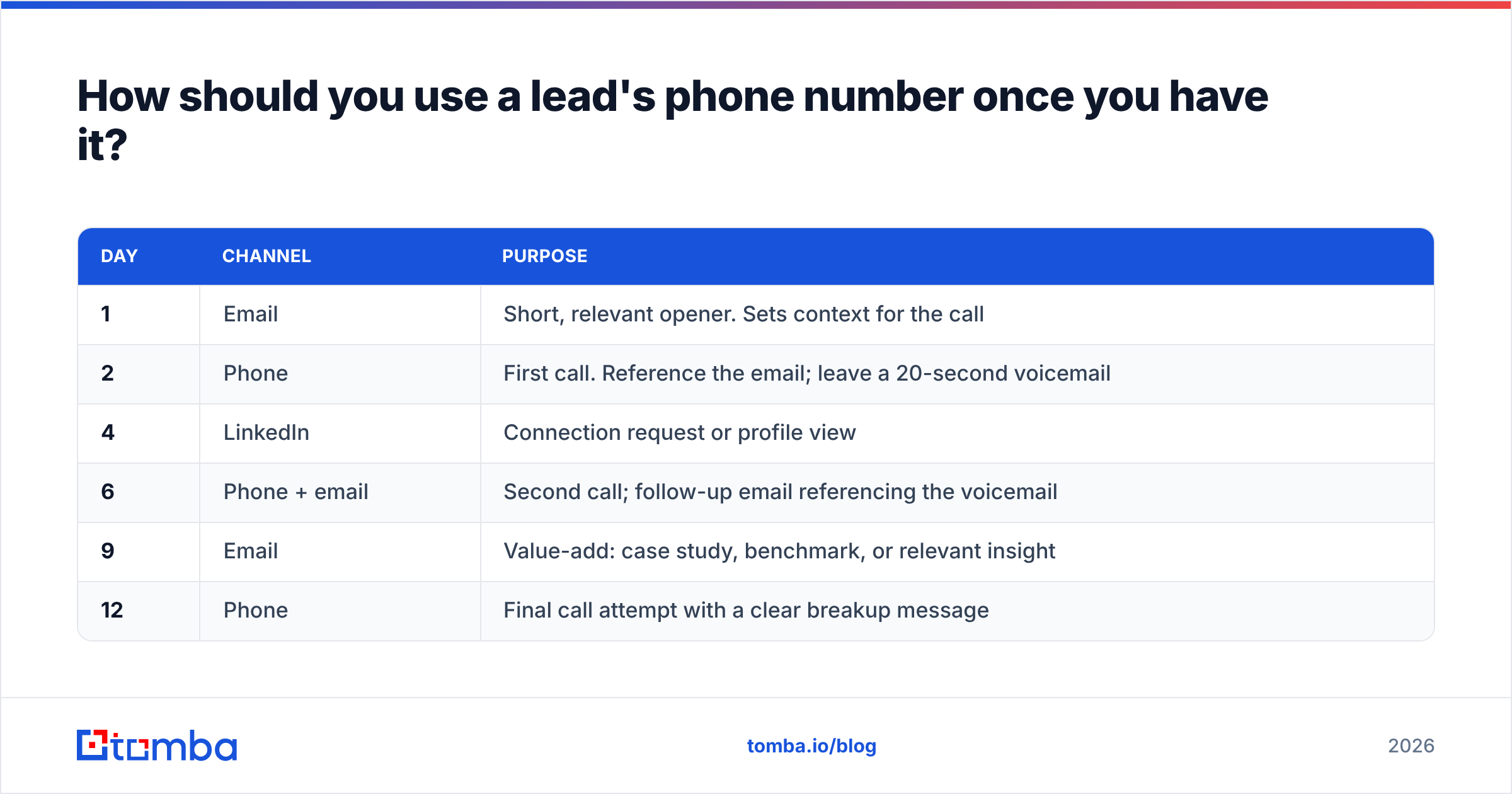
A verified direct dial is worth the most inside a coordinated sequence. Calling cold with nothing before it is the weakest way to use one. A typical high-performing pattern:
| Day | Channel | Purpose |
|---|---|---|
| 1 | Short, relevant opener. Sets context for the call | |
| 2 | Phone | First call. Reference the email; leave a 20-second voicemail |
| 4 | Connection request or profile view | |
| 6 | Phone + email | Second call; follow-up email referencing the voicemail |
| 9 | Value-add: case study, benchmark, or relevant insight | |
| 12 | Phone | Final call attempt with a clear breakup message |
Three tactics improve connect rates with good data:
- Call in local time windows. Early morning (8-9 a.m.) and late afternoon (4-5 p.m.) in the lead's time zone still tend to get more pickups for direct dials.
- Use local presence carefully. Matching area codes can lift answer rates. Spoofing, or rotating numbers too aggressively, gets your lines flagged as spam by carrier analytics.
- Log outcomes back to the record. "Wrong number," "gatekeeper," and "left company" are data. Feed them back so the next rep doesn't dial the same dead line.
How do you build a phone-number workflow that scales?#
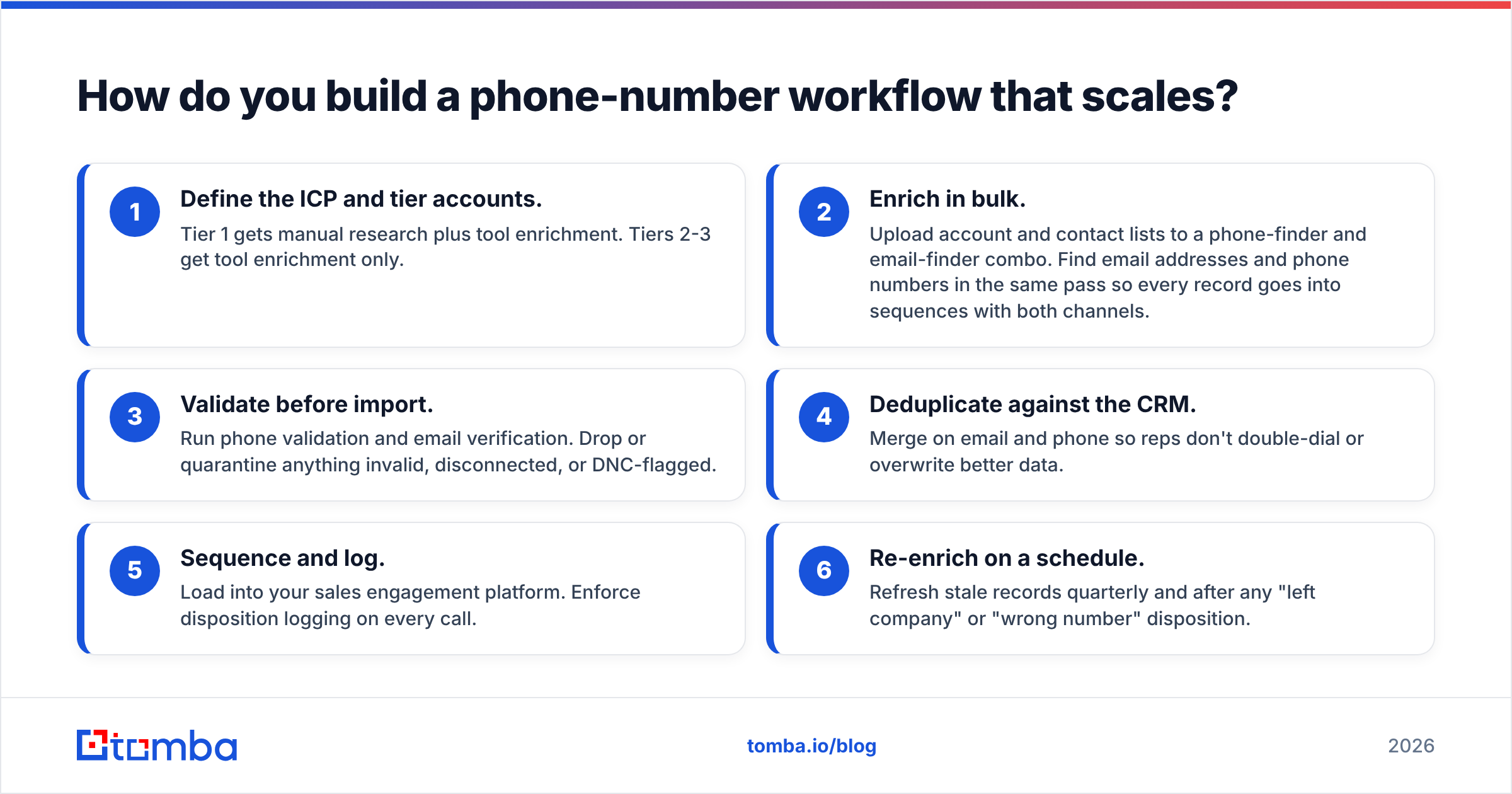
Individual tactics don't add up to a pipeline unless you build them into a repeatable workflow. Here's a lean version most SDR teams can run without a dedicated RevOps hire:
- Define the ICP and tier accounts. Tier 1 gets manual research plus tool enrichment. Tiers 2-3 get tool enrichment only.
- Enrich in bulk. Upload account and contact lists to a phone-finder and email-finder combo. Find email addresses and phone numbers in the same pass so every record goes into sequences with both channels.
- Validate before import. Run phone validation and email verification. Drop or quarantine anything invalid, disconnected, or DNC-flagged.
- Deduplicate against the CRM. Merge on email and phone so reps don't double-dial or overwrite better data.
- Sequence and log. Load into your sales engagement platform. Enforce disposition logging on every call.
- Re-enrich on a schedule. Refresh stale records quarterly and after any "left company" or "wrong number" disposition.
If your team already runs on HubSpot, its calling and sequences documentation shows how to attach dispositions to contact records. The same principle applies in Salesforce or Pipedrive.
What does good phone data cost?#
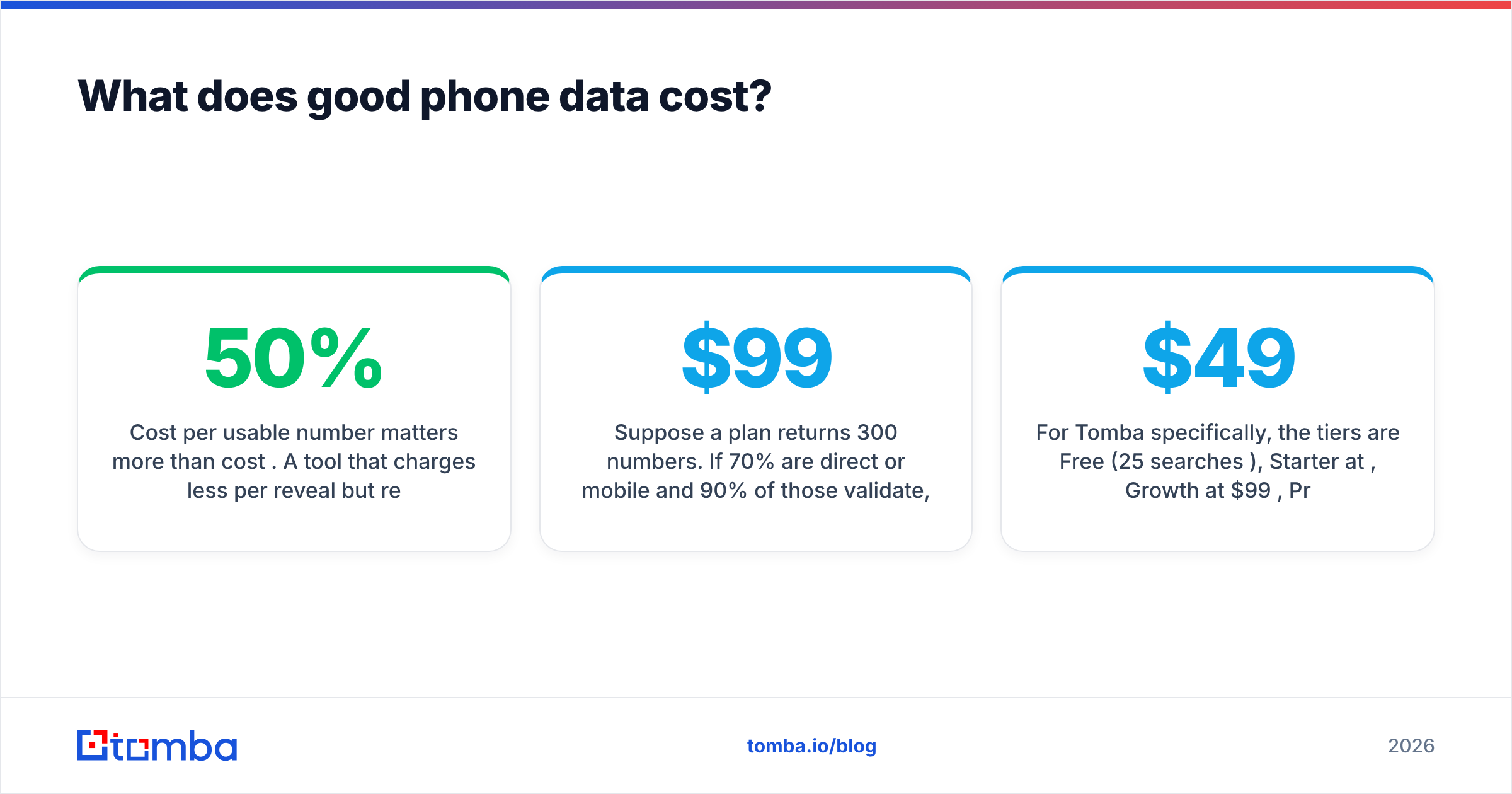
Cost per usable number matters more than cost per credit. A tool that charges less per reveal but returns 50% switchboards costs you more in the end. Here's how to work it out:
- Cost per verified direct dial = monthly spend ÷ (numbers returned × % direct/mobile × % valid after validation)
- Cost per connect = cost per verified direct dial ÷ connect rate
Suppose a $99/month plan returns 300 numbers. If 70% are direct or mobile and 90% of those validate, you get 189 usable dials at roughly $0.52 each. A cheaper plan that returns mostly HQ lines can easily cost several times more per real conversation.
For Tomba specifically, the tiers are Free (25 searches/month), Starter at $49/month, Growth at $99/month, Pro at $249/month, and custom Enterprise. See Tomba pricing for what's included in each. Run a trial on 50-100 of your own ICP contacts before committing to any vendor, because coverage on your segment is the only benchmark that counts.
Frequently asked questions#
How accurate is B2B phone data? It varies a lot by region and seniority. Treat any vendor's headline accuracy claim as a best case, and measure it yourself with a sample of your own ICP.
Should I buy a phone list or enrich my own? Enrich your own. Purchased lists are usually older, poorly matched to your ICP, and harder to defend under GDPR's transparency requirements.
Can I find a lead's phone number from their email? Often, yes. Many enrichment tools accept an email as input and return linked phone numbers, job title, and company data in one lookup.
How often should I refresh phone numbers? Quarterly for active pipeline, and immediately after any wrong-number or left-company disposition.
Where should you start?#
A leads phone number is only valuable when it's a direct line, it's still current, and it sits inside a sequence alongside a verified email. Get those three right and your call blocks turn into conversations, not voicemail tours of corporate switchboards.
If email is your first touch and phone is your second, start with the Tomba Email Finder. Search by name, domain, or company to get verified professional emails, then add Tomba's phone finder and validator so every lead in your sequence has both channels. The free plan includes 25 searches a month, so you can test coverage on your own ICP before paying anything.
Related guides#
// get started
Find, verify and enrich your first contacts today
Start on the free plan with 25 searches a month, then scale when your team is ready.
Free plan · No credit card required · GDPR & CCPA
// about the author