Leadsforge vs VCBacked: Which Lead Source Fits Your Outbound in 2026?
Leadsforge builds lead lists from a chat prompt across the whole B2B market. VCBacked sells a curated list of recently funded startups and their founders. Here's which one fits your pipeline, and where each one falls short.
TL;DR
- Leadsforge is an AI lead search engine. You describe your ICP in plain English and it builds a contact list from a broad B2B dataset. At the time of writing, pricing starts at $49/mo for 2,000 credits, and credits don't expire.
- VCBacked is a curated database of about 41,000 venture-backed startups. It lists funding rounds, lead investors, and founder contacts. Listed pricing starts at $79/mo, with an annual plan and a 7-day trial.
- Choose Leadsforge if your ICP covers many industries, company sizes, or job titles and you want lists built on demand.
- Choose VCBacked if you sell to startups that just raised money, and the funding round is your buying signal.
- With either tool, verify the emails before you send. List vendors can't vouch for data quality in your specific segment, so your bounce rate is still your problem.
What is the real difference between Leadsforge and VCBacked?#
These two tools answer different questions, and that's why people get confused comparing them.
Leadsforge answers: "Who in the market matches my ICP?" You type a prompt like "Heads of RevOps at US SaaS companies with 50-200 employees using HubSpot." It returns a list you can export to CSV or send straight into Salesforge sequences. It's a horizontal prospecting tool that covers the whole B2B market.
VCBacked answers: "Which startups just got funded, and who runs them?" It's a vertical dataset. Every record is a venture-backed company with its funding round, amount, lead investor, and founder contacts. The vendor says it adds 500+ new verified leads per monthly update, covering rounds from $250K to $500M.
Here's an analogy. Leadsforge is a search engine for people. VCBacked is a curated newsletter about who just came into money. The first finds anyone. The second hands you a short list of people who probably have budget right now.
That difference affects everything below: pricing logic, list size, data freshness, and which sales motions each tool supports.
How do Leadsforge and VCBacked compare feature by feature?#
Pricing below comes from each vendor's public pages at the time of writing. Check Leadsforge and VCBacked before you buy, because both change their plans.
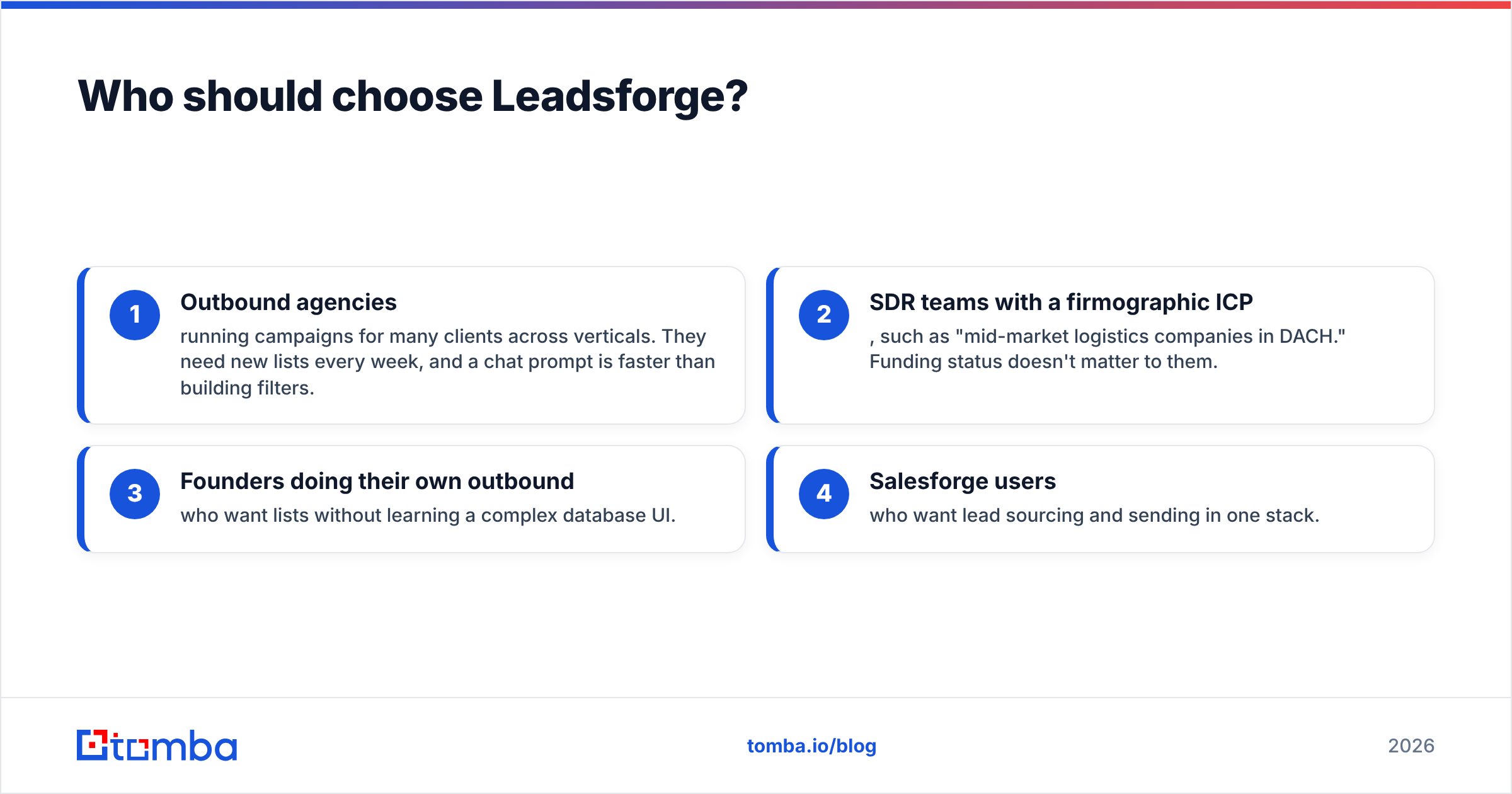
| Attribute | Leadsforge | VCBacked |
|---|---|---|
| Core model | AI chat-based lead search across B2B market | Curated database of VC-backed startups |
| Starting price | $49/mo (2,000 credits) | $79/mo |
| Annual option | $588/yr, 28,000 credits upfront | Annual plan listed from $299/yr |
| Free access | 100 free credits on signup | 7-day free trial |
| Credit rollover | Credits don't expire | Unlimited exports on paid plan (per vendor) |
| Dataset scope | Broad: any industry, title, size | ~41,000 funded startups + founders |
| Primary signal | Firmographic + role fit | Funding round, investor, stage |
| Update cadence | Continuous search index | Monthly batches of new funded companies |
| Native sequencing | Pushes into Salesforge | None; export CSV |
| Best for | Agencies, SDR teams with wide ICPs | Selling to startups, VC deal sourcing, recruiting |
| Main weakness | Lists can be broad and need tightening | Narrow universe; founders are heavily prospected |
A few notes the table can't show:
- Credits vs. exports. Leadsforge counts credits per contact exported, and it estimates the cost before you export. VCBacked works like a subscription to a dataset. If you only need a few hundred funded startups each month, VCBacked's model is simpler. If you need thousands of contacts across segments, Leadsforge's credits go further.
- Signal quality. A funding round is one of the strongest timing signals in B2B sales. Money in the bank means budget for hiring, tooling, and agencies. Leadsforge can filter by firmographics, but that isn't the same as a curated feed of new rounds.
- Workflow. Leadsforge is part of the Forge ecosystem (Salesforge, Warmforge, and others). If you already send from Salesforge, the handoff takes one click. VCBacked is tool-agnostic. You export and import into whatever you use.
Who should choose Leadsforge?#
Leadsforge fits teams whose ICP isn't defined by a single event. Pick it if you fall into one of these groups:
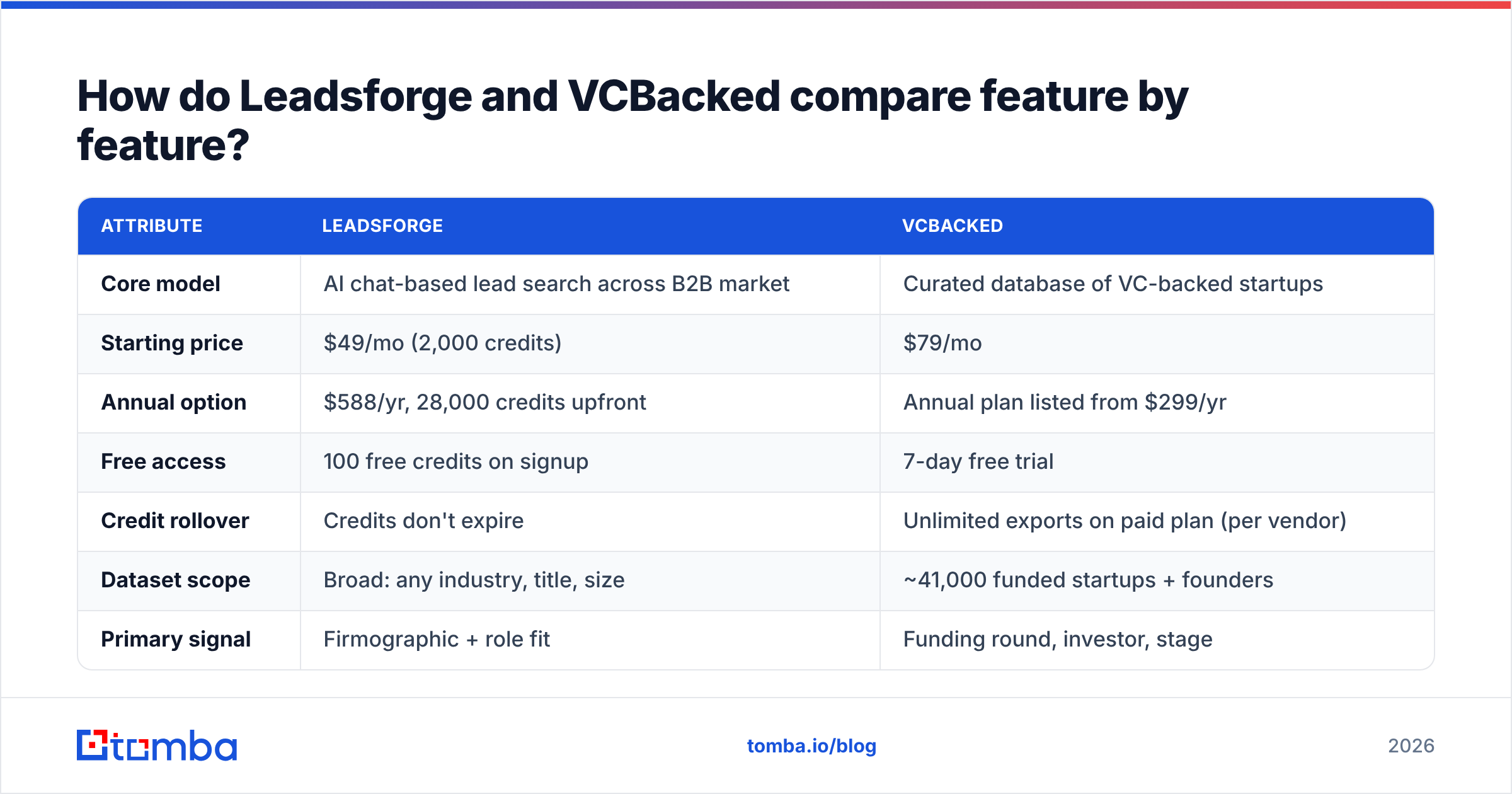
- Outbound agencies running campaigns for many clients across verticals. They need new lists every week, and a chat prompt is faster than building filters.
- SDR teams with a firmographic ICP, such as "mid-market logistics companies in DACH." Funding status doesn't matter to them.
- Founders doing their own outbound who want lists without learning a complex database UI.
- Salesforge users who want lead sourcing and sending in one stack.
The honest caveat: an AI prompt is only as good as the ICP you give it. Vague prompts return vague lists. Expect to refine a few times, and check every export against your CRM so you don't re-contact current customers or open deals. If you use HubSpot or Salesforce, dedupe against the CRM before you import. See the HubSpot knowledge base for how its import deduplication works.

Who should choose VCBacked?#
VCBacked fits sellers whose best customers are startups with fresh capital. Typical buyers:
- Agencies and dev shops selling to seed through Series B companies. These are firms building product, marketing, or design capacity after a raise.
- B2B SaaS tools whose ICP is "post-seed startups hiring their first sales, finance, or people leader."
- Recruiters who know a new round usually means a hiring push within 90 days.
- Investors and scouts who want a low-cost deal-sourcing feed. VCBacked positions itself as an alternative to platforms like PitchBook or CB Insights, which typically sell annual contracts in the thousands of dollars.
The honest caveat: funded founders are some of the most heavily prospected people in B2B. The week after a round is announced, a founder's inbox fills with agencies, recruiters, and SaaS tools that all saw the same data. VCBacked gives you the timing signal, but so does everyone else watching funding news. Your message has to be sharper than "Congrats on the raise!"
How does pricing actually play out over a year?#
Headline prices don't mean much until you map them to volume. Here's a rough model for a small outbound team sending to about 1,000 new contacts per month.
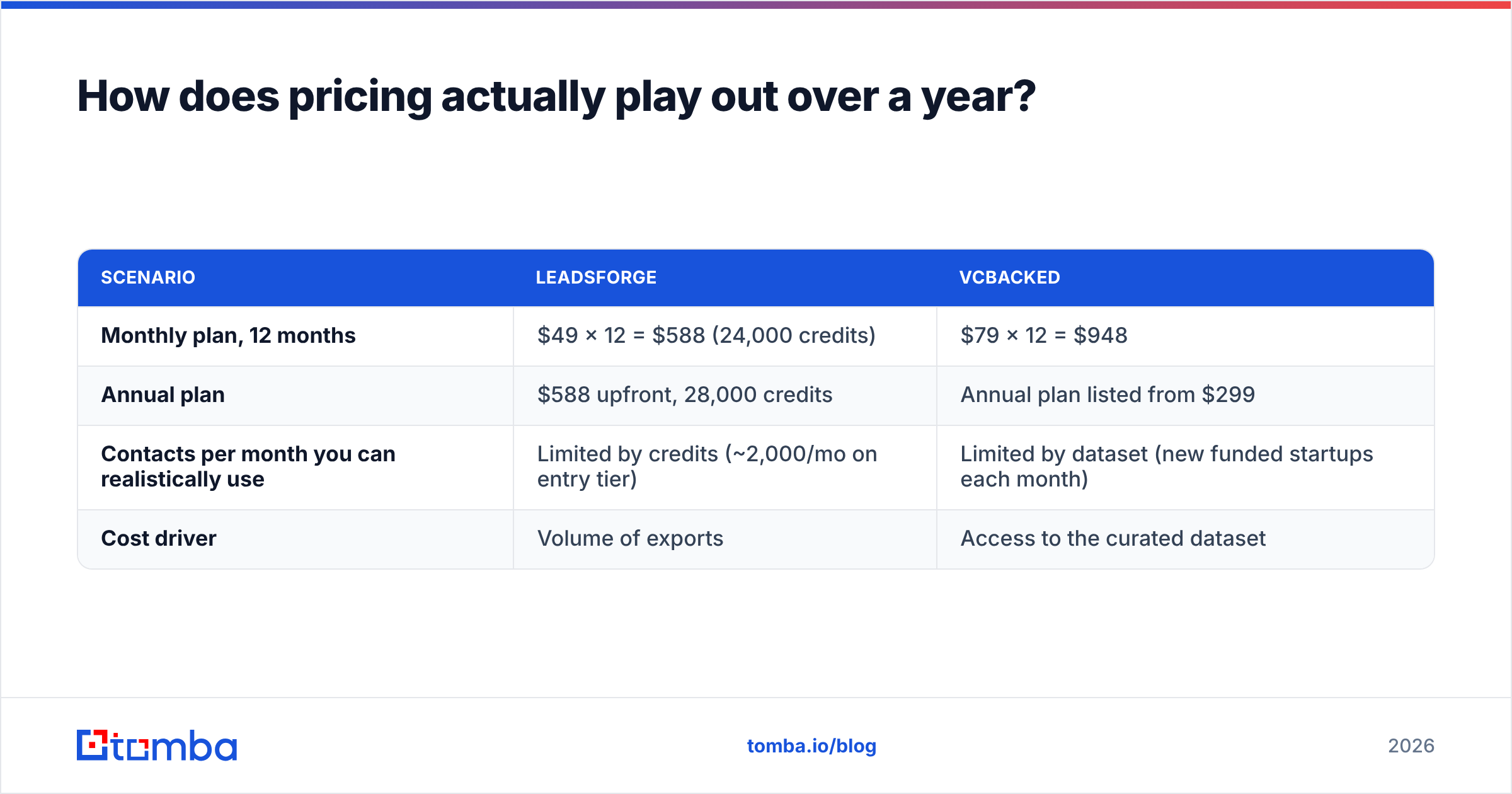
| Scenario | Leadsforge | VCBacked |
|---|---|---|
| Monthly plan, 12 months | $49 × 12 = $588 (24,000 credits) | $79 × 12 = $948 |
| Annual plan | $588 upfront, 28,000 credits | Annual plan listed from $299 |
| Contacts per month you can realistically use | Limited by credits (~2,000/mo on entry tier) | Limited by dataset (new funded startups each month) |
| Cost driver | Volume of exports | Access to the curated dataset |
Two takeaways:
- VCBacked's annual plan is much cheaper than paying monthly, if the listed pricing holds. If you're committed to selling to startups, month-to-month is the expensive way to do it.
- Leadsforge scales with volume, and VCBacked is capped by how many companies raise each month. You can't pull 10,000 new funded startups a month from VCBacked because there aren't that many. If your pipeline math needs volume, Leadsforge is structurally better.
Neither price includes the cost that actually hurts: bounces. A list that bounces at 8-10% can damage a sending domain within a couple of weeks, and then it doesn't matter how cheap the list was.
Is the data from either tool accurate enough to send cold email to?#
This is the question buyers skip and later regret.
Both vendors say they verify their contacts. That's useful, but "verified at collection" is not "verified today." People change jobs and domains get moved to new providers. Catch-all domains accept every address at the SMTP level, so a basic check marks them "valid" even when the mailbox doesn't exist. Startups are especially volatile: founders rotate, early employees leave, and small companies often run catch-all Google Workspace setups.
A practical rule for either tool:
- Re-verify every export with an email verifier right before you load it into your sequencer, not when you first pulled it.
- Split catch-all results into their own low-volume segment so they can't pull down your main domain's reputation.
- Fill in missing contacts with an email finder. If a VCBacked record gives you a founder's name and company domain but no working email, a finder can often recover it.
- Enrich before you personalize. Title, seniority, and company size from data enrichment keep you from writing to a "Head of Growth" who left six months ago.
Mailbox providers have tightened bulk-sender requirements in recent years. Google's email sender guidelines spell out spam-rate and authentication thresholds. List quality is now a deliverability input, not just a data-hygiene preference.
Can you use Leadsforge and VCBacked together?#
Yes, and for some teams that's the best setup. The tools overlap less than their marketing suggests.
A workable combined stack looks like this:
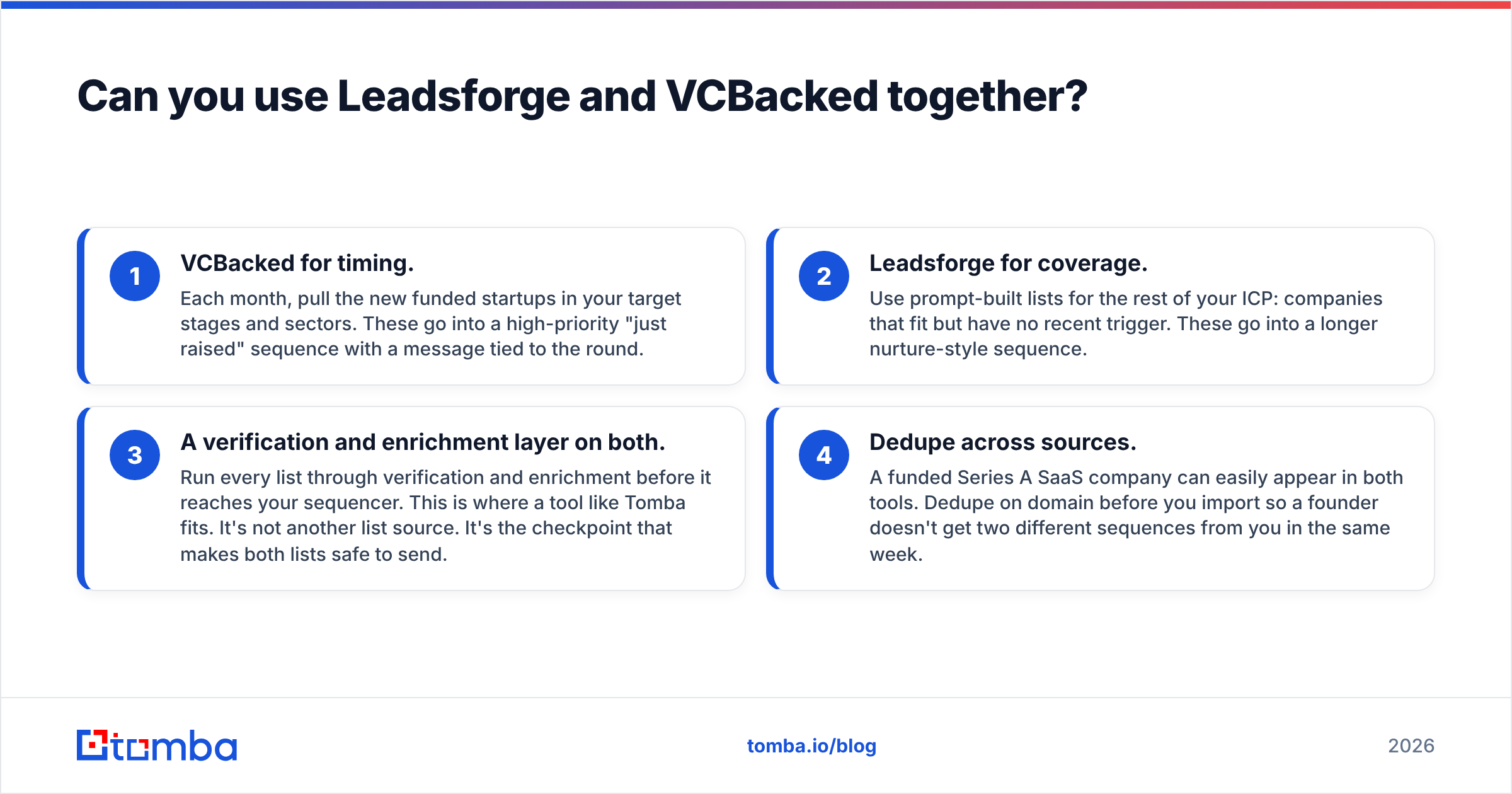
- VCBacked for timing. Each month, pull the new funded startups in your target stages and sectors. These go into a high-priority "just raised" sequence with a message tied to the round.
- Leadsforge for coverage. Use prompt-built lists for the rest of your ICP: companies that fit but have no recent trigger. These go into a longer nurture-style sequence.
- A verification and enrichment layer on both. Run every list through verification and enrichment before it reaches your sequencer. This is where a tool like Tomba fits. It's not another list source. It's the checkpoint that makes both lists safe to send.
- Dedupe across sources. A funded Series A SaaS company can easily appear in both tools. Dedupe on domain before you import so a founder doesn't get two different sequences from you in the same week.
If you only have budget for one, go back to the first question: is your best buying signal a funding event? If yes, choose VCBacked. If your ICP is defined by industry, size, and role, choose Leadsforge.
What do reviewers and users say about each tool?#
Public review coverage is uneven. Leadsforge benefits from the wider Forge ecosystem and is listed in most "AI lead generation tools" roundups. VCBacked is a smaller, focused product with fewer third-party reviews. Before you commit, check current feedback on G2 and look for reviewers whose use case matches yours. A recruiter's review of VCBacked tells you little if you're an agency selling to enterprises.
Patterns that come up repeatedly in public discussion:
- Leadsforge gets credit for speed and a low learning curve. The chat interface is quicker than stacking 12 filters in a traditional database. The common complaint is that lists need tightening, since broad prompts return broad results.
- VCBacked gets credit for price relative to enterprise funding databases and for bundling founder contacts with funding data. The common limitation is the size of its universe. Once you've worked through your target sectors, you're waiting for next month's batch.
Which one should you pick? The verdict#
Pick Leadsforge if you need volume across a broad ICP, you run outbound for several clients, or you already send from Salesforge. It's the more flexible prospecting engine, and credits that don't expire make light months cheaper.
Pick VCBacked if your best customers are startups that just raised, and you want a clean monthly feed of them with founder contacts. It's a sharper tool for a narrower job, and the annual pricing is hard to beat for that niche.
Pick both if you run a two-track motion: trigger-based outreach to newly funded companies, plus steady coverage of the rest of your ICP.
With either tool, the list is only the starting point. What actually protects your pipeline is what happens between export and send: verification, enrichment, and filling in missing contacts.
How does Tomba fit into a Leadsforge or VCBacked workflow?#
Tomba doesn't replace either tool. It makes their output safe to send. You pull a list from Leadsforge or VCBacked, and Tomba finds any missing addresses, verifies every contact, and flags catch-all domains before they reach your sequencer. When a VCBacked record has a founder's name and domain but no working email, or a Leadsforge export includes contacts who have changed roles, the Tomba Email Finder recovers the right address from a name and company domain in seconds. It also works in bulk and through the API. You can start on the free tier with 25 searches a month, and paid plans start at $49/mo. See Tomba pricing to match a plan to your list volume.
Related guides#
// get started
Find, verify and enrich your first contacts today
Start on the free plan with 25 searches a month, then scale when your team is ready.
Free plan · No credit card required · GDPR & CCPA
// about the author