Leadsforge vs ZoomInfo: AI Lead Lists or Enterprise Data in 2026?
Leadsforge builds lead lists from a chat prompt on a monthly plan. ZoomInfo sells one of the deepest B2B datasets on an annual contract. Here's how to tell which one your team needs.
TL;DR
- Leadsforge is an AI lead-list builder from the Salesforge team. You describe your ideal customer in plain English and get a verified contact list back. It runs on self-serve monthly credits and suits lean outbound teams.
- ZoomInfo is a full enterprise go-to-market data platform. It covers contacts, direct dials, intent signals, org charts, website visitor ID and conversation intelligence, usually on annual contracts that often reach five figures.
- If you run cold email at small or mid scale, Leadsforge covers most of what you need for a small fraction of the cost.
- If you run a large SDR floor, rely on phone outreach, or need intent data inside Salesforce, ZoomInfo's extra depth can pay for itself.
- Whichever you choose, verify every email before you send. List quality decays fast, and neither database is exempt.
What is the real difference between Leadsforge and ZoomInfo?#
These two tools are built for different buyers, which makes the head-to-head comparison lopsided. Leadsforge is a prospecting tool: it finds people and hands you a list. ZoomInfo is a data platform: it tries to be the system of record for everything you know about your market.
The gap shows up in five places:
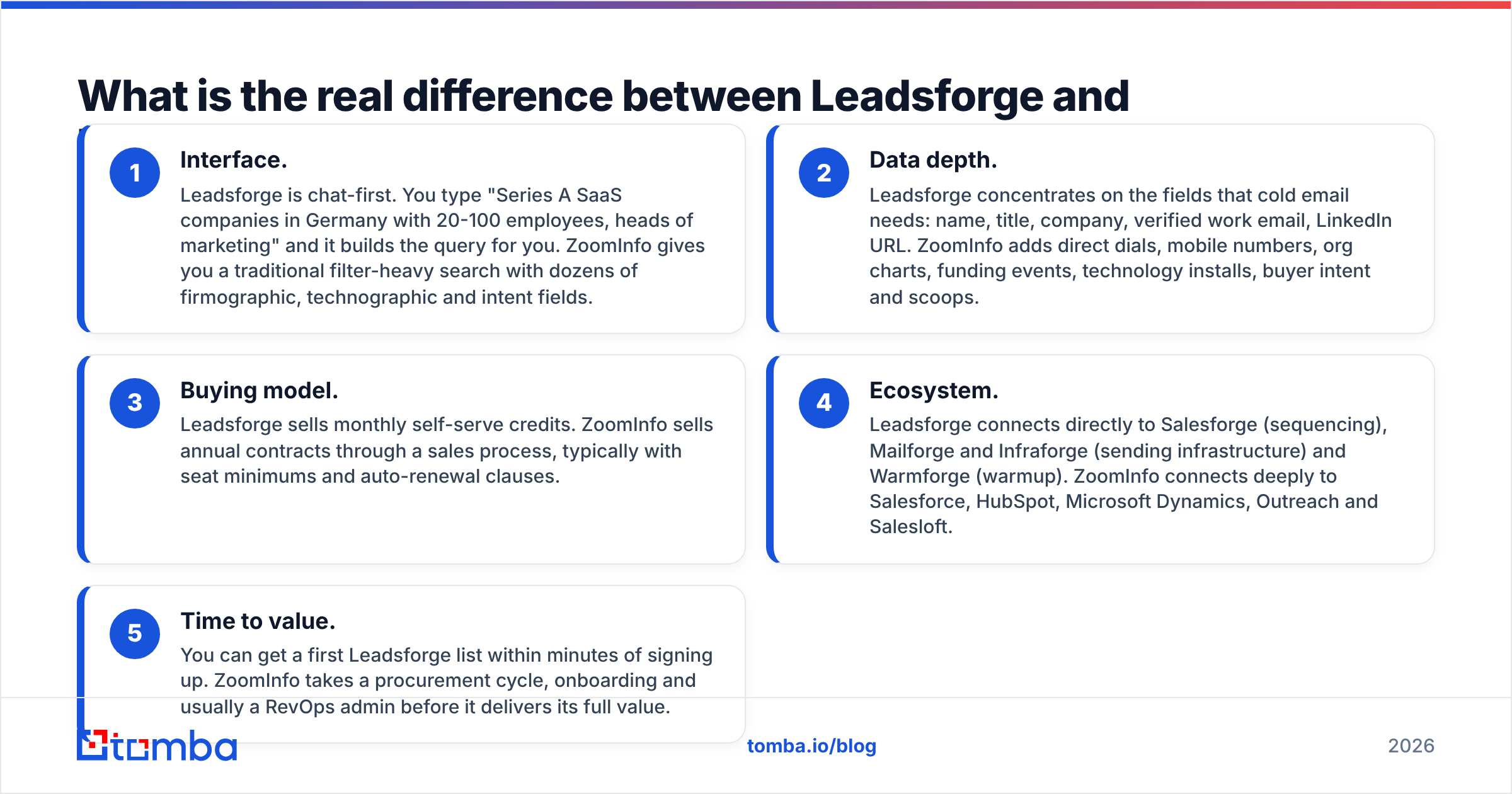
- Interface. Leadsforge is chat-first. You type "Series A SaaS companies in Germany with 20-100 employees, heads of marketing" and it builds the query for you. ZoomInfo gives you a traditional filter-heavy search with dozens of firmographic, technographic and intent fields.
- Data depth. Leadsforge concentrates on the fields that cold email needs: name, title, company, verified work email, LinkedIn URL. ZoomInfo adds direct dials, mobile numbers, org charts, funding events, technology installs, buyer intent and scoops.
- Buying model. Leadsforge sells monthly self-serve credits. ZoomInfo sells annual contracts through a sales process, typically with seat minimums and auto-renewal clauses.
- Ecosystem. Leadsforge connects directly to Salesforge (sequencing), Mailforge and Infraforge (sending infrastructure) and Warmforge (warmup). ZoomInfo connects deeply to Salesforce, HubSpot, Microsoft Dynamics, Outreach and Salesloft.
- Time to value. You can get a first Leadsforge list within minutes of signing up. ZoomInfo takes a procurement cycle, onboarding and usually a RevOps admin before it delivers its full value.
A useful analogy: Leadsforge is a good butcher who cuts exactly the piece you asked for. ZoomInfo is the wholesale warehouse. It has far more choice, and you pay a membership fee for access to it.
What is Leadsforge?#
Leadsforge belongs to the Forge product family, alongside Salesforge, Mailforge, Infraforge, Warmforge and the AI SDR "Agent Frank." Its pitch is that you shouldn't need to learn a filter UI to build a lead list.
Here's how it works in practice:
- You describe your ICP in natural language, and Leadsforge turns that into search parameters you can refine.
- It supports lookalike searches: give it a company you like and it finds similar ones.
- Emails are verified before export, so you pay credits for usable contacts, not raw guesses.
- Lists push straight into Salesforge sequences or export to CSV for any other sending tool.
Where it's strong: speed, simplicity, and a price that a two-person agency can expense without a meeting. For cold-email-first teams it removes a lot of friction.
Where it's thinner: phone data is limited compared with dedicated dialer-grade providers. It doesn't offer ZoomInfo-grade intent data. Coverage outside mainstream tech and services verticals is less reliable than a database with decades of enterprise investment behind it.
What is ZoomInfo?#
ZoomInfo is one of the largest B2B data vendors in the world. Its flagship SalesOS product combines a contact and company database with a set of add-ons:
- Direct dials and mobile numbers. This is historically ZoomInfo's biggest moat for phone-heavy teams.
- Intent data. It surfaces companies researching topics related to your product.
- WebSights. It identifies the companies visiting your website.
- Org charts and scoops. You get reporting lines, leadership changes, funding and project news.
- Enrichment and data hygiene that keep CRM records current automatically.
- Engage, Chorus and Copilot. These cover sequencing, call recording and AI-driven account prioritization.
Where it's strong: depth, breadth, phone coverage, and enterprise-grade CRM integration. If your motion includes cold calling, account-based selling into large companies, or territory planning, it's hard to match.
Where it hurts: price and contract terms. User reviews on G2 repeatedly mention high renewal quotes, strict auto-renewal notice windows, and credit limits that feel tight for the money. Email accuracy on smaller companies and fast-moving startups also draws more complaints than its enterprise coverage does.

How do Leadsforge and ZoomInfo compare feature by feature?#
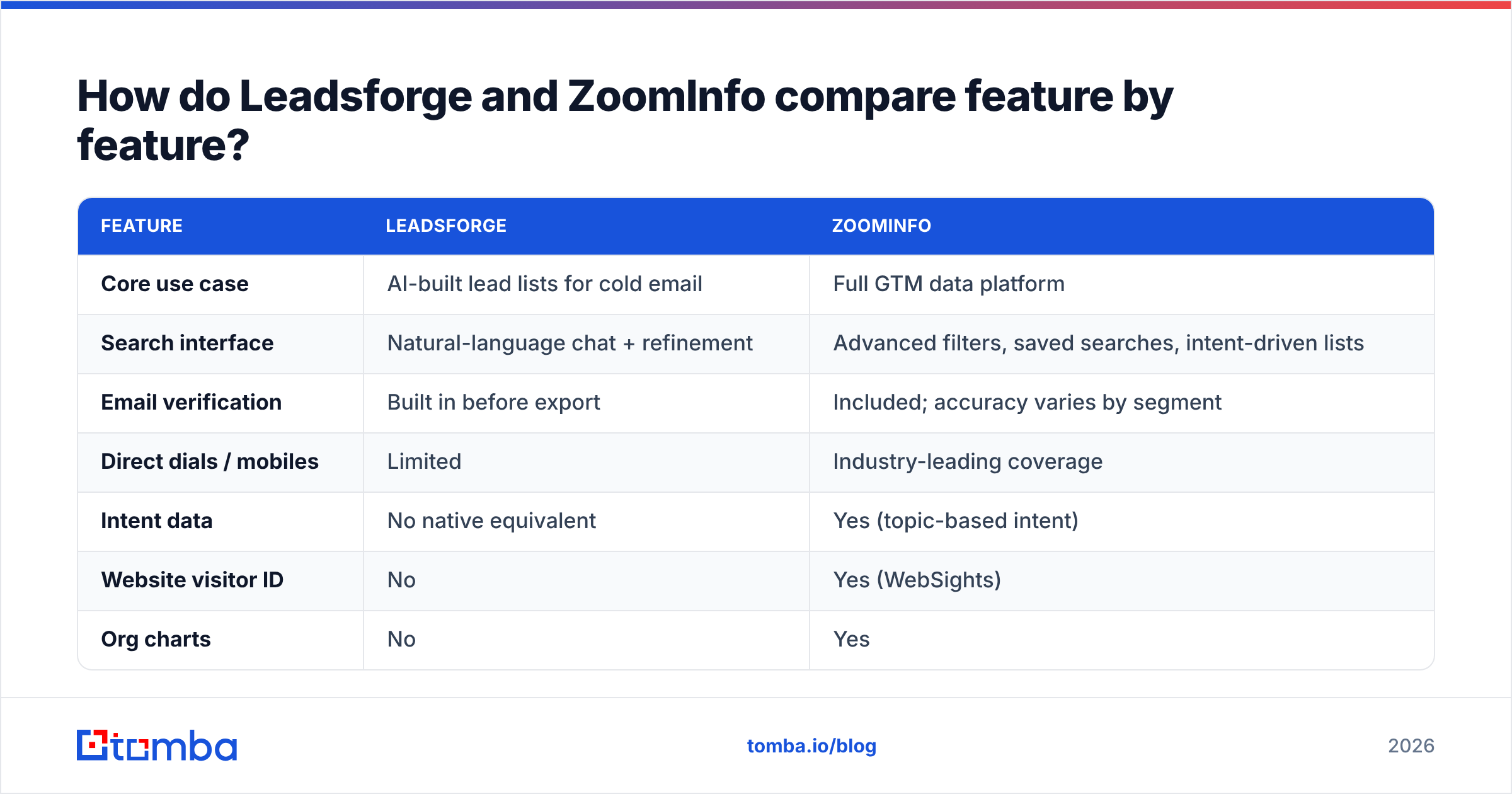
| Feature | Leadsforge | ZoomInfo |
|---|---|---|
| Core use case | AI-built lead lists for cold email | Full GTM data platform |
| Search interface | Natural-language chat + refinement | Advanced filters, saved searches, intent-driven lists |
| Email verification | Built in before export | Included; accuracy varies by segment |
| Direct dials / mobiles | Limited | Industry-leading coverage |
| Intent data | No native equivalent | Yes (topic-based intent) |
| Website visitor ID | No | Yes (WebSights) |
| Org charts | No | Yes |
| CRM integrations | CSV + Forge ecosystem, common CRMs via export/integrations | Native Salesforce, HubSpot, Dynamics, plus enrichment sync |
| Sequencing | Via Salesforge | Via ZoomInfo Engage or Outreach/Salesloft |
| Buying model | Self-serve monthly credits | Annual contract via sales |
| Setup time | Minutes | Weeks (procurement + onboarding) |
| Best for | Founders, agencies, SMB outbound teams | Mid-market and enterprise sales orgs |
The table shows one tool that does one job well and another that does ten jobs at an enterprise level. The practical question is how many of those ten jobs you'll actually use.
How much do Leadsforge and ZoomInfo cost?#
This part of the comparison decides it for most readers.
Leadsforge publishes self-serve, credit-based plans. The entry tiers sit in the range an individual founder can put on a card, and larger credit bundles are available for agencies. You can start, pause or cancel month to month. Check the vendor's pricing page for current credit counts, because Forge-family pricing has changed several times.
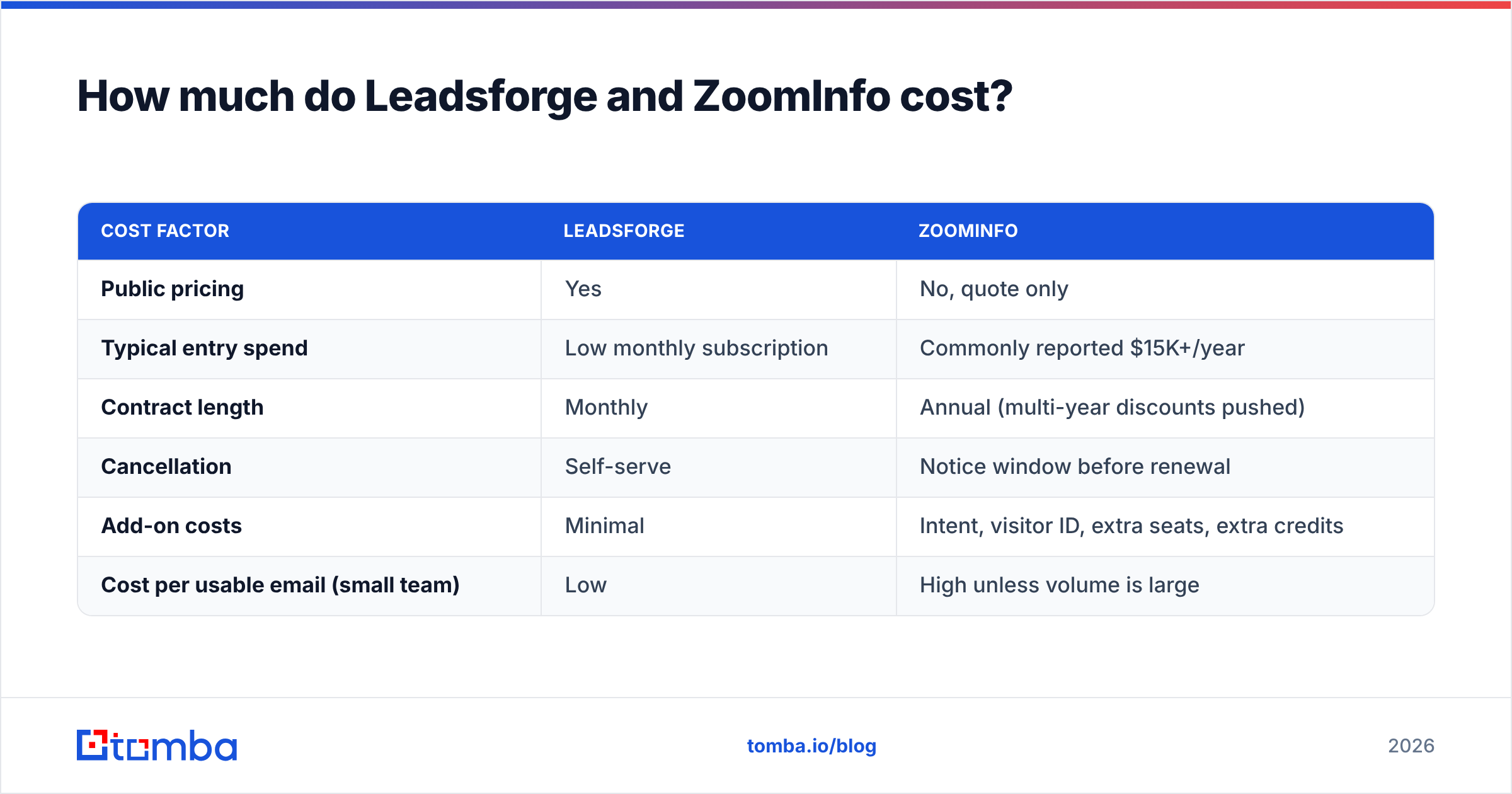
ZoomInfo doesn't publish list prices. Buyer reports and review sites consistently put entry SalesOS contracts somewhere in the low-to-mid five figures per year. Costs rise with extra seats, extra credits, and add-ons such as intent, WebSights or Chorus. Annual commitments are standard. Many buyers report auto-renewal clauses that require written cancellation well before the term ends.
| Cost factor | Leadsforge | ZoomInfo |
|---|---|---|
| Public pricing | Yes | No, quote only |
| Typical entry spend | Low monthly subscription | Commonly reported $15K+/year |
| Contract length | Monthly | Annual (multi-year discounts pushed) |
| Cancellation | Self-serve | Notice window before renewal |
| Add-on costs | Minimal | Intent, visitor ID, extra seats, extra credits |
| Cost per usable email (small team) | Low | High unless volume is large |
If you're a three-person team sending a few thousand cold emails a month, ZoomInfo's price rarely makes sense. If you're a 60-rep org booking pipeline across phone, email and LinkedIn, the cost per rep drops and the extra signals start paying for themselves.
Which has better data accuracy and coverage?#
The honest answer is that it depends on your segment.
- Enterprise and large mid-market accounts: ZoomInfo generally wins. Decades of data collection, contributory networks and research teams give it strong coverage of big companies, including org charts and direct dials that most tools can't match.
- Startups, SMBs and fast-changing companies: the gap narrows. Leadsforge verifies emails before you export them, so you're less likely to pay for dead addresses. ZoomInfo's records on small companies can lag behind job changes.
- Phone numbers: ZoomInfo leads clearly. If your motion is phone-first, this alone may decide it.
- International coverage: both are strongest in North America. Test your target regions with a sample before committing.
Whichever tool you use, B2B contact data decays constantly as people change jobs, companies rebrand, and domains switch to catch-all configurations. Run exports through an independent email verifier before they enter a sequence, especially when the list is more than a few weeks old. A bounce rate above 2-3% damages sender reputation no matter which vendor supplied the contact.
Is Leadsforge better than ZoomInfo for small teams?#
For most small teams, yes. The reasons are practical:
- You'll use most of what you pay for. Leadsforge's feature set matches what a cold email team does every day. ZoomInfo's intent, visitor ID and org chart features mostly go unused in a five-person company.
- No procurement drag. You can test it this afternoon. You won't sit through a discovery call or security review, and you won't face a 12-month commitment on unproven ICP assumptions.
- It fits the sending stack. If you already use Salesforge or dedicated sending infrastructure, Leadsforge lists drop straight into campaigns.
- Cash flow. Paying month to month keeps data spend tied to results. When a campaign stops working, you can stop paying.
The main exception is a small team that sells mainly by phone. Direct-dial quality matters more there than anything else, and ZoomInfo's phone data can justify the cost even at low headcount.
When is ZoomInfo worth the money?#
ZoomInfo earns its price when several of these are true:
- You have 15+ quota-carrying reps sharing the data cost.
- Your motion is multi-channel, with cold calling as a primary channel.
- You sell into enterprise accounts where mapping the buying committee matters.
- Your RevOps team wants automated CRM enrichment and territory planning in one place.
- You'll actually operationalize intent data, meaning someone owns routing those signals to reps.
If only one or two of these apply, you're probably overpaying. Many teams in that position get similar outcomes by combining a lighter list builder with a separate email finder and verifier. That's also why "ZoomInfo alternative" is one of the most searched phrases in B2B data. We cover similar trade-offs in our Apollo alternative breakdown.
What should you pair with either tool?#
Neither tool covers everything, and the gaps tend to show up at the same points:
- Account-first research. If you start from a list of target domains, not a persona, a domain search tool shows every public email at a company along with its sources. That helps when an ICP chat prompt or filter search misses the exact person you need.
- Single-contact lookups. When a champion changes jobs or a referral comes in, a dedicated email finder is faster than running a new database search.
- Verification as a separate step. Treat verification as its own step, even when the vendor says its data is verified. Catch-all domains especially need a second opinion.
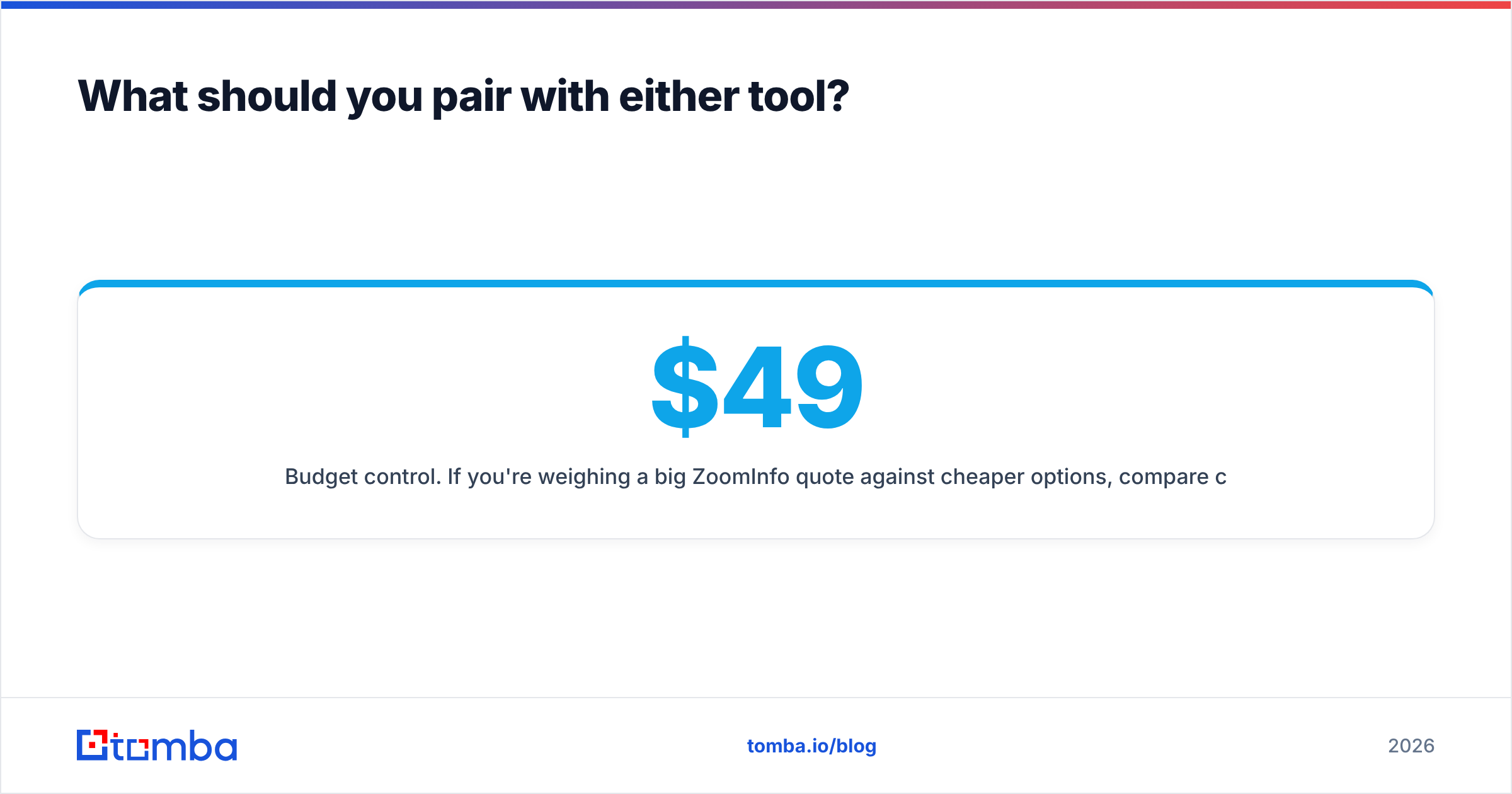
- Budget control. If you're weighing a big ZoomInfo quote against cheaper options, compare cost per verified contact across tools. Tomba pricing starts with a free tier of 25 searches per month, then $49/mo (Starter), $99/mo (Growth) and $249/mo (Pro), which makes a useful baseline.
Which one should you pick?#
Here is the short version, by team type:
- Solo founder or early startup doing cold email: Leadsforge. It's fast and cheap, and it doesn't lock you into a contract.
- Lead-gen or outbound agency: Leadsforge, possibly alongside a standalone email finder for client-specific account lists.
- Mid-market team, email-first, 5-15 reps: start with Leadsforge or a similar tool. Revisit ZoomInfo once phone or intent becomes a real bottleneck.
- Phone-heavy SDR team of any size: ZoomInfo, or at least a trial of its direct-dial coverage in your segment.
- Enterprise sales org with RevOps support: ZoomInfo. The platform depth, CRM sync and intent layer match how you already operate.
Before signing anything annual, run a 200-contact test in your real ICP. Measure verified email rate, bounce rate after sending, and phone connect rate. Those three numbers will tell you more than any feature table, including this one.
Frequently asked questions#
Is Leadsforge a ZoomInfo alternative?#
For cold email prospecting, yes. For phone data, intent signals, org charts and CRM-wide enrichment, it isn't a full replacement. It covers the list-building part of ZoomInfo's job at a much lower cost.
Does ZoomInfo offer monthly plans?#
ZoomInfo sells mainly on annual contracts. It has offered lighter self-serve options at times, but most SalesOS buyers go through a sales-led annual agreement.
Does Leadsforge verify emails?#
Yes. Leadsforge verifies contacts before export. Running a second verification pass just before sending is still good practice, especially for older lists or catch-all domains.
Which has better phone numbers?#
ZoomInfo, by a clear margin. Direct dials and mobile numbers are among its strongest assets.
Find the exact contacts either database misses#
Leadsforge and ZoomInfo both give you lists. Outbound often depends on the one decision-maker who isn't in them, or the domain where every export bounces. Tomba Email Finder fills that gap. Search by name and company, or by domain, and get a verified professional email with its public sources shown, starting free with 25 searches a month and $49/mo after that. Use it alongside whichever database you pick, or on its own if an annual data contract doesn't fit your budget.
Related guides#
// get started
Find, verify and enrich your first contacts today
Start on the free plan with 25 searches a month, then scale when your team is ready.
Free plan · No credit card required · GDPR & CCPA
Get the Tomba newsletter
Product and data updates
// about the author