LeadsGorilla Alternatives: 8 Better Tools for Local Leads in 2026
LeadsGorilla finds local businesses with weak online presence, but it leaves you with thin contact data and no verification. Here are 8 LeadsGorilla alternatives, sorted by what your agency actually needs.
TL;DR
- LeadsGorilla is built for agencies and freelancers selling to local businesses. It finds listings, flags gaps in their online presence, and gives you pitch templates. It is weak at verified decision-maker emails and CRM-grade data.
- If you mostly need local business discovery, look at Outscraper or D7 Lead Finder. For verified emails at those businesses, add Tomba, Hunter, or Snov.io.
- Apollo.io is the all-in-one pick if you also sell to mid-market and enterprise accounts. BookYourData fits if you want pre-built, pay-per-contact lists without a subscription.
- The setup that holds up best in 2026 has two layers: one tool finds the businesses, and a second tool finds and verifies the person who can sign.
- Tomba's free tier (25 searches/mo) lets you test the email layer on your own LeadsGorilla exports before you pay for anything.
What is LeadsGorilla, and why are people looking for alternatives?#
LeadsGorilla is a lead-generation app sold mainly to marketing agencies, web designers, and freelancers who target local businesses. Its core promise is simple. You enter a niche and a city, and it returns businesses along with signals about their online presence: missing website, poor reviews, weak social activity, no ads running. It then gives you outreach templates built around those gaps.
It is mostly sold through launch marketplaces as a one-time license with optional upgrade tiers, not as a monthly SaaS subscription. That pricing is the main draw. Pay once, find local prospects forever.
People start searching for LeadsGorilla alternatives for the same few reasons:
- Contact data is thin. A local listing usually gives you a generic inbox like info@ or contact@, or a phone number. That is not the owner or marketing manager, and a generic address rarely gets a reply.
- No verification layer. Scraped emails go straight into your sequence, and your bounce rate climbs with them.
- Limited scale and integrations. Once you run more than a few campaigns a week, you want CRM sync, an API, and bulk workflows.
- One-time-license risk. Pricing like this keeps the upfront cost low. The trade-off is that you depend on the vendor to keep the data sources and scrapers working as platforms change.
None of this makes LeadsGorilla useless. It is a reasonable discovery tool for a solo agency owner. It is just one layer of a prospecting stack, and most people outgrow it once cold email becomes a real revenue channel.
What should you look for in a LeadsGorilla alternative?#
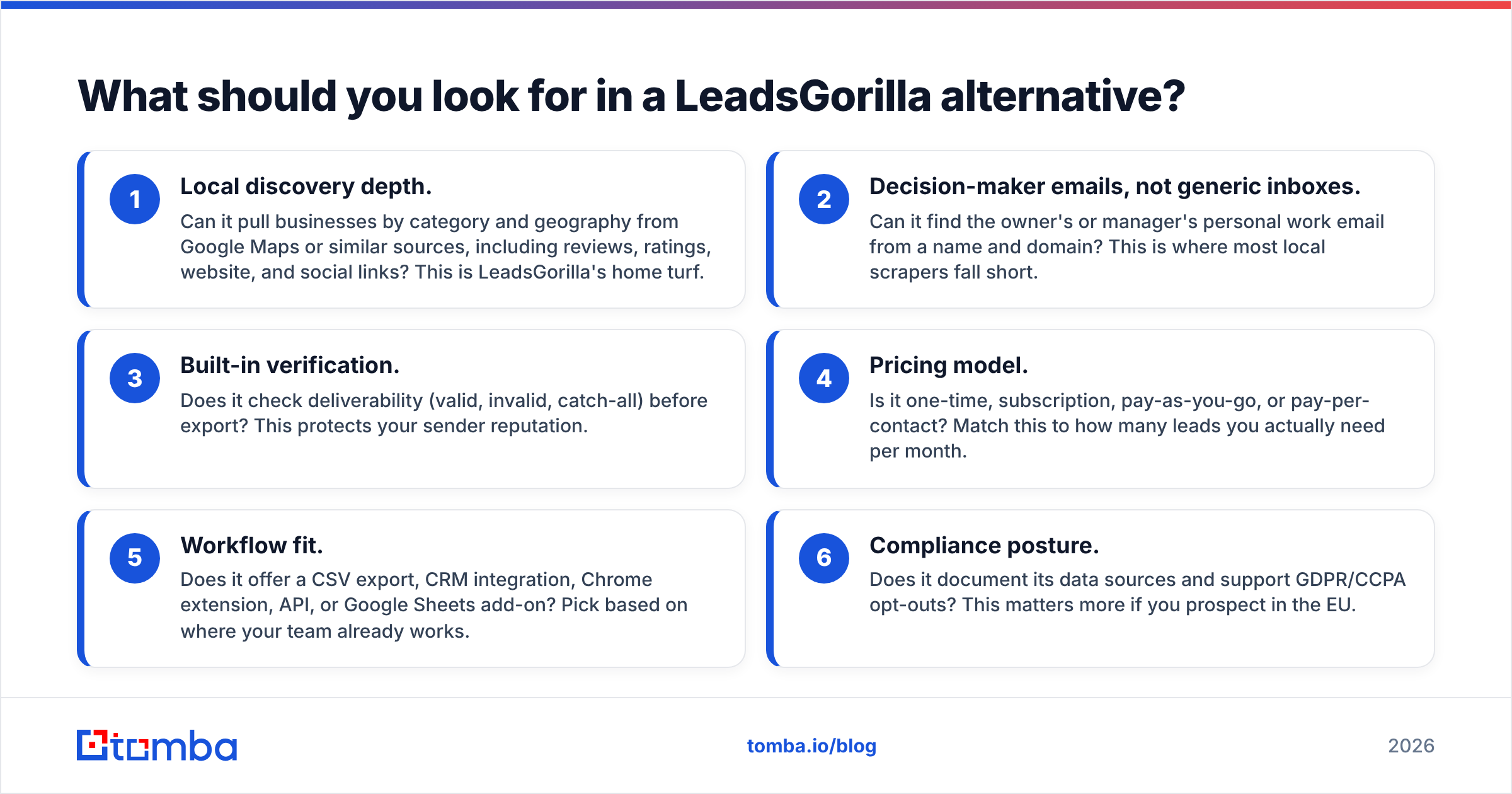
Before you compare vendors, decide which job you are replacing. Most bad tool switches happen because someone buys an all-in-one platform when they only needed a better email layer, or the other way around.
- Local discovery depth. Can it pull businesses by category and geography from Google Maps or similar sources, including reviews, ratings, website, and social links? This is LeadsGorilla's home turf.
- Decision-maker emails, not generic inboxes. Can it find the owner's or manager's personal work email from a name and domain? This is where most local scrapers fall short.
- Built-in verification. Does it check deliverability (valid, invalid, catch-all) before export? This protects your sender reputation.
- Pricing model. Is it one-time, subscription, pay-as-you-go, or pay-per-contact? Match this to how many leads you actually need per month.
- Workflow fit. Does it offer a CSV export, CRM integration, Chrome extension, API, or Google Sheets add-on? Pick based on where your team already works.
- Compliance posture. Does it document its data sources and support GDPR/CCPA opt-outs? This matters more if you prospect in the EU.
Keep this list next to the comparison table below. Each tool wins on two or three of these criteria, and none wins on all six.
Which LeadsGorilla alternatives are worth your time in 2026?#
Here are eight tools, grouped by the job they do best. Pricing is based on public plans at the time of writing, and vendors change tiers often, so confirm on each vendor's pricing page before you buy.
1. Tomba: best for turning local listings into verified decision-maker emails#
Tomba does not try to replace LeadsGorilla's niche-and-city discovery. It fixes the step where LeadsGorilla leaves you stuck: you have a business and a domain, but no person to email.
With Tomba's domain search, you paste a local business's website and get the email addresses tied to that domain, each with sources and confidence scores. If you know the owner's name from the Google listing or the About page, the email finder returns their work address directly. Every result can go through the email verifier before export, which is the step most local-lead tools skip.
- Strengths: Name + domain lookup, domain-wide search, built-in verification and catch-all handling, Chrome extension, Google Sheets add-on, API, and native CRM integrations.
- Limitations: It is not a Google Maps scraper, so you still need a discovery source for "every dentist in Phoenix."
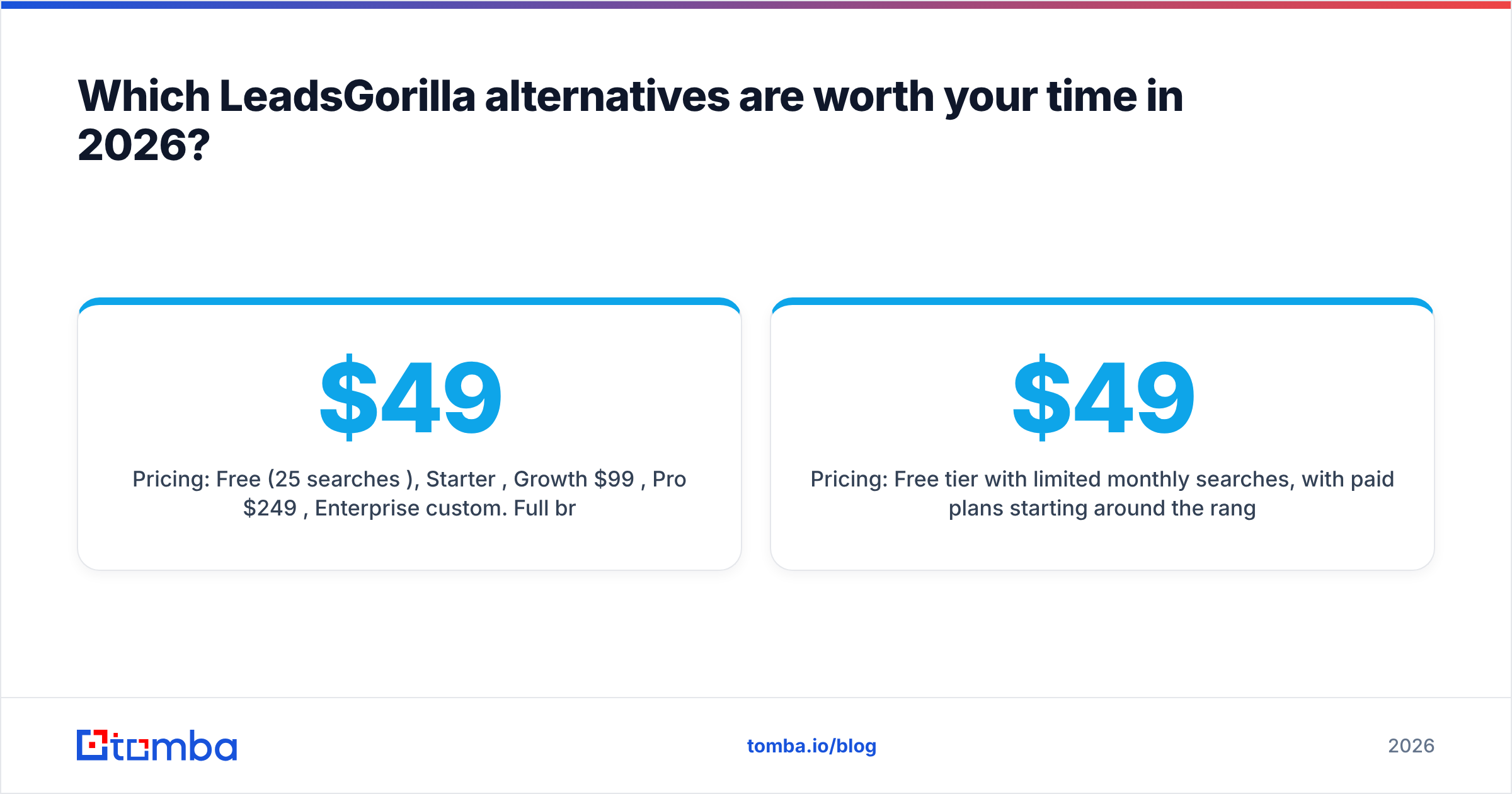
- Pricing: Free (25 searches/mo), Starter $49/mo, Growth $99/mo, Pro $249/mo, Enterprise custom. Full breakdown on Tomba pricing.
2. Outscraper: best for raw Google Maps discovery at scale#
Outscraper is the closest like-for-like replacement for LeadsGorilla's discovery engine. It scrapes Google Maps listings, reviews, and related business data by category and location, and it can enrich listings with the emails and social profiles found on their websites.
- Strengths: Very large coverage, pay-as-you-go pricing, review data you can use for personalization.
- Limitations: The emails it finds are mostly site-scraped generic inboxes. You get raw data, not a guided "pitch this business" workflow.
- Pricing: Usage-based with a free monthly allowance, so light users often pay very little.
3. D7 Lead Finder: best for agencies that want LeadsGorilla-style simplicity on a subscription#
D7 Lead Finder targets the same buyer as LeadsGorilla: small agencies that need local business lists by keyword and city. It returns business names, websites, phones, emails, and social links in a simple interface.
- Strengths: Very easy to learn, low monthly cost, built for local niches.
- Limitations: Data quality varies by region, and there is no deep verification or decision-maker search.
- Pricing: Low-cost monthly tiers, usually cheaper than a single month of most B2B data platforms.
4. Apollo.io: best all-in-one if you sell beyond local SMBs#
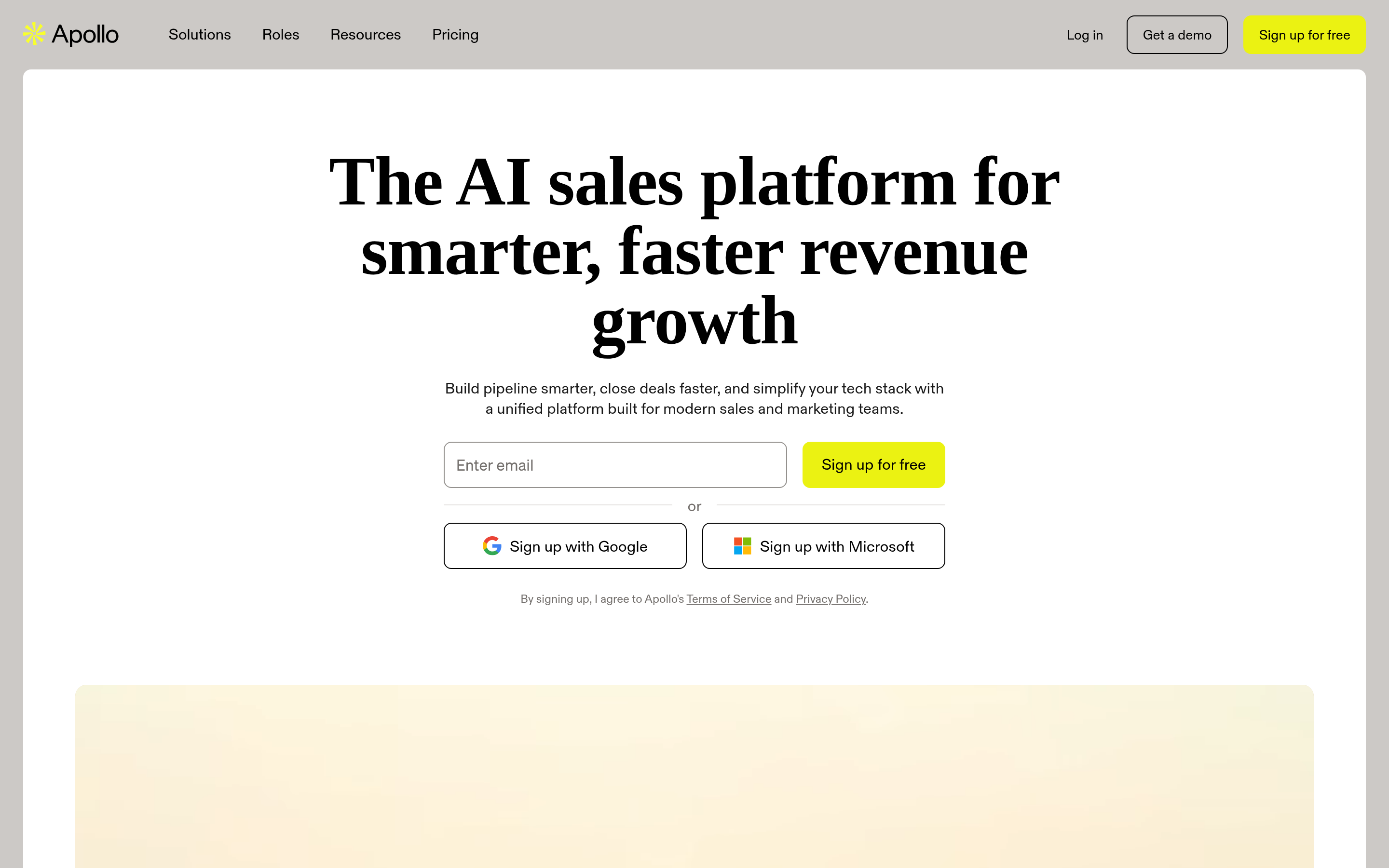
Apollo.io combines a large B2B contact database, filters, sequences, and a dialer. If your agency is moving upmarket from local plumbers to regional chains or SaaS companies, Apollo covers discovery and outreach in one place.
- Strengths: Strong role and seniority filters, built-in sequencing, generous free plan.
- Limitations: Coverage of very small local businesses (single-location restaurants, trades) is thinner than Google Maps sources. Credits and seat pricing add up as your team grows.
- Pricing: Free plan available, and paid plans are billed per user. Compare the trade-offs in our Apollo alternative breakdown.
5. Hunter.io: best simple email finder for small teams#
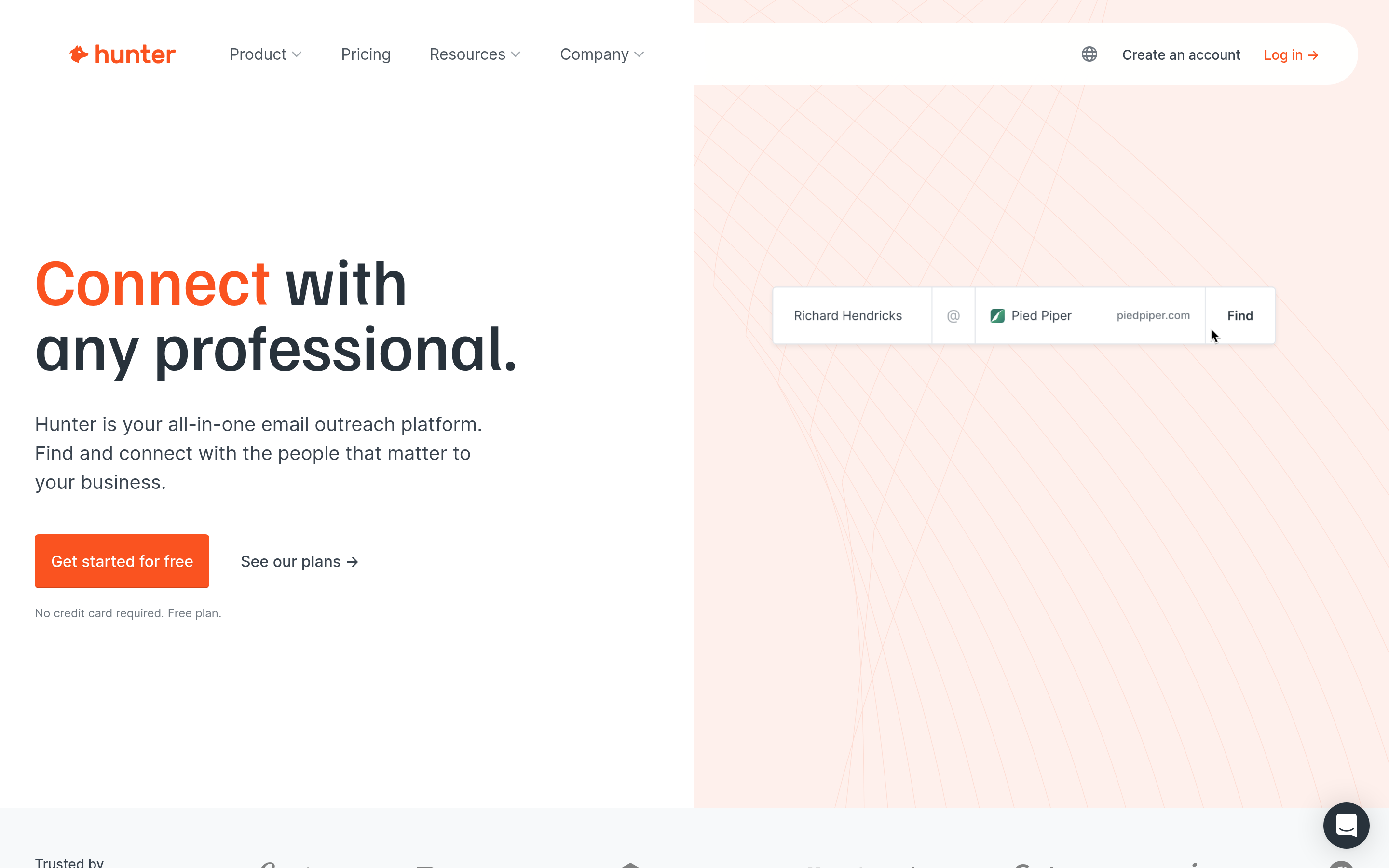
Hunter is a well-known domain search and email finder with a clean interface and a verification step. For many agencies it plays the same role as Tomba: the layer that turns a website into a contact.
- Strengths: Simple UX, reliable pattern detection, built-in verifier, light campaign features.
- Limitations: Smaller local businesses often have few indexed emails, so results on tiny domains can be sparse. No local discovery.
- Pricing: Free tier with limited monthly searches, with paid plans starting around the $49/mo range.
6. Snov.io: best for email finding plus built-in drip campaigns#
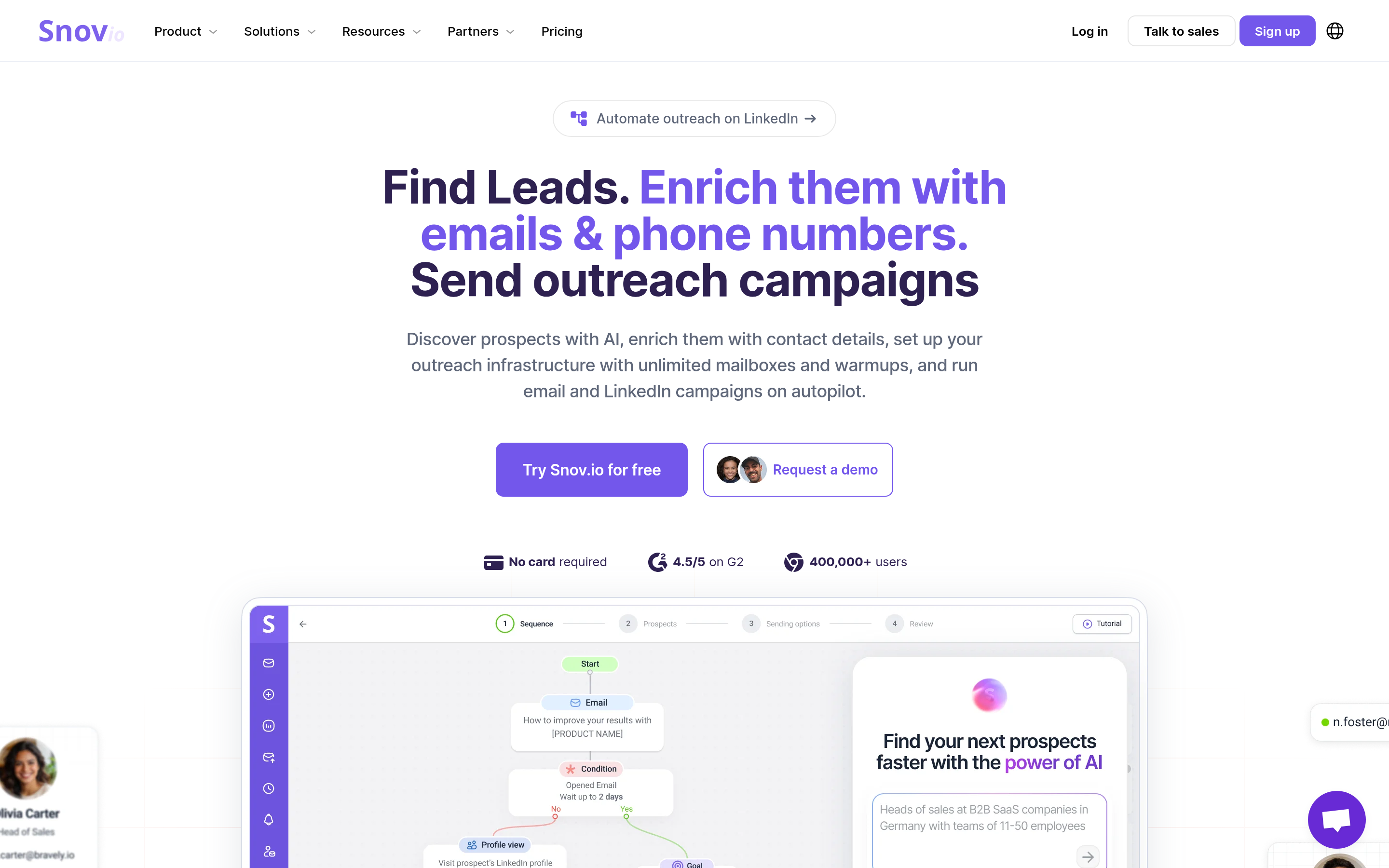
Snov.io bundles an email finder, a verifier, and a basic multichannel sequencer. If you want to move off LeadsGorilla and run outreach from the same tool, Snov.io keeps it in one bill.
- Strengths: Finder, verifier, and sequencing in one product, plus a CRM-lite pipeline.
- Limitations: The sequencing is capable but lighter than dedicated tools such as Instantly or Lemlist. There is no native Google Maps discovery.
- Pricing: Credit-based monthly plans with a free trial tier.
7. PhantomBuster: best for automating extraction across multiple platforms#
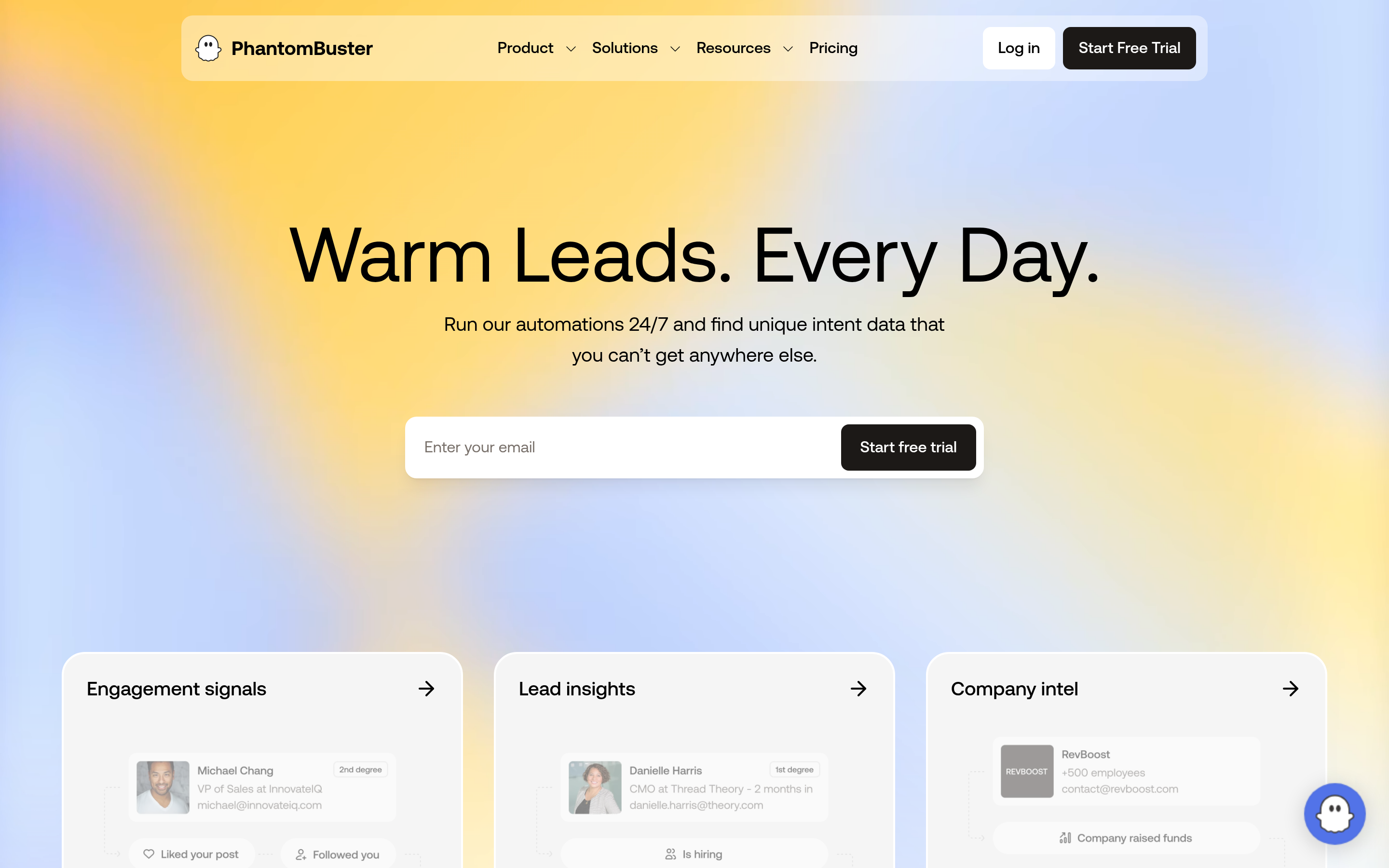
PhantomBuster runs pre-built automations ("Phantoms") that extract data from Google Maps, LinkedIn, Instagram, and other platforms on a schedule. It suits technical marketers who want to chain discovery and enrichment steps together.
- Strengths: Flexible, schedulable, and covers many sources.
- Limitations: Execution-time limits, a learning curve, and platform terms-of-service risk on some automations.
- Pricing: Monthly plans based on execution hours, with a trial.
8. BookYourData: best for pre-built, pay-per-contact lists#
BookYourData takes a different approach from the tools above. Instead of scraping or searching domain by domain, you filter a prebuilt B2B contact database by industry, location, job title, and company size, then buy only the contacts you need. It advertises verified data and a pay-as-you-go model with no required subscription, which suits agencies with uneven monthly volume.
- Strengths: No subscription lock-in, fast list building, and job-title targeting that LeadsGorilla does not offer.
- Limitations: As with any prebuilt database, very small or newly opened local businesses may not be listed yet, so pair it with a Maps source for hyper-local niches.
- Pricing: Credit packs, pay per contact.
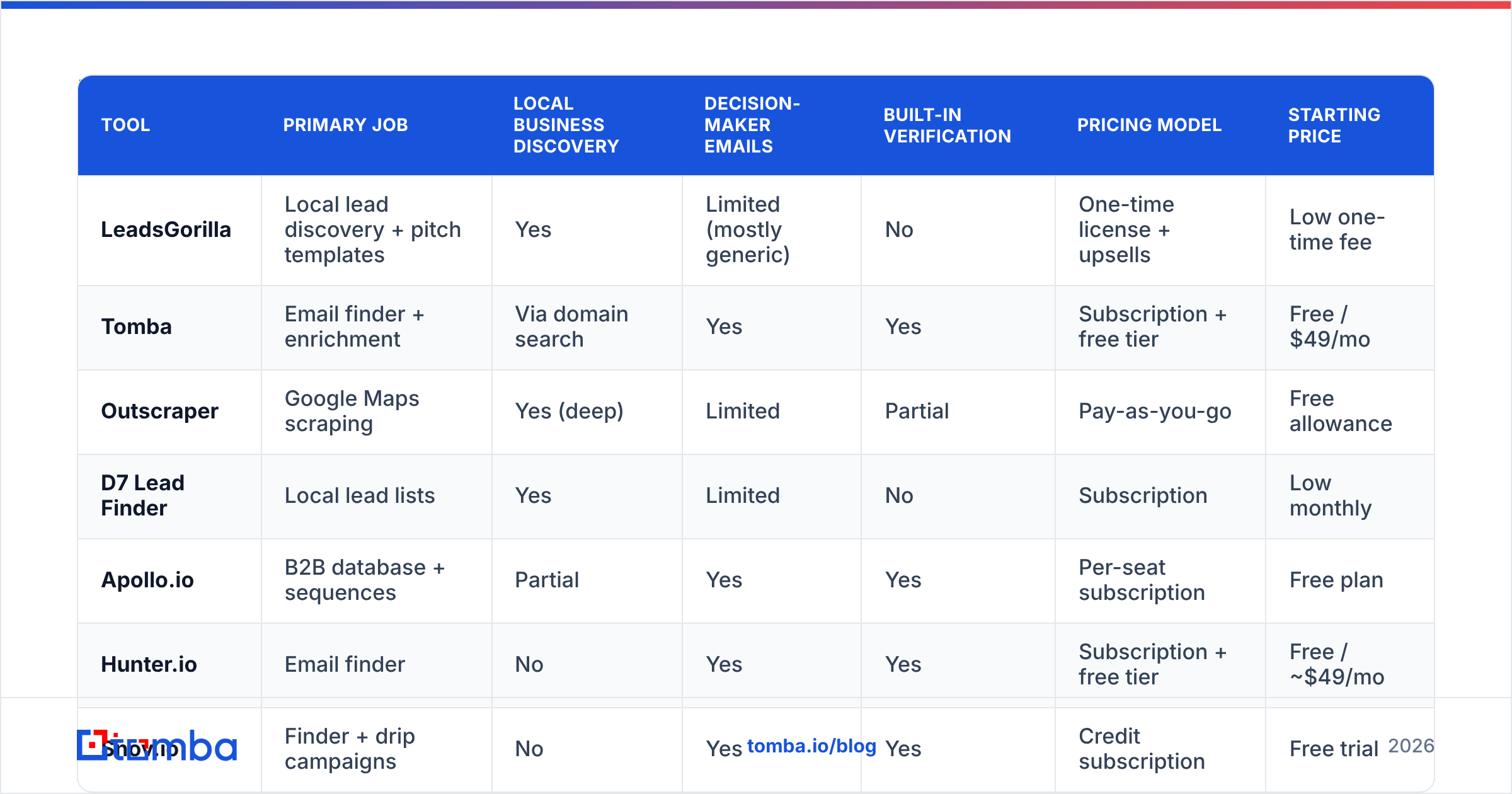
How do the top LeadsGorilla alternatives compare side by side?#
| Tool | Primary job | Local business discovery | Decision-maker emails | Built-in verification | Pricing model | Starting price |
|---|---|---|---|---|---|---|
| LeadsGorilla | Local lead discovery + pitch templates | Yes | Limited (mostly generic) | No | One-time license + upsells | Low one-time fee |
| Tomba | Email finder + enrichment | Via domain search | Yes | Yes | Subscription + free tier | Free / $49/mo |
| Outscraper | Google Maps scraping | Yes (deep) | Limited | Partial | Pay-as-you-go | Free allowance |
| D7 Lead Finder | Local lead lists | Yes | Limited | No | Subscription | Low monthly |
| Apollo.io | B2B database + sequences | Partial | Yes | Yes | Per-seat subscription | Free plan |
| Hunter.io | Email finder | No | Yes | Yes | Subscription + free tier | Free / ~$49/mo |
| Snov.io | Finder + drip campaigns | No | Yes | Yes | Credit subscription | Free trial |
| PhantomBuster | Multi-platform automation | Yes (via Phantoms) | Limited | No | Execution-time plans | Trial |
| BookYourData | Prebuilt B2B lists | Partial | Yes | Yes | Pay-per-contact | Credit packs |
Two patterns stand out. First, no single tool is strong at both hyper-local discovery and verified decision-maker emails. The tools that dig deepest into Google Maps return generic inboxes, and the tools that return named contacts rely on databases or domain indexes. Second, verification is the dividing line. Every tool in the "Yes" column for verification protects your domain. Everything else puts the risk on your email deliverability.
For independent user reviews on any of these vendors, G2 is the most useful single source. Filter reviews by company size to find feedback from agencies like yours.
Is a two-tool stack better than a single LeadsGorilla replacement?#
For most agencies, yes. Here is the workflow that consistently beats a single-tool setup for local outbound:
- Discover. Pull "roofing contractors, Austin TX" from Outscraper, D7, or your existing LeadsGorilla license, with website, rating, and review count.
- Qualify. Keep businesses that have a website but low review counts, or high ratings with no active ads. These are the gaps you can sell against.
- Find the person. Run each domain through an email finder. Use name + domain when the owner's name appears on the listing or site, and domain search when it doesn't.
- Verify. Drop invalid addresses, and treat catch-all domains as a separate lower-volume segment.
- Send. Load the result into your sequencer, and personalize the first line around the gap you found in step 2.
Step 3 is where the reply rate changes. "Hi, I noticed your Google profile has 11 reviews" sent to info@ ends up in a shared inbox. The same line sent to the owner's personal work address gets read by the person who decides.

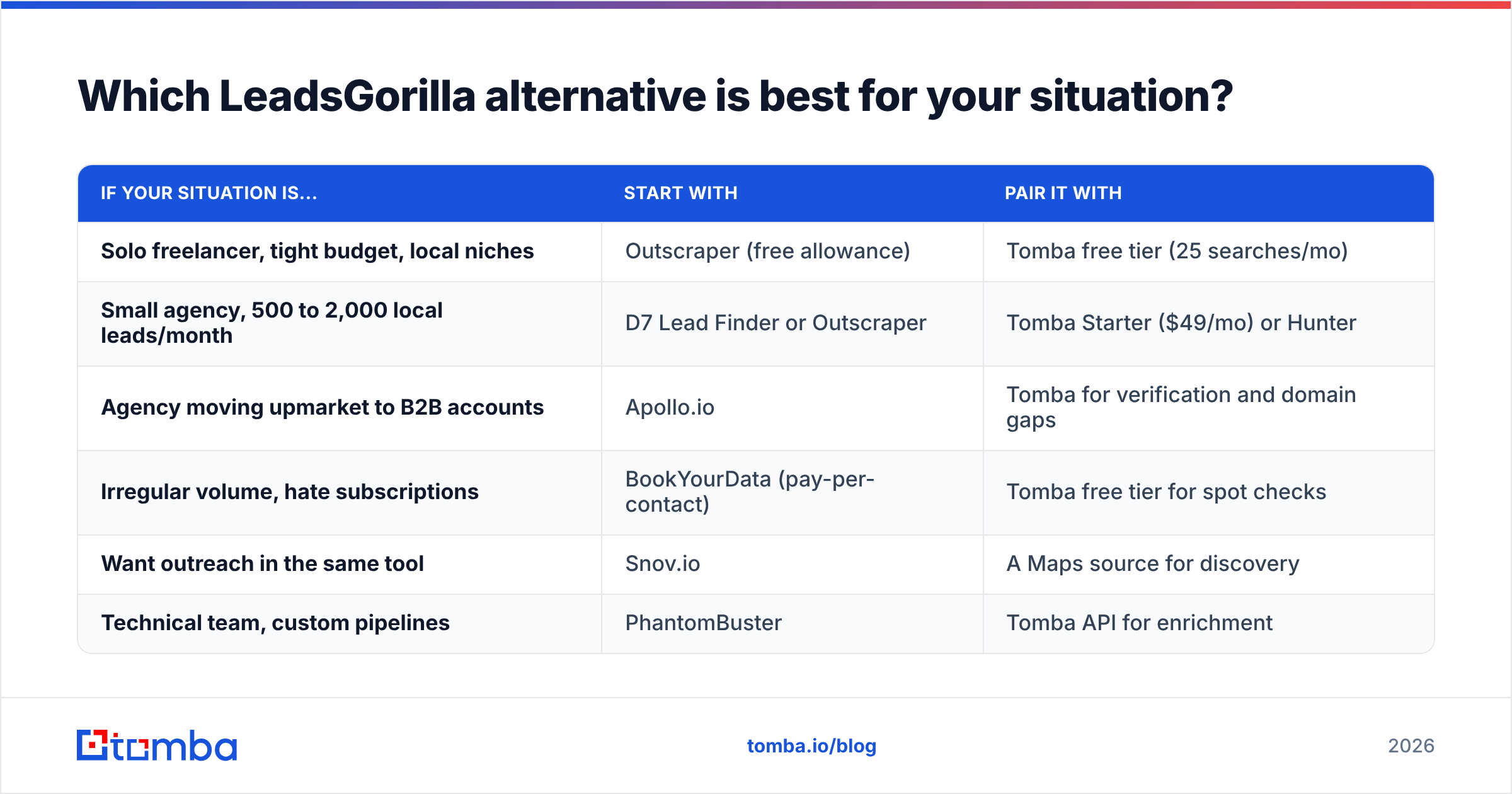
Which LeadsGorilla alternative is best for your situation?#
Match the tool to your bottleneck, not to the longest feature list.
| If your situation is... | Start with | Pair it with |
|---|---|---|
| Solo freelancer, tight budget, local niches | Outscraper (free allowance) | Tomba free tier (25 searches/mo) |
| Small agency, 500 to 2,000 local leads/month | D7 Lead Finder or Outscraper | Tomba Starter ($49/mo) or Hunter |
| Agency moving upmarket to B2B accounts | Apollo.io | Tomba for verification and domain gaps |
| Irregular volume, hate subscriptions | BookYourData (pay-per-contact) | Tomba free tier for spot checks |
| Want outreach in the same tool | Snov.io | A Maps source for discovery |
| Technical team, custom pipelines | PhantomBuster | Tomba API for enrichment |
If you already own a LeadsGorilla license, you don't need to throw it away. Keep using it for discovery and pitch ideas, and add a verification-grade email layer on top. That one change usually fixes the biggest problem, which is emailing generic inboxes with unverified data.
What are the common mistakes when switching from LeadsGorilla?#
- Buying a bigger database when the real problem is email quality. If your bounce rate is above 3 to 5%, a bigger list makes it worse. Verify before you scale.
- Treating catch-all domains as valid. Many small-business domains accept every address at the server level. Send to them in smaller batches and watch bounces separately.
- Ignoring compliance. Scraped local data still counts as personal data under GDPR when it identifies a person. Keep an opt-out process and record where each contact came from. HubSpot's cold email guidance covers the basics if you're new to it.
- Skipping the qualification step. Discovery tools return everything. Your reply rate comes from filtering down to businesses that actually have the problem you solve.
- Switching everything at once. Change one layer at a time, either discovery or the email layer, so you can tell which change moved your numbers.
Frequently asked questions#
Is LeadsGorilla still worth buying in 2026?#
It can be, if you are a solo agency owner who mainly needs local discovery and pitch ideas at a low one-time cost. It is not enough on its own for serious cold email volume, because it lacks decision-maker emails and verification.
What is the cheapest LeadsGorilla alternative?#
For discovery, Outscraper's free usage allowance is hard to beat. For finding and verifying emails, Tomba's free tier (25 searches/mo) and Hunter's free plan let you test on real leads before paying.
Can I use Google Maps data for cold email?#
You can use publicly listed business information for B2B outreach in many jurisdictions, but the rules differ by country. Include a clear opt-out, identify yourself, and follow CAN-SPAM in the US and GDPR's legitimate-interest rules in the EU.
Do I need both a lead finder and an email finder?#
For local businesses, usually yes. Lead finders tell you which businesses to target, and email finders tell you who to contact there and whether the address will deliver.
Ready to fix the weakest link in your local lead stack?#
Whichever discovery tool you choose, whether you keep LeadsGorilla or move to Outscraper, D7, or BookYourData, the step that most affects replies is reaching the owner or manager at an address that won't bounce. Tomba Email Finder takes a business domain or a name plus domain, returns the right work email with sources and a confidence score, and verifies it before you hit send. Start with the free tier's 25 monthly searches on your current lead list, and upgrade to Starter at $49/mo once the reply rates prove it.
Related guides#
Ready to find emails that actually work?
Join 150,000+ professionals who stopped guessing and started sending. Free credits on signup — no credit card required.
Get the Tomba newsletter
Practical outbound tactics and product updates — once every two weeks.
About the author