LeadsGorilla vs Apollo.io: Local Leads or a B2B Database in 2026?
LeadsGorilla finds local businesses that need marketing help. Apollo.io finds B2B decision-makers and runs sequences to reach them. Here's how to pick the right one for your pipeline, and where the email data breaks down in each.
TL;DR
- LeadsGorilla is a local-business lead tool built for marketing agencies and freelancers. It finds businesses by niche and city, flags weak spots in their online presence, and gives you pitch material.
- Apollo.io is a B2B contact database with a built-in sales engagement platform. You get person-level emails, phone numbers, firmographic filters, sequences, and CRM sync.
- If you sell websites, SEO, reviews, or ads to dentists, roofers, and restaurants, LeadsGorilla fits the job better. If you sell to named roles inside companies, like a VP of Sales at a 200-person SaaS firm, choose Apollo.
- Neither tool reliably gets you a verified, person-level email every time. LeadsGorilla mostly surfaces generic inboxes, and Apollo's data can go stale. Plan to run a separate finder and verifier on top of either one.
- Pricing isn't built the same way. Apollo uses per-seat subscriptions with credits. LeadsGorilla has historically sold licence-style plans. Check the current terms on each vendor's site before you buy.
What are LeadsGorilla and Apollo.io, and why compare them?#
People compare these two because both promise "leads." They mean different things by it.
LeadsGorilla is a cloud app for people who sell local marketing services. You type a keyword ("plumber") and a location ("Austin, TX"). It pulls matching businesses from public sources such as map listings and social pages, then scores each one for marketing gaps. Typical gaps are no mobile-friendly site, a missing ad pixel, few reviews, or a thin social presence. The tool then helps you turn those gaps into an audit report and an outreach email. Its buyers are mostly agency owners, freelancers, and white-label resellers.
Apollo.io is a B2B go-to-market platform. It has a large database of people and companies (Apollo advertises well over 200 million contacts), plus filters for job title, seniority, headcount, industry, technology, and funding. It also includes an email sequencer, a dialer, a Chrome extension, and two-way CRM sync. Its buyers are SDR teams, founders doing outbound, and RevOps teams who need one place to source and contact leads. You can see the current feature set on Apollo's official site.
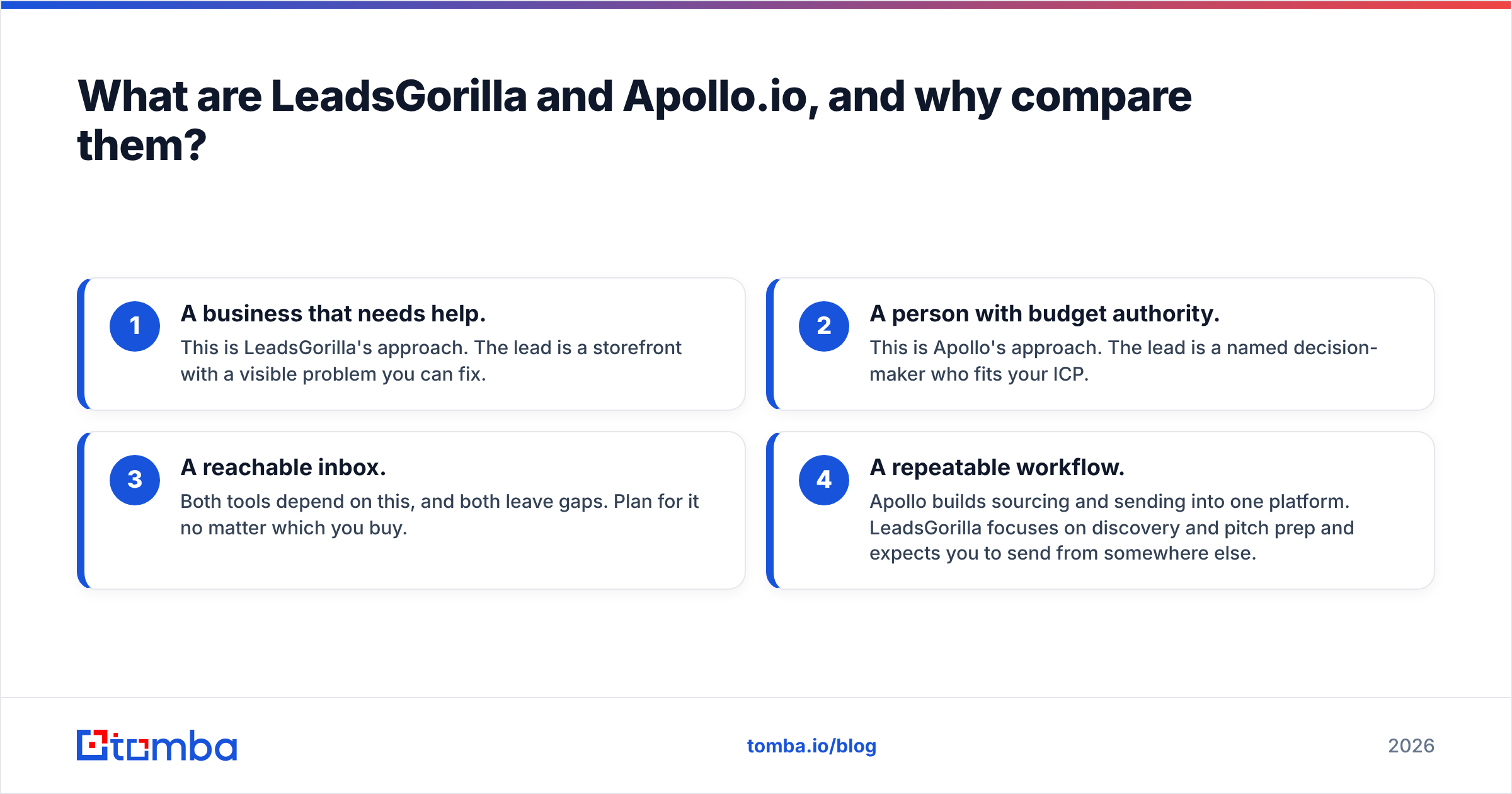
So you aren't choosing between two versions of the same product. You're choosing which kind of customer you want to find:
- A business that needs help. This is LeadsGorilla's approach. The lead is a storefront with a visible problem you can fix.
- A person with budget authority. This is Apollo's approach. The lead is a named decision-maker who fits your ICP.
- A reachable inbox. Both tools depend on this, and both leave gaps. Plan for it no matter which you buy.
- A repeatable workflow. Apollo builds sourcing and sending into one platform. LeadsGorilla focuses on discovery and pitch prep and expects you to send from somewhere else.
How do LeadsGorilla and Apollo.io compare feature by feature?#
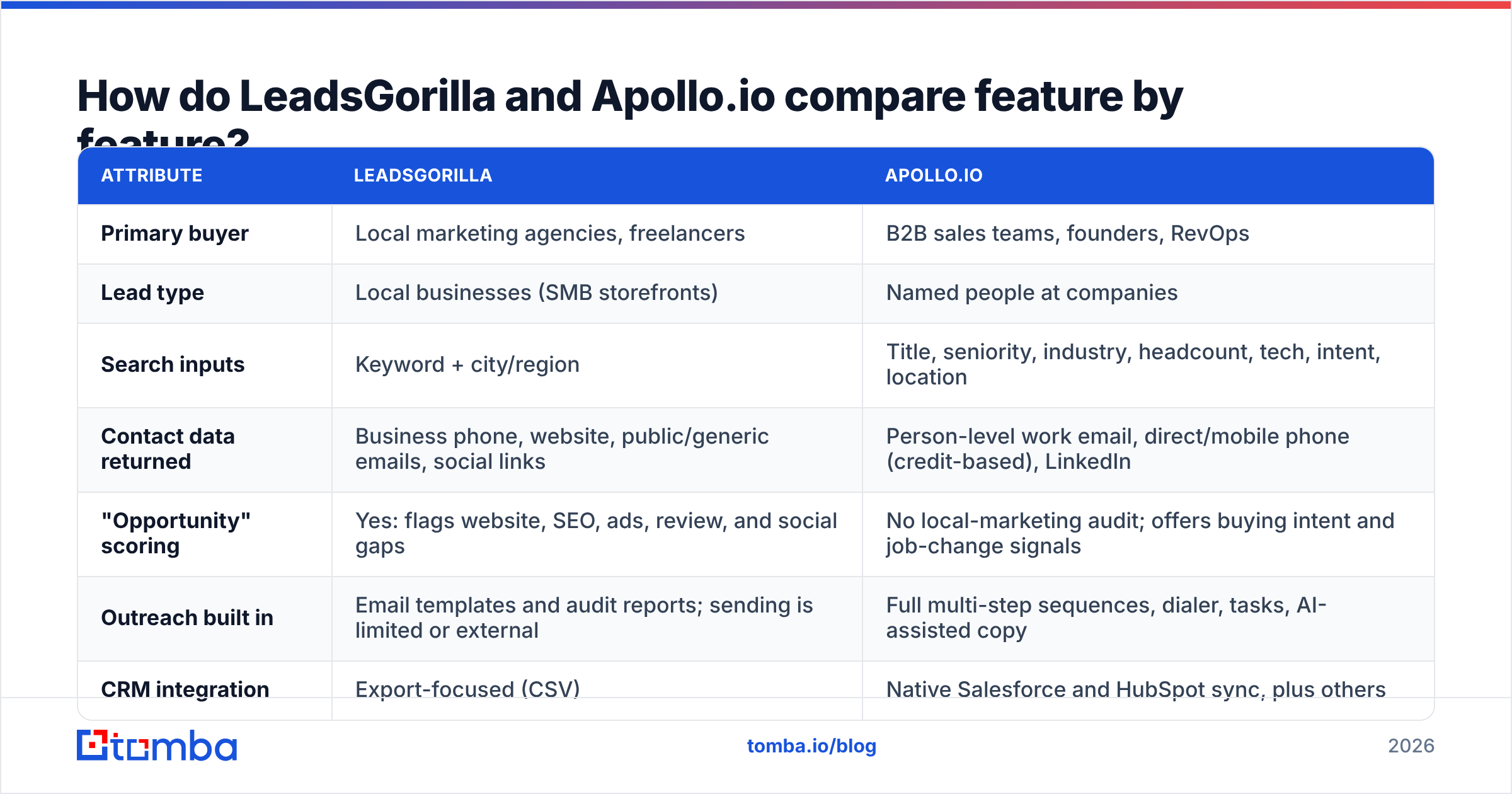
The table below shows how each tool is built. Pricing details change often, so treat them as a starting point and confirm on each vendor's pricing page.
| Attribute | LeadsGorilla | Apollo.io |
|---|---|---|
| Primary buyer | Local marketing agencies, freelancers | B2B sales teams, founders, RevOps |
| Lead type | Local businesses (SMB storefronts) | Named people at companies |
| Search inputs | Keyword + city/region | Title, seniority, industry, headcount, tech, intent, location |
| Contact data returned | Business phone, website, public/generic emails, social links | Person-level work email, direct/mobile phone (credit-based), LinkedIn |
| "Opportunity" scoring | Yes: flags website, SEO, ads, review, and social gaps | No local-marketing audit; offers buying intent and job-change signals |
| Outreach built in | Email templates and audit reports; sending is limited or external | Full multi-step sequences, dialer, tasks, AI-assisted copy |
| CRM integration | Export-focused (CSV) | Native Salesforce and HubSpot sync, plus others |
| Free tier | No meaningful ongoing free plan historically | Yes: free plan with limited monthly credits |
| Pricing model | Historically licence-style (one-time or annual) plus upsells | Per-seat subscription; paid tiers roughly $49–$119/user/mo billed annually at time of writing |
| Best for | Selling SEO, web design, reviews, ads to SMBs | Outbound to mid-market and enterprise roles |
| Main weakness | Generic inboxes, little data on individuals | Data decay and bounce risk on some segments; credit limits |
For Apollo's current tier names, credit allowances, and seat minimums, check Apollo's pricing page directly. The company adjusts credit limits more often than list prices.
Which tool finds better leads for your business model?#
It depends on who signs the contract you're trying to close.
When LeadsGorilla is the better fit. Say you run a small agency selling Google Business Profile optimisation. The ideal prospect is a single-location dental practice with 11 reviews and a site that breaks on mobile. Apollo has trouble finding that practice. Many micro-businesses don't have a well-populated company record, and the owner rarely has a clean LinkedIn profile with a matching work email. LeadsGorilla starts from the listing, so it finds these businesses easily. It also hands you the reason to reach out, such as "your competitor down the street has 140 reviews and you have 11." That kind of relevance is what gets replies from local business owners.
When Apollo is the better fit. Say you sell a $20k/year compliance platform to HR directors at 100–1,000 employee companies. LeadsGorilla can't help with that. Those companies aren't searched by city and category, and you need the person, not the front desk. Apollo lets you filter by title, headcount, and industry, add a technographic filter, and push the list straight into a sequence. It also reveals direct dials and flags job changes, which LeadsGorilla doesn't try to do.
What neither tool covers well: a local business owner's personal work email. LeadsGorilla usually gives you info@ or contact@, which reaches a shared inbox or a receptionist. Apollo sometimes has the owner, but coverage of very small companies is thin and the data can be out of date.

How accurate is the contact data in each tool?#
Accuracy is where the difference between the two shows up most.
LeadsGorilla's data is mostly business data, not people data. Phone numbers and websites pulled from listings are usually correct because the business keeps them current to get customers. Emails are the weak point. The tool shows whatever is publicly listed, which tends to be a generic role inbox. Role inboxes are deliverable but get low reply rates on cold outreach. Mailbox providers also watch them more closely for spam complaints, which can hurt your email deliverability if you send to them in volume.
Apollo's data is person-level, and quality varies by segment. Coverage is strongest in North American tech, SaaS, and professional services, and weaker in small local businesses and some international markets. On review sites such as Apollo's G2 profile, users usually praise the breadth of the database and the price. The most common complaints are bounced emails and outdated job titles. That fits how any large aggregated database works: people change jobs, domains change, and records age between refreshes.
Here's what that means for you in practice:
- With LeadsGorilla, the gap is coverage. You know the business exists but don't know who owns it or how to email them directly.
- With Apollo, the gap is freshness. You have a name and an email, but some of those emails will bounce.
Both gaps have the same fix: add a dedicated finding and verification step before anything goes into a sequence. Run every export through an email verifier and remove invalid and risky addresses. For LeadsGorilla leads, run the business's website through a domain search to see which named people have addresses at that domain and what the company's email pattern is. That turns info@smithdental.com into dr.smith@smithdental.com, which gets far more replies.
How does pricing compare between LeadsGorilla and Apollo.io?#
The two tools charge in different ways, so you can't compare the list prices directly.
LeadsGorilla has historically been sold through launch-style offers: a front-end licence (one-time or annual) plus optional upgrades such as agency or white-label rights, more searches, or extra report templates. Up-front cost is low, and you don't pay per seat. Before you buy, check:
- How many searches or leads per day or month the plan allows
- Whether white-label reports cost extra
- Whether the plan includes ongoing data updates or only access to the app
- What happens to your account if the licence model changes
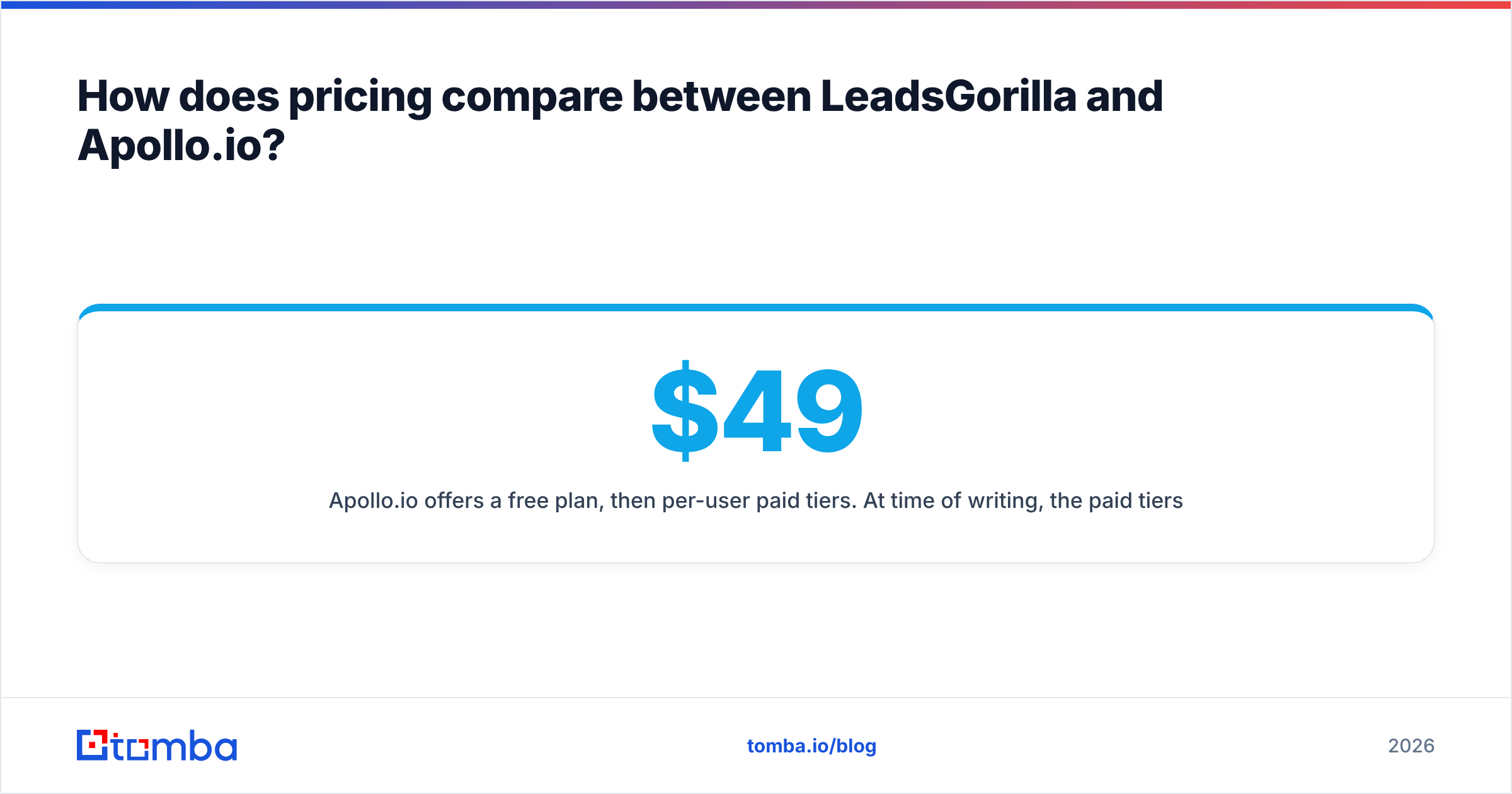
Apollo.io offers a free plan, then per-user paid tiers. At time of writing, the paid tiers run roughly $49, $79, and $119 per user per month on annual billing, with higher month-to-month rates. The top tier has a seat minimum. Each tier includes a credit allowance for email and mobile reveals and exports. Mobile numbers use more credits than emails. The cost that catches teams off guard is credits, not seats. A three-rep team exporting thousands of contacts a month can run out of credits well before month-end and have to buy add-ons.
Simple rule of thumb:
- Solo agency owner, local niche: LeadsGorilla's licence model usually costs less than a year of Apollo.
- Sales team of 3+, B2B ICP: Apollo's per-seat cost is easy to justify because it replaces a separate sequencer and dialer.
- Either way: set aside budget for verification. Sending unverified exports is how domains get burned.
Which one is easier to use day to day?#
LeadsGorilla is built for non-technical users. Enter a niche and a city, browse the results, open a business, see its "opportunities," and generate a report. Onboarding takes minutes. What it lacks is workflow: there are no multi-step sequences, no reply tracking tied to a CRM, and little team management. You'll probably export to a separate sending tool.
Apollo is deeper, so it takes longer to learn. Saved searches, list management, sequences, A/B tests, task queues, call recording, and CRM field mapping take a week or two to set up well. Once they're in place, one rep can research, enrich, sequence, call, and log from a single tab. For a team, keeping everything in one place is worth the learning curve.
A useful test: if your process is find → pitch → close in a phone call, LeadsGorilla's simplicity helps you. If it's find → sequence → book meeting → hand to AE → sync to CRM, you need Apollo's workflow depth.
What are the main pros and cons of each?#
LeadsGorilla pros
- Built for local-services selling, and the "opportunity" flags give you a ready-made reason to reach out
- Audit reports make first contact look consultative instead of spammy
- Low up-front cost and no per-seat pricing
- Fast to learn
LeadsGorilla cons
- Mostly generic emails with little decision-maker data
- Limited native sending and CRM integration
- Not suited to B2B selling outside local SMBs
- Licence and upsell structure means you need to read the offer carefully
Apollo.io pros
- Large person-level database with detailed filters
- Sequencing, dialer, and CRM sync all in one platform
- Usable free plan for testing
- Strong Chrome extension for LinkedIn and Gmail
Apollo.io cons
- Bounce risk on some segments; data needs verification before sending
- Credit limits can surprise growing teams
- Thin coverage of micro and local businesses
- Takes longer to set up well
If Apollo's credit model or data freshness is a problem for you, see our breakdown of Apollo.io alternatives for options that separate data from engagement.
Can you use LeadsGorilla and Apollo.io together?#
Yes. For hybrid agencies it's often the best setup.
Some agencies sell to both local SMBs and mid-market brands, for example a web design shop that does $3k local builds and $40k B2B redesigns. They can run LeadsGorilla for the local side and Apollo for the B2B side. The risk is in the middle: two exports with two data formats and two different kinds of email quality, both feeding one sending domain.
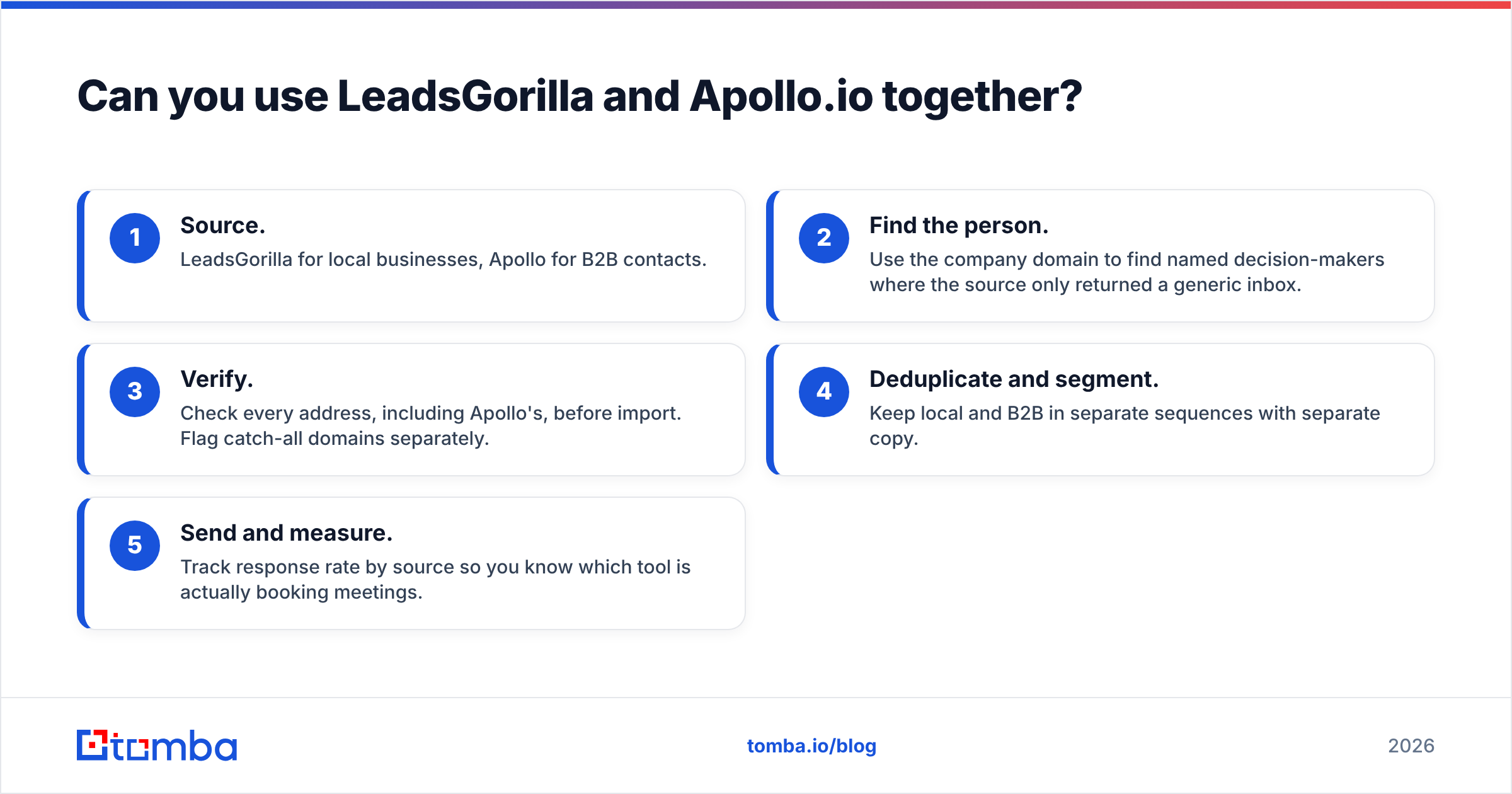
A clean hybrid stack looks like this:
- Source. LeadsGorilla for local businesses, Apollo for B2B contacts.
- Find the person. Use the company domain to find named decision-makers where the source only returned a generic inbox.
- Verify. Check every address, including Apollo's, before import. Flag catch-all domains separately.
- Deduplicate and segment. Keep local and B2B in separate sequences with separate copy.
- Send and measure. Track response rate by source so you know which tool is actually booking meetings.

So which should you pick: LeadsGorilla or Apollo.io?#
Pick LeadsGorilla if:
- You're an agency or freelancer selling marketing services to local businesses
- You want a ready-made reason to reach out (bad reviews, broken site, no ads) more than a big contact list
- You close deals over the phone or in person and don't need a full sequencing platform
- You're budget-sensitive and working alone
Pick Apollo.io if:
- You sell B2B and your buyer is a specific role at a specific type of company
- You want sourcing, sequencing, calling, and CRM sync in one platform
- You have (or plan to have) more than one rep
- You'll verify exports before sending and can manage credits
Our pick: Most readers searching "LeadsGorilla vs Apollo.io" are agencies deciding between the two. For them, the tool should match the customer. Local SMB clients → LeadsGorilla. B2B clients → Apollo. The bigger risk isn't choosing the wrong tool but trusting either tool's emails without checking them. Budget for a finding and verification layer either way. It costs a few cents per contact, and a burned sending domain costs much more.
How do you fill the email gap either tool leaves?#
LeadsGorilla gives you the business without the decision-maker. Apollo gives you the decision-maker but sometimes with an outdated address. Tomba Email Finder covers both cases. Enter a company domain, or a name plus a company, and it returns professional addresses along with their public sources and a confidence score. You can then verify them in the same workflow before they reach your sequencer. It works in the browser, through an API, or in bulk on a CSV export from either tool. The free tier (25 searches/month) is enough to test it on your next LeadsGorilla or Apollo list, and paid plans start at $49/month. See Tomba pricing for the full plan breakdown.
Related guides#
// get started
Find, verify and enrich your first contacts today
Start on the free plan with 25 searches a month, then scale when your team is ready.
Free plan · No credit card required · GDPR & CCPA
// about the author