LeadsGorilla vs ZoomInfo (2026): Local Leads or Enterprise Data?
LeadsGorilla and ZoomInfo both sell leads, but to very different buyers. One is a one-time-license tool for local agencies, and the other is an enterprise contact database priced in five figures. Here is how to pick, and when neither one fits.
TL;DR
- LeadsGorilla is built for marketing agencies and freelancers who sell services to local businesses. It scrapes public listings and flags each prospect's weak spots, such as a site that doesn't work on mobile, few reviews, or no ad pixel.
- ZoomInfo is an enterprise B2B intelligence platform. It combines a large contact and company database with intent data, org charts, and CRM enrichment. Pricing is quote-based and usually lands in five figures per year.
- The two rarely compete head to head. If you pitch dentists and plumbers, choose LeadsGorilla. If you're a sales team selling into mid-market and enterprise accounts, choose ZoomInfo.
- If you need verified B2B emails for a specific list of companies and don't want an annual contract, a pay-as-you-go email finder like Tomba covers most of what small teams actually use ZoomInfo for.
What is LeadsGorilla?#
LeadsGorilla is a web-based lead generation app aimed at digital marketing agencies, local SEO consultants, and web designers. You enter a niche and a location, for example "roofers in Denver". The tool pulls matching businesses from public sources like map listings and social pages.
It doesn't just return a list of names. It runs a quick audit on each business and shows the weaknesses you could sell a fix for:
- Website not mobile-friendly or loading slowly
- No Facebook or retargeting pixel installed
- Low star rating or few reviews
- Weak or missing social presence
- Contact details you can use for outreach, where they're publicly listed
That audit layer is the product's main selling point. An agency owner doesn't just want to know that a dentist exists. They want a reason the dentist should take their call. LeadsGorilla gives you that reason, plus built-in pitch templates to send.
It has usually been sold through launch-style offers as a one-time or annual license, with optional upgrades on top. That's a very different buying experience from enterprise software. Check the vendor's current offer before you buy, because packaging has changed across versions.
What is ZoomInfo?#
ZoomInfo is one of the largest players in B2B go-to-market data. Its core product, SalesOS, gives sales and marketing teams searchable profiles of companies and contacts. Those profiles include direct dials, business emails, job titles, reporting lines, technographics, and firmographics such as revenue and headcount.
On top of the database, ZoomInfo layers:
- Intent data: signals that an account is researching topics related to what you sell
- Website visitor identification: matching anonymous traffic to companies
- CRM enrichment: keeping records in Salesforce, HubSpot, and similar tools up to date automatically
- Engagement and conversation tools: sequencing, dialing, and call recording and analysis
- AI-assisted prospecting: account prioritization and suggested outreach
The company's history and scale are well documented on Wikipedia. Product details are on the official ZoomInfo site. ZoomInfo doesn't publish list prices. Buyers get a custom quote based on seats, credits, and modules. Reports from buyers and review sites commonly put entry contracts at around $15,000 per year or more, usually billed annually.
How do LeadsGorilla and ZoomInfo differ at the core?#
Think of LeadsGorilla as a metal detector for a local beach. You walk a small area and find specific things worth digging up. ZoomInfo is closer to a satellite survey of an entire continent: broad coverage, many layers of data, and a price to match.
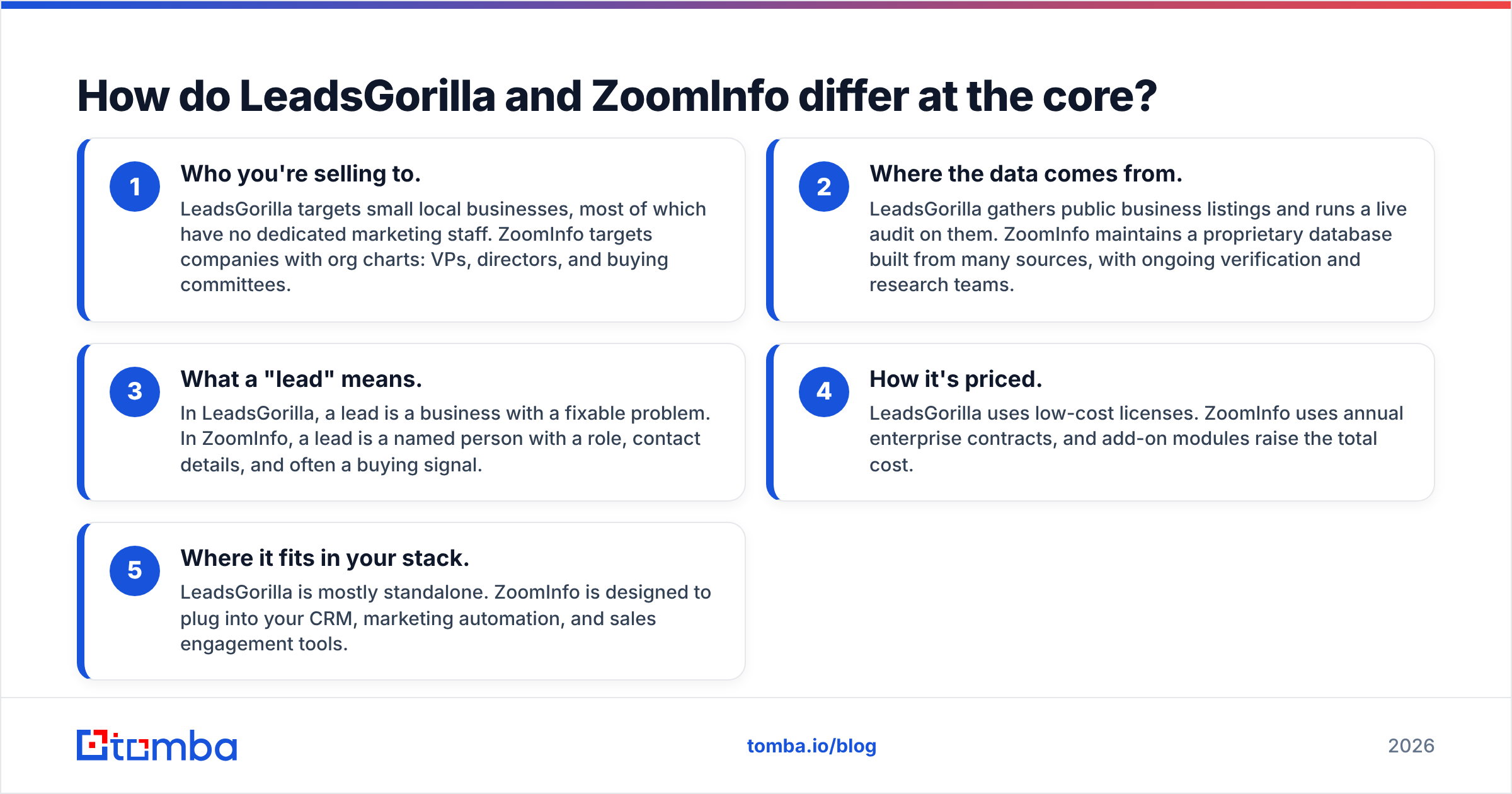
The core differences come down to five areas:
- Who you're selling to. LeadsGorilla targets small local businesses, most of which have no dedicated marketing staff. ZoomInfo targets companies with org charts: VPs, directors, and buying committees.
- Where the data comes from. LeadsGorilla gathers public business listings and runs a live audit on them. ZoomInfo maintains a proprietary database built from many sources, with ongoing verification and research teams.
- What a "lead" means. In LeadsGorilla, a lead is a business with a fixable problem. In ZoomInfo, a lead is a named person with a role, contact details, and often a buying signal.
- How it's priced. LeadsGorilla uses low-cost licenses. ZoomInfo uses annual enterprise contracts, and add-on modules raise the total cost.
- Where it fits in your stack. LeadsGorilla is mostly standalone. ZoomInfo is designed to plug into your CRM, marketing automation, and sales engagement tools.
How do LeadsGorilla and ZoomInfo compare feature by feature?#
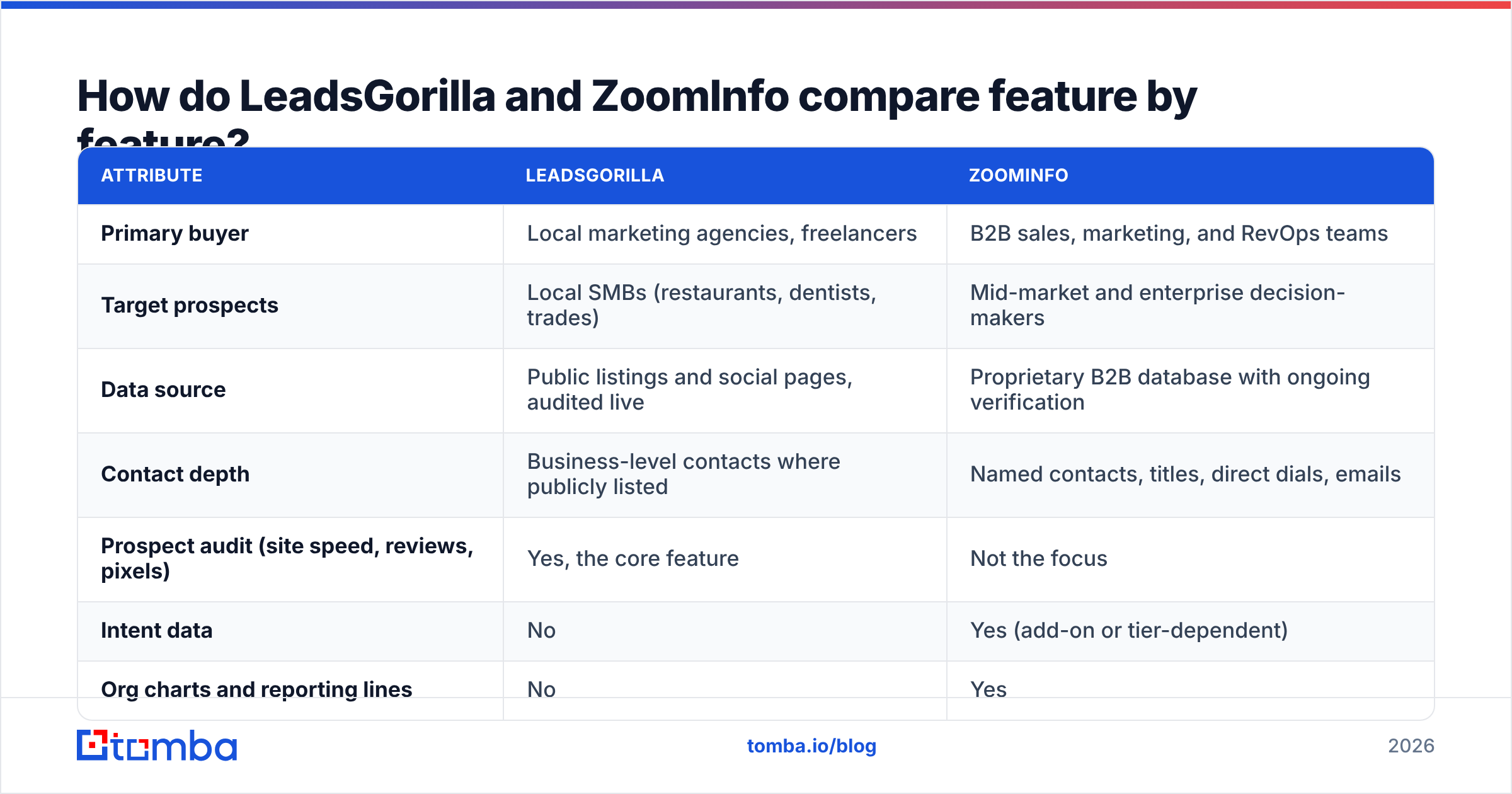
| Attribute | LeadsGorilla | ZoomInfo |
|---|---|---|
| Primary buyer | Local marketing agencies, freelancers | B2B sales, marketing, and RevOps teams |
| Target prospects | Local SMBs (restaurants, dentists, trades) | Mid-market and enterprise decision-makers |
| Data source | Public listings and social pages, audited live | Proprietary B2B database with ongoing verification |
| Contact depth | Business-level contacts where publicly listed | Named contacts, titles, direct dials, emails |
| Prospect audit (site speed, reviews, pixels) | Yes, the core feature | Not the focus |
| Intent data | No | Yes (add-on or tier-dependent) |
| Org charts and reporting lines | No | Yes |
| CRM integrations | Limited, mostly export-based | Deep (Salesforce, HubSpot, Microsoft Dynamics, and more) |
| Pricing model | Low-cost one-time or annual license, plus upsells | Custom annual contract, commonly $15K+/yr |
| Free trial | Occasionally via launch offers | Demo-led, limited trial access |
| Learning curve | Low | Moderate to high |
| Best for | Pitching marketing services locally | Account-based and outbound B2B sales |
The image above is where your first meme goes. Here is the correct placeholder:

Is LeadsGorilla better than ZoomInfo for agencies?#
For a local-services agency, usually yes, and it isn't close. ZoomInfo's strength is its depth on companies with structured buying teams. A family-run bakery doesn't have a VP of Marketing. Its "decision-maker" is the owner, whose contact details are often on the Google listing anyway. Paying enterprise prices to reach that person makes little sense.
LeadsGorilla also answers the question agencies struggle with most: what do I say in the first message? An opener like "Your site takes 9 seconds to load on mobile and you have 11 reviews versus your competitor's 140" gets far more replies than a generic "Do you need marketing help?" The audit turns prospecting into a diagnosis, and a diagnosis earns a response.
Keep the trade-offs in mind:
- Data freshness varies. Public listings are often outdated, and small businesses change owners and phone numbers often.
- Emails are hit-and-miss. Many local businesses list a generic info@ address or none at all. Before sending, run your list through an email verifier to protect your sender reputation.
- Cold outreach rules still apply. Scraped contact data doesn't exempt you from CAN-SPAM, GDPR, or local anti-spam laws.
Is ZoomInfo better than LeadsGorilla for B2B sales teams?#
For a team selling software, services, or infrastructure to other businesses with more than about 50 employees, ZoomInfo is in a different class. You can filter by title, department, seniority, tech stack, funding, and headcount growth. Then you can push those contacts straight into sequences, with CRM records enriched automatically.
Intent data is the other major advantage. Knowing that an account's team has been researching "SOC 2 automation" for three weeks changes when and how you reach out. LeadsGorilla has nothing comparable, and it doesn't try to.
ZoomInfo's weaknesses appear mostly in reviews from smaller teams on G2:
- Cost and contract terms. Annual commitments, credit limits, and auto-renewal clauses come up again and again as complaints.
- Paying for unused features. Many teams use ZoomInfo mainly to look up emails and phone numbers. The intent, visitor-tracking, and conversation modules go unused.
- Accuracy varies by segment. Coverage is strongest for North American mid-market and enterprise companies and thinner for small firms and some international markets.
If your team uses 20% of the platform, you're paying roughly five times what that 20% is worth.
What does each tool actually cost in 2026?#
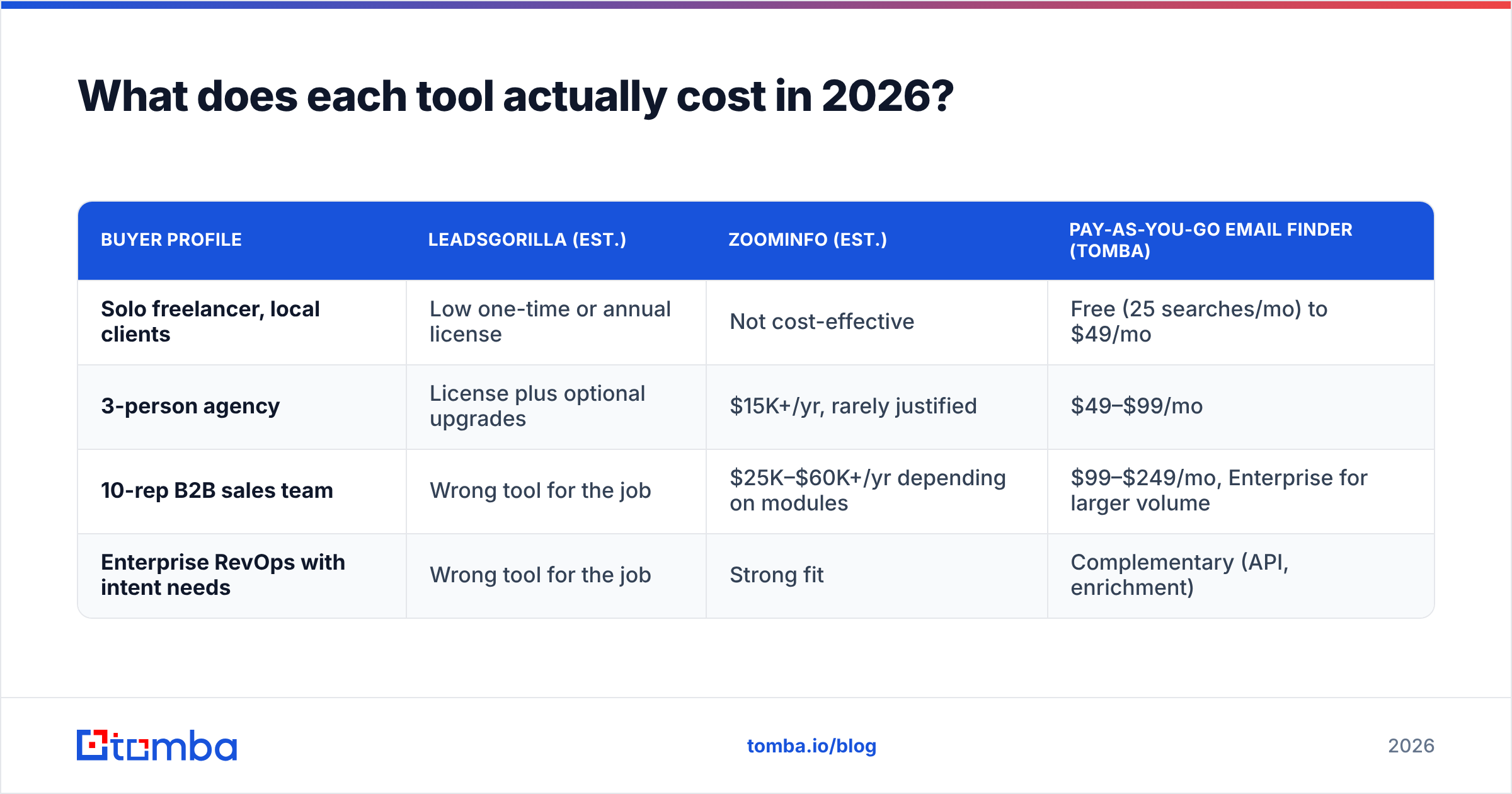
Here's a realistic view of first-year spend for three common buyer profiles. LeadsGorilla figures assume current promotional licensing. ZoomInfo figures are based on commonly reported contract ranges, not published prices.
| Buyer profile | LeadsGorilla (est.) | ZoomInfo (est.) | Pay-as-you-go email finder (Tomba) |
|---|---|---|---|
| Solo freelancer, local clients | Low one-time or annual license | Not cost-effective | Free (25 searches/mo) to $49/mo |
| 3-person agency | License plus optional upgrades | $15K+/yr, rarely justified | $49–$99/mo |
| 10-rep B2B sales team | Wrong tool for the job | $25K–$60K+/yr depending on modules | $99–$249/mo, Enterprise for larger volume |
| Enterprise RevOps with intent needs | Wrong tool for the job | Strong fit | Complementary (API, enrichment) |
The takeaway: LeadsGorilla is cheap but narrow, and ZoomInfo is broad but expensive. Many teams fall in the gap between them. They need reliable B2B emails for named people at specific companies but don't need intent data or an annual contract.
Which one should you choose?#
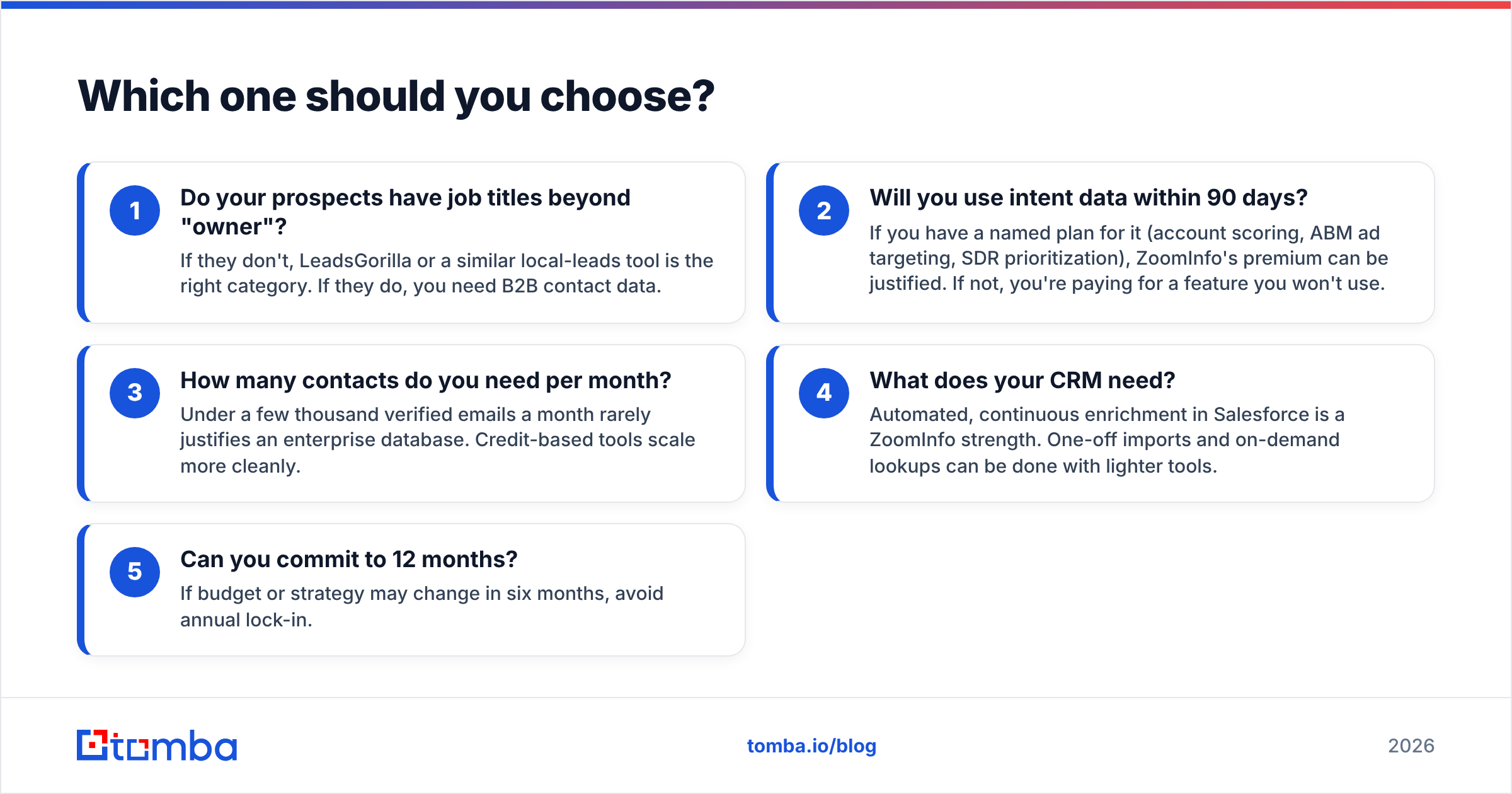
Before you book demos, work through these questions:
- Do your prospects have job titles beyond "owner"? If they don't, LeadsGorilla or a similar local-leads tool is the right category. If they do, you need B2B contact data.
- Will you use intent data within 90 days? If you have a named plan for it (account scoring, ABM ad targeting, SDR prioritization), ZoomInfo's premium can be justified. If not, you're paying for a feature you won't use.
- How many contacts do you need per month? Under a few thousand verified emails a month rarely justifies an enterprise database. Credit-based tools scale more cleanly.
- What does your CRM need? Automated, continuous enrichment in Salesforce is a ZoomInfo strength. One-off imports and on-demand lookups can be done with lighter tools.
- Can you commit to 12 months? If budget or strategy may change in six months, avoid annual lock-in.

Are there alternatives between LeadsGorilla and ZoomInfo?#
Yes, and this is where most small and mid-sized teams end up. The middle of the market has three categories:
- Mid-tier all-in-one platforms combine a database with sequencing at lower price points than ZoomInfo. They work if you want one tool and can live with less data depth. See our breakdown of Apollo.io alternatives for that group.
- Specialist B2B list vendors sell targeted contact lists by industry and title. BookYourData is a well-regarded example. It's a strong choice when you want a ready-made, filtered list instead of building one yourself.
- Email finder and enrichment tools find and verify emails for the companies and people you already know you want. You bring the account list, and they supply the verified contact.
That last category covers what many ZoomInfo customers actually do every day. You have a target account list from your CRM, LinkedIn, or an event attendee file. You need the right people's working emails. With domain search, you enter a company domain and see the email addresses and pattern associated with it. With an email finder, you enter a name and domain and get a verified address.
This approach also works well with LeadsGorilla. Agencies moving upmarket, for example from local restaurants to regional multi-location chains, often find that the listed generic email goes nowhere. Looking up the operations director or marketing manager by name and domain gets you past the info@ inbox.
What do reviewers and analysts say?#
Independent sources show a consistent pattern. On review sites, ZoomInfo scores high for data breadth and integrations and lower for pricing and contract flexibility. Industry analysts regularly place ZoomInfo among the major B2B data and intelligence providers, alongside other enterprise platforms. It's a category leader, and it's priced like one.
LeadsGorilla gets much less formal analyst coverage because it serves a different market: solo agency operators, not procurement teams. User feedback tends to praise the audit feature and the low entry cost. The common complaints are data completeness and the upsell-heavy purchase flow.
Neither of these is a bad product. Each fits one type of buyer well and fits the other type badly.
What is the bottom line on LeadsGorilla vs ZoomInfo?#
- Choose LeadsGorilla if you run a marketing agency selling to local businesses and need prospects plus a ready-made reason to contact them.
- Choose ZoomInfo if you're a funded B2B sales organization with a CRM-centered process, a named use for intent data, and budget for an annual contract.
- Choose neither, or add a lighter tool, if your real need is accurate emails for specific people at specific companies. That's a more focused job than either platform is built around, and it costs far less.
Compare Tomba plans with your current tool before your next renewal. Many teams find they were paying enterprise prices for what is essentially an email lookup workflow.
If that describes your team, start with the Tomba Email Finder. Enter a name and company domain and you get a verified professional email address, with a confidence score and the public sources it came from. The free plan includes 25 searches a month so you can test it on your own target accounts. Paid plans start at $49/month with no enterprise contract. It works for an agency moving from local SMBs to regional chains and for a sales team that has outgrown spreadsheets but not its budget.
Related guides#
// get started
Find, verify and enrich your first contacts today
Start on the free plan with 25 searches a month, then scale when your team is ready.
Free plan · No credit card required · GDPR & CCPA
Get the Tomba newsletter
Product and data updates
// about the author