LeadSift Pricing Reviews Pros and Cons: 2026 Buyer's Guide
LeadSift doesn't publish its prices, and its reviews are split between people who love the intent signals and people who wanted a plain contact database. Here's what you'll actually pay, what users say, and when a cheaper tool does the job.
Here's our LeadSift pricing reviews pros and cons breakdown for 2026: what it costs, what users say, and who should buy it.
TL;DR
- LeadSift is an intent-data platform. It watches public signals like hiring, social activity, news and tech changes. Then it turns them into lists of accounts and contacts that look ready to buy.
- You won't find a price on the site. LeadSift sells on custom, quote-based contracts, usually billed yearly. Expect a sales call and a budget that's closer to enterprise intent tools than to self-serve email finders.
- Pros: signals you can customize, lists built around your ICP, hands-on onboarding, and account timing that goes deeper than firmographic filters.
- Cons: you can't see the price, there's no real free trial, contact coverage outside North America can be thin, and a small team probably won't use enough of it to justify the cost.
- If what you really need is verified emails for accounts you've already picked, a self-serve tool like Tomba (free tier, then $49/mo) costs much less. Many teams run both.
What is LeadSift and who is it built for?#
LeadSift is a B2B intent-data and lead-generation platform based in Toronto. Contact databases start from static filters like industry, headcount and job title. LeadSift starts from behavior. It scans public sources (job postings, company news, social conversations, technology adoption, event activity). It looks for signs that a company may want what you sell.
Out the other end you get a list of accounts that show intent, with contacts attached. They arrive in your CRM or as files. The idea is simple: your SDRs should call companies that are showing buying signals this month, not the whole ICP in alphabetical order.
That puts LeadSift in the same category as Bombora, 6sense and the intent add-ons from ZoomInfo and Demandbase. It's a different category from email finders. Keep that in mind when you read reviews, because a lot of the negative ones come from buyers who expected one kind of tool and got the other.
The best fit usually looks like this:
- Mid-market or enterprise B2B teams with a defined ICP and several SDRs or AEs
- Marketing teams running account-based programs that need timing signals
- Companies selling into North America, where public signal coverage is strongest
- Teams with RevOps capacity to route signals into a CRM and act on them
How does LeadSift actually work?#
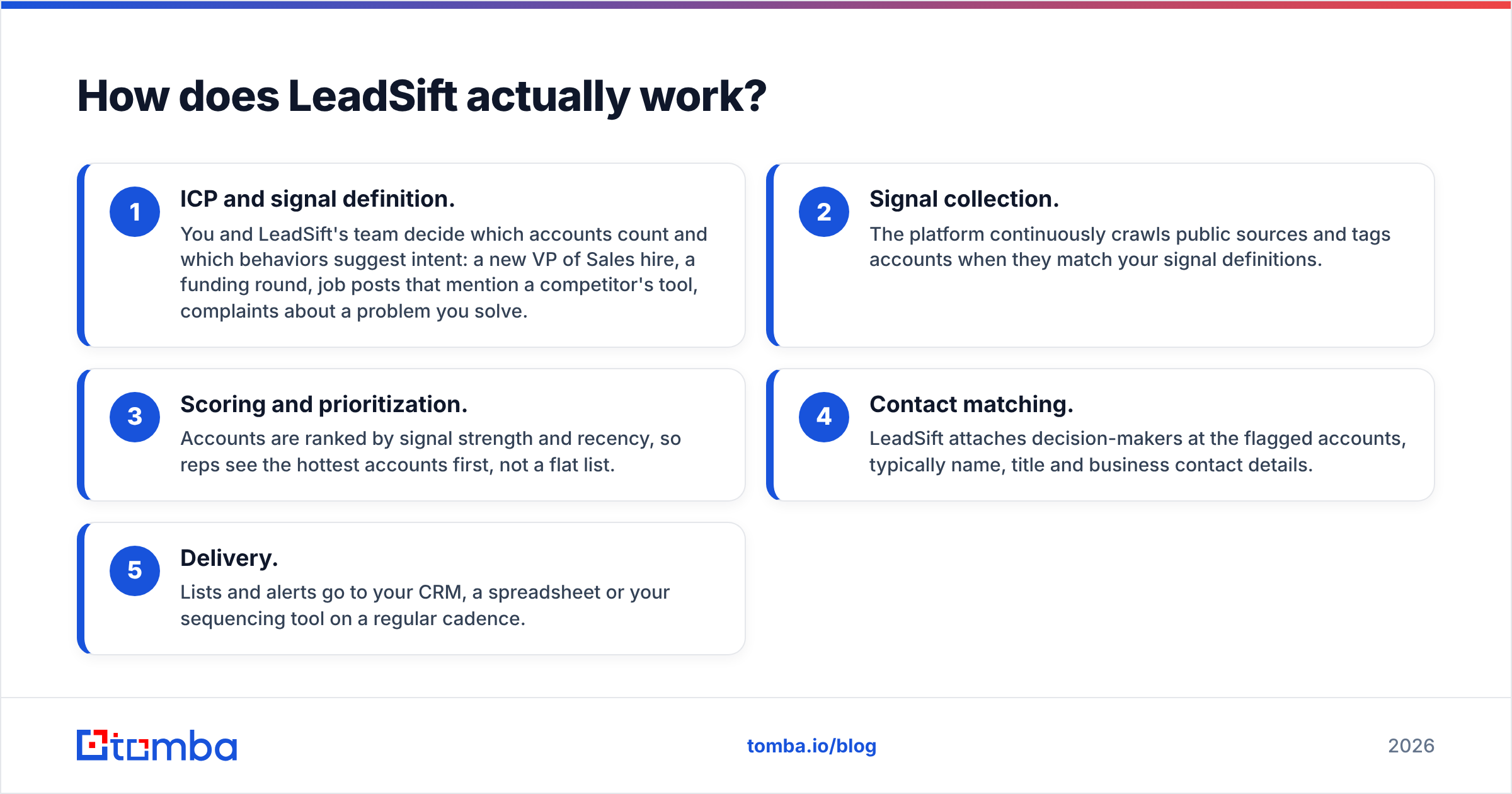
The workflow is worth understanding before you look at pricing, because the price follows how much work the platform does for you. In practice, a LeadSift deployment runs in five stages:
- ICP and signal definition. You and LeadSift's team decide which accounts count and which behaviors suggest intent: a new VP of Sales hire, a funding round, job posts that mention a competitor's tool, complaints about a problem you solve.
- Signal collection. The platform continuously crawls public sources and tags accounts when they match your signal definitions.
- Scoring and prioritization. Accounts are ranked by signal strength and recency, so reps see the hottest accounts first, not a flat list.
- Contact matching. LeadSift attaches decision-makers at the flagged accounts, typically name, title and business contact details.
- Delivery. Lists and alerts go to your CRM, a spreadsheet or your sequencing tool on a regular cadence.
Stage 1 is where LeadSift sets itself apart, and it's also where the cost comes from. Custom signal design takes human time. A self-serve SaaS plan can't sell human time at $49 a month.
How much does LeadSift cost in 2026?#
LeadSift doesn't publish a pricing page. As of 2026 there's no public tier table, no per-credit rate and no self-serve checkout. Getting a number means booking a demo and asking for a quote.
What we can say with confidence:
- Quote-based pricing. Your price depends on how many target accounts you track, how complex your signals are, which regions you cover and how many contacts get delivered.
- Annual contracts are the norm. Like most intent vendors, LeadSift generally sells yearly agreements, not month-to-month plans.
- No meaningful free tier. You might see a sample list or a pilot during the sales process, but there's no permanent free plan you can sign up for yourself.
- Enterprise-style budgets. Intent platforms in this category usually cost thousands of dollars a year at the low end and much more at scale. Plan for that range, and don't rely on any single number you see quoted online. Vendors change deals often and third-party figures go stale.

If you're budgeting, the most useful question for the sales rep is: "What does the contract cost per qualified account delivered per month?" That turns a vague annual figure into something you can compare with your SDR cost per meeting.
What are the hidden costs of LeadSift?#
The line item on the contract isn't the full cost. Buyers regularly underestimate these:
- Contact verification. Intent tools find the right account at the right time. They don't guarantee every email bounces cleanly. Most teams still run delivered contacts through an email verifier before sequencing, and that's a separate line item.
- RevOps time. Signals only pay off if someone routes them into lead scoring, assignment rules and sequences. Budget a few hours a week, at least during setup.
- Sequencing tools. LeadSift finds and scores leads but doesn't send emails. You'll still need Outreach, Salesloft, Apollo, Instantly or something similar.
- Contract lock-in. An annual commitment means a bad fit costs you twelve months, not one.
What do LeadSift reviews say?#
User reviews on sites like G2 and Capterra keep coming back to the same themes. The sample is much smaller than for big-name platforms, so treat any one rating as directional, not final.
What do users like?#
- Signal relevance. Positive reviews mention finding accounts that wouldn't have shown up in a plain firmographic search: companies hiring for a specific role, or companies publicly frustrated with an incumbent vendor.
- Customer success. Reviewers often mention responsive, hands-on account managers who help tune the signals, which is less common in self-serve tools.
- Timing over volume. Sales leaders like getting a shorter, prioritized list instead of a huge export nobody works.
- Custom programs. Signals are defined for your business, not picked from a generic topic taxonomy.
What do users complain about?#
- Price transparency. The quote-only model frustrates buyers who want to compare tools quickly.
- Contact data depth. Some reviewers say contact details on flagged accounts were thinner or less accurate than they'd get from a dedicated contact database, especially outside the US and Canada.
- Ramp time. It takes weeks of tuning before the signals are good, so early results can disappoint.
- Interface. A few reviews call the UI functional rather than polished, and weaker than the dashboards of bigger intent platforms.
The pattern is clear. LeadSift gets its best reviews from teams that bought it as an intent and timing layer. Its weakest reviews come from teams that treated it as a contact database.
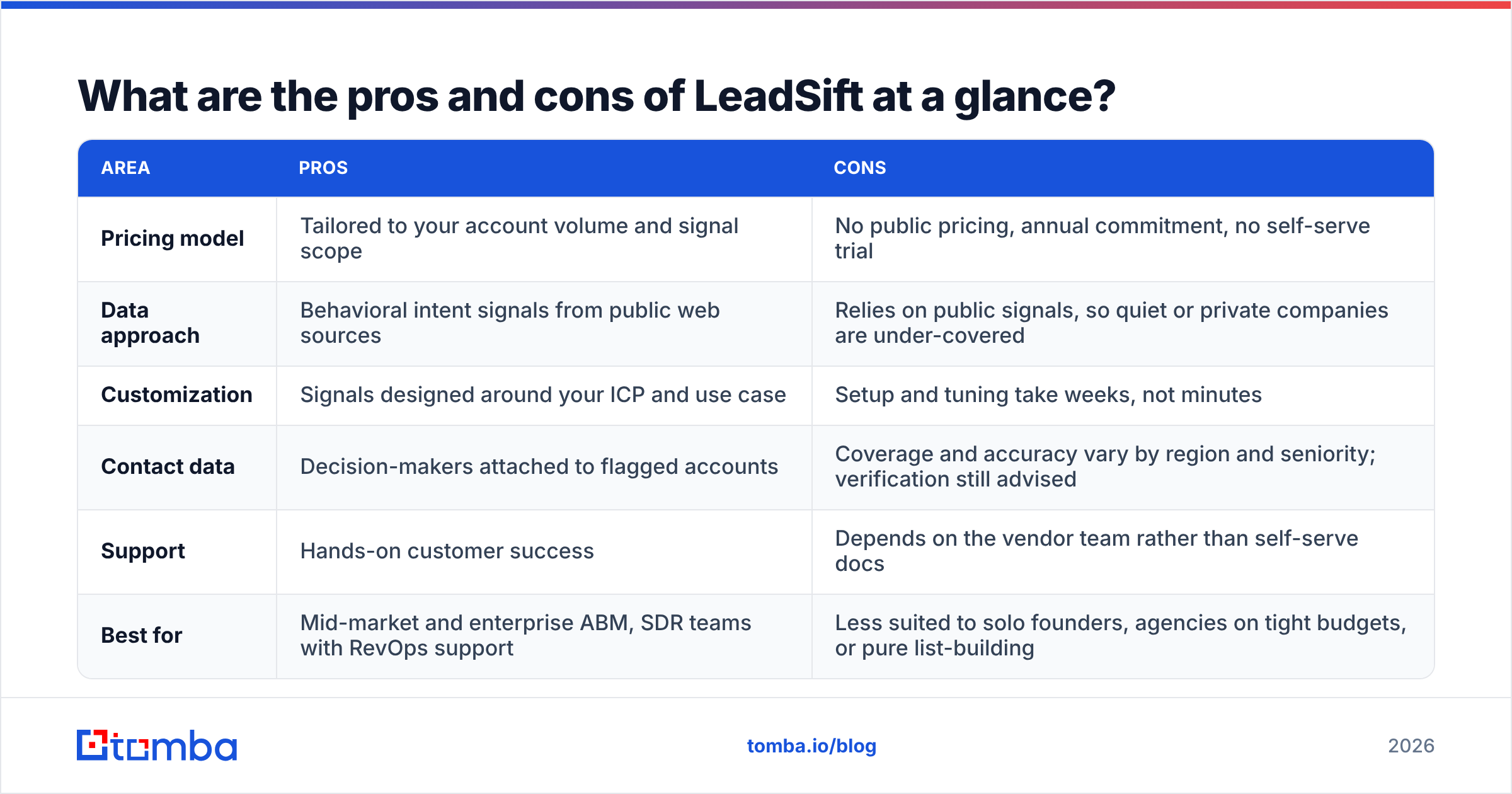
LeadSift pricing reviews pros and cons at a glance#
| Area | Pros | Cons |
|---|---|---|
| Pricing model | Tailored to your account volume and signal scope | No public pricing, annual commitment, no self-serve trial |
| Data approach | Behavioral intent signals from public web sources | Relies on public signals, so quiet or private companies are under-covered |
| Customization | Signals designed around your ICP and use case | Setup and tuning take weeks, not minutes |
| Contact data | Decision-makers attached to flagged accounts | Coverage and accuracy vary by region and seniority; verification still advised |
| Support | Hands-on customer success | Depends on the vendor team rather than self-serve docs |
| Best for | Mid-market and enterprise ABM, SDR teams with RevOps support | Less suited to solo founders, agencies on tight budgets, or pure list-building |
Is LeadSift better than other intent and data platforms?#
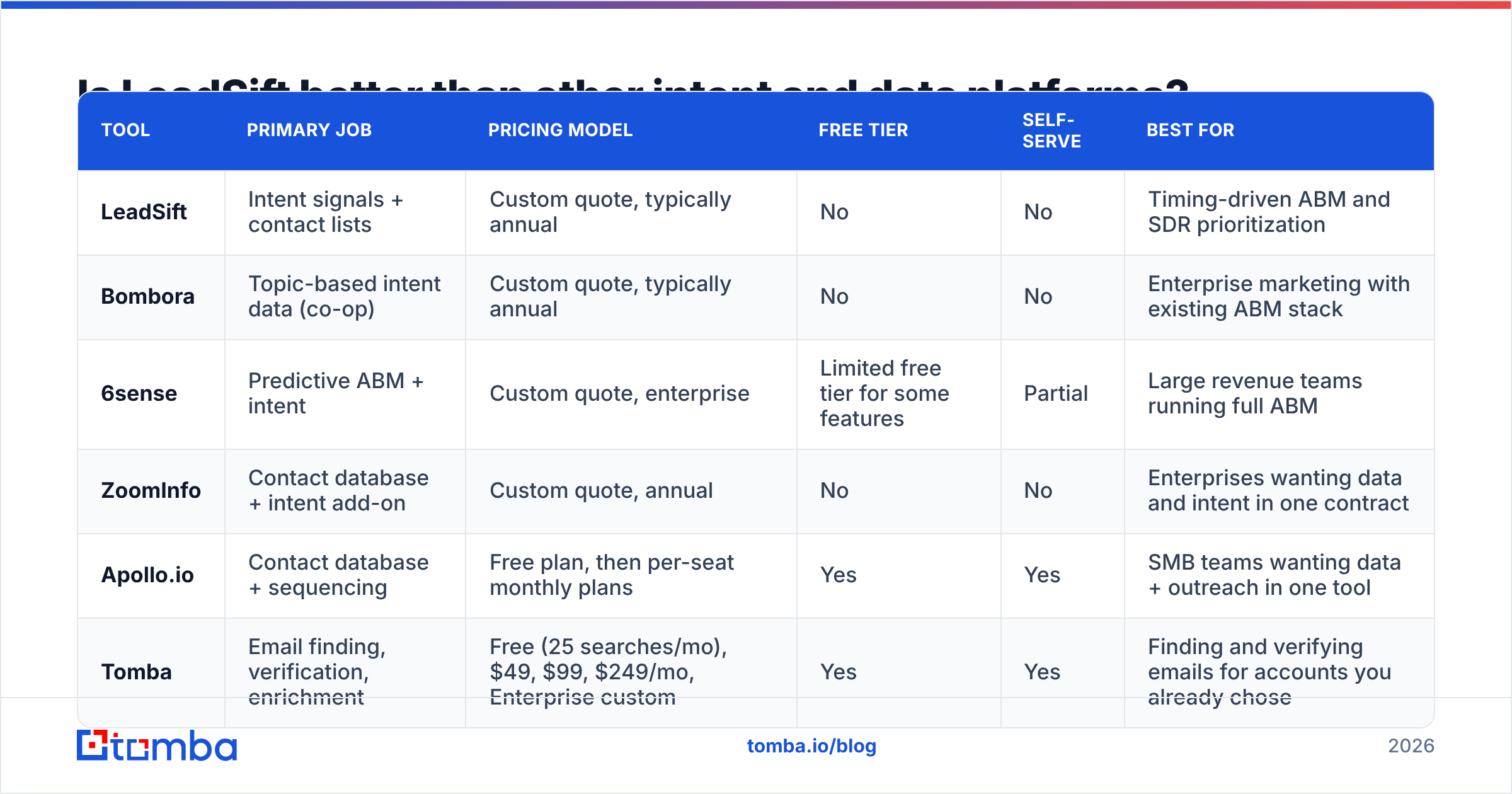
It depends on what problem you're solving. Here's how LeadSift compares with tools buyers often evaluate alongside it. Competitor prices shift often, so confirm current numbers on each vendor's own pricing page.
| Tool | Primary job | Pricing model | Free tier | Self-serve | Best for |
|---|---|---|---|---|---|
| LeadSift | Intent signals + contact lists | Custom quote, typically annual | No | No | Timing-driven ABM and SDR prioritization |
| Bombora | Topic-based intent data (co-op) | Custom quote, typically annual | No | No | Enterprise marketing with existing ABM stack |
| 6sense | Predictive ABM + intent | Custom quote, enterprise | Limited free tier for some features | Partial | Large revenue teams running full ABM |
| ZoomInfo | Contact database + intent add-on | Custom quote, annual | No | No | Enterprises wanting data and intent in one contract |
| Apollo.io | Contact database + sequencing | Free plan, then per-seat monthly plans | Yes | Yes | SMB teams wanting data + outreach in one tool |
| Tomba | Email finding, verification, enrichment | Free (25 searches/mo), $49, $99, $249/mo, Enterprise custom | Yes | Yes | Finding and verifying emails for accounts you already chose |
Three things stand out:
- LeadSift vs Bombora: Bombora's intent comes from a data co-op of B2B publishers tracking content consumption. LeadSift leans on public behavioral signals like hiring, news and social. Some teams layer both. If you need publisher-side research intent, look at Bombora. If you want signals customized to your niche, LeadSift is a better fit.
- LeadSift vs 6sense: 6sense is a much broader platform (orchestration, advertising, predictive scoring) and typically priced accordingly. If you only need the signal layer, LeadSift is the lighter purchase. If you're weighing that category more broadly, our 6sense alternative breakdown is worth reading.
- LeadSift vs Apollo: They aren't really substitutes. Apollo is a self-serve database with outreach built in. LeadSift tells you which accounts to prioritize. See our Apollo alternative guide if Apollo's data quality is the question.
When is LeadSift worth the money?#
LeadSift tends to pay for itself when these conditions are true:
- You have more ICP accounts than your reps can work. Intent scoring earns its keep when you have to choose. With 200 target accounts you can work all of them. With 20,000 you need timing.
- Your average deal is large enough. If one closed deal covers a meaningful slice of the annual contract, the math works quickly. At low ACVs it rarely does.
- Your buyers leave public footprints. Hiring posts, funding news and tech changes are loud in SaaS, fintech and professional services. They're quiet in some traditional industries.
- You can act on signals within days. Intent data goes stale fast. If leads sit in a queue for three weeks, you're paying for timing you don't use.
LeadSift is probably not worth it when:
- You're a founder or a two-person sales team
- Your list is already defined (a named-account list, event attendees, inbound leads) and you mainly need contact details
- You sell mostly outside North America and need deep regional coverage
- You need to test outbound on a month-to-month budget
What is a cheaper alternative if you mainly need contacts?#
Many teams evaluating LeadSift find that "we need better leads" really means "we need the right person's working email address." That's a much cheaper problem.
For that job, a self-serve email-finding stack does the work at a small fraction of the cost:
- Find the contact. An email finder returns a professional address from a name plus a company domain, or lists every public address at a domain.
- Verify before sending. Check each address for deliverability, including catch-all domains, so your sender reputation doesn't pay for bad data.
- Enrich the record. Add title, company size, location and social profiles with data enrichment so reps have context without switching tabs.
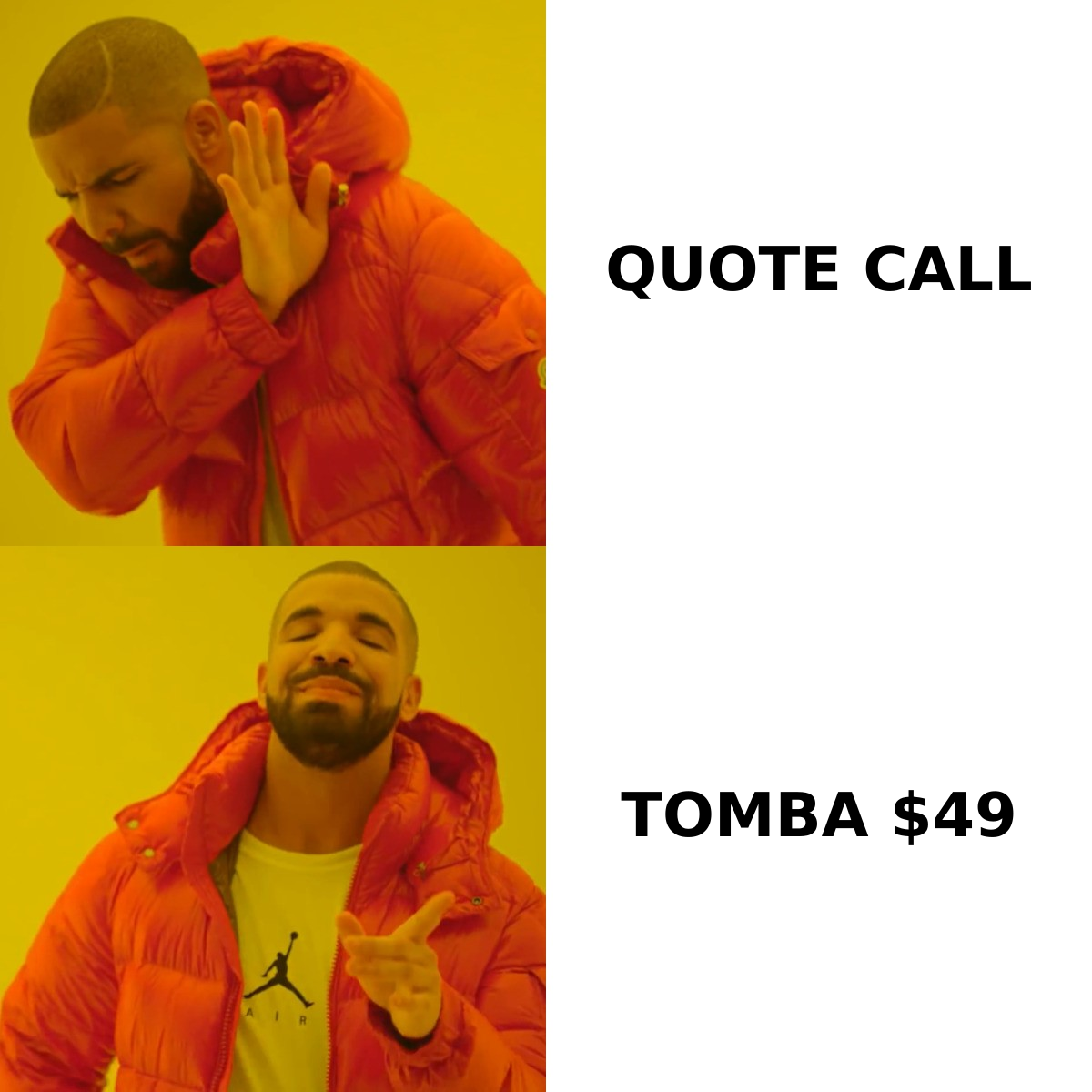
- Pay monthly. Tomba starts with a free tier (25 searches/mo), then Starter at $49/mo, Growth at $99/mo and Pro at $249/mo. See full Tomba pricing for credit details.
This doesn't replace intent data. Tomba won't tell you that a company just posted three RevOps jobs mentioning your competitor. But the two layers combine well: LeadSift, or a similar signal source, flags the account, and a verification-first email tool gets you a clean inbox address for the right person. That split also fixes the most common complaint in LeadSift reviews, which is thin contact data on hot accounts.
How should you evaluate LeadSift before signing?#
If you're heading into a LeadSift demo, go in with a checklist:
- Ask for a pilot on your own accounts. Give them 50 to 100 accounts you know well and check whether the signals match what your reps already know.
- Measure contact accuracy yourself. Run a sample of delivered contacts through an independent verifier and track the bounce rate.
- Get the per-account math. Divide the annual quote by the flagged accounts you expect to receive, and compare that with your cost per meeting.
- Clarify the contract terms. Ask about term length, auto-renewal, account caps, overage handling and exit clauses.
- Check integration depth. Confirm how signals reach your CRM, whether you get native sync or CSV, and how often.
- Talk to a reference customer in your industry and region, not just any happy customer.
Analyst firms like Gartner publish broader guidance on evaluating B2B intent data. Their main point is that intent data only pays off when it feeds a defined process. Buying the signal without the playbook is the most common way these contracts fail to renew.
Frequently asked questions#
Does LeadSift have a free trial?#
LeadSift doesn't offer a permanent free plan or a self-serve trial. Buyers can sometimes get a sample list or a scoped pilot during the sales process. Ask for one explicitly.
Is LeadSift pricing monthly or annual?#
LeadSift is sold on custom quotes, and contracts are typically annual. Confirm the term, renewal and cancellation conditions before you sign.
Is LeadSift an email finder?#
Not mainly. LeadSift is an intent-data and lead-prioritization platform that also delivers contacts. If your main need is finding and verifying email addresses, a dedicated email finder is cheaper and usually more accurate for that task.
Can I use LeadSift and Tomba together?#
Yes. A common setup: LeadSift flags in-market accounts, then Tomba finds and verifies emails for the right decision-makers at those accounts before they go into a sequence.
What's the final verdict on LeadSift?#
LeadSift is a credible, specialized intent platform. It's strongest for mid-market and enterprise teams that have more target accounts than they can work and need to know when to reach out. Its signal customization and hands-on support are real strengths. The quote-only pricing, annual commitment and uneven contact depth are its real weaknesses.
In short, the LeadSift pricing reviews pros and cons all point one way. Buy it if timing is your bottleneck. Skip it if coverage is your bottleneck, because a contact data tool will fix that for much less.
If you need verified professional emails for the accounts you already have, whether from LeadSift signals, a named-account list or last week's event, start with the Tomba Email Finder. It's free for your first 25 searches a month and $49/mo when you're ready to scale. There's no sales call and no annual contract, so you can see results the same day.
Related guides#
// get started
Find, verify and enrich your first contacts today
Start on the free plan with 25 searches a month, then scale when your team is ready.
Free plan · No credit card required · GDPR & CCPA
// about the author