LeadSimple Alternatives: 8 Property Management CRMs Compared
LeadSimple is built for property managers, but it isn't the only option. Here are 8 alternatives, from full property management suites to lighter CRMs, compared by price, automation depth and who each one fits.
TL;DR
- LeadSimple is a CRM and process-automation platform built for property management companies. It's strong for owner-lead pipelines and repeatable workflows like onboarding, move-ins and move-outs.
- The best LeadSimple alternatives fall into three groups: property management suites (AppFolio, Buildium, Rent Manager, DoorLoop), general sales CRMs (HubSpot, Pipedrive, Zoho CRM) and real-estate CRMs (Follow Up Boss).
- If you mainly need to grow doors (win new owner clients), a general CRM paired with a good contact-data tool is often cheaper and more flexible.
- If you mainly need to run operations, the workflow tools inside your property management software may be enough on their own.
- No CRM finds leads for you. You still need a way to get verified owner and investor contact details into whatever pipeline you choose.
What is LeadSimple, and why do teams look for alternatives?#
LeadSimple is a CRM made for residential property management companies. It covers two jobs that most property managers otherwise handle in spreadsheets and shared inboxes:
- Sales pipeline for owner leads. It tracks prospective property owners from first inquiry to signed management agreement, with email and text follow-up.
- Process automation. It gives you templated, trackable workflows for owner onboarding, tenant move-in and move-out, lease renewals, maintenance coordination and similar recurring work.
It also connects to the major property management systems (AppFolio, Buildium, Rent Manager and Propertyware, among others), so your CRM can react to changes in your system of record.
It's a focused product and many teams like it. People start looking at LeadSimple alternatives for a handful of recurring reasons:
- Pricing. LeadSimple is quote-based and doesn't publish a public price list, which makes budgeting hard for small portfolios.
- Overlap. If your property management software already has workflow or CRM features, paying for a second system can feel redundant.
- Vertical lock-in. Some teams also run brokerage, investment or B2B services arms and want a single CRM for all of them.
- Prospecting gaps. LeadSimple manages leads well, but like every CRM it doesn't generate them. Teams doing outbound to owners and investors need a separate data layer anyway.
How should you evaluate a LeadSimple alternative?#
Before you look at vendor pages, decide which job you're actually hiring the tool for. Most bad CRM migrations happen because a team bought a sales tool when it needed an ops tool, or the other way around.
- Primary job: growth or operations. If 70% of your use is tracking owner leads, weight pipeline and outreach features. If 70% is move-in checklists and renewals, weight workflow automation and the property management integration.
- System-of-record fit. Check whether the tool syncs natively with your property management software or depends on Zapier or a custom integration. Native two-way sync saves hours every week.
- Pricing model. Per-unit pricing (common in property management suites) scales with your portfolio. Per-seat pricing (common in general CRMs) scales with headcount. Run both against your 24-month growth plan.
- Automation depth. Look for conditional logic, task assignment by role, SLA timers and triggers from external events. A basic "send email after 3 days" rule isn't process automation.
- Data inputs. Work out where new contacts will come from (web forms, referrals, lists, outbound research) and whether the tool can take them in cleanly.
- Reporting. You should be able to see conversion by lead source, time-to-close for owner deals and workflow completion rates without exporting to Excel.
Which LeadSimple alternatives are worth considering in 2026?#
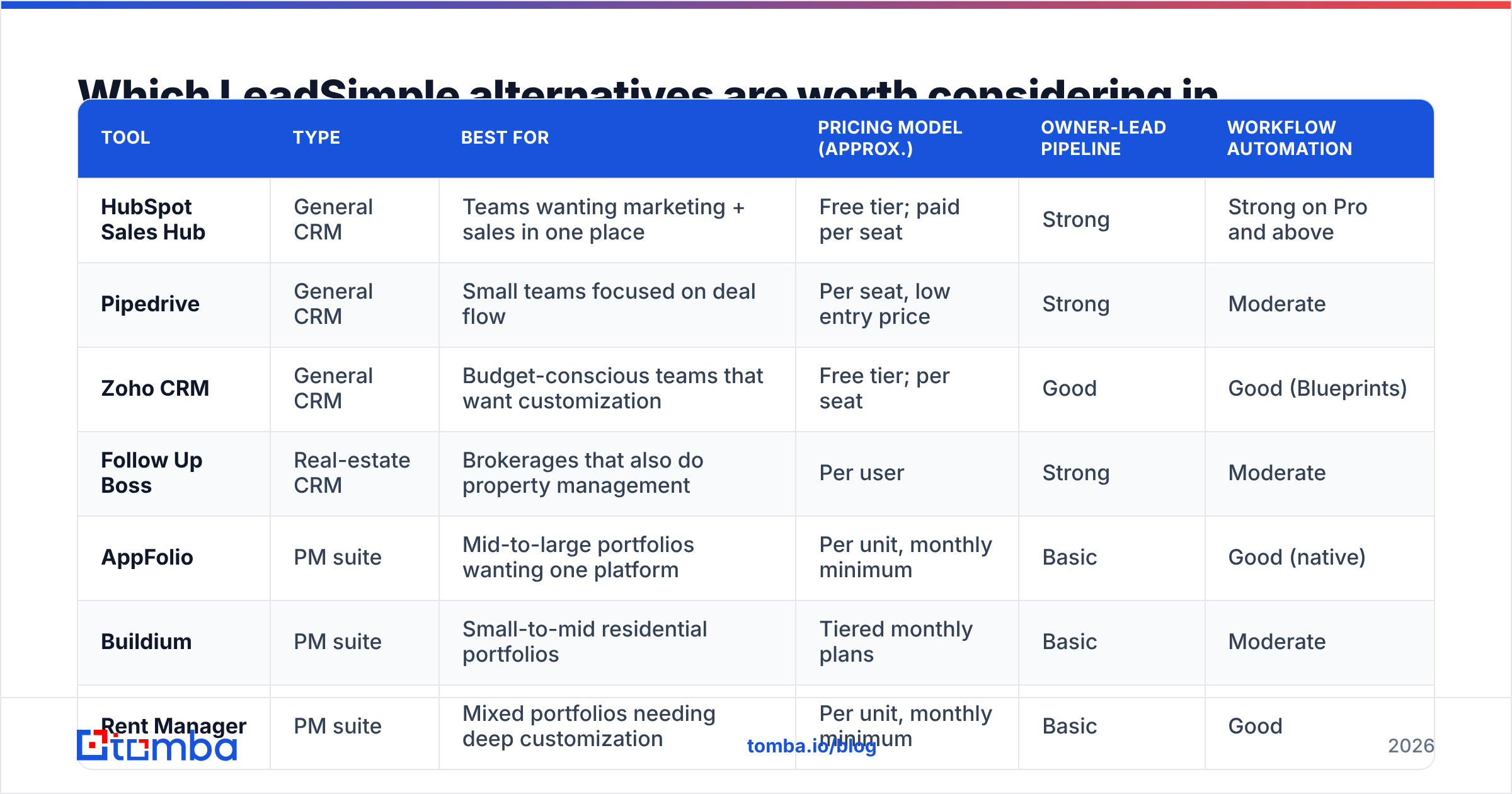
Here are the eight tools that come up most often when property managers replace or supplement LeadSimple. Prices are approximate starting points drawn from public vendor pages and review sites. Always confirm current pricing before you buy.
| Tool | Type | Best for | Pricing model (approx.) | Owner-lead pipeline | Workflow automation |
|---|---|---|---|---|---|
| HubSpot Sales Hub | General CRM | Teams wanting marketing + sales in one place | Free tier; paid per seat | Strong | Strong on Pro and above |
| Pipedrive | General CRM | Small teams focused on deal flow | Per seat, low entry price | Strong | Moderate |
| Zoho CRM | General CRM | Budget-conscious teams that want customization | Free tier; per seat | Good | Good (Blueprints) |
| Follow Up Boss | Real-estate CRM | Brokerages that also do property management | Per user | Strong | Moderate |
| AppFolio | PM suite | Mid-to-large portfolios wanting one platform | Per unit, monthly minimum | Basic | Good (native) |
| Buildium | PM suite | Small-to-mid residential portfolios | Tiered monthly plans | Basic | Moderate |
| Rent Manager | PM suite | Mixed portfolios needing deep customization | Per unit, monthly minimum | Basic | Good |
| DoorLoop | PM suite | Smaller landlords and growing PM firms | Tiered monthly plans | Basic | Moderate |
1. HubSpot Sales Hub#
HubSpot is the default choice if you want one CRM for inbound marketing, owner-lead nurturing and sales follow-up. The free CRM handles contacts, deals and basic email tracking. Paid tiers add sequences, workflows and custom reporting.
- Pros: excellent inbound tooling (forms, landing pages, email nurturing), a huge integration marketplace, and it grows with you.
- Cons: no native property management workflows, so onboarding and move-in processes have to be rebuilt as custom workflows. Costs rise quickly at the Professional tier.
- Choose it if: growth is your main goal and you're comfortable building your own ops workflows or keeping them in your property management software.
2. Pipedrive#
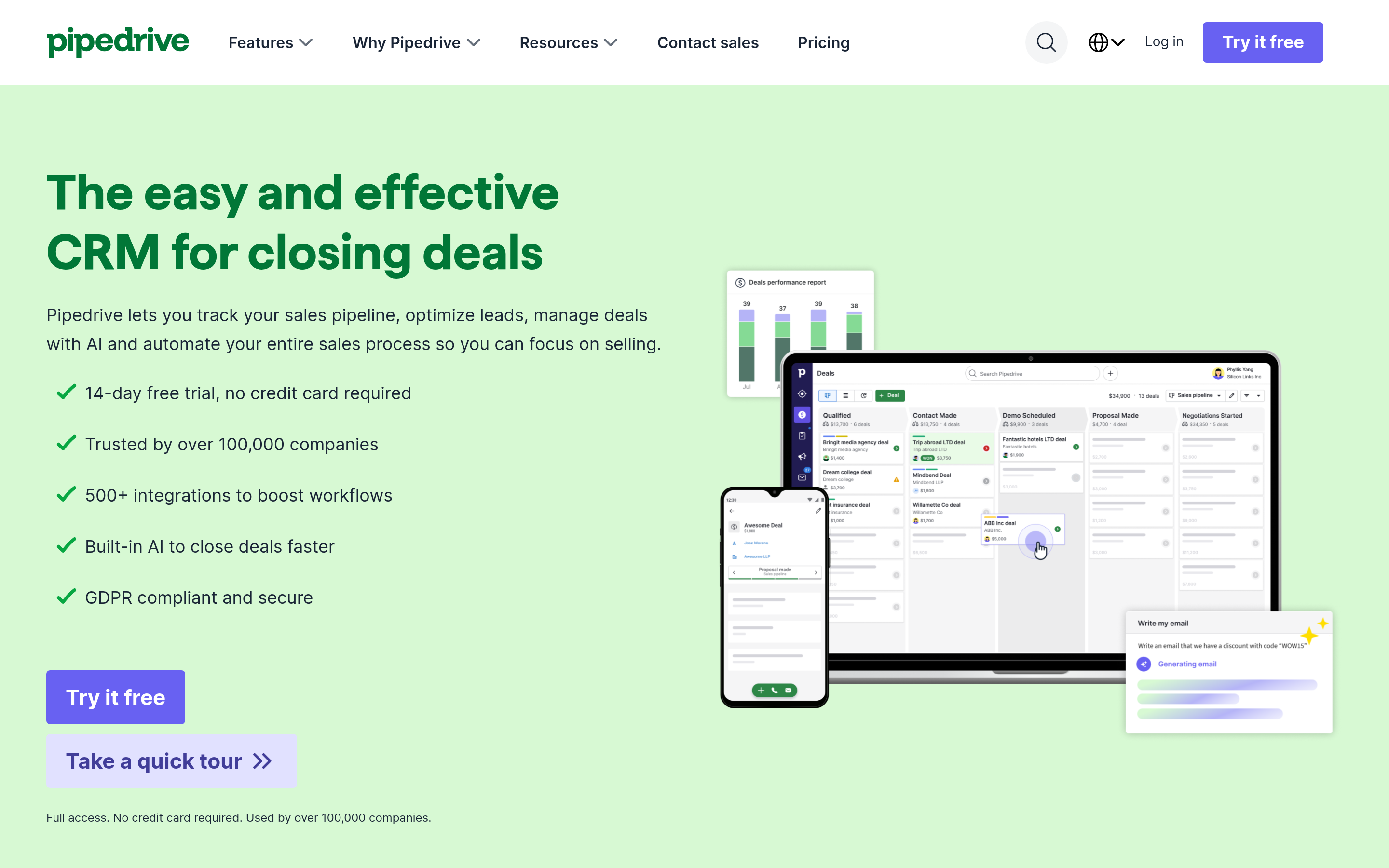
Pipedrive is a visual, deal-first CRM that small teams can learn in a single afternoon. Owner-lead stages map neatly onto its pipeline view.
- Pros: low entry price, a clean interface, and good mobile apps for field-based business development.
- Cons: light on complex, multi-role process automation, and it has no property management integrations out of the box.
- Choose it if: you have one or two people doing business development and want the lightest possible pipeline tool.
3. Zoho CRM#

Zoho CRM offers a lot of customization for the money. Its Blueprint feature lets you model multi-step processes with required fields and handoffs, which comes closer to LeadSimple-style ops workflows than most general CRMs.
- Pros: affordable, highly configurable, and part of a wider suite (Desk, Books, Forms).
- Cons: there's a real learning curve, and setup takes time if you don't have an in-house admin.
- Choose it if: you want sales and process workflows in one tool and have someone willing to configure it.
4. Follow Up Boss#
Follow Up Boss is built for real estate agents and brokerages. If your firm sells homes as well as managing rentals, it keeps both pipelines under one roof, with strong lead routing and speed-to-lead features.
- Pros: fast lead routing, calling and texting built in, and a broad set of real-estate lead-source integrations.
- Cons: it's designed around buyer and seller transactions, not recurring property management operations.
- Choose it if: brokerage revenue matters as much as management revenue.
5. AppFolio#
AppFolio Property Manager is a full property management platform with accounting, leasing, maintenance and owner/tenant portals. Its built-in automation and AI-assisted leasing features cover much of what teams otherwise bolt on with LeadSimple.
- Pros: one system of record, strong leasing automation, and polished portals.
- Cons: owner-lead sales pipeline features are basic compared with a dedicated CRM, and the pricing structure tends to suit mid-size and larger portfolios.
- Choose it if: you want fewer tools and your growth mostly comes from referrals rather than active outbound.
6. Buildium#
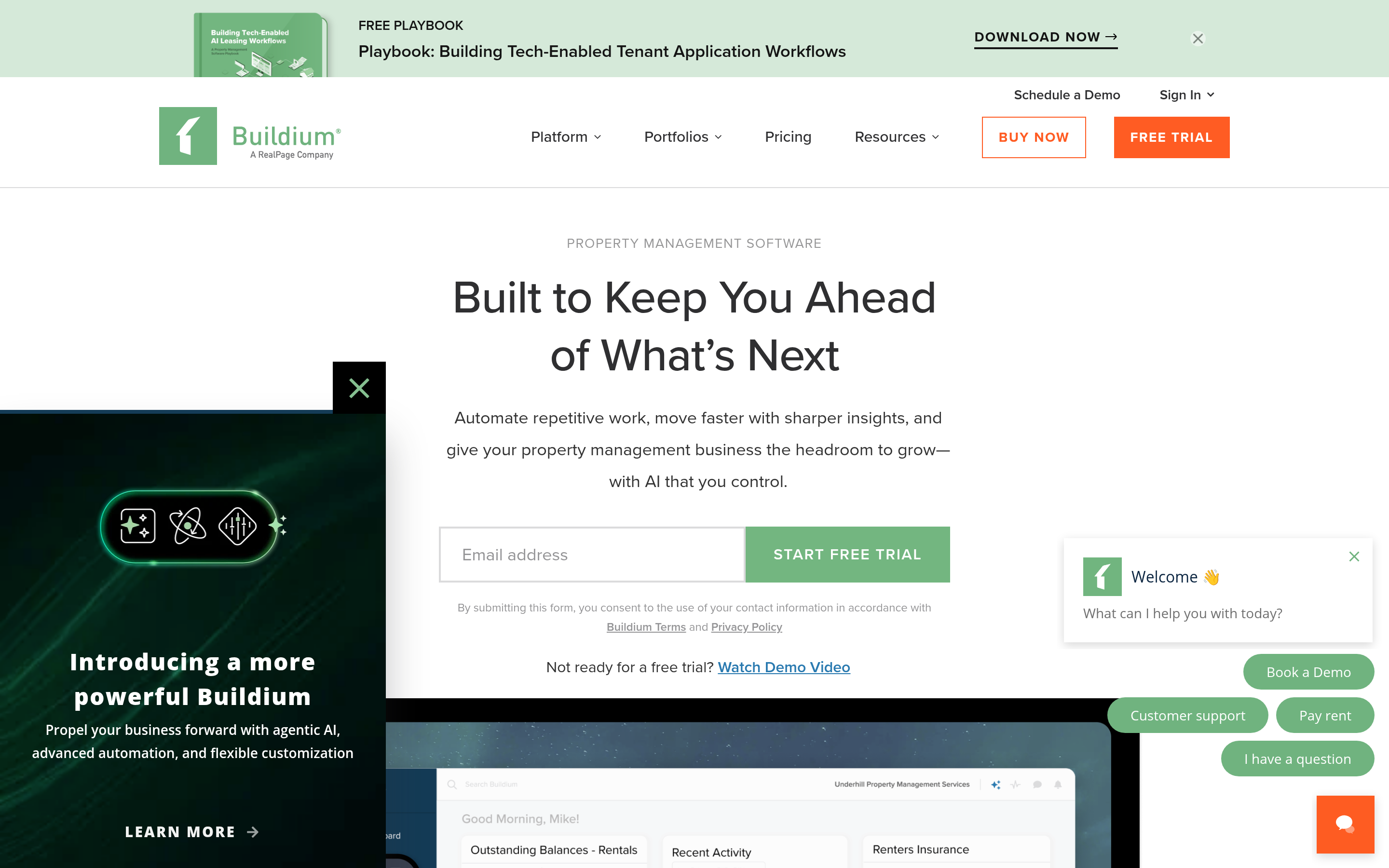
Buildium is a popular pick for small and mid-size residential managers. It covers accounting, leasing, maintenance requests and portals, with tiered plans that make budgeting straightforward.
- Pros: approachable, with predictable tiered pricing and solid core property management features.
- Cons: limited sales CRM, and workflow automation is lighter than LeadSimple's.
- Choose it if: you're under a few hundred doors and your operations matter more than your sales pipeline.
7. Rent Manager#
Rent Manager is known for flexibility: custom fields, reports and a deep API. Mixed portfolios (residential, commercial, HOA) often end up here.
- Pros: highly customizable, strong reporting, and a large partner ecosystem.
- Cons: it takes real configuration effort, and the interface feels heavier than newer tools.
- Choose it if: you have complex portfolios and someone technical enough to shape the system around them.
8. DoorLoop#
DoorLoop is a newer, all-in-one property management platform aimed at smaller landlords and growing PM firms. It's easy to set up and covers rent collection, leasing, maintenance and basic communications.
- Pros: fast onboarding, a modern interface, and straightforward plans.
- Cons: limited sales CRM and less automation depth than LeadSimple or AppFolio.
- Choose it if: you're scaling from a small portfolio and want a simple single platform.
Is a general CRM better than a property management CRM?#
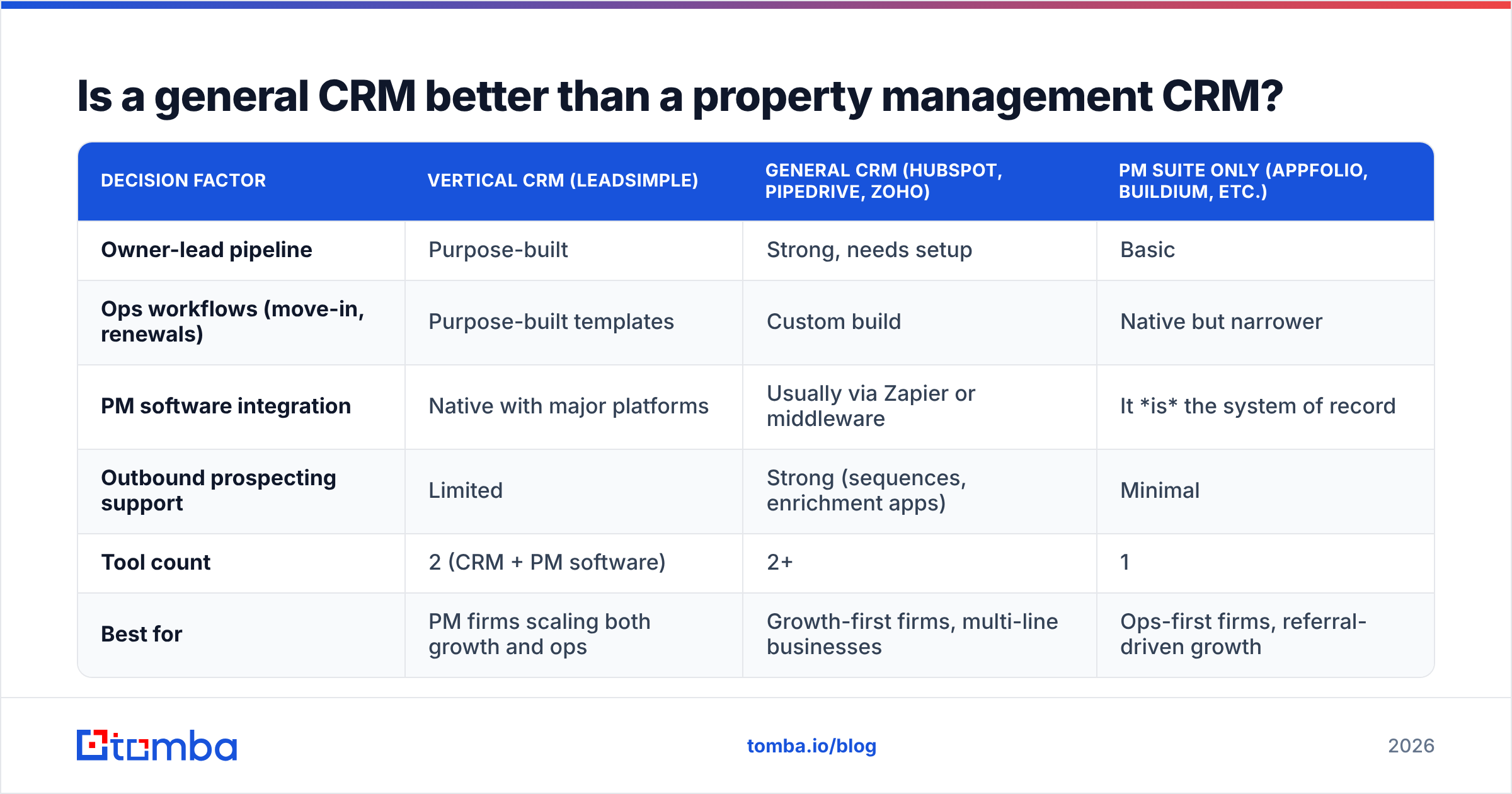
It depends on where your bottleneck is. Here is the trade-off in plain terms:
| Decision factor | Vertical CRM (LeadSimple) | General CRM (HubSpot, Pipedrive, Zoho) | PM suite only (AppFolio, Buildium, etc.) |
|---|---|---|---|
| Owner-lead pipeline | Purpose-built | Strong, needs setup | Basic |
| Ops workflows (move-in, renewals) | Purpose-built templates | Custom build | Native but narrower |
| PM software integration | Native with major platforms | Usually via Zapier or middleware | It is the system of record |
| Outbound prospecting support | Limited | Strong (sequences, enrichment apps) | Minimal |
| Tool count | 2 (CRM + PM software) | 2+ | 1 |
| Best for | PM firms scaling both growth and ops | Growth-first firms, multi-line businesses | Ops-first firms, referral-driven growth |
A rough rule of thumb:
- Pick a vertical CRM if you want property-management-specific templates without building them yourself.
- Pick a general CRM if outbound business development is a real growth channel, or if you run more than one business line.
- Rely on your PM suite if you're referral-driven and want the fewest tools possible.
Where do new owner leads actually come from?#
This is the part most "alternatives" roundups skip. Switching CRMs doesn't add a single door to your portfolio. Your pipeline is only as good as the contacts you put into it.
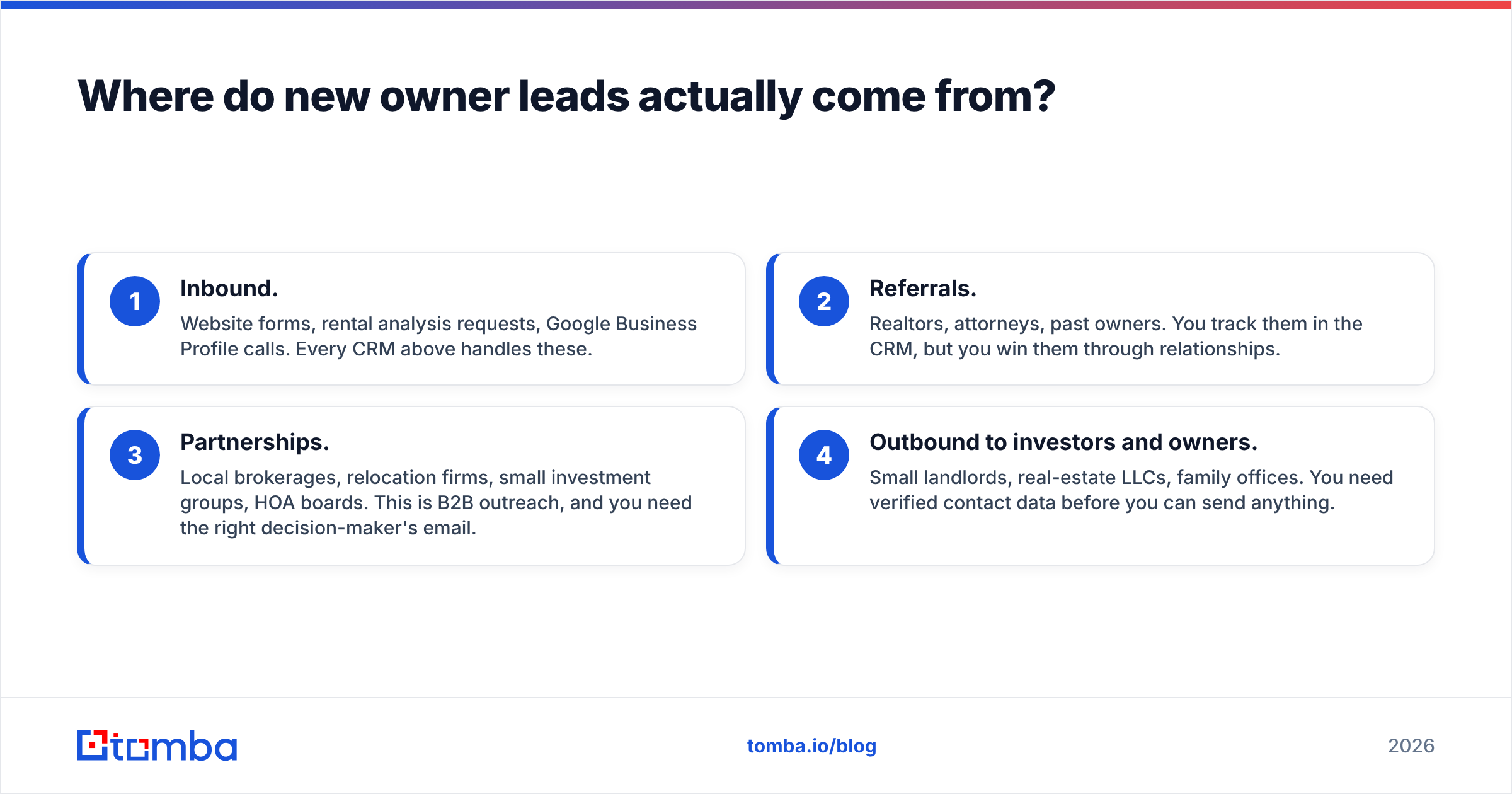
Property management firms usually grow through four channels:
- Inbound. Website forms, rental analysis requests, Google Business Profile calls. Every CRM above handles these.
- Referrals. Realtors, attorneys, past owners. You track them in the CRM, but you win them through relationships.
- Partnerships. Local brokerages, relocation firms, small investment groups, HOA boards. This is B2B outreach, and you need the right decision-maker's email.
- Outbound to investors and owners. Small landlords, real-estate LLCs, family offices. You need verified contact data before you can send anything.
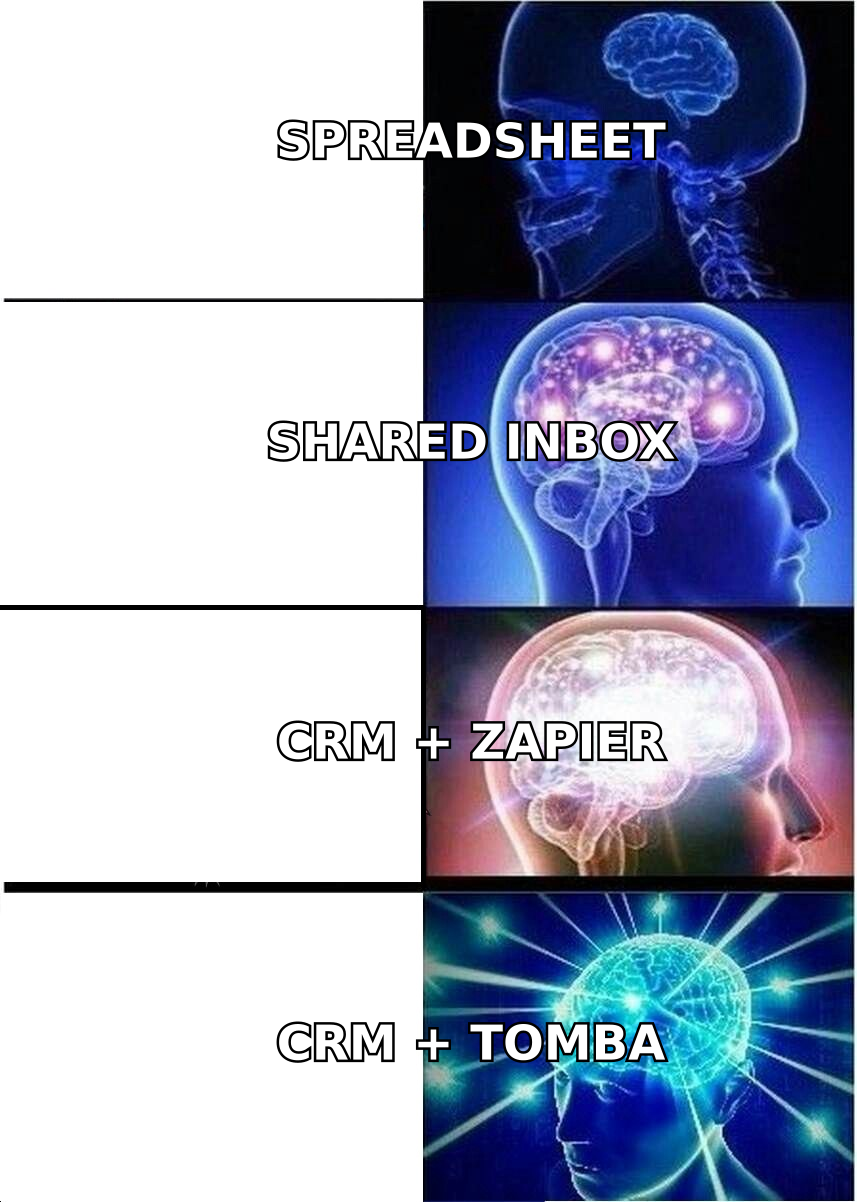
Channels 3 and 4 are where teams lose time. Someone on your team is guessing email formats for a brokerage's managing broker, or pasting LinkedIn names into a spreadsheet. That's the gap a dedicated email finder fills. You look up a company domain, get the pattern and the named contacts, and push them into HubSpot, Pipedrive or whichever CRM you chose.
A practical stack for growth-focused property managers looks like this:
- CRM: HubSpot or Pipedrive for owner and partner pipelines
- System of record: AppFolio, Buildium or Rent Manager for operations
- Contact data: a domain search tool to map every contact at a brokerage or investment firm, plus email verification before anything goes into a sequence
- Glue: native integrations or Zapier to keep the CRM and PM software in sync
Verifying before you send matters more than most PM teams realize. Bounces from a stale investor list can damage your domain's sender reputation. After that, even your routine owner statements and renewal notices start landing in spam.
How do you migrate from LeadSimple without losing data?#
If you've decided to switch, treat migration as a project with an owner and a deadline, not a weekend task.
- Export everything. Pull contacts, companies, deals or leads, notes, and process templates. Screenshot complex workflow logic, because it rarely exports cleanly.
- Clean before you import. Deduplicate, normalize owner and property records, and verify email addresses. Importing dirty data into a new CRM just moves the problem.
- Rebuild your top five processes first. Owner onboarding, lead follow-up, move-in, move-out and renewal usually cover most of the value. Leave the long tail for later.
- Run in parallel for 2–4 weeks. Keep LeadSimple read-only while the new system handles live work, so you can check nothing fell through.
- Reconnect integrations last. Sync with your PM software only after your field mapping is final, so you don't create duplicates.
If you're moving to HubSpot, a native connector such as the Tomba HubSpot integration lets you enrich and verify contacts directly inside the CRM instead of juggling CSVs.
Which LeadSimple alternative should you choose?#
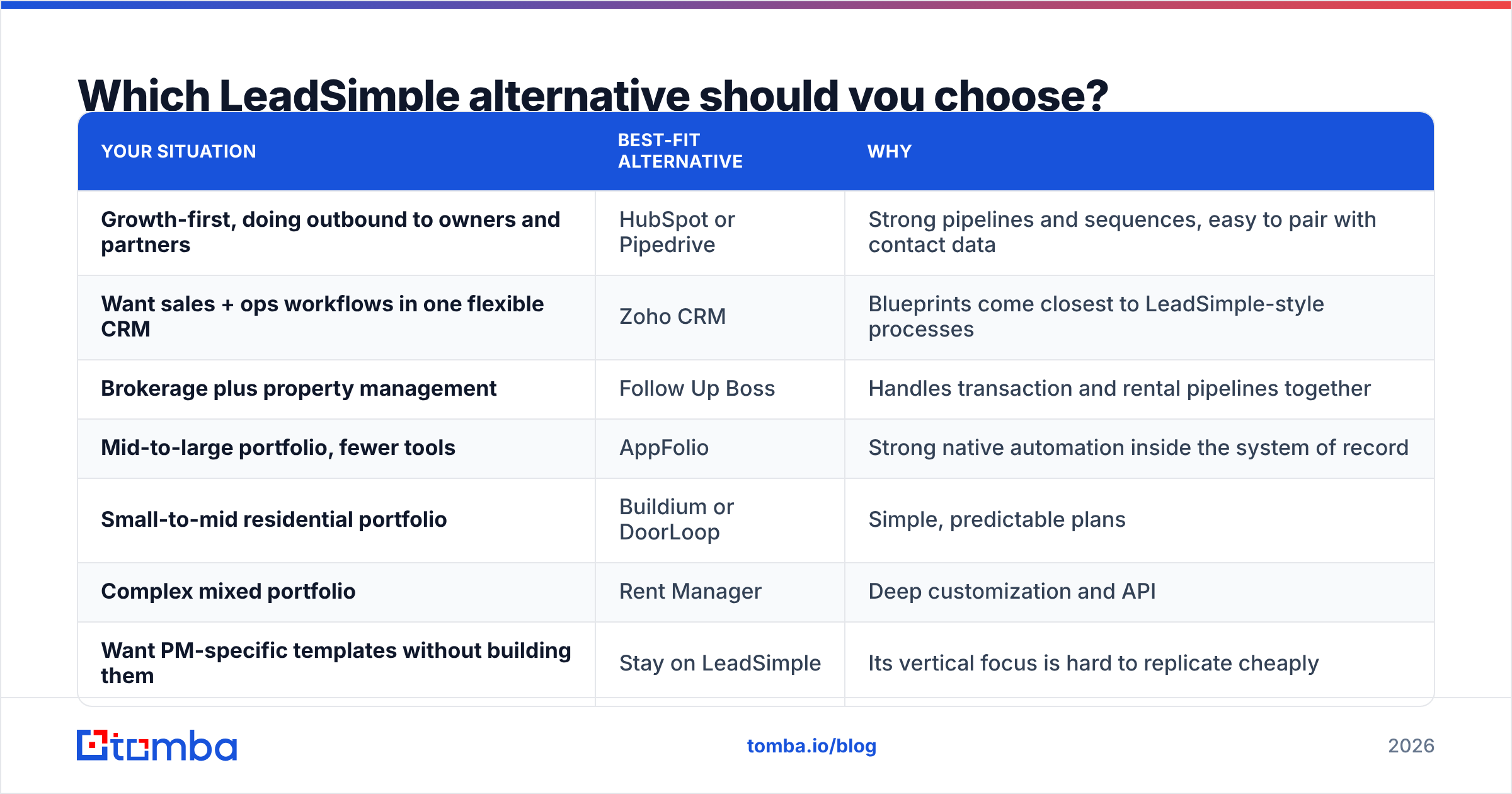
Here's the short version by scenario:
| Your situation | Best-fit alternative | Why |
|---|---|---|
| Growth-first, doing outbound to owners and partners | HubSpot or Pipedrive | Strong pipelines and sequences, easy to pair with contact data |
| Want sales + ops workflows in one flexible CRM | Zoho CRM | Blueprints come closest to LeadSimple-style processes |
| Brokerage plus property management | Follow Up Boss | Handles transaction and rental pipelines together |
| Mid-to-large portfolio, fewer tools | AppFolio | Strong native automation inside the system of record |
| Small-to-mid residential portfolio | Buildium or DoorLoop | Simple, predictable plans |
| Complex mixed portfolio | Rent Manager | Deep customization and API |
| Want PM-specific templates without building them | Stay on LeadSimple | Its vertical focus is hard to replicate cheaply |
Be honest about that last row. For many firms, LeadSimple is still the right answer, and the real fix is adding a better lead source rather than switching CRMs. Check recent user reviews on G2 for the tools on your shortlist, and ask each vendor for a demo built around your onboarding process, not their standard script.
Frequently asked questions#
Is there a free LeadSimple alternative?#
HubSpot and Zoho CRM both have free tiers that cover basic contact and deal tracking. They won't include property-management-specific workflows, but they work for a small owner-lead pipeline.
Can AppFolio or Buildium replace LeadSimple completely?#
For operations workflows, often yes, especially at smaller portfolio sizes. For an active owner-acquisition pipeline with multi-step follow-up, a dedicated CRM usually does better.
Does LeadSimple integrate with other property management software?#
Yes. It integrates with major platforms including AppFolio, Buildium, Rent Manager and Propertyware. Confirm the depth of sync for your specific platform during the demo.
What's the cheapest way to get more owner leads?#
Combine inbound (a strong rental-analysis landing page) with targeted outbound to local investors, brokerages and relocation partners. For the outbound side, you need verified emails before you start.
Ready to fill your new CRM with verified owner and partner contacts?#
Whichever LeadSimple alternative you choose, it will only perform as well as the contacts inside it. Tomba Email Finder finds professional email addresses by name, company or domain. You can map every decision-maker at a brokerage, investment firm or relocation company, then verify and push them straight into HubSpot, Pipedrive or Zoho. Start on the free plan with 25 searches a month, or move to Starter at $49/mo once outbound becomes a real growth channel.
Related guides#
// get started
Find, verify and enrich your first contacts today
Start on the free plan with 25 searches a month, then scale when your team is ready.
Free plan · No credit card required · GDPR & CCPA
// about the author