LeadSquared vs SharpSpring: Sales CRM or Marketing Automation?
LeadSquared is built for high-volume sales teams that need to route and work leads quickly. SharpSpring is built for marketers and agencies that nurture them. Here's how to choose the right one for your pipeline in 2026.
LeadSquared vs SharpSpring comes down to one question: is your bottleneck sales speed or marketing nurture? Here is the short version.
TL;DR
- LeadSquared is a sales CRM with marketing tools added on. It suits busy inbound sales teams in education, finance, healthcare and real estate. It is strongest for teams with field reps.
- SharpSpring (now sold by Constant Contact) is a marketing automation platform with a built-in CRM. It suits small marketing teams and agencies. They get white-label nurture, visitor tracking and flat pricing with no per-seat fees.
- Pricing models differ. LeadSquared charges per user, so cost grows with headcount. SharpSpring has historically charged by contact tier with unlimited users, so cost grows with list size.
- Pick LeadSquared if speed-to-lead, lead routing and rep productivity are your bottleneck. Pick SharpSpring if nurturing and reporting across many clients or campaigns is your bottleneck.
- Neither tool fixes bad input data. Both perform only as well as the contact records you feed them.
LeadSquared vs SharpSpring: what is the real difference?#
The short answer is that these tools solve different problems. People compare them because both combine a CRM with marketing automation, but each one started from the opposite end of the funnel.
LeadSquared started as a lead capture and sales platform. It focuses on what happens after a lead arrives. Who gets it? How fast do they call? What is the next task? Did the field rep actually visit? Its marketing automation is capable, but it exists to feed the sales engine.
SharpSpring started as an affordable HubSpot-style marketing automation suite for agencies. It focuses on what happens before a lead is sales-ready: email nurture, dynamic forms, landing pages, anonymous visitor identification and lead scoring. The CRM is included, so marketers don't need a separate system. Still, most sales teams won't want to live in it all day. Constant Contact bought SharpSpring in 2021. It is now part of the Constant Contact lead-gen and CRM lineup, so you may see it under that brand.
In short, LeadSquared manages people doing sales work, and SharpSpring manages campaigns doing marketing work.
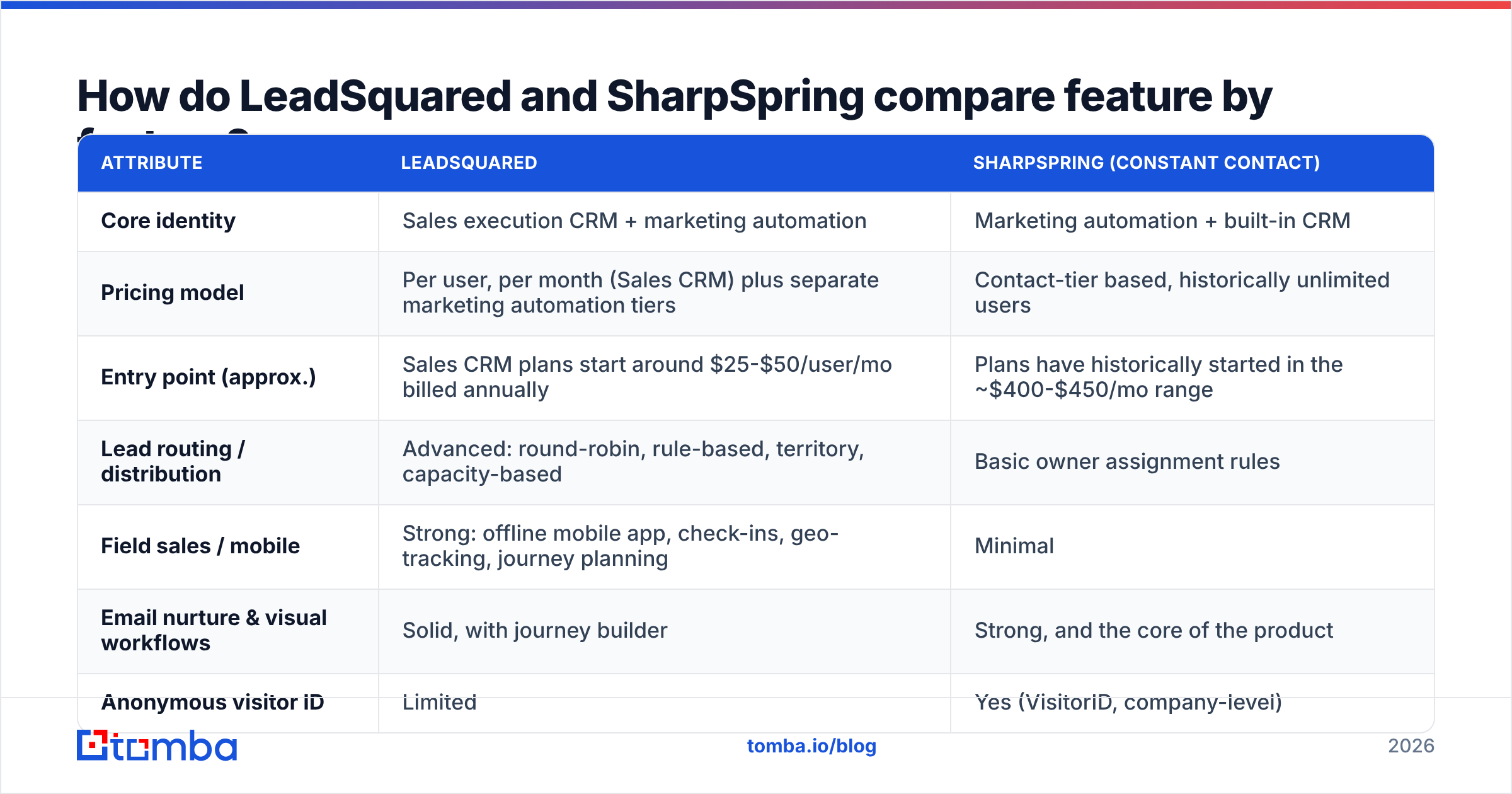
How do LeadSquared and SharpSpring compare feature by feature?#
Here is a side-by-side view of the attributes that usually decide the purchase. Vendor pricing changes often and is usually quoted on request, so check current numbers on each vendor's site before you budget.
| Attribute | LeadSquared | SharpSpring (Constant Contact) |
|---|---|---|
| Core identity | Sales execution CRM + marketing automation | Marketing automation + built-in CRM |
| Pricing model | Per user, per month (Sales CRM) plus separate marketing automation tiers | Contact-tier based, historically unlimited users |
| Entry point (approx.) | Sales CRM plans start around $25-$50/user/mo billed annually | Plans have historically started in the ~$400-$450/mo range |
| Lead routing / distribution | Advanced: round-robin, rule-based, territory, capacity-based | Basic owner assignment rules |
| Field sales / mobile | Strong: offline mobile app, check-ins, geo-tracking, journey planning | Minimal |
| Email nurture & visual workflows | Solid, with journey builder | Strong, and the core of the product |
| Anonymous visitor ID | Limited | Yes (VisitorID, company-level) |
| White-label for agencies | No | Yes, a long-standing differentiator |
| Telephony / WhatsApp | Native integrations, WhatsApp via Converse | Via third-party integrations |
| Best-fit verticals | EdTech, BFSI, healthcare, real estate, high-volume B2C/B2B2C | Agencies, SMB B2B marketing teams |
| Learning curve | Moderate to steep (heavily configurable) | Moderate |
The table leads to a practical conclusion. If most of your cost is sales headcount, LeadSquared's per-seat pricing buys real productivity tooling for those seats. If most of your cost is marketing reach, SharpSpring's model lets you add users without adding line items.
Which platform fits your team? Five decision factors#
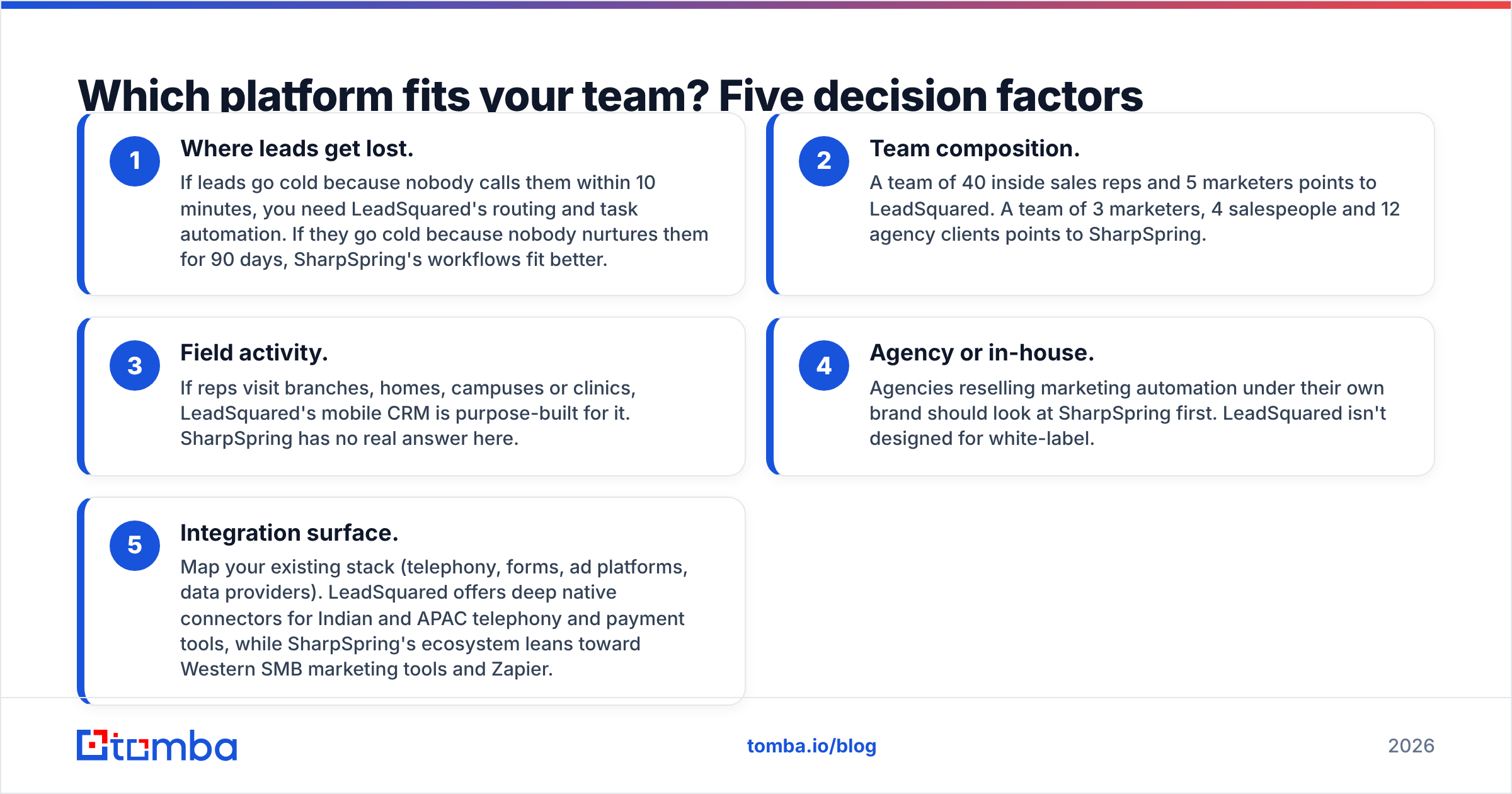
Before you book demos, score yourself on these five factors. They decide the outcome more reliably than feature checklists.
- Where leads get lost. If leads go cold because nobody calls them within 10 minutes, you need LeadSquared's routing and task automation. If they go cold because nobody nurtures them for 90 days, SharpSpring's workflows fit better.
- Team composition. A team of 40 inside sales reps and 5 marketers points to LeadSquared. A team of 3 marketers, 4 salespeople and 12 agency clients points to SharpSpring.
- Field activity. If reps visit branches, homes, campuses or clinics, LeadSquared's mobile CRM is purpose-built for it. SharpSpring has no real answer here.
- Agency or in-house. Agencies reselling marketing automation under their own brand should look at SharpSpring first. LeadSquared isn't designed for white-label.
- Integration surface. Map your existing stack (telephony, forms, ad platforms, data providers). LeadSquared offers deep native connectors for Indian and APAC telephony and payment tools, while SharpSpring's ecosystem leans toward Western SMB marketing tools and Zapier.
Is LeadSquared better than SharpSpring for sales teams?#
For sales-led organisations, generally yes, and by a wide margin.
LeadSquared's strength is speed-to-lead infrastructure. You can capture a lead from a form, ad, call or walk-in. The system then removes duplicates, scores the lead and routes it to the right rep. Routing can use territory, product and current workload. It can also start an SLA timer, all without code. Managers see who is sitting on uncalled leads. Reps get a prioritised task list, not a raw lead list.
Other sales-side capabilities worth knowing:
- Opportunity management with multiple pipelines, which helps companies selling several products (loans and insurance, or several course programmes) to the same contact.
- Field force automation: check-in/check-out, route planning, offline data capture and meeting logs synced to the lead record.
- Sales performance tracking: dashboards on activity, conversion and rep productivity that a sales manager can actually use.
SharpSpring's CRM covers the basics: contacts, accounts, opportunities, a pipeline view, tasks and email tracking. For a small sales team working marketing-qualified leads, that's enough. For a 50-seat inside sales floor, it will feel thin.
One point matters whichever CRM wins. Routing rules and scoring models are only as good as the records under them. Say 20% of inbound emails bounce, or half your outbound list is out of date. Your speed-to-lead dashboard will just show you reaching the wrong people faster. Running captured or imported contacts through an email verifier before they reach the routing engine is cheap insurance.
Is SharpSpring better than LeadSquared for marketing automation?#
For marketing-led organisations and agencies, SharpSpring is usually the more natural fit.
SharpSpring's advantages sit around the top and middle of the funnel:
- Visual workflow builder with branching based on email engagement, page visits, form submissions and score thresholds.
- VisitorID, which identifies companies behind anonymous website traffic so sales can see which accounts are researching you before they convert.
- Dynamic forms and landing pages that change fields and content based on what the platform already knows about a visitor.
- Behavioural lead scoring tied to specific page and asset engagement.
- Agency tooling: white-label branding, multi-client management and partner pricing. This is why SharpSpring built a large agency following in the late 2010s.
LeadSquared's marketing automation isn't weak. It covers email campaigns, landing pages, forms, automation journeys and lead scoring. But it's clearly built to generate and qualify leads for sales, not to run sophisticated multi-month nurture programmes across many brands.
User reviews on G2 follow the same pattern. LeadSquared reviewers most often praise lead management, customisation and support responsiveness. SharpSpring reviewers most often praise value for money and automation depth, and sometimes flag UI dated-ness and reporting limits.
How does pricing actually compare?#
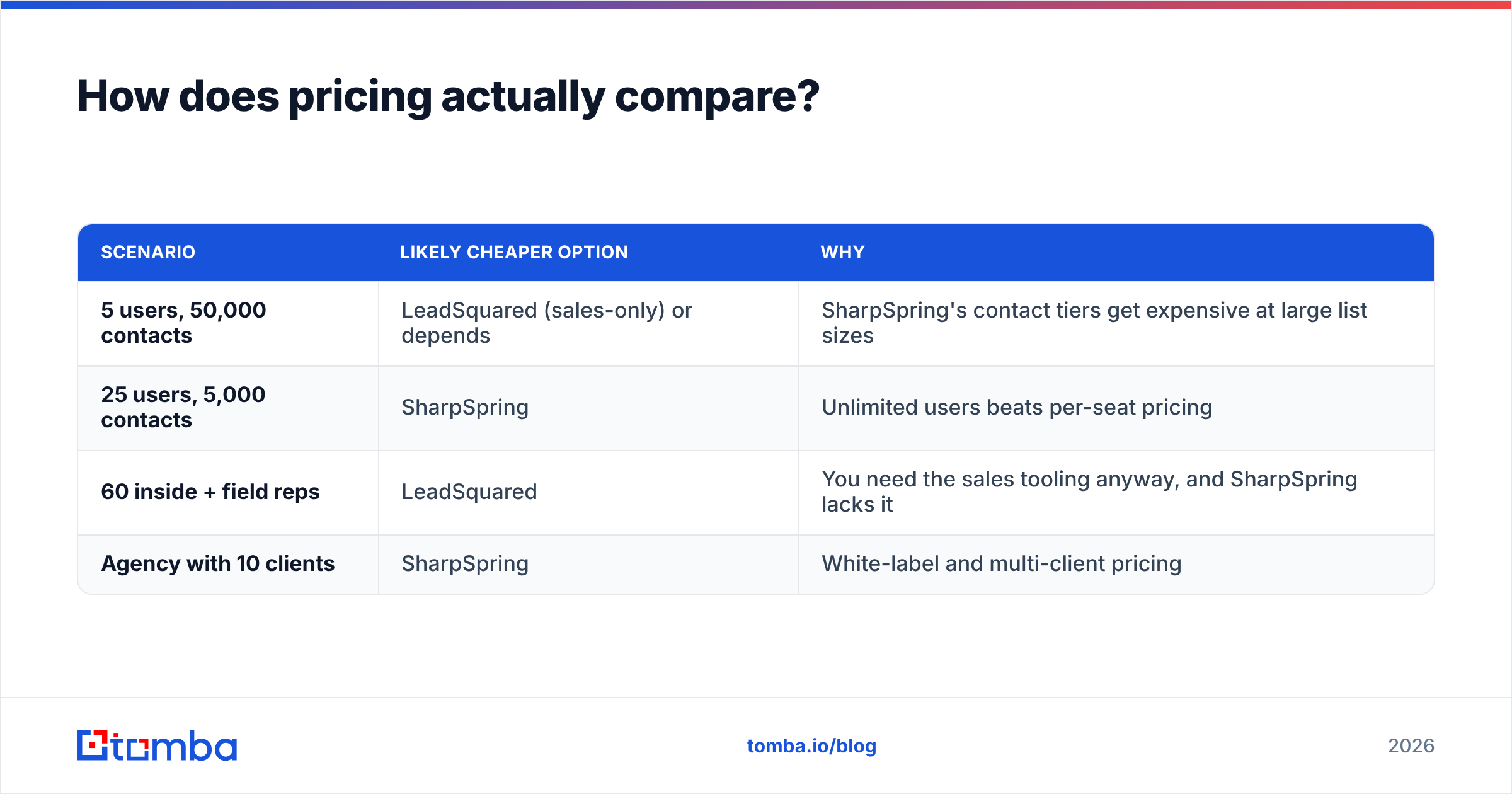
Pricing is where these tools differ most, so model it against your own numbers rather than trusting list prices.
LeadSquared splits its offering. The Sales CRM is priced per user per month. Tiers are usually called Lite, Pro and Super. They run from about $25 to $100 per user per month on annual billing. Marketing automation is priced separately, usually by contact volume, and the higher tiers are quote-based. A 30-seat team on a mid tier with marketing automation can reach low five figures per year quickly. In return, each seat gets a lot of sales tooling.
SharpSpring has historically used contact-based tiers with unlimited users. Plans started around the low-$400s per month for about 1,000 contacts and rose with list size. Since the acquisition, packaging has moved under Constant Contact's lead-gen and CRM plans. Current tiers may differ from older third-party write-ups. Confirm directly on Constant Contact or with sales.
A quick way to model it:
| Scenario | Likely cheaper option | Why |
|---|---|---|
| 5 users, 50,000 contacts | LeadSquared (sales-only) or depends | SharpSpring's contact tiers get expensive at large list sizes |
| 25 users, 5,000 contacts | SharpSpring | Unlimited users beats per-seat pricing |
| 60 inside + field reps | LeadSquared | You need the sales tooling anyway, and SharpSpring lacks it |
| Agency with 10 clients | SharpSpring | White-label and multi-client pricing |
Also budget for implementation. LeadSquared deployments in regulated industries often include paid onboarding and custom configuration. SharpSpring agency partners typically handle setup for their clients.
What do both platforms get wrong?#
Both have gaps you should plan around.
LeadSquared
- The configuration is very flexible, which also makes it complicated. Without a dedicated admin or a strong implementation partner, you can end up with messy custom fields and routing rules nobody understands.
- The UI is functional rather than elegant, and some users find reporting customisation clunky.
- It is less proven in North American and European mid-market B2B SaaS than in APAC and India-centric verticals.
SharpSpring
- Product momentum has been a common concern since the acquisition. Check the roadmap and how actively the product is being developed before you commit to a multi-year contract.
- The CRM and reporting are adequate but basic next to dedicated sales platforms.
- Contact-based pricing penalises you for keeping large, unengaged lists, so list hygiene has a direct cost impact.
Neither platform is a data source. Both assume contacts arrive from forms, imports or integrations. If your outbound motion depends on building lists from scratch, you'll need a separate prospecting layer to find email addresses and enrich leads with firmographic context before they enter either CRM.
How do you migrate or run a pilot without losing data?#
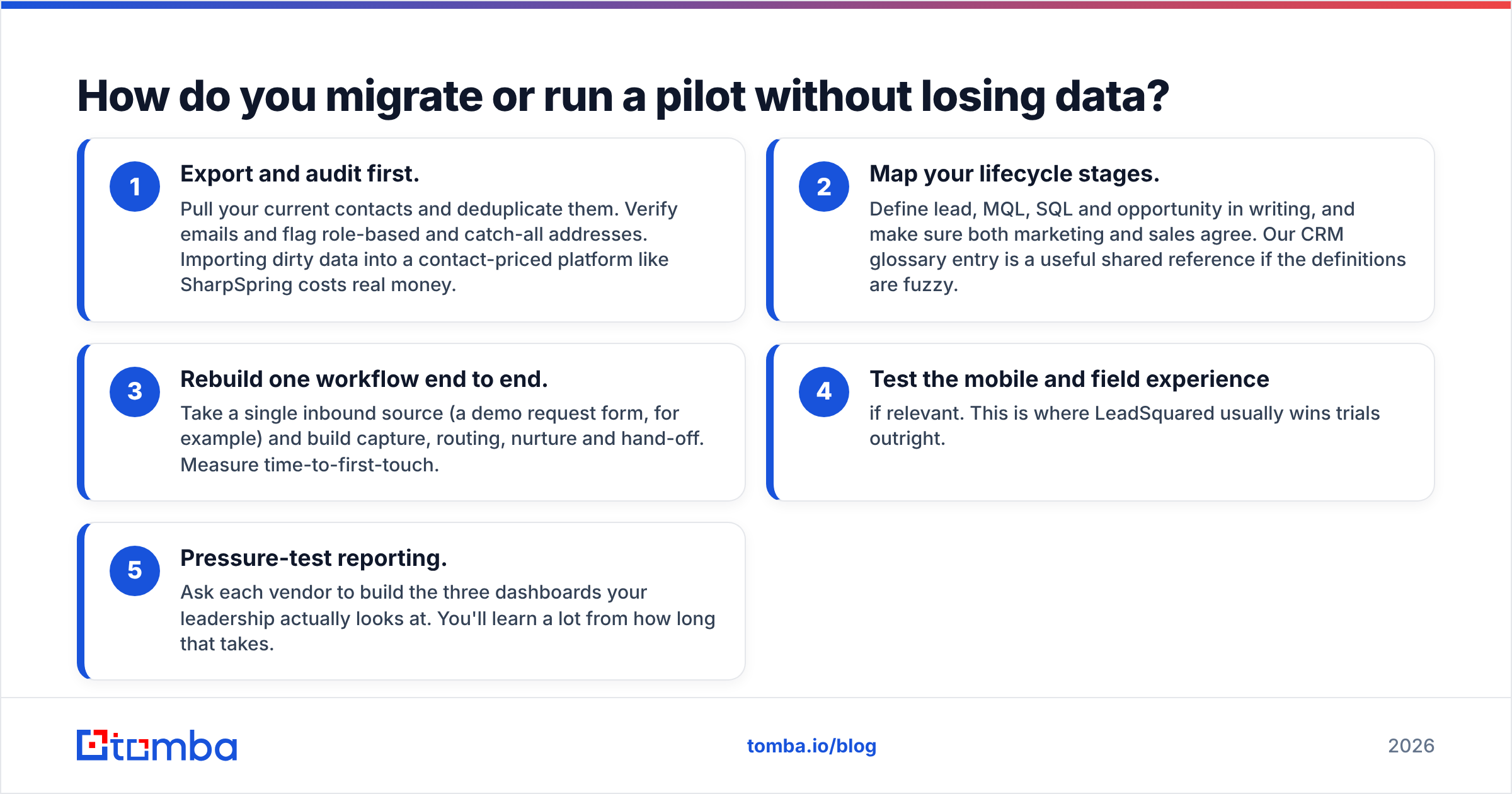
If you're moving from one platform to the other, or from a spreadsheet to either one, a two-week pilot will tell you more than any demo.
- Export and audit first. Pull your current contacts and deduplicate them. Verify emails and flag role-based and catch-all addresses. Importing dirty data into a contact-priced platform like SharpSpring costs real money.
- Map your lifecycle stages. Define lead, MQL, SQL and opportunity in writing, and make sure both marketing and sales agree. Our CRM glossary entry is a useful shared reference if the definitions are fuzzy.
- Rebuild one workflow end to end. Take a single inbound source (a demo request form, for example) and build capture, routing, nurture and hand-off. Measure time-to-first-touch.
- Test the mobile and field experience if relevant. This is where LeadSquared usually wins trials outright.
- Pressure-test reporting. Ask each vendor to build the three dashboards your leadership actually looks at. You'll learn a lot from how long that takes.
LeadSquared vs SharpSpring: which one should you choose in 2026?#
Choose LeadSquared if:
- You run a high-velocity, sales-heavy motion with dozens or hundreds of reps.
- Lead routing, SLA enforcement and rep accountability are your biggest problems.
- You have field sales teams, or operate in education, lending, insurance, healthcare or real estate.
- You're comfortable paying per seat for depth.
Choose SharpSpring if:
- Marketing owns most of the funnel and sales is a small team.
- You're an agency that wants white-label automation for clients.
- You value anonymous visitor identification and behaviour-based nurture.
- You want many users without per-seat fees and can keep your contact list lean.
If you're a mid-market B2B SaaS company that needs both strong sales and strong marketing, you should probably shortlist HubSpot or Salesforce as well. Neither LeadSquared nor SharpSpring is the default pick in that segment.
Frequently asked questions#
Is SharpSpring still available in 2026? Yes. It's owned by Constant Contact, which has repackaged it within its lead generation and CRM offering. Confirm current plan names and pricing directly with Constant Contact, because older reviews often quote legacy SharpSpring tiers.
Does LeadSquared have marketing automation? Yes. It includes email campaigns, landing pages, forms, automation journeys and lead scoring, priced separately from the Sales CRM. It is tuned toward qualifying leads for sales rather than long multi-brand nurture programmes.
Which is better for small businesses? It depends on who drives revenue. A small marketing-led business will usually get more from SharpSpring. A small but call-heavy sales team, such as a local lender or training institute, will usually get more from LeadSquared's Lite or Pro tier.
Can either tool find new contacts for outbound? Not really. Both manage and nurture contacts you already have. For outbound, pair them with a dedicated email finder and verifier, then sync the verified contacts in through a native integration or Zapier.
Feed your CRM better leads, whichever you choose#
Whoever wins LeadSquared vs SharpSpring for you, both tools depend on data arriving clean. If your reps or campaigns rely on outbound lists, Tomba Email Finder lets you find verified work email addresses by name, domain or company before they reach your CRM. That means fewer bounces, more accurate scoring and routing rules that reach real buyers. You can start on the free tier with 25 searches a month, then move up to Starter at $49/mo when your pipeline needs more volume.
Related guides#
// get started
Find, verify and enrich your first contacts today
Start on the free plan with 25 searches a month, then scale when your team is ready.
Free plan · No credit card required · GDPR & CCPA
Get the Tomba newsletter
Product and data updates
// about the author