Leadzenai Pricing 2026: Plans, Cost per Credit and Alternatives
Leadzen.ai starts at $133/month for 300 credits, and review sites list no free tier. Here is what each credit really costs, where the plans run short, and when a cheaper email finder makes more sense.
TL;DR
- Leadzenai pricing on public review sites lists three plans: $133/month for 300 credits, $400/month for 1,100 credits, and $800/month for 2,600 credits, plus a custom enterprise tier.
- That comes to roughly $0.44, $0.36, and $0.31 per credit. One credit unlocks one verified email or one phone number, so a full contact with both can cost two credits.
- TrustRadius and Capterra list no free version or trial. Indian buyers can reportedly pay in INR from about ₹2,500/month through Razorpay.
- Leadzen.ai is a good fit for SDR teams that prospect inside LinkedIn and Sales Navigator and need phone numbers, especially in India.
- If you mostly need verified work emails, a dedicated email finder such as Tomba (free tier, then $49/month) costs much less to start.
What is Leadzen.ai, and what are you actually paying for?#
Leadzen.ai is an AI-assisted B2B lead generation platform. Its main job is to show verified emails, phone numbers, and AI-generated buyer notes directly on LinkedIn profiles and Sales Navigator pages, using a Chrome extension. The company markets heavily to Indian sales teams, and its own blog describes the product as a fix for the "SDR productivity problem" in the Indian market.
So you're not really paying for software seats. You're paying for contact reveals. The extension, the search filters, and the AI summaries are what you use to get to the thing that costs money: a credit spent to unlock an email address or a mobile number.
This matters for the rest of this breakdown. The headline Leadzenai pricing numbers mean little until you turn them into the only number that affects your budget, which is cost per usable contact.
How much does Leadzen.ai cost in 2026?#
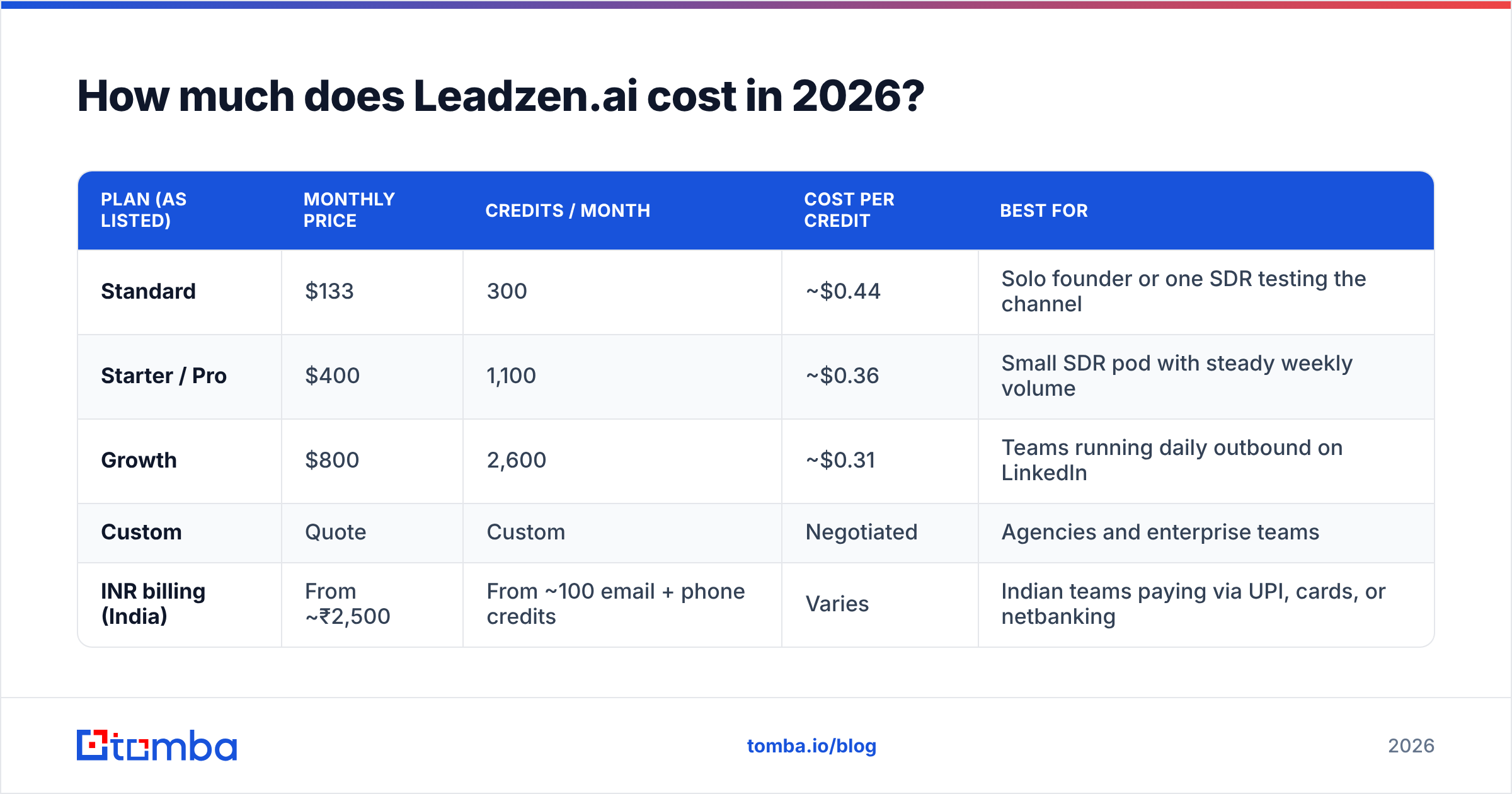
These are the plans listed on TrustRadius and Capterra as of this writing. Plan names differ between sources ("Standard", "Starter", and "Growth" all show up), so treat the names as labels and focus on the credit counts. Check leadzen.ai before you buy, because credit-based vendors change their bundles often.
| Plan (as listed) | Monthly price | Credits / month | Cost per credit | Best for |
|---|---|---|---|---|
| Standard | $133 | 300 | ~$0.44 | Solo founder or one SDR testing the channel |
| Starter / Pro | $400 | 1,100 | ~$0.36 | Small SDR pod with steady weekly volume |
| Growth | $800 | 2,600 | ~$0.31 | Teams running daily outbound on LinkedIn |
| Custom | Quote | Custom | Negotiated | Agencies and enterprise teams |
| INR billing (India) | From ~₹2,500 | From ~100 email + phone credits | Varies | Indian teams paying via UPI, cards, or netbanking |
Credits are listed per user, and every plan describes them as covering "comprehensive person profiles, phone number included." In practice, the credit rule reported by reviewers is simple: 1 email credit = 1 verified email, 1 phone credit = 1 verified phone number, and a one-click reveal spends the credit.
What drives your real Leadzen.ai bill?#
The sticker price is the least important number. These five factors decide what you actually pay per meeting booked:
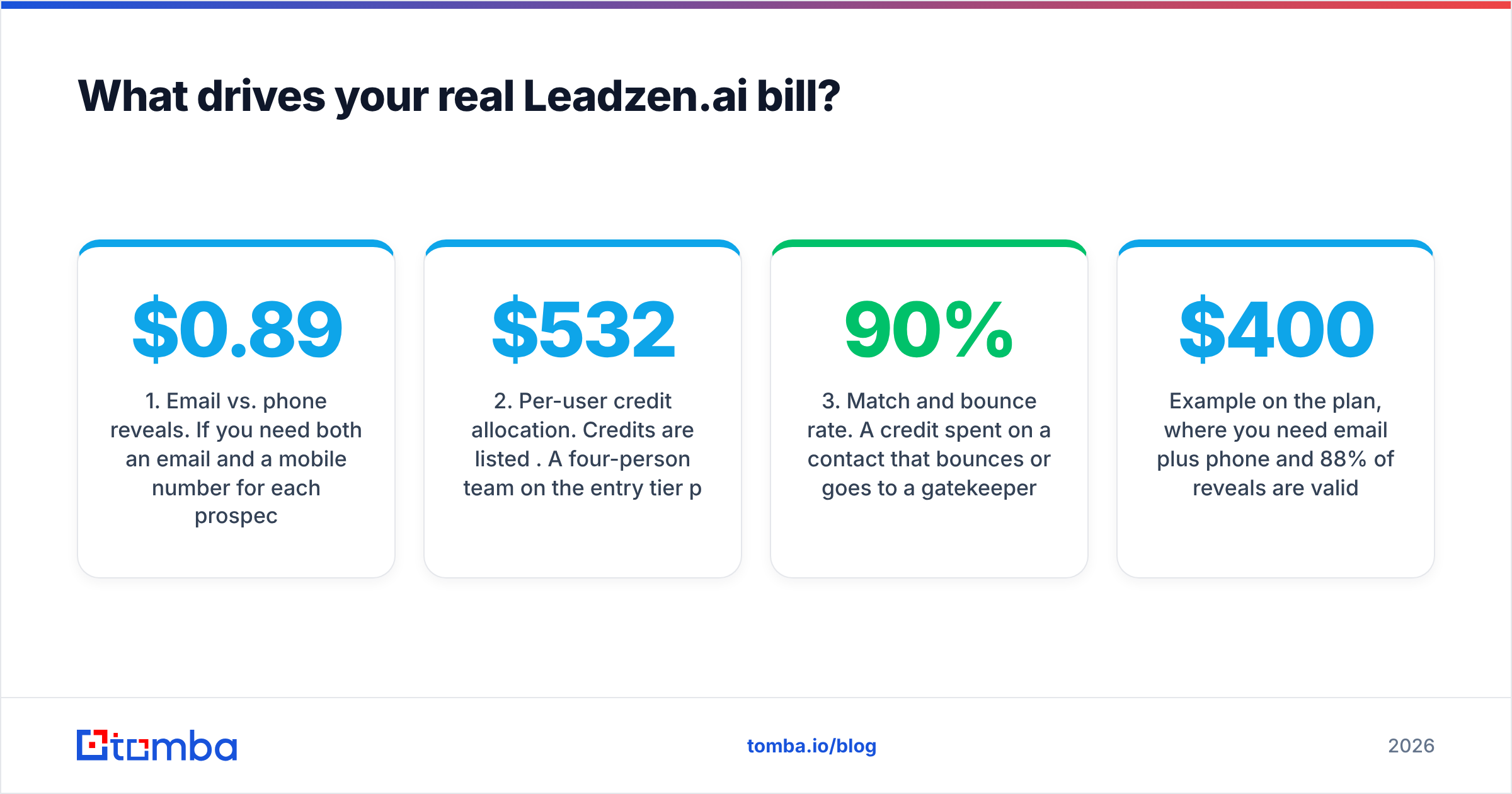
- Email vs. phone reveals. If you need both an email and a mobile number for each prospect, 300 credits covers about 150 fully enriched contacts. On the entry plan, that works out to around $0.89 per complete contact, not $0.44.
- Per-user credit allocation. Credits are listed per user. A four-person team on the entry tier pays $532/month, and one heavy user can run out mid-month while a teammate's credits go unused.
- Match and bounce rate. A credit spent on a contact that bounces or goes to a gatekeeper still counts. Your effective cost is price ÷ (credits × valid-contact rate). At a 90% valid rate, $0.44 per credit becomes about $0.49 per good contact.
- Rollover rules. Review sites don't state whether unused credits roll over. If they expire monthly, a slow month raises your real cost per contact. Ask sales before you sign.
- Currency and billing route. INR billing through Razorpay can come out cheaper than USD list prices for Indian teams. It also avoids foreign-transaction fees on company cards.
Here is the quick formula to run on your own numbers:
Effective cost per usable contact = monthly price ÷ (credits ÷ credits per contact × valid rate)
Example on the $400 plan, where you need email plus phone and 88% of reveals are valid: $400 ÷ (1,100 ÷ 2 × 0.88) = $400 ÷ 484 ≈ $0.83 per usable contact.
Does Leadzen.ai have a free plan or free trial?#
TrustRadius lists no free version and no free trial, and the Capterra listing also shows no free tier. That is uncommon in this category, where most email finders offer at least a small monthly allowance so you can test data quality on your own ICP before paying.
The Chrome Web Store listing for "Email Finder by Leadzen.ai" suggests you can install the extension and look around the interface. Whether a signup comes with a few starter credits changes from time to time, so check during onboarding and don't count on it.
Why this matters: without a trial, your first $133 is effectively your test budget. That's fine if you prospect on LinkedIn every day. It hurts if you're still deciding whether outbound works for you.
How accurate is Leadzen.ai's contact data?#
Leadzen.ai calls its emails and phone numbers "verified." Buyers who compare vendors should run a controlled test instead of relying on marketing copy. Accuracy varies a lot by region: a tool with strong Indian mobile coverage may do only average on German or US mid-market work emails, and the opposite holds for many Western vendors.
A fair way to test:
- Take 100 prospects from your real ICP (not a sample list the vendor gives you).
- Reveal emails in each tool you're evaluating.
- Run every result through the same independent email verifier so no vendor's own "verified" label decides the result.
- Count valid, catch-all, and invalid addresses separately.
For context on how email-finder accuracy varies across the wider market, here is Tomba's 2026 benchmark:

Leadzen.ai is not in that benchmark, so run the 100-contact test above before you commit to an annual plan.
Is Leadzen.ai worth it compared to a dedicated email finder?#
It depends on which channel your pipeline actually runs through.
Leadzen.ai earns its price if:
- Your SDRs spend most of the day in LinkedIn and Sales Navigator and want contact data right on the profile.
- Phone numbers matter, especially Indian mobile numbers, where specialized coverage is valuable.
- You want AI buyer notes next to the contact so reps can personalize faster.
- You're an Indian team that benefits from INR and UPI billing.
A dedicated email finder is the better value if:
- Email is your main outbound channel and phone is occasional.
- You prospect by company domain (account lists, ABM, website visitors), not by LinkedIn profile.
- You need a free tier to validate data quality first.
- You need an API, bulk jobs, or spreadsheet workflows instead of one-click reveals.
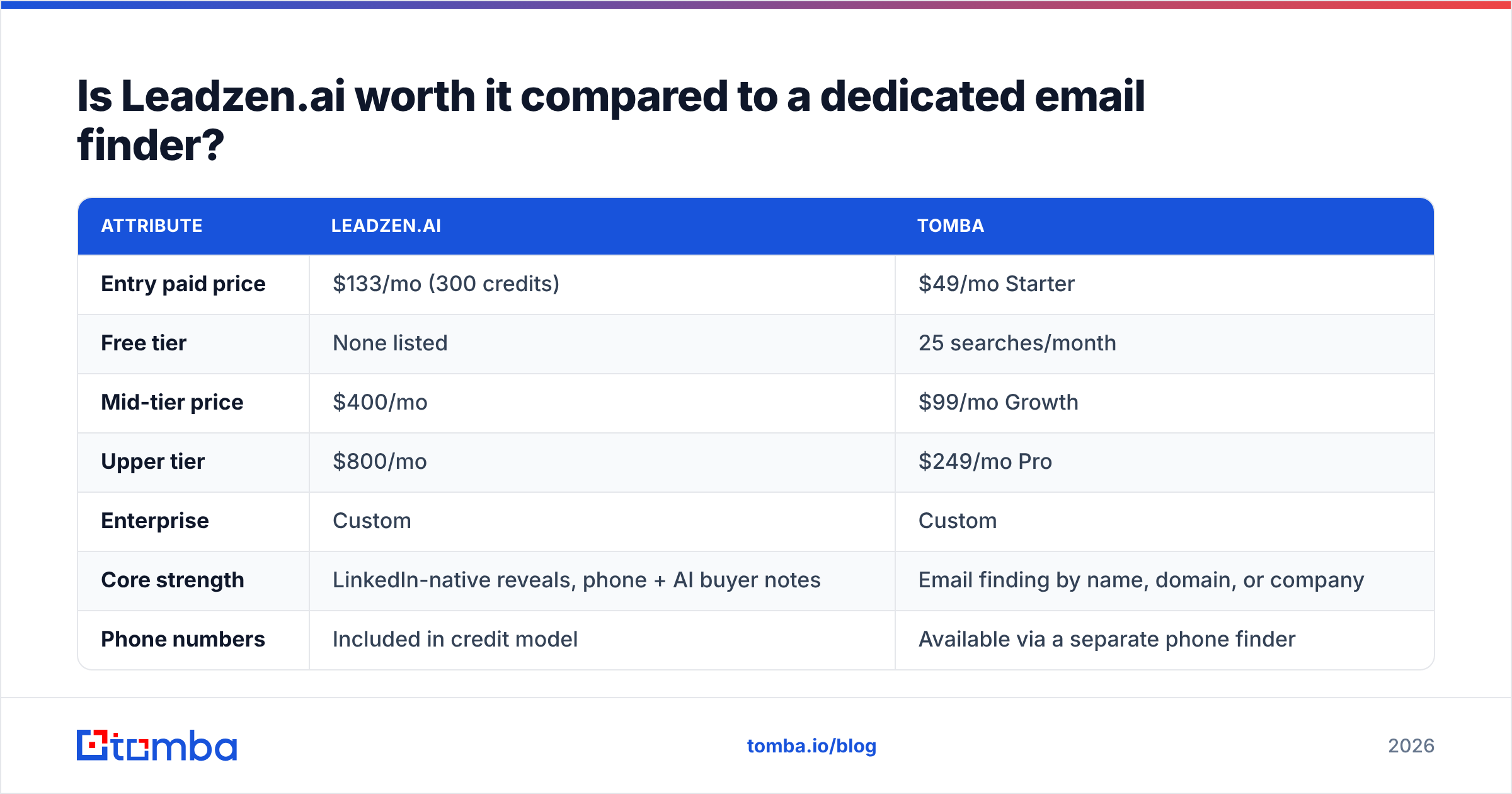
Here's how Leadzen.ai and Tomba compare on the attributes that affect cost:
| Attribute | Leadzen.ai | Tomba |
|---|---|---|
| Entry paid price | $133/mo (300 credits) | $49/mo Starter |
| Free tier | None listed | 25 searches/month |
| Mid-tier price | $400/mo | $99/mo Growth |
| Upper tier | $800/mo | $249/mo Pro |
| Enterprise | Custom | Custom |
| Core strength | LinkedIn-native reveals, phone + AI buyer notes | Email finding by name, domain, or company |
| Phone numbers | Included in credit model | Available via a separate phone finder |
| Domain-wide search | Not the primary workflow | Yes, built in |
| Email verification | Built into reveal | Standalone verifier + catch-all verifier |
| INR / UPI billing | Yes (Razorpay) | USD |

The gap is biggest at the entry level. Leadzen.ai's cheapest plan costs about 2.7× Tomba's Starter plan, and Tomba lets you test for free first. Where Leadzen.ai clearly wins is phone-first, LinkedIn-first prospecting, which Tomba handles through its separate phone finder and extension rather than one bundled reveal.
What are the hidden costs and limits of Leadzenai pricing?#
None of these are hidden on purpose. They just aren't obvious from a pricing card:
- Double-dipping on full contacts. Email and phone are separate credits, so a "300-credit" plan is not 300 fully enriched leads.
- Per-seat scaling. Credits attach to users. Adding reps multiplies the bill instead of adding to a shared pool.
- No-trial risk. Your first month is the trial, at full price.
- Annual lock-in. Credit vendors often offer annual discounts. Only take one after a month of real usage data, not before.
- Workflow ceiling. Reveals built around LinkedIn are fast for one-off lookups but slow for enriching a 5,000-row account list. If you work in bulk, check export and API options with sales.
How do you pick the right Leadzen.ai plan?#
Size the plan from your outbound math, not from the vendor's tier names:
- Count weekly net-new prospects per rep. Example: 60 per week ≈ 260 per month.
- Multiply by credits per contact. Email only = 1, email + phone = 2. So 260 × 2 = 520 credits.
- Add a 10–15% buffer for reveals that return nothing useful: ~600 credits.
- Match to the tier. 600 credits is above the $133 plan and well below the $400 plan. Here you'd either split email lookups to a cheaper finder or accept unused credits.
Step 4 is where many teams combine tools. They keep Leadzen.ai for phone reveals on high-priority LinkedIn prospects and send bulk email finding to a cheaper, domain-based tool. You can find emails by domain for the whole account list, then spend Leadzen.ai credits only on the 20% of contacts where a phone call is worth it.
Who are the main Leadzen.ai alternatives?#
If the entry price or lack of a trial rules Leadzen.ai out, the usual shortlist looks like this:
- Tomba: email finder, domain search, verifier, and phone finder, with a free tier and plans from $49/month. Best for email-first outbound and domain-based account research.
- Apollo.io: a large database with built-in sequencing. Best if you want data and sending in one tool. See our Apollo alternative breakdown for the trade-offs.
- Lusha / ContactOut: LinkedIn-extension competitors with strong direct-dial focus. Closest to Leadzen.ai's workflow.
- BookYourData: a respected pay-as-you-go B2B contact data provider. A good fit if you prefer buying targeted lists over subscribing to monthly credits.
Before you pick, compare independent reviews on G2 and your own 100-contact test results.
Final verdict: is Leadzenai pricing worth it?#
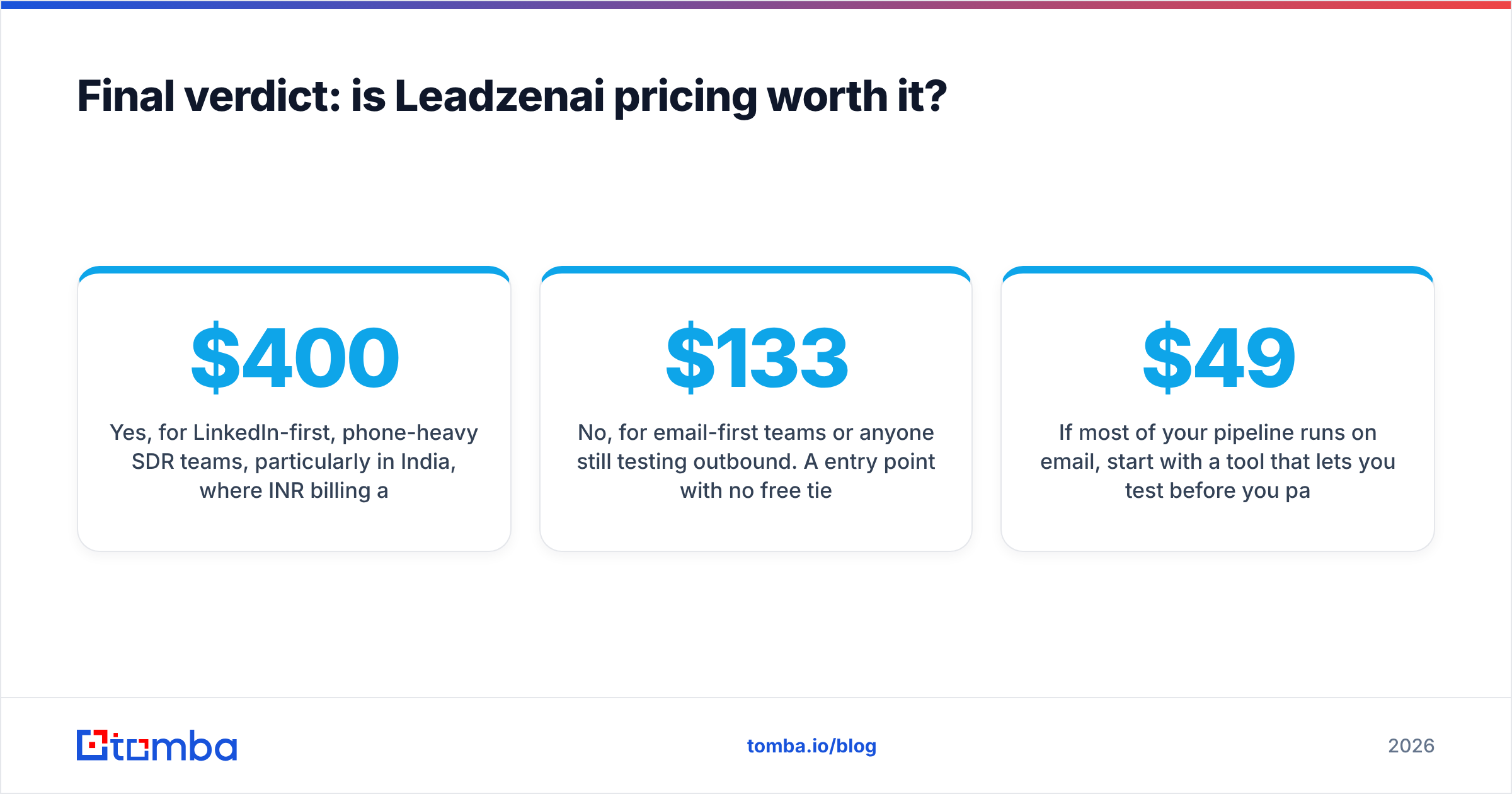
Yes, for LinkedIn-first, phone-heavy SDR teams, particularly in India, where INR billing and local mobile coverage strengthen the value. The $400 and $800 tiers bring the per-credit cost down to a competitive range once you have steady volume.
No, for email-first teams or anyone still testing outbound. A $133 entry point with no free tier is expensive for validating data quality. Once email and phone are split into separate credits, your real cost per fully enriched contact is about double what the headline suggests.
If most of your pipeline runs on email, start with a tool that lets you test before you pay. Tomba Email Finder finds professional email addresses by name, domain, or company. The free tier gives you 25 searches a month to check accuracy on your own ICP, and paid plans start at $49/month, well below Leadzen.ai's entry tier. Run your 100-contact test on both, compare cost per usable contact, and let the numbers decide. Full plan details are on the Tomba pricing page.
Related guides#
// get started
Find, verify and enrich your first contacts today
Start on the free plan with 25 searches a month, then scale when your team is ready.
Free plan · No credit card required · GDPR & CCPA
// about the author