Leadzen.ai vs Apollo.io: Data, Pricing and Workflow Compared
Leadzen.ai sells AI-assisted lead discovery. Apollo.io sells a full prospecting and outreach suite. Here's how they compare on data, pricing and workflow, and which kind of team each one suits.
TL;DR
- Apollo.io is an all-in-one sales platform. It combines a large B2B contact database with sequences, a dialer, CRM sync and AI features. It suits teams that want one tool for both finding leads and contacting them.
- Leadzen.ai is a lighter, AI-led lead discovery tool. You describe your ideal customer and it returns matching companies and contacts. It suits small teams and agencies that already have an outreach tool.
- On data coverage, Apollo is stronger in North America and Europe. Leadzen positions itself as strong in India and other emerging markets. Test both on your own ICP before you trust either claim.
- Neither tool removes the need to verify emails. Run exports through a verifier before sending, or bounce rates will hurt your domain.
- Our pick: choose Apollo if you need a full outbound stack. Choose Leadzen if you want quick AI-built lists and plan to send from a separate tool.
What is Leadzen.ai?#
Leadzen.ai is an AI-powered B2B lead generation platform. You describe the customers you want in plain language, for example "Series A fintech companies in Southeast Asia hiring SDRs". The platform then returns a list of accounts and decision-makers with contact details where it has them.
According to its official site, the product includes:
- AI search: queries in natural language instead of a long set of filters
- Contact enrichment: work emails, and phone numbers where available
- A LinkedIn-side browser extension for pulling contact details while you browse profiles
- Bulk enrichment for CSV lists you already have
- Export to spreadsheets and common CRMs
Leadzen is built around the list, not the sequence. It helps you work out who to contact and how to reach them. Sending the messages is left to other tools such as Instantly, Lemlist or your CRM's sequencer.
What is Apollo.io?#
Apollo.io is one of the most widely used sales intelligence platforms. It advertises a database of more than 200 million contacts and tens of millions of companies. Around that database, it has built an execution layer with:
- Multi-step email sequences with A/B testing
- A built-in dialer and call recording
- A Chrome extension for LinkedIn, Gmail and Salesforce
- Two-way sync with HubSpot and Salesforce
- Intent signals, job-change alerts and AI-written email drafts
- Deal and meeting tracking
Apollo has become the default "first sales tool" for many seed to Series B startups, because its free plan lets a founder build lists and send sequences without paying. The trade-off is complexity: there are a lot of settings, and credit rules differ by plan.
How do Leadzen.ai and Apollo.io compare side by side?#
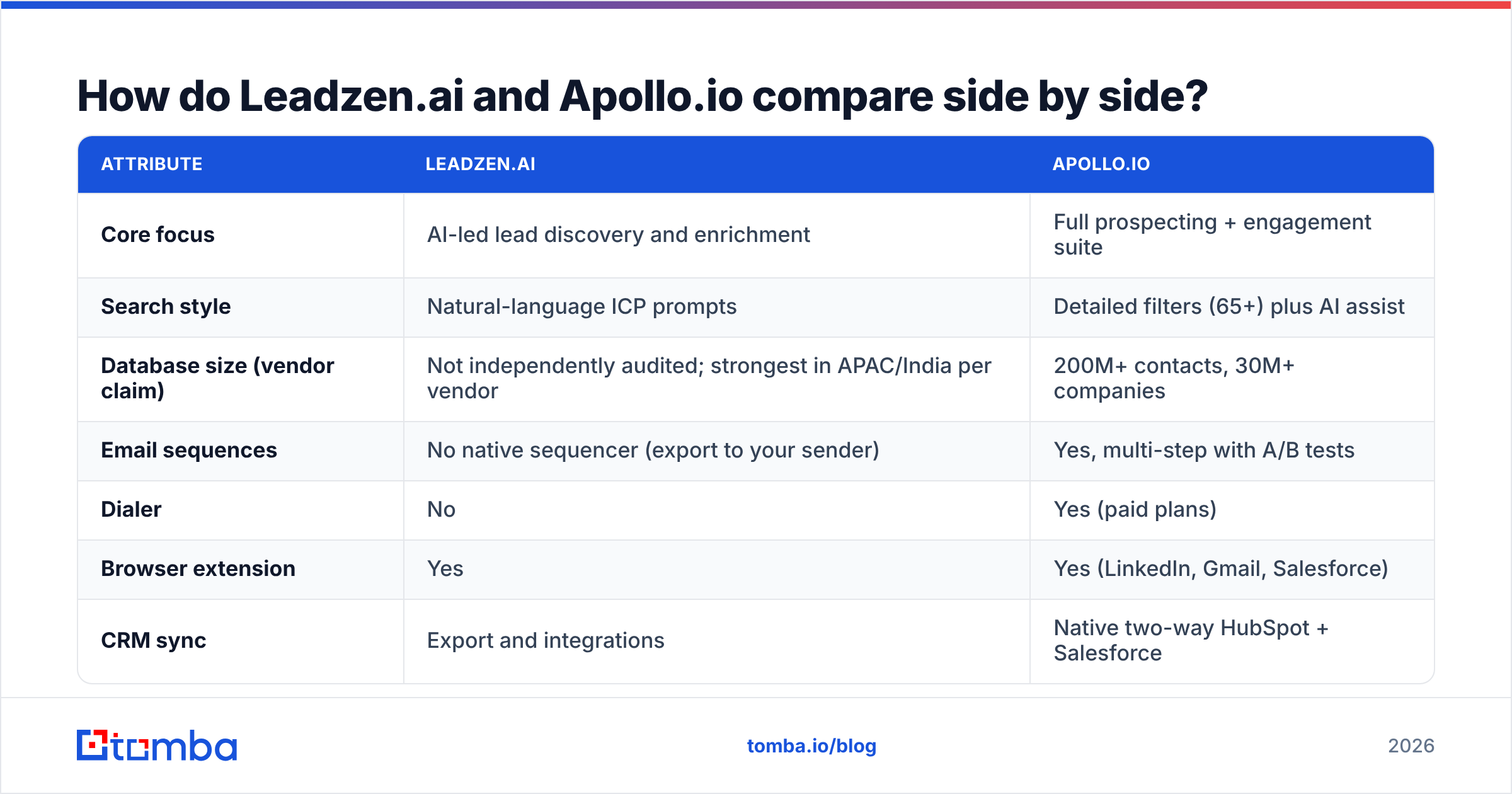
Here is how the two tools compare on the attributes buyers ask about most. Prices change often, so treat the dollar figures as a snapshot and check each vendor's pricing page before you buy.
| Attribute | Leadzen.ai | Apollo.io |
|---|---|---|
| Core focus | AI-led lead discovery and enrichment | Full prospecting + engagement suite |
| Search style | Natural-language ICP prompts | Detailed filters (65+) plus AI assist |
| Database size (vendor claim) | Not independently audited; strongest in APAC/India per vendor | 200M+ contacts, 30M+ companies |
| Email sequences | No native sequencer (export to your sender) | Yes, multi-step with A/B tests |
| Dialer | No | Yes (paid plans) |
| Browser extension | Yes | Yes (LinkedIn, Gmail, Salesforce) |
| CRM sync | Export and integrations | Native two-way HubSpot + Salesforce |
| Free tier | Trial credits | Free plan with limited monthly credits |
| Paid entry point | Credit-based plans, check leadzen.ai | ~$49/user/mo (Basic, billed annually) |
| Mid tier | Higher credit bundles | ~$79/user/mo (Professional, billed annually) |
| Best for | Agencies, lean teams, APAC targeting | SDR teams wanting one platform |
| Learning curve | Low | Medium to high |

In short, one is a list builder and the other is a sales operating system. You are not choosing between two versions of the same product. You are choosing how much of your outbound stack you want a single vendor to own.
Which tool has better data accuracy?#
Neither vendor publishes an independent accuracy audit, so don't rely on marketing claims. What you can do is look at how each one sources its data and then test it yourself.
Apollo combines crowd-sourced data (users who connect their inboxes contribute signature and contact data), public web data and partner feeds. That gives it wide reach, especially for US and EU tech companies. The downside is uneven freshness. Reviews on G2 repeatedly mention outdated titles and bounces on "verified" emails, particularly outside tech hubs.
Leadzen uses public web sources and AI-driven matching to build and enrich profiles. Because its database is smaller, coverage of mid-market US companies can be thinner. The vendor argues this is offset by better targeting in regions where Apollo's crowd-sourced data is sparse.

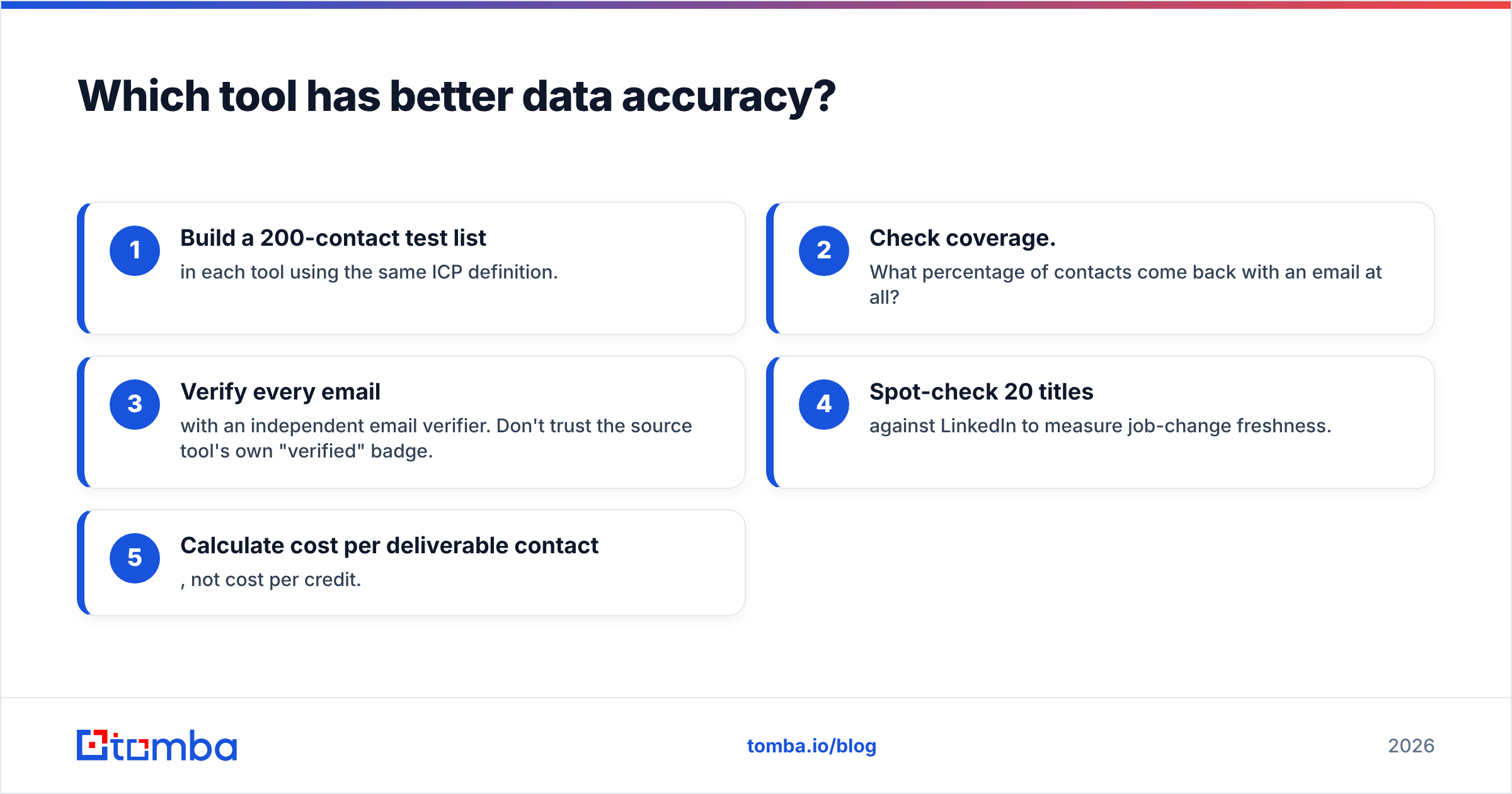
The honest answer is that it depends on your ICP. A quick test tells you more than any comparison article, including this one:
- Build a 200-contact test list in each tool using the same ICP definition.
- Check coverage. What percentage of contacts come back with an email at all?
- Verify every email with an independent email verifier. Don't trust the source tool's own "verified" badge.
- Spot-check 20 titles against LinkedIn to measure job-change freshness.
- Calculate cost per deliverable contact, not cost per credit.
Most teams that run this test find the result depends on geography and industry. Apollo usually wins on US SaaS. Leadzen can win on Indian enterprises and regional SMBs. Catch-all domains hurt both tools.

How does pricing compare in practice?#
Sticker price is only part of the cost. Watch for three hidden cost drivers.
Credit definitions. Apollo separates email credits, mobile credits and export credits, and the limits vary by plan. A "cheap" seat can run out of mobile credits in the first week of a phone-heavy campaign. Leadzen uses a simpler credit model, but you pay per enriched contact, so large exploratory searches get expensive.
Seats vs usage. Apollo prices per user. A five-SDR team on Professional pays five times the seat price before buying any add-ons. Leadzen's pricing is more usage-driven, which suits agencies with one operator building lists for several clients.
Tools you still have to buy. With Leadzen you will also need a sending platform, which typically costs $30–$100 per month per inbox cluster. With Apollo, sequences are included, but many teams still add a dedicated sender for better deliverability control and a separate verifier for list hygiene.
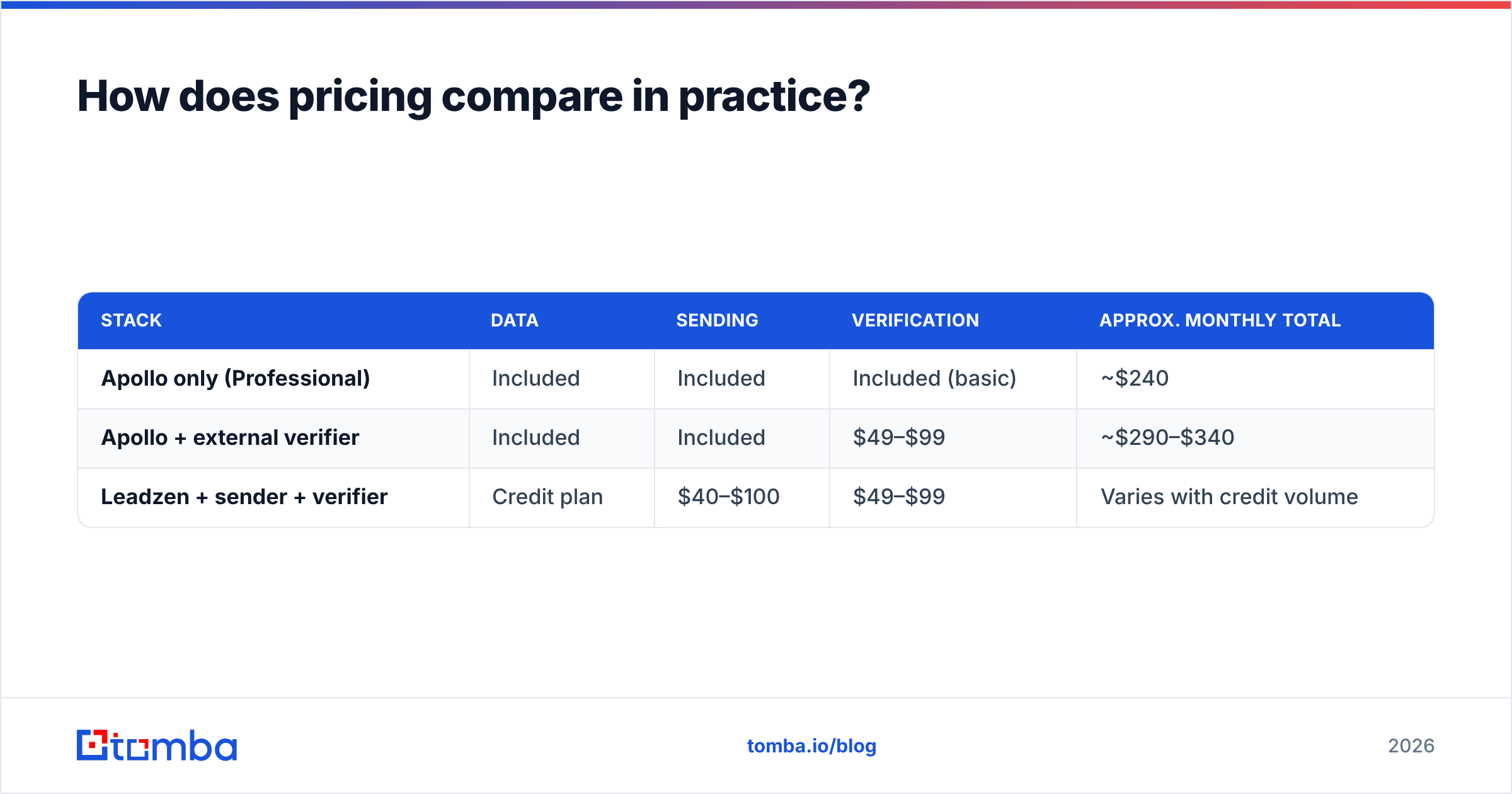
Here is a realistic monthly cost for a three-person outbound team:
| Stack | Data | Sending | Verification | Approx. monthly total |
|---|---|---|---|---|
| Apollo only (Professional) | Included | Included | Included (basic) | ~$240 |
| Apollo + external verifier | Included | Included | $49–$99 | ~$290–$340 |
| Leadzen + sender + verifier | Credit plan | $40–$100 | $49–$99 | Varies with credit volume |
Figures are approximate and billed annually where applicable. Always check the current Apollo pricing page and Leadzen's plans before committing.
Is Apollo.io better than Leadzen.ai for SDR teams?#
For a structured SDR team with quotas, Apollo is usually the better fit. The reason is workflow, not data. SDR managers need:
- Activity tracking across email, calls and LinkedIn tasks in one place
- Sequence templates shared across the team
- CRM sync that logs every touch automatically
- Reporting on reply rates by rep, step and persona
Apollo does all of this natively. Leadzen doesn't try to. If you give Leadzen to an SDR team, you are also signing up to build and maintain the Leadzen → sender → CRM pipeline yourself, usually through Zapier or Make.
That said, a common setup at larger companies is to use Apollo for engagement and a second data source to fill coverage gaps. If Apollo's data is weak in your target region, Leadzen can work well as that second source.
Is Leadzen.ai better for agencies and lean teams?#
Often, yes. Leadzen's natural-language search is faster when you are building a different ICP every week for different clients. You type the brief, review the list, export and move on. You don't have to rebuild a filter set in Apollo every time.
Leadzen also tends to make sense when:
- You already have a sender you like and don't want to migrate sequences
- You target APAC or India, where Leadzen claims deeper coverage
- One operator runs list building for several campaigns or clients
- You want a short learning curve for junior team members or VAs
Where Leadzen falls short is in the second half of the funnel. There is no native dialer, no sequence analytics and no deal pipeline. That is fine if you planned for it and painful if you didn't.
What do both tools get wrong?#
Both platforms have the same underlying weakness: a database is a snapshot, and people change jobs. Industry estimates put B2B contact data decay at roughly 2–3% per month. After a year, a large share of any static list is stale.
In practice, this shows up as:
- Bounces on "verified" emails because the contact left months ago
- Catch-all domains reported as valid when the mailbox doesn't exist
- Duplicate records after exporting from two tools into one CRM
- Inconsistent formats (first.last vs flast) guessed incorrectly on smaller companies
None of this is specific to Apollo or Leadzen. It is how contact databases work. The fix is to treat whatever you export as unverified until it passes a check. HubSpot's guidance on email bounce rates matches what deliverability teams say: keep hard bounces well under 2%, or mailbox providers will start filtering you.

How should you pick between Leadzen.ai and Apollo.io?#
Use this decision path:
- Do you need sequences, dialing and CRM sync in one tool? Choose Apollo.
- Do you already have a sender and only need better lists? Leadzen is worth a trial.
- Is most of your target market in India or APAC? Test Leadzen alongside Apollo, since coverage may differ a lot.
- Are you an agency building lists for several clients? Leadzen's prompt-based search will save setup time.
- Is budget tight and your team is one founder? Start on Apollo's free plan, then decide whether you need more.
Whichever you pick, plan for a verification layer and a backup finder for contacts your main tool misses. No single database covers everyone. If you're weighing Apollo against a wider set of options, our breakdown of Apollo.io alternatives covers the tools teams most often switch to.
Where does Tomba fit alongside either tool?#
Tomba isn't a sequencing platform, so it doesn't replace Apollo's engagement features. It plugs into either stack at two points.
Filling gaps. When Apollo or Leadzen returns a contact with no email, Tomba's email finder works from the person's name and company domain. It combines crawled sources with pattern detection. This is where teams usually recover a meaningful share of "no email found" rows.
Cleaning exports. Before a list reaches your sender, run it through verification, including catch-all checks. This is the step that keeps your bounce rate low no matter which database the contacts came from.
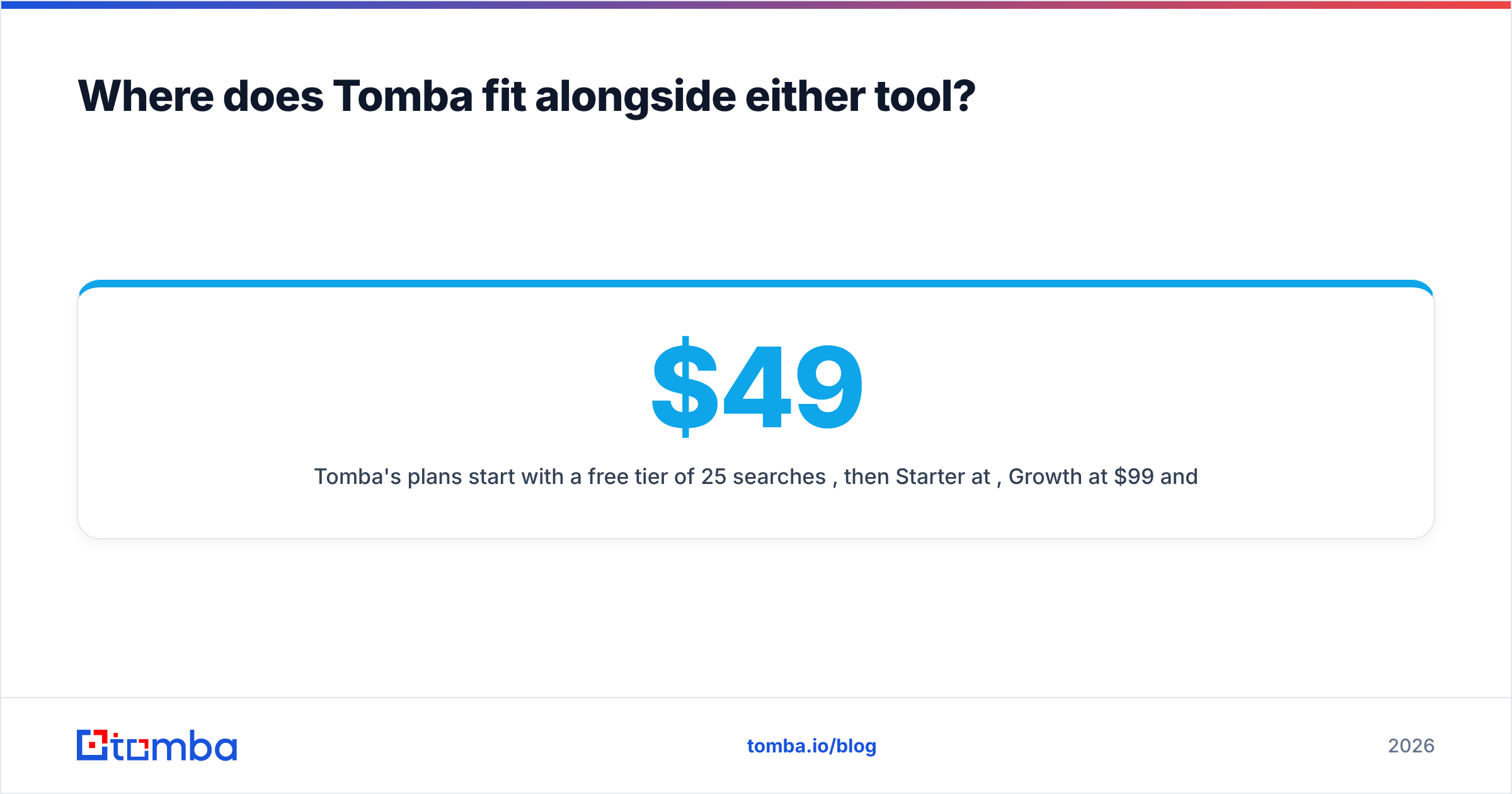
Tomba's plans start with a free tier of 25 searches per month, then Starter at $49/mo, Growth at $99/mo and Pro at $249/mo. You can compare them on the Tomba pricing page. A useful setup is Apollo or Leadzen for discovery and Tomba for finding missing emails and verification, which usually costs less than upgrading to the next Apollo tier just for more credits.
Final verdict: Leadzen.ai vs Apollo.io#
Apollo.io is the stronger all-round platform. It has a bigger database, native sequences and dialing, and mature CRM integrations. If you want one login for your SDR team, choose it.
Leadzen.ai is the more focused tool. It offers fast AI-built lists, a gentler learning curve and, according to the vendor, stronger coverage in regions where Apollo is thin. It works best for agencies and lean teams that already have a sender.
Most teams don't need to choose forever. Run the 200-contact test above, measure cost per deliverable contact and let your own data decide.
Whichever database you choose, don't send unverified exports. Use Tomba Email Finder to find the emails Apollo or Leadzen missed, from a name and company domain, and verify every address before it reaches your outbox. You can start free with 25 searches per month and see how many extra contacts you can reach.
Related guides#
Ready to find emails that actually work?
Join 150,000+ professionals who stopped guessing and started sending. Free credits on signup — no credit card required.
Get the Tomba newsletter
Practical outbound tactics and product updates — once every two weeks.
About the author