Leadzenai vs LFBBD (Lead For Business): Which B2B Data Source Wins?
Leadzen.ai lets you search for leads yourself with AI. LFBBD sells ready-made lists built for you. We compare data model, coverage, pricing, freshness and fit so you can pick the right source for your 2026 outbound.
TL;DR
- Leadzen.ai is a self-serve, AI-assisted prospecting platform. You search, filter and export contacts yourself. It is strongest on Indian companies, where it adds registry-style firmographics such as director and filing data.
- LFBBD (Lead For Business) is a UK-registered data vendor that builds and sells lead lists for you: B2B, SaaS, eCommerce, Amazon sellers and local businesses. You buy a finished list instead of running searches.
- Pick Leadzen.ai if you prospect every week and want control over each query. Pick LFBBD if you need a large, niche list delivered fast and don't want to learn another tool.
- Neither one removes the need to verify emails before you send. A list with bounces damages your domain whichever vendor it came from.
- Pricing is hard to compare on paper. Leadzen.ai sells subscription tiers, and LFBBD mostly quotes per list. Work out your cost per verified, sendable contact before you commit.
What is the real difference between Leadzen.ai and LFBBD?#
Think of it like cooking at home versus ordering catering. Leadzen.ai gives you a kitchen: the ingredients (a contact database), the tools (AI search, filters, a Chrome extension) and the freedom to make whatever you want, whenever you want. LFBBD sends a finished meal: you describe what you need, and a list comes back ready to load into your sequencer.
That difference in delivery model matters more than any single feature. Most "Leadzenai vs LFBBD" comparisons go wrong because they line up the two as if they were both SaaS apps. They aren't.
- Leadzen.ai presents itself as an AI lead generation tool for startups and SMEs. It's a platform with logins, credits, saved searches and exports.
- LFBBD presents itself as a lead-data provider that supplies B2B, eCommerce and Amazon-seller data with named contacts, emails and direct-dial or mobile numbers. On its own site it claims 500M+ contacts across 35M companies and 200+ countries, with monthly updates and "AI + human" verification.
So the question isn't "which app is better?" It's "do you want to run prospecting in-house, or buy it as a deliverable?"
How do Leadzen.ai and LFBBD compare feature by feature?#
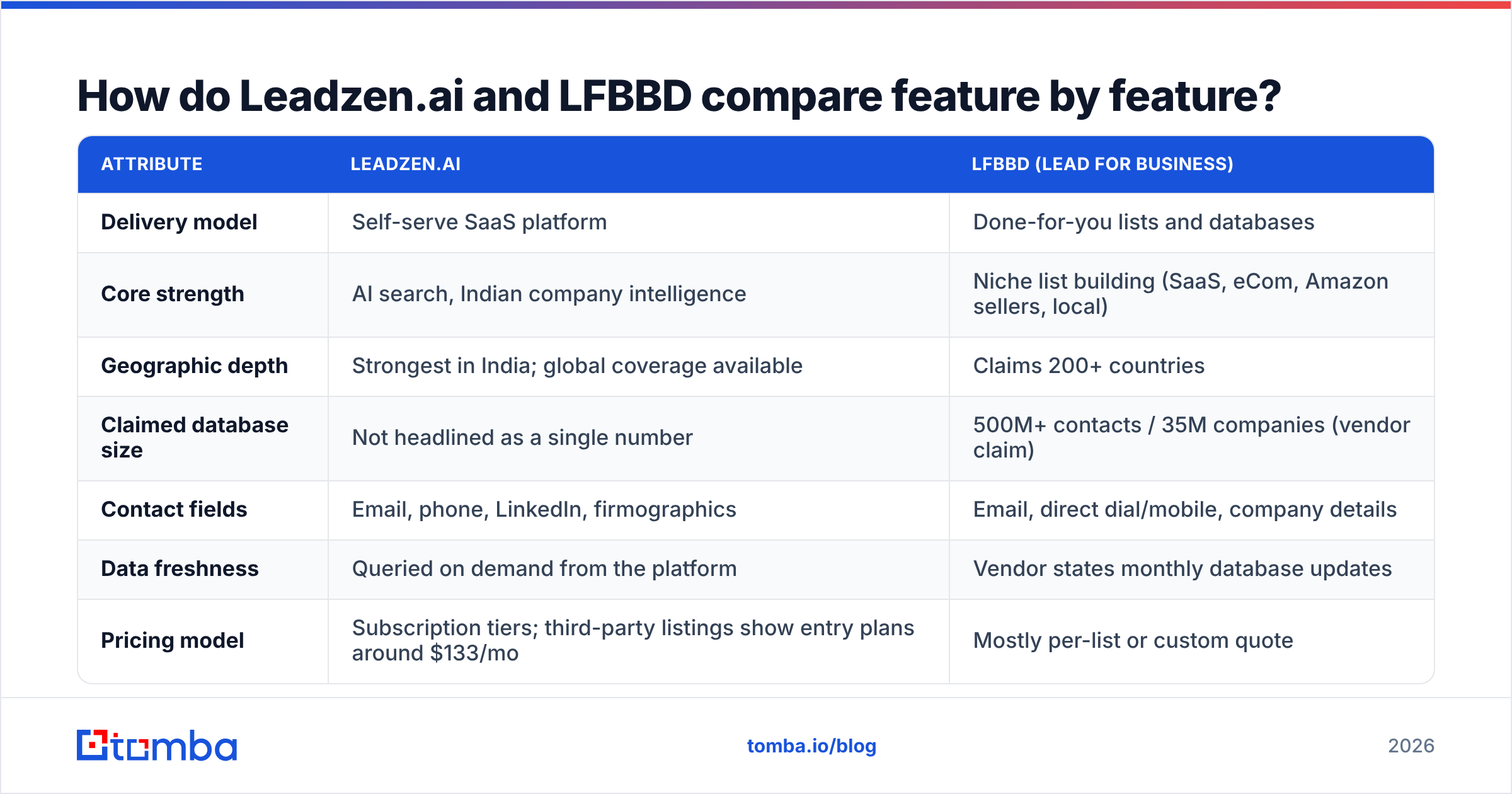
The table below uses each vendor's public positioning and third-party listings as of September 2026. Both vendors change their packaging often, so check the numbers on their own sites before you buy.
| Attribute | Leadzen.ai | LFBBD (Lead For Business) |
|---|---|---|
| Delivery model | Self-serve SaaS platform | Done-for-you lists and databases |
| Core strength | AI search, Indian company intelligence | Niche list building (SaaS, eCom, Amazon sellers, local) |
| Geographic depth | Strongest in India; global coverage available | Claims 200+ countries |
| Claimed database size | Not headlined as a single number | 500M+ contacts / 35M companies (vendor claim) |
| Contact fields | Email, phone, LinkedIn, firmographics | Email, direct dial/mobile, company details |
| Data freshness | Queried on demand from the platform | Vendor states monthly database updates |
| Pricing model | Subscription tiers; third-party listings show entry plans around $133/mo | Mostly per-list or custom quote |
| Free option | Conflicting reports; confirm with the vendor | Samples are typically on request |
| Learning curve | Moderate: you build the queries | Minimal: you write a brief |
| Best for | SDR teams prospecting every week | Marketers and founders needing a one-off or niche list |
For Leadzen.ai's pricing tiers, TrustRadius is a useful independent snapshot. Different directories list different editions, which usually means the vendor adjusts plans by region or deal size.
Which one gives you better data quality?#
Neither vendor gets to grade its own homework, and you shouldn't take accuracy claims at face value. LFBBD states around 95% accuracy on its site. Leadzen.ai leans on AI enrichment and registry-sourced firmographics for Indian companies. Both claims are plausible and both are unaudited.
What drives quality in practice is where each vendor's model is structurally strong or weak.
Leadzen.ai's structural strength: because you query the platform yourself, you get whatever the database holds at that moment. For Indian SMEs and funded startups, the added company data (directors, filings, revenue estimates) is hard to match with Western-first tools.
Leadzen.ai's structural weakness: outside its home market, coverage for smaller companies can thin out. Always test your exact ICP before you sign a long contract.
LFBBD's structural strength: a person builds the list against your brief, so niche segments are possible. "Shopify stores doing $1M+ in the Nordics" or "Amazon sellers in the home-goods category" are hard to express in a filter UI.
LFBBD's structural weakness: a list is a snapshot. Monthly refreshes help, but once the CSV lands in your inbox it starts to age. B2B contact data decays quickly as people change roles and companies reorganise. A list bought in January and still being worked in June will bounce more than it did on day one.

The fix is the same for both. Run every exported or purchased list through an email verifier before the first send, and verify again before any re-send after a few weeks. If the list contains many addresses on catch-all domains, a dedicated catch-all verifier separates "accepts everything" servers from mailboxes that actually exist.
How should you evaluate a lead source before you buy?#
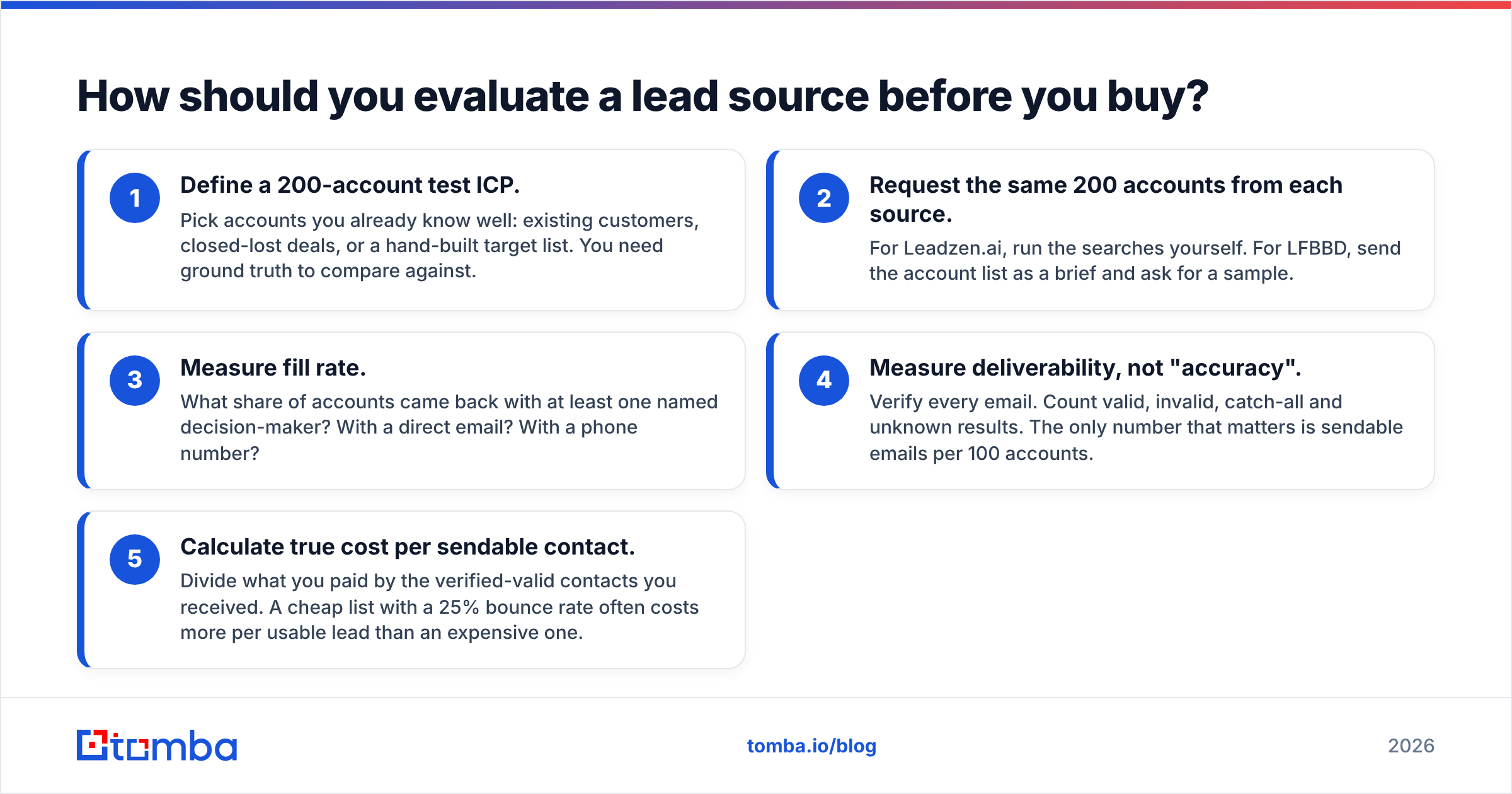
Use this five-step test on either vendor. It takes about an afternoon and saves you from buying 50,000 bad rows.
- Define a 200-account test ICP. Pick accounts you already know well: existing customers, closed-lost deals, or a hand-built target list. You need ground truth to compare against.
- Request the same 200 accounts from each source. For Leadzen.ai, run the searches yourself. For LFBBD, send the account list as a brief and ask for a sample.
- Measure fill rate. What share of accounts came back with at least one named decision-maker? With a direct email? With a phone number?
- Measure deliverability, not "accuracy". Verify every email. Count valid, invalid, catch-all and unknown results. The only number that matters is sendable emails per 100 accounts.
- Calculate true cost per sendable contact. Divide what you paid by the verified-valid contacts you received. A cheap list with a 25% bounce rate often costs more per usable lead than an expensive one.
This turns the comparison from a marketing debate into a spreadsheet. It also protects your sender reputation. Mailbox providers such as Google judge you by your bounce and complaint rates, not by which vendor you used.
Is Leadzen.ai better than LFBBD for SDR teams?#
For a team that prospects every day, usually yes, provided your market overlaps with Leadzen.ai's strong coverage.
SDRs need to react to signals: a new funding round, a job post, a champion who just moved to a new company. A platform lets them look up a contact at the moment the signal appears. A purchased list can't do that. It was built before the signal existed.
Leadzen.ai also fits the usual SDR workflow better:
- Saved searches that you re-run weekly for net-new accounts
- A browser extension for looking up contacts while you're on LinkedIn or a company site
- Exports and integrations that push contacts into your CRM or sequencer
The trade-off is time. Someone has to build and maintain the queries, and the account is only as good as the operator. If your SDRs are already stretched, a platform nobody logs into is worse value than a list someone actually uses.
Is LFBBD better for marketers and founders?#
Often, yes. LFBBD's model suits situations where prospecting is a project rather than a daily routine:
- Launch campaigns. You need 10,000 SaaS marketing leaders for an event or a product launch, once.
- Hard niches. eCommerce and Amazon-seller segments are LFBBD's home ground, and many SaaS databases cover them poorly.
- No RevOps capacity. A founder who is selling alone doesn't have time to learn a new search UI. Writing a brief and receiving a CSV is faster.
- Paid-media audiences. Marketing teams uploading matched audiences to ad platforms care more about volume and match rate than about SDR-grade freshness.
The risks are the usual ones for list buying: check how the data was collected, confirm that your use of it fits the privacy rules in the recipients' countries (GDPR in the UK and EU is the big one), and never send a purchased list at full volume from a cold domain.
What does each option really cost?#
Headline prices mislead in both directions.
Leadzen.ai. Third-party directories list tiered plans. The entry tier is often quoted around $133/month, and higher editions cost considerably more. Credits usually cap how many contacts you can reveal or export. The hidden cost is operator time. At an SDR's loaded hourly cost, three hours a week of query-building matters.
LFBBD. Pricing is usually per list or quoted to your brief, so a small niche list can be cheap and a multi-country database costs more. The hidden cost is decay. You pay once, but the list loses value every month, and you'll need to re-verify or re-buy.
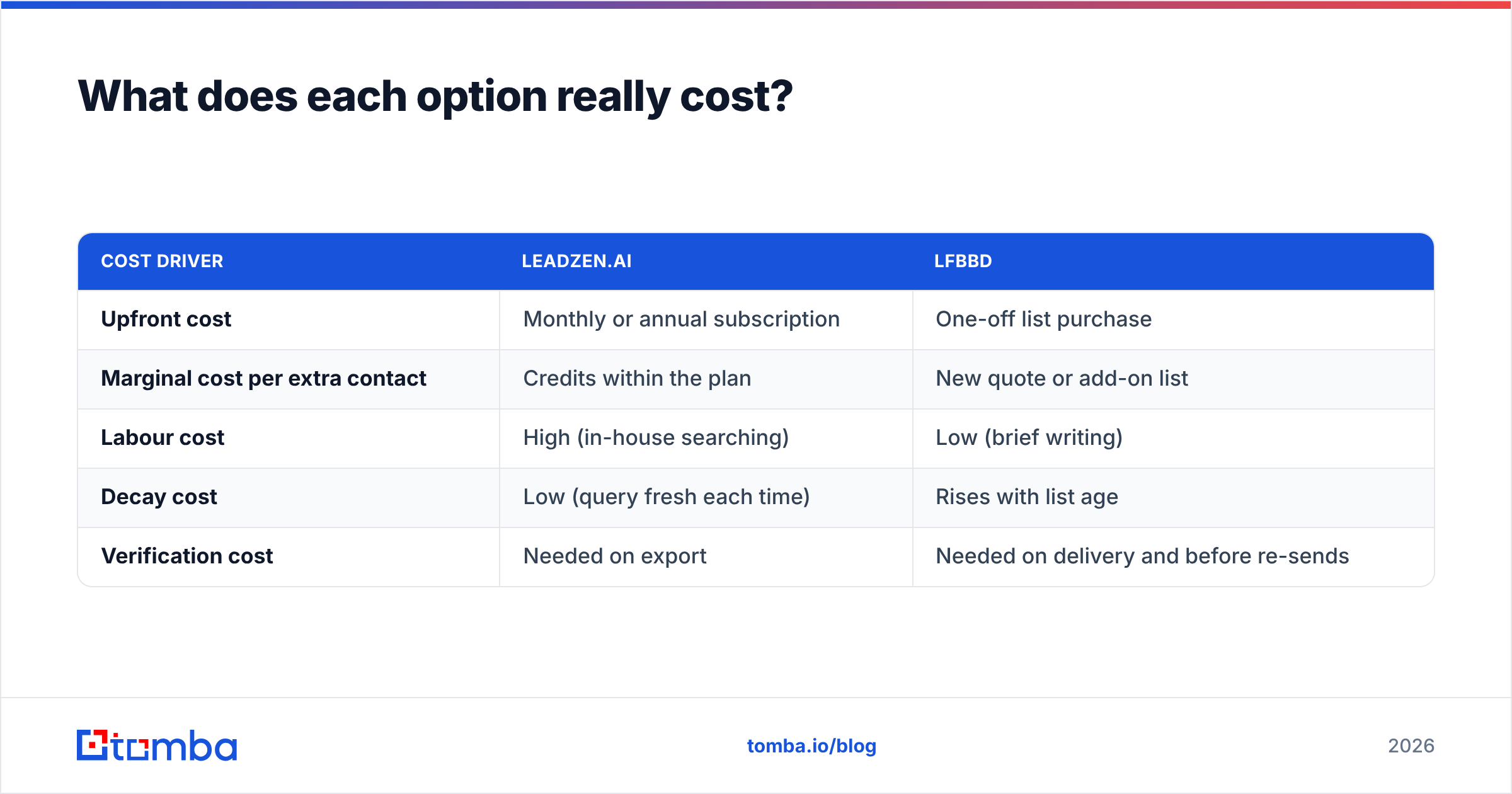
Here is a simple way to compare them:
| Cost driver | Leadzen.ai | LFBBD |
|---|---|---|
| Upfront cost | Monthly or annual subscription | One-off list purchase |
| Marginal cost per extra contact | Credits within the plan | New quote or add-on list |
| Labour cost | High (in-house searching) | Low (brief writing) |
| Decay cost | Low (query fresh each time) | Rises with list age |
| Verification cost | Needed on export | Needed on delivery and before re-sends |
If you verify both outputs the same way, the cheaper option is whichever gives you more valid contacts per dollar in your specific ICP. That's why the 200-account test above matters.
Where do both tools fall short?#
Neither is built as a precision email finder. Both are broad lead-data sources: they give you many contacts per filter or brief, and email coverage for any particular person is a side effect of the database.
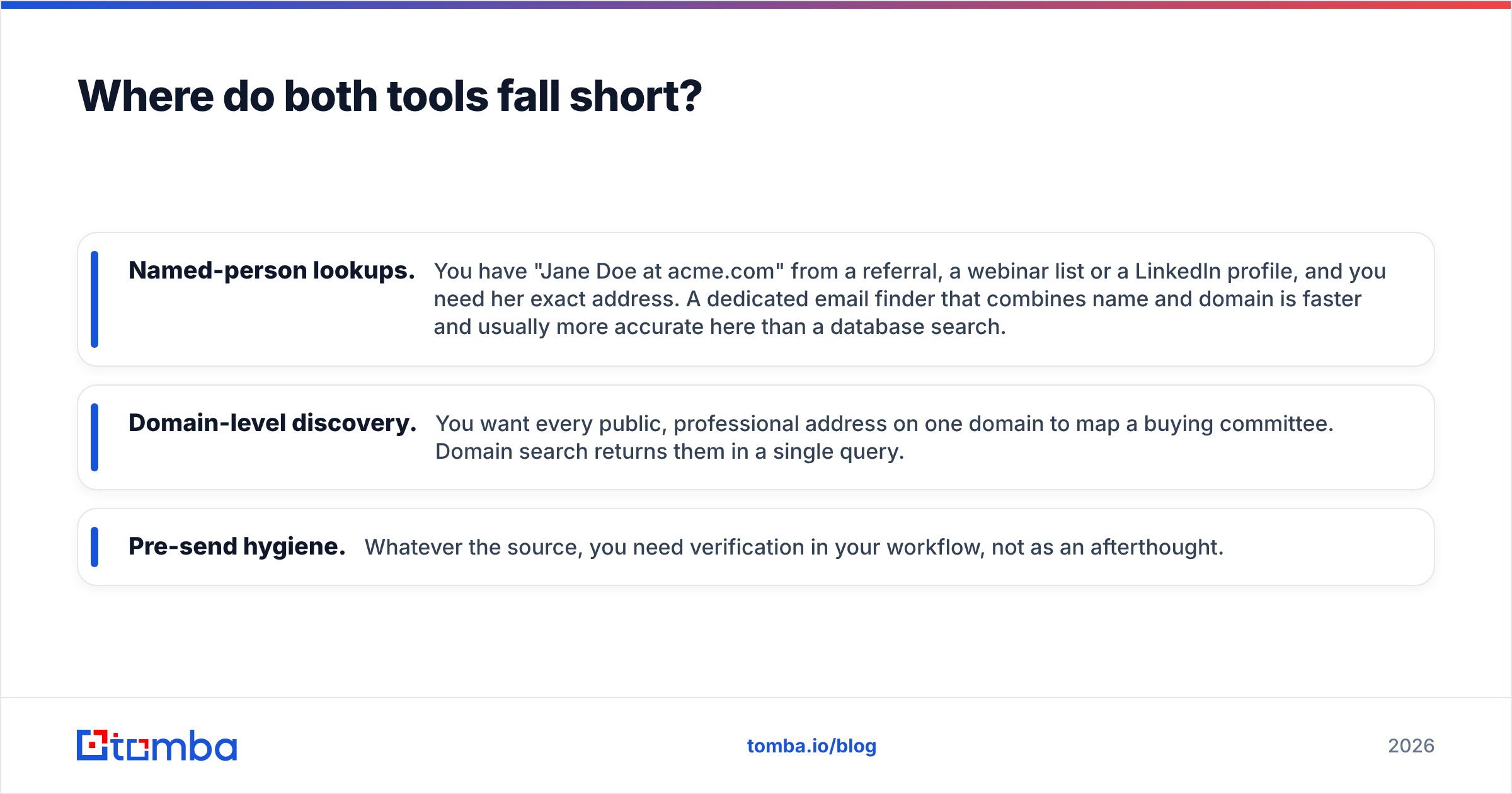
That leaves three gaps that many teams fill with a third tool:
- Named-person lookups. You have "Jane Doe at acme.com" from a referral, a webinar list or a LinkedIn profile, and you need her exact address. A dedicated email finder that combines name and domain is faster and usually more accurate here than a database search.
- Domain-level discovery. You want every public, professional address on one domain to map a buying committee. Domain search returns them in a single query.
- Pre-send hygiene. Whatever the source, you need verification in your workflow, not as an afterthought.
For comparison, the wider market of all-in-one data platforms such as Apollo, ZoomInfo, Lusha and BookYourData (a respected list and database provider in the same space as LFBBD) has the same pattern: breadth from the database, precision from a finder, and safety from a verifier. Reviews on G2 are a good way to see how real users rate each layer before you choose.
So which should you choose: Leadzen.ai or LFBBD?#
Use this decision shortcut:
- Choose Leadzen.ai if you have SDRs prospecting every week, you sell into India or other markets where it's strong, and you want to act on fresh signals.
- Choose LFBBD if you need a large or niche list quickly (SaaS, eCommerce, Amazon sellers, local businesses), you run campaigns occasionally rather than daily, or you have no one to operate a platform.
- Use both if you run an always-on SDR motion and periodic marketing blasts. Many teams do: a platform for daily prospecting, a list vendor for campaign volume.
Whichever you choose, add a finder and a verifier layer to your stack. The lead source decides who you could contact. Verification decides whether your email actually lands.
Frequently asked questions#
Is LFBBD a SaaS tool like Leadzen.ai? Not really. LFBBD mainly sells prepared databases and custom lead lists. Leadzen.ai is a self-serve platform you log into and query.
Does Leadzen.ai work outside India? Yes, but its deepest differentiation is Indian company data. Test your target geography with a sample before you buy an annual plan.
How accurate are purchased lead lists? It depends on the vendor and the list's age. Treat any accuracy percentage as a claim, and measure it yourself by verifying a sample.
Do I still need an email verifier if the vendor says the data is verified? Yes. Verification reflects the moment it ran. People change jobs every week, so verify right before you send.
Get sendable emails whichever source you pick#
Whichever side of the Leadzenai vs LFBBD debate you land on, the gap between "lead" and "reply" is an address that actually works. Tomba Email Finder fills that gap. Enter a name and a company domain, get the professional email, and check it before it goes into your sequence. You can start on the free tier with 25 searches a month and move to Starter at $49/mo when volume grows. See Tomba pricing to compare plans.
Related guides#
// get started
Find, verify and enrich your first contacts today
Start on the free plan with 25 searches a month, then scale when your team is ready.
Free plan · No credit card required · GDPR & CCPA
// about the author