LeadzenAI vs Mattermark: Which B2B Data Tool Fits Your Team?
LeadzenAI finds people to contact. Mattermark tracks which private companies are growing. Before you buy either one, see where each tool is strong, where it falls short and what to pair it with.
TL;DR
- LeadzenAI is an AI-assisted prospecting tool. It helps you find decision-makers and their contact details so you can start outreach.
- Mattermark is a company-intelligence platform built around growth signals for private companies, like funding, headcount trends and traction scores. It was acquired by FullContact in 2017.
- Pick LeadzenAI if your job is filling a sequence with contacts this week. Pick Mattermark only if your job is deciding which companies to target, and first confirm that the product and data are still actively maintained.
- Neither tool replaces a dedicated email-finding and verification step. Budget for one before you send anything.
- Our pick for most outbound teams in 2026 is LeadzenAI, or a contact-first tool like it, paired with an email verifier. Mattermark is a niche research input, not a prospecting engine.
What are LeadzenAI and Mattermark, really?#
These two tools often get compared because both sit under the label "B2B data." They answer different questions, though.
LeadzenAI (leadzen.ai) answers who should I contact, and how do I reach them? It's an AI-assisted lead-generation platform. You describe your ideal customer, filter by industry, role, location and company attributes, and get back prospect profiles with contact details you can export to your CRM or sequencer. It also offers a browser extension so you can pull contact data while browsing LinkedIn profiles.
Mattermark (mattermark.com) answers which companies are worth my attention? It launched in 2013 as a research tool for venture investors. It tracked private companies with signals like funding rounds, employee growth, web traffic and its own "Growth Score." Sales teams later used it to spot fast-growing startups before competitors did. FullContact acquired Mattermark in 2017, and the product has had a much lower profile since then. So before you commit, check that the current offering covers what you need.
A simple analogy: Mattermark is the scouting report and LeadzenAI is the phone book. Scouting tells you which teams are on the rise. The phone book tells you who to call there. Most revenue teams need both, but they buy them at different stages of maturity.
How do LeadzenAI and Mattermark compare feature by feature?#
Here's the side-by-side. Pricing for both tools changes often and isn't always published, so treat the pricing rows as a starting point and confirm on each vendor's site.
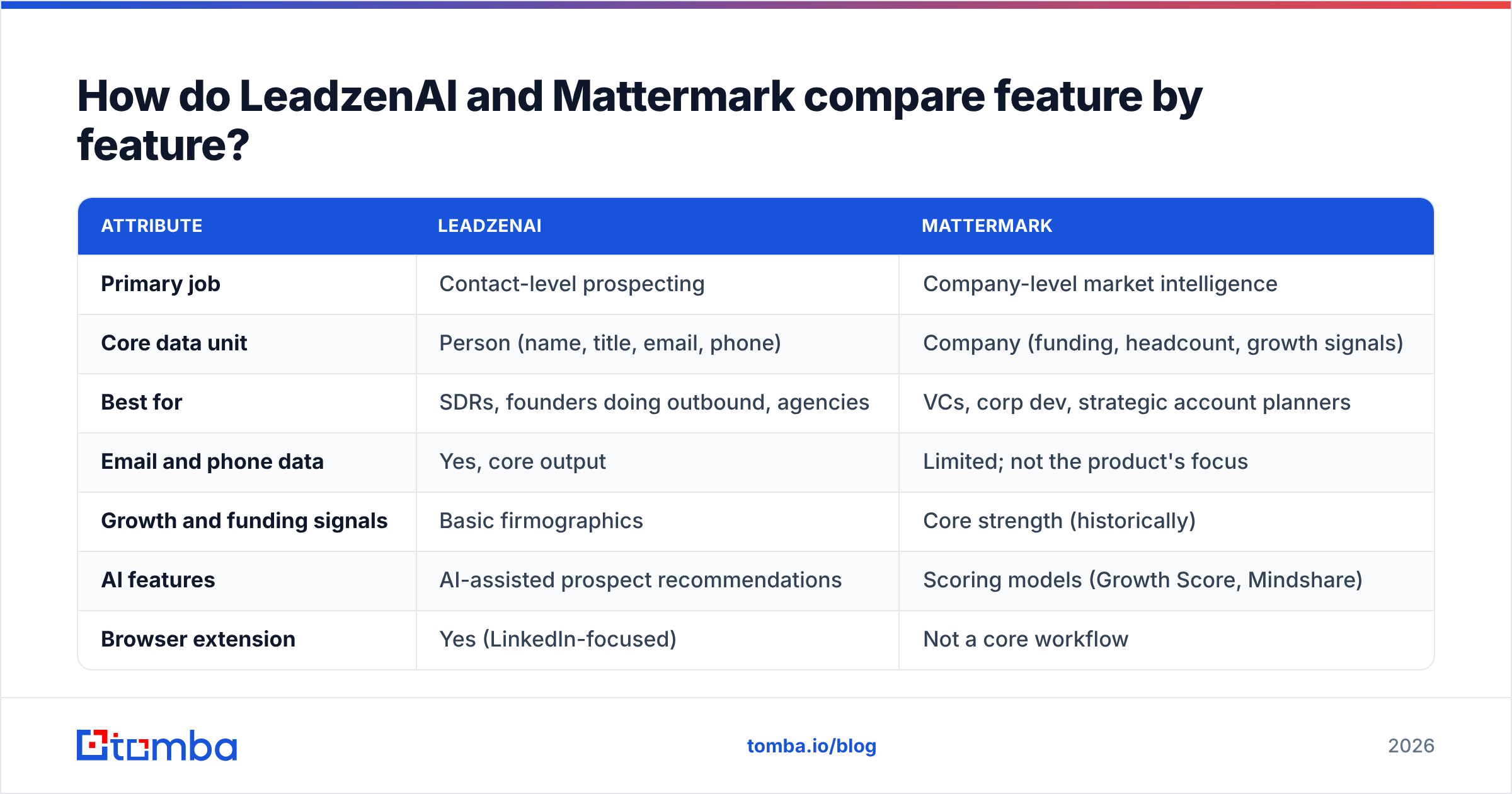
| Attribute | LeadzenAI | Mattermark |
|---|---|---|
| Primary job | Contact-level prospecting | Company-level market intelligence |
| Core data unit | Person (name, title, email, phone) | Company (funding, headcount, growth signals) |
| Best for | SDRs, founders doing outbound, agencies | VCs, corp dev, strategic account planners |
| Email and phone data | Yes, core output | Limited; not the product's focus |
| Growth and funding signals | Basic firmographics | Core strength (historically) |
| AI features | AI-assisted prospect recommendations | Scoring models (Growth Score, Mindshare) |
| Browser extension | Yes (LinkedIn-focused) | Not a core workflow |
| CRM export | CSV and CRM integrations | CSV and API (historically) |
| Pricing model | Credit-based tiers; check leadzen.ai | Quote-based / historically premium |
| Product momentum (2026) | Actively marketed | Low visibility since the 2017 acquisition |
The table points to one thing: these tools overlap much less than their category label suggests. If you're comparing them head to head, you probably haven't decided which problem you're solving yet. Settle that first.
Which problem are you actually solving?#
Before you compare pricing pages, work out which of these jobs sits at the top of your list. Each one points to a different tool.
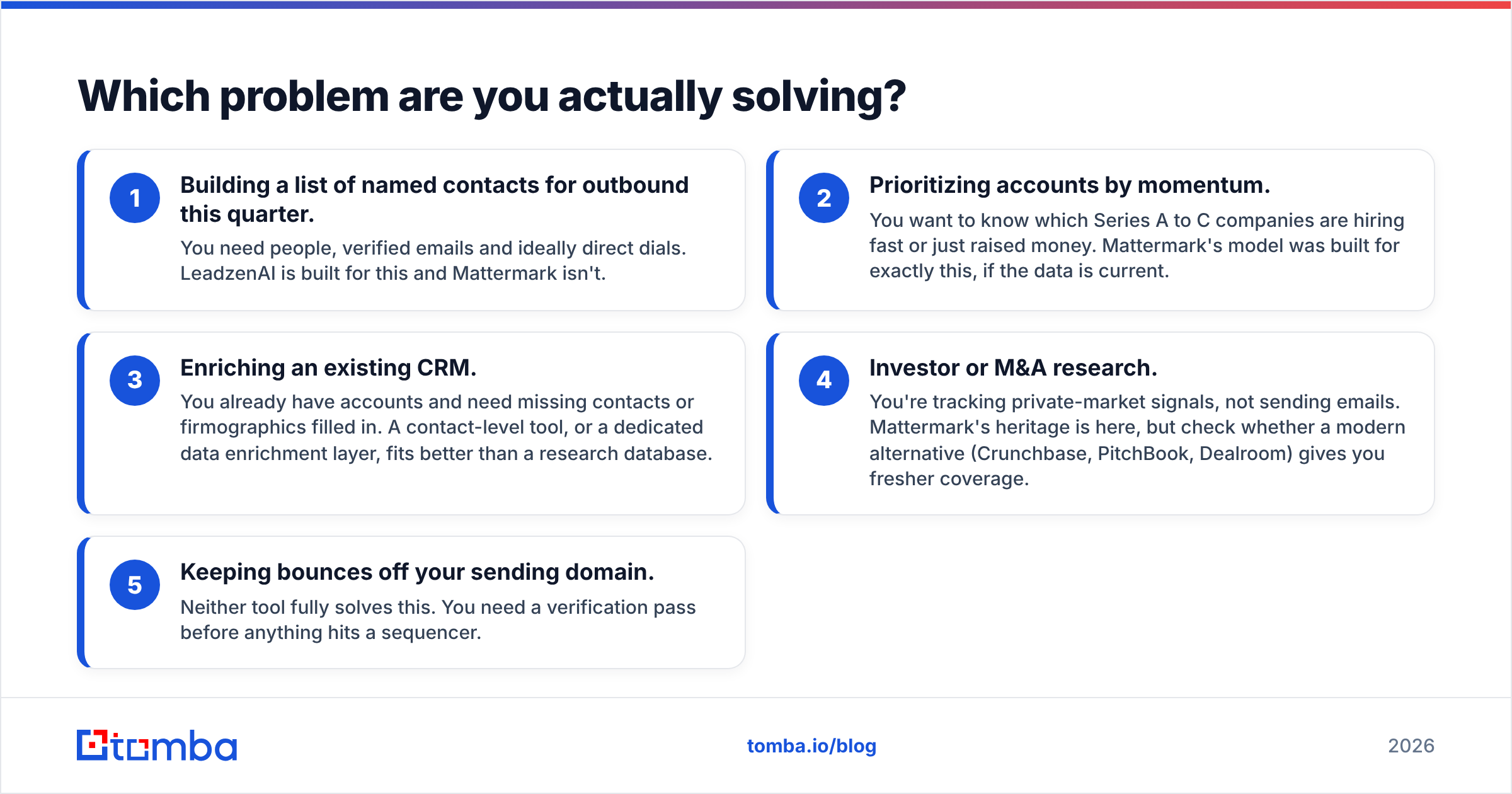
- Building a list of named contacts for outbound this quarter. You need people, verified emails and ideally direct dials. LeadzenAI is built for this and Mattermark isn't.
- Prioritizing accounts by momentum. You want to know which Series A to C companies are hiring fast or just raised money. Mattermark's model was built for exactly this, if the data is current.
- Enriching an existing CRM. You already have accounts and need missing contacts or firmographics filled in. A contact-level tool, or a dedicated data enrichment layer, fits better than a research database.
- Investor or M&A research. You're tracking private-market signals, not sending emails. Mattermark's heritage is here, but check whether a modern alternative (Crunchbase, PitchBook, Dealroom) gives you fresher coverage.
- Keeping bounces off your sending domain. Neither tool fully solves this. You need a verification pass before anything hits a sequencer.
If you picked 1, 3 or 5, keep reading the LeadzenAI sections. If you picked 2 or 4, Mattermark (or its modern competitors) is your shortlist.

Is LeadzenAI good for sales prospecting?#
For its core job, mostly yes, with the usual caveats that come with any AI-assisted contact database.
Where LeadzenAI does well:
- Speed to a usable list. You go from an ICP description to an exportable list of named contacts in minutes, not days of manual LinkedIn research.
- Contact details included. The output includes reachable emails and, where available, phone numbers. That's the part research databases like Mattermark leave out.
- LinkedIn workflow. The browser extension fits the way SDRs already work: open a profile, pull the contact, push it to a list.
- Accessible entry pricing. Credit-based plans let small teams start without an enterprise contract.
Where to be careful:
- Coverage varies by region and segment. Contact databases tend to be strongest in the markets where their user base is densest. Test your own ICP before you buy an annual plan. Run 50 known contacts through it and count how many come back correct.
- AI recommendations aren't qualification. "Similar to your best customers" is a useful starting filter, but a rep still has to check fit.
- Email accuracy needs independent checks. Any database email can go stale when people change jobs. Run exports through an email verifier before sequencing, especially on catch-all domains.
To check real user sentiment, cross-reference reviews on G2, where you can filter by company size and see whether reviewers match your team's profile.
Is Mattermark still worth using in 2026?#
This is the honest question, and the answer depends on what you get when you talk to sales.
What Mattermark did well historically:
- Private-company growth signals from before these became common features. Tracking headcount changes, funding and web traffic in one score was genuinely useful for VCs and startup-focused sales teams.
- Market-mapping workflows. It let you build lists of companies by sector and sort them by momentum, which suits territory planning and account-based strategies.
- API access for teams feeding signals into internal scoring models.
What to verify before you buy:
- Data freshness. Growth signals lose value quickly. A headcount trend from 18 months ago can send you after companies that have since cut staff. Ask for a sample export with timestamps.
- Product roadmap. Since the FullContact acquisition, Mattermark has had very little public visibility. Ask directly what's being maintained, and check recent reviews.
- Contact data. If you expect Mattermark to hand you emails, you'll be disappointed. It was never a contact-finder, so plan for a separate email finder step.
If your use case is "find fast-growing startups," Mattermark may still help. But in 2026 you should benchmark it against newer company-intelligence platforms that update more often and publish their pricing.
How does pricing compare between LeadzenAI and Mattermark?#
Neither vendor makes this easy, so here's how to think about it structurally instead of guessing numbers.
LeadzenAI uses tiered, credit-based plans. The questions to ask:
- How many credits does one contact with email cost, versus one with a phone number?
- Do unused credits roll over?
- Are there per-seat charges on top of credits?
- Is there a free trial long enough to test your actual ICP?
Mattermark has historically priced like a research tool: quote-based and aimed at investors and larger sales organizations. The questions to ask:
- Is pricing per seat or per company record?
- Is API access a separate line item?
- How often is the dataset refreshed, and is that in the contract?
- What happens to exports if you cancel?
One pattern holds across the category. Research databases cost more per seat. Contact databases cost more per record. A two-person outbound team will usually spend less on a contact-first tool. A strategy team of the same size might get more value per dollar from a research tool, because they need fewer records but deeper signals.
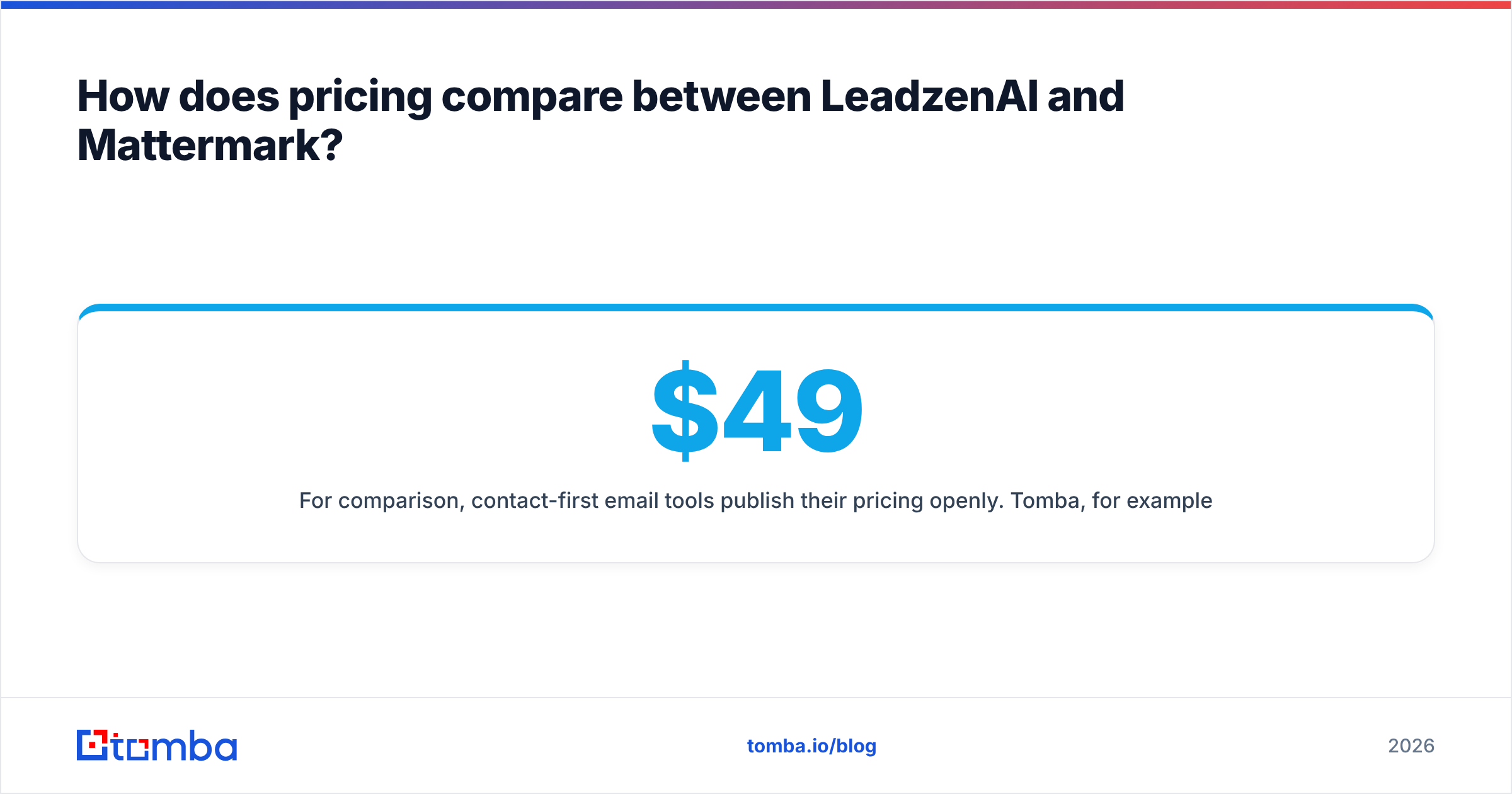
For comparison, contact-first email tools publish their pricing openly. Tomba, for example, starts with a free tier of 25 searches per month, then Starter at $49/mo, Growth at $99/mo and Pro at $249/mo. You can check the full Tomba pricing breakdown to benchmark against whatever quotes you receive.
What does a realistic stack look like for each team type?#
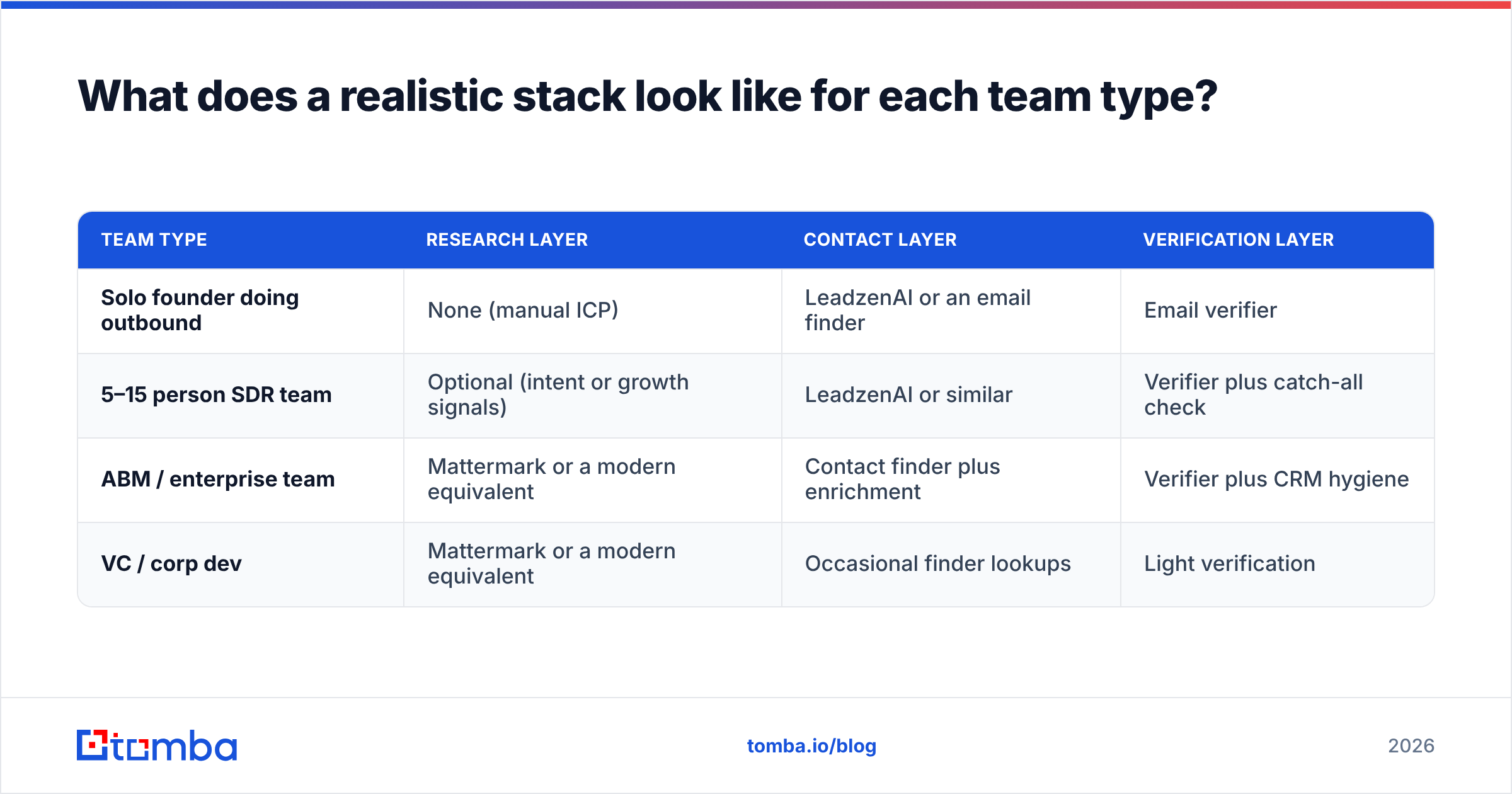
Most teams don't choose one tool. They put two or three together. Here are three setups we see often.
| Team type | Research layer | Contact layer | Verification layer |
|---|---|---|---|
| Solo founder doing outbound | None (manual ICP) | LeadzenAI or an email finder | Email verifier |
| 5–15 person SDR team | Optional (intent or growth signals) | LeadzenAI or similar | Verifier plus catch-all check |
| ABM / enterprise team | Mattermark or a modern equivalent | Contact finder plus enrichment | Verifier plus CRM hygiene |
| VC / corp dev | Mattermark or a modern equivalent | Occasional finder lookups | Light verification |
The biggest mistake here is making a research tool do contact work, or the reverse. Mattermark won't fill your sequencer, and LeadzenAI won't tell you which Series B just doubled its engineering headcount.

LeadzenAI vs Mattermark: which should you choose?#
Here's the verdict, organized by who you are.
Choose LeadzenAI if:
- Your KPI is meetings booked, not markets mapped.
- You need named contacts with emails and phones, exported to a CRM or sequencer.
- You're a small-to-mid team that wants credit-based pricing instead of an enterprise contract.
- You're comfortable adding a verification step before sending.
Choose Mattermark if:
- Your KPI is picking the right accounts, not reaching them.
- You're doing investor research, market mapping or strategic account planning.
- You've confirmed the data is current and the product is maintained.
- You already have a separate contact-finding workflow.
Choose neither if:
- You mostly need to find the email of a specific person at a specific company. A dedicated email finder is cheaper, faster and usually more accurate for that single job.
- You're mainly trying to fix bounce rates. That's a verification problem, not a database problem.
On balance, LeadzenAI is the more practical buy for most outbound teams in 2026. It solves the job most buyers actually have, which is getting reachable contacts into a pipeline. Mattermark is a specialist research input with a strong history, but its low product visibility since 2017 means you should do real diligence before signing.
How do you test either tool before committing?#
Don't trust a demo. Run a structured two-week trial:
- Build a truth set. Pull 50 contacts or companies you already know well, such as current customers or recent closed-lost deals, where you know the correct data.
- Run them through the tool. Record hits, misses and wrong answers separately. A wrong email is worse than no email.
- Verify independently. For contact tools, run every returned email through a verifier and log how many come back valid, risky or invalid.
- Check freshness. For research tools, look at the timestamps on headcount and funding data. Anything older than six months on a fast-growing company is a warning sign.
- Price it per usable record. Divide the plan cost by the number of correct, usable records, not total records returned.
- Check the workflow fit. Does it export cleanly into your CRM? Does your team actually open it without being reminded?
This process takes a few hours and will tell you more than any comparison article, including this one.
What's the bottom line on LeadzenAI vs Mattermark?#
LeadzenAI and Mattermark sit next to each other in "B2B data" listings, but they're built for different buyers. LeadzenAI is a prospecting tool that hands you people to contact. Mattermark is a company-intelligence tool that historically told you which private companies were gaining momentum. For most sales teams running outbound in 2026, the contact-first approach delivers more pipeline per dollar, as long as you verify every email before it reaches a sequencer.
If the step you're really missing is reliable contact data (the right person's professional email, found and checked before you hit send), try the Tomba Email Finder. Search by name and company, domain, or LinkedIn profile, get a confidence score on every result, and start on the free tier with 25 searches a month before you pay for anything. It works alongside a research tool like Mattermark or a prospecting database like LeadzenAI.
Related guides#
// get started
Find, verify and enrich your first contacts today
Start on the free plan with 25 searches a month, then scale when your team is ready.
Free plan · No credit card required · GDPR & CCPA
// about the author