Leadzenai vs Pitchbox: Lead Data vs Outreach Platform Compared
Leadzenai and Pitchbox both get mentioned in outbound conversations, but they solve different problems. Here is how they compare on data, outreach, pricing and fit, and when you need both or neither.
TL;DR
- Leadzenai is a B2B lead-data platform. It finds decision-makers and gives you their emails and phone numbers. It is strongest for SDR teams selling into India and APAC.
- Pitchbox is an outreach and relationship CRM for SEO link building, digital PR and influencer campaigns. It is not a sales-contact database.
- Pricing works differently. Pitchbox publishes seat- and volume-based plans that start around $165/mo. Third-party directories list Leadzenai plans from roughly $133/mo, and larger editions are quoted through sales.
- Pick Leadzenai if you need people to call and email for pipeline. Pick Pitchbox if you need to pitch editors, bloggers and site owners at scale.
- Neither tool gets you verified emails for an arbitrary list on its own. Most teams add a dedicated email finder and verifier to either one.
Why are people comparing Leadzenai vs Pitchbox at all?#
People search "leadzenai vs pitchbox" because both tools sit loosely under "outreach," and both show up when a growth team is trying to fill a spreadsheet with contacts and send them emails. Past that, they have little in common.
Think of a hardware store and a post office. The hardware store (Leadzenai) sells you the materials, which here means names, titles, emails and phone numbers. The post office (Pitchbox) handles sending, tracking follow-ups and remembering who replied. A lot of buyers compare the two because they need both jobs done and have one budget line.
Before you book demos, get clear on which job you're actually hiring for:
- Pipeline generation. You want decision-makers at target accounts, with direct dials and work emails. That is Leadzenai's category.
- Link building / digital PR. You want to find websites, identify the editor or author, and run personalised pitch campaigns with follow-ups and reporting. That is Pitchbox's category.
If you're a B2B SaaS founder doing both (outbound sales plus content-led SEO), you may end up with two tools. If you only do one of them, this comparison should settle quickly.
What is Leadzenai?#
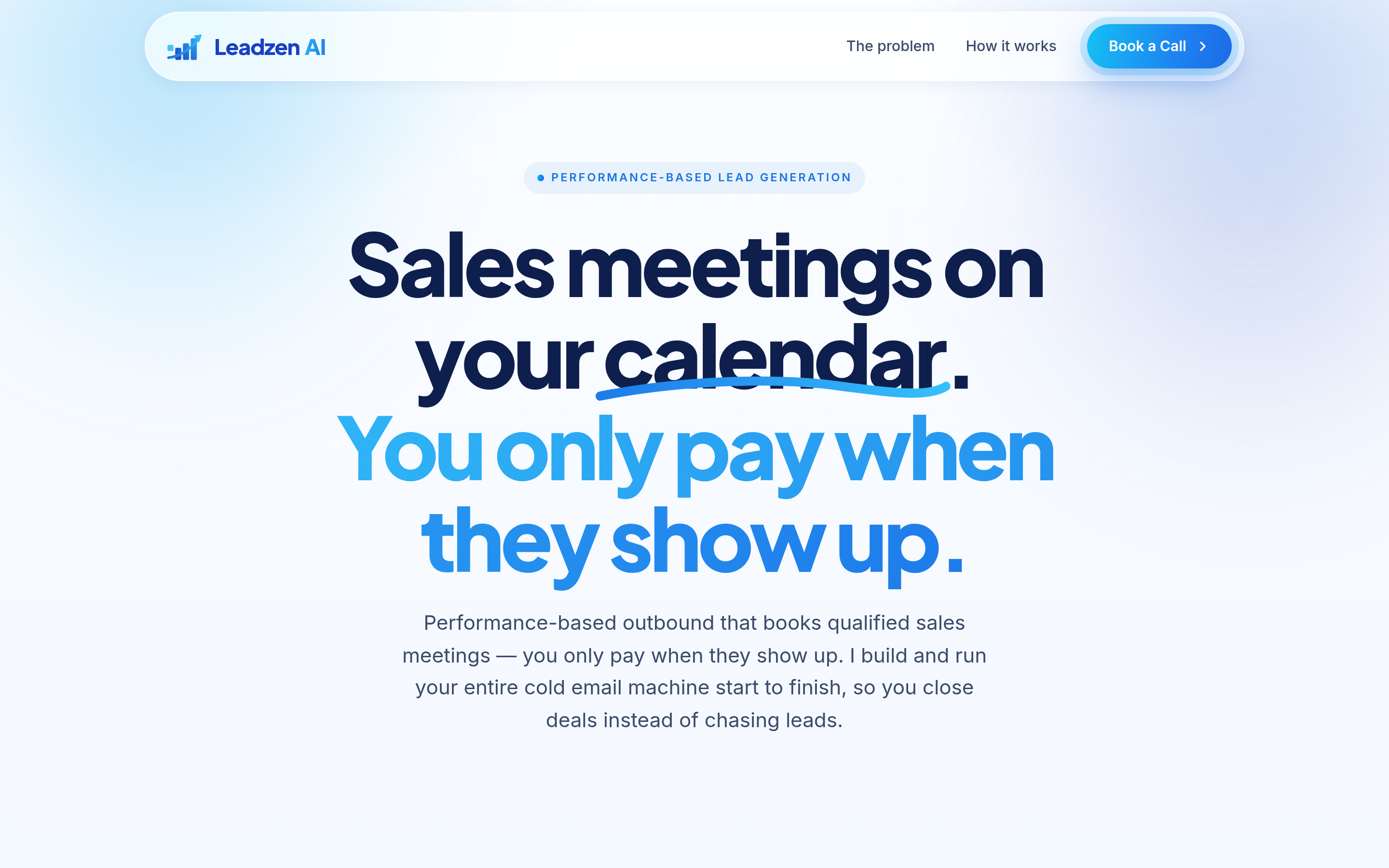
Leadzen.ai is an AI-driven B2B lead-generation platform aimed at startups and SMEs. Its home market is India, and it positions itself around the productivity problems of Indian SDR teams. It pulls company data from real-time web crawling and Indian corporate registry (MCA) data, and it offers contact details for people at those companies.
Core capabilities:
- Prospect search with intelligent filters. Filter by industry, location, company size, designation and more.
- Contact data. Emails, phone numbers and company information for decision-makers.
- Bulk search. Upload or build lists and enrich them in one pass.
- LinkedIn and Chrome extensions. Pull contact data while you browse profiles.
- Trending leads. Feeds of recently funded companies and active angel investors, which work as a timing signal.
- Native outreach. The vendor promotes outreach across email, LinkedIn, WhatsApp and calling. WhatsApp matters a lot in Indian B2B.
The main thing to know is that Leadzenai sells data first and workflow second. Its value depends on how good its contact records are for your specific ICP.
What is Pitchbox?#
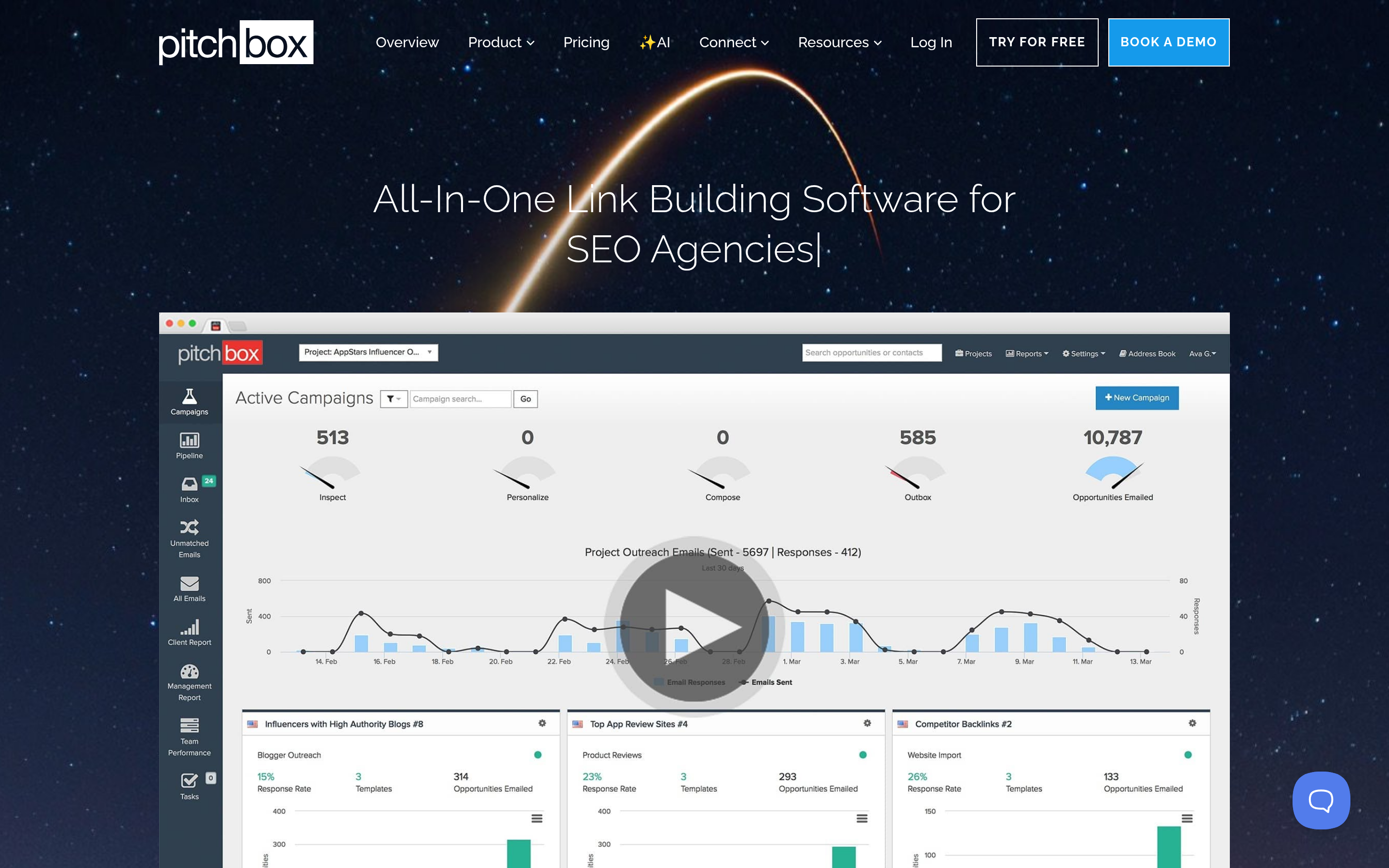
Pitchbox is an outreach platform built for SEO agencies, in-house SEO teams, and PR and content marketers. It has been a staple of the link-building market for years and shows up consistently in the outreach categories on review sites like Capterra.
Core capabilities:
- Opportunity discovery. Run keyword-based searches to surface blogs, publishers and resource pages you could pitch.
- SEO metrics integration. Connects to Ahrefs, Semrush and Moz so you can qualify prospects by authority and traffic. You pay for those subscriptions separately.
- Contact discovery on websites. Finds the site owner, editor or author contact for the domains you've shortlisted.
- Personalised campaigns. Templates, merge fields, AI personalisation on higher tiers, and automated follow-ups.
- Relationship CRM. Tracks every conversation with a publisher so your team doesn't pitch the same editor twice.
- Agency features. Multiple workspaces, white-label reports and team permissions.
Pitchbox is workflow first and data second. Its contact discovery is tuned to websites and publishers, not to "VP of Finance at a 500-person logistics company."

How do Leadzenai and Pitchbox compare feature by feature?#
The table below lines up the attributes buyers ask about most. Pricing reflects public listings and third-party directories at the time of writing. Check each vendor's page before you commit, because both have changed plan structures in the past.
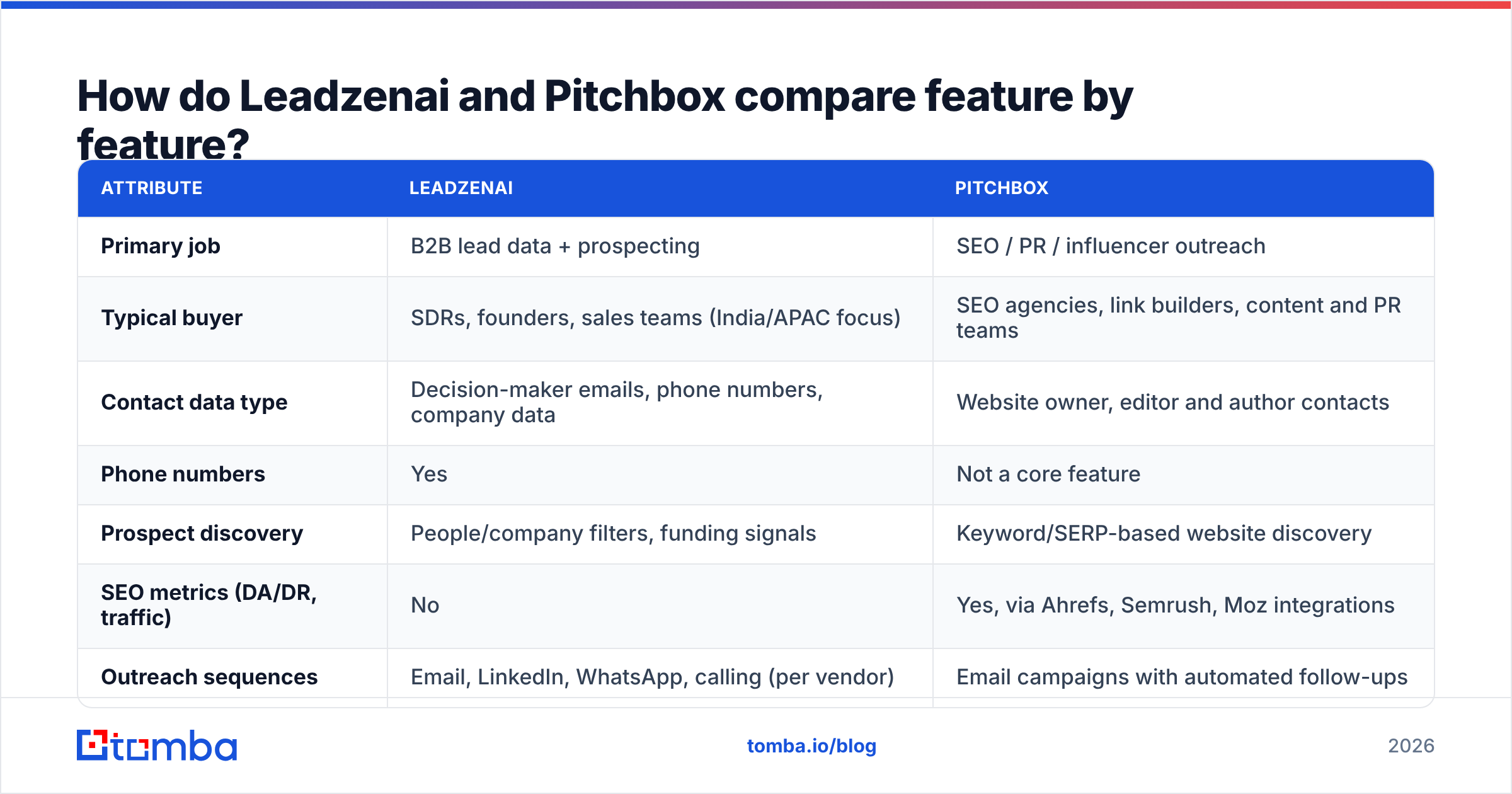
| Attribute | Leadzenai | Pitchbox |
|---|---|---|
| Primary job | B2B lead data + prospecting | SEO / PR / influencer outreach |
| Typical buyer | SDRs, founders, sales teams (India/APAC focus) | SEO agencies, link builders, content and PR teams |
| Contact data type | Decision-maker emails, phone numbers, company data | Website owner, editor and author contacts |
| Phone numbers | Yes | Not a core feature |
| Prospect discovery | People/company filters, funding signals | Keyword/SERP-based website discovery |
| SEO metrics (DA/DR, traffic) | No | Yes, via Ahrefs, Semrush, Moz integrations |
| Outreach sequences | Email, LinkedIn, WhatsApp, calling (per vendor) | Email campaigns with automated follow-ups |
| Relationship CRM | Basic lead management | Strong: per-publisher history, deduplication |
| Browser extension | Yes (Chrome + LinkedIn) | Yes, for on-page prospecting |
| Starting price | Around $133/mo reported by directories; custom quotes above | Pro around $165/mo (2 users, 2,000 emails/mo) |
| Upper tiers | Enterprise editions, quoted by sales | Advanced around $420/mo; Scale around $675/mo; Enterprise custom |
| Free option | Free trial, limited features | Free trial, no free plan |
| Annual discount | Varies by quote | Up to ~30% vs monthly |
What stands out in that table?#
- Only Leadzenai gives you phone numbers. If calling is part of your motion, that decides it.
- Only Pitchbox understands SEO metrics. Pitching a DR 15 blog and a DR 80 publication are different jobs, and Pitchbox is built to help you tell them apart.
- Pitchbox is much stronger on relationship memory. Agencies running 20 client campaigns need to know that someone on the team already pitched that editor last month.
- Leadzenai is much stronger on account-level targeting. Firmographic filters and funding signals are sales tools, and Pitchbox doesn't try to compete there.
How does Leadzenai pricing compare to Pitchbox pricing?#
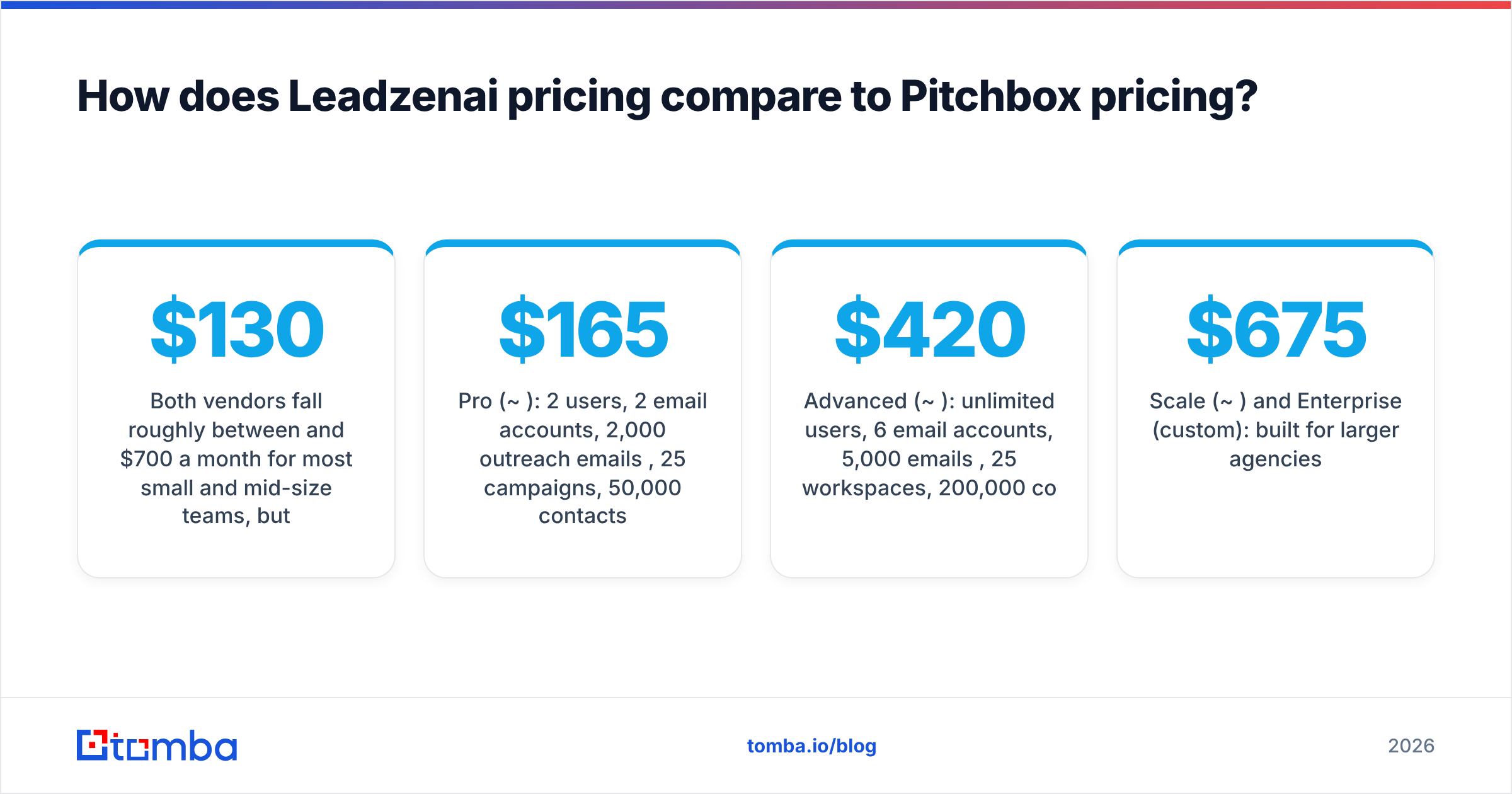
Both vendors fall roughly between $130 and $700 a month for most small and mid-size teams, but they meter completely different things.
Pitchbox prices on users, connected mailboxes, emails per month, campaigns, contacts and workspaces. According to its pricing page and recent third-party breakdowns, the tiers look like this:
- Pro (~$165/mo): 2 users, 2 email accounts, 2,000 outreach emails/month, 25 campaigns, 50,000 contacts, 1 workspace.
- Advanced (~$420/mo): unlimited users, 6 email accounts, 5,000 emails/month, 25 workspaces, 200,000 contacts, bulk AI personalisation, white-label reports.
- Scale (~$675/mo) and Enterprise (custom): built for larger agencies.
The hidden cost to watch is the SEO data. Pitchbox gets far more useful with an Ahrefs or Semrush subscription connected, and those cost extra.
Leadzenai pricing is less transparent. Directory listings put public editions somewhere between about $133/mo and several thousand dollars a month at the top end. Pricing is usually credit- or usage-based, and larger contracts are custom. Many Indian buyers are quoted in INR. The hidden cost here is credit burn. If a large share of the records you unlock turn out outdated or unreachable, your effective cost per usable lead goes up quickly.
A practical way to compare them: work out cost per outcome, not cost per seat.
- For Pitchbox, the outcome is cost per link or placement won.
- For Leadzenai, the outcome is cost per verified, reachable decision-maker.
Those two numbers answer different questions, which is one more reason this isn't really an either/or decision.
Which one has better data quality?#
This is where both tools need scrutiny, and where most buyers under-test.
Leadzenai's data is strongest where its sources are strongest: Indian companies, which the MCA registry data backs up, and fast-moving startup ecosystems its crawlers cover well. Coverage of mid-market companies in North America and Western Europe is thinner than at global-first vendors, based on user reviews and third-party comparisons. If most of your ICP is outside India, run a sample of 100 of your actual target accounts through the trial before you sign.
Pitchbox's contact discovery is built for websites. It's good at finding the right person to pitch on a given blog or publication. It isn't meant to find the Head of Procurement at a manufacturing firm, and it won't return direct dials.
In both cases, verify before you send. Bounces hurt your sender reputation whether you're pitching guest posts or booking demos. Run every list through an email verifier before it enters a sequence. That matters most for catch-all domains, where a "valid" SMTP response doesn't guarantee a real inbox.
Which tool is better for outreach workflows?#
Pitchbox wins on email outreach depth. It was built around the pitching workflow: discover, qualify, personalise, send, follow up, track the relationship, report to the client. The follow-up logic, the per-publisher history and the agency reporting come from years of feedback from link builders. If you're running outreach for multiple clients, those features save hours every week.
Leadzenai wins on channel breadth for sales. Email, LinkedIn, WhatsApp and calling from one platform fits how B2B selling works in India, where WhatsApp is often a primary business channel. It isn't trying to be a full sequencing engine on the level of dedicated sales engagement platforms, though. Larger teams often export Leadzenai data into a separate sequencer or their CRM.
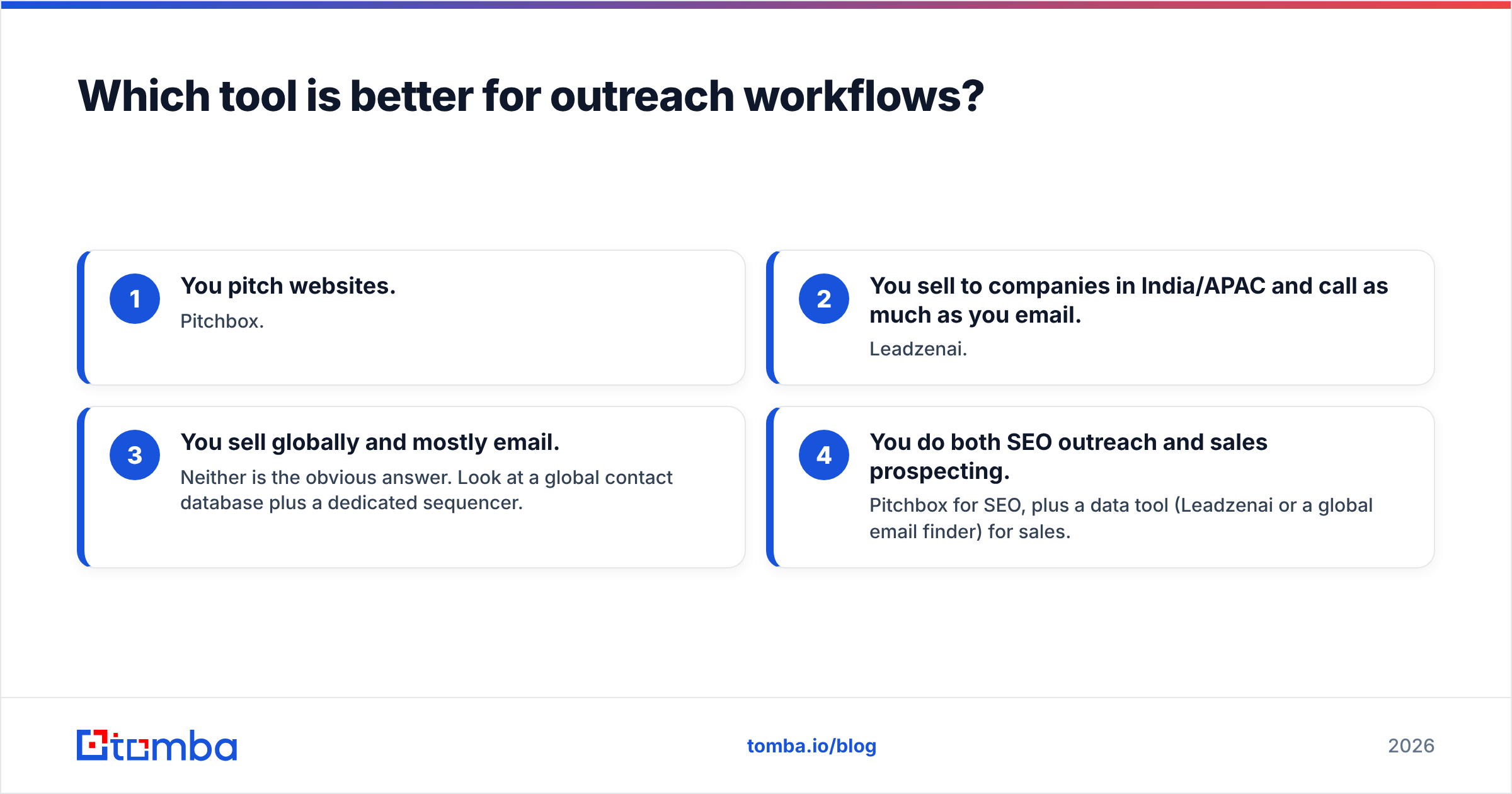
Here's a simple decision rule:
- You pitch websites. Pitchbox.
- You sell to companies in India/APAC and call as much as you email. Leadzenai.
- You sell globally and mostly email. Neither is the obvious answer. Look at a global contact database plus a dedicated sequencer.
- You do both SEO outreach and sales prospecting. Pitchbox for SEO, plus a data tool (Leadzenai or a global email finder) for sales.

What are the pros and cons of each tool?#
Leadzenai pros#
- Emails and phone numbers in one place, which suits call-heavy motions.
- Strong India coverage, backed by registry-grade company data.
- Funding and investor signals that help you time outreach.
- Multi-channel outreach, including WhatsApp.
- Chrome and LinkedIn extensions for in-context prospecting.
Leadzenai cons#
- Pricing isn't very transparent. Expect a sales conversation.
- Coverage outside India is inconsistent. Test with your own ICP.
- Its sequencing is lighter than dedicated sales engagement tools.
Pitchbox pros#
- Purpose-built for link building and digital PR, with a mature workflow.
- SEO-metric qualification through Ahrefs, Semrush and Moz.
- Relationship CRM that prevents duplicate pitches across a team.
- Agency-ready, with workspaces and white-label reports.
- Clear, published pricing tiers.
Pitchbox cons#
- Not a sales contact database. No direct dials, and weak firmographic targeting.
- The entry tier limits users and mailboxes. Agencies usually outgrow Pro quickly.
- SEO tool subscriptions add to the real cost.
- Setup and onboarding take time. Reviews regularly mention a learning curve.
Where does an email finder fit next to Leadzenai or Pitchbox?#
Both tools leave the same gap: finding and verifying a specific person's work email when all you have is a name and a company. Pitchbox users hit it when the author of a target article isn't listed on the site. Leadzenai users hit it when a record is missing, stale or outside the database's coverage.
A dedicated email finder fills that gap without replacing either platform. You feed it a name and a domain, or a whole domain, and it returns the most likely address along with a confidence signal and the public sources it was found on. Tomba's domain search works especially well alongside Pitchbox. Point it at a publisher's domain and you get every public email tied to it, so you can pick the editor instead of guessing at info@.
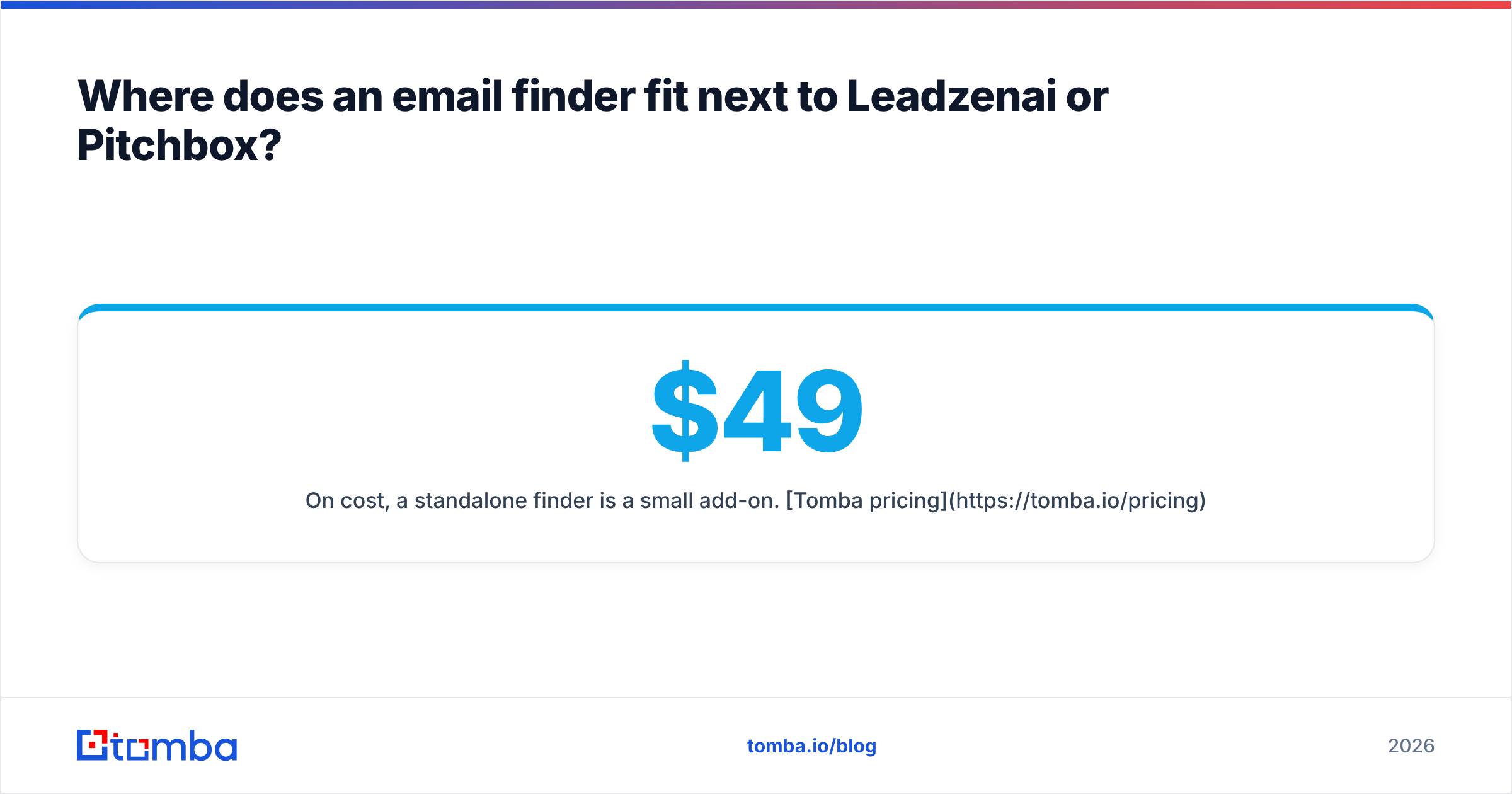
On cost, a standalone finder is a small add-on. Tomba pricing starts with a free tier of 25 searches a month, then Starter at $49/mo, Growth at $99/mo and Pro at $249/mo, with Enterprise quoted separately. That's well below either platform's entry price, and it covers the "one missing contact" problem that otherwise eats into your campaign time.
So, Leadzenai vs Pitchbox: which should you choose?#
Base the choice on the job you need done, not on which tool has more features.
- Choose Leadzenai if you're an SDR team or founder generating sales pipeline, especially into Indian and APAC accounts, and you need phone numbers alongside emails.
- Choose Pitchbox if you're an SEO agency, in-house SEO team or PR function that pitches websites for links, mentions and placements, and you need a relationship CRM that scales across clients.
- Choose both only if you run both motions. Keep them separate: Pitchbox for publishers, a data tool for buyers.
Whichever you choose, run a structured trial. Take 100 real targets and track reachability, bounce rate and reply rate. Then work out cost per outcome. That tells you more than any feature grid, this one included.
Ready to fill the contact gaps either tool leaves?#
Whether you're pitching editors through Pitchbox or building pipeline with Leadzenai, you'll still hit missing and unverified emails. Tomba Email Finder finds professional email addresses by name, domain or company, shows the public sources behind each result, and pairs with built-in verification so your campaigns don't bounce. Start on the free plan with 25 searches a month and test it on your hardest-to-reach contacts before you add another seat to your stack.
Related guides#
// get started
Find, verify and enrich your first contacts today
Start on the free plan with 25 searches a month, then scale when your team is ready.
Free plan · No credit card required · GDPR & CCPA
// about the author