LeadzenAI vs PlusVibe: Data Platform or Cold Email Engine in 2026?
LeadzenAI finds the people. PlusVibe sends the emails. Here's where each tool fits in an outbound stack, what each one really costs, and when you need both of them or neither.
TL;DR
- LeadzenAI and PlusVibe solve different problems. LeadzenAI is a B2B lead discovery and enrichment platform, with the strongest coverage in India. PlusVibe (the rebrand of Pipl.ai) is a cold email sending and deliverability platform.
- PlusVibe is cheaper to start with. Paid plans begin around $37/mo, and there's a 14-day trial. Third-party listings put LeadzenAI's Standard plan at about $133/mo, but its public pricing is inconsistent, so expect to talk to sales.
- Pick LeadzenAI if your problem is finding people, especially Indian decision-makers with phone numbers. Pick PlusVibe if you already have a list and need to send at volume without landing in spam.
- Most outbound teams need a data layer and a sending layer. The real question is whether LeadzenAI's data or a lighter email finder should feed PlusVibe.
- If your market is global and you mostly need verified work emails, a dedicated finder like Tomba ($49/mo Starter) plus PlusVibe usually costs less than LeadzenAI alone.
What is the real difference between LeadzenAI and PlusVibe?#
People search "LeadzenAI vs PlusVibe" as if the two tools compete for the same budget line. Mostly they don't. They sit at opposite ends of an outbound pipeline.
LeadzenAI (leadzen.ai) is a lead discovery and contact enrichment platform. You describe your ideal customer with filters or natural-language prompts. It returns prospects with emails, phone numbers and company data. A Chrome extension shows contact details and AI-generated buyer notes while you browse LinkedIn. It was built with Indian sales teams in mind, and that shows in its database coverage and in its WhatsApp and calling features.
PlusVibe (plusvibe.ai) is a cold email platform. You connect mailboxes, warm them up, write multi-step sequences, rotate inboxes and handle replies in one unified inbox. It has some light enrichment built in (email finding, verification, website and LinkedIn scraping on a monthly credit allowance), but that isn't the main product. The main product is getting your emails into the inbox.
Put simply, LeadzenAI tells you who to contact, and PlusVibe decides how, when and from which mailbox you contact them.
That matters because a team that buys the wrong one will feel it within a week. If you buy PlusVibe with no list, you have a well-tuned sending engine and nothing to send it. If you buy LeadzenAI with no sending setup, you have a spreadsheet of phone numbers and no scalable way to email them.
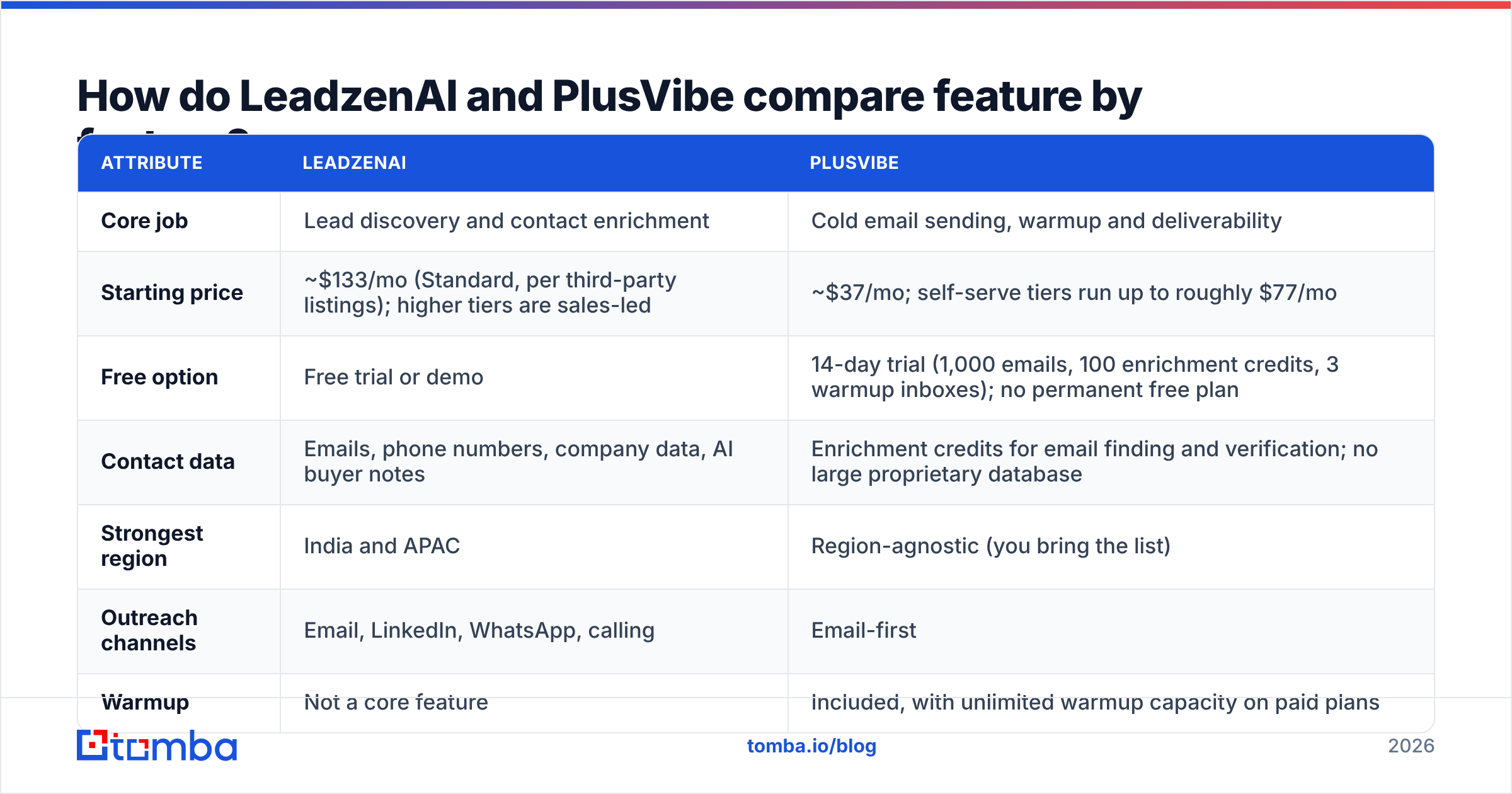
How do LeadzenAI and PlusVibe compare feature by feature?#
Here is the head-to-head. Pricing is based on public listings and review sites as of 2026. Both vendors change plans often, so check the live pricing pages before you commit.
| Attribute | LeadzenAI | PlusVibe |
|---|---|---|
| Core job | Lead discovery and contact enrichment | Cold email sending, warmup and deliverability |
| Starting price | ~$133/mo (Standard, per third-party listings); higher tiers are sales-led | ~$37/mo; self-serve tiers run up to roughly $77/mo |
| Free option | Free trial or demo | 14-day trial (1,000 emails, 100 enrichment credits, 3 warmup inboxes); no permanent free plan |
| Contact data | Emails, phone numbers, company data, AI buyer notes | Enrichment credits for email finding and verification; no large proprietary database |
| Strongest region | India and APAC | Region-agnostic (you bring the list) |
| Outreach channels | Email, LinkedIn, WhatsApp, calling | Email-first |
| Warmup | Not a core feature | Included, with unlimited warmup capacity on paid plans |
| Unified inbox | Limited | Yes (Unibox) |
| CRM sync | Export and integrations | Mostly via Zapier or Make (extra cost) |
| Team seats | Varies by plan | Unlimited team members on paid plans |
| Best for | SDR teams that need fresh prospects, especially in India | Agencies and growth teams sending high volume from many mailboxes |
What the table shows: the two tools overlap only a little, in light enrichment and a basic email-sending capability. Each is clearly weaker than the other at the other's main job.

Which parts of an outbound stack does each tool cover?#
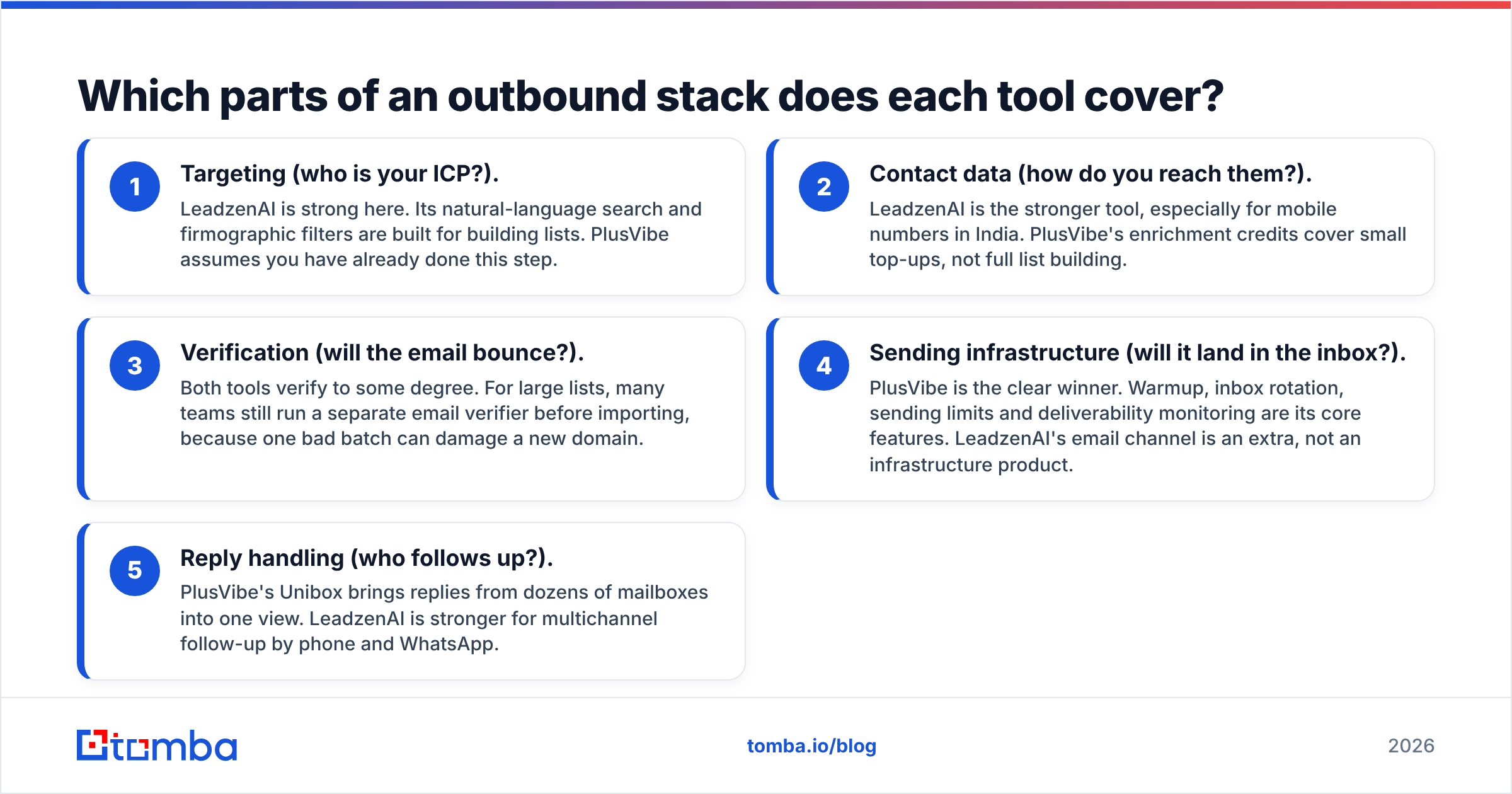
A useful way to think about any outbound stack is the five jobs it has to do. Here is how LeadzenAI and PlusVibe split them:
- Targeting (who is your ICP?). LeadzenAI is strong here. Its natural-language search and firmographic filters are built for building lists. PlusVibe assumes you have already done this step.
- Contact data (how do you reach them?). LeadzenAI is the stronger tool, especially for mobile numbers in India. PlusVibe's enrichment credits cover small top-ups, not full list building.
- Verification (will the email bounce?). Both tools verify to some degree. For large lists, many teams still run a separate email verifier before importing, because one bad batch can damage a new domain.
- Sending infrastructure (will it land in the inbox?). PlusVibe is the clear winner. Warmup, inbox rotation, sending limits and deliverability monitoring are its core features. LeadzenAI's email channel is an extra, not an infrastructure product.
- Reply handling (who follows up?). PlusVibe's Unibox brings replies from dozens of mailboxes into one view. LeadzenAI is stronger for multichannel follow-up by phone and WhatsApp.
If you score one point for each job, LeadzenAI wins 1 and 2 and PlusVibe wins 4 and 5. Neither tool fully covers verification at scale.
Is LeadzenAI better than PlusVibe for finding leads?#
Yes, and by a wide margin. LeadzenAI is a data product and PlusVibe isn't.
The real question is whether LeadzenAI's data suits your market. Its positioning, customer stories and channel mix (WhatsApp, calling) all point to Indian SMB and mid-market sales teams. If you sell to Indian fintechs, IT services firms or D2C brands, a platform built around that market is likely to beat a general Western database on phone coverage and data freshness.
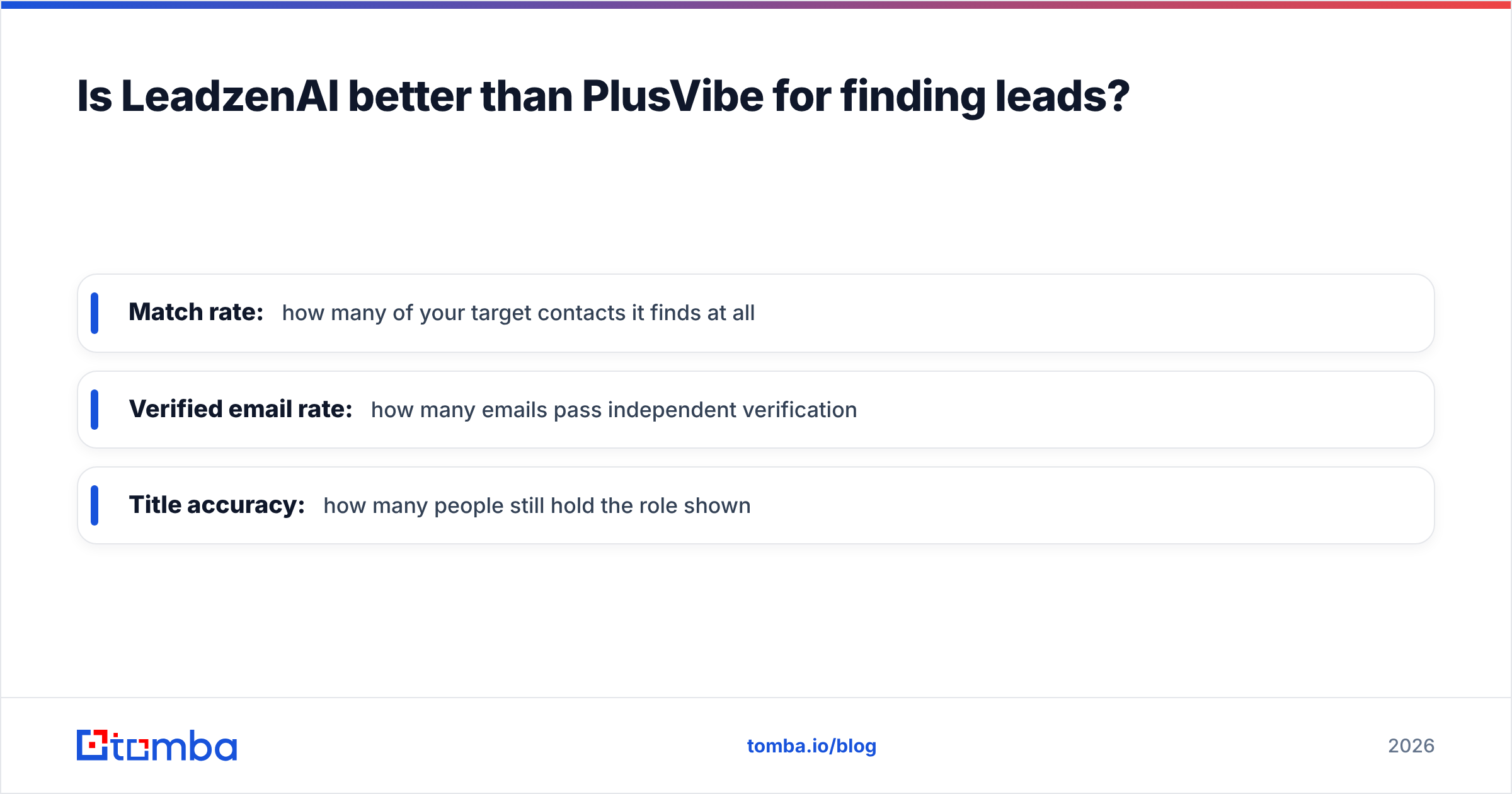
If you sell mainly to North America or Europe, test before you commit. Run 100 of your real target accounts through the trial and measure three things:
- Match rate: how many of your target contacts it finds at all
- Verified email rate: how many emails pass independent verification
- Title accuracy: how many people still hold the role shown
A cheap, sound approach is to compare the same 100 accounts against a domain-based finder. With Tomba's domain search, you can pull every public professional address tied to a company domain and compare the results against LeadzenAI's output. Whichever tool finds more verified contacts for your ICP wins the data slot in your stack.
Also look at how LeadzenAI prices its data. Some sources describe pricing tied to outcomes such as qualified meetings delivered, alongside standard seat plans. Before you sign an annual contract, ask for the exact credit allocation per plan, how credits are used up (per reveal, per export, per phone number), and whether unused credits roll over.
Is PlusVibe better than LeadzenAI for cold email?#
Yes. PlusVibe is purpose-built for high-volume cold email, and LeadzenAI isn't.
PlusVibe's strengths are the parts of cold email most teams underestimate:
- Unlimited warmup on paid plans. Many competitors charge per warmed inbox. PlusVibe includes warmup in the base plan, which matters if you rotate 20+ mailboxes.
- Inbox rotation and sending caps. Spreading volume across many domains and mailboxes keeps each one under the thresholds that trigger spam filtering.
- Unibox. One reply view across every connected mailbox, which agencies running many client campaigns especially need.
- Unlimited seats. Adding SDRs or client stakeholders doesn't raise your bill.
The weaknesses are real, but they're manageable. There's no permanent free plan. Native CRM sync is thin, so most teams route data to HubSpot or Salesforce through Zapier or Make, which adds roughly $20–50/mo depending on volume. And because the built-in enrichment runs on a monthly credit allowance, it isn't meant to replace a real data source.
For context on how cold email tools get rated overall, review aggregators like G2 are worth checking. Filter reviews by company size and region so you read feedback from teams like yours.
How much does each tool really cost?#
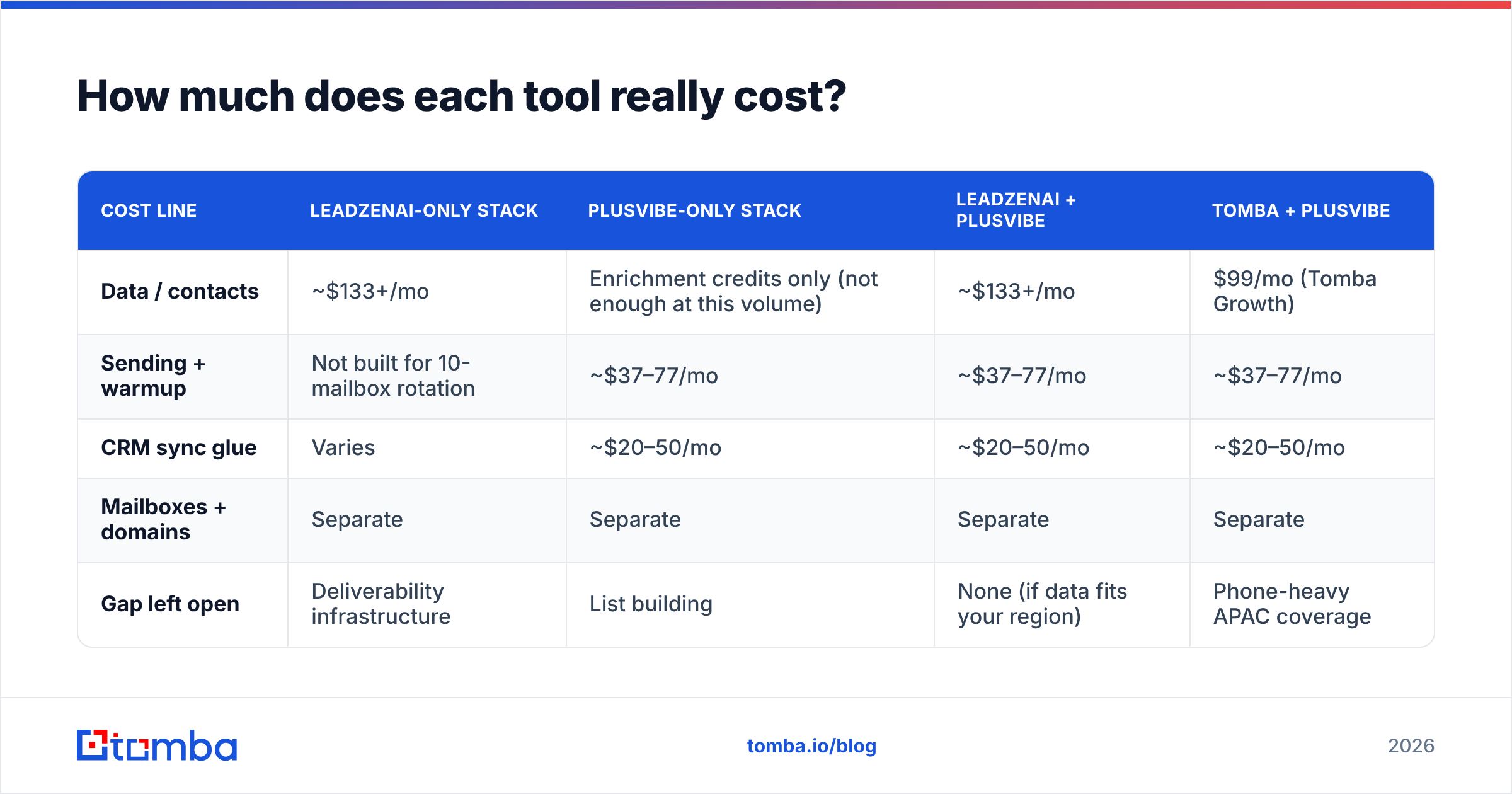
Sticker prices mislead in both directions. Here is a realistic monthly cost for a small outbound team (2 SDRs, ~5,000 new contacts per month, 10 sending mailboxes):
| Cost line | LeadzenAI-only stack | PlusVibe-only stack | LeadzenAI + PlusVibe | Tomba + PlusVibe |
|---|---|---|---|---|
| Data / contacts | ~$133+/mo | Enrichment credits only (not enough at this volume) | ~$133+/mo | $99/mo (Tomba Growth) |
| Sending + warmup | Not built for 10-mailbox rotation | ~$37–77/mo | ~$37–77/mo | ~$37–77/mo |
| CRM sync glue | Varies | ~$20–50/mo | ~$20–50/mo | ~$20–50/mo |
| Mailboxes + domains | Separate | Separate | Separate | Separate |
| Gap left open | Deliverability infrastructure | List building | None (if data fits your region) | Phone-heavy APAC coverage |
The takeaways:
- A PlusVibe-only setup is cheap, but it isn't complete. It works if you already buy lists elsewhere or have an in-house research team.
- A LeadzenAI-only setup leaves you exposed on deliverability. Pushing thousands of cold emails through anything other than a warmed, rotated mailbox pool is how domains get burned.
- LeadzenAI + PlusVibe is the complete India-focused stack. Your data layer is region-native, and your sending layer is built for volume.
- A dedicated email finder + PlusVibe is the leaner global stack. If you mostly need verified work emails rather than mobile numbers, you pay less for data and get the same sending engine. See Tomba pricing for tier limits.
Who should choose LeadzenAI?#
Choose LeadzenAI if most of these apply:
- Your market is India or broader APAC, and your reps close deals on the phone or WhatsApp, not just by email.
- You don't have a list-building process yet, and you want AI-assisted prospect discovery in one console.
- Your team spends its day inside LinkedIn, and a Chrome extension that shows contact details there would save hours each week.
- Budget isn't your main constraint. You're comfortable with a sales conversation and possibly an annual commitment.
Skip it if your buyers are mainly in the US or EU and email is your only channel. In that case you'd be paying for phone and multichannel features you won't use.
Who should choose PlusVibe?#
Choose PlusVibe if most of these apply:
- You already have contacts, from a data vendor, inbound, events or manual research, and your bottleneck is sending them safely.
- You run many mailboxes, or you're an agency managing campaigns for several clients.
- Deliverability has hurt you before, and you want warmup and rotation included rather than bolted on.
- You want a low, predictable entry price with a real trial.
Skip it if you expect it to replace a data provider. The enrichment credits are for top-ups, not for building lists from scratch.
What goes wrong when teams pick only one?#
The most common failure we see is blaming the sequencer for a data problem.
A team signs up for PlusVibe and imports a scraped or outdated list. Their bounce rate comes in at 8–12%. Warmup can't save a domain that keeps hitting invalid addresses, so inbox placement drops. They conclude that "PlusVibe doesn't work." The real cause is upstream: nobody verified the list.
The opposite failure happens too. A team buys LeadzenAI, exports 3,000 contacts and sends them all from one fresh Google Workspace inbox on day one. The data was fine, but the sending was the problem.
The fix in both cases is the same. Treat data and sending as two separate systems with a verification gate between them. Whichever data source you use (LeadzenAI, Tomba or anything else), verify before import. Keep bounces under 2%. Let the sending platform handle ramp-up and rotation.
So which one wins: LeadzenAI or PlusVibe?#
It depends on which half of the pipeline is broken for you.
- If you have no prospects, LeadzenAI wins, provided your market matches its coverage.
- If you have prospects but your emails land in spam, PlusVibe wins, and it does so at a lower entry price.
- If you're building from zero, don't choose between them. Pair a data source with PlusVibe. For India-focused, phone-heavy selling, that source is LeadzenAI. For global, email-first outbound, a dedicated email finder is usually the cheaper and more accurate option.
Our pick for most global B2B teams reading this: PlusVibe for sending, paired with a dedicated email finder for data. Our pick for Indian SMB and mid-market sales teams: LeadzenAI + PlusVibe.
Where does Tomba fit in this stack?#
If you're building the leaner global stack, Tomba Email Finder covers the data half without the cost of a full sales-intelligence suite. You can find professional emails by name, by company or by entire domain, verify them in the same workflow, and export a clean CSV straight into PlusVibe. You can also sync through Zapier or Make if you prefer. The free tier gives you 25 searches a month to test your own ICP, and paid plans start at $49/mo. Run your top 100 target accounts through Tomba, verify them, then load them into PlusVibe and track your bounce rate. That test shows you in one campaign whether you need a heavier data platform at all.
Related guides#
// get started
Find, verify and enrich your first contacts today
Start on the free plan with 25 searches a month, then scale when your team is ready.
Free plan · No credit card required · GDPR & CCPA
// about the author