LeadzenAI vs Power Almanac: B2B Data Tools Compared for 2026
LeadzenAI and Power Almanac both sell B2B contact data, but to very different buyers. One targets Indian SMB and startup prospects; the other targets US local government decision-makers. Here's how to pick.
- Different markets, different buyers. LeadzenAI is an AI-assisted prospecting platform with its deepest data on Indian companies. Power Almanac is a contact database for US local government decision-makers: cities, counties and townships.
- Pricing models differ a lot. LeadzenAI sells monthly SaaS plans and has a freemium tier. Power Almanac has a free "Power Entry" level and paid annual subscriptions sold in blocks of download credits. G2 lists its entry annual plan at around $5,400.
- Choose by ICP, not by feature list. If you sell to Indian startups and SMEs, LeadzenAI is the better fit. If you sell to US municipalities, Power Almanac wins because of its coverage.
- Neither one replaces a dedicated email finder and verifier for private-sector accounts outside its core niche. That's where a tool like Tomba fills the gaps.
What is the real difference between LeadzenAI and Power Almanac?#
On paper, LeadzenAI and Power Almanac are both "B2B contact databases." In practice they barely compete. When you compare the two, you're really asking which market you sell into.
LeadzenAI (Leadzen.ai) calls itself an AI lead generation platform. It has a web console where you can search for prospects with filters or plain-language queries, a Chrome extension, bulk search, and an outreach layer that covers email, LinkedIn, WhatsApp and calling. Its best-known strength is Indian company data: firmographics, director information and revenue estimates, the kind of regional detail US-centric databases usually don't have. Independent reviews say coverage gets thinner outside India.
Power Almanac is a narrow database. It covers local government decision-makers in the US, including essentially every city, county and township with a population of 1,000 or more. If you sell software, services or equipment to municipal clerks, public works directors, IT managers or finance officers, that's the audience it's built for.
In short, LeadzenAI covers broad private-sector prospecting with an India-first bias. Power Almanac covers a narrow public-sector vertical in depth.
How do LeadzenAI and Power Almanac compare side by side?#
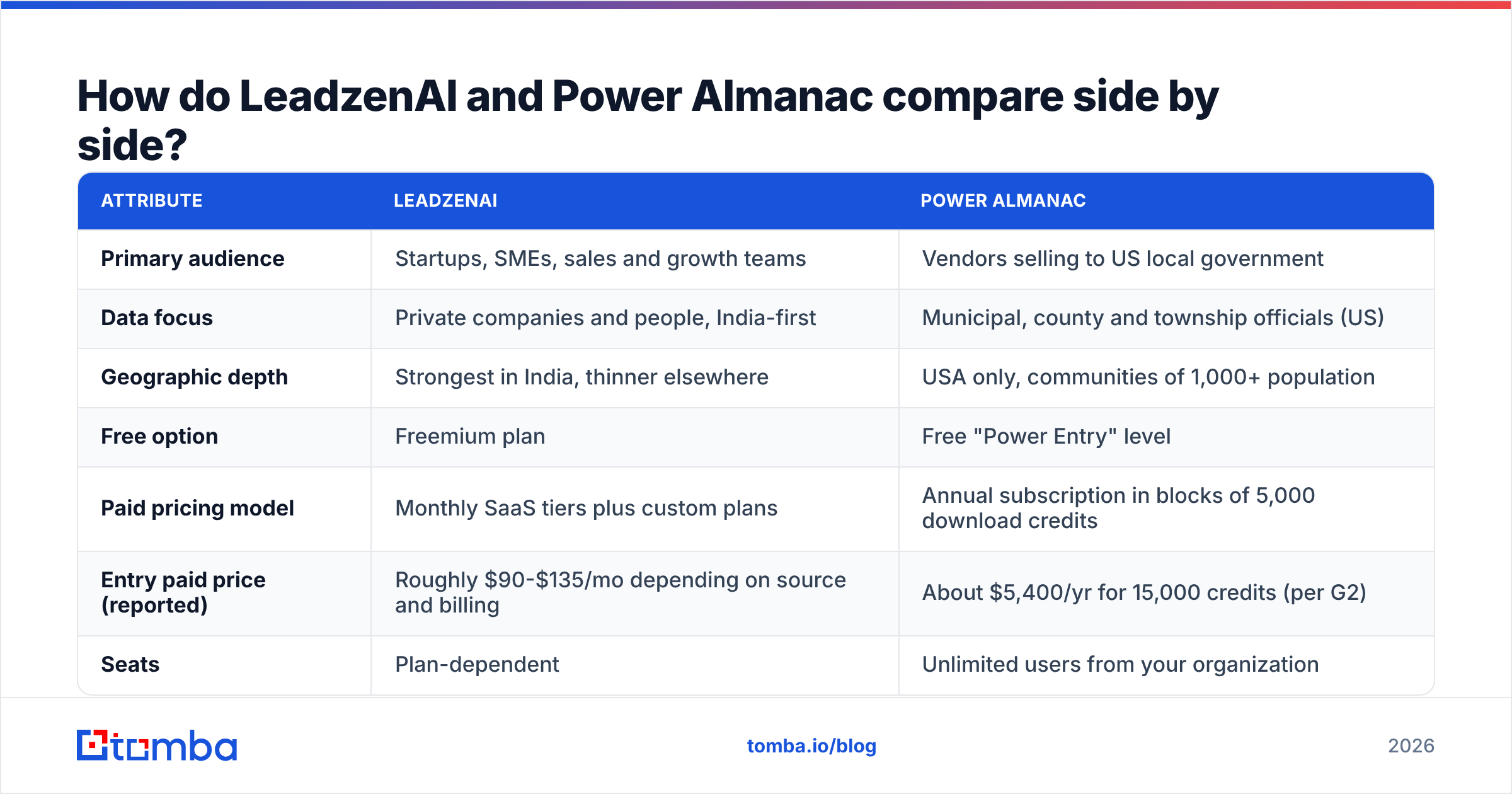
This table compares the attributes that usually decide a purchase. Pricing comes from public listings at the time of writing and changes often, so check each vendor's pricing page before you commit.
| Attribute | LeadzenAI | Power Almanac |
|---|---|---|
| Primary audience | Startups, SMEs, sales and growth teams | Vendors selling to US local government |
| Data focus | Private companies and people, India-first | Municipal, county and township officials (US) |
| Geographic depth | Strongest in India, thinner elsewhere | USA only, communities of 1,000+ population |
| Free option | Freemium plan | Free "Power Entry" level |
| Paid pricing model | Monthly SaaS tiers plus custom plans | Annual subscription in blocks of 5,000 download credits |
| Entry paid price (reported) | Roughly $90-$135/mo depending on source and billing | About $5,400/yr for 15,000 credits (per G2) |
| Seats | Plan-dependent | Unlimited users from your organization |
| Search style | Filters plus natural-language AI search | Filters by jurisdiction, role, population, geography |
| Outreach built in | Yes: email, LinkedIn, WhatsApp, calling | No, it's a data and export tool |
| Browser extension | Yes (Chrome) | No |
| Best for | India-focused outbound, founder-led sales | GovTech and public-sector sales teams |
The biggest structural difference is at the bottom of the table. LeadzenAI tries to be the whole workflow, from search to outreach. Power Almanac does one job: it gives you an accurate list of people who run local governments, and you take the export into your own CRM and sequencer.
Which tool has better data coverage?#
That depends on where your buyers are, because each tool is deep in a different place.
Where LeadzenAI is strong:
- Indian private companies, including recently funded startups and active angel investors highlighted in its "trending leads" feeds
- Regional data points such as director details and revenue estimates
- Multi-source enrichment. The vendor says it draws on more than 100 data points from 500+ sources
Where LeadzenAI is weaker:
- North America, EMEA and APAC outside India, where third-party reviewers report much shallower records
- Public-sector and non-corporate organizations
Where Power Almanac is strong:
- Coverage of US local government. Few commercial databases list the finance director of a 3,000-person township
- Role-based targeting inside public bodies (clerk, manager, public works, IT, police, fire, and so on)
- Organization-wide access, since extra users are free and each gets a credit allowance
Where Power Almanac is weaker:
- Anything outside US local government. There are no private-company prospects, no international data and no federal-agency breadth
- No native outreach, so you'll need a separate sequencer
If you sell to a mixed audience, for example private manufacturers plus the counties that buy from them, you'll probably end up running two data sources whichever you pick.

How does pricing actually work for each tool?#
The pricing models point to very different buying motions.
LeadzenAI pricing#
LeadzenAI uses a familiar SaaS structure: a freemium tier to test search quality, then monthly paid plans and custom enterprise pricing. Third-party listings put the entry paid tier at roughly $90 to $135 per month depending on the edition and billing cycle, and top editions reach into the thousands per month. Some listings also mention pricing tied to qualified meetings delivered on higher-touch plans. Confirm the current structure on the official Leadzen.ai site before you budget.
What that means for you: it's cheap to start and easy to cancel, which suits founders and small SDR teams who want to test a market.
Power Almanac pricing#
Power Almanac sells annual subscriptions in blocks of 5,000 download credits, and the per-credit price drops as volume goes up. According to its G2 comparison listing, the entry annual plan is about $5,400 for 15,000 credits with unlimited users. The free Power Entry level lets any organization look around before upgrading. Current tiers are on the Power Almanac pricing page.
What that means for you: it's a larger upfront commitment. But at 15,000 credits, the entry plan works out to roughly $0.36 per downloaded record, which is reasonable for a niche with no real substitute.
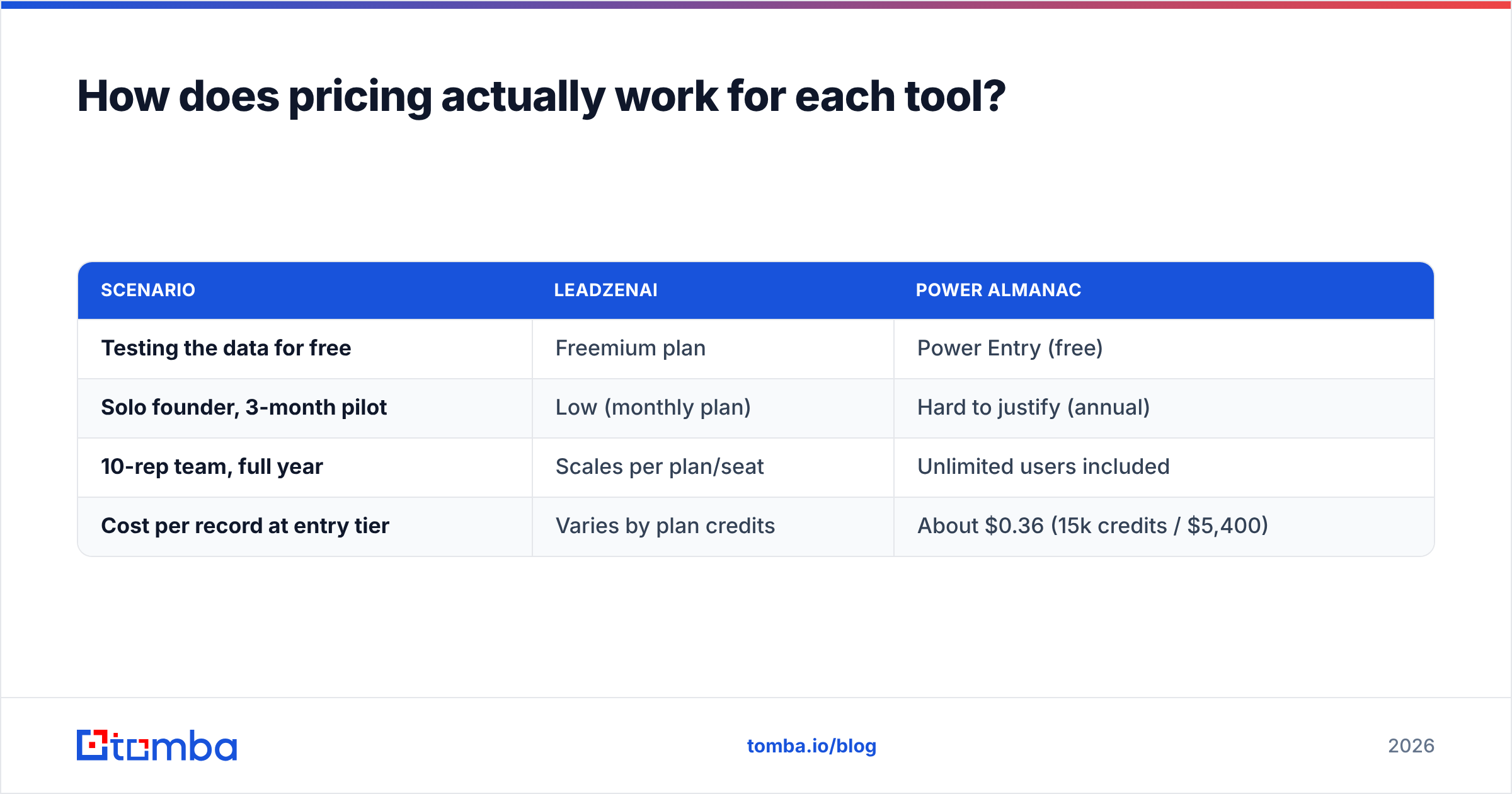
Cost comparison at a glance#
| Scenario | LeadzenAI | Power Almanac |
|---|---|---|
| Testing the data for free | Freemium plan | Power Entry (free) |
| Solo founder, 3-month pilot | Low (monthly plan) | Hard to justify (annual) |
| 10-rep team, full year | Scales per plan/seat | Unlimited users included |
| Cost per record at entry tier | Varies by plan credits | About $0.36 (15k credits / $5,400) |
Is LeadzenAI or Power Almanac easier to use?#
LeadzenAI is designed for reps who want to go from search to outreach in one place. The natural-language search helps if you don't want to build filter logic by hand, since you can type something like "Series A fintechs in Bengaluru hiring sales." The Chrome extension adds prospecting from LinkedIn and company websites. The trade-off is that all-in-one tools tend to have outreach modules that are thinner than dedicated sequencers.
Power Almanac is simpler because its job is simpler. You filter by state, population band, jurisdiction type and role, then download. Its interface is built for list-building rather than daily prospecting. Most teams push the export into their CRM and run sequences from there.
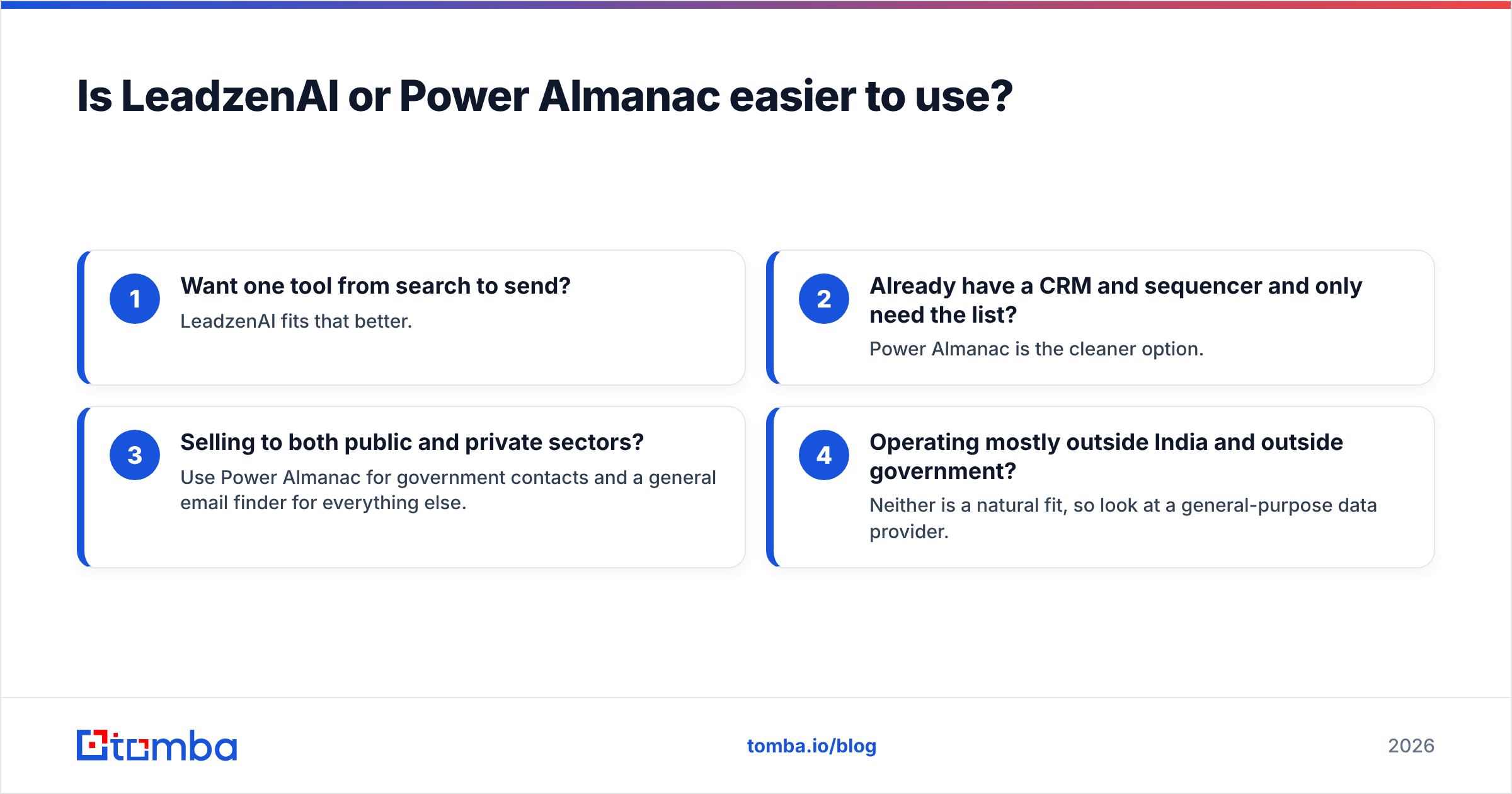
A practical way to decide:
- Want one tool from search to send? LeadzenAI fits that better.
- Already have a CRM and sequencer and only need the list? Power Almanac is the cleaner option.
- Selling to both public and private sectors? Use Power Almanac for government contacts and a general email finder for everything else.
- Operating mostly outside India and outside government? Neither is a natural fit, so look at a general-purpose data provider.
What are the pros and cons of each?#
LeadzenAI#
Pros
- Freemium entry, so you can test before paying
- AI and natural-language search
- Deep Indian company data that Western tools rarely match
- Built-in multichannel outreach (email, LinkedIn, WhatsApp, calling)
- Chrome extension for prospecting while you browse
Cons
- Coverage drops noticeably outside India
- Pricing details vary across public sources, so you'll likely need a sales call for clarity
- All-in-one outreach may not match specialist sequencers
Power Almanac#
Pros
- Very deep coverage of US local government decision-makers
- Unlimited users on paid plans
- Volume discounts on credits
- Free entry level for exploration
Cons
- Annual commitment with a meaningful entry price
- Only covers local government, with no private-sector or international contacts
- No native outreach tooling
Who should choose LeadzenAI?#
Choose LeadzenAI if:
- Your ICP is Indian startups, SMEs or mid-market companies
- You're a founder or small team who wants search and outreach in one subscription
- You sell into companies where WhatsApp and phone matter as much as email
- You want month-to-month flexibility while you validate a market
Who should choose Power Almanac?#
Choose Power Almanac if:
- You sell to US cities, counties, townships or special districts
- You need role-level targeting inside public organizations
- Your team is large enough that unlimited seats save real money
- You already have a CRM and sequencing stack and only need clean data going in

What gaps will you still need to fill?#
Whichever tool you pick, three gaps show up in almost every real pipeline.
1. Contacts outside the tool's core niche. LeadzenAI users targeting US or European accounts, and Power Almanac users who also sell to private contractors, will run into records that don't exist or are too thin to use. A general-purpose email finder that works from a name and company domain covers these without buying a third database.
2. Verification before you send. Every database decays. People change jobs, municipal staff turn over after elections, and startups pivot or shut down. Industry estimates commonly put B2B contact decay at 20-30% a year, so running exports through an email verifier before each campaign protects your bounce rate and sender reputation.
3. Account-level coverage. Sometimes you know the organization but not the right person. A domain search that lists every publicly associated address on a company or city domain helps you map a buying committee that a filtered database export might miss.
These gaps don't mean either tool is bad. Niche databases are meant to be deep rather than broad, so plan to add breadth and verification yourself.
LeadzenAI vs Power Almanac: which one should you pick?#
The decision is simpler than most tool comparisons because the two barely overlap:
- Sell to Indian private-sector companies? Pick LeadzenAI. Its regional depth and built-in outreach are hard to beat for that market.
- Sell to US local government? Pick Power Almanac. Its municipal coverage is what you're paying for.
- Sell to both, or to neither? Don't force either tool outside its niche. Use the specialist where it's strong and a general email finder for the rest.
Most teams do best with one niche database for their core vertical, one flexible finder and verifier for everything else, and a sequencer they already trust.
How can Tomba complement either tool?#
If your pipeline goes beyond Indian SMBs or US municipalities, and most do, Tomba Email Finder covers the rest. Enter a name and company domain and you get a professional address. You can run domain searches to map whole teams, and you can verify every address before it reaches your sequencer. There's a free tier with 25 searches a month for testing, and paid plans start at $49/mo (Starter), with Growth at $99/mo and Pro at $249/mo. See Tomba pricing for full plan details. Use it with LeadzenAI or Power Almanac so your coverage stops at your ICP rather than at a database's boundary.
Related guides#
// get started
Find, verify and enrich your first contacts today
Start on the free plan with 25 searches a month, then scale when your team is ready.
Free plan · No credit card required · GDPR & CCPA
// about the author