Leadzenai vs Pubrio (2026): Pricing, Data Coverage and Our Pick
Leadzen.ai and Pubrio both sell B2B contact data, but they are built for different markets and budgets. We compare pricing, credits, regional coverage, API access and data quality so you can choose the right one.
Leadzenai vs Pubrio comes down to two things: where your buyers are and how much you want to spend. Below we compare pricing, credits, coverage, API access and data quality.
TL;DR
- Pubrio fits teams that want a large self-serve B2B database, a usable free tier, a documented API and strong Asia-Pacific coverage. Paid plans start at about $125/mo for 6,000 credits.
- Leadzen.ai fits teams that sell into India and want AI-assisted profile lookups with mobile numbers. Third-party listings put entry pricing near $133/mo for 300 credits, and there's no free trial.
- On cost per credit, Pubrio is far cheaper. The two companies define a "credit" differently, though, so you have to compare cost per usable contact.
- Neither tool replaces a dedicated verification step. Verify every exported email before it goes into a sequence.
- If you mostly need work emails at a predictable price, a focused email finder such as Tomba (from $49/mo) is often cheaper than either platform.
What are Leadzen.ai and Pubrio?#
Both products sell B2B contact and company data. They were built for different buyers, and that shows in their coverage, pricing and workflow.
Leadzen.ai is an AI-driven lead generation platform with roots in the Indian market. You search for decision-makers or look up a profile, often from LinkedIn through its browser extension. Leadzen then returns contact details: work emails, phone numbers and company context. The goal is to turn a LinkedIn profile or a list of target accounts into contacts you can reach. It puts a lot of weight on direct-dial and mobile numbers. In Indian B2B sales, phone and WhatsApp outreach often matter more than email, so that emphasis makes sense.
Pubrio is a B2B data and sales intelligence platform headquartered in Hong Kong. It runs a searchable database of companies and people. The vendor cites 300M+ records. You can filter by industry, location, headcount, technology and job role. It also offers contact reveals, list exports, a Chrome extension and a developer API with public documentation. Its biggest strength is Asia-Pacific coverage, where Western data vendors tend to be thin.
The short version is that Leadzen resolves individual profiles, while Pubrio is a database you search and filter first and reveal contacts from second.
Leadzenai vs Pubrio: how do they compare side by side?#
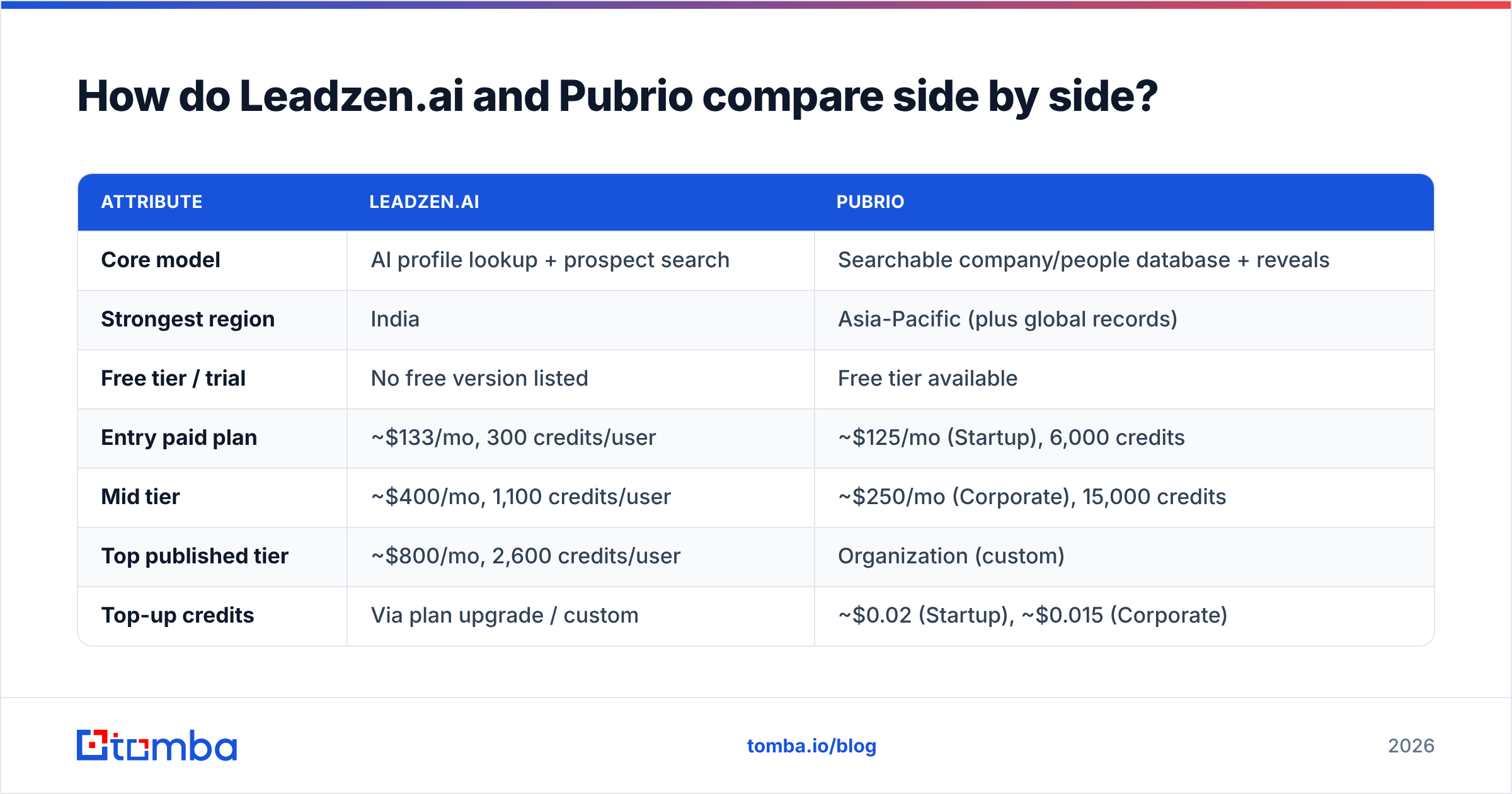
This table summarizes the attributes that usually decide the purchase. Pricing comes from public vendor pages and third-party listings (Capterra, GetApp, TrustRadius) as of 2026. Credit bundles change often, so confirm current numbers with each vendor before you buy.
| Attribute | Leadzen.ai | Pubrio |
|---|---|---|
| Core model | AI profile lookup + prospect search | Searchable company/people database + reveals |
| Strongest region | India | Asia-Pacific (plus global records) |
| Free tier / trial | No free version listed | Free tier available |
| Entry paid plan | ~$133/mo, 300 credits/user | ~$125/mo (Startup), 6,000 credits |
| Mid tier | ~$400/mo, 1,100 credits/user | ~$250/mo (Corporate), 15,000 credits |
| Top published tier | ~$800/mo, 2,600 credits/user | Organization (custom) |
| Top-up credits | Via plan upgrade / custom | ~$0.02 (Startup), ~$0.015 (Corporate) |
| Phone numbers | Core focus, including mobiles | Available, credit-based |
| Email addresses | Yes | Yes |
| API | Available on higher/custom plans | Documented public API |
| Browser extension | Yes (LinkedIn-focused) | Yes |
| Best for | India-focused SDR teams, phone-led outreach | Data-heavy teams, APAC prospecting, developers |
The per-credit gap looks enormous: roughly $0.44 per credit on Leadzen's entry tier against about $0.02 on Pubrio's. Don't stop at that number. On Pubrio, credits are spent on several actions (searching, revealing emails, exporting), and each action has its own cost. A Leadzen credit is closer to "one enriched person profile." The honest comparison is cost per verified, usable contact, and you only get that number by running a pilot.
How do the pricing models differ?#
Both tools use credits, but the credits behave differently.
Pubrio's model is volume-oriented. You get a large pool of credits and spend them across actions. The free tier lets you explore the database, test filters and try the API before you pay anything. That lowers the risk of an evaluation, and it's why Pubrio tends to win with technical buyers who want to build their own enrichment pipelines. Annual billing lowers the effective price, and top-up credits get cheaper as you move up tiers.
Leadzen's model is per-user and per-profile. Each seat gets a monthly credit allowance. That makes spend predictable for a small SDR team where each rep needs a fixed number of lookups, but it gets expensive quickly if you want to enrich thousands of rows in bulk. With no free trial listed, you'll probably need a sales demo before you can test data quality on your own accounts.
Three practical questions to put to each vendor before you sign:
- What exactly costs a credit? Ask whether a search consumes credits, whether a failed lookup (no email found) is refunded, and whether a phone reveal costs more than an email reveal.
- Do unused credits roll over? Monthly credits that expire punish teams with lumpy prospecting cycles.
- Is the API metered separately? Some platforms charge more for API calls than for UI reveals.

Which tool has better data coverage?#
Coverage depends on where your buyers are.
For India, Leadzen has the stronger home-market position. Indian B2B data is hard to source: company websites often don't expose staff emails, and mobile numbers are the main channel for many decision-makers. A vendor built around that market usually beats a global database on hit rate for Indian mid-market and SME contacts. If your ICP is Indian manufacturers, distributors or regional service firms, test Leadzen first.
For broader Asia-Pacific (Hong Kong, Singapore, Southeast Asia, Greater China, Australia), Pubrio is the more natural fit. Much of its positioning rests on filling APAC gaps that US-centric vendors leave, and its filters work across a larger company universe.
For North America and Western Europe, neither tool is the usual first choice. Global incumbents and specialist email finders tend to have deeper coverage there. Both tools can still return usable contacts, but benchmark hit rates against your current provider before you switch.
Coverage claims mean little until you test them on your own list. Take 100 accounts from your real target list, split across your key regions, and run the same list through each tool. Count four things:
- Match rate: the share of target people each tool found at all
- Email found rate: the share of matched people returned with a work email
- Phone found rate: the share returned with a direct or mobile number
- Verified-valid rate: after running exports through an independent email verifier, the share of emails that actually deliver
The fourth number matters most, and it's the one vendor comparison pages skip.
How accurate is the data from each tool?#
Neither vendor publishes an independent, audited accuracy benchmark, so be skeptical of any single percentage you see quoted. What we can say structurally:
- Profile-lookup tools like Leadzen often generate or infer emails from name and domain patterns, then validate them. That works well on domains with standard formats. It works poorly on catch-all domains, where the mail server accepts every address and can't confirm any single one.
- Database tools like Pubrio hold stored records that were collected and verified at some point in the past. Accuracy decays as people change jobs. B2B contact data is commonly estimated to decay by 20-30% a year, so how often a record is refreshed matters as much as whether it was right when collected.
In either case, the safest workflow is to re-verify at the moment you export, not when the record was created. Bounces above roughly 2-3% start to damage sender reputation, and a damaged domain costs more to fix than any data subscription. Catch-all domains need separate handling, because a standard SMTP check can't give a clean yes or no on them.
What about workflow, integrations and API access?#
Pubrio is the stronger choice if you're a developer or RevOps team. The documented API lets you pipe company and people search straight into your CRM, enrichment scripts or AI agents. You can build lead lists programmatically, enrich inbound signups, or add firmographics to accounts without anyone clicking through a UI. The Chrome extension handles the ad-hoc prospecting that SDRs still do on LinkedIn and company websites.
Leadzen is more rep-centric. The main loop is simple: a rep is on a prospect's LinkedIn profile, clicks the extension, and gets contact details. That fits teams where the SDR builds lists by hand and calls the prospect soon afterward. Bulk search and CSV export are there for list-building, but the per-user credit model nudges you toward lookups that each rep does on demand, not large batch enrichment.
For CRM sync, check which native integrations each vendor currently supports (HubSpot and Salesforce are the usual must-haves) against what needs a Zapier-style middle layer. Both products are still adding integrations, so current documentation is more reliable than any third-party roundup, this one included.
What are the pros and cons of each?#
Leadzen.ai: pros
- Strong fit for India-based prospecting, with an emphasis on mobile numbers
- Simple, rep-friendly LinkedIn lookup flow
- Predictable per-seat credit allowance
Leadzen.ai: cons
- High effective cost per credit on lower tiers
- No free trial listed, so you'll likely need a demo to evaluate
- Less suited to high-volume programmatic enrichment
Pubrio: pros
- Free tier with real database access
- Much lower cost per credit, cheap top-ups
- Documented API, good for RevOps and developers
- Strong APAC coverage
Pubrio: cons
- Credits are spent on several action types, so burn rate is harder to predict
- Western-market depth should be benchmarked against incumbents
- Richer filtering means a steeper learning curve for casual users
Is Leadzen.ai or Pubrio the better choice?#
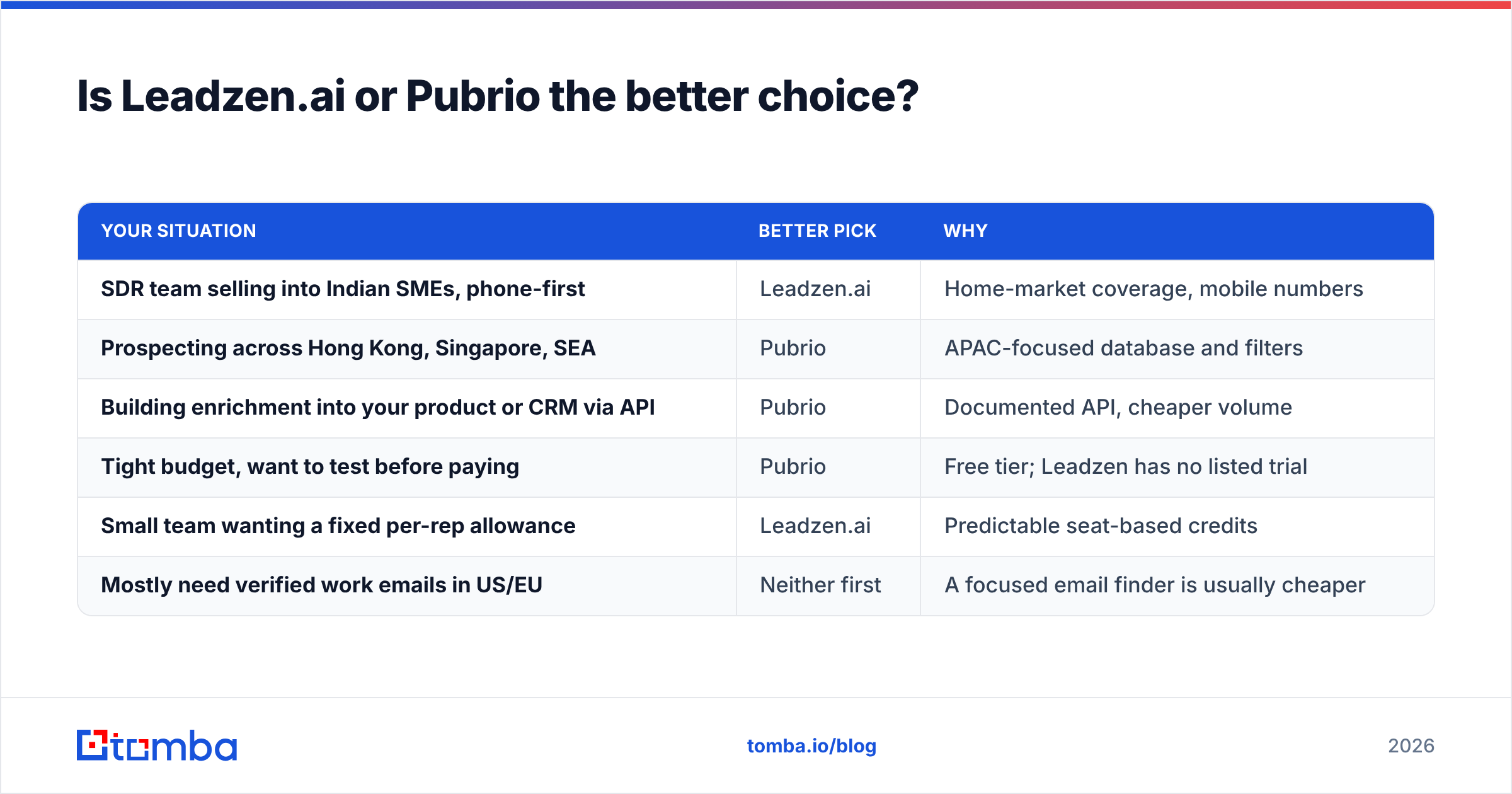
The Leadzenai vs Pubrio decision depends on which of these profiles matches your team.
| Your situation | Better pick | Why |
|---|---|---|
| SDR team selling into Indian SMEs, phone-first | Leadzen.ai | Home-market coverage, mobile numbers |
| Prospecting across Hong Kong, Singapore, SEA | Pubrio | APAC-focused database and filters |
| Building enrichment into your product or CRM via API | Pubrio | Documented API, cheaper volume |
| Tight budget, want to test before paying | Pubrio | Free tier; Leadzen has no listed trial |
| Small team wanting a fixed per-rep allowance | Leadzen.ai | Predictable seat-based credits |
| Mostly need verified work emails in US/EU | Neither first | A focused email finder is usually cheaper |
Our pick: for most teams evaluating both, Pubrio is the safer default. Its free tier makes evaluation cheap, its per-credit economics suit volume, and the API future-proofs the purchase. Leadzen.ai wins clearly in one specific case: phone-led outreach into India. If that's your core motion, run its demo and pilot it against Pubrio on the same 100 accounts.

Where does a dedicated email finder fit?#
Both Leadzen and Pubrio sell breadth: phones, firmographics, search filters and lists. If a large share of your outreach is email, you may be paying for data you don't use.
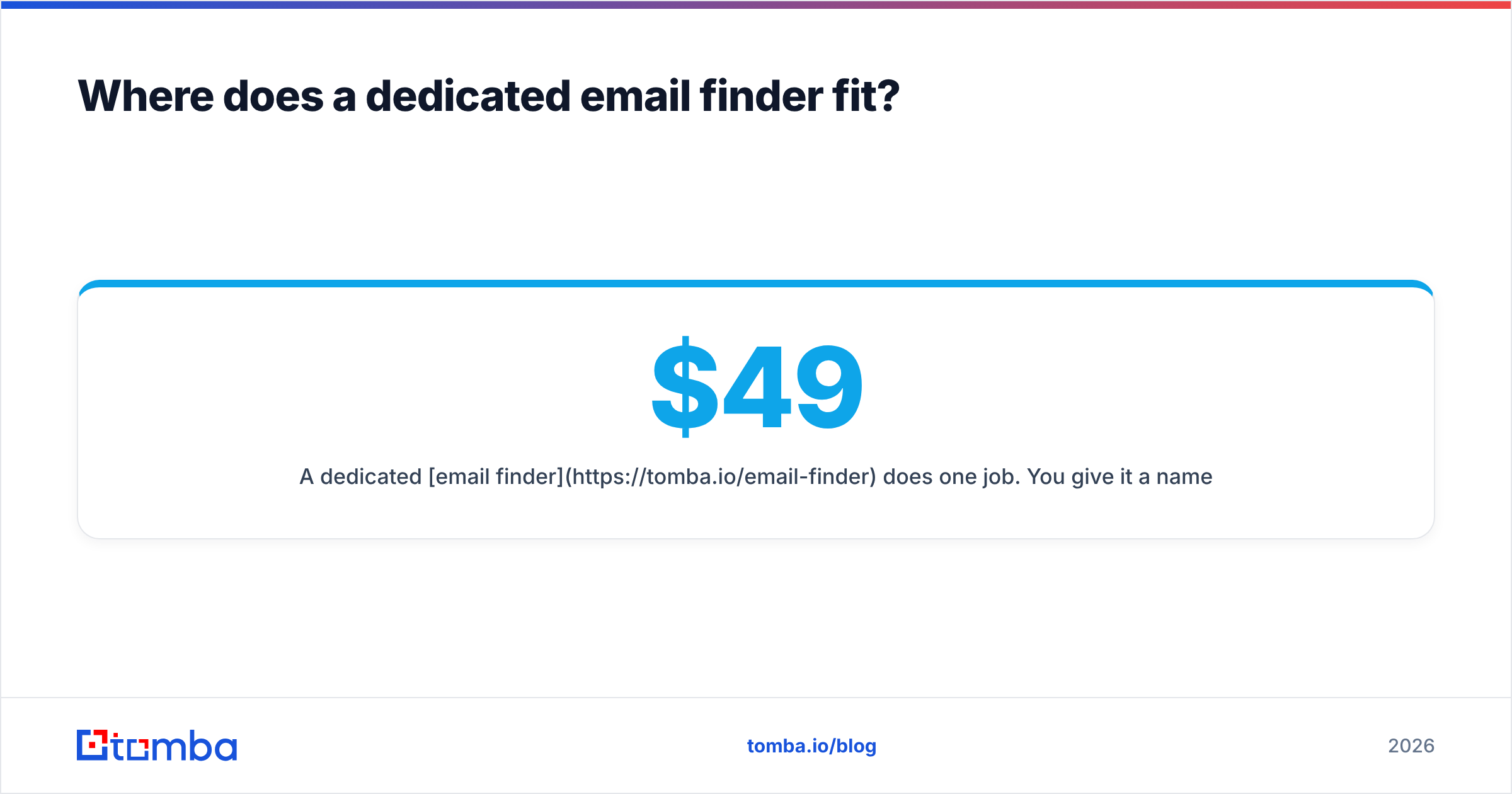
A dedicated email finder does one job. You give it a name and company (or just a domain) and it returns the most likely work email with a confidence score, then verifies it. Tomba, for example, starts with a free tier of 25 searches a month, and paid plans run from $49/mo (Starter) to $99/mo (Growth) and $249/mo (Pro). Full details are on the Tomba pricing page. Teams often pair a database tool for account discovery with a focused finder and verifier for the contacts they actually email, and that combination can cost less than moving up a tier on an all-in-one platform.
Developers can use the Tomba API to add email lookup and verification to the same pipeline that pulls companies from Pubrio or another source. Discovery and contact resolution stay separate, and you only pay for contacts you need.
Here's a workflow that works with whichever platform you pick:
- Discover accounts in the platform that best covers your region (Pubrio for APAC, Leadzen for India).
- Resolve contacts for the specific people you'll email, using the platform's reveal or a dedicated finder.
- Verify every email at export time, and handle catch-all domains separately.
- Load into your sequencer only the contacts marked valid.
- Track bounce rate per source so you know which vendor's data actually performs.
For more on how different vendors define and sell B2B data, G2's sales intelligence category is a reasonable neutral starting point for peer reviews.
Frequently asked questions#
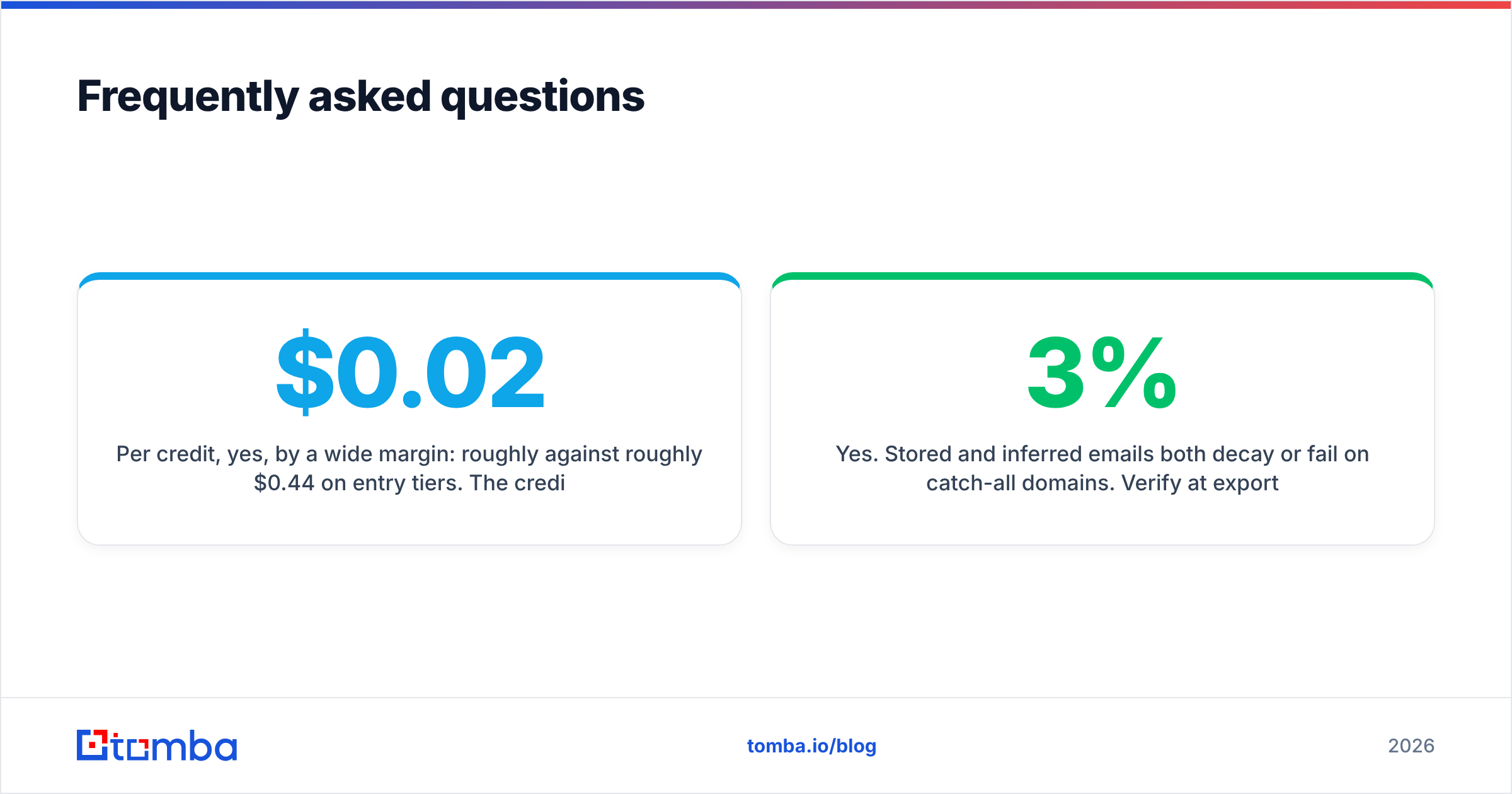
Is Pubrio cheaper than Leadzen.ai? Per credit, yes, by a wide margin: roughly $0.02 against roughly $0.44 on entry tiers. The credits cover different actions, though, so compare cost per verified contact from a pilot on your own list.
Does Leadzen.ai have a free trial? Third-party listings report no free version or trial. Expect to go through a demo. Pubrio does offer a free tier.
Which tool is better for Asia-Pacific prospecting? Pubrio for broad APAC coverage (Hong Kong, Singapore, Southeast Asia). Leadzen.ai for India specifically.
Do I still need an email verifier with these tools? Yes. Stored and inferred emails both decay or fail on catch-all domains. Verify at export time to keep bounces under 2-3%.
Can I use both together? Yes. Some teams use Pubrio for APAC account discovery and Leadzen for Indian phone numbers, then run everything through a single verification step before outreach.
Ready to find verified emails without paying for data you don't use?#
If your outreach runs mainly on email, start with the one thing you actually need: accurate, verified work addresses. Tomba Email Finder finds professional emails by name, domain or company, scores each result, and verifies it before you send. It's free for 25 searches a month, and paid plans start at $49/mo. Run it on the same 100-account test list you use for your Leadzenai vs Pubrio pilot, and compare the verified-valid rates.
Related guides#
// get started
Find, verify and enrich your first contacts today
Start on the free plan with 25 searches a month, then scale when your team is ready.
Free plan · No credit card required · GDPR & CCPA
Get the Tomba newsletter
Product and data updates
// about the author