Leadzenai vs Respona (2026): Lead Data or Outreach Engine?
Leadzenai finds B2B contacts. Respona runs personalized outreach campaigns. They solve different problems, so the right pick depends on where your pipeline breaks. Here's how to choose.
TL;DR
- Leadzenai is mainly a lead-data tool. It uses AI to help you search, filter and enrich B2B contacts: names, roles, emails and phone numbers.
- Respona is mainly an outreach tool. It's built around content-driven campaigns such as link building, digital PR, partnerships and personalized cold outreach, with prospecting and sequencing in one workspace.
- They only partly compete. Leadzenai answers "who should I contact?" Respona answers "how do I reach them at scale without sounding like a robot?"
- Choose by bottleneck. If you don't have enough good contacts, start with Leadzenai. If you have contacts but weak campaigns, start with Respona. Many teams will want a data layer plus an outreach layer.
- Whichever you pick, verify emails before you send. Bad data hurts deliverability no matter how good your copy is.
What is Leadzenai vs Respona really about?#
Most "X vs Y" searches assume the two tools do the same job. This one mostly doesn't. Leadzenai and Respona sit at different points in the outbound workflow, and that's where most buyers get confused.
A simple analogy: Leadzenai is the address book and Respona is the mailroom. The address book tells you who exists and how to reach them. The mailroom decides what goes in each envelope, when it goes out and what happens when someone replies. You can run a mailroom with a thin address book, or keep a thick address book with no mailroom, but neither setup gets you far.
So the real question isn't which tool is better. It's which part of your pipeline is weaker today. The rest of this comparison helps you answer that.
What is Leadzenai?#
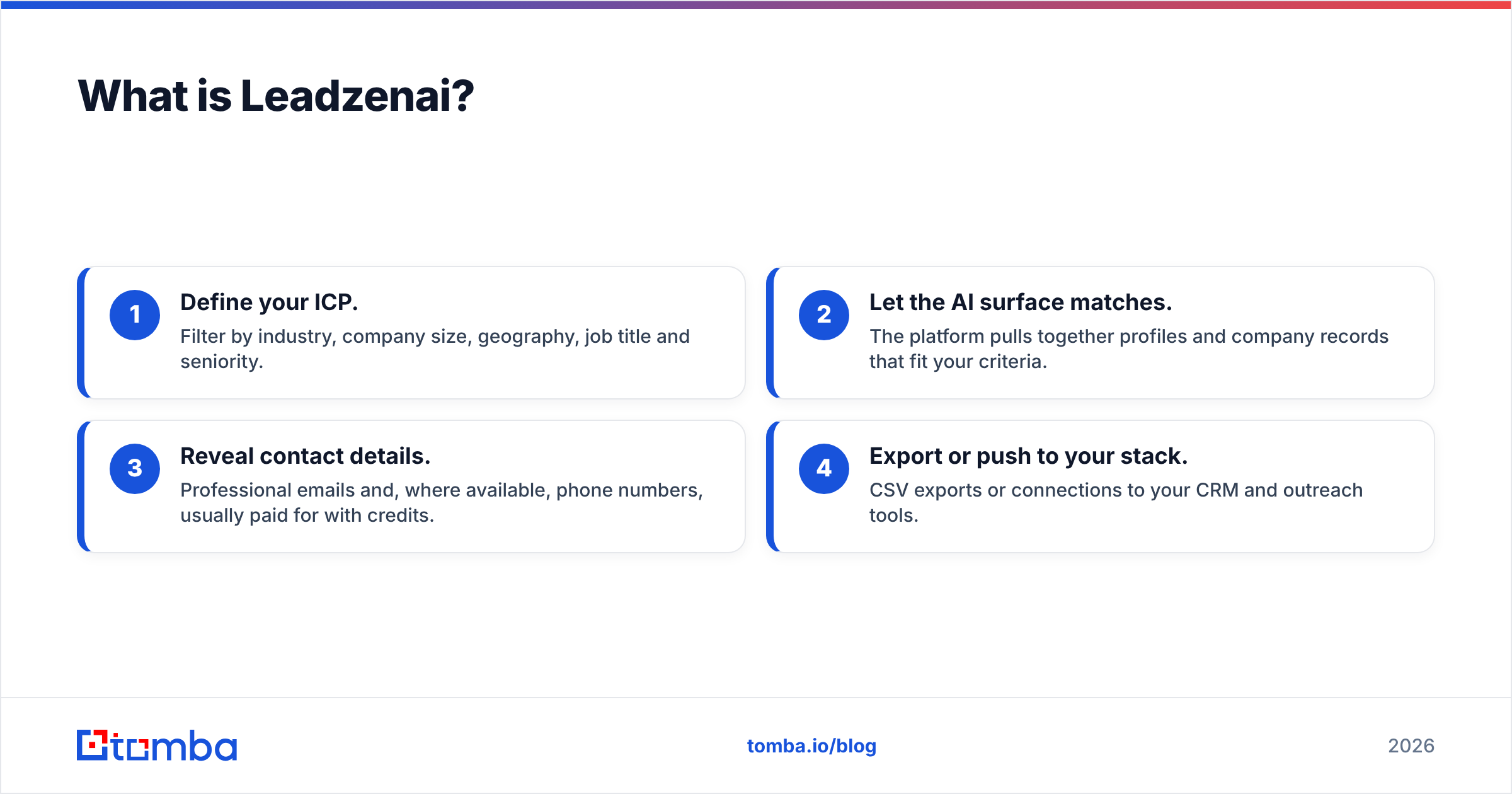
Leadzen.ai is an AI-assisted B2B lead generation platform. Its main promise is to cut down the time between "I need leads in this segment" and "I have a list of reachable people." The usual workflow is:
- Define your ICP. Filter by industry, company size, geography, job title and seniority.
- Let the AI surface matches. The platform pulls together profiles and company records that fit your criteria.
- Reveal contact details. Professional emails and, where available, phone numbers, usually paid for with credits.
- Export or push to your stack. CSV exports or connections to your CRM and outreach tools.
Leadzenai has a strong presence in South and Southeast Asian markets, which matters if that's where your buyers are. Many Western-first databases are thin there, so regional coverage can be a real advantage rather than a footnote.
What Leadzenai doesn't try to be is a full outreach suite. You won't get sequencing on the level of dedicated engagement tools, and you'll still need somewhere to write, schedule and track your campaigns.
What is Respona?#
Respona is an outreach platform that started in link building and digital PR and has since grown into broader partnership and cold outreach. Its standout feature is how it finds prospects. Instead of relying only on a people database, Respona lets you search the web for content, such as articles, podcasts and listicles, find the site owner or author, and then run a personalized sequence to them.
Its core building blocks:
- Content-based prospecting. Search Google-style results inside the app to find pages relevant to your campaign.
- Built-in contact lookup. Find the author or decision-maker for each page.
- Personalization with AI assistance. Variables and AI-drafted openers tailored to each prospect's content.
- Multi-step sequences and a shared inbox. Follow-ups, reply handling and team collaboration in one place.
- Campaign analytics. Open, reply and conversion tracking by campaign.
Respona is priced as a team outreach platform, not a lightweight data tool, so expect a noticeably higher entry cost than a credit-based lead database. Check their current pricing page before you budget. Plans and seat rules have changed more than once.
How do Leadzenai and Respona compare feature by feature?#
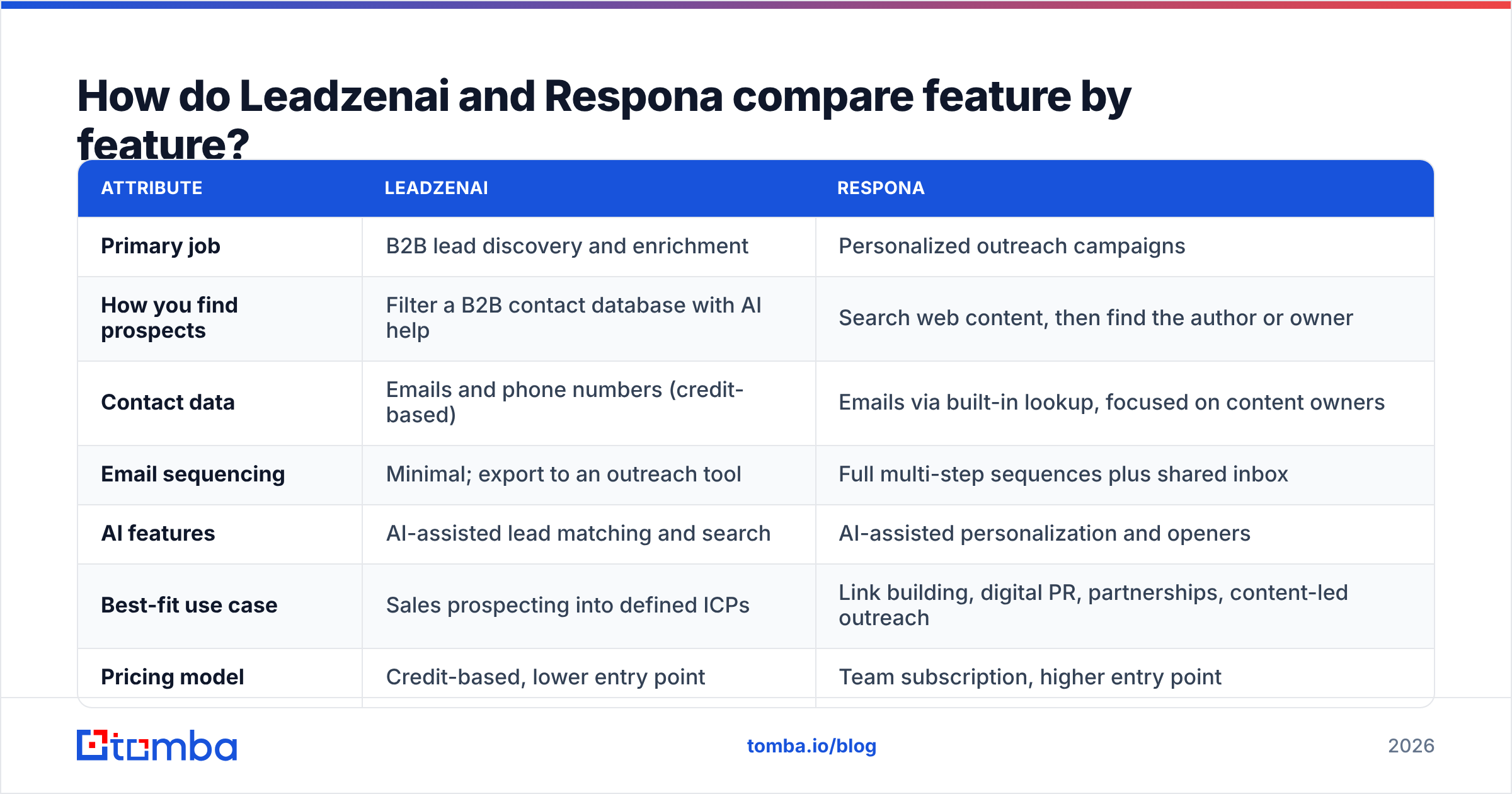
Here's the side-by-side view. Where a vendor doesn't publish a firm number, the table describes the model instead of guessing a figure.
| Attribute | Leadzenai | Respona |
|---|---|---|
| Primary job | B2B lead discovery and enrichment | Personalized outreach campaigns |
| How you find prospects | Filter a B2B contact database with AI help | Search web content, then find the author or owner |
| Contact data | Emails and phone numbers (credit-based) | Emails via built-in lookup, focused on content owners |
| Email sequencing | Minimal; export to an outreach tool | Full multi-step sequences plus shared inbox |
| AI features | AI-assisted lead matching and search | AI-assisted personalization and openers |
| Best-fit use case | Sales prospecting into defined ICPs | Link building, digital PR, partnerships, content-led outreach |
| Pricing model | Credit-based, lower entry point | Team subscription, higher entry point |
| Regional strength | Strong in India and APAC | Global, with an English-language content focus |
| Learning curve | Low: search, filter, export | Moderate: campaign setup, templates, sequences |
| Needs a companion tool? | Yes, for sending | Sometimes, for high-volume sales data |
Two things stand out. First, the tools barely overlap. Second, each one has a gap the other fills: Leadzenai needs a place to send from, and Respona's contact discovery is tuned to content owners, not to "every VP of Finance at 200-person SaaS companies in Germany."
Which tool should you choose for your use case?#
Pick by the job you actually need done this quarter. Here are the most common scenarios:
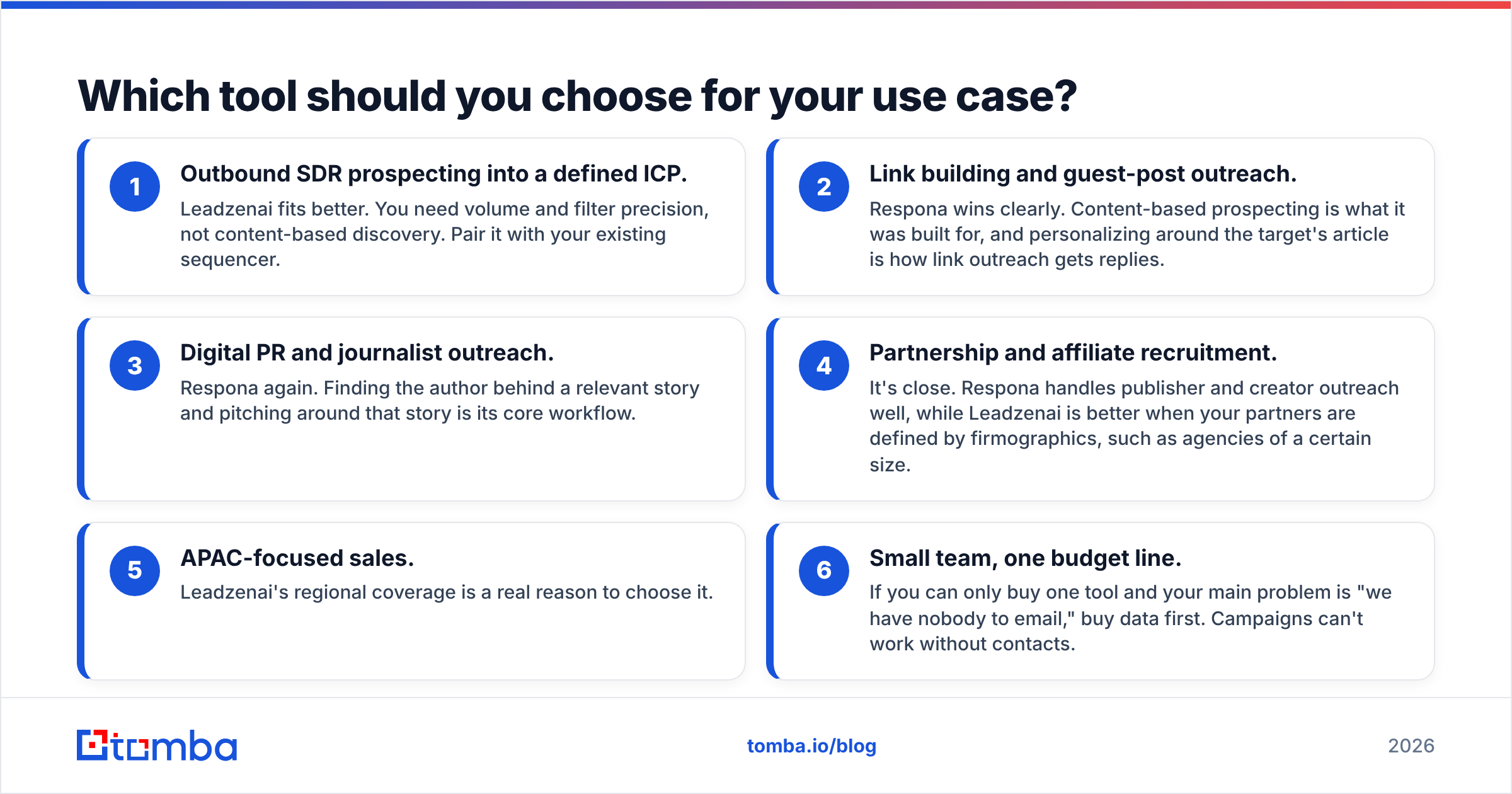
- Outbound SDR prospecting into a defined ICP. Leadzenai fits better. You need volume and filter precision, not content-based discovery. Pair it with your existing sequencer.
- Link building and guest-post outreach. Respona wins clearly. Content-based prospecting is what it was built for, and personalizing around the target's article is how link outreach gets replies.
- Digital PR and journalist outreach. Respona again. Finding the author behind a relevant story and pitching around that story is its core workflow.
- Partnership and affiliate recruitment. It's close. Respona handles publisher and creator outreach well, while Leadzenai is better when your partners are defined by firmographics, such as agencies of a certain size.
- APAC-focused sales. Leadzenai's regional coverage is a real reason to choose it.
- Small team, one budget line. If you can only buy one tool and your main problem is "we have nobody to email," buy data first. Campaigns can't work without contacts.
How does pricing compare between Leadzenai and Respona?#
Pricing is where the difference in category shows up most.
Leadzenai uses a credit-based model. You pay for revealed contacts, so costs scale with the size of your lists. That suits founders and small teams testing a new segment, because you can start small and grow once a segment proves itself.
Respona is priced like a campaign platform. You're paying for the workflow (prospecting, personalization, sequences, inbox and collaboration), not just raw contacts. Plans have historically started in the low hundreds of dollars per month, with higher tiers for more users and email volume. Always confirm on the vendor's live pricing page, because tiers and limits shift.
The hidden cost to watch is the same on both sides: bad email data. Every bounce hurts your sender reputation, and a high bounce rate can push a whole domain into spam folders. Budget for verification whichever tool you choose. An email verifier pass before each campaign costs far less than rebuilding a burned domain.
For reference, Tomba's own plans start with a free tier of 25 searches per month, then Starter at $49/mo, Growth at $99/mo, Pro at $249/mo and custom Enterprise. See the Tomba pricing page for details. That's the kind of data-layer budget you'd usually pair with an outreach platform like Respona.
What are the pros and cons of each?#
Leadzenai#
Pros
- Fast ICP-based list building with AI-assisted search
- Credit-based pricing keeps entry costs low
- Emails and phone numbers in one place
- Strong coverage in India and APAC
Cons
- Not a full outreach suite, so you still need a sender
- Coverage outside its core regions may be thinner than with the largest global databases
- Like every database, record freshness varies, so verification is still on you
Respona#
Pros
- Excellent for content-led outreach: link building, PR, partnerships
- Prospecting, personalization, sequencing and inbox in one tool
- Personalization around each prospect's content improves reply quality
- Built for team collaboration
Cons
- Higher entry price than data-only tools
- Contact discovery is tuned to content owners, not broad firmographic prospecting
- More setup work before your first campaign goes out
- Overkill if all you need is a list of emails
Independent review sites such as G2 are worth a look for recent user feedback on onboarding, support and data quality. Sort by the most recent reviews, because both products change quickly.
Can you use Leadzenai and Respona together?#
Yes, and for some teams that's the best setup. A typical stack:
- Data layer: Leadzenai (or another contact database) builds the ICP list.
- Verification layer: Every address gets checked before it enters a campaign.
- Engagement layer: Respona runs the personalized sequences, especially for PR and partnership campaigns.
- CRM: Replies and meetings sync to your system of record.
The weak spot in this stack is usually the handoff between data and engagement. That's where duplicates, outdated contacts and catch-all domains get through. If your source tool doesn't verify at export, add a separate check. Catch-all domains in particular can look valid while quietly bouncing or disappearing.

Is there a simpler alternative for the data side?#
If your main need is finding and verifying professional emails, not a full AI lead-search database, a dedicated email finder can be simpler and cheaper. With Tomba you can find email addresses from a name plus a company domain, pull every public address at a company with domain search, and verify the results in the same workflow. Then you export to Respona or any sequencer you already use.
That's not a knock on Leadzenai. AI-assisted ICP search is useful when you're still working out who to target. But if you already know the accounts and just need the right inbox for the right person, a focused finder is a cleaner fit.
So, which wins: Leadzenai or Respona?#
It depends on which job you're hiring the tool for:
- Leadzenai wins on lead discovery, especially for sales teams prospecting into defined ICPs and teams selling into APAC.
- Respona wins on outreach execution, especially for link building, digital PR and content-led partnership campaigns.
- Neither one fixes bad data by itself. Verification belongs in both workflows.
If you're a sales-led team with an empty pipeline, start with a data tool. If you're a marketing or SEO team whose outreach gets ignored, start with Respona. If you're growing fast, you'll probably end up running both, with a verification step between them.
Ready to fill your pipeline with contacts that actually reply?#
Whichever outreach tool you use, the results depend on the email addresses you feed it. Tomba Email Finder finds professional emails from a name and company domain, checks them before you hit send, and exports to Respona, your CRM or any sequencer you already use. Start with the free tier's 25 searches per month, test it on your next campaign list, and upgrade to Starter at $49/mo once the bounce rate shows it's worth it.
Related guides#
// get started
Find, verify and enrich your first contacts today
Start on the free plan with 25 searches a month, then scale when your team is ready.
Free plan · No credit card required · GDPR & CCPA
// about the author