LeadzenAI vs RocketReach (2026): Data, Pricing and Which to Pick
LeadzenAI and RocketReach both promise verified B2B contacts, but they're built for different markets and budgets. Here's where each one wins, where each falls short, and how to choose.
LeadzenAI vs RocketReach comes down to one question. Do you need help finding the right people, or finding their emails? Here is the short answer.
- RocketReach is the safer pick for wide global coverage. It has a mature Chrome extension, CRM integrations and an API. Lookups are pricey, and the lower tiers have strict caps.
- LeadzenAI builds lists with AI. You describe your ideal customer and it finds prospects. It shines in India, APAC and other regions where US-focused databases are thin.
- Neither tool removes the need to verify emails before you send. Budget for that step either way.
One more point before the details:
- If you already have a name and a company domain, a dedicated email finder with built-in verification is usually cheaper per valid contact.
- Our pick: RocketReach for global enterprise prospecting. LeadzenAI for AI-led list building in its home markets. A lighter email finder if cost per valid email matters most.
What are LeadzenAI and RocketReach, really?#
The two tools sit in the same category, B2B contact data. But they solve the problem from opposite ends.
RocketReach is one of the older players in contact lookup. You search for a person or company and get back emails, phone numbers and social profiles. It says its database covers hundreds of millions of professionals worldwide. Its core job is lookup: you already know who you want, and RocketReach gives you their details. Over time it has added bulk lookups, a Chrome extension, an API and links to the major CRMs.
LeadzenAI is younger and calls itself AI-first. You don't search person by person. Instead, you describe your ideal customer by industry, role, region and company size. The platform then builds a prospect list, with contact details where it has them. It is strong in India and the wider APAC region, and much of its marketing targets teams selling there.
In short, RocketReach helps when you know who you want to reach. LeadzenAI helps when you're still working out who to target. Once that's clear, most of the LeadzenAI vs RocketReach decision follows.
How do LeadzenAI and RocketReach compare feature by feature?#
The table below reflects each vendor's public positioning and plan structure at the time of writing. Both change pricing and plan limits regularly, so check their pricing pages before you buy. Treat the numbers as a snapshot.
| Attribute | LeadzenAI | RocketReach |
|---|---|---|
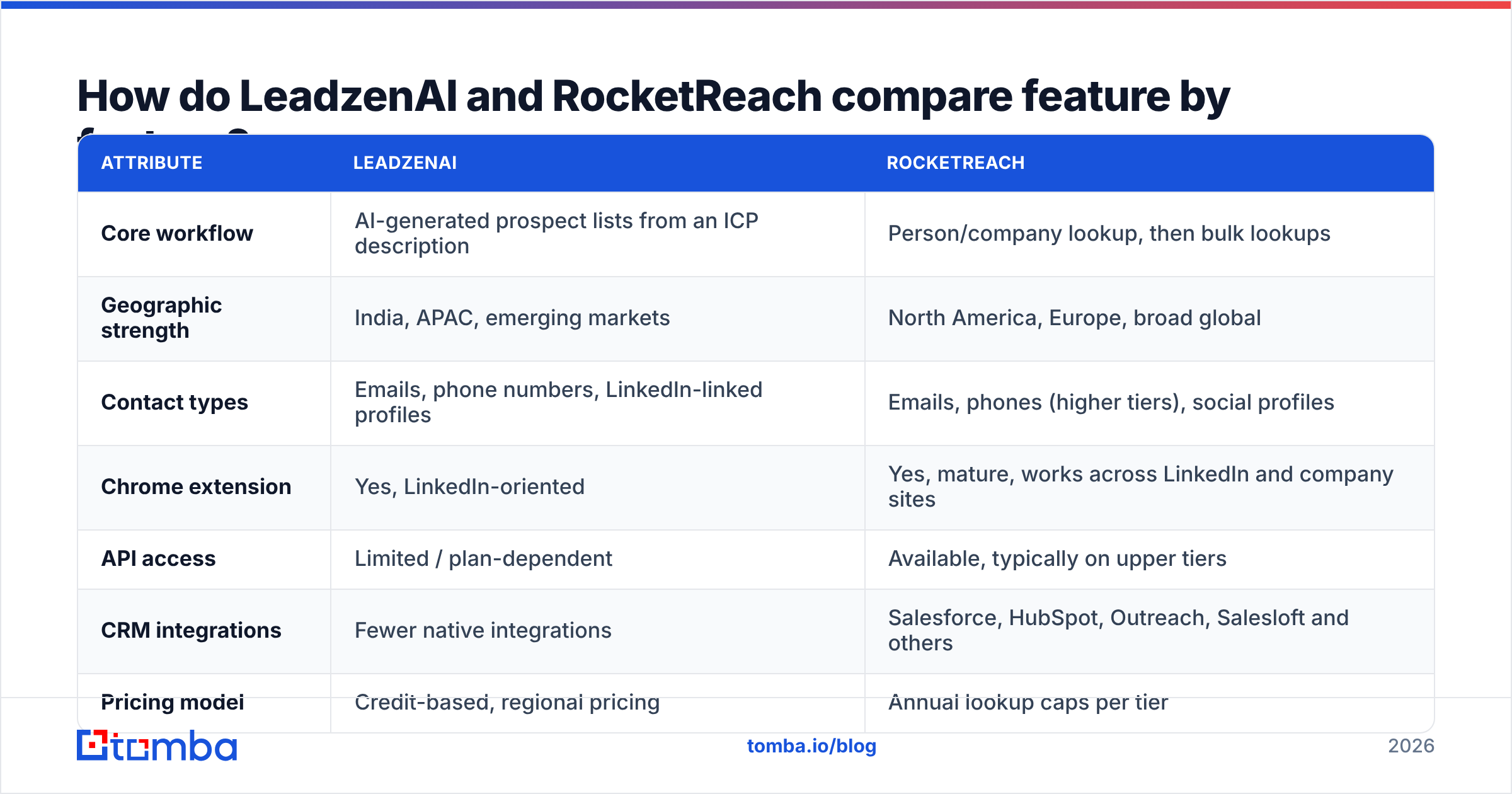
| Core workflow | AI-generated prospect lists from an ICP description | Person/company lookup, then bulk lookups |
| Geographic strength | India, APAC, emerging markets | North America, Europe, broad global |
| Contact types | Emails, phone numbers, LinkedIn-linked profiles | Emails, phones (higher tiers), social profiles |
| Chrome extension | Yes, LinkedIn-oriented | Yes, mature, works across LinkedIn and company sites |
| API access | Limited / plan-dependent | Available, typically on upper tiers |
| CRM integrations | Fewer native integrations | Salesforce, HubSpot, Outreach, Salesloft and others |
| Pricing model | Credit-based, regional pricing | Annual lookup caps per tier |
| Entry price (approx.) | Lower entry point, credit bundles | Roughly $50-80/mo for Essentials, email-only |
| Top self-serve tier (approx.) | Mid-range | Around $200+/mo (Ultimate, billed annually) |
| Free option | Trial credits | A handful of free lookups per month |
| Best for | Building target lists fast in underserved regions | Enterprise and mid-market outbound teams in the US/EU |
Three differences matter more than the rest:
- Discovery vs lookup. LeadzenAI is optimized for "find me 500 people who match this profile." RocketReach is optimized for "give me this specific person's work email and mobile."
- Regional depth. RocketReach's database skews toward Western markets. LeadzenAI's value depends on coverage in regions where RocketReach tends to return blanks.
- Ecosystem. RocketReach plugs straight into most sales stacks. With LeadzenAI you'll likely use more CSV exports and manual syncing.
Which tool has more accurate email data?#
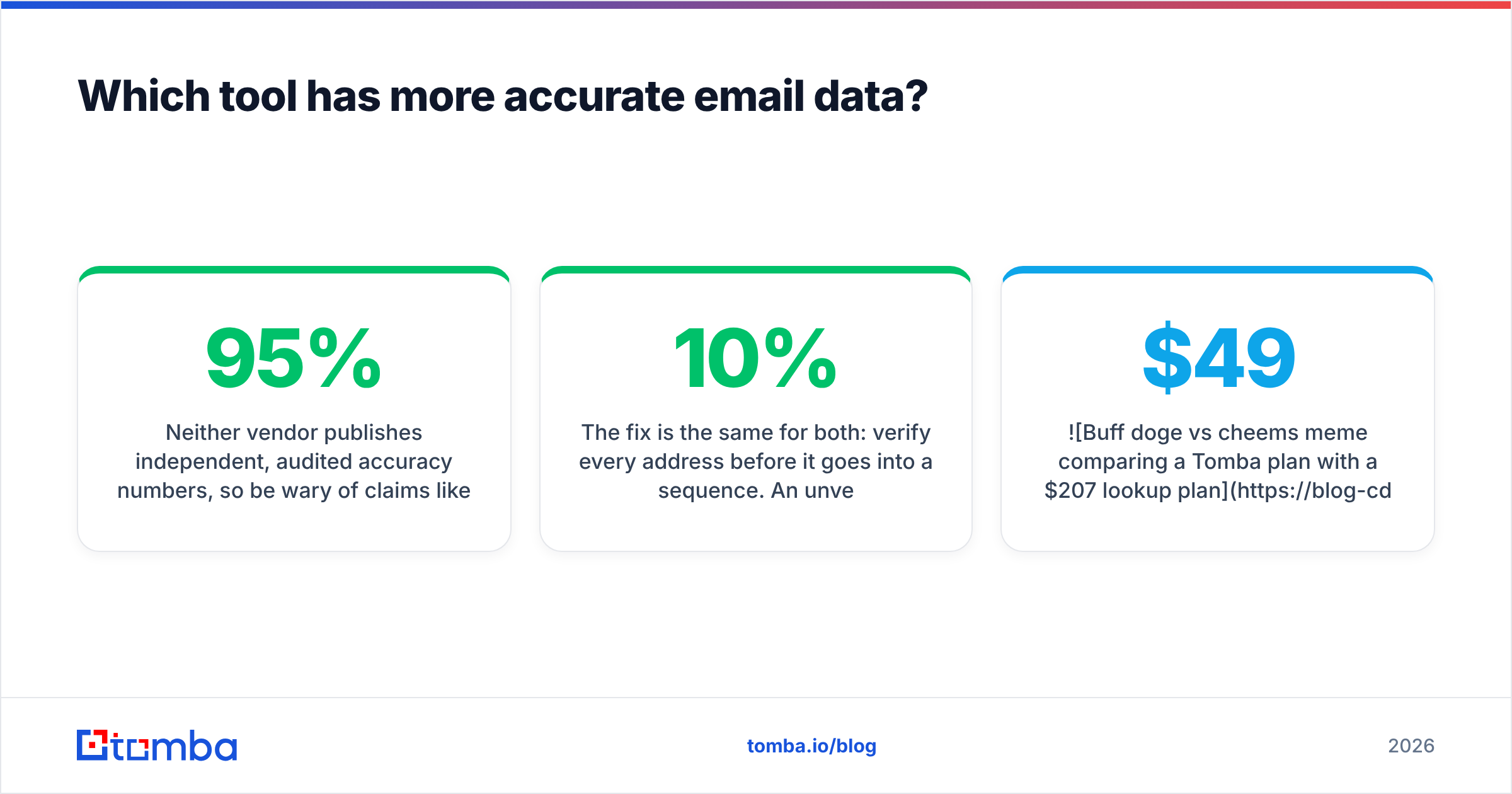
Neither vendor publishes independent, audited accuracy numbers. So be wary of claims like "95% accuracy," whoever makes them. Accuracy depends a lot on who you're prospecting. A US SaaS VP of Sales is far easier to find than a plant manager at a mid-size factory in Pune.

Here's what users on review sites like G2 generally report, and what we see in practice:
- RocketReach does well for known companies in North America and Western Europe. Common complaints are stale records, such as people who changed jobs months ago. Some mobile numbers also go to switchboards. Its emails usually carry a confidence grade, which helps.
- LeadzenAI is more variable. In its strong regions it can find contacts that global databases miss. Outside them, fewer records come back and more emails are guessed from patterns. The AI list builder adds one more risk: a prospect can match your profile on paper and still be the wrong person.
The fix is the same for both: verify every address before it goes into a sequence. Even 8-10% bounces can hurt your sender reputation within a week. Running exports through an email verifier is cheap insurance. It matters most for catch-all domains, where the server accepts everything and the real bounce shows up later.
How does pricing actually work on each platform?#
Pricing is where these tools differ most, and where buyers most often get caught out.
RocketReach pricing#
RocketReach sells annual lookup allowances in tiers, roughly:
- Essentials: email-only lookups, a relatively small annual cap, and the lowest price.
- Pro: adds phone numbers and a bigger lookup allowance.
- Ultimate: the largest allowance, direct dials, and access to more advanced features such as the API and integrations.
The advertised monthly price usually assumes annual billing. Month-to-month costs noticeably more. A lookup is spent whether or not the result is usable, so the real cost climbs. If a quarter of your lookups return no usable email, you pay about a third more per contact than the headline rate.
LeadzenAI pricing#
LeadzenAI uses credit bundles and has historically priced competitively for its home markets. The entry cost is lower than RocketReach's, which makes it easy to trial. Before you commit, check:
- How many credits an email reveal costs compared with a phone reveal
- Whether credits roll over or expire monthly
- Whether you get refunds or credits back for bounced or invalid contacts
- Export limits and seat pricing on team plans
What does that mean for you?#
For a solo founder or a small SDR team sending a few hundred emails a week, LeadzenAI's credit model is usually friendlier. For a 10-seat team that lives in Salesforce, RocketReach costs more. But that price buys integrations you'd otherwise build with Zapier and spreadsheets.
Which one fits your prospecting workflow?#
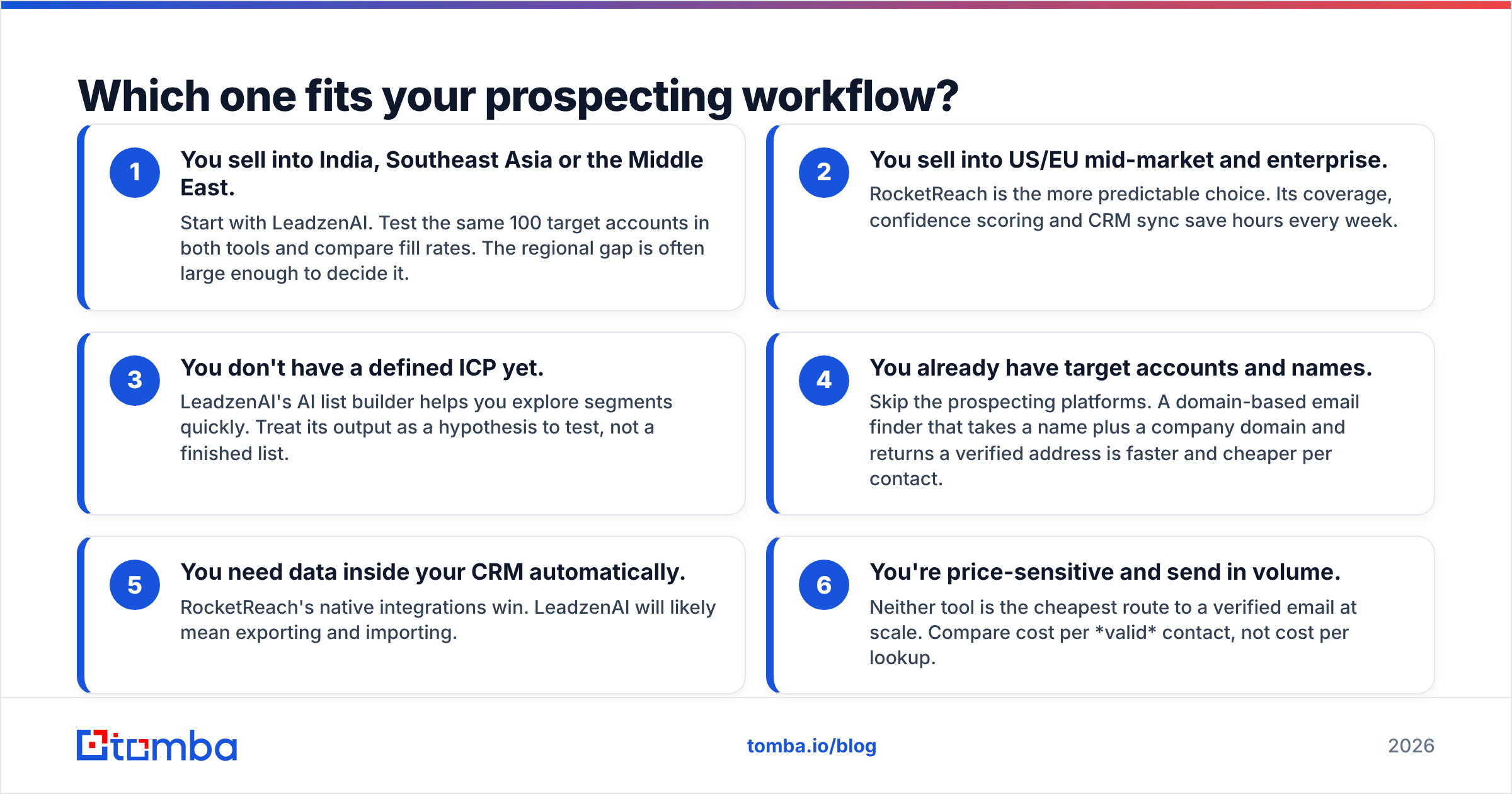
Match the tool to how your team actually works, not to the feature list. Start with where you sell and how clear your target is:
- You sell into India, Southeast Asia or the Middle East. Start with LeadzenAI. Test the same 100 target accounts in both tools and compare fill rates. The regional gap is often large enough to decide it.
- You sell into US/EU mid-market and enterprise. RocketReach is the more predictable choice. Its coverage, confidence scoring and CRM sync save hours every week.
- You don't have a defined ICP yet. LeadzenAI's AI list builder helps you explore segments quickly. Treat its output as a hypothesis to test, not a finished list.
Then think about what you already have and what you can spend:
- You already have target accounts and names. Skip the prospecting platforms. A domain-based email finder takes a name plus a company domain and returns a verified address. It's faster and cheaper per contact.
- You need data inside your CRM automatically. RocketReach's native integrations win. LeadzenAI will likely mean exporting and importing.
- You're price-sensitive and send in volume. Neither tool is the cheapest route to a verified email at scale. Compare cost per valid contact, not cost per lookup.
What are the pros and cons of each?#
LeadzenAI#
Pros
- AI-driven list building from a plain-language ICP description
- Strong relevance for India and APAC prospecting
- Lower entry price and easy trial
- Useful for early-stage teams still finding product-market fit
Cons
- Coverage thins out in North America and Western Europe
- Fewer native CRM and sales engagement integrations
- AI-matched lists need a human sanity check before outreach
- Less third-party review data to judge long-term reliability
RocketReach#
Pros
- Large, mature global database with good Western coverage
- Well-regarded Chrome extension and bulk lookup tools
- Native integrations with Salesforce, HubSpot and major sequencers
- API available for teams building their own enrichment workflows
Cons
- Expensive per lookup, especially on month-to-month billing
- Annual caps can run out quickly on the lower tiers
- Phone data and API access are gated behind higher plans
- Stale records and job-change lag are recurring complaints
Is there a cheaper alternative to both?#
Maybe your main job is finding and verifying work emails, not AI list building or enterprise-wide enrichment. If so, you're likely paying for features you don't use in either tool.

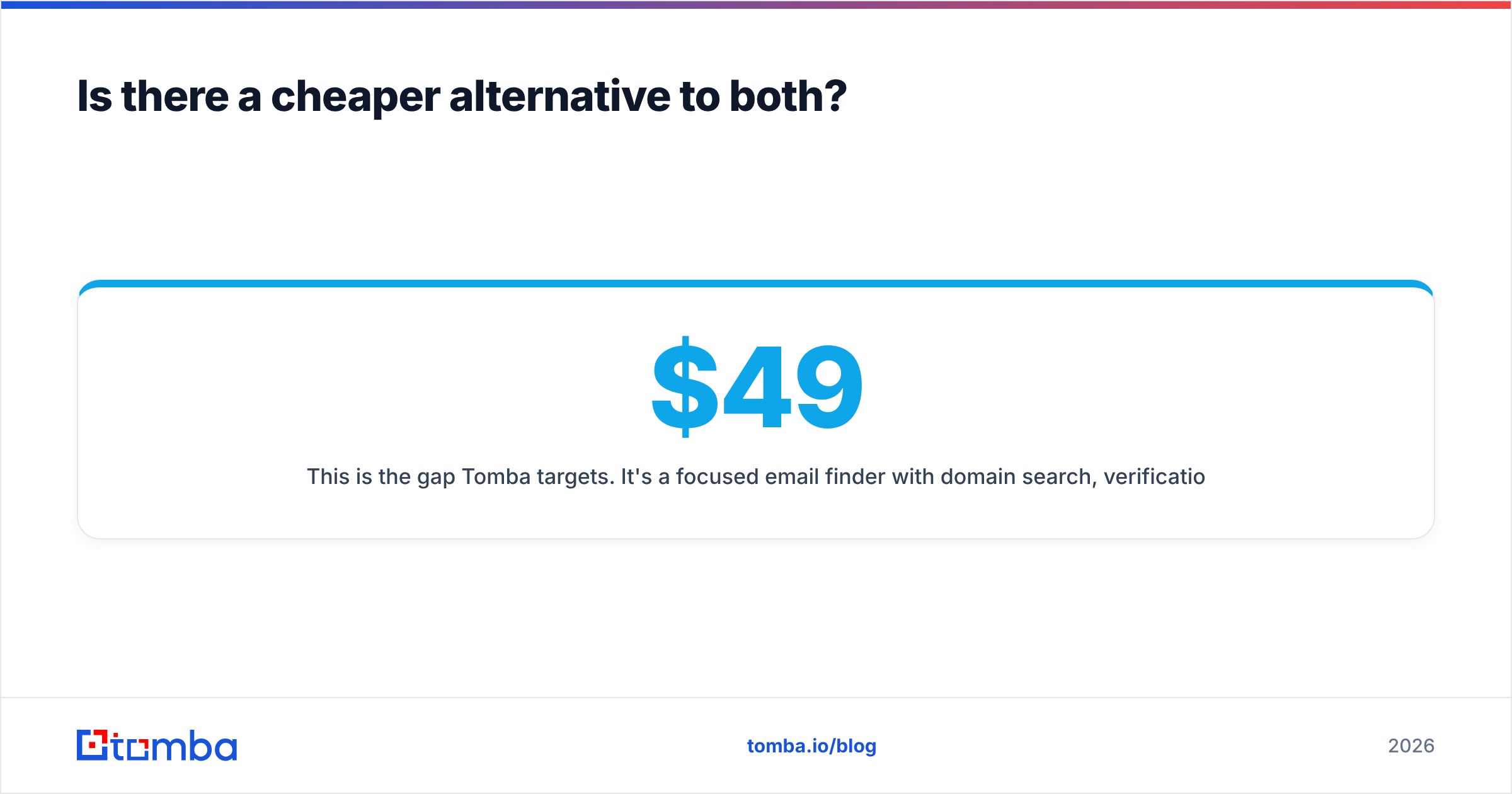
This is the gap Tomba targets. It's a focused email finder with domain search, verification, catch-all checking and enrichment in one account. Plans start with a free tier of 25 searches per month. Then come Starter at $49/mo, Growth at $99/mo and Pro at $249/mo. You can compare the tiers on the Tomba pricing page. Teams moving off RocketReach can find a side-by-side on the RocketReach alternative page.
Tomba doesn't replace either tool across the board. It isn't an AI prospect explorer like LeadzenAI. And a large enterprise with deep Salesforce workflows may still prefer RocketReach's integrations. But for the common case of "give me an email for this person that won't bounce," a focused finder usually costs least per valid address.
| Use case | Best fit |
|---|---|
| AI-built prospect lists for India/APAC | LeadzenAI |
| Global enterprise lookups with CRM sync | RocketReach |
| Verified work emails from name + domain | Tomba Email Finder |
| Cleaning an exported list before sending | Any tool + a dedicated verifier |
How should you run a fair test before buying?#
Don't pick based on demos. Run a small, controlled LeadzenAI vs RocketReach bake-off:
- Build a test set of 100 contacts you already know are correct, such as current customers or past prospects with confirmed emails. Include a mix of regions and seniority levels.
- Run the same list through each tool you're evaluating, including a focused email finder as a control.
- Measure fill rate: what percentage of contacts returned an email at all.
- Measure accuracy: what percentage of returned emails match your known-good addresses.
- Verify the rest: send the unknowns through a verifier and count valid, invalid and catch-all results.
- Calculate cost per valid email: plan price divided by the number of valid emails you'd realistically get per month.
The sixth number is the one that matters. A tool that is 30% cheaper per credit but returns half as many valid emails ends up costing more.
LeadzenAI vs RocketReach: which should you choose?#
Choose LeadzenAI if you prospect mainly in India, APAC or other emerging markets, you want AI help defining and building target lists, and you're working with a smaller budget.
Choose RocketReach if you sell into North America or Europe, your team runs on Salesforce or HubSpot, and you'll pay a premium for coverage, integrations and a mature extension.
Choose neither if your bottleneck is getting a deliverable email for people you've already identified. A focused finder with verification built in will do that job for less.
Whichever you pick, don't send to an unverified export. Data quality doesn't come from the vendor's marketing page. You get it by verifying every address and measuring your own bounce rate.
If you already know who you're targeting and just need their work email, try Tomba Email Finder. Enter a name and a company domain, get back a verified professional address, and start on the free tier (25 searches a month) before you commit to a paid plan.
Related guides#
// get started
Find, verify and enrich your first contacts today
Start on the free plan with 25 searches a month, then scale when your team is ready.
Free plan · No credit card required · GDPR & CCPA
// about the author