LeadzenAI vs Startup Tracker: Which B2B Data Tool Fits You in 2026?
LeadzenAI gives you contact data. Startup Tracker gives you startup intelligence. Here's how each works, where each falls short, and which one to pick for your pipeline in 2026.
TL;DR
- LeadzenAI is an AI lead-generation platform. You use it to find people and their contact details, with filters, a Chrome/LinkedIn extension, and bulk enrichment. It's built for SMB and startup sales teams.
- Startup Tracker is a startup search engine. It gives you company profiles covering product, market, founders, funding, and traction. Its main job is discovering and monitoring young companies, not pulling contact data.
- If your goal is "book meetings this quarter," LeadzenAI fits better. If your goal is "find and watch the right startups before competitors do," Startup Tracker fits better.
- Neither tool removes the need to verify emails before you send. Plan for a separate finder and verifier step.
- Many teams do best with both: Startup Tracker for the account list and a dedicated email tool for the contact layer.
Searching "LeadzenAI vs Startup Tracker" suggests these two tools compete head-to-head. They mostly don't. They sit at different layers of the B2B data stack, and picking the wrong one usually means paying for data you can't act on.
This guide covers what each tool does, how they compare on data, workflow, and pricing, and which one belongs in your stack.
What is LeadzenAI?#
LeadzenAI is an AI-driven B2B lead-generation platform aimed at startups and small-to-mid-sized sales teams. You describe your ideal customer and filter by industry, role, location, and company attributes. The tool then returns prospect profiles with contact data attached.
According to its public positioning and directory listings, the core features are:
- Filtered prospect search across company and person attributes, including location filters that go down to postal-code level.
- Bulk search / enrichment: upload an existing list and fill in missing fields.
- Chrome and LinkedIn extensions that capture contact details while you browse profiles.
- 100+ data points aggregated from 500+ sources, according to the vendor.
A useful mental model: LeadzenAI is a contact vending machine. You enter filters and get people plus ways to reach them. The output is tuned for reps who need to fill a sequence this week.
Pricing: LeadzenAI advertises a freemium entry point. Paid tiers on third-party directories such as GetApp start around $133/month for the Standard plan, and larger editions scale into custom pricing. Check the vendor's pricing page before you budget, because directory figures can lag behind.
What is Startup Tracker?#
Startup Tracker calls itself "the startup company search engine." Founded in 2015, it crawls, aggregates, and crowdsources startup profiles. Each profile covers what the company builds, its target market, its founders, and traction signals such as funding rounds and growth indicators.
The tagline says it well: keep tabs on cool, up-and-coming and competing startups. The typical users are:
- VCs and scouts building deal flow.
- Corporate innovation and M&A teams mapping emerging competitors.
- B2B sellers whose ICP is startups, for example dev tools, fintech infrastructure, HR/payroll, or cloud services. For them, a newly funded seed or Series A company is a buying signal.
If LeadzenAI is a contact vending machine, Startup Tracker is a radar. It tells you which companies exist, what they do, and what just changed. It doesn't aim to hand you a verified inbox for each decision-maker.
Pricing: Startup Tracker doesn't publish a simple self-serve price list the way many sales tools do. Free access is limited to partial profile data, and full access is subscription-based. Contact the vendor for a current quote.
How do LeadzenAI and Startup Tracker compare side by side?#
Here's the head-to-head across the attributes that matter when you choose a B2B data tool.
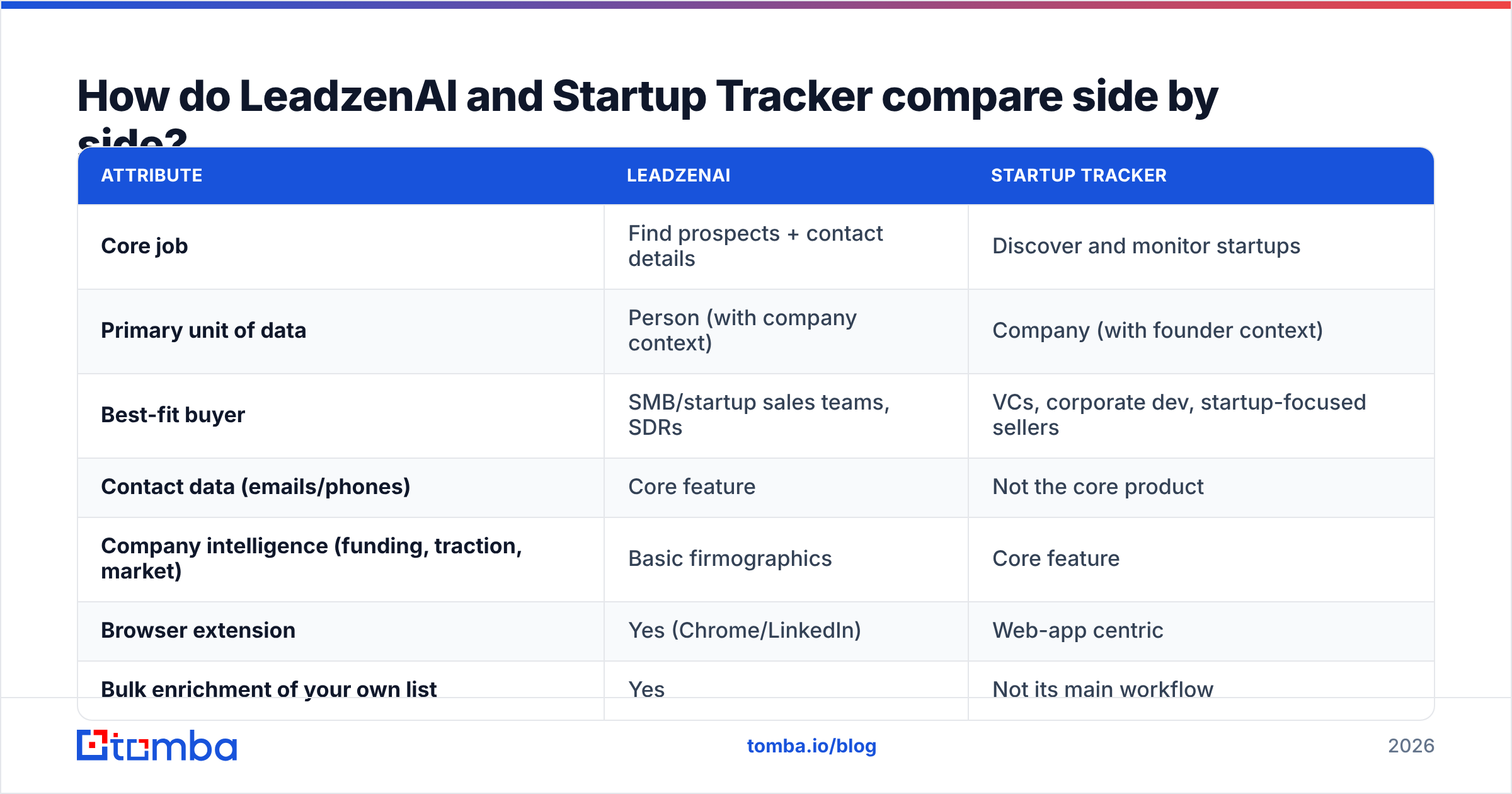
| Attribute | LeadzenAI | Startup Tracker |
|---|---|---|
| Core job | Find prospects + contact details | Discover and monitor startups |
| Primary unit of data | Person (with company context) | Company (with founder context) |
| Best-fit buyer | SMB/startup sales teams, SDRs | VCs, corporate dev, startup-focused sellers |
| Contact data (emails/phones) | Core feature | Not the core product |
| Company intelligence (funding, traction, market) | Basic firmographics | Core feature |
| Browser extension | Yes (Chrome/LinkedIn) | Web-app centric |
| Bulk enrichment of your own list | Yes | Not its main workflow |
| Signal tracking (new rounds, changes) | Limited | Core feature |
| Entry pricing | Freemium; paid from ~$133/mo (directory listings) | Limited free access; paid subscription on request |
| Biggest gap | Thin "why now" context | No ready-to-send contact layer |
The pattern is clear. LeadzenAI answers "who do I email?" and Startup Tracker answers "which companies should I care about right now?" That's why comparing them purely on price misses the point.
Which data does each tool actually give you?#
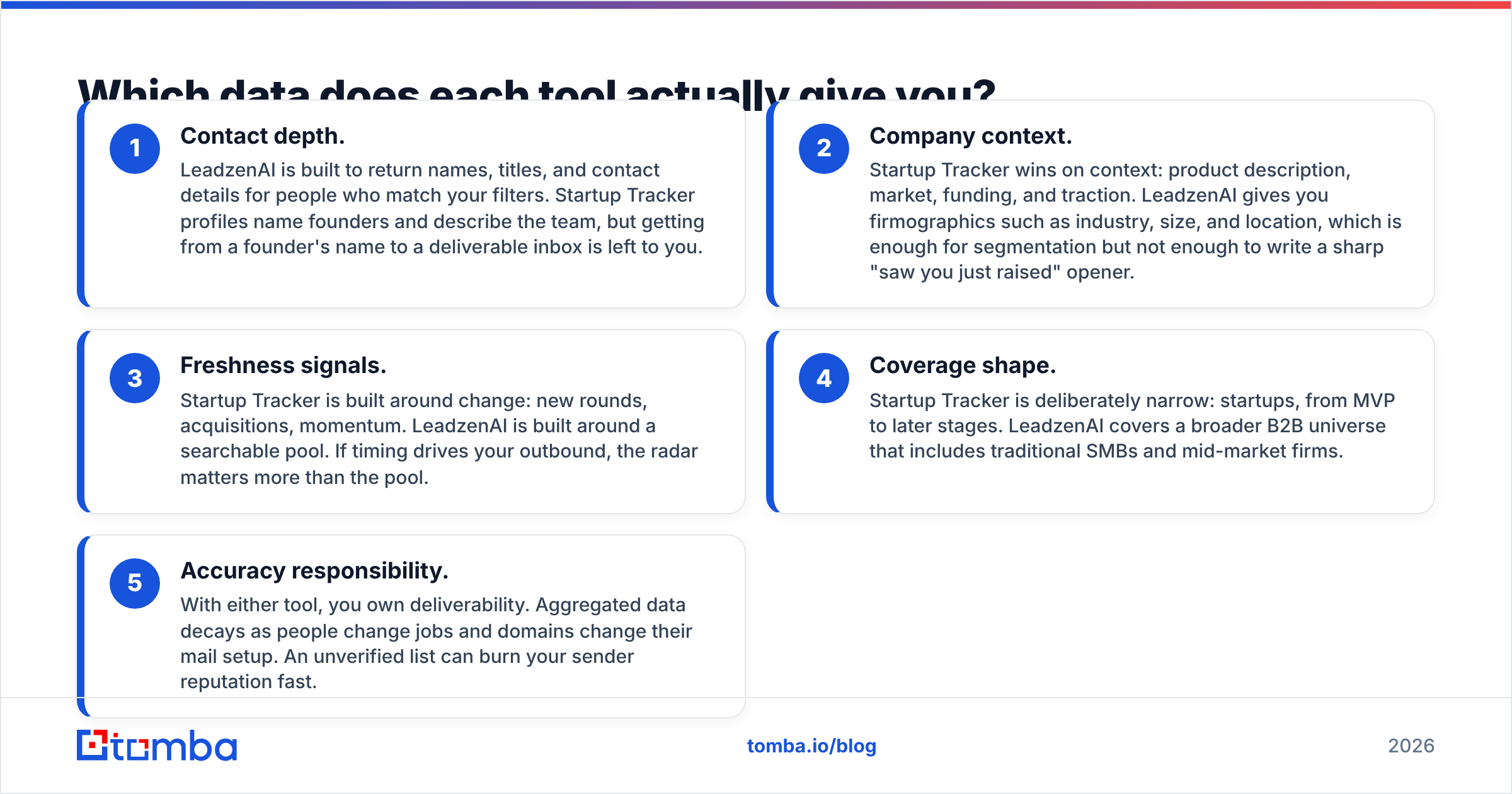
The practical difference between the two platforms comes down to the fields you can put into a sequence. Here's how that plays out in five dimensions:
- Contact depth. LeadzenAI is built to return names, titles, and contact details for people who match your filters. Startup Tracker profiles name founders and describe the team, but getting from a founder's name to a deliverable inbox is left to you.
- Company context. Startup Tracker wins on context: product description, market, funding, and traction. LeadzenAI gives you firmographics such as industry, size, and location, which is enough for segmentation but not enough to write a sharp "saw you just raised" opener.
- Freshness signals. Startup Tracker is built around change: new rounds, acquisitions, momentum. LeadzenAI is built around a searchable pool. If timing drives your outbound, the radar matters more than the pool.
- Coverage shape. Startup Tracker is deliberately narrow: startups, from MVP to later stages. LeadzenAI covers a broader B2B universe that includes traditional SMBs and mid-market firms.
- Accuracy responsibility. With either tool, you own deliverability. Aggregated data decays as people change jobs and domains change their mail setup. An unverified list can burn your sender reputation fast.
That last point is where most teams get hurt. Salesforce's State of Sales research repeatedly flags data quality as a top productivity drain for reps. A startup list with no contact layer and a contact list with no verification both lead to the same outcome: wasted sends.
Is LeadzenAI better than Startup Tracker for outbound sales?#
For classic outbound, where the goal is to build a list, load a sequence, and start conversations, LeadzenAI is the more direct fit. Here's why:
- It returns people, not just companies, so your SDRs aren't doing a second research pass for every account.
- The extension lets reps capture contacts while they browse LinkedIn, which fits how many SMB teams already prospect.
- Bulk enrichment helps when marketing hands you a half-empty CSV of event signups.
Where LeadzenAI is weaker is the "why now." You'll get a relevant persona at a relevant company, but little about what changed there last month. You'll need other signals for that, such as funding, hiring, or tech changes, or your copy stays generic.
Before you load LeadzenAI output into a sequencer, run it through an email verifier. Any aggregated database carries some invalid and catch-all addresses. Catching them before the send is cheaper than fixing a damaged domain afterwards.
Is Startup Tracker better than LeadzenAI for account research?#
For account discovery and prioritisation, especially when your ICP is venture-backed startups, Startup Tracker is the stronger tool. Here's why:
- You can find companies before they show up in generic B2B databases, because many young startups are thinly covered elsewhere.
- Funding and traction data gives you a timing trigger. A company that just closed a round is hiring, buying tools, and open to new vendors.
- Watching competitors and adjacent players helps founders and product teams, not just sales.
The catch is the handoff. Once Startup Tracker has told you which 200 startups matter, you still need to reach the right people at each one. That's where a dedicated email finder comes in. You feed it the company domain plus a founder or executive name and get back a deliverable address with a confidence score.
This two-step flow (radar, then contact layer) is also how many VC platform teams and startup-focused agencies work. They don't expect one tool to be excellent at both jobs.
How do the pricing models compare?#
The pricing models differ as much as the products do.
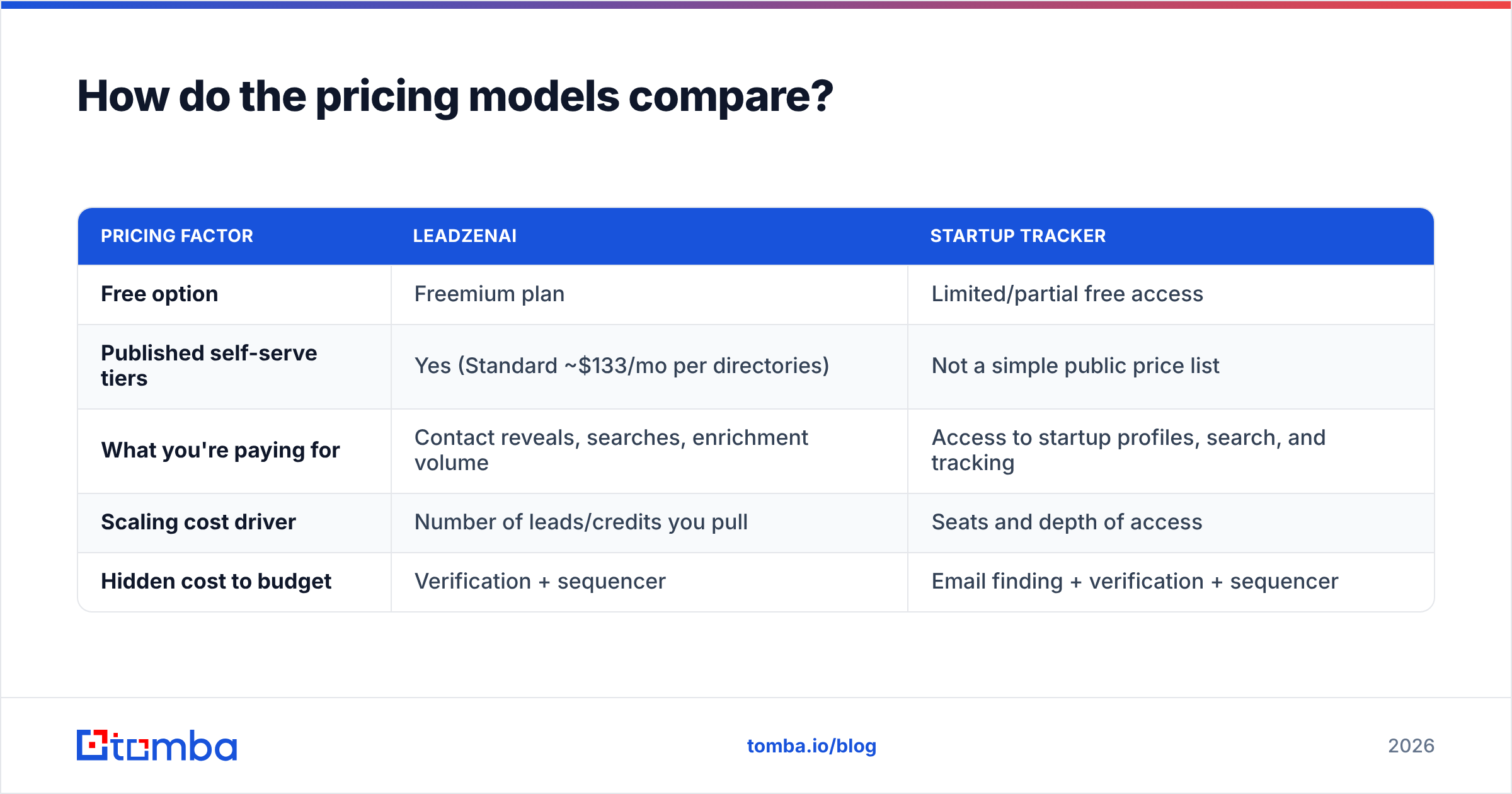
| Pricing factor | LeadzenAI | Startup Tracker |
|---|---|---|
| Free option | Freemium plan | Limited/partial free access |
| Published self-serve tiers | Yes (Standard ~$133/mo per directories) | Not a simple public price list |
| What you're paying for | Contact reveals, searches, enrichment volume | Access to startup profiles, search, and tracking |
| Scaling cost driver | Number of leads/credits you pull | Seats and depth of access |
| Hidden cost to budget | Verification + sequencer | Email finding + verification + sequencer |
Two takeaways:
- LeadzenAI's cost tracks your outbound volume. More reps pulling more contacts means more spend, which is predictable if you forecast pipeline carefully.
- Startup Tracker's cost is more like a research subscription. It's cheaper per insight, but you'll almost certainly pay for a contact tool on top.
Neither total cost is complete without the verification and sending layer. Compare the whole stack, not just the headline subscription.
Which tool should you choose?#
Map your situation to the closest row:
- You sell to SMBs and mid-market across many industries, and your SDRs need names today → LeadzenAI.
- You sell to venture-backed startups and timing matters → Startup Tracker for discovery, plus a finder/verifier for contacts.
- You're a VC, scout, or corporate-development team → Startup Tracker. LeadzenAI's contact focus isn't your bottleneck.
- You already have a CRM full of accounts and just need contacts → Neither is ideal. Use a finder with domain search and bulk enrichment instead.
- You're budget-constrained and testing a new ICP → Start with free tiers on both, run a 50-account pilot, and measure how many contacts you actually reach, not how many rows you download.
The pilot matters more than any feature list. Pick 50 target accounts, run them through each workflow, verify every email, and count the replies. Review sites like G2 can help you shortlist, but your own reply-rate data is what should decide.
Where does Tomba fit alongside either tool?#
Tomba isn't a replacement for Startup Tracker's startup radar, and it isn't trying to be a filter-first prospect database like LeadzenAI. It covers the layer both tools leave open: turning a company or a name into a verified, sendable email.
In practice, that looks like this:
- With Startup Tracker: export or note your target startups, then run their domains through Tomba's domain search to see known addresses and the company's email pattern. Use the email finder for specific founders and execs.
- With LeadzenAI: push its contacts through Tomba's verifier before sequencing, and use data enrichment to fill gaps on records that came back incomplete.
- On its own: if you already know your accounts, Tomba's finder, verifier, and phone finder may cover the whole contact layer without a separate database subscription.
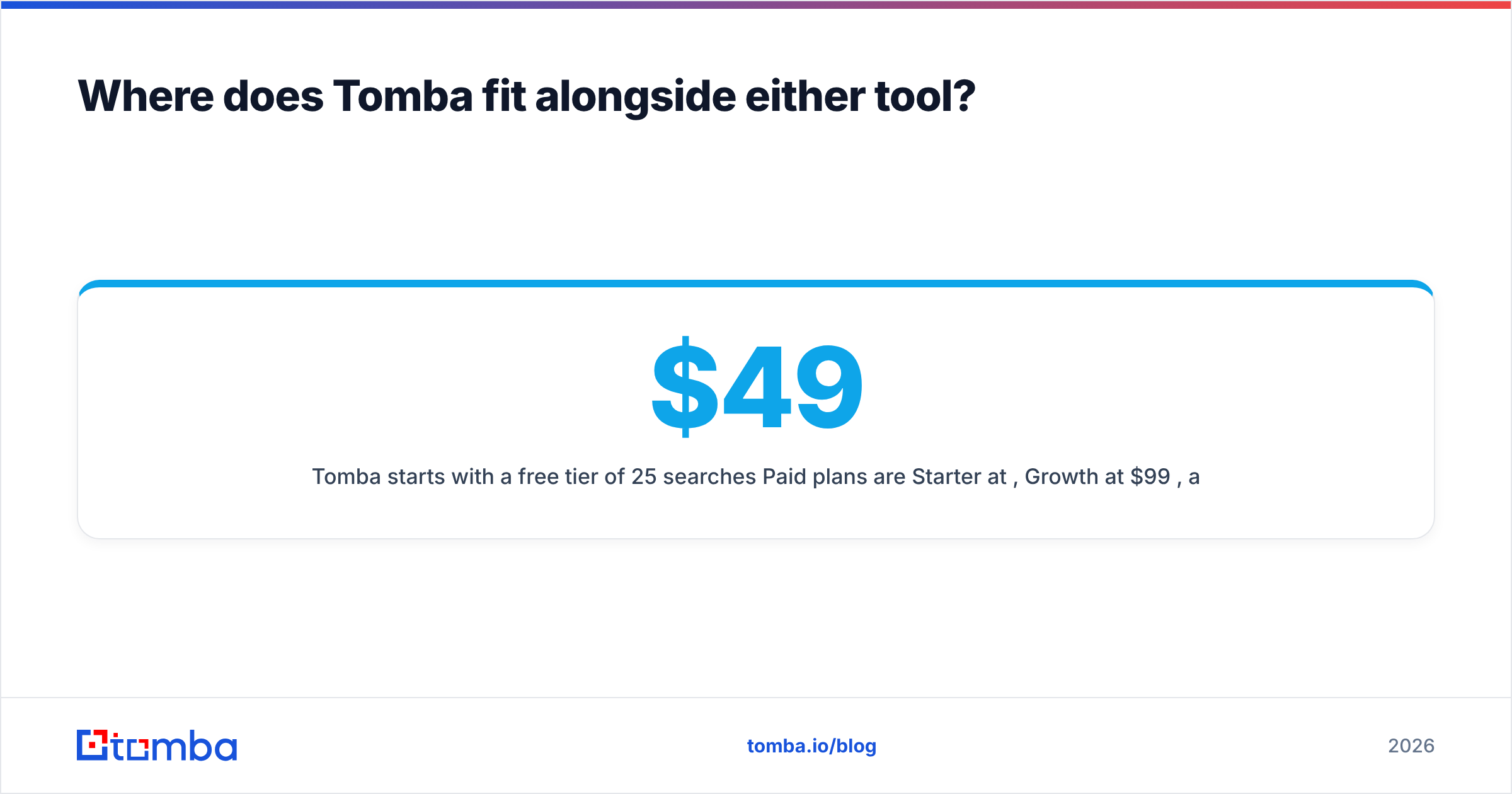
Tomba starts with a free tier of 25 searches/month. Paid plans are Starter at $49/mo, Growth at $99/mo, and Pro at $249/mo, with custom Enterprise pricing. The full breakdown is on the Tomba pricing page.
Frequently asked questions#
Is LeadzenAI a direct Startup Tracker alternative?#
Not really. LeadzenAI is a contact-focused lead-generation tool. Startup Tracker is a startup discovery and monitoring platform. They overlap only when your ICP is startups and you want some contact data in the same place.
Does Startup Tracker provide email addresses?#
Startup Tracker profiles focus on the company, its founders, market, and traction. Verified contact data isn't its core product, so most sales teams pair it with a separate email finder and verifier.
How much does LeadzenAI cost in 2026?#
LeadzenAI offers a freemium plan. Directory listings show paid plans starting around $133/month, with larger editions and custom pricing above that. Confirm current pricing on the vendor's site.
Can I use both tools together?#
Yes. It's often the strongest setup for startup-focused sellers: Startup Tracker to pick the accounts and time the outreach, and a contact tool to reach the right people. Just verify every address before sending.
Ready to close the gap between list and inbox?#
Whichever radar you choose, LeadzenAI or Startup Tracker, your outbound only works if the emails land. Take the domains and names you've shortlisted and run them through the Tomba Email Finder. It returns professional addresses by domain, name, or company, with verification built into the workflow. Start with the free 25 searches, test it on your next 50 target accounts, and compare the reply rates against your current process.
Related guides#
Ready to find emails that actually work?
Join 150,000+ professionals who stopped guessing and started sending. Free credits on signup — no credit card required.
Get the Tomba newsletter
Practical outbound tactics and product updates — once every two weeks.
About the author