LeadzenAI vs ZoomInfo: Honest B2B Data Platform Comparison 2026
LeadzenAI sells affordable, AI-assisted lead search. ZoomInfo sells enterprise data depth with an enterprise contract. Here's where each one wins, where each one costs you, and what to do if neither fits.
TL;DR
- ZoomInfo is the enterprise default. It has deep firmographic, technographic, org-chart, and intent data. It also has pricing that isn't public, annual contracts, and seat-based costs that often reach five figures a year.
- LeadzenAI is a lighter, AI-assisted prospecting tool. It's built for SMBs, agencies, and founders who need lead lists and contact details without an enterprise buying process.
- Pick ZoomInfo if you run a structured RevOps motion with a CRM, several SDRs, and a real need for intent signals and account hierarchies.
- Pick LeadzenAI if your budget is tight, your team is small, and you mostly need "find me decision-makers at companies like X" plus contact details.
- If what you really need is verified work emails at a predictable monthly price, a dedicated email finder may beat both. Test each on your own ICP before you commit.
What are LeadzenAI and ZoomInfo, really?#
These two tools get compared because they both answer the same question: "Who should I sell to, and how do I reach them?" They answer it at very different scales.
ZoomInfo is a publicly traded go-to-market intelligence platform. Its core product, SalesOS, combines a large B2B contact and company database with intent data, org charts, technographics, website visitor tracking, and workflow add-ons such as engagement and conversation intelligence. Enterprise sales teams buy it as a system of record for account data, and it usually sits next to Salesforce or HubSpot. You can see the current product lineup on the ZoomInfo website.
LeadzenAI (leadzen.ai) is an AI-driven B2B lead generation platform. You describe your ideal customer, filter by industry, location, role, and company attributes, and get prospect lists with contact details. It also offers enrichment and a browser extension for pulling contact data while you browse profiles. It's built for self-serve buyers: small sales teams, agencies, recruiters, and founders doing their own outbound.
An analogy: ZoomInfo is a full commercial kitchen with specialist staff, and LeadzenAI is a good home kitchen. The commercial kitchen can do far more, but it costs more to run and you have to commit to a lease. If you only cook dinner for four, you'd be paying for capacity you never use.
How do LeadzenAI and ZoomInfo compare side by side?#
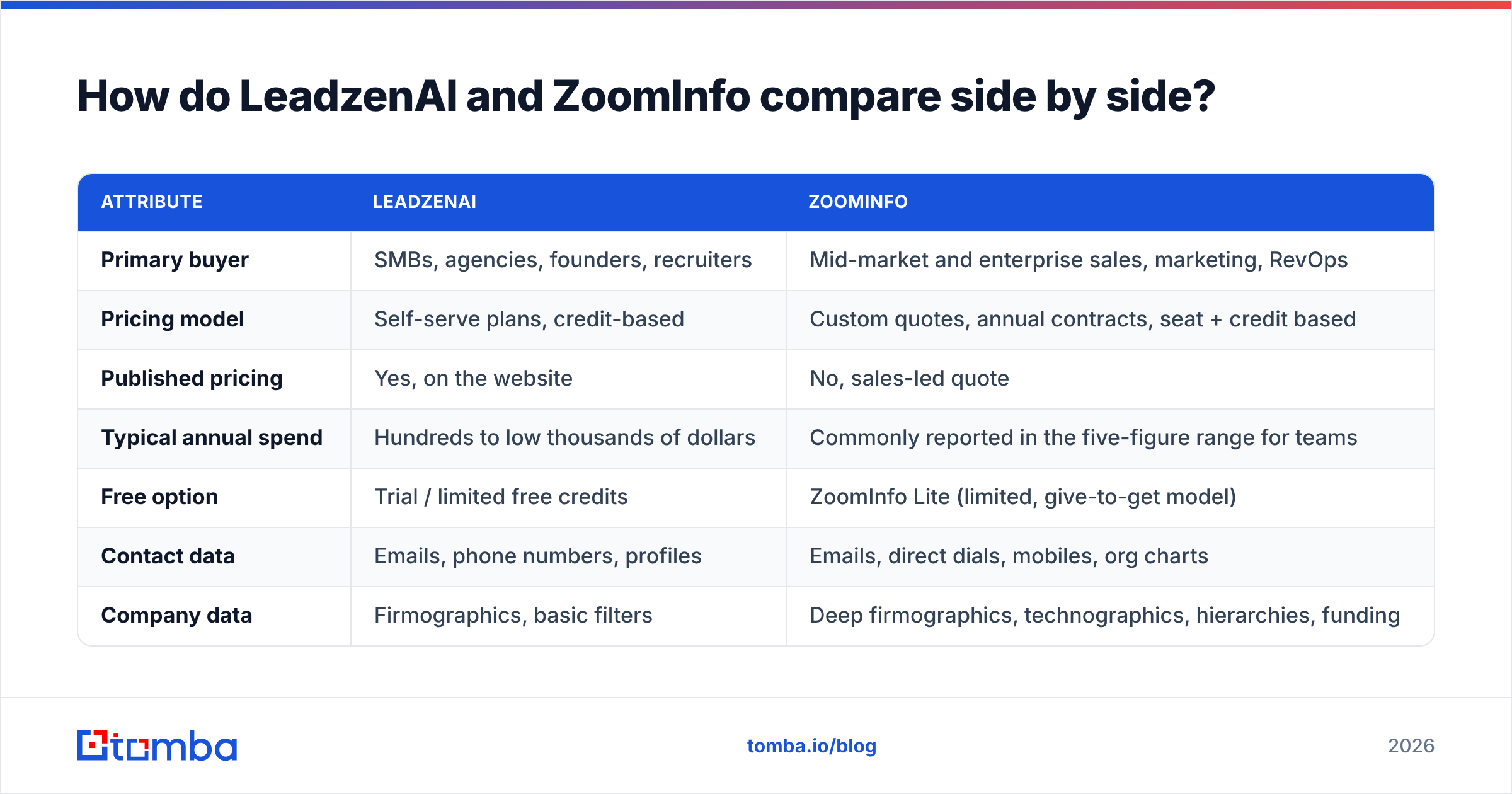
This table covers the attributes buyers usually ask about. Pricing changes often and ZoomInfo doesn't publish list prices, so treat the cost rows as directional and confirm with each vendor.
| Attribute | LeadzenAI | ZoomInfo |
|---|---|---|
| Primary buyer | SMBs, agencies, founders, recruiters | Mid-market and enterprise sales, marketing, RevOps |
| Pricing model | Self-serve plans, credit-based | Custom quotes, annual contracts, seat + credit based |
| Published pricing | Yes, on the website | No, sales-led quote |
| Typical annual spend | Hundreds to low thousands of dollars | Commonly reported in the five-figure range for teams |
| Free option | Trial / limited free credits | ZoomInfo Lite (limited, give-to-get model) |
| Contact data | Emails, phone numbers, profiles | Emails, direct dials, mobiles, org charts |
| Company data | Firmographics, basic filters | Deep firmographics, technographics, hierarchies, funding |
| Intent data | Limited / AI-based search signals | Yes, a core differentiator (Streaming Intent) |
| CRM integrations | Export + common integrations | Native Salesforce, HubSpot, Dynamics, plus enrichment workflows |
| Onboarding | Self-serve in minutes | Implementation, admin setup, training |
| Contract risk | Low (monthly or short plans) | High (annual terms, auto-renewal clauses to watch) |
| Best for | Fast list building on a budget | Account-based selling at scale |
The gap is widest in three places: intent data, account hierarchies, and commercial terms. If none of those matter to you, most of ZoomInfo's price premium buys you nothing.

Which factors should decide LeadzenAI vs ZoomInfo?#
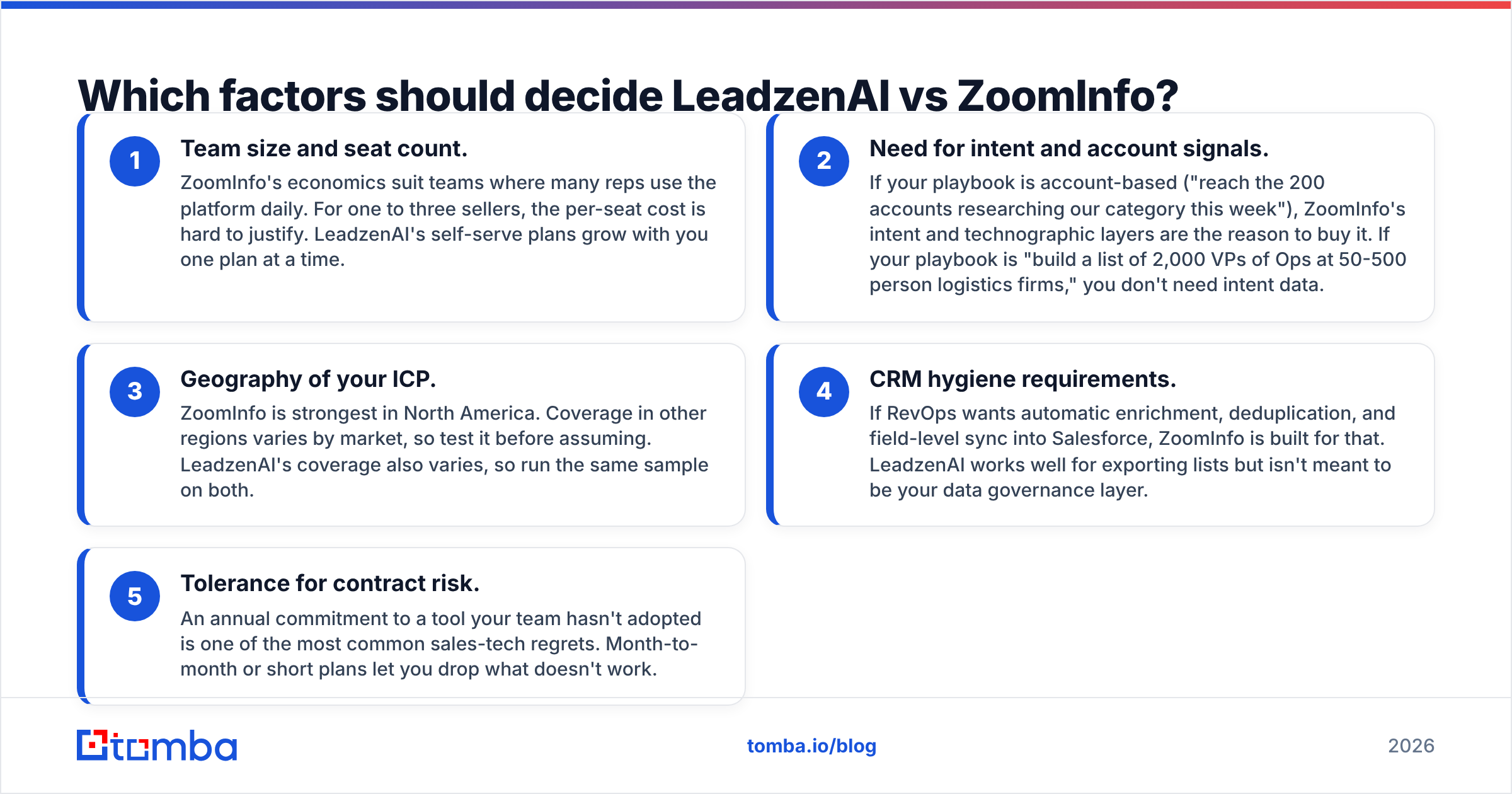
Don't start with feature lists. Start with how your team actually prospects. These five factors settle most LeadzenAI vs ZoomInfo decisions:
- Team size and seat count. ZoomInfo's economics suit teams where many reps use the platform daily. For one to three sellers, the per-seat cost is hard to justify. LeadzenAI's self-serve plans grow with you one plan at a time.
- Need for intent and account signals. If your playbook is account-based ("reach the 200 accounts researching our category this week"), ZoomInfo's intent and technographic layers are the reason to buy it. If your playbook is "build a list of 2,000 VPs of Ops at 50-500 person logistics firms," you don't need intent data.
- Geography of your ICP. ZoomInfo is strongest in North America. Coverage in other regions varies by market, so test it before assuming. LeadzenAI's coverage also varies, so run the same sample on both.
- CRM hygiene requirements. If RevOps wants automatic enrichment, deduplication, and field-level sync into Salesforce, ZoomInfo is built for that. LeadzenAI works well for exporting lists but isn't meant to be your data governance layer.
- Tolerance for contract risk. An annual commitment to a tool your team hasn't adopted is one of the most common sales-tech regrets. Month-to-month or short plans let you drop what doesn't work.
How accurate is the contact data from each?#
Neither vendor can promise that every email will deliver. B2B contact data decays constantly because people change jobs, companies rebrand domains, and mail servers change configuration. Industry estimates usually put B2B data decay at roughly 20-30% a year, which is why the date a contact was last verified matters as much as how many contacts a database holds.
What we see in practice:
- ZoomInfo puts heavy investment into data collection and human and machine verification. Its direct dials and org-chart data are generally regarded as a strength, especially for US mid-market and enterprise accounts. Reviews on G2 often praise the depth while complaining about stale records at smaller companies and the cost of credits.
- LeadzenAI gets you to a list quickly. As with most budget platforms, email accuracy depends on the segment. Well-documented companies come back clean. Small companies, catch-all domains, and non-US markets need more checking.
Whichever tool you choose, run every exported list through an email verifier before sending. A 5% bounce rate on one campaign can hurt your sender reputation for weeks, and no data vendor pays that cost for you.
A fair test takes one afternoon:
- Pull the same 100 target contacts (same titles, same accounts) from both tools.
- Count how many records each tool returns (coverage).
- Verify all emails and count valid, risky, and invalid results (accuracy).
- Spot-check 10 phone numbers per tool (connect rate).
- Divide cost by valid contacts (cost per usable lead).
The last number, cost per usable lead, is the only one worth putting in a budget request.
How much do LeadzenAI and ZoomInfo cost?#
ZoomInfo doesn't publish pricing. It sells through tiered packages (historically Professional, Advanced, and Elite for SalesOS) with add-ons for extra seats, credits, intent topics, and modules. Buyer reports and procurement marketplaces commonly place entry contracts in the low-to-mid five figures per year, with larger teams paying much more. Negotiate hard on:
- Credit allotments and what happens to unused credits
- Auto-renewal notice windows (often 60-90 days before term end)
- Price increase caps at renewal
- Data export rights if you leave
LeadzenAI publishes self-serve plans on its site, with credit limits that go up by tier. For most small teams the total yearly cost is a small fraction of a ZoomInfo contract. Check the current plan page before you budget, because credit definitions (what counts as one "credit": a profile view, an email reveal, or a phone reveal) differ between vendors and change how far your money goes.
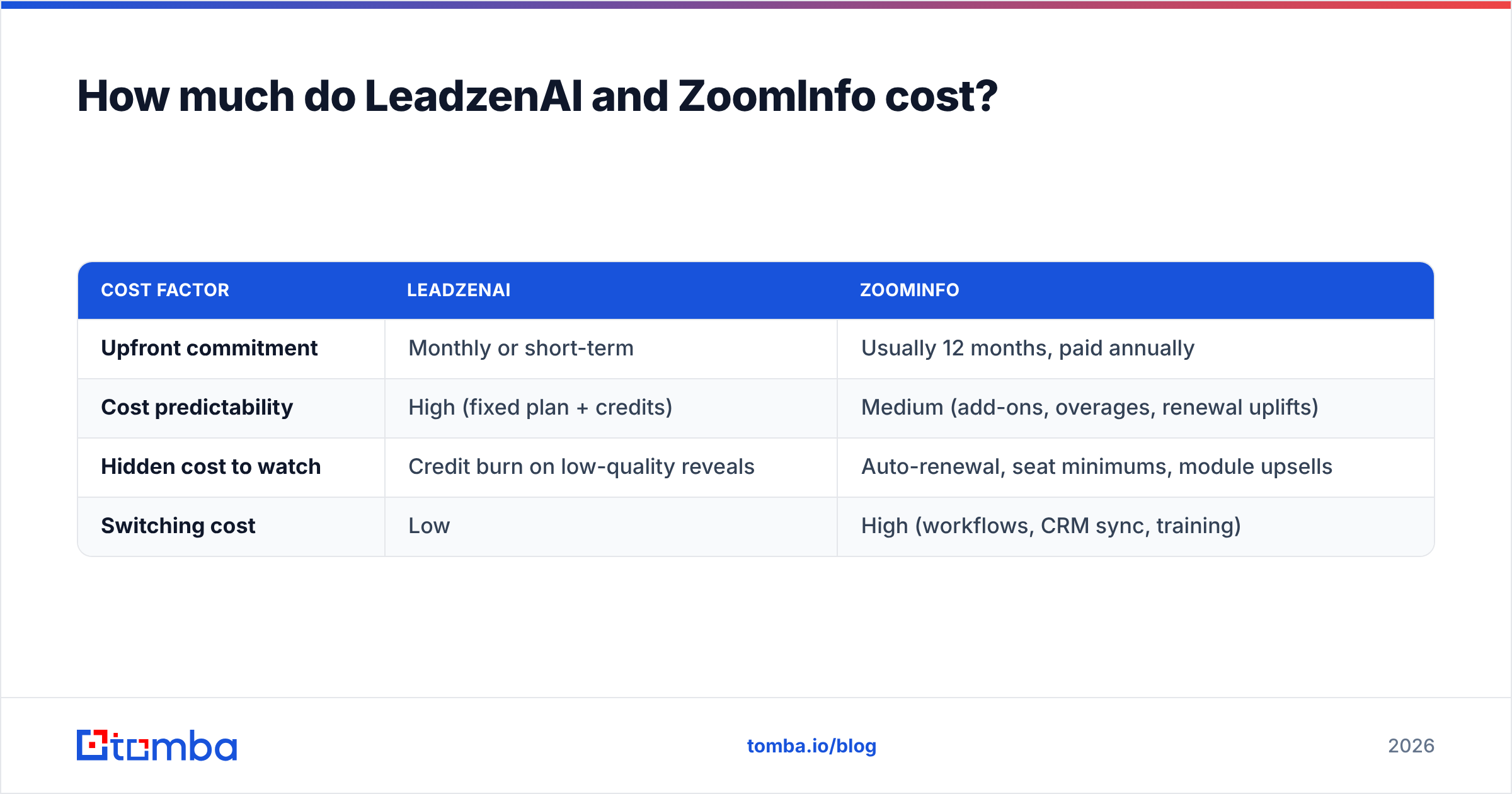
Here's how the two cost models compare for a typical three-person outbound team:
| Cost factor | LeadzenAI | ZoomInfo |
|---|---|---|
| Upfront commitment | Monthly or short-term | Usually 12 months, paid annually |
| Cost predictability | High (fixed plan + credits) | Medium (add-ons, overages, renewal uplifts) |
| Hidden cost to watch | Credit burn on low-quality reveals | Auto-renewal, seat minimums, module upsells |
| Switching cost | Low | High (workflows, CRM sync, training) |
If you only need email addresses for a defined list of accounts, compare both against a pay-as-you-go email finder. Tomba pricing, for reference, starts with a free tier of 25 searches a month, then Starter at $49/mo, Growth at $99/mo, and Pro at $249/mo, all published up front.
Is ZoomInfo better than LeadzenAI?#
For the job it was built to do, yes. ZoomInfo is the more complete platform. If you need:
- Intent data to prioritize in-market accounts
- Org charts and reporting lines for multi-threaded enterprise deals
- Technographics ("companies using Snowflake and Salesforce, 1,000+ employees")
- Automated CRM enrichment and ongoing data hygiene
- Website visitor intelligence tied to account records
...then LeadzenAI isn't a like-for-like replacement, and pretending otherwise will cost you pipeline.
"Better" only matters if you use the extra capability, though. Many ZoomInfo customers mostly use it for search, export, and email lookup. If that's your team, you're paying enterprise prices for a list-building workflow. Forrester and Gartner research on sales tech adoption keeps finding that companies underuse the tools they license. The Gartner sales technology research hub is a good place to see how common shelfware is.
When is LeadzenAI the smarter choice?#
LeadzenAI is the better pick when speed and budget matter more than depth:
- Founder-led sales. You're the only seller and you need 300 good prospects this month, not a data platform.
- Agencies running outbound for clients. You need to build lists for many ICPs quickly and bill the cost per client.
- Early-stage testing. You're testing a new vertical or geography and don't want an annual contract before you know it converts.
- Recruiting and partnerships. Your outreach isn't a revenue-team sales motion, so enterprise RevOps features don't apply.
The trade-off: you take on more of the data-quality work yourself. Plan to verify emails, deduplicate lists, and enrich missing fields before anything goes into your CRM. A data enrichment step between export and outreach covers most of the gaps.

What are the pros and cons of each?#
LeadzenAI pros
- Self-serve signup, working in minutes
- Published, affordable plans
- AI-assisted search makes ICP list building quick
- Low commitment, easy to cancel or downgrade
LeadzenAI cons
- Shallower company intelligence (no enterprise-grade intent or hierarchies)
- Data quality varies more by segment and region
- Fewer native, bi-directional CRM sync options
- Smaller review footprint, so there's less independent validation
ZoomInfo pros
- One of the deepest B2B contact and company datasets available
- Intent data, technographics, and org charts in one place
- Strong native CRM integrations and enrichment automation
- Mature admin controls, compliance tooling, and support
ZoomInfo cons
- No public pricing, and contracts often reach five figures a year
- Annual commitments with renewal terms you have to watch
- Can be too much for small teams, who pay for unused modules
- Credit limits frustrate heavy users
What if neither LeadzenAI nor ZoomInfo fits?#
A lot of teams comparing LeadzenAI vs ZoomInfo discover that their real bottleneck is simpler: they already know which companies to target and just need accurate work emails for the right people. In that case, a full lead database is the wrong tool.
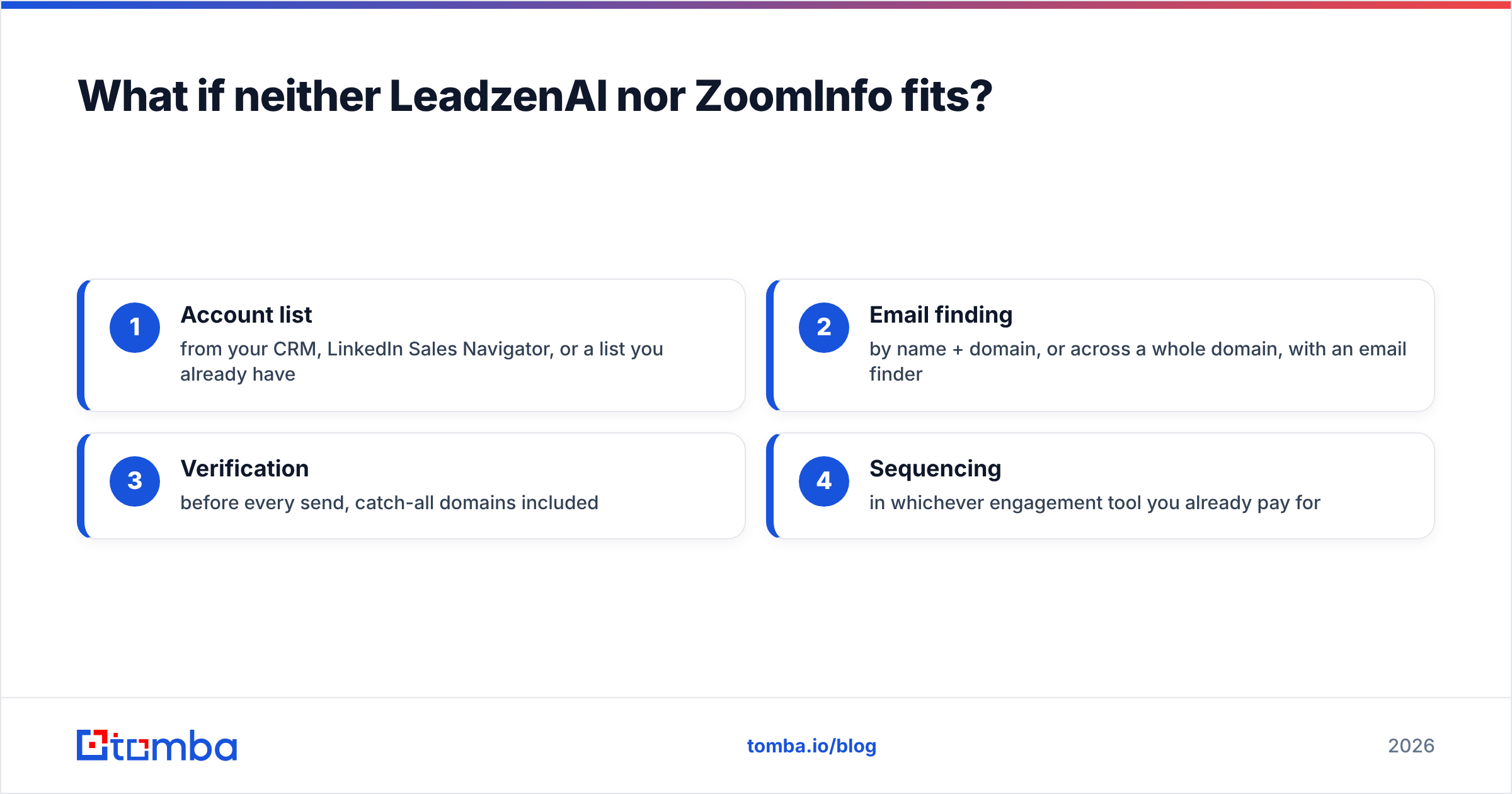
A lean stack that works for many teams:
- Account list from your CRM, LinkedIn Sales Navigator, or a list you already have
- Email finding by name + domain, or across a whole domain, with an email finder
- Verification before every send, catch-all domains included
- Sequencing in whichever engagement tool you already pay for
This setup costs a fraction of a ZoomInfo contract, is more targeted than a generic LeadzenAI export, and keeps each layer replaceable. If you later grow into intent-driven ABM, you can add ZoomInfo then, when the use case justifies the contract.
So which should you choose in 2026?#
- Choose ZoomInfo if you have 5+ quota-carrying reps, a RevOps function, an account-based strategy, and budget approved for a multi-year data platform. Negotiate renewal terms before you sign.
- Choose LeadzenAI if you're a small team or agency that needs affordable, fast list building and can live with doing your own verification.
- Choose a dedicated email finder if your accounts are already defined and deliverable contact emails are the missing piece.
Whichever route you take, run the 100-contact head-to-head described above. Cost per verified, usable contact will tell you more than any vendor demo or review.
Ready to test the lean option? Tomba Email Finder finds professional email addresses by name, domain, or company, with verification built in. The free tier gives you 25 searches a month, so you can run it against your own target accounts next to LeadzenAI or ZoomInfo and compare cost per usable lead before you commit to anything.
Related guides#
Ready to find emails that actually work?
Join 150,000+ professionals who stopped guessing and started sending. Free credits on signup — no credit card required.
Get the Tomba newsletter
Practical outbound tactics and product updates — once every two weeks.
About the author