Leaky Sales Funnel: How to Find and Fix the 7 Biggest Leaks
Most funnels don't have a lead problem. They have a leak problem. Here's how to find the exact stage where your deals disappear, and the fix for each of the seven most common leaks.
TL;DR
- A leaky sales funnel loses qualified buyers between stages. Buying more leads won't fix it, because the same share of the new leads leaks out too.
- Most leaks fall into seven groups: bad contact data, slow response, weak qualification, poor handoffs, follow-up that stops too early, stalled mid-funnel deals, and lost deals nobody reviews.
- Before you fix anything, measure stage-to-stage conversion and time-in-stage. The stage with the worst drop-off relative to its benchmark is the one to fix first.
- Data quality is the cheapest leak to fix and the one teams skip most often. If a contact is wrong, every later stage fails for that lead.
- Fix one leak at a time, measure for two to four weeks, then move to the next.
What is a leaky sales funnel?#
A leaky sales funnel is a pipeline where good prospects drop out between stages for reasons you could have prevented. Some drop-off is normal. Every funnel narrows, which is the whole idea behind the purchase funnel model. The problem is drop-off that has nothing to do with fit: the buyer was a good match and ready to talk, and you lost them anyway.
Think of a bucket with holes in it. You can keep pouring water in faster, which is what most teams do when they buy more lead lists, add SDRs, or raise ad spend. Or you can patch the holes. Patching almost always pays back faster, because every lead you already paid for is worth more afterward.
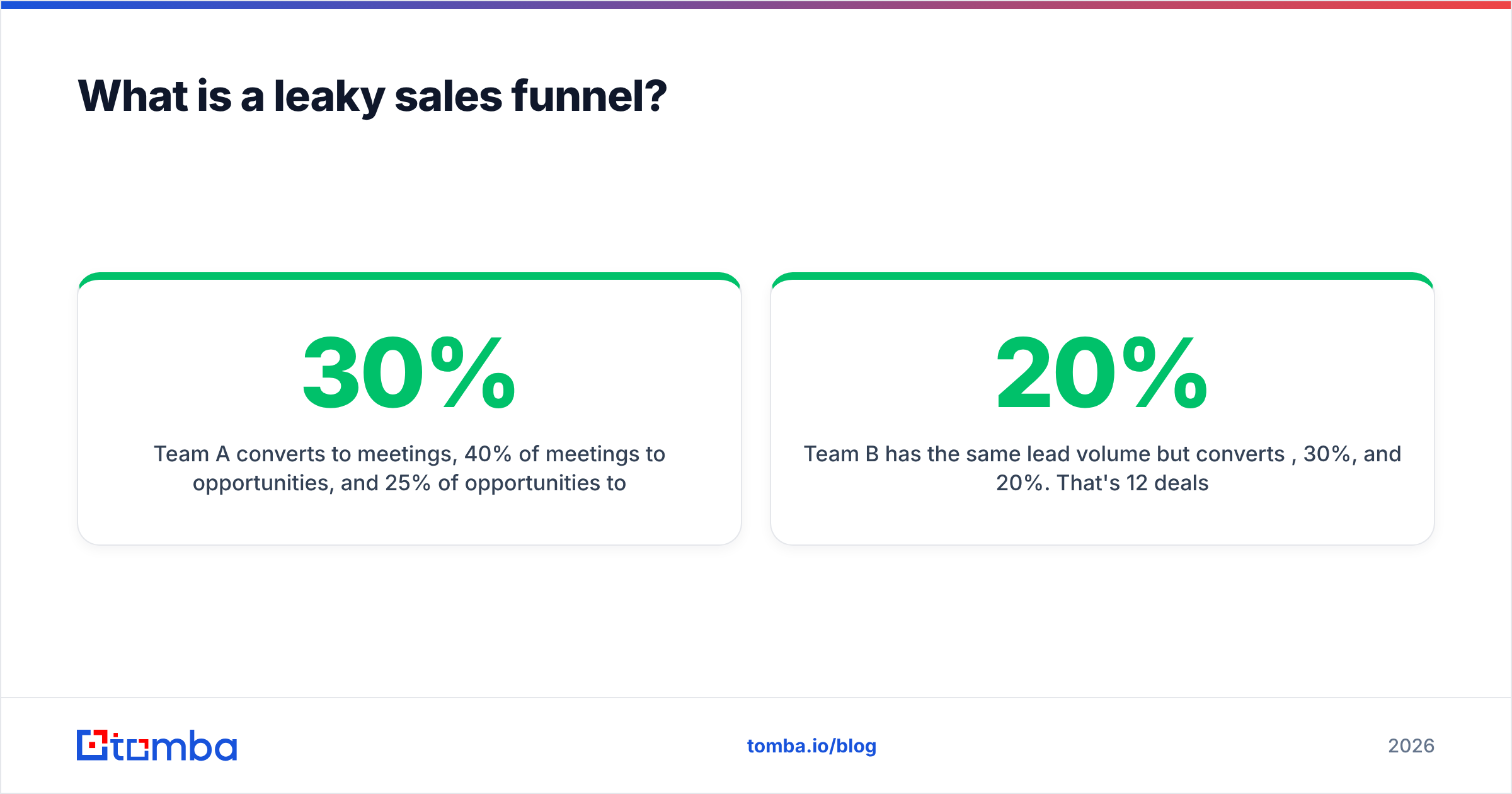
Here's the difference in practice. Say two teams each generate 1,000 leads a month:
- Team A converts 30% to meetings, 40% of meetings to opportunities, and 25% of opportunities to closed-won. That's 30 deals.
- Team B has the same lead volume but converts 20%, 30%, and 20%. That's 12 deals.
Team B doesn't have a lead problem. It has a leak problem. Doubling its lead volume gets it 24 deals, which is still behind Team A, and it costs twice as much.
How do you know your sales funnel is leaking?#
You find leaks by looking at stage-to-stage conversion rates and time-in-stage. Total pipeline value won't show them. Pipeline can look healthy while deals quietly rot inside it.
Look for these signals:
- Conversion falls sharply at one stage. For example, 35% of leads book meetings, but only 10% of meetings turn into opportunities.
- Time-in-stage keeps growing. Deals sit in "proposal sent" for 45 days when they used to close in 20.
- High bounce or no-reply rates on outbound. This usually means a data problem, not a messaging problem.
- Reps disagree on stage definitions. If "qualified" means something different to each rep, your conversion numbers are noise.
- Closed-lost reasons are mostly "no decision" or blank. That means nobody knows why deals die.
Your CRM should give you most of this. If it can't, fix your stage definitions and required fields before you try to diagnose anything. A funnel you can't measure is one you can't fix.
Where do most sales funnels leak?#
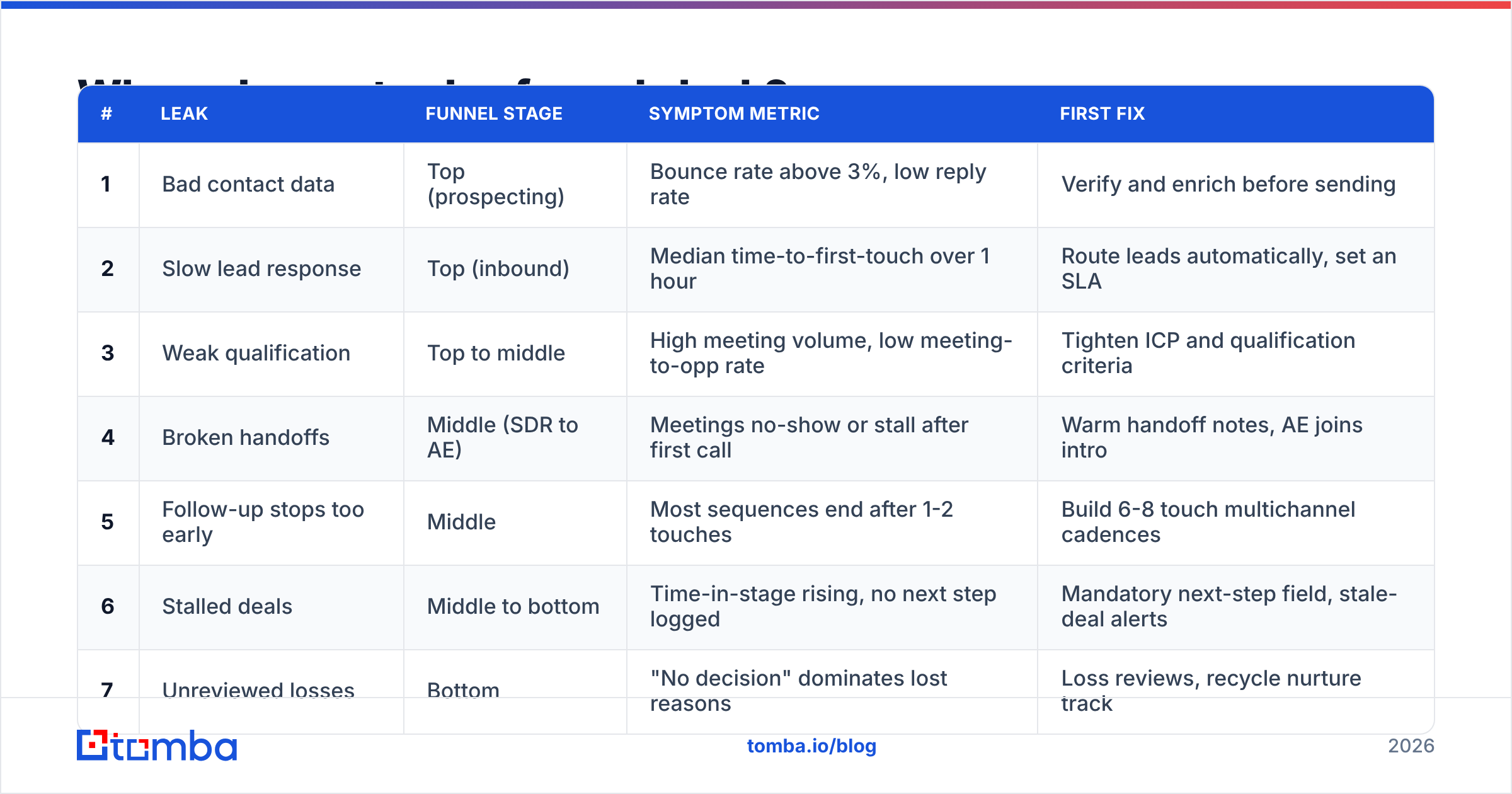
Most B2B funnels lose deals in the same seven places. The table below maps each leak to the stage where it shows up, the metric that exposes it, and the first fix to try.
| # | Leak | Funnel stage | Symptom metric | First fix |
|---|---|---|---|---|
| 1 | Bad contact data | Top (prospecting) | Bounce rate above 3%, low reply rate | Verify and enrich before sending |
| 2 | Slow lead response | Top (inbound) | Median time-to-first-touch over 1 hour | Route leads automatically, set an SLA |
| 3 | Weak qualification | Top to middle | High meeting volume, low meeting-to-opp rate | Tighten ICP and qualification criteria |
| 4 | Broken handoffs | Middle (SDR to AE) | Meetings no-show or stall after first call | Warm handoff notes, AE joins intro |
| 5 | Follow-up stops too early | Middle | Most sequences end after 1-2 touches | Build 6-8 touch multichannel cadences |
| 6 | Stalled deals | Middle to bottom | Time-in-stage rising, no next step logged | Mandatory next-step field, stale-deal alerts |
| 7 | Unreviewed losses | Bottom | "No decision" dominates lost reasons | Loss reviews, recycle nurture track |
The sections below go through each leak in order, starting at the top of the funnel, because a leak near the top reduces everything that happens below it.
Why is bad data the most expensive leak?#
Bad data is the most expensive leak because it happens first and nothing later can make up for it. When an email bounces, the lead is gone. A better subject line won't help and neither will a sharper AE. You also pay twice: once for the lost prospect, and again in sender reputation damage that lowers inbox placement for every other email you send.
B2B contact data decays all the time. People change jobs, companies rebrand domains, and role-based inboxes get shut down. A list that was clean six months ago isn't clean now.
How to patch it:
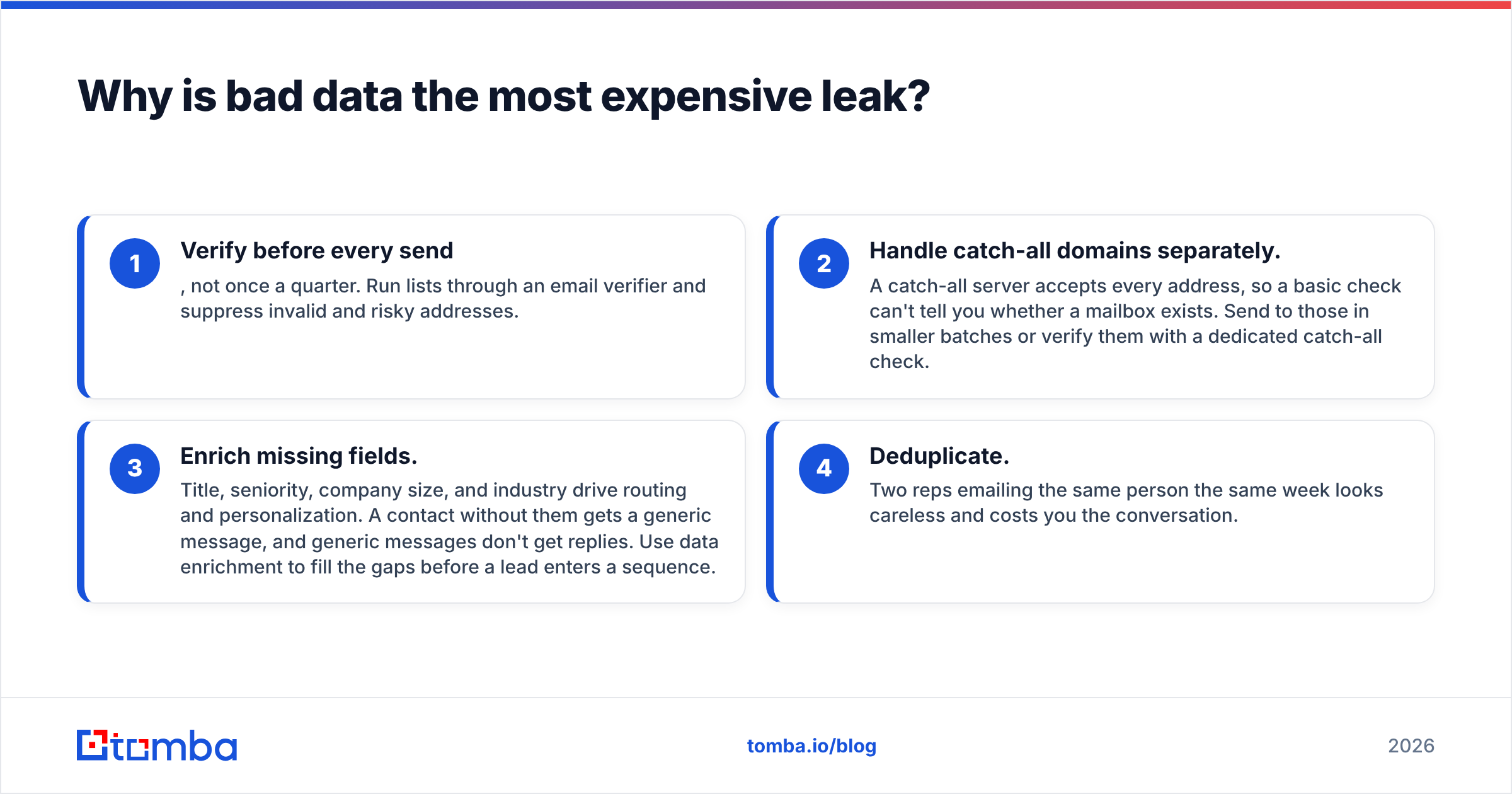
- Verify before every send, not once a quarter. Run lists through an email verifier and suppress invalid and risky addresses.
- Handle catch-all domains separately. A catch-all server accepts every address, so a basic check can't tell you whether a mailbox exists. Send to those in smaller batches or verify them with a dedicated catch-all check.
- Enrich missing fields. Title, seniority, company size, and industry drive routing and personalization. A contact without them gets a generic message, and generic messages don't get replies. Use data enrichment to fill the gaps before a lead enters a sequence.
- Deduplicate. Two reps emailing the same person the same week looks careless and costs you the conversation.
What to measure: bounce rate (keep it under 2-3%), reply rate by list source, and the share of contacts missing key fields.
How fast should you respond to a new lead?#
Respond within minutes, and never more than an hour. Harvard Business Review's research on the short life of online sales leads found that firms contacting a lead within an hour were nearly seven times as likely to qualify it as firms that waited longer. The study is from 2011, but the finding holds up. Buyers who fill in a form are comparing options right then, and whoever replies first sets the frame.
How to patch it:
- Route inbound leads automatically by territory or segment. Don't park them in a shared queue.
- Set a written SLA, for example "first touch within 15 minutes during business hours", and report on it weekly.
- Offer instant booking on the form's thank-you page so high-intent buyers can schedule without waiting for a rep.
- For after-hours leads, send an immediate personal-sounding acknowledgment and make the first live touch at the start of the next business day.
Is your qualification too loose or too strict?#
Either one leaks. Loose qualification fills calendars with meetings that never turn into opportunities, and AEs spend their week on bad-fit calls. Strict qualification throws out buyers who would have closed because they didn't tick a box on the first call.
The fix is to define qualification with data, not gut feel:
- Pull your last 50 closed-won deals and list what they share: company size, industry, tech stack, buyer title, trigger event.
- Pull your last 50 closed-lost deals and do the same.
- Write your ICP from the differences between the two lists, not from what marketing wishes were true.
- Make qualification criteria required fields in the CRM, so a deal can't move forward without them.
If you use a framework like BANT or MEDDIC, keep it light at the SDR stage. Confirm fit and a real problem, then let the AE dig into budget and decision process.
What happens when SDR-to-AE handoffs break?#
The buyer ends up repeating themselves, loses confidence, and stops responding. The handoff is a sneaky leak because both sides of it look fine on paper: the SDR hit their meeting quota, and the AE ran the call. The deal just never moved.
How to patch it:
- Warm handoff notes with a standard template: pain stated in the buyer's own words, current tool, timeline, who else is involved, and what was promised.
- AE joins the last few minutes of the SDR's qualifying call, or at least sends a personal intro email before the meeting.
- Track no-show rate by SDR and AE pair. A pair with a high no-show rate usually has a handoff problem, not a lead-quality problem.
- Shared credit. When SDRs are paid on opportunities created instead of meetings booked, handoff quality goes up.

Why does follow-up stop too early?#
Reps treat no reply as a no. Usually it isn't. It means the email arrived on a busy day, got buried, or reached someone who meant to answer later. Stopping after one or two touches leaves interested buyers behind, and it's one of the most common leaks in outbound.
How to patch it:
- Build cadences of 6-8 touches over 3-4 weeks, mixing email, phone, and LinkedIn.
- Make every follow-up add something new, such as a relevant case study, a short insight, or a question. "Just bumping this" adds nothing.
- Space touches out: tighter at the start, wider later.
- End with a clear breakup email. These often get replies because they give the buyer an easy out.
- Track your email response rate by touch number. If touches 4-6 are producing replies, early stopping has been costing you deals.
How do you unstick stalled mid-funnel deals?#
Give every deal a dated next step, and treat a deal with no next step as at risk. Deals don't die all at once. They slow down, lose their next step, and fade from the rep's attention until someone marks them closed-lost months later.
How to patch it:
- Mandatory next-step field with a date. If the date passes with no update, the deal gets flagged.
- Stale-deal alerts when time-in-stage goes past 1.5x your average for that stage.
- Multi-thread early. A deal with one contact stalls when that person goes on holiday, changes priorities, or leaves. Map at least two or three stakeholders by the proposal stage. A domain search is a quick way to find other decision-makers at the same company.
- Mutual action plans for larger deals, so both sides agree on the steps and dates to signature.
Salesforce's State of Sales research keeps finding that reps spend most of their week on non-selling work. Stalled deals make that worse, because reps end up chasing deals that aren't moving instead of working ones that are.
What should you do with lost deals?#
Review them, categorize them honestly, and recycle the ones that are recoverable. A lost deal that nobody reviews is a leak twice over: you lose the revenue, and you lose what it could have taught you.
How to patch it:
- Require a specific loss reason. Ban "other" and allow "no decision" only with a short note.
- Run a monthly loss review. Pick five lost deals and walk through what happened at each stage. Patterns show up quickly.
- Build a recycle track. "Bad timing" and "no budget this quarter" are not permanent. Put those contacts into a low-touch nurture and re-engage them in 90-180 days.
- Re-verify before re-engaging. Six months later, a fair share of those contacts will have changed jobs. The good news is that a champion who moved to a new company is often a warm lead there.
How do you prioritize which leak to fix first?#
Fix the leak with the biggest gap between your conversion rate and a realistic benchmark, weighted by how far up the funnel it sits. A leak at the top multiplies through every stage below it, so a 5-point gain there is usually worth more than the same gain at the bottom.
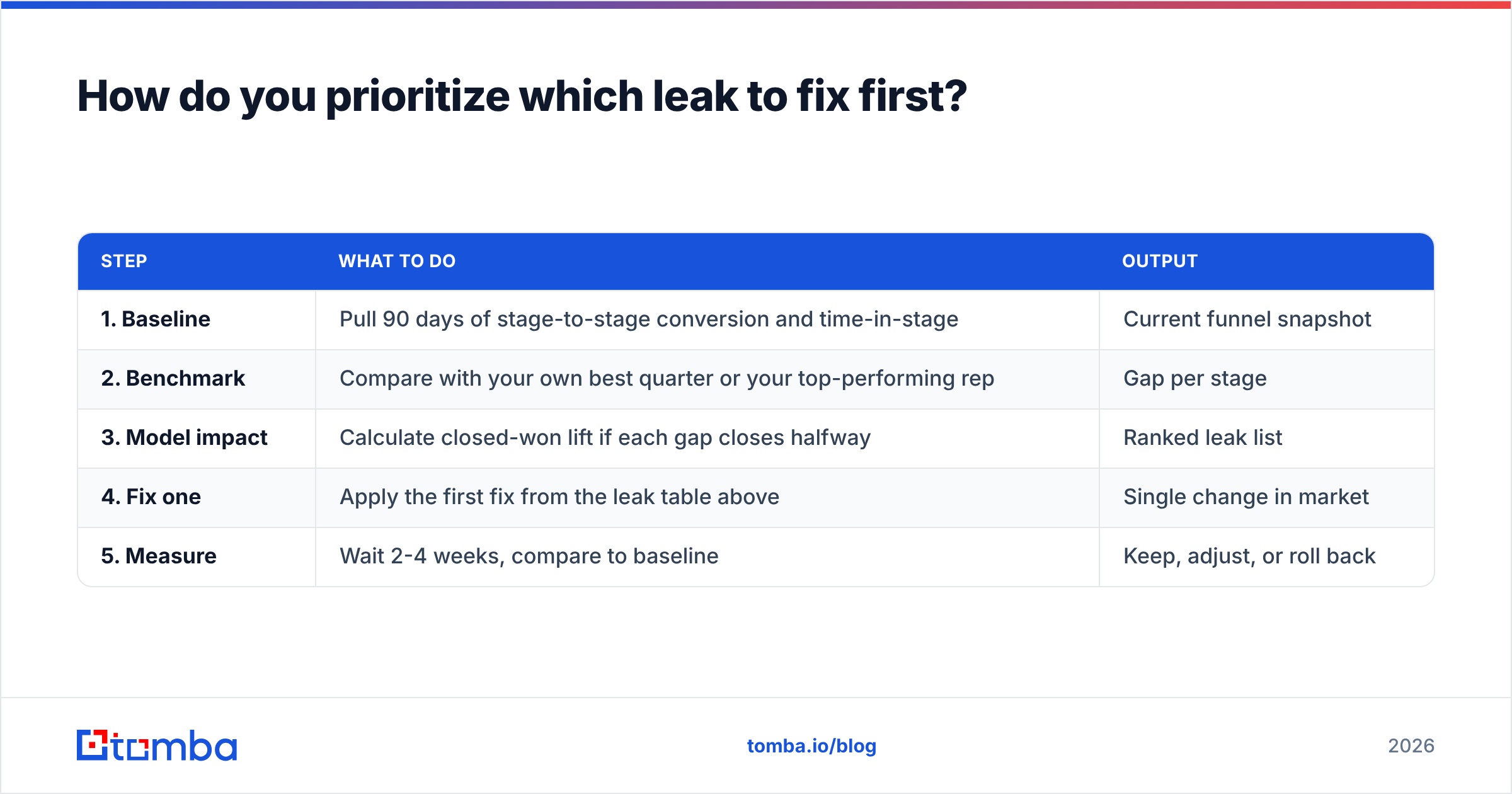
A simple way to prioritize:
| Step | What to do | Output |
|---|---|---|
| 1. Baseline | Pull 90 days of stage-to-stage conversion and time-in-stage | Current funnel snapshot |
| 2. Benchmark | Compare with your own best quarter or your top-performing rep | Gap per stage |
| 3. Model impact | Calculate closed-won lift if each gap closes halfway | Ranked leak list |
| 4. Fix one | Apply the first fix from the leak table above | Single change in market |
| 5. Measure | Wait 2-4 weeks, compare to baseline | Keep, adjust, or roll back |
Don't fix three leaks at once. If you change data sources, cadence length, and qualification criteria in the same month, you won't know which change moved the numbers, or which one quietly made things worse.
Is buying more leads ever the right fix?#
Sometimes, but only after the funnel holds water. If your conversion rates are close to your benchmarks at every stage and you still miss targets, you have a volume problem, and more leads is the right answer. If one stage is far below benchmark, new leads just leak at the same rate.
When you do add volume, the source matters more than the quantity. A smaller list of verified, enriched contacts that match your ICP will beat a large scraped list almost every time, because it doesn't bring new leaks at the top. Tools like HubSpot or your existing CRM can track conversion by lead source, so you can see which sources actually turn into pipeline and cut the ones that don't.
Fixing the first leak#
Most teams can find their worst leak in an afternoon with a CRM export and a spreadsheet. The fixes are rarely complicated. They take discipline: verify before you send, respond fast, qualify with data, hand off cleanly, keep following up, give every deal a next step, and learn from every loss.
If your diagnosis points to the top of the funnel, with bounces, low reply rates, or contacts missing basic fields, start there. Tomba Email Finder finds professional email addresses by name, domain, or company and verifies them before they reach your sequence, so fewer leads drop out at the first step. The free tier includes 25 searches a month for testing it on a live list, and paid plans start at $49/mo when you're ready to run it across your whole pipeline.
Related guides#
// get started
Find, verify and enrich your first contacts today
Start on the free plan with 25 searches a month, then scale when your team is ready.
Free plan · No credit card required · GDPR & CCPA
Get the Tomba newsletter
Product and data updates
// about the author