LeanData Alternatives: 7 Lead Routing Tools Compared for 2026
LeanData is powerful but costly and heavily tied to Salesforce. Here are 7 LeanData alternatives for lead routing, matching, and scheduling, plus how to choose one based on your CRM, budget, and RevOps headcount.
TL;DR
- LeanData is still the reference tool for complex, Salesforce-native lead-to-account matching and routing. Its pricing is quote-based, it is Salesforce-first, and it usually needs a dedicated RevOps admin.
- Chili Piper and Default fit best if you care about speed-to-lead on inbound forms and booking meetings. Traction Complete is the closest like-for-like LeanData alternative inside Salesforce.
- Openprise and ZoomInfo Operations OS (formerly RingLead) are data-orchestration platforms that include routing. Pick them when dirty data is the bigger problem.
- If your routing logic fits on one whiteboard, native Salesforce Flow or HubSpot workflows may be enough, and they cost you nothing extra.
- Routing quality depends on the data you feed it. Missing emails, wrong domains, and unmatched accounts cause more misroutes than any rules engine.
What is LeanData, and why do teams look for alternatives?#
LeanData is a revenue orchestration platform built on Salesforce. Its main job is to take an incoming lead, match it to the right account, and route it to the right owner through a visual drag-and-drop flow builder. Over time it has added BookIt (scheduling), account-based routing, buyer-group matching, and Slack notifications.
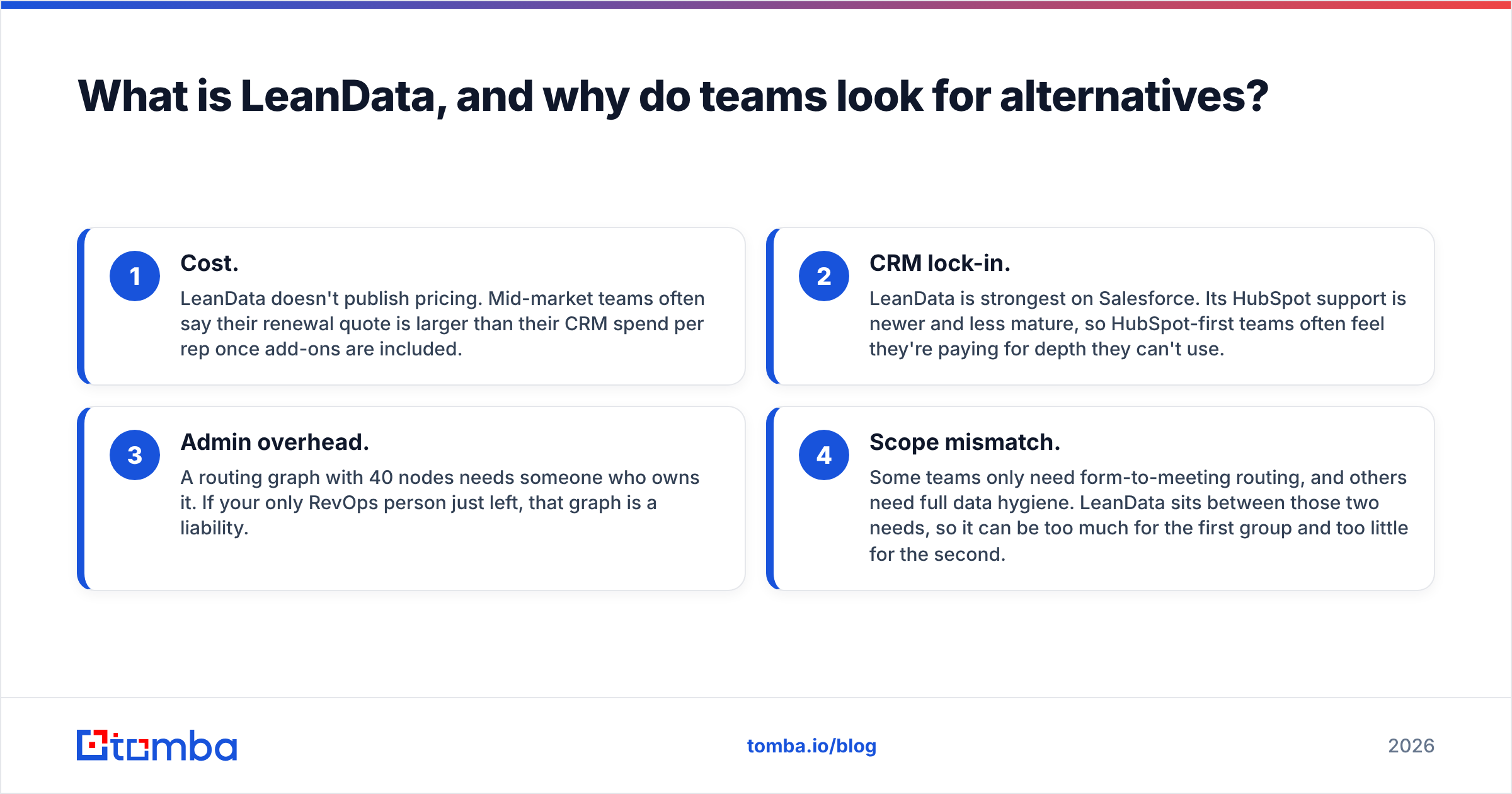
It does these things well. Teams usually start looking at LeanData alternatives for one of four reasons:
- Cost. LeanData doesn't publish pricing. Mid-market teams often say their renewal quote is larger than their CRM spend per rep once add-ons are included.
- CRM lock-in. LeanData is strongest on Salesforce. Its HubSpot support is newer and less mature, so HubSpot-first teams often feel they're paying for depth they can't use.
- Admin overhead. A routing graph with 40 nodes needs someone who owns it. If your only RevOps person just left, that graph is a liability.
- Scope mismatch. Some teams only need form-to-meeting routing, and others need full data hygiene. LeanData sits between those two needs, so it can be too much for the first group and too little for the second.
In practice, routing is a RevOps problem that happens to be solved in software. The right alternative depends on which of those four reasons applies to you.
What should a LeanData alternative actually do?#
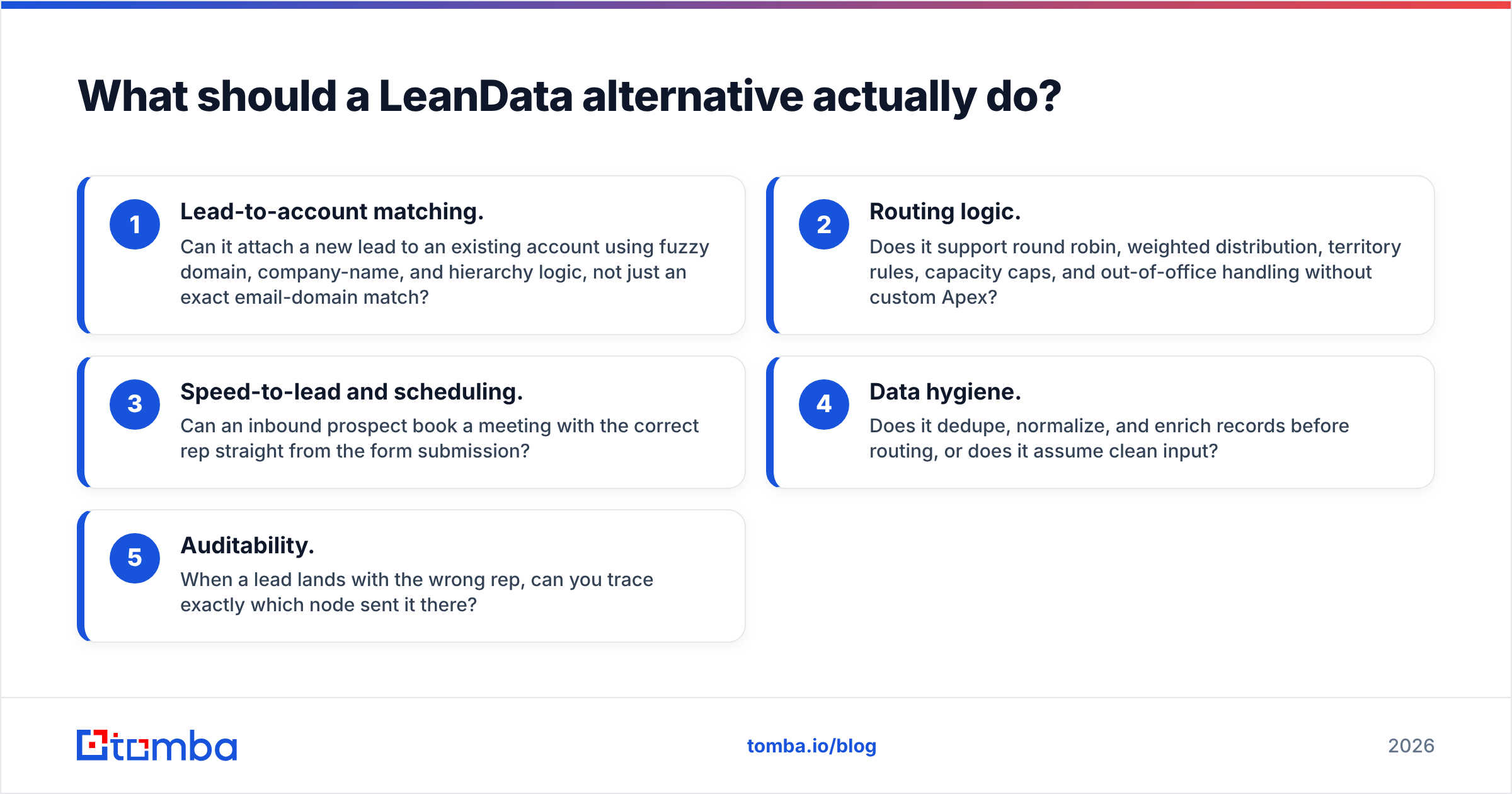
Before comparing vendors, list the jobs you are hiring the tool for. Most LeanData evaluations come down to these five capabilities:
- Lead-to-account matching. Can it attach a new lead to an existing account using fuzzy domain, company-name, and hierarchy logic, not just an exact email-domain match?
- Routing logic. Does it support round robin, weighted distribution, territory rules, capacity caps, and out-of-office handling without custom Apex?
- Speed-to-lead and scheduling. Can an inbound prospect book a meeting with the correct rep straight from the form submission?
- Data hygiene. Does it dedupe, normalize, and enrich records before routing, or does it assume clean input?
- Auditability. When a lead lands with the wrong rep, can you trace exactly which node sent it there?
LeanData scores well on 1, 2, and 5. Most alternatives are better on one or two of these and weaker on the rest. That's why "best LeanData alternative" has no single answer.
Which LeanData alternatives are worth evaluating in 2026?#
These seven options cover nearly every reason teams switch. Each entry lists who it suits and what you give up compared with LeanData.
1. Chili Piper (Distro + Concierge)#
Chili Piper started as inbound scheduling. Concierge qualifies and routes a form submission, then shows the prospect the right rep's calendar immediately. Distro, its routing product, handles lead and account routing in Salesforce and HubSpot.
- Best for: inbound-heavy teams whose main KPI is time from form fill to booked meeting.
- Strengths: conversion-focused UX, strong HubSpot support, fast to launch for demo-request flows.
- Trade-offs: lead-to-account matching is less granular than LeanData's. Complex territory hierarchies take more workarounds.
2. Traction Complete (Complete Leads)#
Traction Complete is built natively on Salesforce and is the most direct LeanData replacement for Salesforce shops. Complete Leads handles lead-to-account matching and routing. Sibling products cover hierarchy building and account relationships.
- Best for: Salesforce-only orgs that need LeanData-grade matching with a different pricing structure or UI.
- Strengths: runs inside Salesforce with no external sync, strong matching, and good account-hierarchy tooling.
- Trade-offs: no HubSpot support to speak of, and you still need a Salesforce-savvy admin.
3. Default#
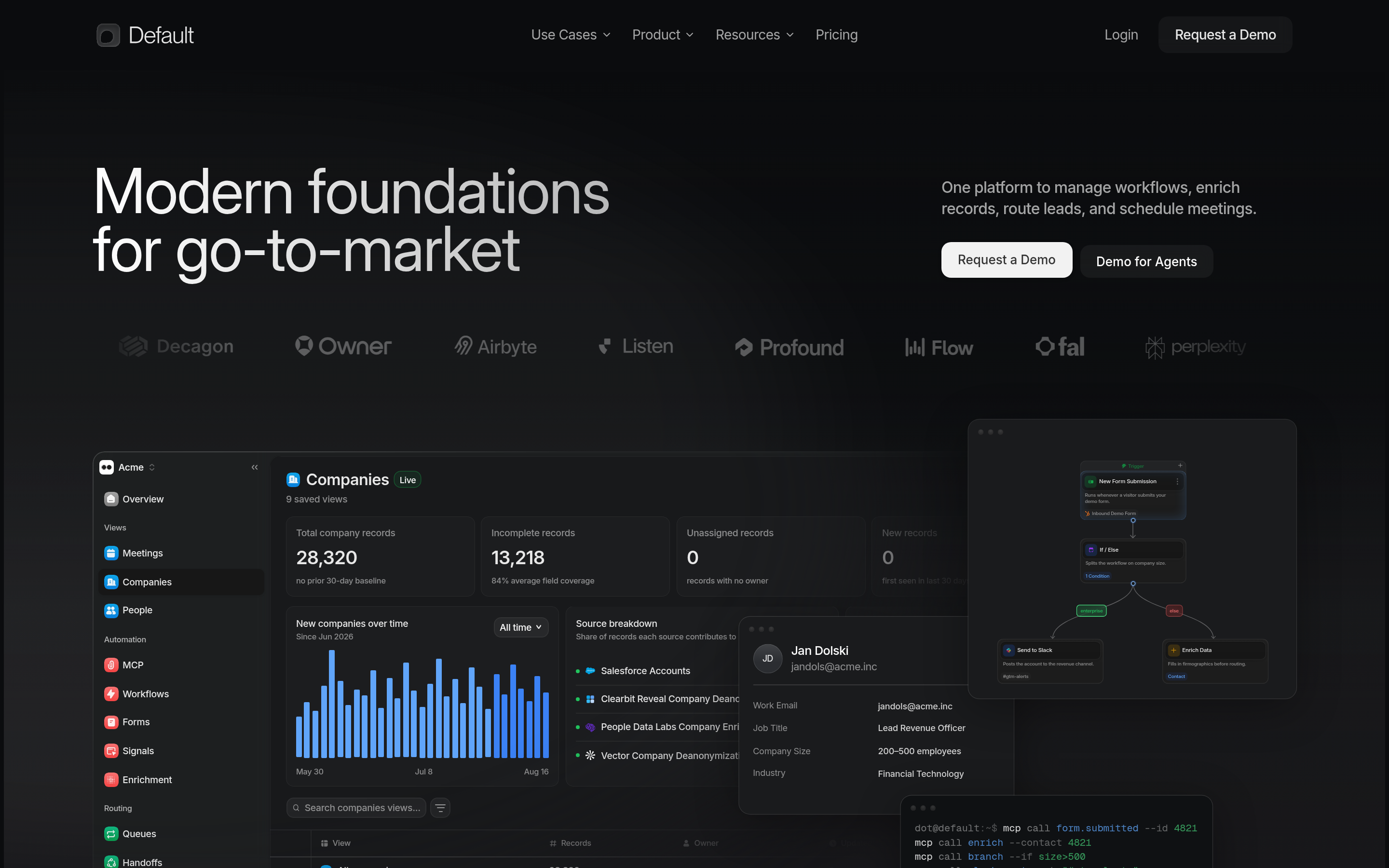
Default combines form enrichment, qualification, routing, and scheduling for inbound pipelines. It targets modern B2B SaaS teams on HubSpot or Salesforce who want one tool to replace a form-enrichment vendor, a scheduler, and a router.
- Best for: Series A–C teams that want inbound speed-to-lead without assembling three tools.
- Strengths: all-in-one inbound workflow, workable for lean RevOps teams.
- Trade-offs: younger product. Enterprise territory logic and multi-object routing are less proven than LeanData's.
4. Openprise#
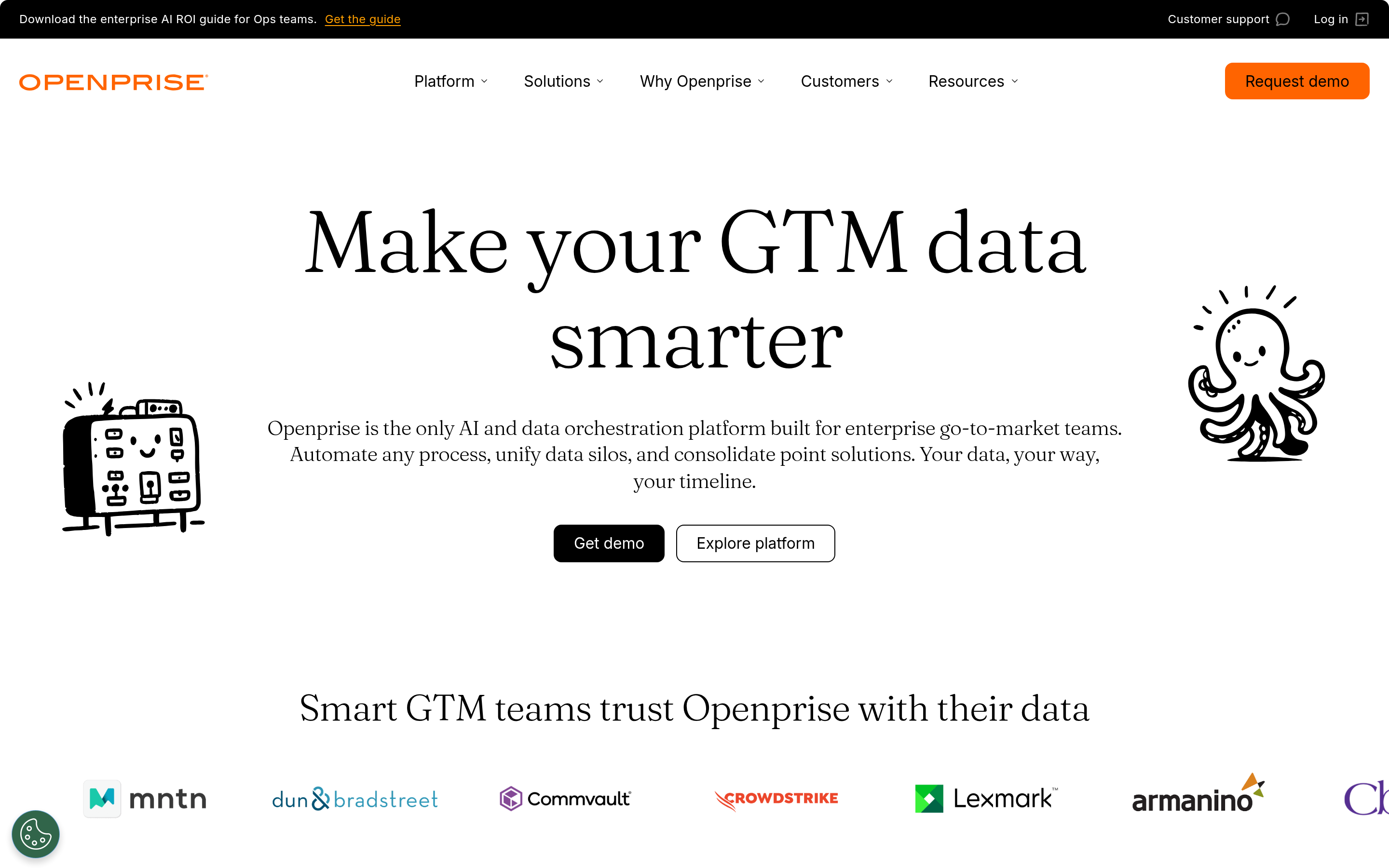
Openprise is a RevOps data-orchestration platform. Routing is one of many "bots" alongside dedupe, normalization, enrichment orchestration, and attribution.
- Best for: operations teams whose real problem is data quality across CRM and marketing automation, with routing as a downstream job.
- Strengths: very flexible data pipelines and works across systems.
- Trade-offs: steeper learning curve, and it's more platform than point solution. It's overkill if you only need routing.
5. ZoomInfo Operations OS (formerly RingLead)#
ZoomInfo acquired RingLead in 2021 and folded its dedupe, normalization, and routing into what it now sells as Operations OS. If you already buy ZoomInfo data, it can reduce your tool count.
- Best for: existing ZoomInfo customers who want data and routing from one vendor.
- Strengths: mature dedupe and normalization, tight coupling with ZoomInfo enrichment.
- Trade-offs: most attractive inside a ZoomInfo contract, and it deepens reliance on a single data vendor.
6. Distribution Engine#
Distribution Engine is a Salesforce AppExchange app focused on assignment: round robin, skills-based routing, capacity limits, and shift schedules. It routes leads, cases, and custom objects.
- Best for: teams whose main pain is fair, capacity-aware distribution, including support teams routing cases.
- Strengths: simple to configure, good workload balancing, handles more than leads.
- Trade-offs: little matching intelligence. It assumes you already know which account a lead belongs to.
7. Native Salesforce Flow or HubSpot workflows#
Native tools cost the least and are more capable than most teams think. Salesforce Flow with assignment rules can handle territory and round-robin logic. HubSpot's "rotate record to owner" workflow action covers basic distribution on Professional tiers and above.
- Best for: teams with fewer than ~15 reps, simple territories, and a mostly inbound funnel.
- Strengths: no extra license, no sync, no new vendor to review.
- Trade-offs: no fuzzy lead-to-account matching, weak audit trails, and logic that gets brittle once you pass a few dozen rules.
How do the LeanData alternatives compare side by side?#
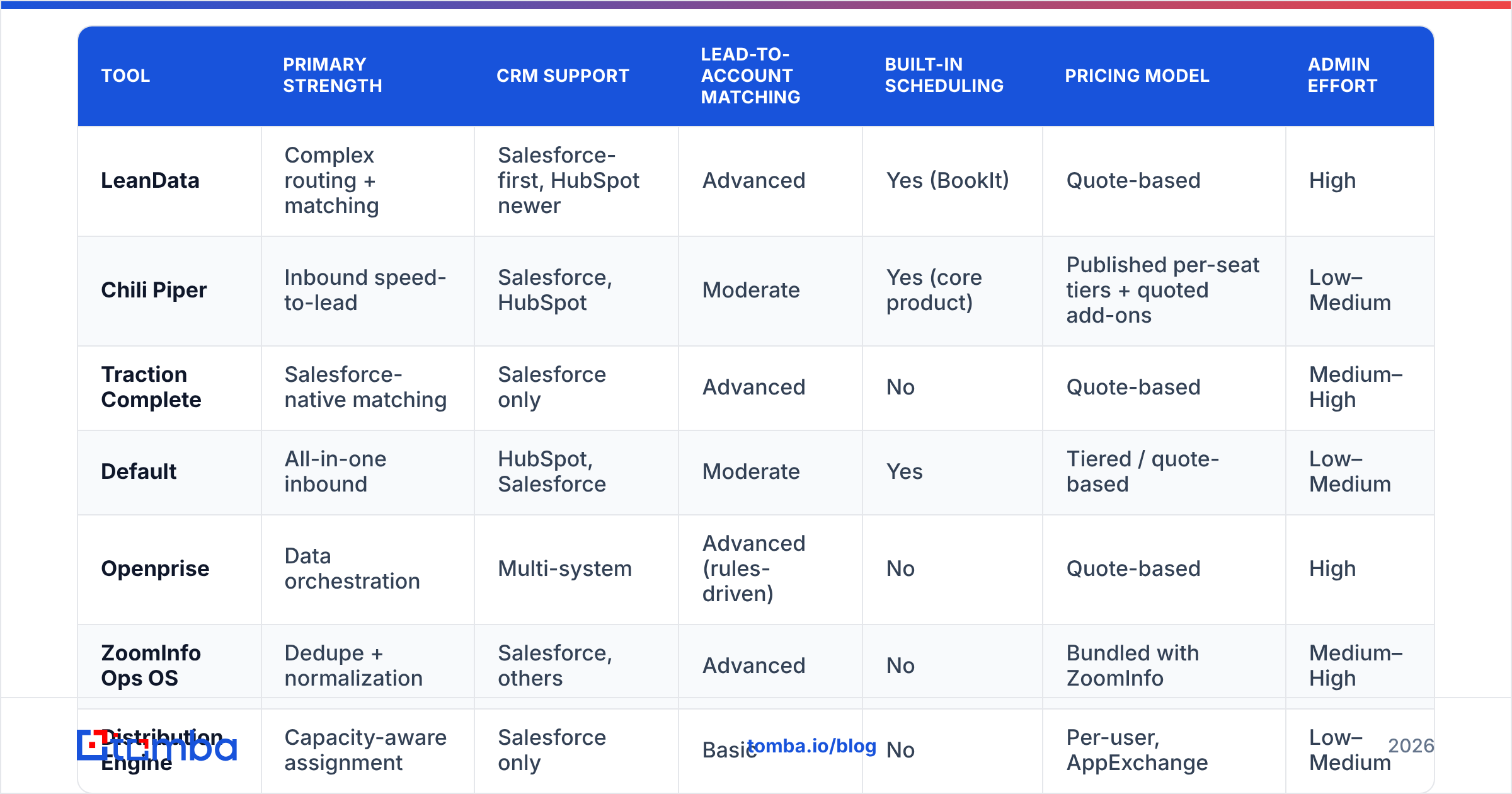
| Tool | Primary strength | CRM support | Lead-to-account matching | Built-in scheduling | Pricing model | Admin effort |
|---|---|---|---|---|---|---|
| LeanData | Complex routing + matching | Salesforce-first, HubSpot newer | Advanced | Yes (BookIt) | Quote-based | High |
| Chili Piper | Inbound speed-to-lead | Salesforce, HubSpot | Moderate | Yes (core product) | Published per-seat tiers + quoted add-ons | Low–Medium |
| Traction Complete | Salesforce-native matching | Salesforce only | Advanced | No | Quote-based | Medium–High |
| Default | All-in-one inbound | HubSpot, Salesforce | Moderate | Yes | Tiered / quote-based | Low–Medium |
| Openprise | Data orchestration | Multi-system | Advanced (rules-driven) | No | Quote-based | High |
| ZoomInfo Ops OS | Dedupe + normalization | Salesforce, others | Advanced | No | Bundled with ZoomInfo | Medium–High |
| Distribution Engine | Capacity-aware assignment | Salesforce only | Basic | No | Per-user, AppExchange | Low–Medium |
| Native Flow / HubSpot | Zero added cost | Native only | None (exact match) | No | Included in CRM tier | Medium |
Before you trust any vendor claim, check recent reviews on G2's lead-to-account matching category. Look for reviewers whose company size and CRM match yours, and ignore the rest.
Is there a cheaper alternative to LeanData?#
Yes, but "cheaper" means different things. There are three realistic ways to cut cost:
- Downshift to native tools if your matching is simple. Many teams find that 80% of their LeanData graph handled edge cases that no longer exist.
- Move to a focused tool such as Chili Piper or Distribution Engine if you only use one part of LeanData, such as inbound routing or round robin.
- Consolidate into Openprise or ZoomInfo Operations OS if you already pay separately for dedupe, enrichment orchestration, and routing.
Watch for hidden costs. Migrating a mature routing graph usually takes weeks of RevOps time. During the cutover, misroutes spike and reps lose trust in the system. Include that in the total cost of ownership, not only the license line.
Why does routing break even with a good tool?#
This part rarely appears in vendor demos. Most "routing bugs" are data bugs.
A lead-to-account match needs a reliable company domain. When a prospect signs up with a Gmail address, a typo, or a subsidiary domain your CRM has never seen, every tool on this list falls back to guesswork. The lead lands in a catch-all queue, sits there for hours, and your speed-to-lead metric suffers.
Common upstream failures include:
- Personal emails on inbound forms with no company domain to match on.
- Outbound-sourced contacts with no verified work email, so they can't be attached to an account.
- Stale records where the contact changed jobs and the domain now points to the wrong owner.
- Duplicate accounts created because one record uses
acme.comand another usesacme.io.

The fix belongs upstream of the router. Run contact enrichment on inbound submissions so the router gets a company domain, firmographics, and a verified work email. Verify emails before records reach the CRM so bounced or fake addresses never trigger assignment. For outbound lists, a tool that can find emails by domain gives each contact a clean, matchable company key from the start.
To be clear about roles, Tomba is not a router and doesn't replace LeanData or any tool above. It sits one step earlier, making sure the router has something reliable to route.
How do you choose the right LeanData alternative?#
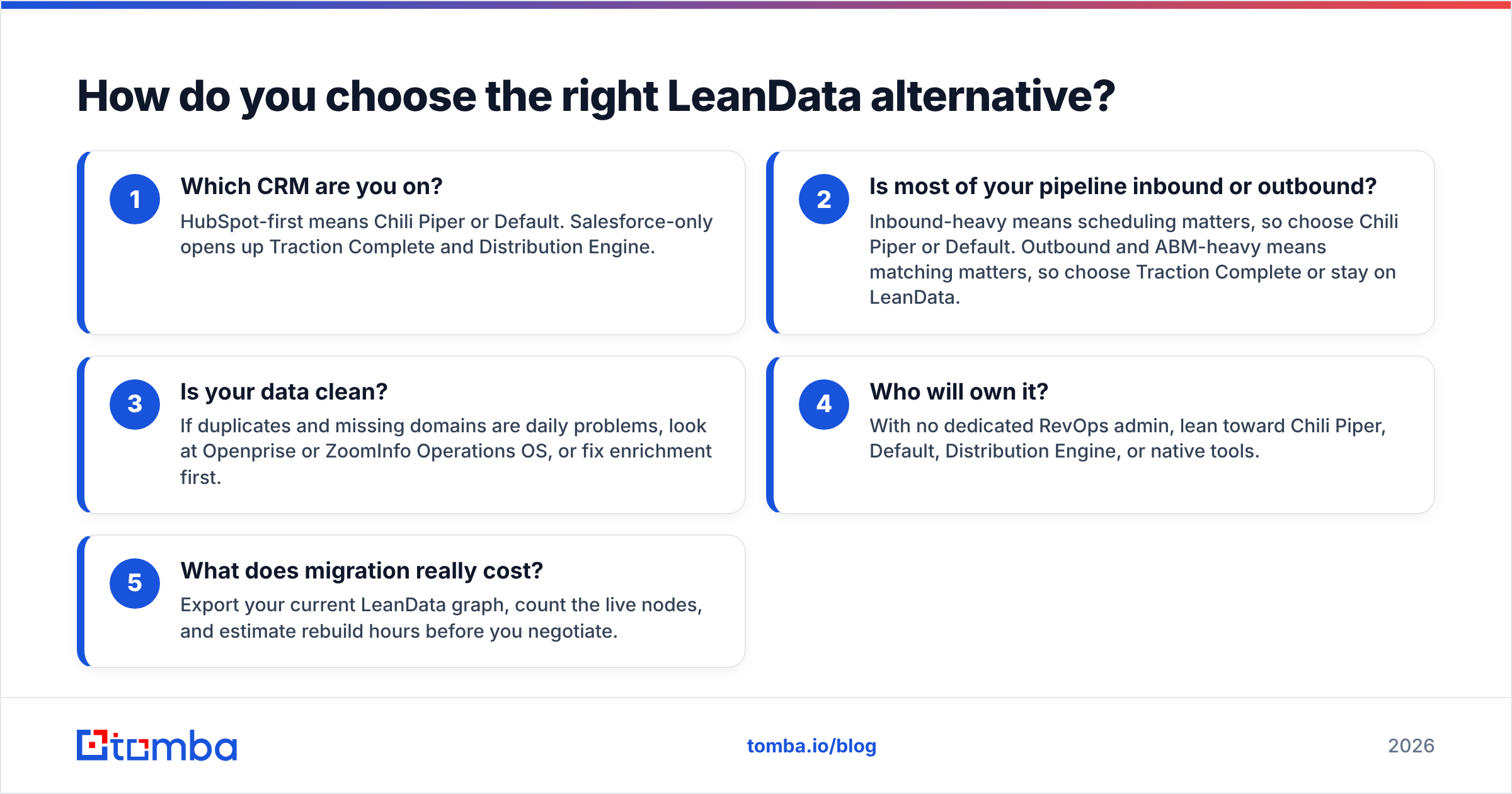
Answer these questions in order. The first answer that clearly applies to you points to a shortlist.
- Which CRM are you on? HubSpot-first means Chili Piper or Default. Salesforce-only opens up Traction Complete and Distribution Engine.
- Is most of your pipeline inbound or outbound? Inbound-heavy means scheduling matters, so choose Chili Piper or Default. Outbound and ABM-heavy means matching matters, so choose Traction Complete or stay on LeanData.
- Is your data clean? If duplicates and missing domains are daily problems, look at Openprise or ZoomInfo Operations OS, or fix enrichment first.
- Who will own it? With no dedicated RevOps admin, lean toward Chili Piper, Default, Distribution Engine, or native tools.
- What does migration really cost? Export your current LeanData graph, count the live nodes, and estimate rebuild hours before you negotiate.
Then run a two-week pilot on a single segment, such as EMEA inbound demo requests. Measure three numbers: match rate, median time-to-owner, and the percentage of leads reassigned manually. If the new tool can't beat LeanData on at least two of those three, the switch probably isn't worth it.
Frequently asked questions#
Does LeanData work with HubSpot?#
LeanData has added HubSpot support, but its deepest functionality, including the most mature matching and the richest routing graph, is still Salesforce-centric. HubSpot-first teams usually find Chili Piper or Default a more natural fit.
What is the closest direct replacement for LeanData?#
For Salesforce orgs, Traction Complete is the closest like-for-like option for lead-to-account matching and routing. For inbound-first teams, Chili Piper covers the routing-plus-scheduling use case that many buyers originally bought LeanData for.
Can I replace LeanData with Salesforce Flow?#
You can if your routing is mostly territory-based round robin with exact domain matching. Once you need fuzzy matching, account hierarchies, or detailed audit trails, Flow becomes expensive to maintain.
Does better data really reduce misroutes?#
Yes. Misroutes usually come from missing or wrong company domains, not bad rules. Enriching and verifying contacts before they reach the CRM raises match rates in any routing tool.
What's the bottom line on LeanData alternatives?#
LeanData is still a strong product. If you run a complex Salesforce org with dedicated RevOps staff, it may remain the right choice. If you're on HubSpot, inbound-heavy, short on admins, or paying for matching depth you don't use, one of the seven options above will likely fit better and cost less.
Whichever router you pick, feed it clean data. Tomba Email Finder finds and verifies professional email addresses by name, domain, or company, so every lead reaching your routing tool has a real work email and a matchable company domain. Try it on the free tier with 25 searches a month, or see Tomba pricing for plans from $49/mo. Better input data means fewer misroutes, faster speed-to-lead, and less time debugging your routing rules.
Related guides#
// get started
Find, verify and enrich your first contacts today
Start on the free plan with 25 searches a month, then scale when your team is ready.
Free plan · No credit card required · GDPR & CCPA
// about the author