Lemlist Reviews 2026: What Users Love, Hate, and Actually Pay
Lemlist is known for strong personalization and multichannel sequences, but reviews often complain about per-seat costs and a learning curve. Here are the pros, the cons, and who should buy it in 2026.
TL;DR
- In most lemlist reviews, users give it credit for personalization (custom images, dynamic landing pages, liquid syntax) and multichannel sequences that combine email, LinkedIn, and calls.
- The complaints repeat too: per-seat pricing that climbs quickly, a learning curve on advanced sequences, and uneven experiences with support and billing.
- Lemlist suits small-to-mid outbound teams that care about creative, personalized campaigns. It's weaker if you just want to send large volumes cheaply across many inboxes.
- Built-in warmup (lemwarm) helps, but it won't save you from bad data. Deliverability still depends on sending to verified addresses.
- Our verdict: worth trialing if personalization is how you win deals. If your main constraint is inbox count or budget, compare volume-first tools first.
What is lemlist, and who is it built for?#
Lemlist is a sales engagement platform. It began as a cold email tool known for personalized images and has since grown into multichannel prospecting. You build a sequence of steps (email, LinkedIn visit, connection request, LinkedIn message, call task, manual task), add conditions, and lemlist runs it for each lead.
In recent years it has added a built-in B2B lead database, email and phone finding credits, the lemwarm warmup engine, and AI help with writing sequences. The official product overview is on lemlist.com.
Most of the users writing lemlist reviews fall into three groups:
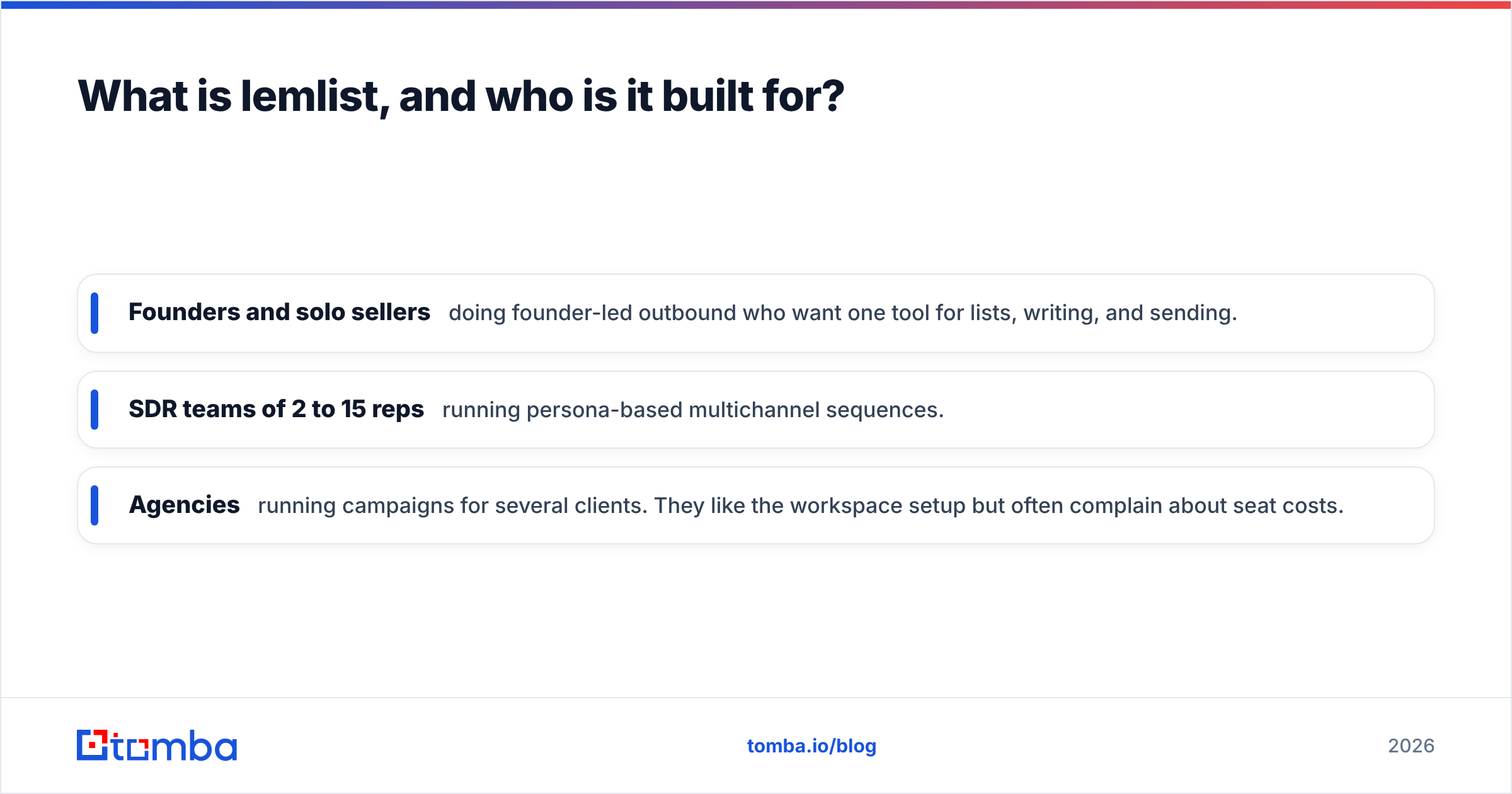
- Founders and solo sellers doing founder-led outbound who want one tool for lists, writing, and sending.
- SDR teams of 2 to 15 reps running persona-based multichannel sequences.
- Agencies running campaigns for several clients. They like the workspace setup but often complain about seat costs.
If you're in one of those groups, the reviews below apply to you. If you're an enterprise team with Salesforce-heavy governance requirements, lemlist can still work, but you'll be comparing it with Outreach and Salesloft, and it plays a different role there.
What do lemlist reviews praise most?#
Across review platforms like G2's lemlist reviews page, positive feedback comes back to the same few themes.
1. Personalization beyond first-name tokens. This is the most common praise. Lemlist lets you drop custom variables into text, images, and landing pages, so a prospect can see a screenshot of their own website or a personalized image with their name on a whiteboard. Reviewers from agencies and creative B2B brands say this is what makes lemlist feel different from plain mail-merge tools.
2. Multichannel sequences in one builder. Users like building one flow in which a lead who opens but doesn't reply gets a LinkedIn profile visit, then a connection request, then a call task. The conditional branching ("if opened," "if LinkedIn invite accepted") comes up often as a reason teams moved away from email-only senders.
3. Lemwarm and deliverability tooling. Built-in warmup, plus checks on your domain setup, gets consistently positive mentions from people who are new to outbound. It won't replace good list hygiene, but beginners appreciate not having to buy a separate warmup tool on day one.
4. Templates and community content. Lemlist puts a lot into educational content, sequence templates, and its community. Reviewers who are new to cold email often say this shortened their ramp-up.
5. Clean, visual UI. For a tool with this many features, many users say the interface is pleasant to work in day to day, especially the campaign reports.
What do lemlist reviews complain about?#
Negative lemlist reviews are just as consistent, and several of these issues should shape your buying decision.
1. Pricing climbs fast with seats and add-ons. Lemlist charges per user. The multichannel features that people actually buy it for are on the higher tiers. Teams often say the jump from "one founder testing it" to "five SDRs on the multichannel plan" costs more than they expected, and more again once they buy extra lead-finding credits.
2. A learning curve on advanced sequences. Simple sequences are easy. Conditional multichannel flows with custom variables, image personalization, and A/B tests take time to set up correctly. Several reviewers say they sent broken variables (such as an empty {{companyName}}) before they learned to preview carefully.
3. Support and billing friction. A share of reviews, especially on consumer-style review sites, describe slow support responses on lower tiers and frustration with cancellations or renewals. This isn't universal, and many other users praise support, but it comes up often enough that you should read the billing terms before you pay annually.
4. LinkedIn automation risk. Lemlist's LinkedIn steps are useful, but any LinkedIn automation comes with account-restriction risk. Some reviewers report warnings or temporary limits after pushing volume too hard. You're responsible for keeping activity within reasonable limits.
5. Built-in data quality varies by segment. The integrated lead database is convenient, but reviewers say coverage and accuracy drop outside well-covered markets such as US tech. Teams prospecting in Europe, specific verticals, or small businesses often still use a dedicated finder and verifier.
6. It's not built for high-volume inbox rotation. If your model is 50+ sending inboxes and thousands of emails a day, reviewers say volume-first tools handle inbox rotation more cheaply. Lemlist is tuned for quality per touch, not raw send capacity.
How much does lemlist cost in 2026?#
Lemlist changes its plan names and prices from time to time, so always check the live lemlist pricing page before you budget. The shape of the pricing has stayed fairly stable:
- An email-focused plan with unlimited campaigns, lemwarm, and core personalization, priced per user per month.
- A multichannel plan that unlocks LinkedIn steps, calls, and advanced conditions. This is the tier most reviewers actually use, and it's usually around $99 per user per month on monthly billing in recent years, with a discount for annual billing.
- An enterprise tier with custom pricing, SSO, and advanced controls.
- Credits for finding emails and phone numbers, which are consumed per enrichment and can be topped up.
The gotcha reviewers mention most: the plan price isn't your real cost. Add seats × tier, then extra sending domains and inboxes, extra enrichment credits, and possibly a separate verifier. A five-rep team on the multichannel tier can reach four figures a month before data costs.
How does lemlist compare to Instantly, Smartlead, and Apollo?#
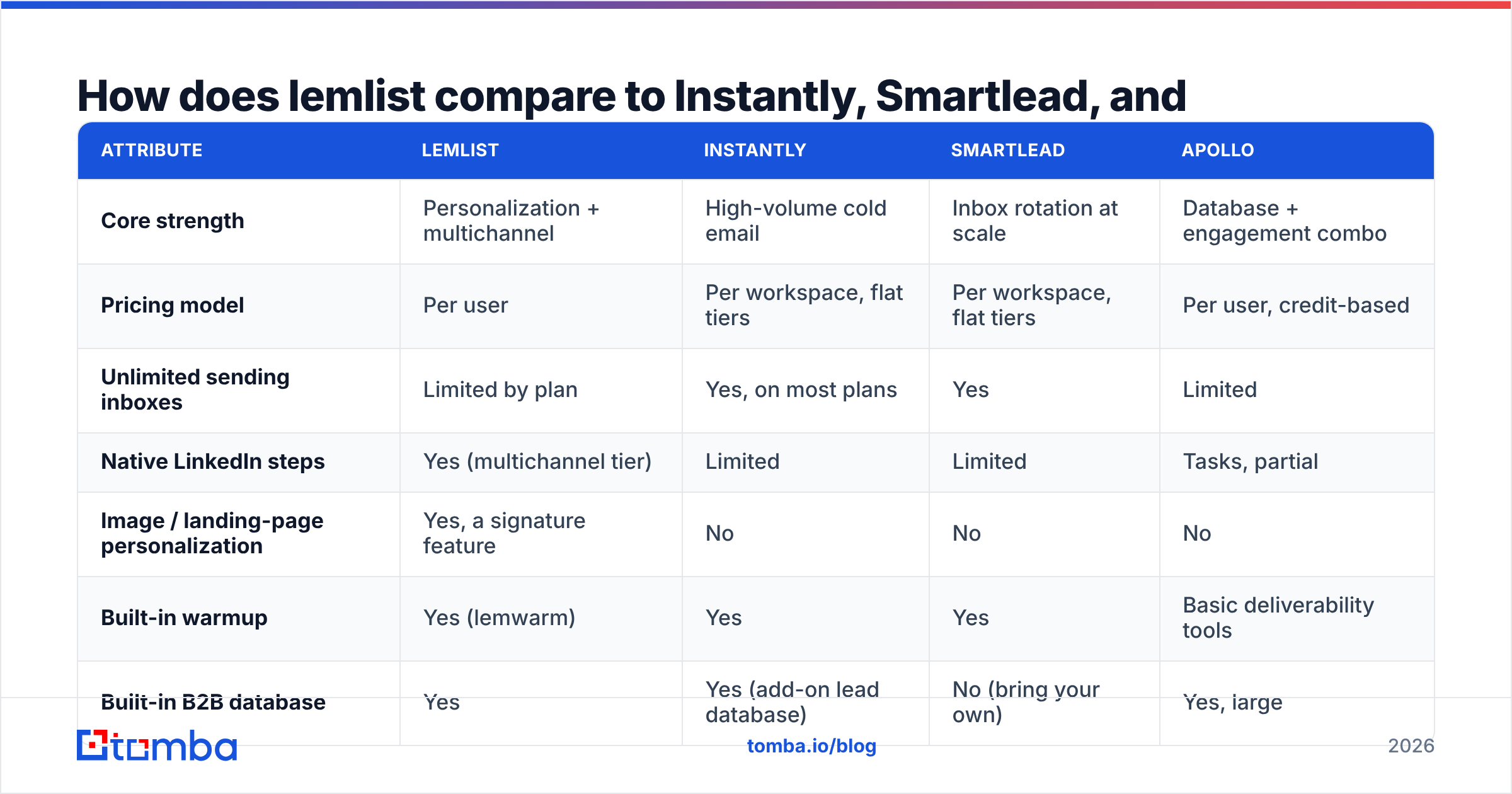
Most people researching lemlist reviews are really choosing between it and three or four alternatives. This comparison focuses on how each tool is positioned. Prices are approximate entry points and change often, so confirm them with each vendor.
| Attribute | lemlist | Instantly | Smartlead | Apollo |
|---|---|---|---|---|
| Core strength | Personalization + multichannel | High-volume cold email | Inbox rotation at scale | Database + engagement combo |
| Pricing model | Per user | Per workspace, flat tiers | Per workspace, flat tiers | Per user, credit-based |
| Unlimited sending inboxes | Limited by plan | Yes, on most plans | Yes | Limited |
| Native LinkedIn steps | Yes (multichannel tier) | Limited | Limited | Tasks, partial |
| Image / landing-page personalization | Yes, a signature feature | No | No | No |
| Built-in warmup | Yes (lemwarm) | Yes | Yes | Basic deliverability tools |
| Built-in B2B database | Yes | Yes (add-on lead database) | No (bring your own) | Yes, large |
| Best for | Creative, personalized outbound for small-to-mid teams | Agencies and volume senders | Technical teams scaling many domains | Teams wanting data + sequencing in one place |
Here's how to read it: if your reply rates depend on how you personalize, lemlist is usually the best fit. If they depend on how many people you reach, look at Instantly or Smartlead first. Tomba also has a breakdown of Instantly alternatives if you're comparing volume senders.
Is lemlist good for deliverability?#
Mostly yes, with one important caveat. Lemlist gives you the right building blocks: lemwarm, sending limits per inbox, custom tracking domains, and setup checks. Reviewers generally say their inbox placement is stable when they follow the recommended ramp.
But no sending tool can fix a list full of invalid or risky addresses. Bounces are one of the fastest ways to damage your sender reputation. Once reputation drops, warmup won't bring your open rates back. Several negative lemlist reviews that blame "deliverability" turn out, when you read them closely, to describe teams that uploaded scraped or unverified CSVs.
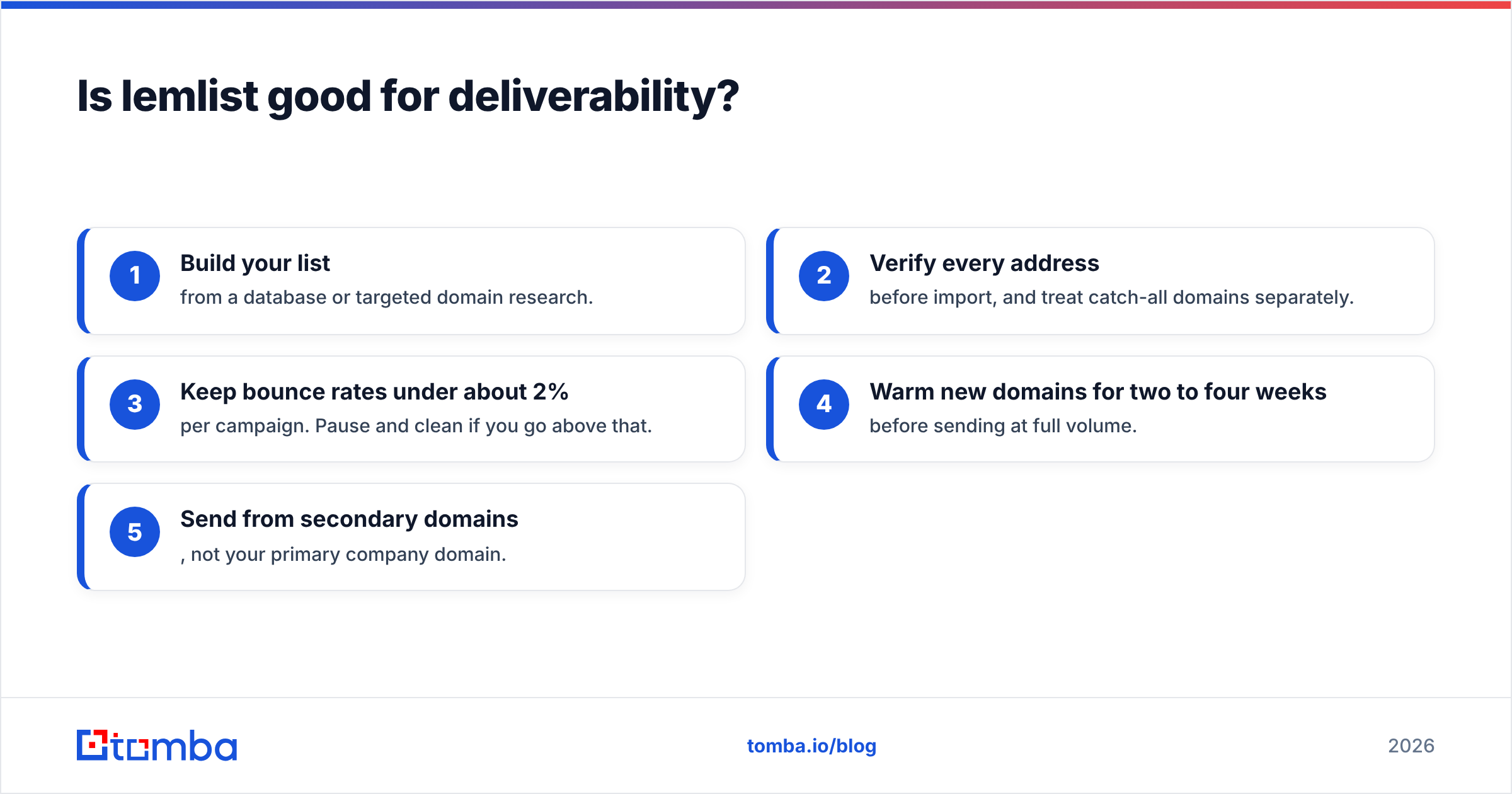
The practical workflow that experienced reviewers describe:
- Build your list from a database or targeted domain research.
- Verify every address before import, and treat catch-all domains separately.
- Keep bounce rates under about 2% per campaign. Pause and clean if you go above that.
- Warm new domains for two to four weeks before sending at full volume.
- Send from secondary domains, not your primary company domain.
Running every list through an email verifier before it reaches lemlist is the cheapest deliverability protection you can buy. It costs a fraction of a burned domain.
Should you use lemlist's built-in data or a separate email finder?#
This question comes up often in lemlist reviews from growing teams. The built-in database is convenient: you can search, add leads to a campaign, and enrich them without leaving the app. For well-covered segments that convenience is worth something.
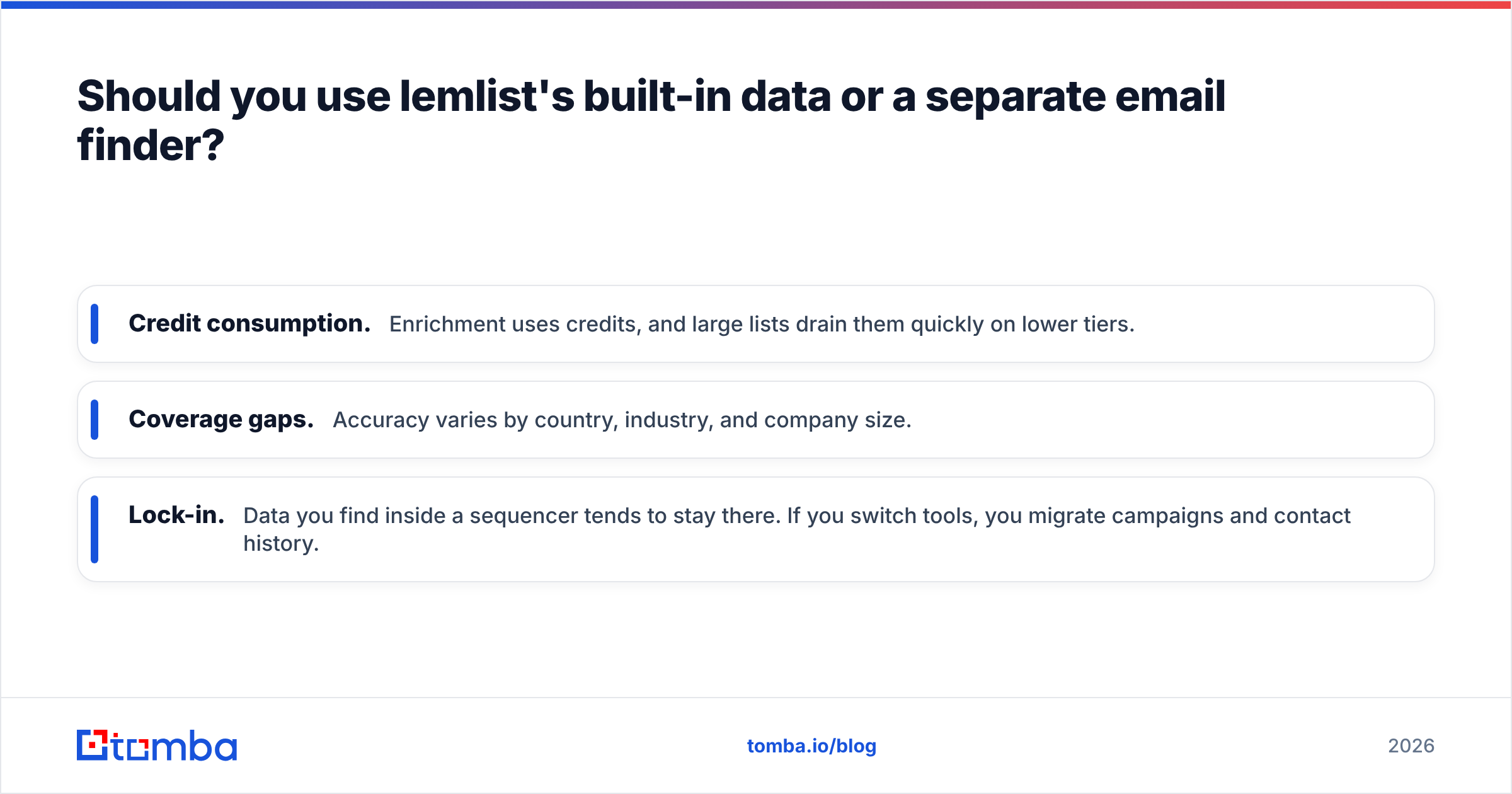
The trade-offs reviewers raise:
- Credit consumption. Enrichment uses credits, and large lists drain them quickly on lower tiers.
- Coverage gaps. Accuracy varies by country, industry, and company size.
- Lock-in. Data you find inside a sequencer tends to stay there. If you switch tools, you migrate campaigns and contact history.
Many teams separate the data layer from the sending layer. They use a dedicated email finder to build and verify lists, sync them to the CRM, and push clean leads into lemlist for sequencing. That way the sequencer is a tool you can swap, not the place your data lives.

What are the real pros and cons of lemlist?#
Here are the review themes condensed for a quick decision:
| Pros | Cons |
|---|---|
| Strong personalization (images, landing pages, custom variables) | Per-seat pricing grows quickly with team size |
| Multichannel sequences with conditional logic | Advanced sequences take time to learn |
| Built-in warmup and deliverability checks | Some users report slow support or billing friction |
| Integrated lead database and enrichment credits | Data coverage varies outside core markets |
| Good templates, education, and community | LinkedIn automation carries account-restriction risk |
| Clean reporting and campaign UI | Less cost-efficient for very high-volume inbox rotation |
Who should (and shouldn't) buy lemlist?#
Buy lemlist if:
- You sell to a defined ICP where personalization visibly improves replies (agencies, SaaS selling to marketers or founders, high-ACV deals).
- You want email, LinkedIn, and calls in one sequence rather than three tools.
- Your team is small enough that per-seat pricing stays manageable, roughly 1 to 10 senders.
Skip or trial carefully if:
- Your strategy depends on high volume and many inboxes. Flat-rate volume senders will cost less.
- You need enterprise governance, deep Salesforce-native workflows, or strict approval flows.
- You expect the built-in database alone to cover a niche or non-US market.
What's our verdict on lemlist in 2026?#
Lemlist is still one of the most capable tools for personalized, multichannel cold outreach, and most lemlist reviews confirm that its strengths are real. The weaknesses are real too, but they're predictable. You pay for quality per touch in per-seat costs, and the tool rewards teams who take time to learn it.
The deciding factor is usually data, not the sequencer. Teams that feed lemlist verified, targeted contacts report the results the product promises. Teams that upload unverified lists end up writing the frustrated reviews. Start a trial, run one campaign with a small, clean list, and measure reply rate per 100 contacts before you add seats.
Where does Tomba fit alongside lemlist?#
If you use lemlist or are about to trial it, what you send into it matters more than any feature on its pricing page. Tomba Email Finder helps you find professional email addresses by domain, name, or company, and verify them before they reach a sequence, so your lemlist campaigns start with low bounce rates and a healthy sender reputation. You can start on the free tier (25 searches a month) and move to paid plans from $49/month as your outbound grows. See Tomba pricing for full plan details.
Related guides#
Ready to find emails that actually work?
Join 150,000+ professionals who stopped guessing and started sending. Free credits on signup — no credit card required.
Get the Tomba newsletter
Practical outbound tactics and product updates — once every two weeks.
About the author