LetsExtract vs SalesIntel: Email Scraper or Verified B2B Data?
LetsExtract scrapes emails from the open web. SalesIntel sells human-verified B2B contacts with intent data. These are two very different ways to build a prospect list, and this is how to choose between them.
LetsExtract vs SalesIntel is a choice between two ways to build a prospect list: scrape emails yourself, or buy verified B2B data.
TL;DR
LetsExtract is a low-cost email extraction tool. It crawls websites, search results and files, then pulls out any email addresses and phone numbers it finds. It works for volume, but the data is raw and needs checking.
SalesIntel is an enterprise B2B data platform. It sells human-verified contacts, direct dials, technographics and intent signals. It is priced for sales teams that sign annual contracts.
Pick LetsExtract if you have more time than budget and target small businesses with public contact pages. You must verify everything before you send.
Pick SalesIntel if you sell to mid-market or enterprise accounts in North America and need direct dials. You also need to justify a five-figure yearly spend.
Maybe you just need accurate work emails for named people, at a price between the two. Then a dedicated email finder with built-in checks usually costs less and wastes less time than either one.
LetsExtract vs SalesIntel: what is the real difference?#
The LetsExtract vs SalesIntel question is really about two different jobs. That explains most of the comparison.
LetsExtract is an extractor. You give it keywords, URLs or files. It visits pages and collects any string that looks like an email address or phone number. The main product, LetsExtract Email Studio, has long been a Windows desktop app. The company has also shipped browser-based extractors. You own the crawl and the output. You also own the cleanup.
SalesIntel is a curated database. You don't crawl anything. You search a ready-made index of companies and contacts. You filter by title, industry, headcount, technology or intent topic, then export records into your CRM. Its main selling point is that contacts are human-verified and checked again on a regular cycle. The company has publicly described that cycle as every 90 days. It also offers Research-on-Demand, where its team finds contacts that aren't in the database yet.
An analogy: LetsExtract gives you a metal detector for the beach. SalesIntel sells you a catalogued coin collection. The metal detector is cheap and fun. It sometimes finds something good, but you'll dig up a lot of bottle caps. The collection costs far more because someone has already checked each item.
How do LetsExtract and SalesIntel compare feature by feature?#
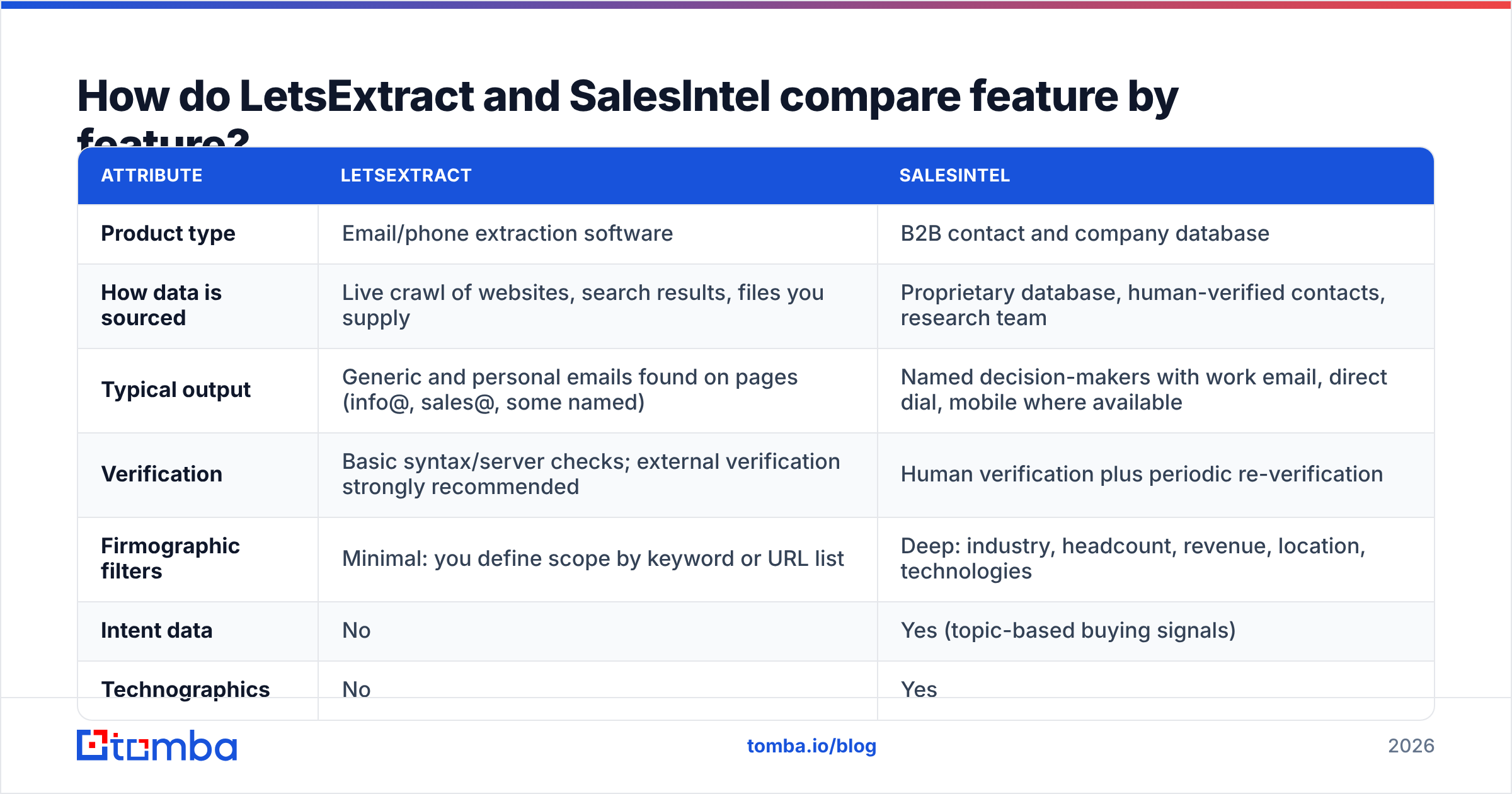
The table below covers what matters most when you choose a prospecting data source. Pricing for both vendors changes, so confirm current numbers on LetsExtract's site and SalesIntel's site before you buy.
| Attribute | LetsExtract | SalesIntel |
|---|---|---|
| Product type | Email/phone extraction software | B2B contact and company database |
| How data is sourced | Live crawl of websites, search results, files you supply | Proprietary database, human-verified contacts, research team |
| Typical output | Generic and personal emails found on pages (info@, sales@, some named) | Named decision-makers with work email, direct dial, mobile where available |
| Verification | Basic syntax/server checks; external verification strongly recommended | Human verification plus periodic re-verification |
| Firmographic filters | Minimal: you define scope by keyword or URL list | Deep: industry, headcount, revenue, location, technologies |
| Intent data | No | Yes (topic-based buying signals) |
| Technographics | No | Yes |
| CRM integrations | Export to CSV/TXT | Native connectors for Salesforce, HubSpot and major engagement platforms |
| Browser extension | Extractor-style extensions | RevDriver extension for LinkedIn and company sites |
| Pricing model | Low-cost license or subscription | Quote-based, annual contracts, per-seat |
| Geographic strength | Wherever public pages exist | Strongest in North America |
| Best fit | Solo marketers, SMB lists, local-business outreach | Mid-market/enterprise sales teams, ABM programs |

Most of the other differences come from the first three rows. An extractor can only return what a website chose to publish. A curated database returns what a research team confirmed, and you pay for that check.
How accurate is the data from each tool?#
Accuracy is the biggest gap in LetsExtract vs SalesIntel. It matters more than any feature on the pricing page.
For LetsExtract, "accuracy" isn't quite the right word. The tool reports what it found. If a page lists jane.doe@company.com, you get that address. If the page is from 2019 and Jane has left, you still get it. Scraped lists also tend to fill up with:
- Role addresses (
info@,contact@,support@) that rarely reach a decision-maker. - Addresses copied from footers, legal notices and web agencies' sites.
- Broken or hidden strings that look like emails but can't receive mail.
- Spam traps planted on pages to catch scrapers.
That last point is serious. Sending to a planted trap can hurt your sender reputation fast. Run anything from an extractor through an email verifier before it gets near a sending domain.
For SalesIntel, accuracy is the product. Human checks with regular re-checks aim to lower bounce rates. They also catch job changes faster than purely automated databases. Reviews on G2 often praise the direct-dial quality and the Research-on-Demand service. Common complaints are thin coverage outside the US and the cost. No database is perfect, and people change jobs all the time. Still, a verified dataset starts far above anything raw scraping produces.

The takeaway: LetsExtract accuracy depends mostly on your process, meaning how you scope the crawl and how hard you verify. SalesIntel accuracy depends mostly on the vendor's process. That is what the contract pays for.
What does each tool actually cost you?#
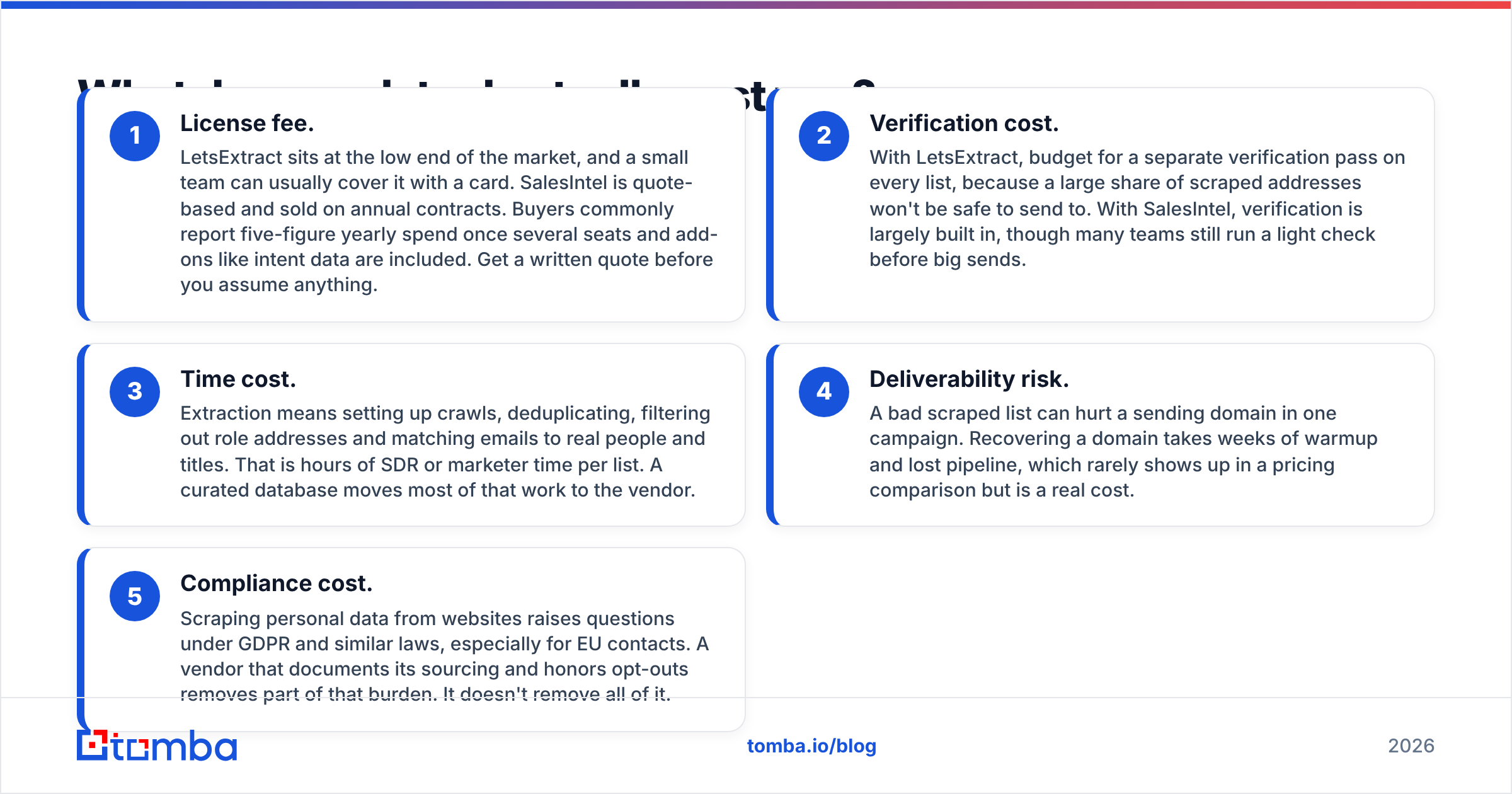
In a LetsExtract vs SalesIntel decision, the license fee is only part of the cost. Compare total cost per usable contact.
License fee. LetsExtract sits at the low end of the market, and a small team can usually pay by card. SalesIntel is quote-based and sold on annual contracts. Buyers often report five-figure yearly spend once several seats and add-ons like intent data are included. Get a written quote before you assume anything.
Verification cost. With LetsExtract, budget for a separate check on every list. A large share of scraped addresses won't be safe to send to. With SalesIntel, checks are mostly built in, though many teams still run a light pass before big sends.
Time cost. Extraction means setting up crawls, removing duplicates, filtering out role addresses and matching emails to real people. That is hours of SDR or marketer time per list. A curated database moves most of that work to the vendor.
Deliverability risk. A bad scraped list can hurt a sending domain in one campaign. Recovery takes weeks of warmup and lost pipeline. That cost rarely shows up in a pricing comparison, but it is real.
Compliance cost. Scraping personal data from websites raises questions under GDPR and similar laws, especially for EU contacts. A vendor that documents its sources and honors opt-outs removes part of that burden. It doesn't remove all of it.
Cost per usable contact changes the picture. LetsExtract can look nearly free per record and still be expensive per meeting booked. SalesIntel looks expensive per seat. But for enterprise teams working a defined account list, its cost per verified decision-maker can be competitive.
Who should choose LetsExtract?#
LetsExtract fits a narrow but real set of use cases:
- Local and SMB outreach. Restaurants, agencies, clinics and trades often publish one contact address on their site. For them, the generic inbox is the owner's inbox, so extraction works well.
- Link building and PR research. You need contact addresses for many websites, not buying committees.
- Bootstrapped founders who have far more time than budget and will verify everything.
- One-off research projects where you collect whatever contact data is published across a set list of URLs.
Skip it if you sell to companies with more than a few hundred staff. At that size, the person you want almost never lists their email on the website. An extractor will mostly return info@ addresses.
Who should choose SalesIntel?#
SalesIntel fits teams where data quality directly affects revenue:
- Mid-market and enterprise sales teams that need several contacts per account, including direct dials for calling.
- ABM programs that use technographics and intent signals to rank accounts before outreach.
- RevOps teams that want steady CRM enrichment and are tired of cleaning stale records.
- North America–focused sellers, where SalesIntel's verified coverage is deepest.
Skip it if you're a small team on a thin budget or you sell mainly into EMEA or APAC. Also skip it if you mostly need email addresses for companies you've already chosen. In those cases you'd pay for a full platform when you only need one piece of it.
Is there a middle ground between scraping and an enterprise database?#
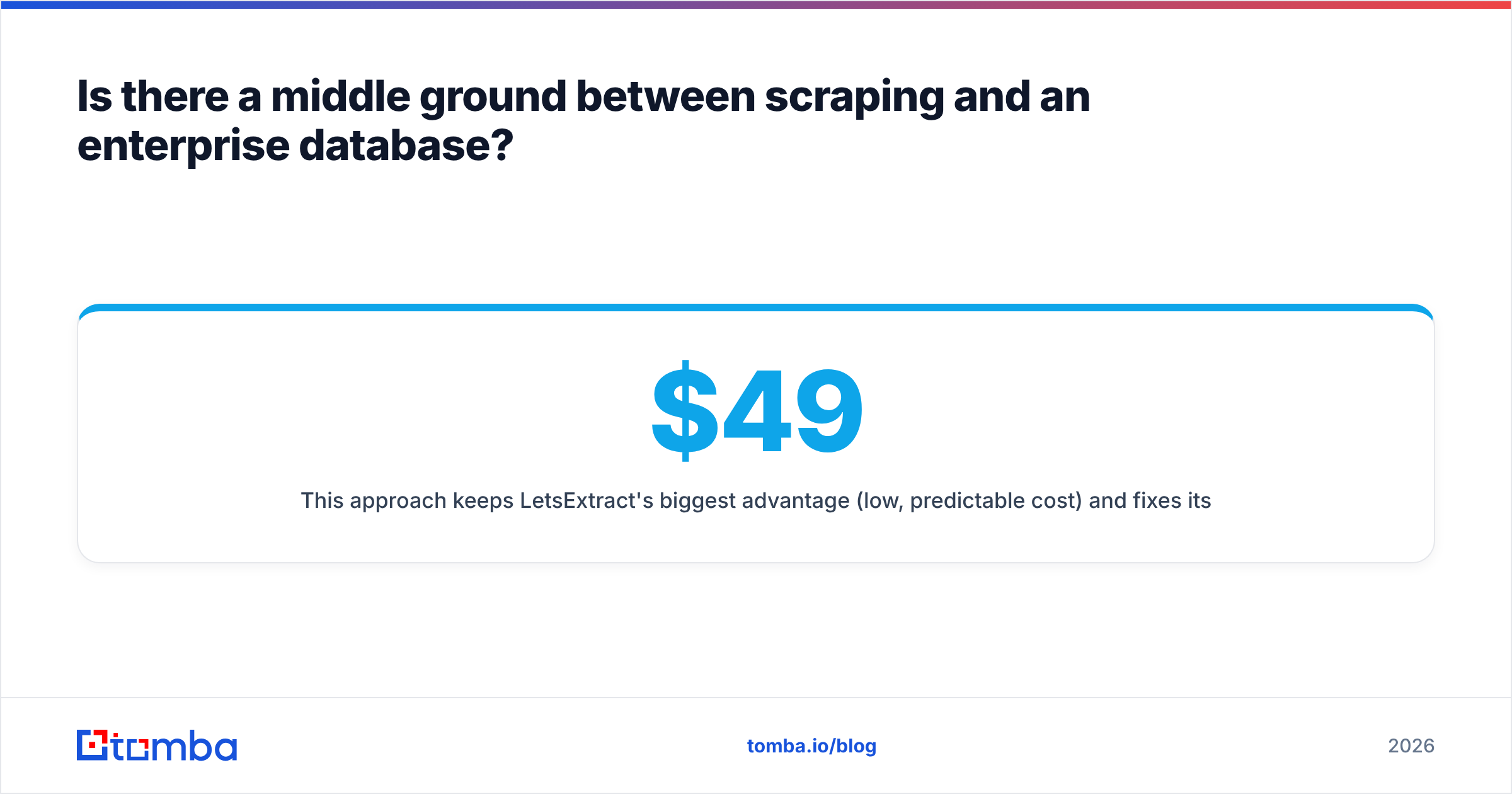
Yes. Plenty of teams find that neither side of LetsExtract vs SalesIntel fits. What they need is a named person's verified work email, found on demand, at a price close to the scraping end.
That is the job of a dedicated email finder. It doesn't crawl blindly, and it doesn't lock you into an annual contract. It combines known company email patterns, indexed public sources and real-time checks. It then returns a scored address for a specific person. Typical workflows look like this:
- Run a domain search to see every known address and the main email pattern for a company.
- Look up a specific person by name and domain.
- Verify the result, including catch-all handling, before export.
- Push the results into your CRM or sequencer.
This approach keeps LetsExtract's biggest strength: low, predictable cost. It also fixes its biggest weakness: unverified, generic output. And it skips the parts of SalesIntel that many small teams never use, like intent topics, technographic filters and multi-seat contracts. You can see how the tiers scale on the Tomba pricing page. There's a free tier with 25 searches a month, then Starter at $49/mo, Growth at $99/mo, and Pro at $249/mo.
The middle ground has limits too. A lean email finder won't match SalesIntel's direct-dial depth, its intent data, or its human research team. If those features drive your pipeline, a platform like SalesIntel earns its price.
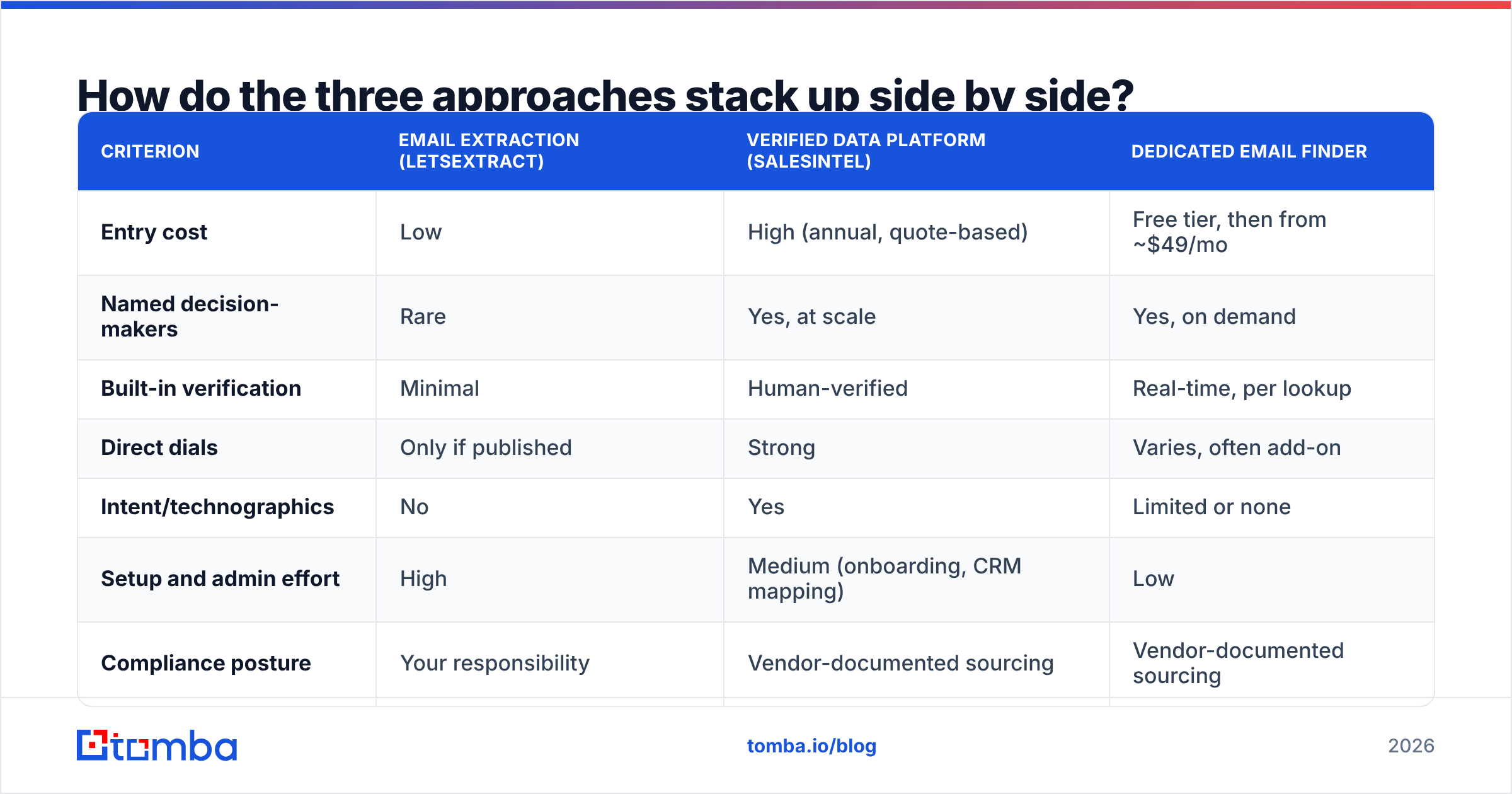
How do the three approaches stack up side by side?#
| Criterion | Email extraction (LetsExtract) | Verified data platform (SalesIntel) | Dedicated email finder |
|---|---|---|---|
| Entry cost | Low | High (annual, quote-based) | Free tier, then from ~$49/mo |
| Named decision-makers | Rare | Yes, at scale | Yes, on demand |
| Built-in verification | Minimal | Human-verified | Real-time, per lookup |
| Direct dials | Only if published | Strong | Varies, often add-on |
| Intent/technographics | No | Yes | Limited or none |
| Setup and admin effort | High | Medium (onboarding, CRM mapping) | Low |
| Compliance posture | Your responsibility | Vendor-documented sourcing | Vendor-documented sourcing |
| Best for | SMB/local lists, PR research | Enterprise ABM, calling-heavy teams | SDRs and founders targeting known accounts |
What are the common mistakes when choosing between them?#
A few LetsExtract vs SalesIntel mistakes come up again and again with teams that picked the wrong tool:
- Treating extraction volume as pipeline. Ten thousand scraped addresses feel productive. Then 30% bounce, a third of the rest are role inboxes, and your domain lands on a blocklist. Measure replies per 100 sends, not records per hour.
- Buying a platform for one feature. If you only use SalesIntel for email exports, you pay enterprise prices for the cheapest part of the product. Check what you actually use before renewal.
- Skipping checks because the vendor says "verified." Even well-kept databases decay between refresh cycles. A final check before big sends is cheap insurance.
- Ignoring geography. A database that's great in Texas may be thin in Germany. Test with a sample of your target accounts before signing, not the vendor's demo list.
- Forgetting compliance until legal asks. If you prospect EU contacts, record where each contact came from and how people can opt out. Scraped data makes that much harder.
How should you run a fair LetsExtract vs SalesIntel trial?#
Don't settle LetsExtract vs SalesIntel from marketing pages. Run a simple test:
- Build a list of 50 target accounts that matches your real ICP. Use the same industries, sizes and regions you sell into.
- Pull contacts from each tool for the same accounts and the same two or three buyer personas.
- Verify everything through the same neutral verifier so the test is fair.
- Score each source on four numbers: named-contact match rate, valid-email rate, direct-dial connect rate (if you call), and hours spent.
- Work out cost per usable contact, including license, checks and labor.
Most teams find the answer is obvious after one afternoon. The tool that looked cheapest is rarely the cheapest per meeting booked.
So, LetsExtract vs SalesIntel: which wins?#
It depends on what you sell and who you sell to.
- LetsExtract wins for budget-limited SMB and local outreach, where the published contact address is the buyer, and where you're strict about checks.
- SalesIntel wins for enterprise and mid-market teams that need verified decision-makers, direct dials and intent signals, and can support an annual contract.
- Neither is ideal if you just need accurate work emails for specific people at companies you've already picked. That's a lookup problem, not a scraping or platform problem.
Where does Tomba fit in your stack?#
Maybe this LetsExtract vs SalesIntel comparison left you in the middle. A scraper is too noisy for your buyers, and a platform contract is too big for your team. If so, try a focused lookup tool first. The Tomba Email Finder finds work email addresses by name, domain or company. It scores each result and verifies it before you export. That covers LetsExtract's cleanup work without SalesIntel's annual commitment. Start with the free 25 monthly searches and run the 50-account trial above against your current source. Upgrade only if the numbers justify it.
Related guides#
// get started
Find, verify and enrich your first contacts today
Start on the free plan with 25 searches a month, then scale when your team is ready.
Free plan · No credit card required · GDPR & CCPA
// about the author