Letter for a Meeting Invitation: Templates, Structure and Examples
Most meeting invitations get ignored because they're vague, not because people are busy. Use this 6-part structure and 7 copy-paste templates for internal, client, board, and cold invites.
TL;DR
- A good letter for a meeting invitation answers five questions before anyone has to ask: why, who, when, where, and what they should prepare.
- Use formal letters for board meetings, AGMs, and external stakeholders. Use short emails for internal syncs and most sales meetings.
- The sentence that decides whether people accept is your purpose line. Write it before you write anything else.
- Cold meeting invites work differently from internal ones. Keep them under 100 words, make one specific ask, and send them only to a verified address.
- Below you'll find seven templates you can copy, a comparison table showing which format fits which situation, and the mistakes that get invitations ignored.
What is a letter for a meeting invitation?#
A letter for a meeting invitation is a written request asking one or more people to attend a meeting at a set time and place (or on a video link). It also tells them why the meeting matters and what they need to bring.
It can be a formal printed letter on company letterhead, a formal email, or a two-line Slack-style note. The format changes. What the reader needs doesn't: they want to decide quickly whether to accept, and they want to show up prepared.
Formal invitation letters are still the norm in a few settings:
- Governance meetings such as board meetings, AGMs, and shareholder meetings, where bylaws often require written notice by a set deadline
- External partners and government bodies, where a letter on letterhead signals seriousness
- Legal or HR meetings, including disciplinary hearings and grievance meetings, where you need a documented paper trail
- Formal events such as ceremonies, award meetings, and launch briefings
Everything else, including team syncs, client check-ins, and sales discovery calls, is better handled with a short email plus a calendar invite. The structure of a classic business letter still helps with those, just in compressed form.
What should a meeting invitation letter include?#
Every effective invitation has the same six building blocks. Strong invitations don't differ from weak ones in length. They differ in whether each block is clear.
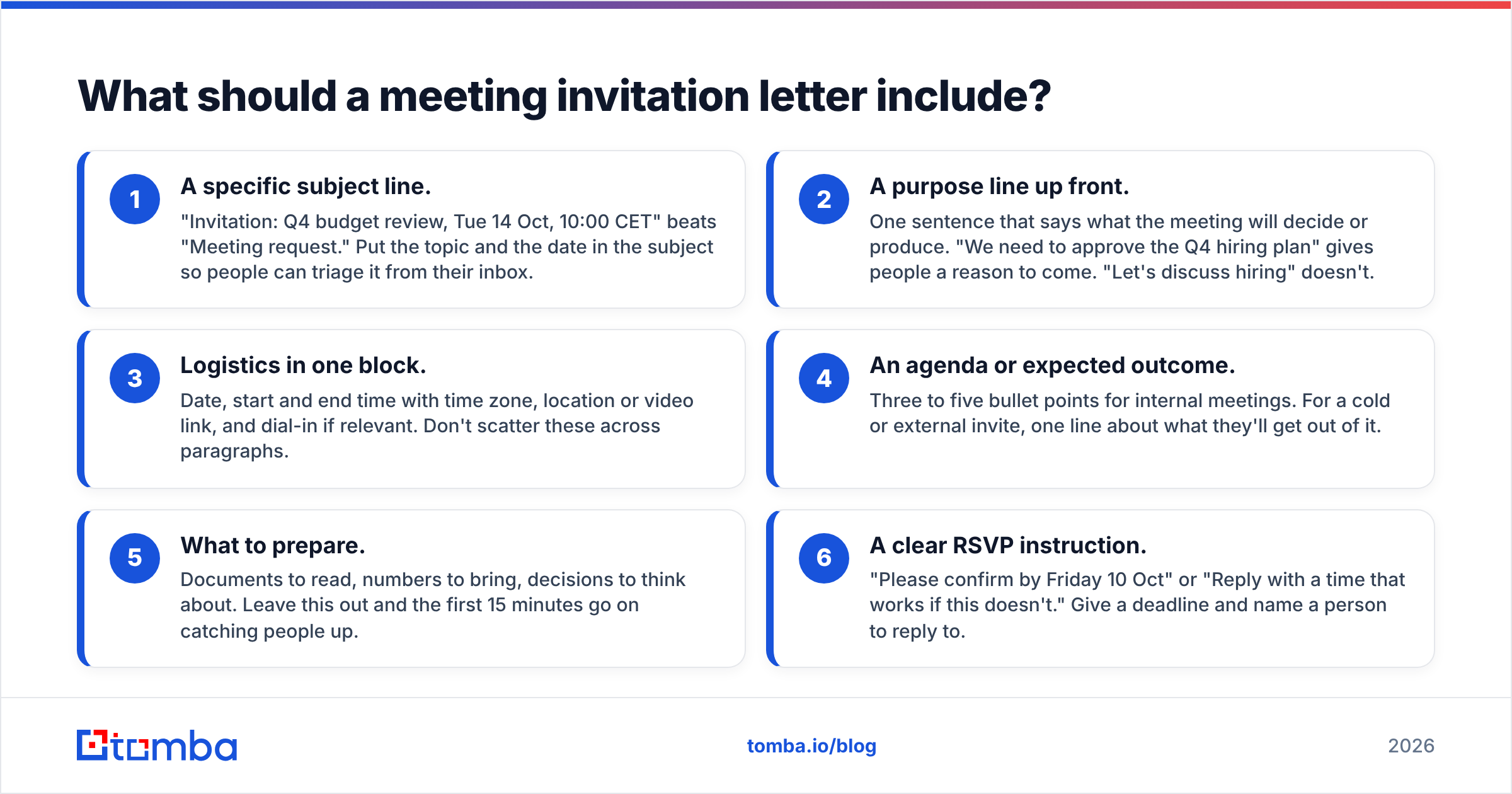
- A specific subject line. "Invitation: Q4 budget review, Tue 14 Oct, 10:00 CET" beats "Meeting request." Put the topic and the date in the subject so people can triage it from their inbox.
- A purpose line up front. One sentence that says what the meeting will decide or produce. "We need to approve the Q4 hiring plan" gives people a reason to come. "Let's discuss hiring" doesn't.
- Logistics in one block. Date, start and end time with time zone, location or video link, and dial-in if relevant. Don't scatter these across paragraphs.
- An agenda or expected outcome. Three to five bullet points for internal meetings. For a cold or external invite, one line about what they'll get out of it.
- What to prepare. Documents to read, numbers to bring, decisions to think about. Leave this out and the first 15 minutes go on catching people up.
- A clear RSVP instruction. "Please confirm by Friday 10 Oct" or "Reply with a time that works if this doesn't." Give a deadline and name a person to reply to.
Formal letters add the usual framing around these six: your letterhead or sender address, the date, the recipient's name and title, a salutation, and a signature block with your title and contact details.
Should you send a formal letter or an email?#
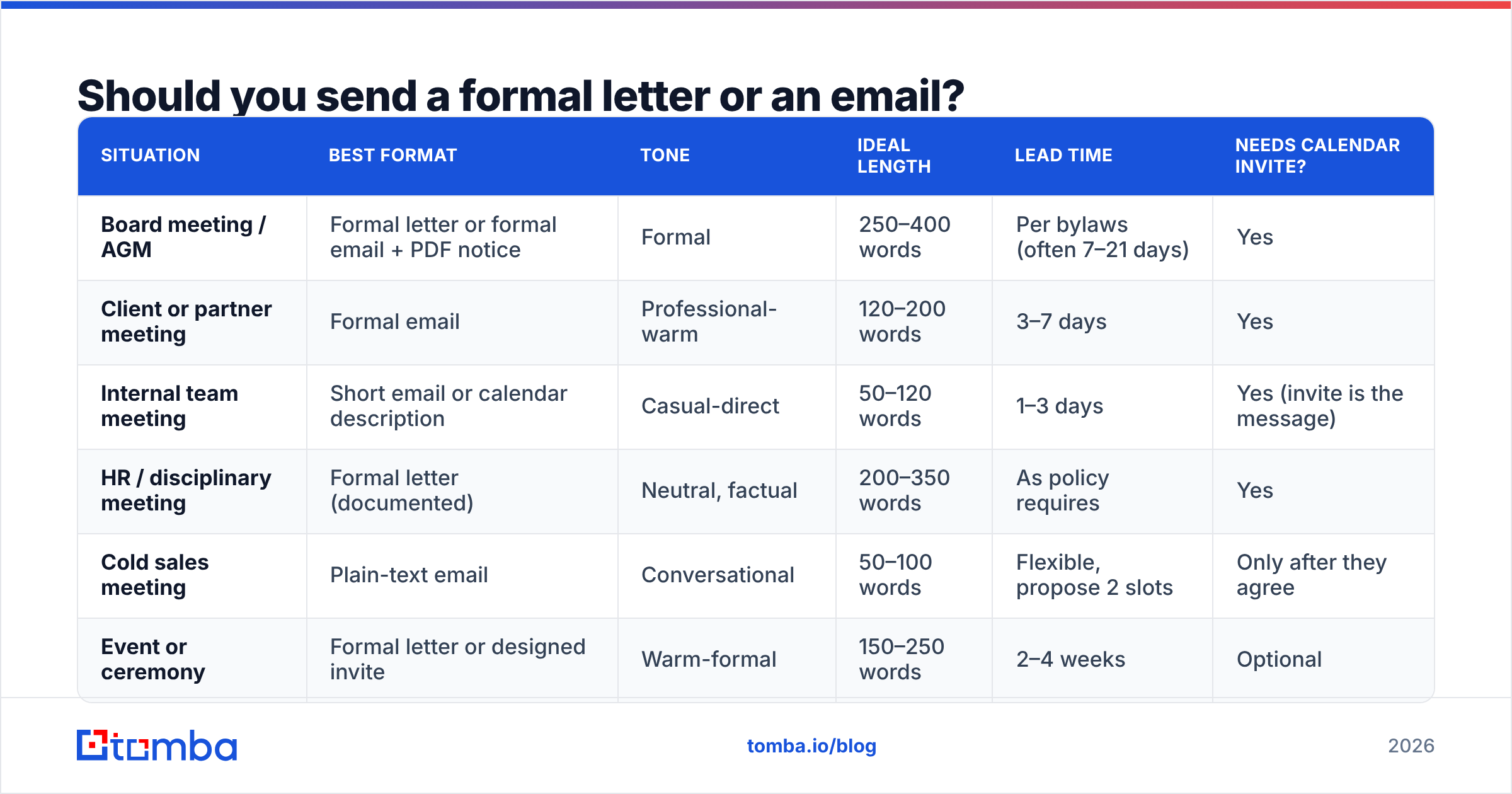
Pick the format based on the stakes, the relationship, and whether you need a record. The table below covers the most common situations.
| Situation | Best format | Tone | Ideal length | Lead time | Needs calendar invite? |
|---|---|---|---|---|---|
| Board meeting / AGM | Formal letter or formal email + PDF notice | Formal | 250–400 words | Per bylaws (often 7–21 days) | Yes |
| Client or partner meeting | Formal email | Professional-warm | 120–200 words | 3–7 days | Yes |
| Internal team meeting | Short email or calendar description | Casual-direct | 50–120 words | 1–3 days | Yes (invite is the message) |
| HR / disciplinary meeting | Formal letter (documented) | Neutral, factual | 200–350 words | As policy requires | Yes |
| Cold sales meeting | Plain-text email | Conversational | 50–100 words | Flexible, propose 2 slots | Only after they agree |
| Event or ceremony | Formal letter or designed invite | Warm-formal | 150–250 words | 2–4 weeks | Optional |
Two rules cover most of the table. If someone could later ask "did you notify them properly?", send a formal letter or a formal email with a clear record. If the meeting is routine, the calendar invite itself should carry the message, and a separate email is usually just noise.
How do you write a formal letter for a meeting invitation?#
Here's a template you can adapt for board meetings, stakeholder briefings, or any meeting where formality matters.
Template 1: Formal meeting invitation letter#
[Company Letterhead]
[Date]
[Recipient Name]
[Title]
[Organization]
[Address]
Subject: Invitation to [Meeting Name] on [Date]
Dear [Mr./Ms./Dr. Last Name],
On behalf of [Organization], I am pleased to invite you to [meeting name], to be held on [day, date] from [start time] to [end time] [time zone] at [venue / video link].
The purpose of this meeting is to [specific decision or outcome, e.g., review and approve the FY2027 operating budget].
The agenda will cover:
- [Agenda item 1]
- [Agenda item 2]
- [Agenda item 3]
Please review the enclosed [documents] before the meeting. [If applicable: If you are unable to attend, you may appoint a proxy using the attached form.]
Kindly confirm your attendance by [RSVP date] by replying to [name] at [email/phone].
We look forward to your participation.
Sincerely,
[Full Name]
[Title]
[Organization]
[Phone] | [Email]
Template 2: Board meeting notice (email version)#
Subject: Notice of Board Meeting – [Date], [Time] [TZ]
Dear Board Members,
This is formal notice of the [quarterly/special] board meeting of [Company], scheduled for [date] at [time] [TZ] at [location / link].
Purpose: [e.g., approve Q3 financials and vote on the Series B term sheet].
Agenda and board pack: attached. Please read section 3 (term sheet) before the meeting.
Please confirm attendance or send your proxy to [name] by [date].
Regards,
[Name], [Company Secretary / Chair]
Check your bylaws before sending. Many organisations set a minimum notice period and require that the agenda go out with the notice. A beautifully written letter can still be invalid if it arrives late.
How do you write a meeting invitation email to a client or partner?#
Client invitations should read professionally but warmly. The reader didn't have to agree to this meeting, so make the value obvious and make saying yes easy.
Template 3: Client meeting invitation#
Subject: 30 min on [topic], Thu 16 Oct?
Hi [First Name],
Now that [project/milestone] is live, I'd like to set up a 30-minute review to go over [results / next phase] and agree on priorities for [period].
Proposed: Thursday 16 Oct, 14:00–14:30 [TZ], on [Zoom/Teams link]
What we'll cover:
- [Result or metric 1]
- [Open decision 2]
- [Next steps and owners]
If that time doesn't work, reply with a slot that does and I'll send a new invite. It would help if you could bring [specific input, e.g., your Q1 launch dates].
Best,
[Name]
Template 4: Partner or vendor kickoff#
Subject: Kickoff: [Project name] – choose a slot
Hi [First Name],
We're ready to start [project]. Before work begins, I'd like a 45-minute kickoff with your team and ours to confirm scope, timelines, and points of contact.
Here are three options (all [TZ]):
- Mon 20 Oct, 10:00
- Tue 21 Oct, 15:00
- Wed 22 Oct, 11:00
Or pick any open slot here: [scheduling link].
Attendees on our side: [names + roles]. Could you bring whoever will own [area] on your side?
Thanks,
[Name]
Offering two or three slots, or a scheduling link from a tool like Calendly, cuts out the back-and-forth that kills momentum.
How do you invite your team to an internal meeting?#
Internal invitations fail when they're too vague rather than too short. "Sync on the launch" makes eight people guess why they're there.
Template 5: Internal team meeting#
Subject: Decide launch date – Wed 10:00 (30 min)
Team,
We need to lock the launch date for [product] this week. Wednesday 10:00–10:30, [room / link].
Goal: leave with one date and an owner for each blocker.
Before the meeting: update your status in [doc link]. If something's blocking you, put it in the doc so we don't spend meeting time finding out.
If you're not a decision-maker on this, you can skip it. I'll post the outcome in #launch.
[Name]
The "you can skip it" line is underrated. Making attendance optional for people who don't need to be there tells everyone else that the meeting matters.
Put the same text in the calendar invite description. Most people only open the calendar event, so if your context lives only in a separate email, they won't read it.
How do you write a cold email asking for a meeting?#
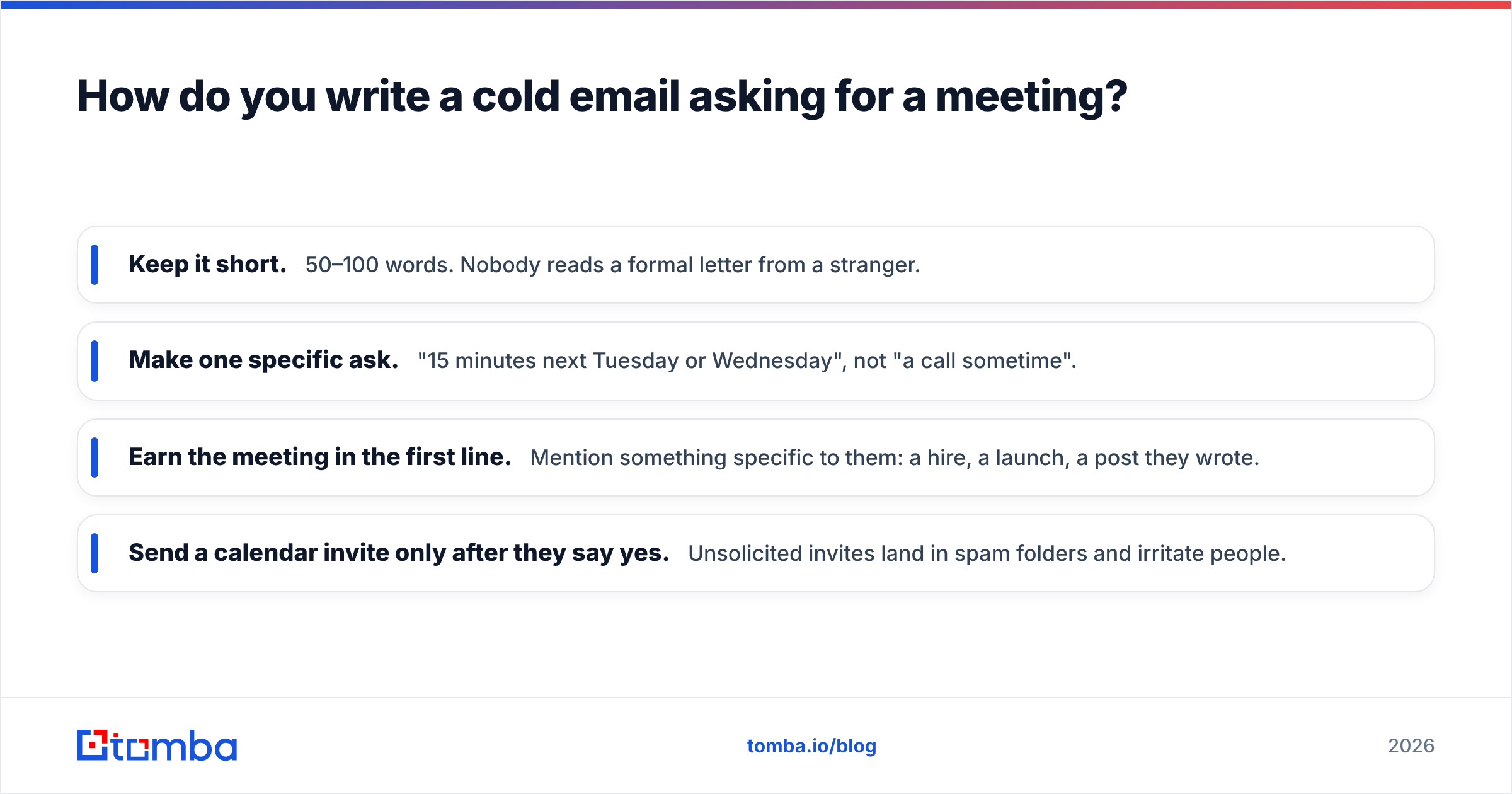
A cold meeting invite is really a sales email: the recipient doesn't know you and owes you nothing. The rules change:
- Keep it short. 50–100 words. Nobody reads a formal letter from a stranger.
- Make one specific ask. "15 minutes next Tuesday or Wednesday", not "a call sometime".
- Earn the meeting in the first line. Mention something specific to them: a hire, a launch, a post they wrote.
- Send a calendar invite only after they say yes. Unsolicited invites land in spam folders and irritate people.
Template 6: Cold meeting request#
Subject: [Their company]'s [specific initiative]
Hi [First Name],
Saw [Company] just opened [X] roles for [team]. Usually that means [specific pain, e.g., onboarding is about to become a bottleneck].
We helped [similar company] cut [metric] by [result] during a similar ramp.
Worth 15 minutes next Tue or Wed to see if it applies to you?
[Name]
Template 7: Follow-up meeting invite#
Subject: Re: [original subject]
Hi [First Name],
Bumping this in case it got buried. Happy to keep it to 15 minutes, and if [topic] isn't a priority this quarter, just say so and I'll close the loop.
[Name]
If you need help with the opening line, a subject line generator can give you variations to A/B test. For cold invites, though, the hard part is usually getting the message delivered at all.
Why do meeting invitations go unanswered?#
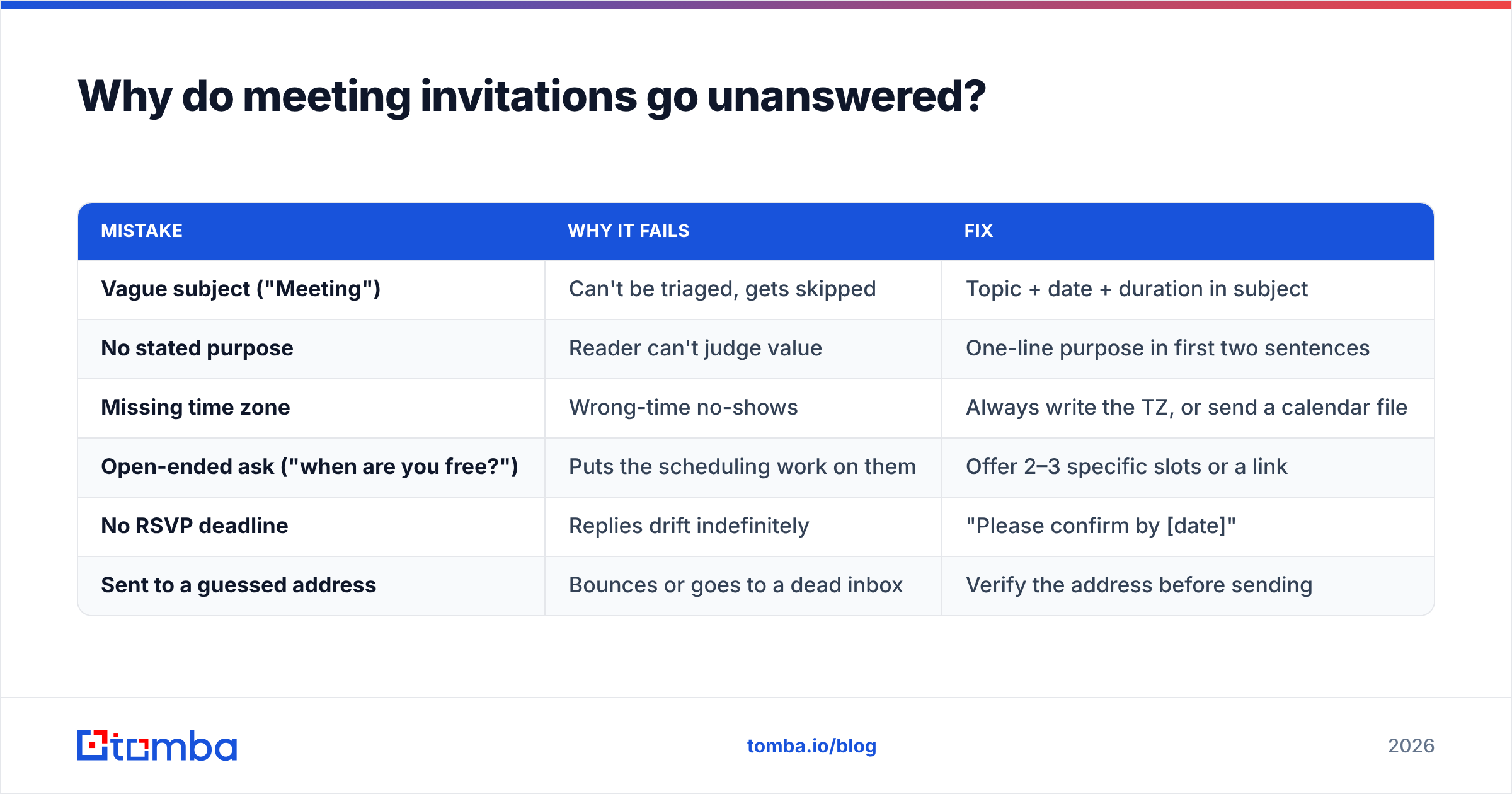
Most unanswered invitations fail for one of these reasons, and none of them are about the reader being busy.
| Mistake | Why it fails | Fix |
|---|---|---|
| Vague subject ("Meeting") | Can't be triaged, gets skipped | Topic + date + duration in subject |
| No stated purpose | Reader can't judge value | One-line purpose in first two sentences |
| Missing time zone | Wrong-time no-shows | Always write the TZ, or send a calendar file |
| Open-ended ask ("when are you free?") | Puts the scheduling work on them | Offer 2–3 specific slots or a link |
| No RSVP deadline | Replies drift indefinitely | "Please confirm by [date]" |
| Sent to a guessed address | Bounces or goes to a dead inbox | Verify the address before sending |
The last row matters most for external and cold invites. If you guessed firstname.lastname@company.com and the company actually uses f.lastname@, your well-written letter never arrives, and repeated bounces damage your sender reputation for every email you send afterwards.
Before sending an important invite to someone outside your company, check the address. You can look up the company's format with a company email pattern check, or run the address through an email verifier to confirm the mailbox exists.

How should you format the calendar invite that goes with the letter?#
The letter explains the meeting. The calendar invite is what gets it into people's schedules. Most calendar tools send invitations in the iCalendar (.ics) format, so what you write in the event shows up in Google Calendar, Outlook, and Apple Calendar alike.
Use this checklist:
- Title: the same wording as your subject line, e.g., "Q4 Budget Review – Decision."
- Description: paste the purpose line, the agenda, and the prep links. Don't just write "see email."
- Location field: the video link or the full room name. Put dial-in numbers in the description.
- Guest permissions: for large internal meetings, turn off "guests can invite others" so the meeting doesn't grow.
- Attachments: link to documents in shared storage instead of attaching files, so everyone reads the latest version.
- Reminders: a 10-minute reminder is fine. For board meetings, add a one-day reminder too.
For recurring meetings, send a short message each time with that week's specific agenda. Otherwise people stop reading the invite after the third week.
What are the best practices for polite, professional wording?#
The wording in a meeting invitation should be confident without being pushy. Here are some phrases for each part:
Opening lines
- "I'd like to invite you to…"
- "On behalf of [team], I'm pleased to invite you to…"
- "We're setting up a short session to…"
Purpose lines
- "The goal is to agree on…"
- "By the end, we'll have…"
- "This meeting will decide…"
RSVP lines
- "Please confirm by [date] so we can finalise the agenda."
- "If this time doesn't work, reply with one that does."
- "If you can't attend, feel free to send a delegate."
Phrases to avoid
- "Just wanted to touch base" (says nothing)
- "At your earliest convenience" (no deadline, so no urgency)
- "Quick call?" with no topic (this is how invitations get ignored)
On tone: match the reader, not yourself. A founder emailing a board chair should write formally even if the company is informal. A sales rep emailing a startup CTO should drop the formality or the email reads like a template, which it usually is.
Quick checklist before you hit send#
Run through this before any invitation goes out:
- Subject includes topic, date, and duration
- Purpose is stated in one sentence near the top
- Logistics include a time zone and a working link
- Agenda or outcome is listed
- Prep instructions are specific
- RSVP has a deadline and a named contact
- Address is verified for every external recipient
If every item checks out, the invitation will get read and people will be able to answer it quickly. After that, acceptance comes down to whether the meeting is worth their time.
Get your meeting invitations to the right inbox#
A well-structured letter for a meeting invitation does nothing if it goes to the wrong person. That's the real problem with partner, investor, and cold outreach invites: you often don't have the decision-maker's direct email. Tomba Email Finder lets you find a professional email address from a name and company domain, then verify it before you send, so your invitation reaches an inbox someone reads. The free plan includes 25 searches a month, which is enough to test it on your next important invite. Paid plans start at $49/mo if you send invitations at volume; see Tomba pricing for details.
Related guides#
// get started
Find, verify and enrich your first contacts today
Start on the free plan with 25 searches a month, then scale when your team is ready.
Free plan · No credit card required · GDPR & CCPA
// about the author