Letter for Introduction of Company: Templates & Examples (2026)
Most company introduction letters get deleted because they talk about the sender. Here's the structure, six copy-ready templates, and the mistakes that kill replies.
TL;DR
- A letter for introduction of company tells a specific reader who you are, why you're contacting them, and what one next step you want. Everything else is optional.
- The best-performing intros in 2026 run 90–150 words when sent by email. Formal printed letters can go longer, but they should still fit on one page.
- Match the letter type to the relationship: a cold prospect, a potential partner, a new market, a rebrand, or a warm referral each needs a different opening and CTA.
- Send it to a named person at a verified address. A great letter sent to info@ or to an address that bounces never gets read.
- Six copy-ready templates are below. Adapt the bracketed parts, and don't send any of them unchanged.
What is a letter for introduction of company?#
A company introduction letter is a short business letter or email. It presents your organization to someone who doesn't know it yet, usually a prospective client, partner, supplier, investor, or distributor. Its job is to start a conversation. It's not there to close a deal.
Picture a handshake at a conference. You say your name, one line about what you do, and something relevant to the person in front of you. Then you either keep talking or you move on. Nobody hands over a 40-slide deck mid-handshake. Your letter should work the same way.
The format has its roots in the traditional business letter: sender block, date, recipient, salutation, body, closing. Today most introductions go out by email, and the formal parts shrink to a subject line and a signature. The printed version still matters in some places: government procurement, some Middle Eastern, Japanese, and German markets, and regulated industries where a signed letter on letterhead is expected.
Why do most company introduction letters fail?#
They're written for the sender, not the reader. Open ten intro letters in any procurement inbox and you'll find the same pattern:
- "We are a leading provider of…"
- A paragraph of founding history
- A bulleted list of every service
- "Please find attached our company profile"
- "Feel free to contact us"
Not one of those lines answers what the recipient actually wants to know: why is this in my inbox, and what's in it for me?
Other common reasons they fail:
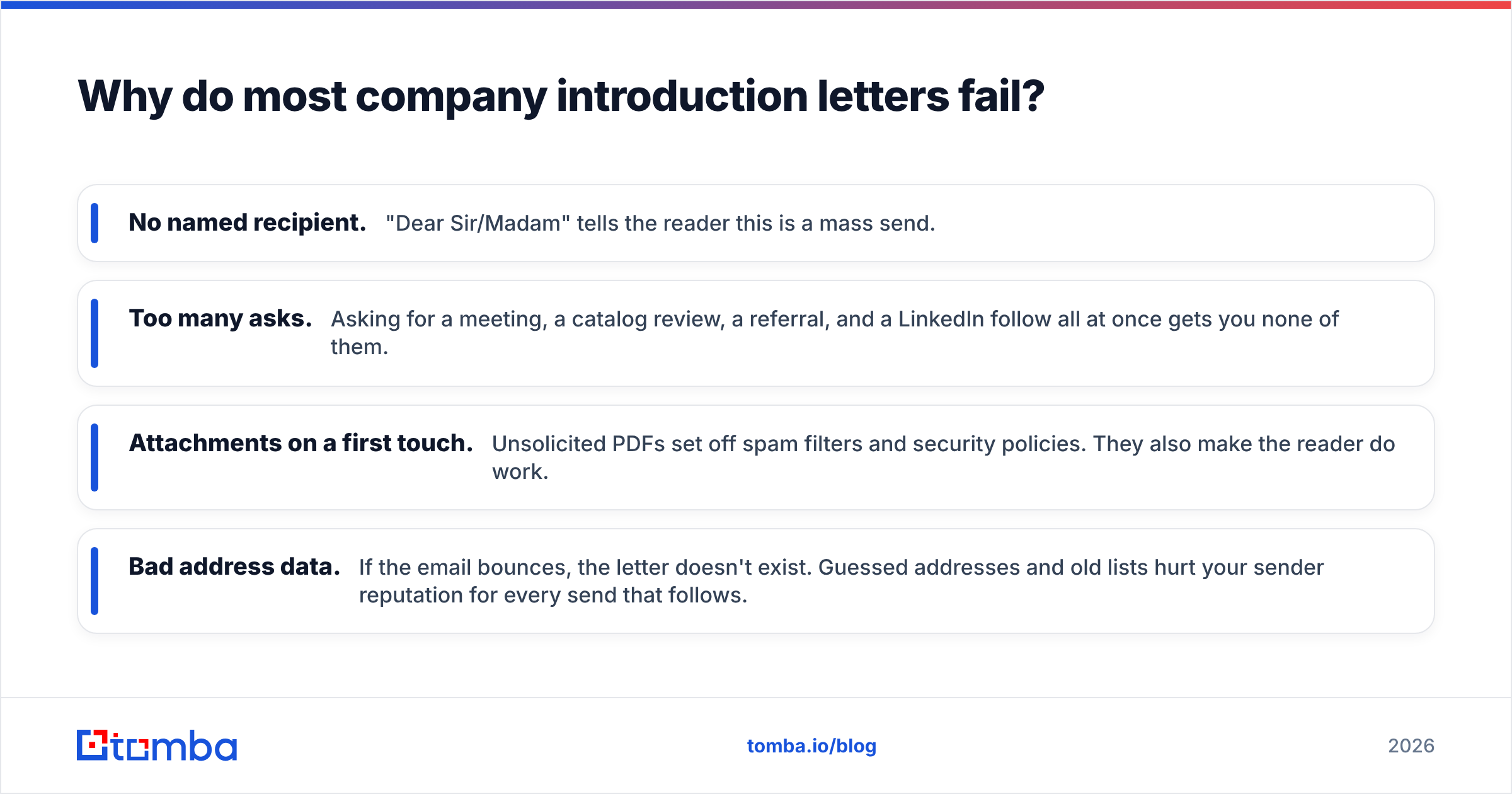
- No named recipient. "Dear Sir/Madam" tells the reader this is a mass send.
- Too many asks. Asking for a meeting, a catalog review, a referral, and a LinkedIn follow all at once gets you none of them.
- Attachments on a first touch. Unsolicited PDFs set off spam filters and security policies. They also make the reader do work.
- Bad address data. If the email bounces, the letter doesn't exist. Guessed addresses and old lists hurt your sender reputation for every send that follows.
What should a company introduction letter include?#
Every strong introduction has the same five parts, in this order. Think of them as a checklist you run before you hit send.
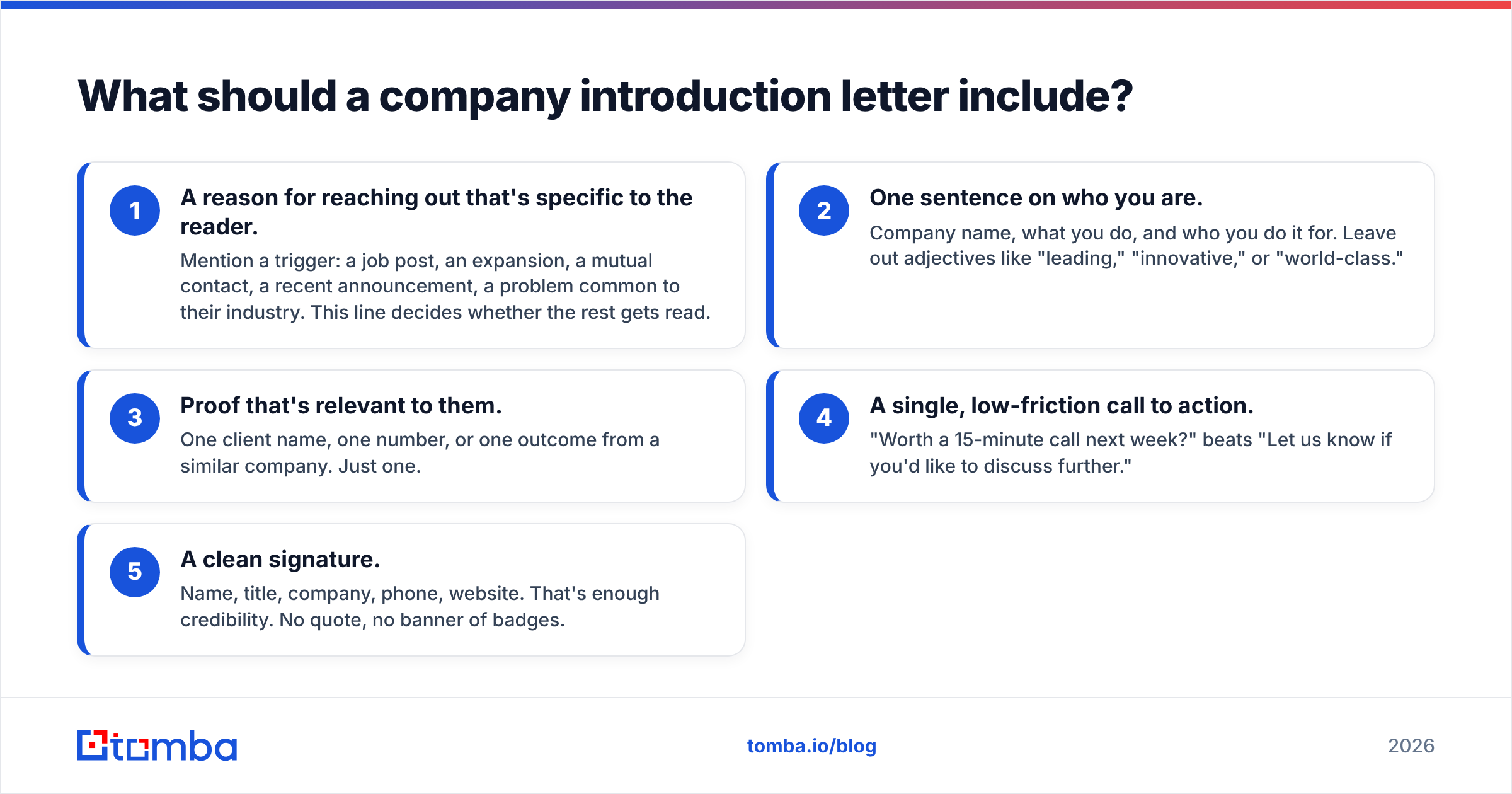
- A reason for reaching out that's specific to the reader. Mention a trigger: a job post, an expansion, a mutual contact, a recent announcement, a problem common to their industry. This line decides whether the rest gets read.
- One sentence on who you are. Company name, what you do, and who you do it for. Leave out adjectives like "leading," "innovative," or "world-class."
- Proof that's relevant to them. One client name, one number, or one outcome from a similar company. Just one.
- A single, low-friction call to action. "Worth a 15-minute call next week?" beats "Let us know if you'd like to discuss further."
- A clean signature. Name, title, company, phone, website. That's enough credibility. No quote, no banner of badges.
If you only have room for three parts, keep 1, 2, and 4.
Which type of introduction letter do you need?#
The right structure depends on who you're writing to and what you want from them. Use this table to pick a format before you write a word.
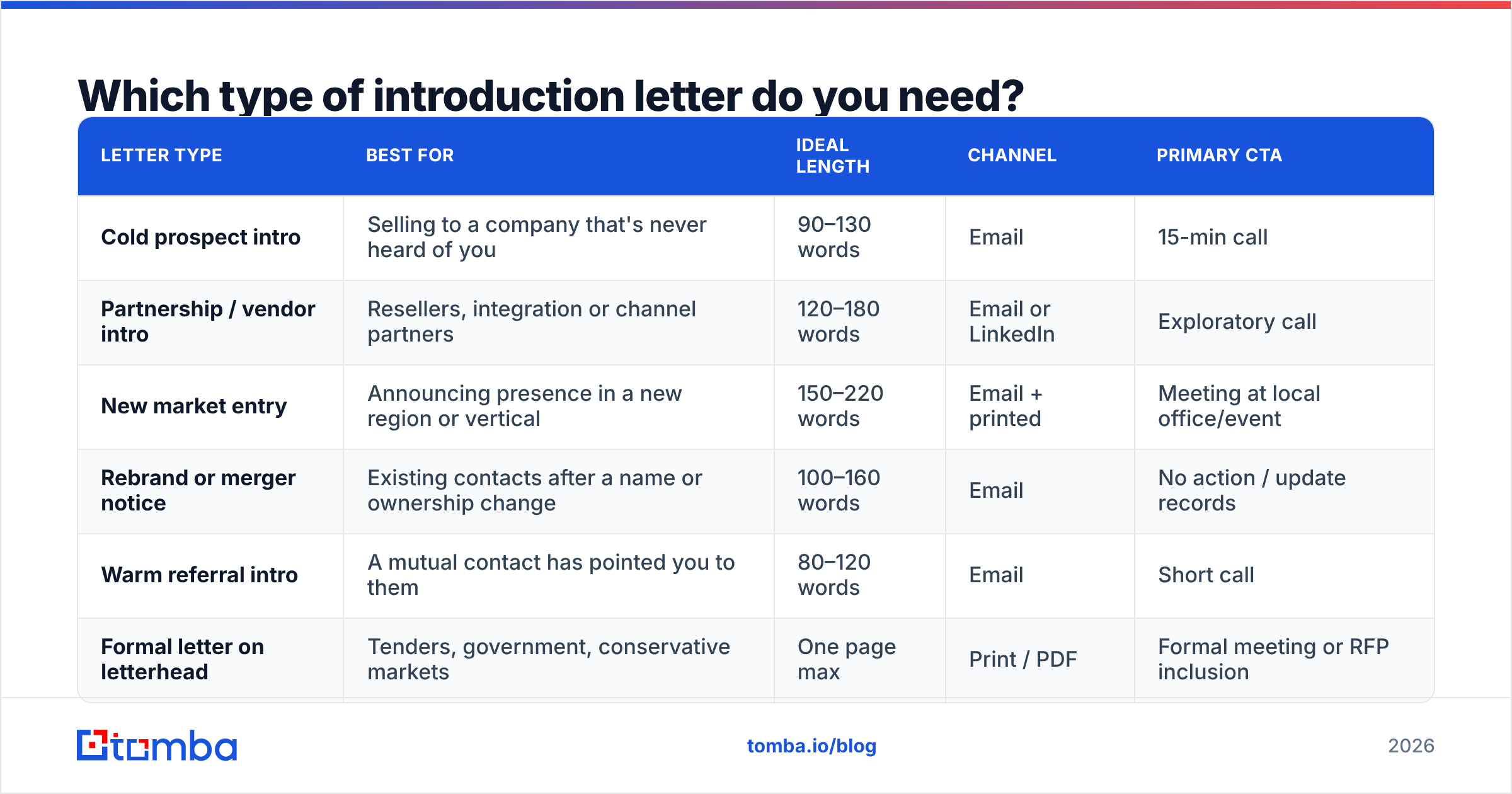
| Letter type | Best for | Ideal length | Channel | Primary CTA |
|---|---|---|---|---|
| Cold prospect intro | Selling to a company that's never heard of you | 90–130 words | 15-min call | |
| Partnership / vendor intro | Resellers, integration or channel partners | 120–180 words | Email or LinkedIn | Exploratory call |
| New market entry | Announcing presence in a new region or vertical | 150–220 words | Email + printed | Meeting at local office/event |
| Rebrand or merger notice | Existing contacts after a name or ownership change | 100–160 words | No action / update records | |
| Warm referral intro | A mutual contact has pointed you to them | 80–120 words | Short call | |
| Formal letter on letterhead | Tenders, government, conservative markets | One page max | Print / PDF | Formal meeting or RFP inclusion |
A good rule of thumb: the colder the relationship, the shorter the letter and the smaller the ask.
How do you write a cold company introduction email?#
For cold outreach, the letter is only half the work. The other half is getting it to the right person. Before writing, identify the actual decision-maker (Head of Operations, not "the company") and find their direct work address. A tool like the Tomba Email Finder returns a professional address from a name and company domain. If you're working out the format by hand, the company email pattern checker shows you whether a company uses first.last@, f.last@, or something else.
Then run the address through an email verifier before sending. One bounced intro is harmless. Two hundred will damage the domain you rely on for every future send.
Template 1: Cold prospect introduction#
Subject: [Their company] + [your company] — quick question
Hi [First name],
I noticed [Their company] is [hiring three SDRs / opening a Berlin office / rolling out a new product line]. Teams at that stage usually run into [specific problem, e.g. "onboarding reps faster than the CRM data can keep up"].
I'm [Name] from [Your company]. We help [type of company] [outcome] — [Client name] used us to [specific result, e.g. "cut lead research time by 60% in one quarter"].
Would a 15-minute call next Tuesday or Wednesday be worth it to see if that applies to you?
[Signature]
Why it works: the first line is about them, the proof is one sentence, and the CTA offers two concrete days.
How do you introduce your company to a potential partner?#
Partners care about fit and mutual upside more than features. Lead with the overlap: shared customers, complementary products, or a gap in their offering you fill.
Template 2: Partnership introduction#
Subject: Partnership idea: [Your company] x [Their company]
Hi [First name],
A lot of [Their company]'s customers — [segment, e.g. "mid-market logistics firms"] — also ask us for [adjacent need]. We don't compete with you on [their core product]; we plug in right after it.
[Your company] provides [one-line description]. We currently partner with [Partner name] on a similar arrangement, which brought [result, e.g. "40 co-sold deals in 2025"].
I'd like to explore whether a referral or integration partnership makes sense. Are you the right person to talk to, or is there someone on your partnerships team I should contact?
[Signature]
The "are you the right person" line is useful. If you picked the wrong contact, you still get a reply that routes you to the right one.
How do you announce your company in a new market?#
When you're entering a new region or vertical, the introduction does double duty. It's a hello and a credibility signal. This is where a slightly longer letter, sometimes on letterhead, pays off.
Template 3: New market entry#
Subject: [Your company] is now operating in [Region]
Dear [Mr./Ms. Last name],
I'm writing to introduce [Your company], which has opened its [City] office this month to serve [industry] companies across [Region].
For the past [X] years we've worked with organizations such as [Client A] and [Client B] on [service], helping them [measurable outcome]. Our local team, led by [Name], has [relevant local experience].
Given [Their company]'s [specific reason — growth, a recent tender, a known challenge], I believe there may be a fit. I'd welcome the chance to meet at our office or yours during the week of [date].
Yours sincerely,
[Name, Title]
[Company, address, phone, website]
For formal markets, use full names and titles and send a signed PDF alongside the email.
How do you write an introduction letter after a rebrand or merger?#
This one goes to people who already know you, just not under your new name. The goal is to reassure them. You don't want them confused, you don't want them worried, and you don't want your next invoice flagged as fraud.
Template 4: Rebrand / merger notice#
Subject: [Old name] is now [New name] — nothing changes for you
Hi [First name],
A quick heads-up: as of [date], [Old name] is now [New name], following [our merger with X / our rebrand].
What stays the same: your account manager ([Name]), your contract terms, and your support line.
What changes: our email domain (now @[newdomain].com) and the name on invoices.
Please add our new domain to your approved senders so nothing lands in spam. Questions? Just reply here.
[Signature]
Note the explicit "what stays / what changes" split, plus the practical ask about whitelisting the domain. A domain change is exactly when email deliverability problems show up, so warm up the new domain before the announcement goes out.
How do you use a referral in a company introduction letter?#
A mutual connection is the strongest opener there is. Put it in the subject line and the first sentence.
Template 5: Warm referral introduction#
Subject: [Mutual contact] suggested I reach out
Hi [First name],
[Mutual contact] mentioned you're looking at ways to [goal] and thought we should talk.
I run [function] at [Your company]; we helped [Mutual contact]'s team at [Their company] [result].
Open to a 15-minute call this week? Happy to work around your calendar.
[Signature]
Keep it short. The referral already did the work of establishing trust, so don't bury it under a company history.
What does a formal company introduction letter look like?#
Tenders, government buyers, banks, and some international distributors still expect a printed or PDF letter on letterhead. The five-part structure still applies. You just wrap it in traditional formatting.
Template 6: Formal letter on letterhead#
[Company letterhead]
[Date]
[Recipient name]
[Title]
[Organization]
[Address]
Subject: Introduction of [Your company] — [Service/Product category]
Dear [Mr./Ms. Last name],
We are writing to introduce [Your company], a [registered/certified] provider of [service] based in [City], and to express our interest in [supplying / partnering / being considered for upcoming tenders].
Established in [year], we currently serve [number] clients in [sectors], including [notable client]. We hold [certifications, e.g. ISO 9001], and our [key differentiator] has allowed clients such as [Client] to [result].
We would be grateful for the opportunity to present our capabilities in person, or to be included in your approved vendor list. Our company profile and certifications are available on request.
Yours faithfully,
[Signature]
[Name, Title]
[Phone | Email | Website]
"Available on request" does the job an attachment would, without the attachment risk.
Should you send a company introduction letter by email or post?#
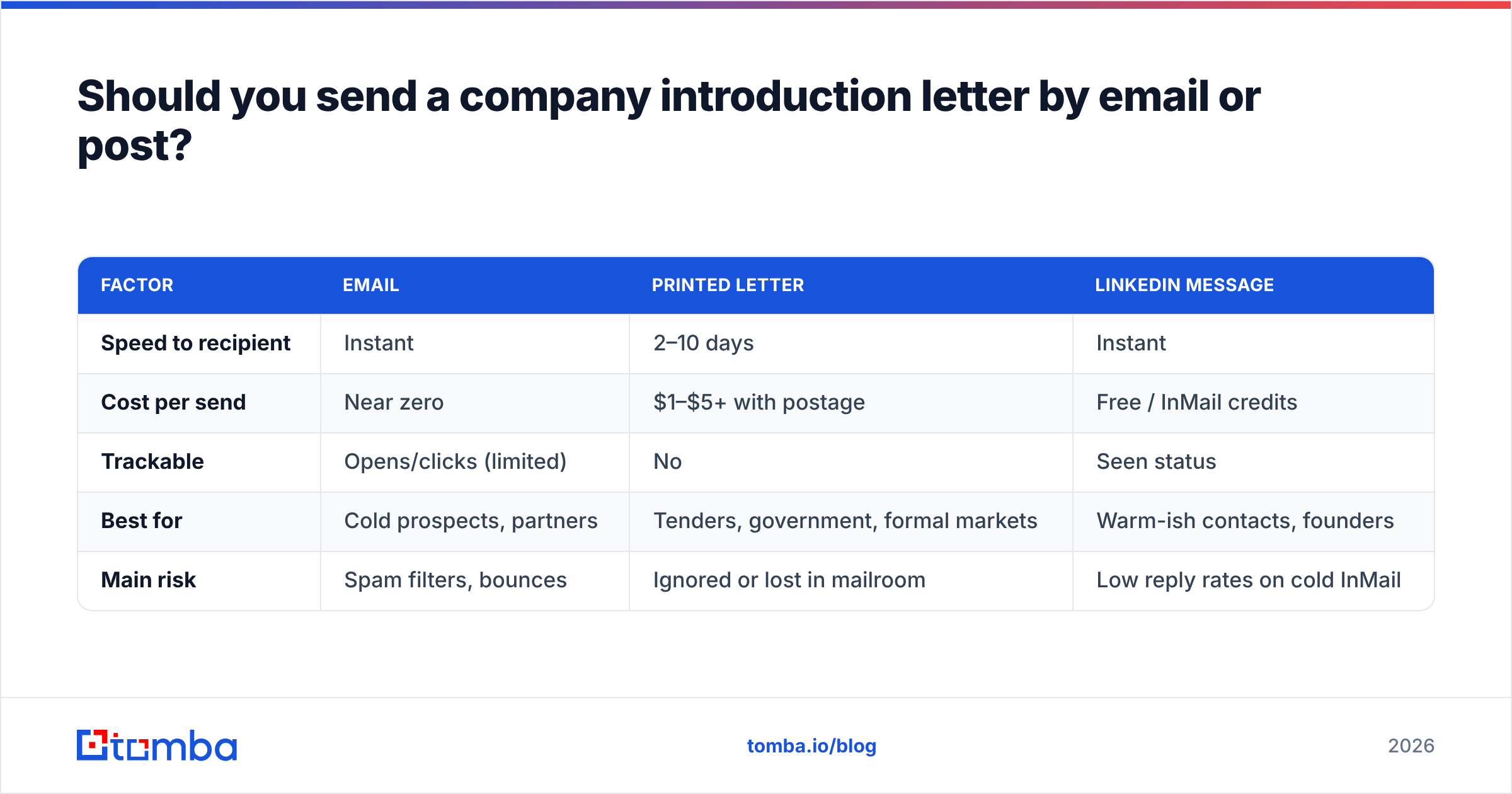
Email by default, post when the culture or process expects it. Here's how the channels compare in practice:
| Factor | Printed letter | LinkedIn message | |
|---|---|---|---|
| Speed to recipient | Instant | 2–10 days | Instant |
| Cost per send | Near zero | $1–$5+ with postage | Free / InMail credits |
| Trackable | Opens/clicks (limited) | No | Seen status |
| Best for | Cold prospects, partners | Tenders, government, formal markets | Warm-ish contacts, founders |
| Main risk | Spam filters, bounces | Ignored or lost in mailroom | Low reply rates on cold InMail |
If you send by email to prospects in the U.S., follow the basic rules in the FTC's CAN-SPAM compliance guide. Use an accurate sender, a truthful subject line, a physical address, and a way to opt out. EU and UK recipients fall under GDPR's legitimate-interest rules, so keep your targeting relevant and your records clean.
How do you follow up on a company introduction letter?#
Most replies come from the follow-ups, not the first email. A simple cadence that stays polite:
- Day 3: A two-line bump that adds one new piece of value (a relevant case study, a stat).
- Day 7: A different angle, such as another pain point or another proof point.
- Day 14: A breakup email: "Should I close the loop on this, or is someone else better placed to talk?"
Log each touch in your CRM. Sales platforms like HubSpot can automate the sequence and stop it as soon as the prospect replies. If you'd rather start from proven wording, Tomba's library of cold email templates includes follow-up variants you can adapt.
What mistakes should you cut before you send?#
Run one last pass and delete anything that matches this list:
- "We are a leading…" Replace it with one concrete proof point.
- More than one CTA. Pick the single next step you want.
- Paragraphs over three lines. Most people read these on a phone.
- Generic greetings. Find the person's name. If you can't, you probably haven't found the right person yet.
- Unverified addresses. A bounce rate above roughly 2% is a warning sign for your domain.
- Attachments on first contact. Link to them, or offer them on request.
- Typos in the recipient's name or company. This is the fastest way to lose credibility.
Ready to put your introduction in front of the right person?#
Even a strong letter for introduction of company fails if it goes to a generic inbox or an address that bounces. Before you send any of the templates above, use the Tomba Email Finder to get the direct professional email of the actual decision-maker. Search by name and company domain, check the address with the built-in verification, and send knowing it will arrive. The free plan includes 25 searches a month, which covers your first batch of intros, and paid plans start at $49/mo when you're ready to scale.
Related guides#
// get started
Find, verify and enrich your first contacts today
Start on the free plan with 25 searches a month, then scale when your team is ready.
Free plan · No credit card required · GDPR & CCPA
// about the author