LFBBD vs TAMI AI (Lead For Business): B2B Data Compared 2026
LFBBD sells large B2B, eCommerce and Amazon-seller contact lists. TAMI AI maps your total addressable market with AI and technographics. Here's how they compare on data, pricing and workflow, and which one fits your team.
LFBBD vs TAMI AI comes down to one question: do you want to buy a list, or use a platform? Here's how the two compare on data, pricing and workflow.
TL;DR
- LFBBD (Lead For Business) is a data provider. It sells B2B, eCommerce and Amazon-seller contact lists with emails and direct dials. It claims 250M+ business contacts.
- TAMI AI (formerly SalesOptimize) is a sales intelligence platform. Its AI maps your total addressable market across about 100M companies and 400M+ contacts. It adds technographics and a HubSpot sync.
- TAMI starts at about £39 per user per month, with a free trial. LFBBD has no public pricing, so ask for a quote.
- Pick LFBBD for one big list of merchants or Amazon sellers, fast. Pick TAMI for ongoing market mapping and CRM enrichment.
- Either way, verify emails before you send. All data decays, and bounces hurt sender reputation.
What is LFBBD (Lead For Business)?#
Lead For Business Ltd, which runs at lfbbd.com, is a lead generation and data company. Its catalogue covers three areas that many US data vendors skip:
- Traditional B2B contact data: decision-makers at companies, with email addresses and direct dial or mobile numbers.
- eCommerce store data: businesses that run online shops, useful if you sell payments, logistics, apps, agency services or SaaS to merchants.
- Amazon seller data: sellers on Amazon marketplaces along with the contact person behind the storefront.
The company says it has more than 250 million business contact records. Reviews on Trustpilot give it a TrustScore of around 4.5 out of 5, filed under data collection and business development consulting.
In practice, LFBBD works like a data supplier more than a SaaS tool. You describe your ideal customer (industry, geography, platform, seller category, job title), and you get a dataset back. That makes it fast for teams that already know their target segment and just need volume. It is less suited to teams that want to explore a market interactively, run saved searches or watch accounts change over time.
What is TAMI AI?#
TAMI is a Dublin-based B2B data and market intelligence platform. It was founded in 2015 as SalesOptimize and later rebranded. The name is a nod to TAM, total addressable market, and that describes the product well.
TAMI's pitch is that its patented AI identifies every company that fits your ideal customer profile, then layers on:
- Technographics: which platforms, payment providers and tools a company's website runs on.
- eCommerce insights: store platform, estimated scale and product categories.
- Web traffic data: a proxy for company size and momentum.
- Verified decision-maker contacts: listed as GDPR-compliant, with real-time updates.
It connects to HubSpot through a marketplace app with custom field mapping, and it can enrich incomplete form fills through a multi-URL lookup. TAMI says it holds ISO 27001, SOC 2 and GDPR certifications. The customer logos it names (Stripe, Amazon Payments, DPD) show that payments and logistics companies selling to merchants are its core market.
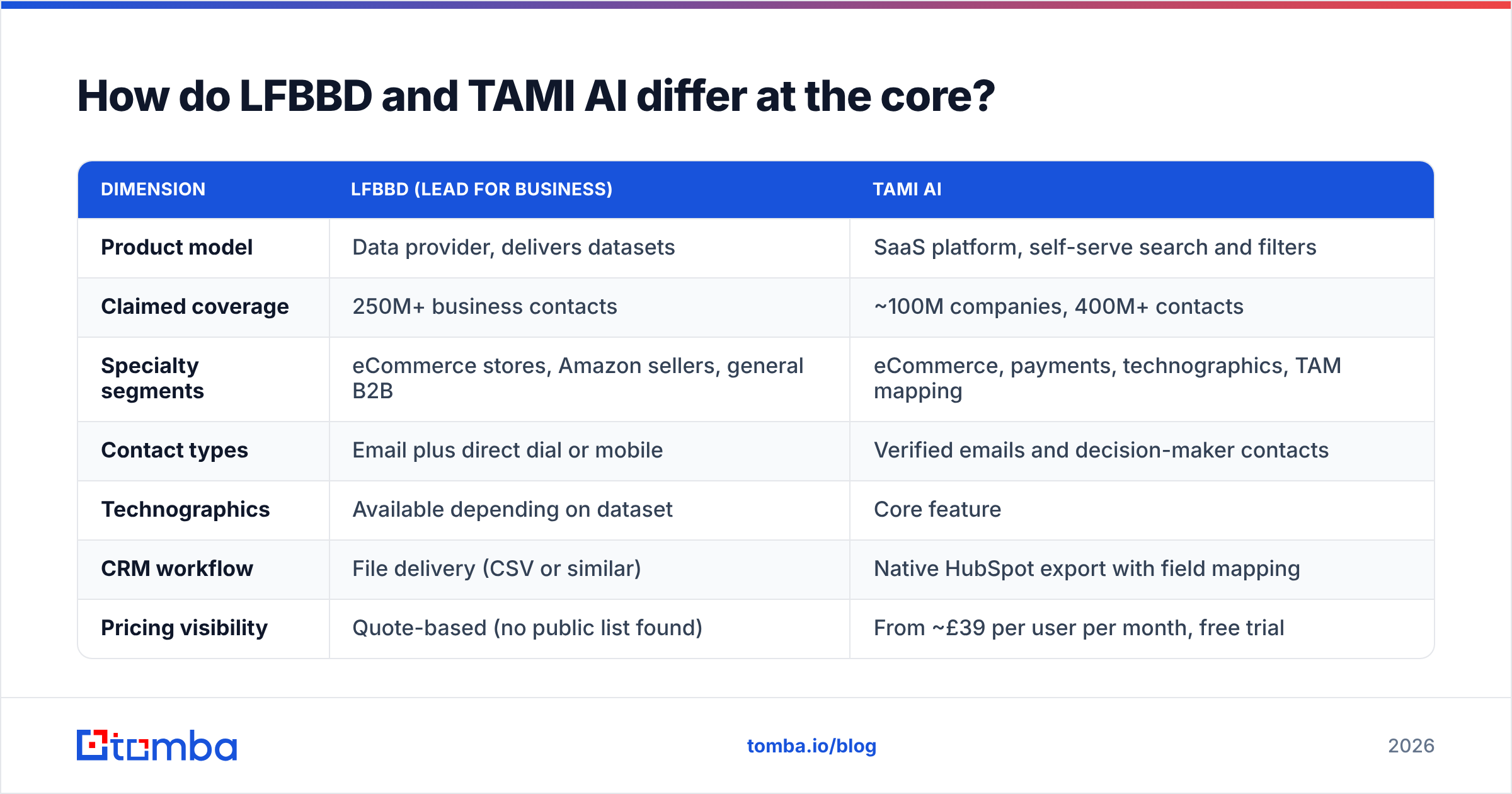
LFBBD vs TAMI AI: how do they differ at the core?#
The simplest way to think about it: LFBBD sells you the fish, TAMI sells you a sonar-equipped boat. Both can put you in front of a merchant's decision-maker. The difference is whether you want a finished dataset or an ongoing system for finding and qualifying accounts.
| Dimension | LFBBD (Lead For Business) | TAMI AI |
|---|---|---|
| Product model | Data provider, delivers datasets | SaaS platform, self-serve search and filters |
| Claimed coverage | 250M+ business contacts | ~100M companies, 400M+ contacts |
| Specialty segments | eCommerce stores, Amazon sellers, general B2B | eCommerce, payments, technographics, TAM mapping |
| Contact types | Email plus direct dial or mobile | Verified emails and decision-maker contacts |
| Technographics | Available depending on dataset | Core feature |
| CRM workflow | File delivery (CSV or similar) | Native HubSpot export with field mapping |
| Pricing visibility | Quote-based (no public list found) | From ~£39 per user per month, free trial |
| Best for | One-off or periodic list buys at volume | Ongoing prospecting and CRM enrichment |
Two points in that table matter more than the rest.
The delivery model decides your workflow. A dataset is a snapshot. It's accurate on the day it's compiled and starts decaying right away. B2B contact data is often estimated to decay 20–30% a year. People change jobs, companies rebrand and domains move. A platform like TAMI refreshes continuously, so a search you run in March shows March data. With LFBBD, you'll want to plan when you buy each refresh.
Technographics decide your targeting quality. If you sell a Shopify app, a payment gateway or a shipping integration, "companies in retail" is a poor filter. "Stores on Shopify Plus with over X monthly visits using a competitor's payment provider" is a good one. TAMI builds its product around that kind of filtering. LFBBD can segment by platform and marketplace, which covers a lot of merchant use cases. But you define the segment up front instead of refining it live.
Which has better data for eCommerce and Amazon sellers?#
This is where the comparison gets interesting, because both vendors aim at the same unusual niche: businesses that sell to online merchants.
Amazon sellers are LFBBD's clearest advantage. Few mainstream platforms model Amazon marketplace sellers as a first-class entity. Finding the human behind a storefront name usually means manual research. If your ICP is "US and UK Amazon sellers in home and kitchen with an estimated revenue band," an LFBBD dataset can save weeks of scraping and lookup work.
Web-based eCommerce with technographics is TAMI's clearest advantage. TAMI's roots in SalesOptimize were about crawling online stores and detecting their technology. If your trigger is "this store just switched checkout providers" or "this merchant runs platform X," TAMI's live filtering fits better.
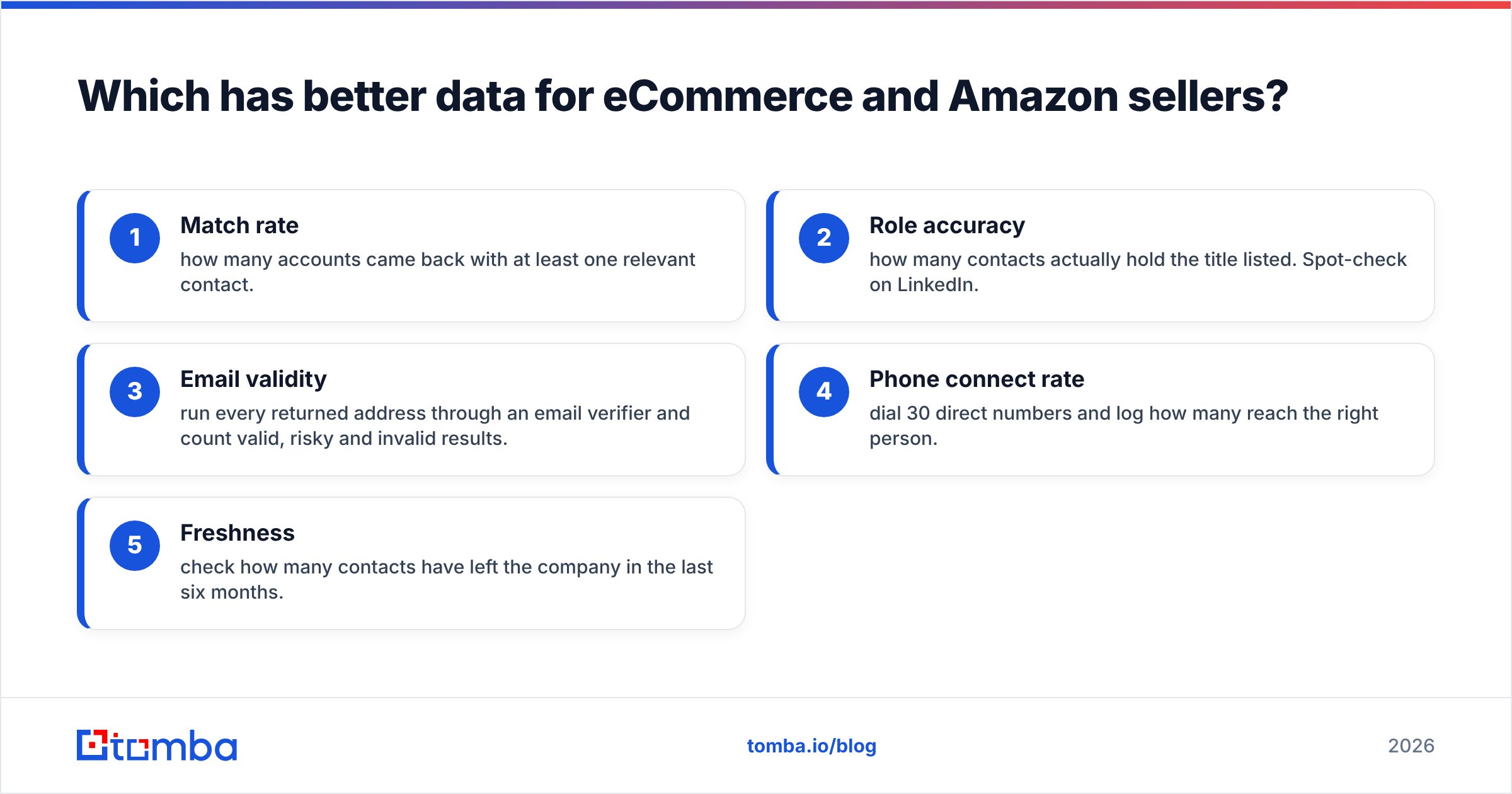
General B2B (SaaS, services, manufacturing) is closer to a draw. Both claim hundreds of millions of contacts. In practice your match rate will depend on geography and seniority. Run a sample before you commit to either. Give each vendor the same list of 200 target accounts and compare:
- Match rate: how many accounts came back with at least one relevant contact.
- Role accuracy: how many contacts actually hold the title listed. Spot-check on LinkedIn.
- Email validity: run every returned address through an email verifier and count valid, risky and invalid results.
- Phone connect rate: dial 30 direct numbers and log how many reach the right person.
- Freshness: check how many contacts have left the company in the last six months.
That five-point test takes a day and tells you more than any vendor's headline database size.
How much do LFBBD and TAMI AI cost?#
Pricing is where the two models differ most, and where you need to be careful comparing like with like.
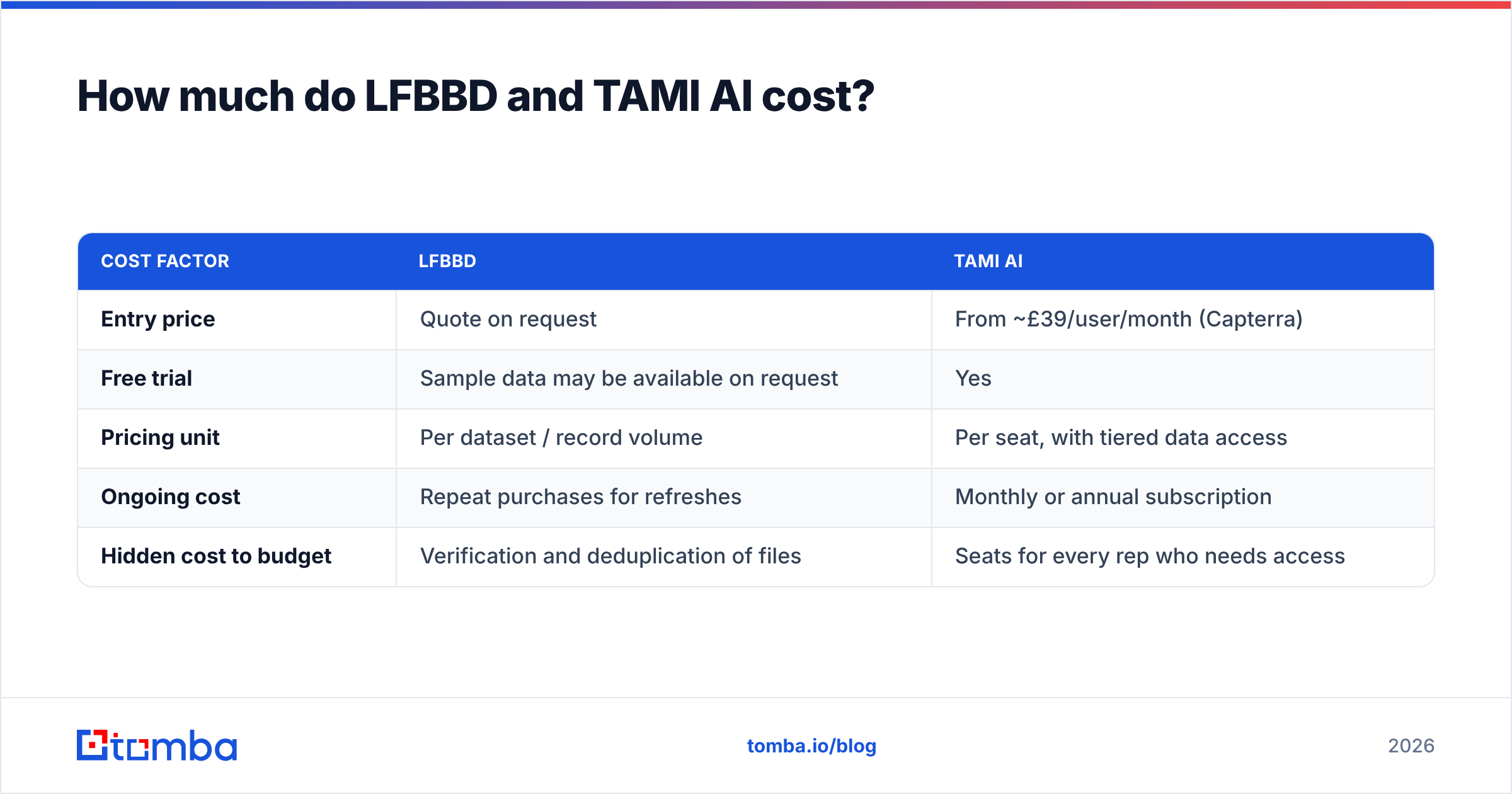
| Cost factor | LFBBD | TAMI AI |
|---|---|---|
| Entry price | Quote on request | From ~£39/user/month (Capterra) |
| Free trial | Sample data may be available on request | Yes |
| Pricing unit | Per dataset / record volume | Per seat, with tiered data access |
| Ongoing cost | Repeat purchases for refreshes | Monthly or annual subscription |
| Hidden cost to budget | Verification and deduplication of files | Seats for every rep who needs access |
With LFBBD, you're paying for records. That can be very cost-effective when you need 20,000 merchant contacts once for a campaign. It's less efficient when you want a small, highly qualified list each week. Ask about refresh terms and replacement guarantees for bounced emails. Also ask whether you can pay per segment instead of taking the full export.
With TAMI, you're paying for access. The £39 starting figure is an entry tier. Expect export limits, contact credits and advanced features such as technographic filters or HubSpot sync to vary by plan. Team plans with CRM integration will cost more per seat. Ask for the total annual cost for your actual headcount, not the per-user sticker price.
For reference, a pure email-finding tool sits in a different price band. Tomba's plans run from a free tier (25 searches per month) to Starter at $49/mo, Growth at $99/mo and Pro at $249/mo. See Tomba pricing for credit details. That isn't a like-for-like substitute for either vendor. It's the layer many teams add on top to fill contact gaps and check deliverability.
Is TAMI AI better than LFBBD?#
Neither is better in general. The LFBBD vs TAMI AI choice depends on the question you're asking.
Choose LFBBD if:
- Your ICP is Amazon sellers or a well-defined slice of eCommerce merchants.
- You run campaign-based outbound, such as a quarterly blitz or a new-market launch, and want volume delivered in one go.
- You need direct dials and mobiles for a phone-heavy SDR motion.
- You don't want to train reps on another platform. A clean CSV loaded into your sequencer is enough.
Choose TAMI AI if:
- You sell into merchants where technology is the trigger: payments, checkout, logistics, eCommerce apps.
- You want continuous TAM mapping and account discovery, not a one-time snapshot.
- Your team lives in HubSpot and you want enrichment to flow into records automatically.
- Compliance certifications (ISO 27001, SOC 2) are a procurement requirement in your organization.
Consider running both if you're a payments or logistics company with a large Amazon-seller segment and a web-store segment. That's more common than it sounds. Use TAMI for web merchants with technographic triggers. Use LFBBD for marketplace sellers that TAMI's crawl-based model may cover less well.
What should you do after you get the data?#
This is the step both vendors' marketing skips, and it's where campaigns succeed or fail.
However good the source, any contact dataset contains some invalid addresses, catch-all domains, role accounts and people who left last quarter. Send to that list unfiltered and your bounce rate climbs. Mailbox providers notice, and your domain reputation drops for every campaign after that. Gmail's sender guidelines spell out how bounces and complaints affect delivery.
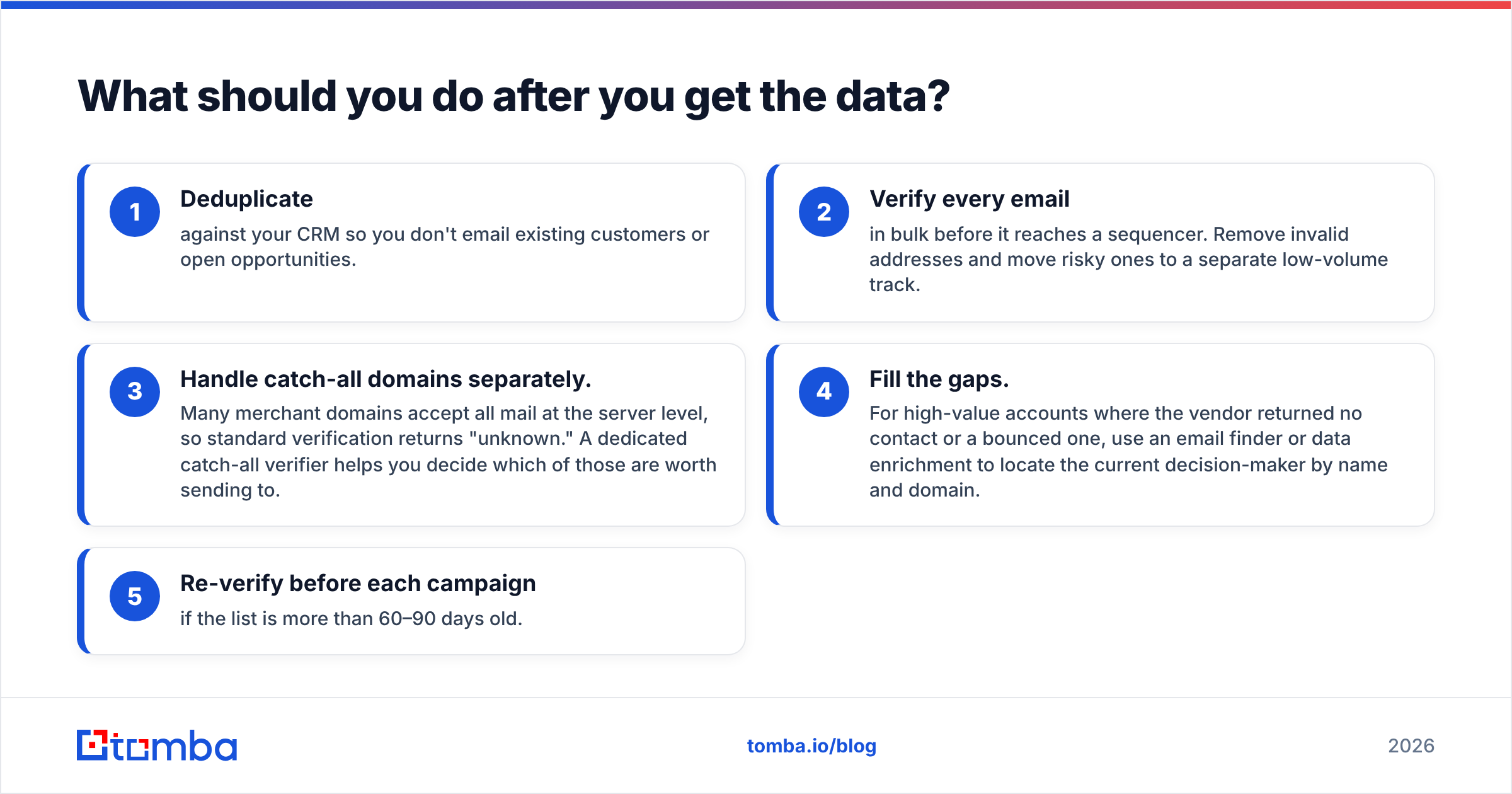
A practical post-purchase workflow:
- Deduplicate against your CRM so you don't email existing customers or open opportunities.
- Verify every email in bulk before it reaches a sequencer. Remove invalid addresses and move risky ones to a separate low-volume track.
- Handle catch-all domains separately. Many merchant domains accept all mail at the server level, so standard verification returns "unknown." A dedicated catch-all verifier helps you decide which of those are worth sending to.
- Fill the gaps. For high-value accounts where the vendor returned no contact or a bounced one, use an email finder or data enrichment to locate the current decision-maker by name and domain.
- Re-verify before each campaign if the list is more than 60–90 days old.
This isn't a criticism of either vendor. It's how B2B data works. The team with better data hygiene will usually beat the team with a bigger database.
What do real users say?#
Public review volume is modest for both. That's typical for specialist data providers compared with the large all-in-one platforms.
- LFBBD holds a TrustScore of about 4.5 on Trustpilot. Positive reviews tend to mention responsiveness and dataset targeting. As with any list vendor, read the recent reviews on accuracy for your specific region before buying.
- TAMI appears on Capterra, GetApp and Software Advice (still indexed partly under its SalesOptimize name) and on the HubSpot marketplace. Its published case studies focus on payments and merchant services. iwocaPay, for example, reports replacing three prospecting tools with TAMI.
Our advice: weight a sample test of your own accounts far above any review score. A vendor can be excellent for UK Shopify merchants and mediocre for German manufacturers. Aggregate reviews won't show you that.
Final verdict: LFBBD vs TAMI AI#
- For Amazon seller prospecting and fast, high-volume list buys: LFBBD is the more direct route.
- For technographic targeting, ongoing market mapping and HubSpot-centric teams: TAMI AI is the stronger platform.
- For merchant-focused companies with mixed segments: a combination often works, with LFBBD for marketplace sellers and TAMI for web stores.
In every scenario, add a verification and gap-filling layer between the data source and your outbox. That's where your bounce rate, sender reputation and reply rate are protected.
Fill the gaps and verify before you send#
If you end up with LFBBD datasets, TAMI exports or both, the last mile is the same: confirm every address is deliverable and find the right person where the source came back empty. The Tomba Email Finder takes a name and company domain and returns the professional email address with a confidence score. Bulk and verification options are available if you're processing whole files. Start on the free tier with 25 searches a month, run your vendor's sample through it, and see how many contacts you can recover before your next campaign goes out.
Related guides#
// get started
Find, verify and enrich your first contacts today
Start on the free plan with 25 searches a month, then scale when your team is ready.
Free plan · No credit card required · GDPR & CCPA
Get the Tomba newsletter
Product and data updates
// about the author