Limeleads vs NeverBounce: Lead Database or Email Verifier?
Limeleads and NeverBounce show up in the same searches, but they do different jobs. One sells you contacts and the other cleans the list you already have. Here's how pricing, accuracy and workflow compare, and which one to buy first.
TL;DR
- Limeleads and NeverBounce do different jobs. Limeleads is a B2B contact database where you search, filter and unlock leads. NeverBounce is an email verification service: it checks addresses you already have and doesn't find new ones.
- Pricing works differently too. Limeleads charges a subscription, starting around $99/mo for about 500 contact credits. NeverBounce charges per verification, about $8 per 1,000 emails on pay-as-you-go, and the price per email drops at volume.
- Choose Limeleads if your problem is "I don't know who to email." Choose NeverBounce if your problem is "my list bounces too much."
- You may need both. Lists you bought or scraped still decay by roughly 2–3% a month, so buying a database and verifying before each send is a common setup.
- The alternative is one tool that does both. Tomba's email finder and email verifier share one account, starting with a free tier and a $49/mo Starter plan.
What is the real difference between Limeleads and NeverBounce?#
Think of it like a grocery store and a food inspector. Limeleads is the store: you walk the aisles (filters), pick what you want (contacts) and pay per item (credits). NeverBounce is the inspector: it doesn't sell you anything to eat, it tells you whether what's already in your fridge has gone bad.
That's why people who search "Limeleads vs NeverBounce" are often a little confused. The two tools aren't direct competitors. They show up in the same searches because both claim to cut bounces, but they get there from opposite ends.
- Limeleads is a B2B lead database. You filter by industry, job title, seniority, company size and location, then unlock contacts to get a work email plus firmographic data. Limeleads says it verifies emails in real time when you unlock them, and that's its main selling point against older static databases.
- NeverBounce is an email verification and list-cleaning platform, owned by ZoomInfo since 2019. You upload a CSV, connect an ESP or CRM, or call the API. Each address comes back tagged
valid,invalid,disposable,catchallorunknown.
So the question isn't which tool is better. It's which problem you actually have.
How do Limeleads and NeverBounce work, step by step?#
The two workflows barely overlap. Here's each one:
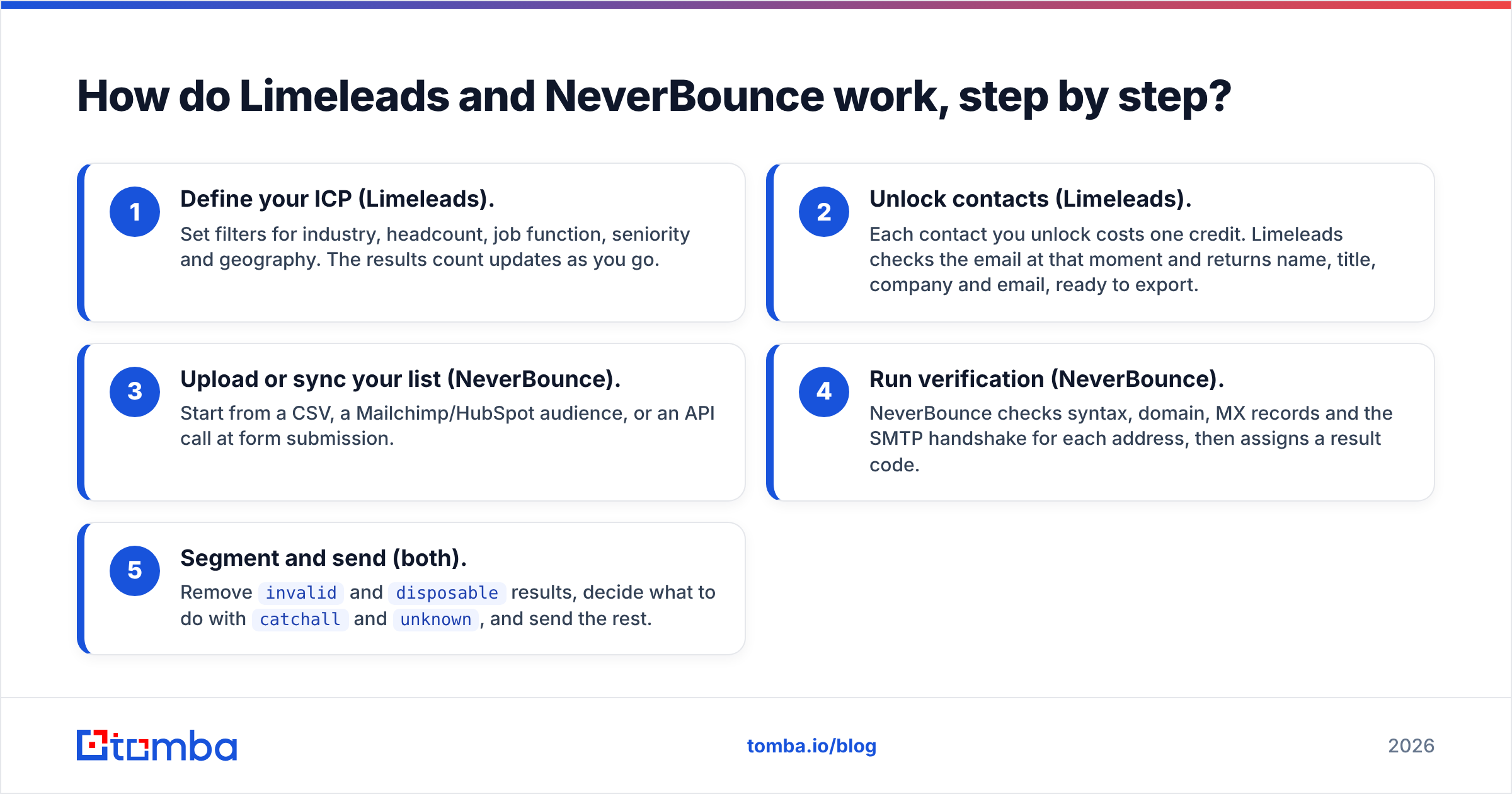
- Define your ICP (Limeleads). Set filters for industry, headcount, job function, seniority and geography. The results count updates as you go.
- Unlock contacts (Limeleads). Each contact you unlock costs one credit. Limeleads checks the email at that moment and returns name, title, company and email, ready to export.
- Upload or sync your list (NeverBounce). Start from a CSV, a Mailchimp/HubSpot audience, or an API call at form submission.
- Run verification (NeverBounce). NeverBounce checks syntax, domain, MX records and the SMTP handshake for each address, then assigns a result code.
- Segment and send (both). Remove
invalidanddisposableresults, decide what to do withcatchallandunknown, and send the rest.
Steps 1–2 create data. Steps 3–4 check data. If you only have a list-quality problem, you never touch steps 1–2. If you're starting from zero, NeverBounce has nothing to check yet.

How do Limeleads and NeverBounce compare feature by feature?#
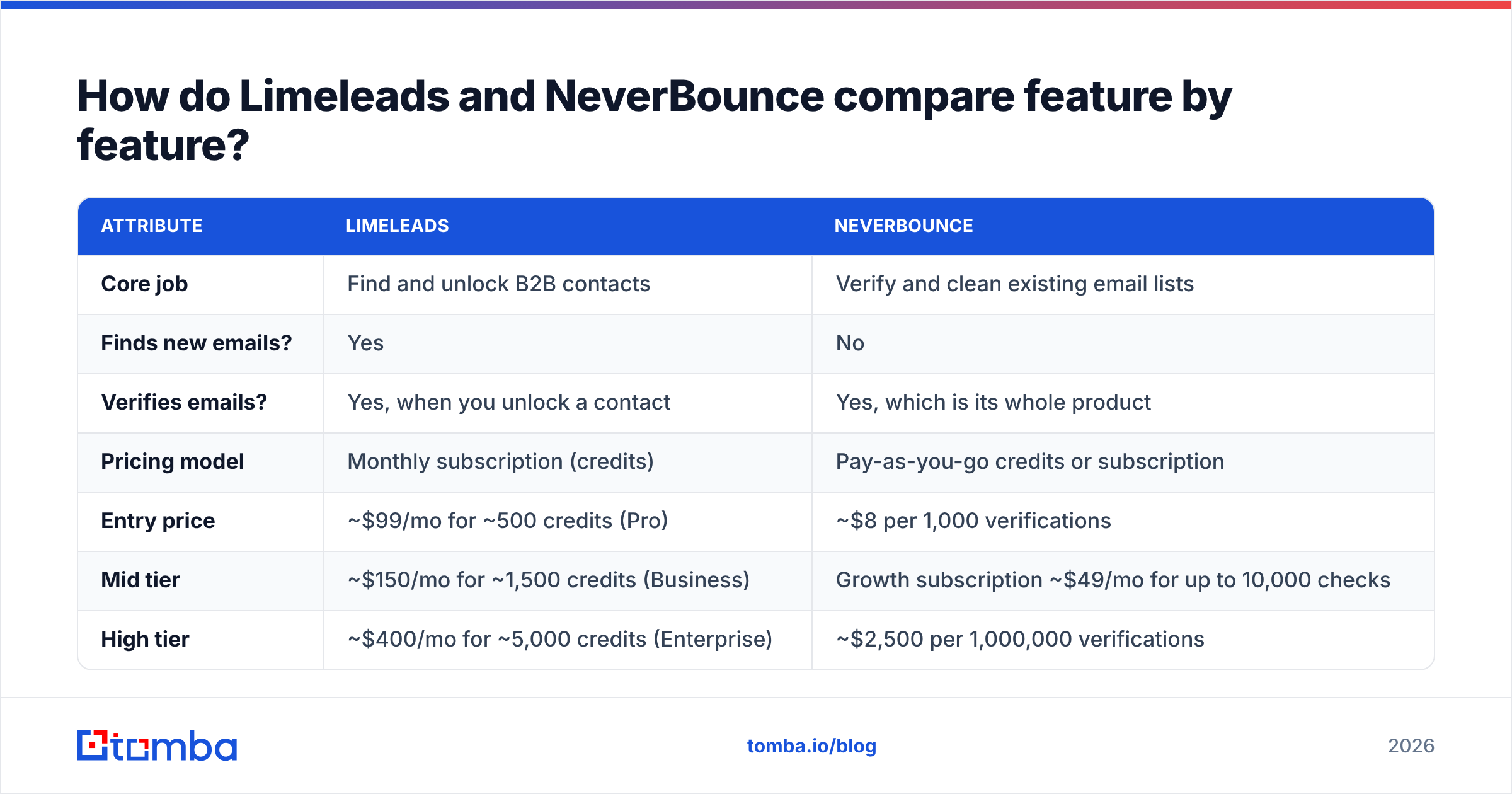
Here's the side-by-side. Prices are the published list prices at the time of writing (September 2026). Both vendors change them, so check their pricing pages before you buy.
| Attribute | Limeleads | NeverBounce |
|---|---|---|
| Core job | Find and unlock B2B contacts | Verify and clean existing email lists |
| Finds new emails? | Yes | No |
| Verifies emails? | Yes, when you unlock a contact | Yes, which is its whole product |
| Pricing model | Monthly subscription (credits) | Pay-as-you-go credits or subscription |
| Entry price | ~$99/mo for ~500 credits (Pro) | ~$8 per 1,000 verifications |
| Mid tier | ~$150/mo for ~1,500 credits (Business) | Growth subscription ~$49/mo for up to 10,000 checks |
| High tier | ~$400/mo for ~5,000 credits (Enterprise) | ~$2,500 per 1,000,000 verifications |
| Credit expiry | Unused credits reported to roll over | Pay-as-you-go credits expire after 12 months |
| Annual discount | Yes (reported ~35%) | Volume discounts instead |
| Catch-all handling | Depends on how the unlocked email checks out | Flags catchall but can't confirm the mailbox |
| Integrations | CSV export, CRM connectors on higher tiers | ESPs, CRMs, Zapier, REST API, real-time widget |
| Best for | Building net-new outbound lists | Cleaning CRM, newsletter and event lists |
Two things stand out.
Unit cost is very different. One Limeleads credit gets you a new contact with an email already checked. One NeverBounce credit gets you a yes/no verdict on an email you already had. At about $0.20 per Limeleads contact against under a cent per NeverBounce check, you're paying for discovery, not verification.
Credit expiry affects teams with lumpy usage. If you prospect hard one quarter and slowly the next, rollover credits (as third-party breakdowns such as G2's Limeleads pricing page describe) are worth real money. NeverBounce's 12-month window is generous for list cleaning, since most teams clean in batches anyway.
Is Limeleads accurate enough to skip a separate verifier?#
Usually yes for the first send, and no after that.
Limeleads checks an email when you unlock it, so the export you download today should bounce very little. The problem is time. B2B contact data decays steadily as people change jobs, companies rebrand domains, and IT teams switch mail providers. A list that was clean in January won't be clean in June.
That gives you three practical rules:
- Send within a couple of weeks of unlocking. If you do, you probably don't need a second pass.
- Re-verify anything older than about 60–90 days before it goes into a sequence. This is where a verifier like NeverBounce earns its money.
- Treat catch-all domains as a risk, not a green light. A catch-all server accepts every address during the SMTP check, so no verifier can confirm the mailbox exists that way. Limeleads and NeverBounce both hit this limit. A dedicated catch-all verifier uses more signals to guess further.
If your sender reputation is already fragile, from a new domain or a recent bounce spike, it's worth paying under a cent per address to double-check even fresh exports.
Is NeverBounce enough if you already have a CRM full of contacts?#
For list hygiene, yes. NeverBounce is a well-established verifier with a long list of native integrations, so it's a good fit when:
- You run a newsletter or product-marketing list that's been growing for years.
- Your CRM is full of old trade-show badge scans.
- You want real-time checks on signup forms to block typos (
gmial.com) and throwaway addresses. - You need to clean hundreds of thousands of records a quarter and care most about cost per check.
What NeverBounce can't do is replace the contacts it removes. If a cleaning run flags 18% of your CRM as invalid, you now have 18% fewer people to sell to and no way to find their replacements inside NeverBounce. You'd need a separate email finder or database for that.
Also keep in mind what NeverBounce is designed for. Its sweet spot is marketing lists and signup forms. It works for sales prospect lists, but it doesn't add anything sales-specific like title, seniority or company size.
Which tool fits which team?#
Here's a quick way to decide by team type:
- Early-stage founder doing outbound: Limeleads. You need names before you need hygiene, and verification when you unlock covers your first sends.
- SDR team running ongoing sequences: Limeleads to source contacts, plus a verifier for anything older than one quarter. Or pick a single platform that does both (see below).
- Marketing ops with a large newsletter list: NeverBounce. You already own the audience, and a sales database adds little.
- Agency cleaning client lists at volume: NeverBounce, for the price per check and the bulk tooling.
- RevOps consolidating the stack: Neither on its own. Look for a platform that finds, verifies and enriches under one contract.
A lot of teams end up in that last group. Once you've written a Zap to push new Limeleads exports into NeverBounce, and then another to push the results into HubSpot, you're maintaining a small data pipeline. That's the hidden cost of buying two tools for one job.

What does Limeleads plus NeverBounce actually cost per month?#
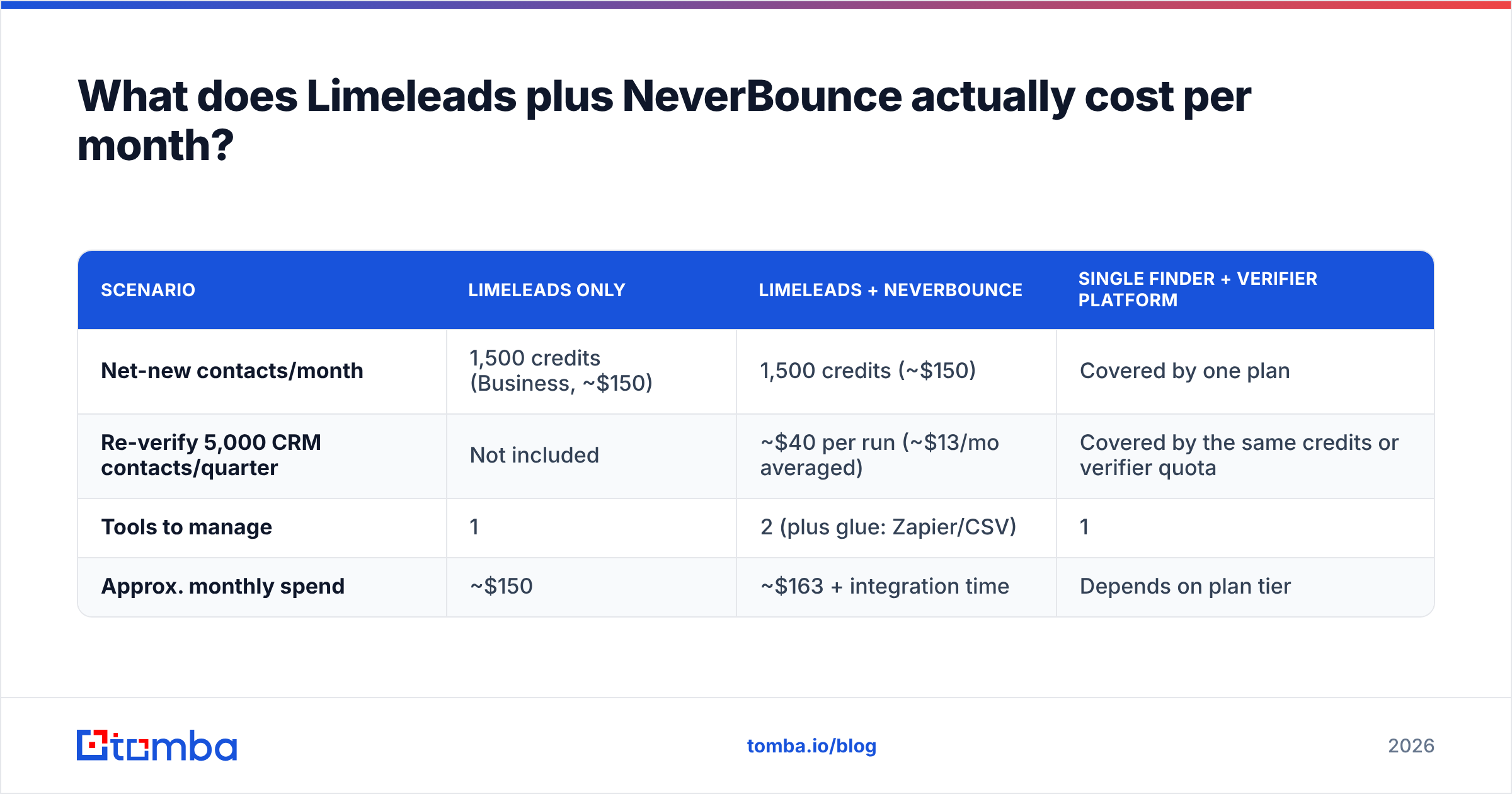
Say you want 1,000 new prospects a month and you re-verify your existing 5,000-contact CRM once a quarter.
| Scenario | Limeleads only | Limeleads + NeverBounce | Single finder + verifier platform |
|---|---|---|---|
| Net-new contacts/month | 1,500 credits (Business, ~$150) | 1,500 credits (~$150) | Covered by one plan |
| Re-verify 5,000 CRM contacts/quarter | Not included | Covered by the same credits or verifier quota | |
| Tools to manage | 1 | 2 (plus glue: Zapier/CSV) | 1 |
| Approx. monthly spend | ~$150 | ~$163 + integration time | Depends on plan tier |
The NeverBounce add-on is cheap in dollars. The real cost is the workflow: two logins, two CSV formats, two sets of result codes to map into your CRM, and a Zap that breaks when a field name changes.
You can compare this against Tomba pricing: a free tier with 25 searches a month, then Starter at $49/mo, Growth at $99/mo and Pro at $249/mo. Search and verification sit in the same account.
What are the pros and cons of each?#
Limeleads — pros
- Checks emails when you unlock them, so first sends start clean
- Straightforward filter UI that doesn't take long to learn
- Credits reportedly roll over, which helps with uneven prospecting months
- Returns firmographic context (title, company, size), not just an email
Limeleads — cons
- Subscription starts around $99/mo, which is steep if you only need a few hundred contacts
- No separate bulk-verification product for lists you got elsewhere
- Coverage varies by region and niche, so test your ICP during any trial before committing
NeverBounce — pros
- Very low cost per check at volume
- Lots of native integrations and a real-time API for forms
- Clear result codes that are easy to automate
- Backed by ZoomInfo's infrastructure
NeverBounce — cons
- Can't find or replace contacts
- Catch-all results remain unresolved
- No sales context (title, seniority, company data) on results
- Pay-as-you-go credits expire after 12 months
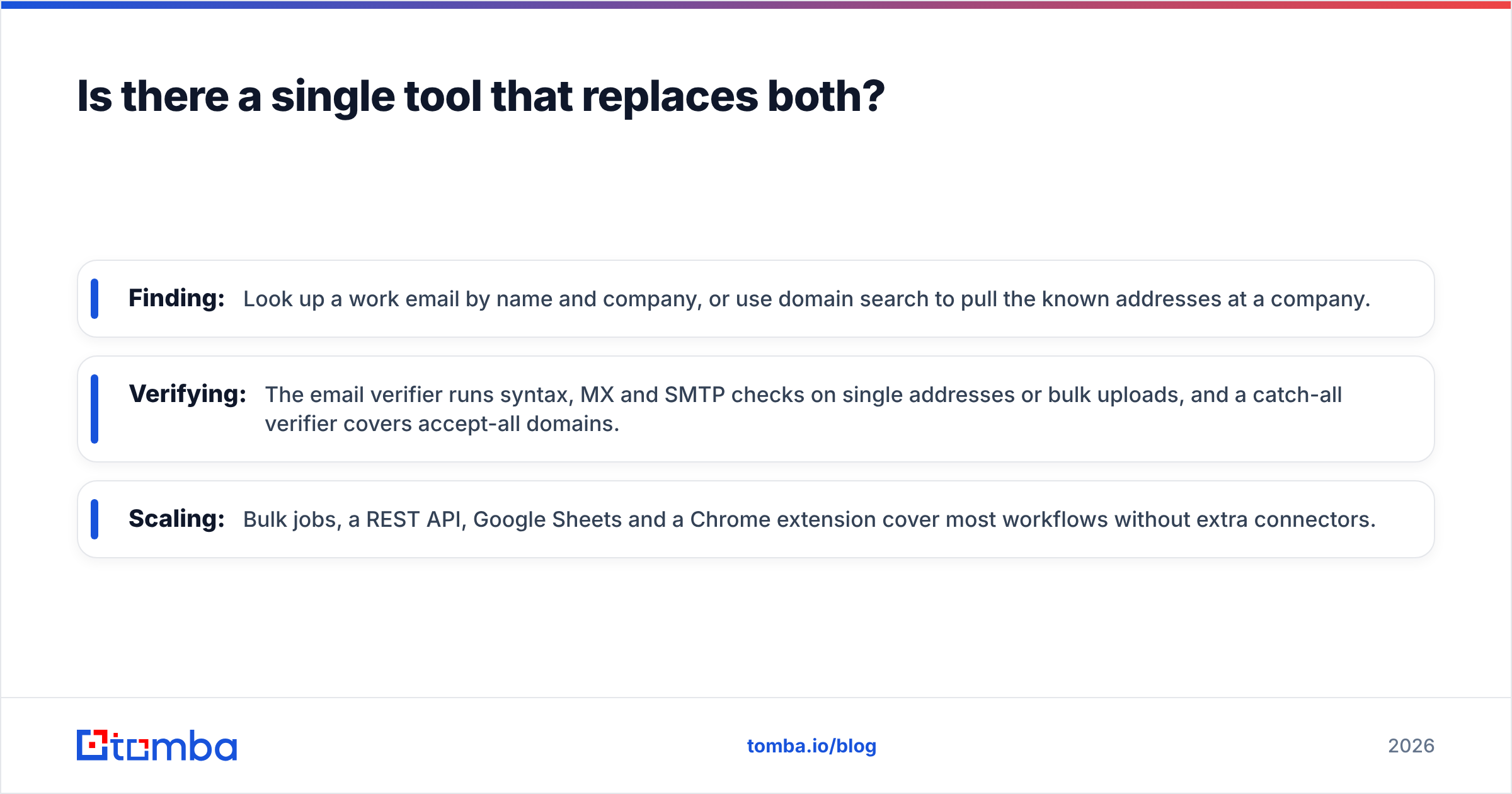
Is there a single tool that replaces both?#
Yes, if you're willing to trade some specialist depth for a simpler stack. The main option is an email-finder platform with built-in verification. That covers the sourcing side like Limeleads and the list-cleaning side like NeverBounce, though it won't match NeverBounce's per-check price at millions of records a month.
Here's where Tomba fits, described plainly:
- Finding: Look up a work email by name and company, or use domain search to pull the known addresses at a company.
- Verifying: The email verifier runs syntax, MX and SMTP checks on single addresses or bulk uploads, and a catch-all verifier covers accept-all domains.
- Scaling: Bulk jobs, a REST API, Google Sheets and a Chrome extension cover most workflows without extra connectors.
If you mostly clean very large marketing lists, a dedicated verifier like NeverBounce may still be cheaper per check. If you mostly prospect with filters and never touch old lists, Limeleads' database UI may suit you better. The combined route makes the most sense for sales teams in the middle, who both source new contacts and maintain old ones.
For background on why bounce rates matter this much, HubSpot's guide to email deliverability covers how mailbox providers use bounces to judge sender reputation.
So, Limeleads or NeverBounce?#
Pick by the problem you actually have:
- "I need people to email" → Limeleads.
- "The people I have keep bouncing" → NeverBounce.
- "Both, and I'm tired of glue code" → a combined finder + verifier.
Comparing them as competitors leads to the wrong decision. Treat Limeleads as a sourcing tool and NeverBounce as a hygiene tool, and look at what your pipeline is actually short on this quarter.
If your team is doing both jobs and paying two vendors for it, try Tomba Email Finder. Find a prospect's work email by name, company or domain, verify it in the same account, and push it to your CRM without building a Zapier bridge. The free tier includes 25 searches a month, so you can check it against your own ICP before you cancel anything.
Related guides#
// get started
Find, verify and enrich your first contacts today
Start on the free plan with 25 searches a month, then scale when your team is ready.
Free plan · No credit card required · GDPR & CCPA
Get the Tomba newsletter
Product and data updates
// about the author