LimeLeads vs SalesIntel: Pricing, Data Quality and Our Pick
LimeLeads charges per contact with credits that roll over. SalesIntel sells human-verified data on annual contracts that can run into five figures. Here is what each one costs, where each is strong, and which fits your team.
- LimeLeads is a self-serve US B2B contact database. You buy credits by the month (from $99/mo for 500 credits), and unused credits roll over. It suits founders, small agencies, and SDR teams of one to five.
- SalesIntel is a sales intelligence platform built on human-verified contacts, intent data, and technographics. Pricing is quote-based. Third-party estimates put the median annual contract around $17,600.
- The core trade-off: LimeLeads gives you low commitment and a low price per contact. SalesIntel gives you researcher-verified direct dials and intent signals, in exchange for a contract and a larger budget.
- Our pick: Choose LimeLeads if you need a few hundred to a few thousand US contacts a month. Choose SalesIntel if you run a funded outbound team where phone reach and intent data pay for themselves.
- If most of what you need is verified emails for accounts you already know, a finder plus verifier such as Tomba (from $49/mo) is usually cheaper than either database.
What are LimeLeads and SalesIntel?#
These two tools are sold into the same budget line, "B2B contact data," but they come from different philosophies.
LimeLeads is a lean, search-and-export database focused mainly on US companies. You filter by industry, job title, company size, and location, and preview records. Then you spend credits to unlock contacts, and emails are verified at the point of export. There are no sales calls and no annual lock-in unless you want the discount. Its main pitch is that unused credits roll over instead of expiring.
SalesIntel is a full sales intelligence platform. Its differentiator is research-verified data. The company says it employs a large in-house research team that re-checks contacts on a rolling cycle, and it markets a 95% accuracy guarantee on human-verified records. On top of the contact database it sells intent data (Bombora-powered topic surges), technographics, website visitor identification (VisitorIntel), CRM enrichment, and an API.
In short, LimeLeads is a list builder. SalesIntel is a data platform with a list builder inside it.
How do LimeLeads and SalesIntel compare side by side?#
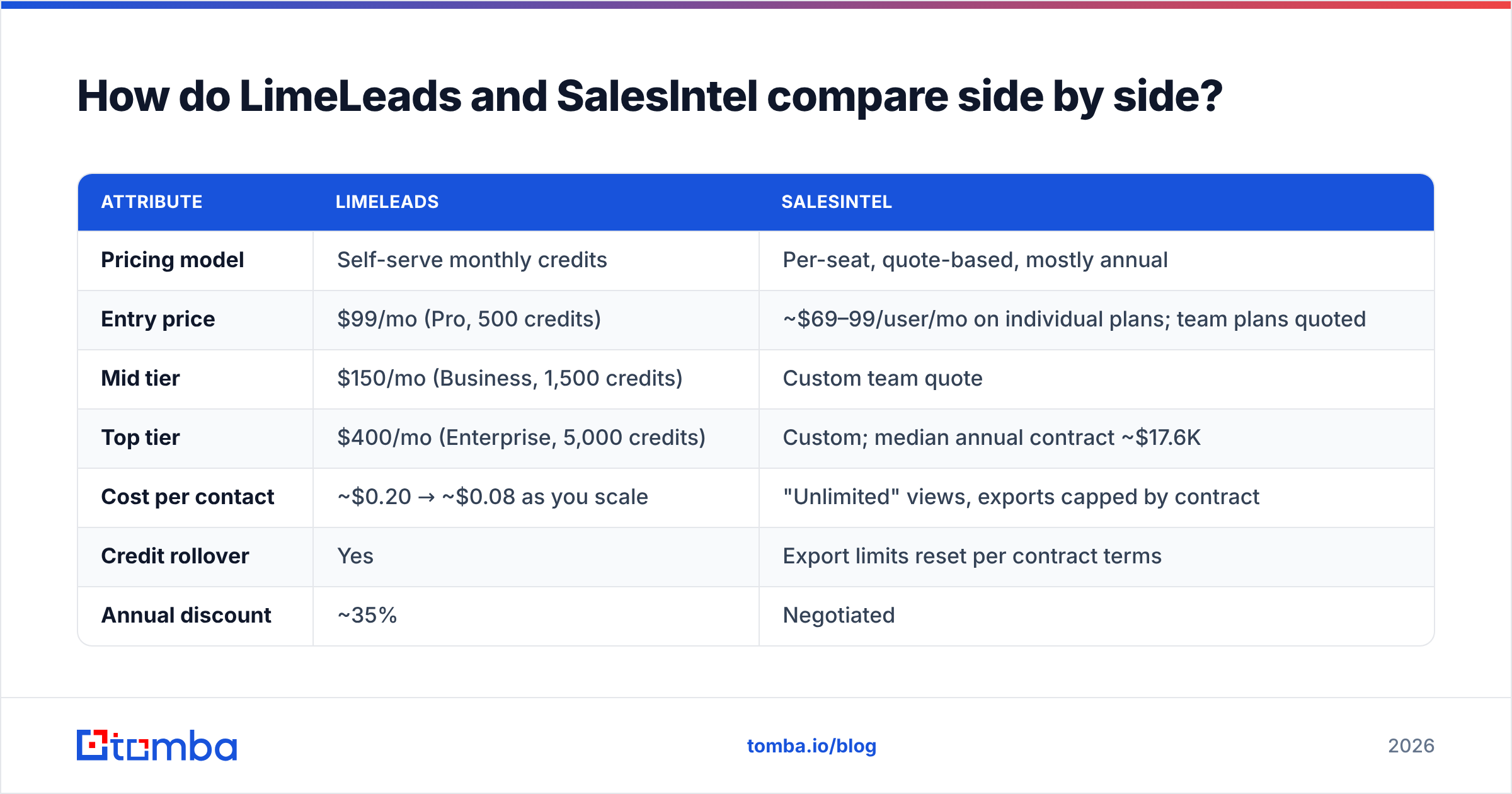
The table below covers what most buyers actually decide on. SalesIntel figures are based on public plan descriptions and third-party contract data, not a public price list, so treat them as ranges.
| Attribute | LimeLeads | SalesIntel |
|---|---|---|
| Pricing model | Self-serve monthly credits | Per-seat, quote-based, mostly annual |
| Entry price | $99/mo (Pro, 500 credits) | ~$69–99/user/mo on individual plans; team plans quoted |
| Mid tier | $150/mo (Business, 1,500 credits) | Custom team quote |
| Top tier | $400/mo (Enterprise, 5,000 credits) | Custom; median annual contract ~$17.6K |
| Cost per contact | ~$0.20 → ~$0.08 as you scale | "Unlimited" views, exports capped by contract |
| Credit rollover | Yes | Export limits reset per contract terms |
| Annual discount | ~35% | Negotiated |
| Data verification | Automated email verification on export | Human-researcher re-verification + 95% accuracy claim |
| Direct dials / mobiles | Limited | A core strength |
| Intent data | No | Yes (paid add-on, often $5K–10K+/yr) |
| Technographics | Basic filters | Yes |
| Geographic focus | Mostly US | Mostly North America, with growing global coverage |
| Best for | Solo founders, agencies, small SDR teams | Mid-market and enterprise sales orgs |
Pricing sources: LimeLeads on Capterra and the official SalesIntel site. Expect SalesIntel quotes to shift with seat count, add-ons, and renewal terms.
How much do LimeLeads and SalesIntel actually cost?#
This is where the two tools separate most clearly.
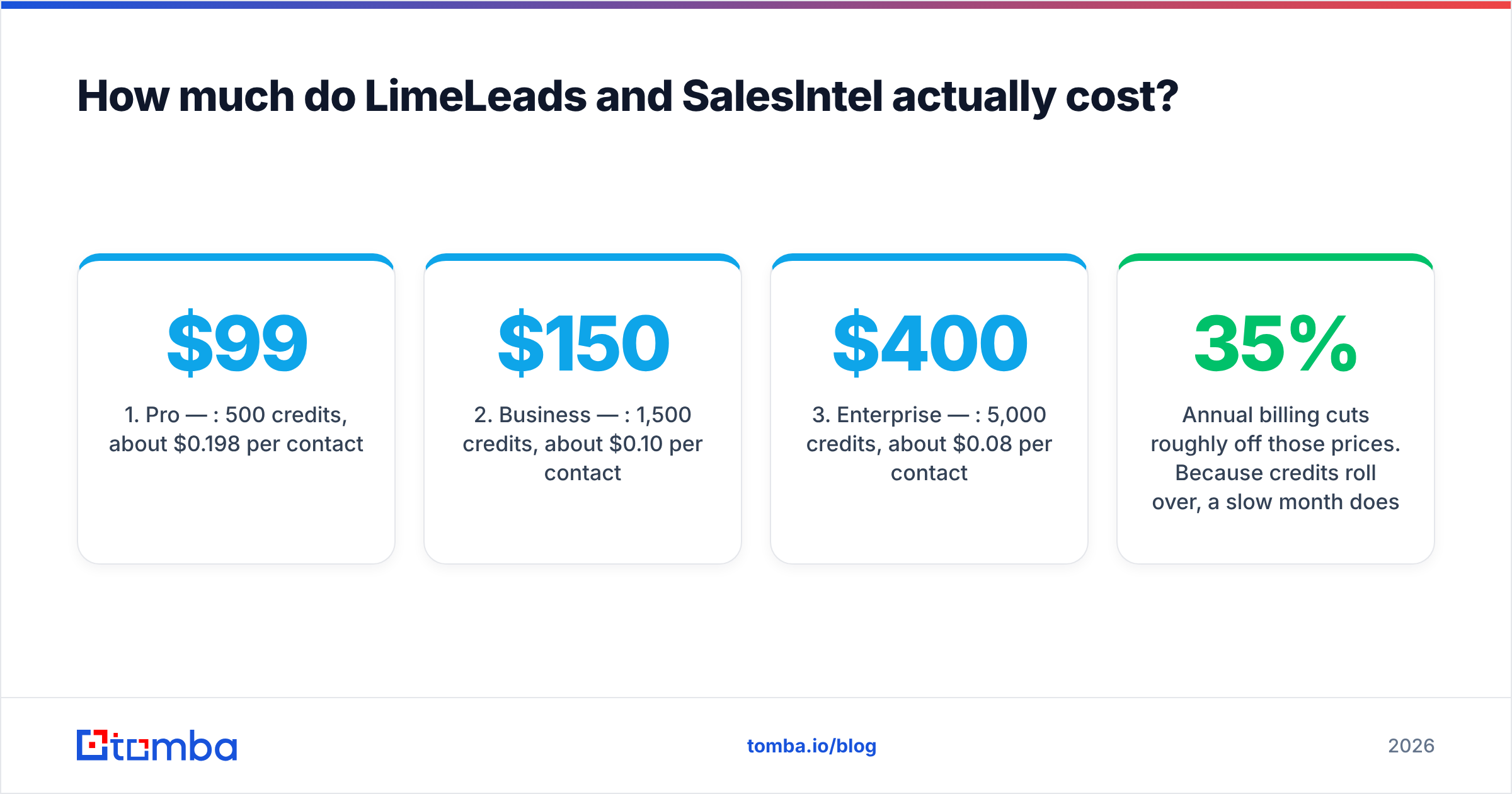
LimeLeads pricing is transparent. You pick a tier, pay monthly, and each unlocked contact costs one credit:
- Pro — $99/mo: 500 credits, about $0.198 per contact.
- Business — $150/mo: 1,500 credits, about $0.10 per contact.
- Enterprise — $400/mo: 5,000 credits, about $0.08 per contact.
Annual billing cuts roughly 35% off those prices. Because credits roll over, a slow month doesn't cost you anything. If you only prospect in bursts around campaigns, this matters more than the headline price.
SalesIntel pricing is negotiated. Individual plans reportedly start in the $69–99 per user per month range, with unlimited views and capped exports. Team and enterprise plans require a sales conversation. Public contract data puts the median annual deal around $17,600, with observed contracts ranging from roughly $8,700 to over $41,000. Intent data, visitor identification, and higher export limits are typically priced as add-ons.

Now translate that into cost per usable contact. Suppose a three-person SDR team needs about 1,500 new US contacts a month:
- LimeLeads Business: $150/mo, or roughly $1,170/yr with the annual discount.
- SalesIntel team plan: probably $10K–20K/yr before intent add-ons.
SalesIntel isn't overpriced. It's selling something different: phone numbers that connect, intent signals that tell you who to call this week, and research-verified records. If you don't use those features, you're paying for them anyway.
Which has better data accuracy: LimeLeads or SalesIntel?#
On paper, SalesIntel wins. Human re-verification is the most expensive way to maintain a B2B database, and SalesIntel builds its brand on it. The 95% accuracy guarantee applies to its human-verified records. This matters most for direct dials and mobile numbers, where automated sources decay quickly and bad numbers waste a rep's entire calling block.
LimeLeads takes an automated approach. It verifies emails in real time when you export, which keeps hard bounces down on the records you actually pay for. Where it's weaker is breadth and freshness outside core US segments: niche industries, very small companies, and international markets. Reviewers on Capterra and G2 generally rate LimeLeads well for ease of use and value, with coverage outside the US as the most common complaint.
Practically:
- For cold email only: The accuracy gap narrows a lot, because LimeLeads verifies at export and you can re-verify with any email verifier before sending.
- For cold calling: SalesIntel's researcher-checked direct dials are a real advantage, and LimeLeads isn't built to compete on phones.
- For CRM hygiene at scale: SalesIntel's enrichment and re-verification cycle is the stronger option.
Whichever database you choose, don't trust any vendor's accuracy number without checking it. Pull 200 records in your ICP, verify the emails, and dial 50 of the numbers. Your own bounce rate and connect rate are the only accuracy benchmark that matters for your pipeline.
What features does each platform offer beyond contact data?#
The gap in platform depth is large, and it determines who each tool is really built for.
LimeLeads features
- Filter-based search: Industry, title, seniority, headcount, revenue band, and location.
- Real-time email verification when you unlock a contact.
- CSV export plus basic CRM-friendly output.
- Credit rollover, which is rare among self-serve databases.
- A simple UI that a new rep can learn in about ten minutes.
SalesIntel features
- Human-verified contacts with direct dials and mobiles.
- Intent data: topic-level buying signals at the account level.
- Technographics: filter by the software a company runs.
- VisitorIntel: identifies companies visiting your website.
- CRM and MAP integrations (Salesforce, HubSpot, and others) with ongoing enrichment.
- API access on higher plans.
- Research on Demand: request that researchers find specific contacts not yet in the database.
If your motion is "build a list, verify it, load it into a sequencer," LimeLeads covers that. If your motion is "prioritize accounts showing intent, call the buying committee, keep the CRM clean automatically," you're shopping in SalesIntel's category, alongside ZoomInfo and Apollo. If Apollo is also on your shortlist, our breakdown of Apollo alternatives covers that side of the market.
Is LimeLeads or SalesIntel better for small teams?#
For most small teams, LimeLeads is the better choice, for three reasons:
- No contract risk. You can start at $99, test your list quality for a month, and leave if it doesn't work.
- Rollover credits match how small teams actually prospect, which is unevenly.
- Low per-contact cost at volume. At $0.08–0.10 per contact on higher tiers, you can build a full campaign list for less than one month of a SalesIntel seat.
Where small teams do outgrow LimeLeads is phone-heavy outbound and non-US markets. If either of those is central to your plan, test SalesIntel's individual plan before committing to a team contract.
Is SalesIntel worth it for mid-market and enterprise?#
It often is, provided you use what you pay for. SalesIntel justifies its price when:
- Reps call as much as they email. Verified direct dials improve connect rates enough to show up in meetings booked.
- You'll act on intent data. The add-on pays off only if RevOps routes surging accounts to reps who work them the same week.
- CRM decay is costing you. Continuous enrichment replaces a lot of manual cleanup.
- You have 5+ seats. Per-seat economics improve and export pools get larger.
It's harder to justify when a team buys the full bundle and then uses it as a CSV export tool. That pattern is where the "hidden costs" complaints in reviews usually come from: add-ons signed during the sales process that nobody operationalizes, followed by renewal increases.
Before you sign, negotiate three things:
- An export cap that matches your real monthly volume.
- A renewal price ceiling.
- A pilot period or accuracy clause tied to the 95% guarantee.
What are the pros and cons of each tool?#
| LimeLeads | SalesIntel | |
|---|---|---|
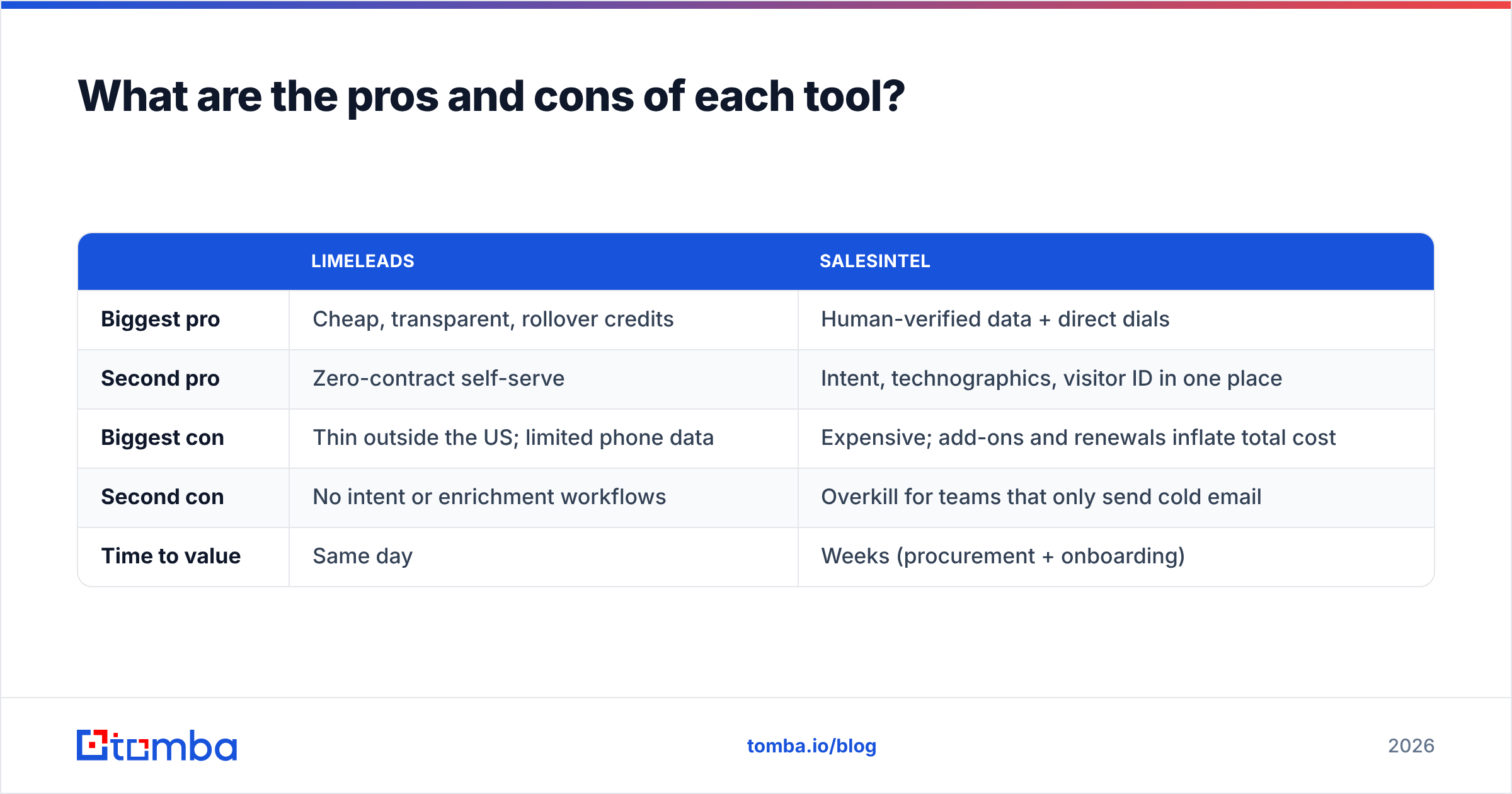
| Biggest pro | Cheap, transparent, rollover credits | Human-verified data + direct dials |
| Second pro | Zero-contract self-serve | Intent, technographics, visitor ID in one place |
| Biggest con | Thin outside the US; limited phone data | Expensive; add-ons and renewals inflate total cost |
| Second con | No intent or enrichment workflows | Overkill for teams that only send cold email |
| Time to value | Same day | Weeks (procurement + onboarding) |
Do you need a full database at all?#
This question often gets skipped. Many teams buy a database when their real job is simpler: they already know their target accounts from a named-account list, an event attendee list, or website visitors, and they need verified emails for the right people at those companies.
For that workflow, a dedicated email finder is usually cheaper and more precise than either database:
- Account-based lists: Run a domain search on each target company to see the people and email patterns you can reach.
- Named people: Find their addresses directly by name and domain, then verify before sending.
- Existing CRM records: Use data enrichment to fill in missing emails, titles, and company data instead of buying new records.

For scale: Tomba's free tier gives you 25 searches a month, and paid plans start at $49/mo, with Growth at $99/mo and Pro at $249/mo (full pricing details). That doesn't replace SalesIntel's intent data or its researcher-verified mobiles, and it isn't built for open-ended "show me every VP of Ops in Texas" discovery the way LimeLeads is. But when you already know the account, a finder-first approach often gives you more contacts per dollar.
A setup that works well for lean teams: use LimeLeads or a similar database for discovery, use an email finder for account-based gaps, and verify everything before it goes into your sequencer. That keeps your sender reputation intact no matter where the data came from.
So which should you choose: LimeLeads or SalesIntel?#
Choose LimeLeads if:
- You're a founder, consultant, agency, or SDR team of 1–5.
- Your market is mainly the US.
- Email is your main channel.
- You want month-to-month billing with credits that don't expire.
Choose SalesIntel if:
- You run a funded outbound team of 5+ seats.
- Cold calling is a primary channel and connect rates drive your numbers.
- You have RevOps capacity to act on intent data and CRM enrichment.
- You can absorb a five-figure annual contract, with negotiated renewal protections.
Choose neither (yet) if your real bottleneck is finding verified emails at accounts you've already picked. In that case, start with a finder and verifier, prove the channel works, and buy a database once list discovery becomes the constraint.
Frequently asked questions#
Does LimeLeads offer a free trial? LimeLeads has historically offered a small number of free credits so you can test exports. Check the current offer on its site, since trial terms change.
Does SalesIntel have public pricing? Only partially. Individual plans are sometimes listed, but team and enterprise pricing requires a quote. Budget for add-ons such as intent data separately.
Which has more accurate emails? SalesIntel's human verification gives it the edge on paper, especially for phone data. For email, LimeLeads' real-time verification at export narrows the gap. Test both on your own ICP.
Can I use LimeLeads data internationally? It's strongest in the US. For EMEA or APAC prospecting, test coverage carefully before scaling.
Ready to fill the gaps without a five-figure contract?#
If you already know which companies you want to reach and just need the right people's verified addresses, start with Tomba Email Finder. Search by domain, name, or company, verify results in the same workflow, and push clean contacts into your CRM or sequencer. The free tier covers 25 searches a month, so you can check coverage against your own target list before spending anything.
Related guides#
// get started
Find, verify and enrich your first contacts today
Start on the free plan with 25 searches a month, then scale when your team is ready.
Free plan · No credit card required · GDPR & CCPA
Get the Tomba newsletter
Product and data updates
// about the author