Limeleads vs Sparklane: Which B2B Lead Database Fits Your Team?
Limeleads sells cheap, credit-based US contact lists. Sparklane sells AI buying signals with a European focus. Here's how they compare on price, data, and workflow, and which team each one fits.
TL;DR
- Limeleads is a self-serve B2B contact database built around credits. It's aimed at small US-focused outbound teams that want filtered lists fast. Paid plans start at about $99/mo for 500 credits, and unused credits roll over.
- Sparklane is a French sales intelligence platform. It's built around AI account scoring and real-time business signals, with its strongest coverage in France and Europe. Plans are priced per user, starting at about €44–59/user/mo, and the signal-driven Predict tier is custom-quoted.
- Pick Limeleads if you want volume at a low cost per contact. Pick Sparklane if you need timing, meaning you want to know which accounts are in-market right now.
- Neither one replaces a separate verification step. Check every exported email before it goes into a sequence.
- If you already know your target accounts and only need the right people's emails, a dedicated email finder is usually cheaper than either platform.
What is the real difference between Limeleads and Sparklane?#
People compare these two tools because both claim to "give you leads." They answer different questions, though.
Limeleads answers "who?" You set filters like industry, headcount, location, job title and revenue band. You get a list of companies and contacts, then spend credits to unlock emails and export them. It's a list-building tool, and it's simple on purpose.
Sparklane answers "who, and why now?" It watches company news and business events such as fundraising, hiring sprees, new locations, leadership changes and tenders. It uses those signals to score accounts against your ideal customer profile, and contact data comes attached to the accounts it recommends. It's a prioritisation engine first and a database second.
Put simply, Limeleads gives you a phone book. Sparklane gives you a phone book with a highlighter that marks who is most likely to pick up today. How much the highlighter is worth depends on your deal size and your market.
How do Limeleads and Sparklane compare side by side?#
Here's the head-to-head on the things that affect your budget and your pipeline. Prices come from public listings and third-party pricing trackers at the time of writing. Both vendors change their packaging, so check before you sign anything.
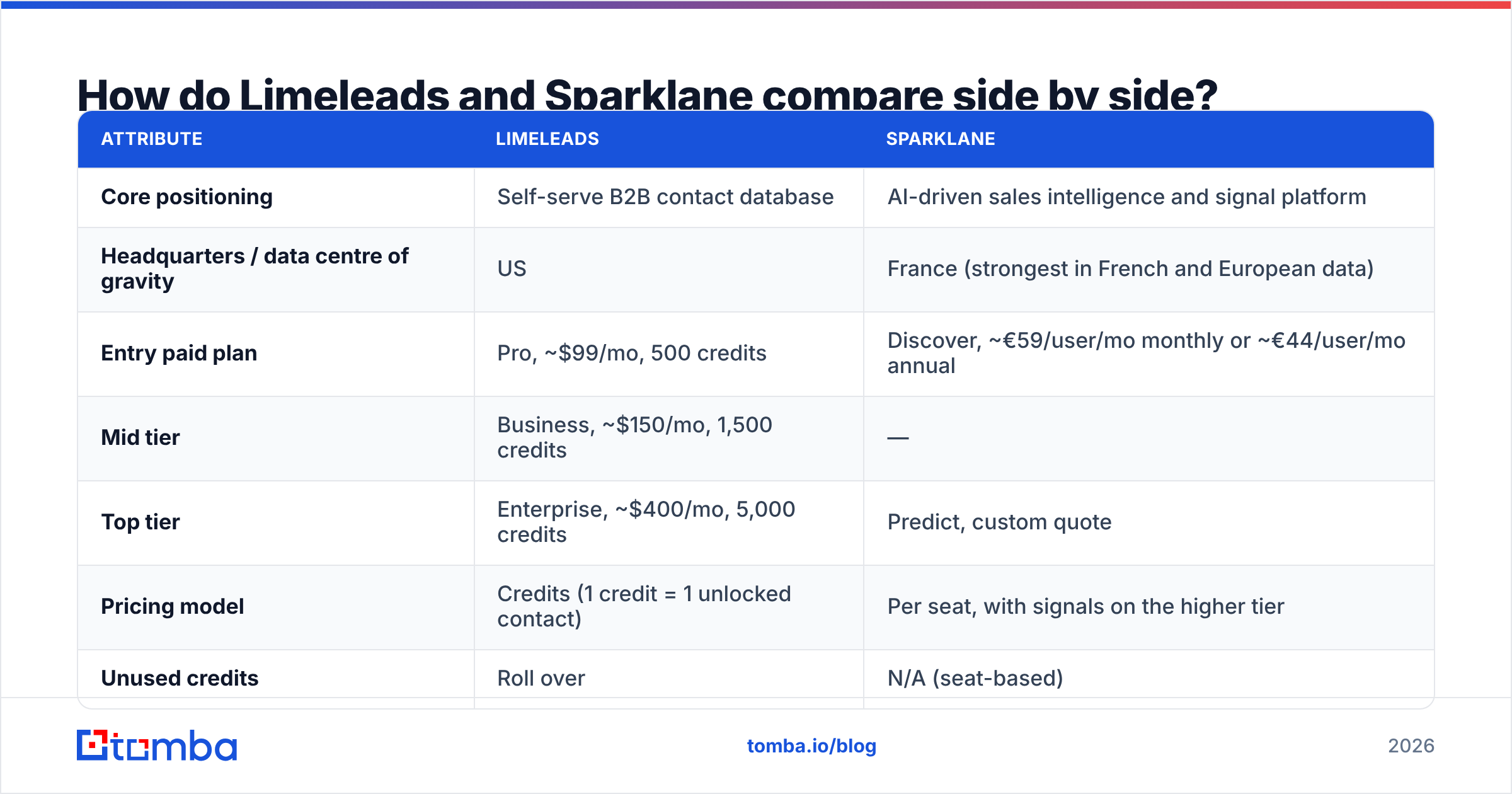
| Attribute | Limeleads | Sparklane |
|---|---|---|
| Core positioning | Self-serve B2B contact database | AI-driven sales intelligence and signal platform |
| Headquarters / data centre of gravity | US | France (strongest in French and European data) |
| Entry paid plan | Pro, ~$99/mo, 500 credits | Discover, ~€59/user/mo monthly or ~€44/user/mo annual |
| Mid tier | Business, ~$150/mo, 1,500 credits | — |
| Top tier | Enterprise, ~$400/mo, 5,000 credits | Predict, custom quote |
| Pricing model | Credits (1 credit = 1 unlocked contact) | Per seat, with signals on the higher tier |
| Unused credits | Roll over | N/A (seat-based) |
| Buying / business signals | No | Yes, a core feature |
| Predictive account scoring | No | Yes (ICP analysis + AI scoring) |
| Mobile numbers | Limited | Professional mobiles on Discover |
| Built-in sequences | No | AI-assisted email sequences |
| CRM integration | CSV export, basic integrations | Native CRM connectors (Salesforce, HubSpot, etc.) |
| Learning curve | Low, usable in minutes | Moderate, needs ICP setup to get value |
| Best fit | SMB outbound, agencies, founders | Mid-market / enterprise sales teams selling into Europe |
The biggest structural difference is credits vs seats. Limeleads costs the same whether one person or five pull the lists. You're paying for contacts, not logins. Sparklane scales with headcount, so a 10-rep team on Discover pays roughly €440–590/mo before anyone touches the Predict tier.
Is Limeleads cheaper than Sparklane?#
It's cheaper per contact for small teams. It isn't always cheaper per closed deal.
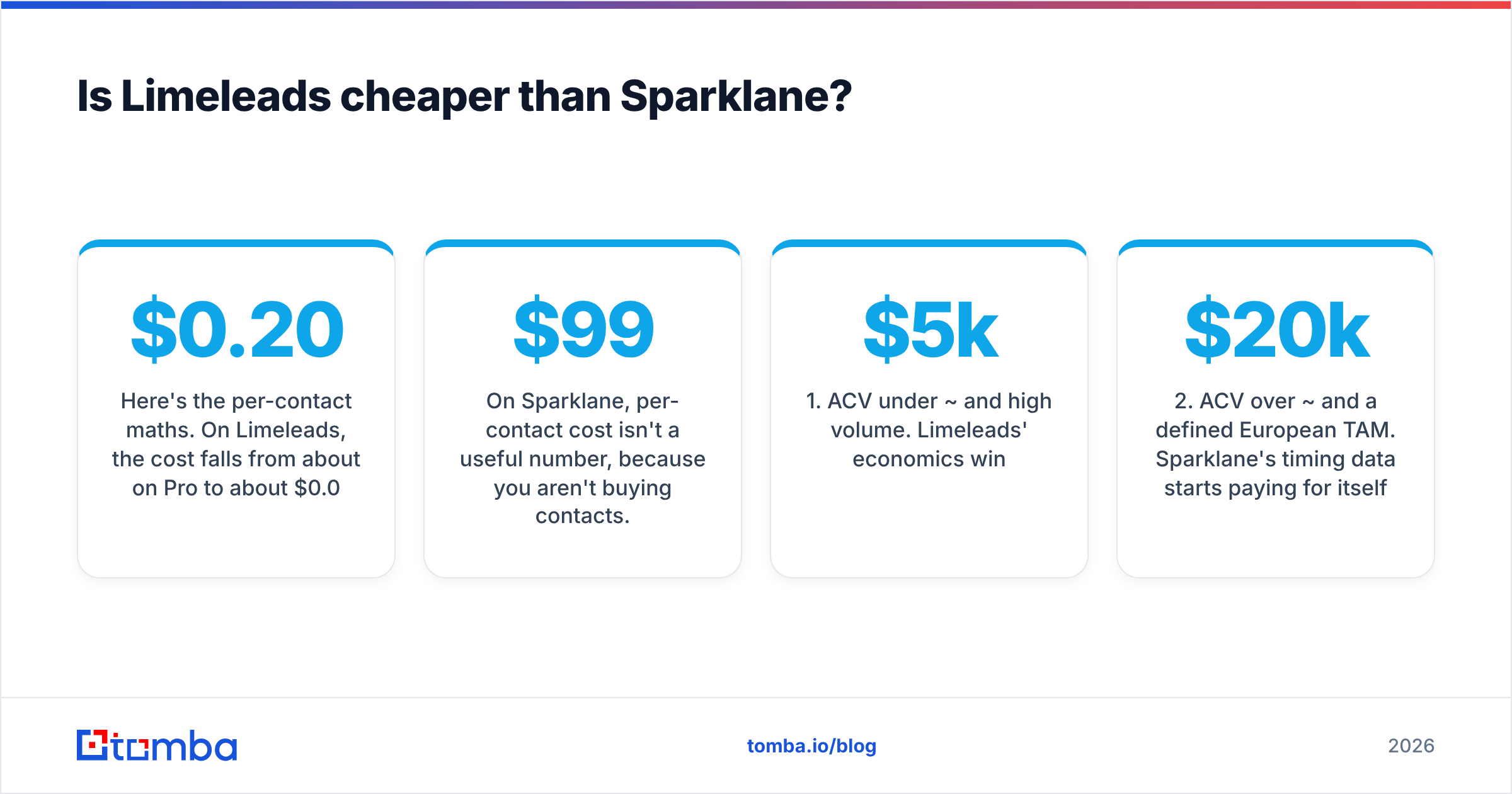
Here's the per-contact maths. On Limeleads, the cost falls from about $0.20 per credit on Pro to about $0.08 on Enterprise. If you need 1,500 contacts a month, Business at ~$150 comes to about $0.10 each. Because credits roll over, a slow month doesn't burn money, and that's a real advantage for agencies and founders whose prospecting comes in bursts.
On Sparklane, per-contact cost isn't a useful number, because you aren't buying contacts. You're buying seats plus, on Predict, a signal feed. What matters is whether those signals lift your reply and meeting rates enough to cover the premium. A team selling a €30k ACV product into French mid-market companies can justify that easily. A team selling a $99/mo tool to US agencies can't.
Here's a quick rule of thumb:
- ACV under ~$5k and high volume. Limeleads' economics win.
- ACV over ~$20k and a defined European TAM. Sparklane's timing data starts paying for itself.
- Somewhere in between. Run a 30-day test of each against the same ICP and compare meetings booked, not contacts exported.
Which tool has better data coverage?#
It depends on where your buyers are.
Limeleads is built mainly around North American companies. Its filters work well for US-style segmentation by state, SIC/NAICS-style industries and revenue bands. It also runs email verification when you unlock a contact, which cuts down on obvious bounces. Coverage outside the US is thinner, so European teams should expect gaps.
Sparklane comes from France and it shows. Company-level data on French and wider European businesses is its home turf: legal entities, establishments, and news-driven events such as public tenders and funding rounds. If your territory is France, Benelux or DACH, its account coverage and signal density are hard to match with a US-first database. If your territory is Texas, it's the wrong tool.
Whichever you pick, remember that both are databases. Contact records decay at around 20–30% a year as people change jobs, so any list you export is already ageing. Before an export goes into your sequencer, run it through an email verifier to catch addresses that have gone stale since the vendor last checked them.
What do Sparklane's buying signals actually give you?#
This is Sparklane's main advantage, so it's worth being specific. In practice, signal-based prospecting works like this:
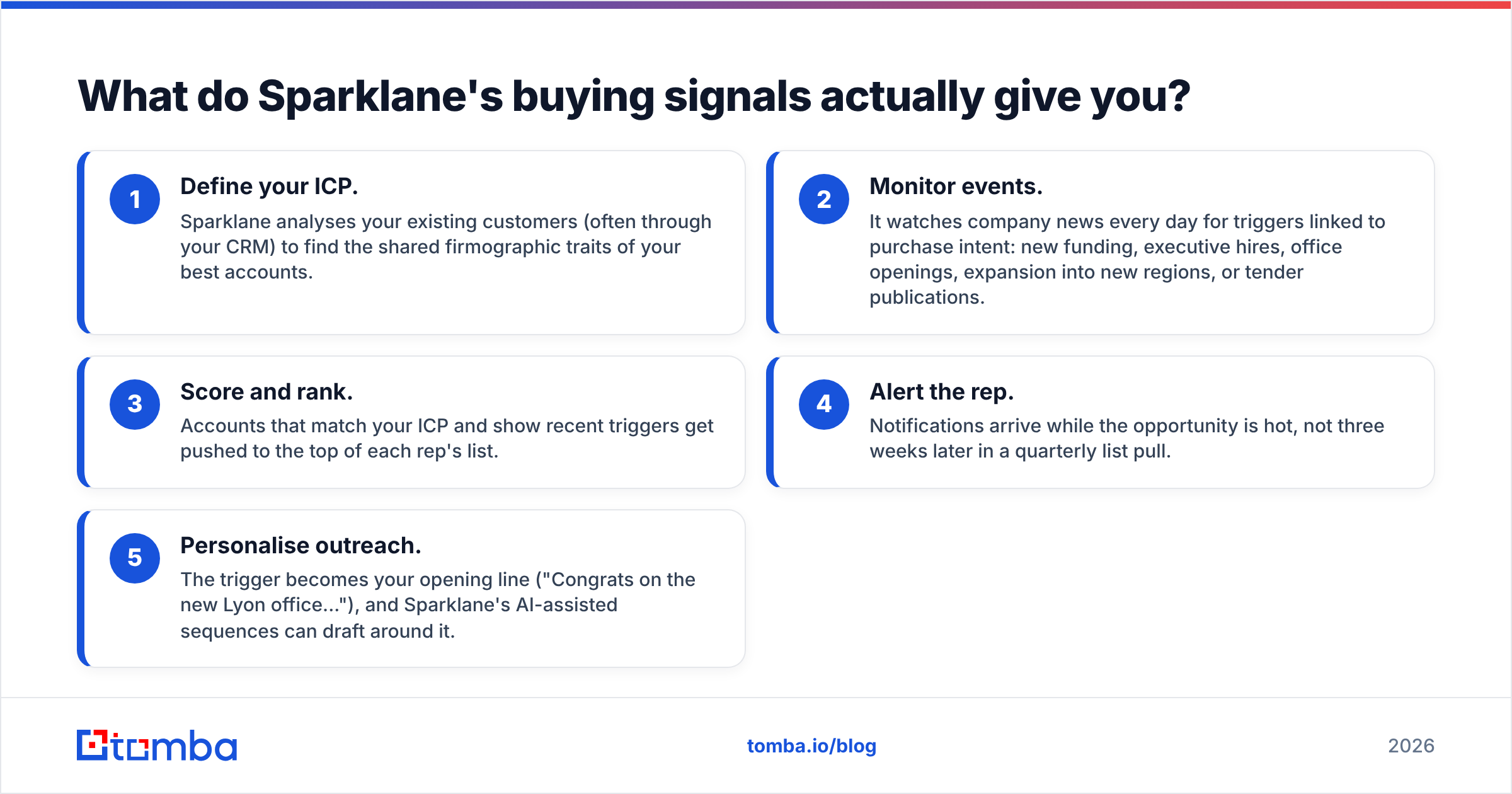
- Define your ICP. Sparklane analyses your existing customers (often through your CRM) to find the shared firmographic traits of your best accounts.
- Monitor events. It watches company news every day for triggers linked to purchase intent: new funding, executive hires, office openings, expansion into new regions, or tender publications.
- Score and rank. Accounts that match your ICP and show recent triggers get pushed to the top of each rep's list.
- Alert the rep. Notifications arrive while the opportunity is hot, not three weeks later in a quarterly list pull.
- Personalise outreach. The trigger becomes your opening line ("Congrats on the new Lyon office..."), and Sparklane's AI-assisted sequences can draft around it.
This is the same idea Forrester and Gartner have pushed for years under the "intent data" label: reaching an account while it's actively changing beats cold volume. The difference is that Sparklane's signals are mostly public business events. They are not third-party web-browsing intent. That makes them easier to explain to a prospect, and in the EU they're easier to defend under GDPR.
Limeleads has no equivalent. You bring the timing yourself, for example by combining a Limeleads list with Google Alerts, LinkedIn Sales Navigator job-change alerts, or a funding-news feed.
Which is easier to set up and use?#
Limeleads is easy to learn. You sign up, open the search screen, set five filters, preview the results and unlock what you want. Most people have a usable CSV within 10 minutes. The flip side is that there's little workflow beyond the export. You'll need a separate sequencer, a CRM and usually a verifier.
Sparklane takes a real onboarding effort. To get value from scoring and signals, you need to connect your CRM, define your ICP and tune which triggers count for your business. Expect days to weeks before reps trust the recommendations. Once that's done, it covers more of the workflow in one place: account prioritisation, contact data, alerts and sequences.
If you're a two-person founding team, that onboarding is time you probably don't have. If you're a 25-rep team with a RevOps function, it's a normal part of rolling out a platform.
What are the pros and cons of each?#
Limeleads — pros
- Low entry cost and clear, credit-based pricing
- Credits roll over, so you don't waste money in slow months
- Verification when you unlock a contact reduces hard bounces
- Almost no learning curve
Limeleads — cons
- No buying signals or account scoring
- Coverage is US-first and thinner in Europe
- Few native workflow features beyond export
- Mobile-number coverage is limited
Sparklane — pros
- AI-scored business signals tell you when to reach out
- Strong French and European company data
- ICP analysis based on your own customer base
- Native CRM connectors and AI-assisted sequences
Sparklane — cons
- Per-seat pricing adds up quickly for larger teams
- The best features (Predict) are behind a custom quote
- Onboarding takes real effort before you see ROI
- Less useful if your market is mainly outside Europe
For third-party user feedback, the Limeleads profile on Capterra and the vendors' own sites (limeleads.com, sparklane.com) are the best places to check current features and plan limits.
Where do both tools fall short?#
This is the part most comparison pages leave out. Both platforms sell you someone else's snapshot of a contact. That causes three problems no matter which logo you choose.
- Staleness. A record verified six months ago may belong to someone who left in month four. Database vendors re-verify on their own schedule, not yours.
- Coverage gaps on specific people. Your champion at a target account might not be in either database at all, and filters won't find someone who isn't there.
- Catch-all domains. Many mid-market and enterprise companies accept mail for any address. A simple verifier then reports "valid" for addresses that will never reach a person.
The fix is a lookup step after the database step. When you already know the account, whether it came from a Limeleads filter or a Sparklane signal, you can run a domain search to see every public address and the company's email pattern, then find the exact person you need. Add data enrichment to fill in the title, LinkedIn URL and company attributes the database missed.
Limeleads vs Sparklane: which should you choose?#
Choose Limeleads if:
- You sell mainly into North America
- Your deal sizes are small to mid and you win on volume
- You have 1–5 people prospecting and hate paying per seat
- You already have a sequencer and CRM and just need lists
Choose Sparklane if:
- Your territory is France or broader Europe
- Your deal sizes justify paying for timing and prioritisation
- You have a team large enough to benefit from shared account scoring
- You want signals, contacts and sequences in one platform
Choose neither (yet) if:
- You already know your target accounts from an event list, a partner list or inbound traffic, and only need verified emails for specific people. In that case you're paying database prices for a lookup problem.
Here's how to decide in practice. Take 50 accounts that fit your ICP and pull contacts for the same three personas from both tools during their trials. Verify everything, send the same sequence, and count meetings after 21 days. That number settles the question better than any feature grid, this one included.
How does Tomba fit alongside either tool?#
Tomba doesn't replace Sparklane's signal engine, and it isn't trying to be a filter-everything database like Limeleads. It covers the step both of them leave to you: finding and verifying the exact address for a specific person at a specific company, when you need it, not from a snapshot taken months ago.
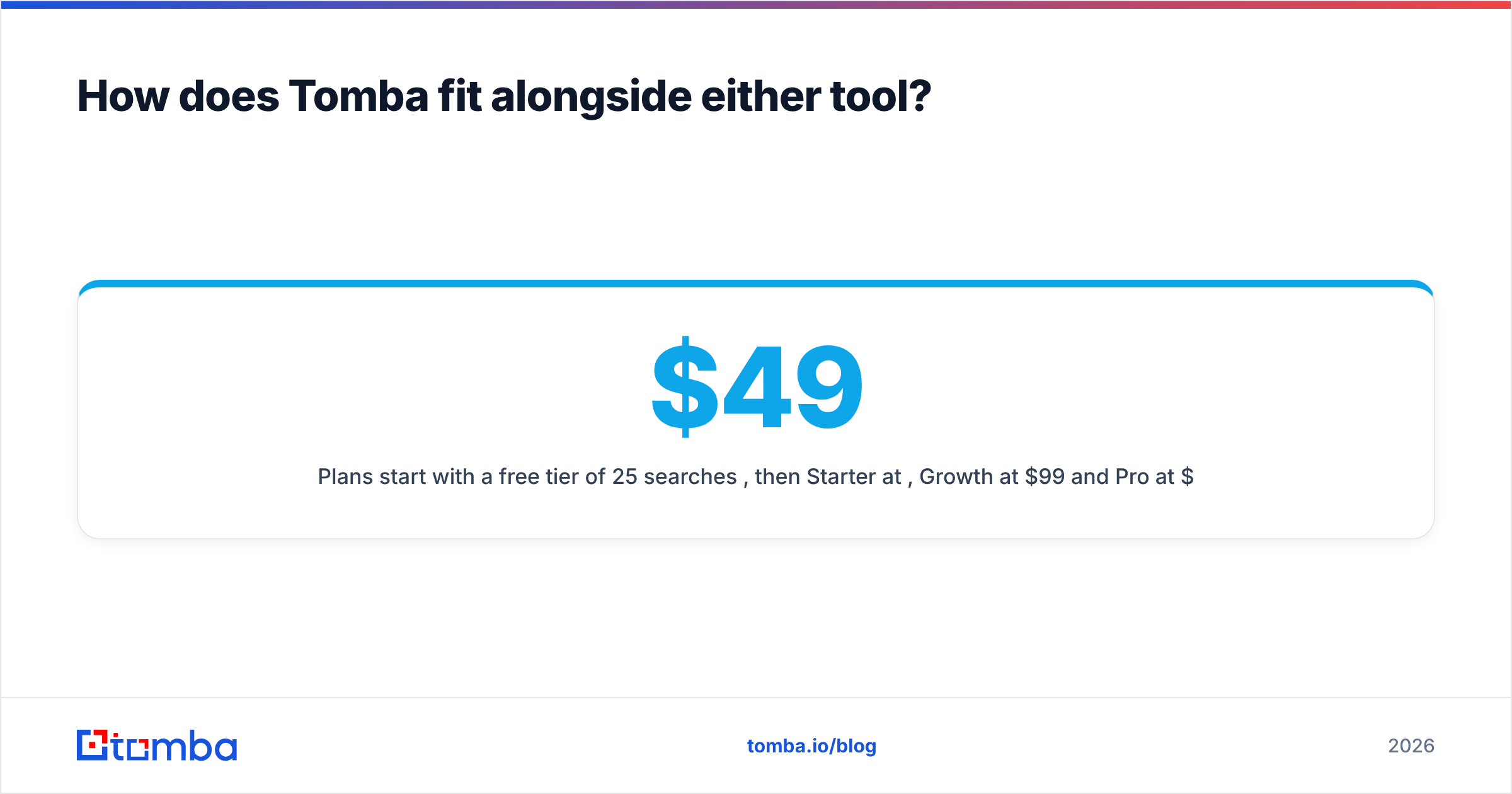
Plans start with a free tier of 25 searches per month, then Starter at $49/mo, Growth at $99/mo and Pro at $249/mo. See the Tomba pricing page for credit limits. Many teams use Limeleads or Sparklane to decide which accounts to target and Tomba to get the right inbox at each one.
If you've found your accounts and need emails that actually land, try the Tomba Email Finder. Enter a name and a company domain and get a verified professional address in seconds. The free tier needs no credit card, so you can test it on your next 25 prospects before you commit to any database contract.
Related guides#
// get started
Find, verify and enrich your first contacts today
Start on the free plan with 25 searches a month, then scale when your team is ready.
Free plan · No credit card required · GDPR & CCPA
// about the author