List Building Service in 2026: Costs, Options, and DIY Alternatives
Paying someone to build your B2B lead list can save weeks, or it can burn your domain with stale contacts. Here is how to judge a list building service, what it costs, and when building the list yourself makes more sense.
TL;DR
- A list building service researches and delivers B2B contacts (names, titles, emails, sometimes phones) that match your ideal customer profile. You pay a person, an agency, or a data vendor instead of doing the research yourself.
- There are four main models: a freelancer, a managed agency, a prebuilt data vendor, and doing it yourself with an email finder. Each one trades cost against control and data freshness differently.
- The biggest risk isn't the price. It's getting unverified or recycled data that pushes your bounce rate past 2-3% and damages your sending domain.
- Outsource when you have no time and a narrow, well-defined ICP. Build the list in-house when you run outbound all the time and need to control accuracy.
- Whoever builds the list, verify every address before the first send.
What is a list building service?#
A list building service puts together a targeted list of prospects for you, usually B2B decision-makers who fit criteria you set: industry, company size, geography, job title, tech stack, or funding stage. You get a spreadsheet or a CRM import with contact names, roles, company data, and business email addresses. Some services also include direct dials or LinkedIn URLs.
Think of it like hiring a professional shopper. You hand over the grocery list (your ICP), they go through the aisles (databases, company websites, LinkedIn, public records), and they come back with a full cart. How good the result is depends on how precise your list was and how careful the shopper was.
The term covers very different offerings, though. A freelancer on a marketplace who copies profiles into a spreadsheet is a list building service. So is an agency with a research team and a QA process, and so is a data company selling filtered records from a large database. If you treat them as the same thing, you'll overpay, or you'll pay very little and get data you can't use.
If you want the broader context, list building sits within lead generation. It's the step that turns a market definition into specific, reachable people.
What does a good list building service actually deliver?#
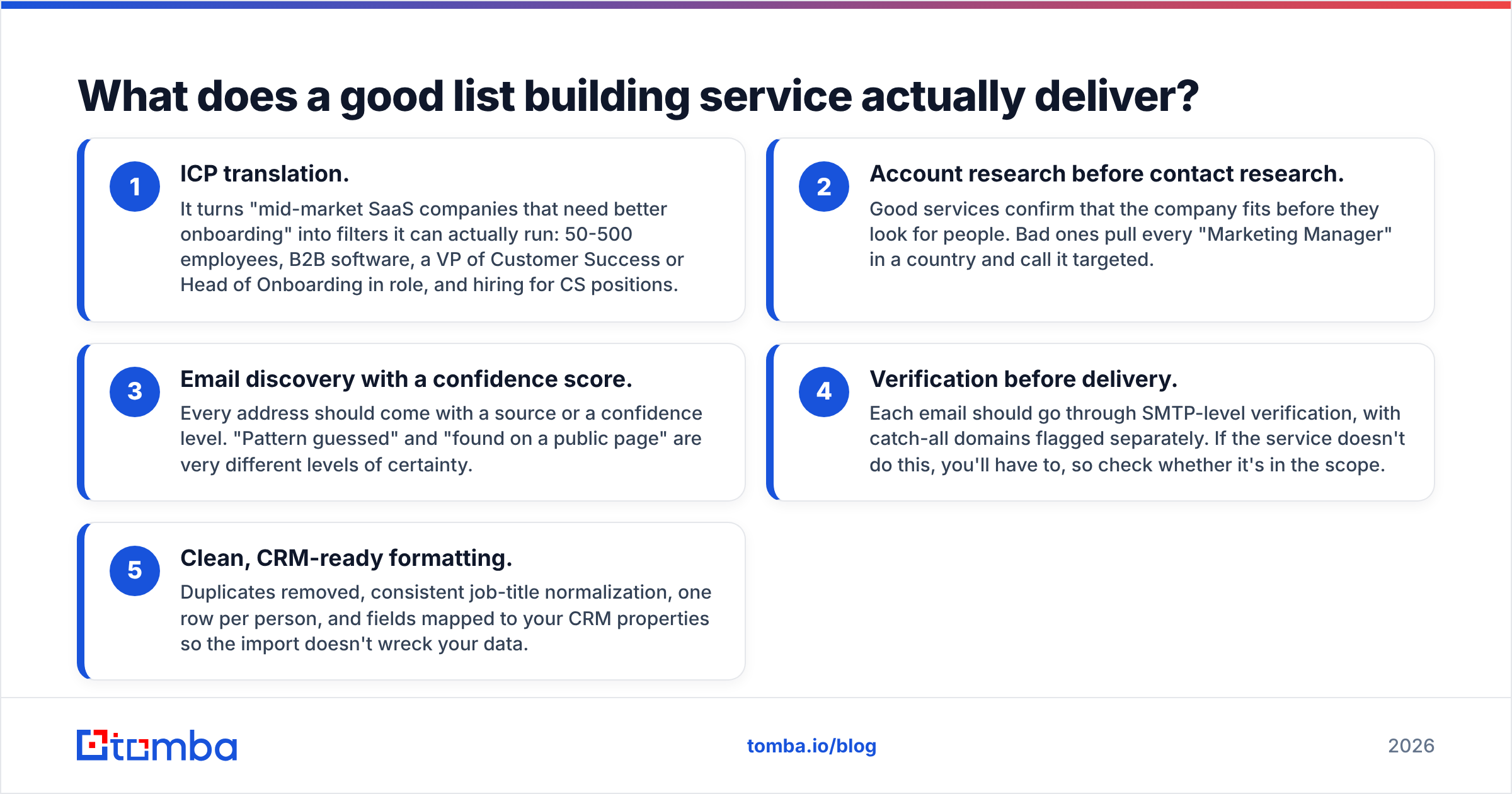
The file is the easy part. What you're really paying for is the process behind it. A service is doing its job when it covers these five things:
- ICP translation. It turns "mid-market SaaS companies that need better onboarding" into filters it can actually run: 50-500 employees, B2B software, a VP of Customer Success or Head of Onboarding in role, and hiring for CS positions.
- Account research before contact research. Good services confirm that the company fits before they look for people. Bad ones pull every "Marketing Manager" in a country and call it targeted.
- Email discovery with a confidence score. Every address should come with a source or a confidence level. "Pattern guessed" and "found on a public page" are very different levels of certainty.
- Verification before delivery. Each email should go through SMTP-level verification, with catch-all domains flagged separately. If the service doesn't do this, you'll have to, so check whether it's in the scope.
- Clean, CRM-ready formatting. Duplicates removed, consistent job-title normalization, one row per person, and fields mapped to your CRM properties so the import doesn't wreck your data.
If a vendor can't explain how it handles items 2 through 4, you're buying volume rather than a researched list.

How much does a list building service cost?#
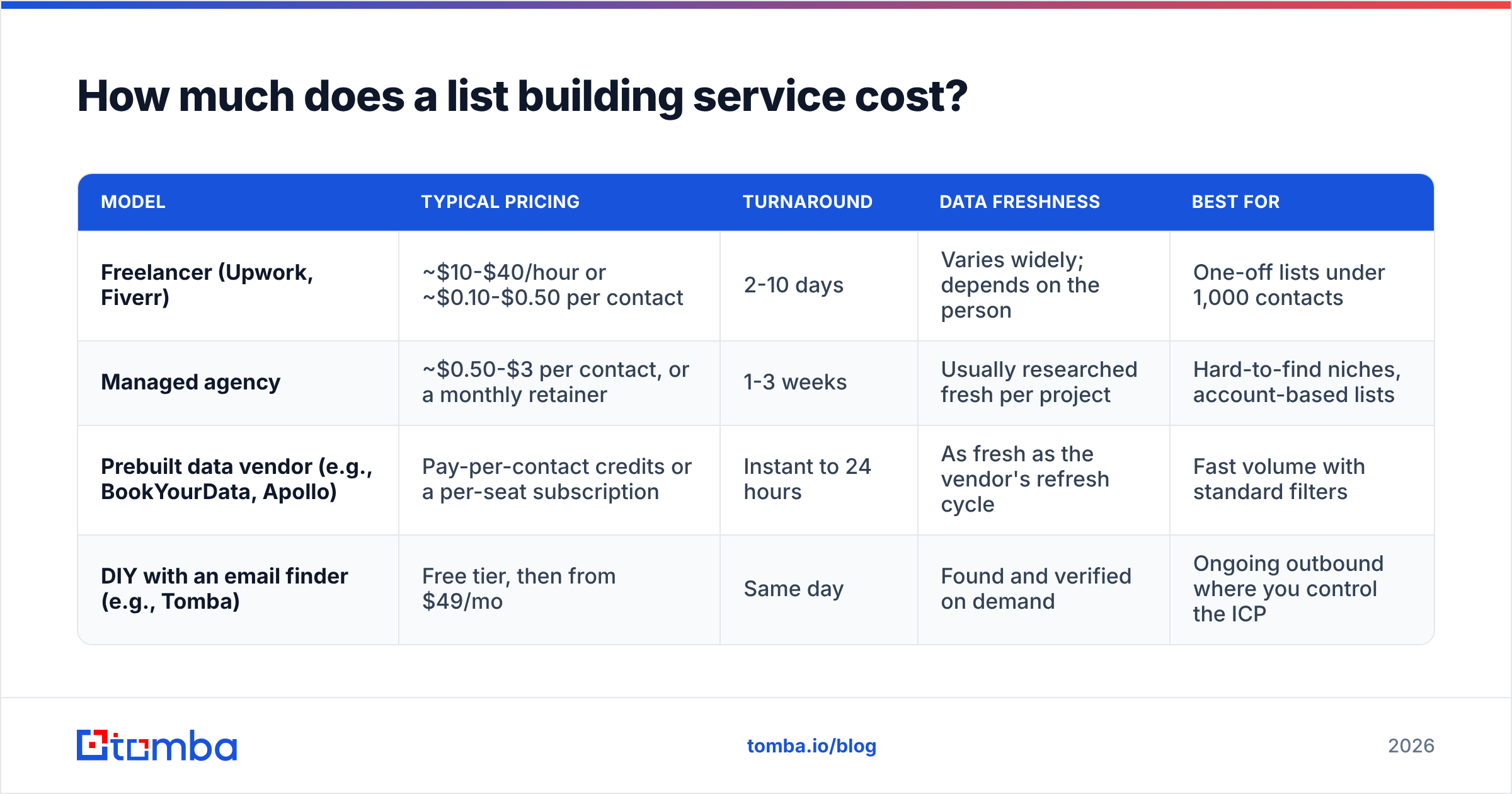
Prices vary a lot because the models vary a lot. The ranges below are typical market quotes as of 2026. Get at least two quotes for your own ICP, because niche segments cost more.
| Model | Typical pricing | Turnaround | Data freshness | Best for |
|---|---|---|---|---|
| Freelancer (Upwork, Fiverr) | ~$10-$40/hour or ~$0.10-$0.50 per contact | 2-10 days | Varies widely; depends on the person | One-off lists under 1,000 contacts |
| Managed agency | ~$0.50-$3 per contact, or a monthly retainer | 1-3 weeks | Usually researched fresh per project | Hard-to-find niches, account-based lists |
| Prebuilt data vendor (e.g., BookYourData, Apollo) | Pay-per-contact credits or a per-seat subscription | Instant to 24 hours | As fresh as the vendor's refresh cycle | Fast volume with standard filters |
| DIY with an email finder (e.g., Tomba) | Free tier, then from $49/mo | Same day | Found and verified on demand | Ongoing outbound where you control the ICP |
A few notes to read the table correctly:
- The per-contact price is the wrong number to optimize. A $0.20 contact that bounces costs you more than a $1.50 contact that books a meeting, because every bounce also damages your sender reputation.
- Prebuilt data vendors aren't the same as cheap data. Established vendors such as BookYourData sell filtered B2B contacts with accuracy guarantees and a self-serve interface, which is a solid option when you need standard segments fast. Just remember that database records age, so re-verify anything that has been sitting in your CRM for weeks.
- Retainers hide the unit cost. If an agency charges $2,500/month for "up to 1,500 contacts," ask how many will actually pass verification. That's your real denominator.
Should you outsource list building or do it yourself?#
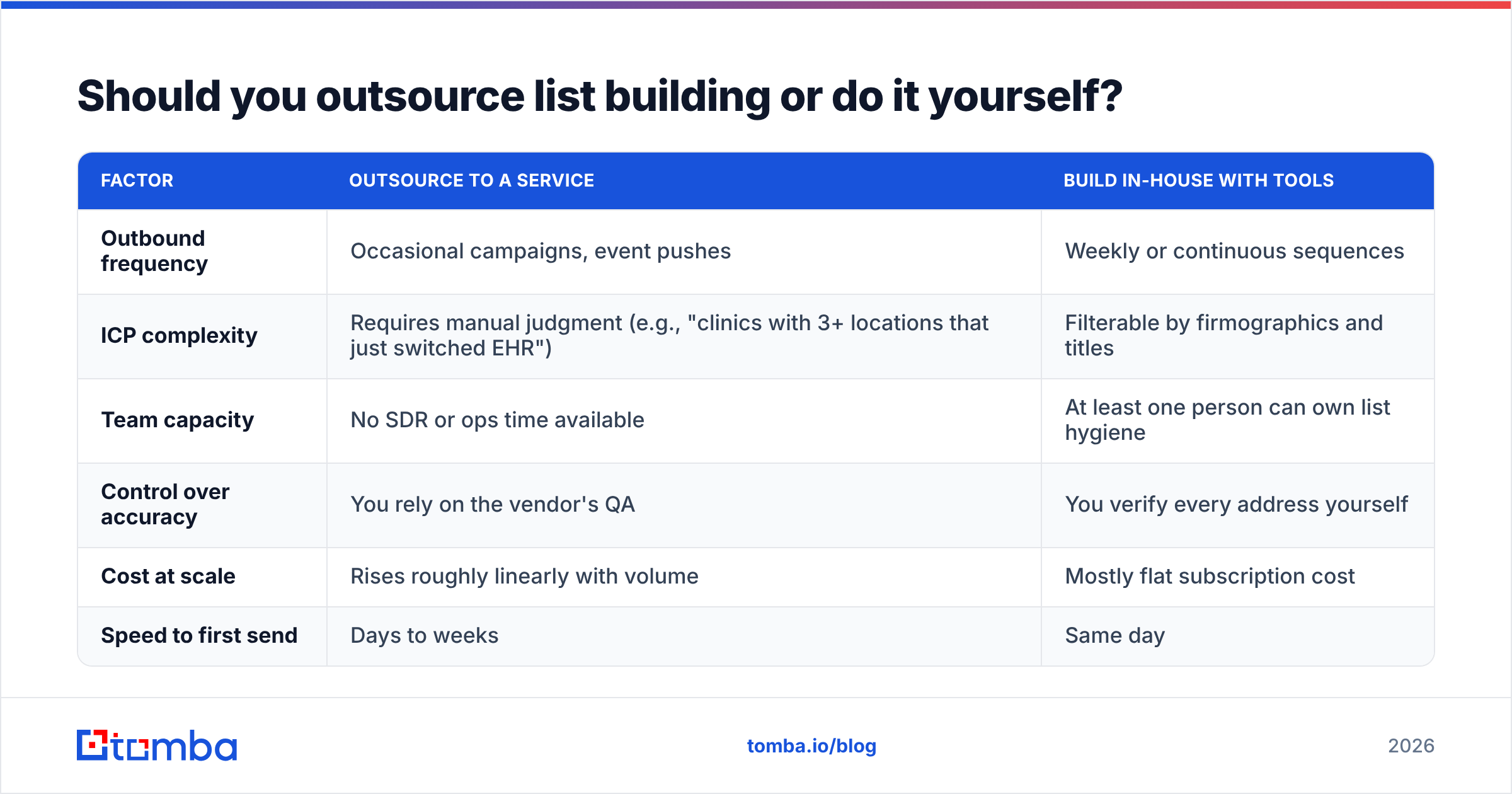
The honest answer is that it depends on how often you prospect and how specific your ICP is. Here's how the decision usually plays out.
| Factor | Outsource to a service | Build in-house with tools |
|---|---|---|
| Outbound frequency | Occasional campaigns, event pushes | Weekly or continuous sequences |
| ICP complexity | Requires manual judgment (e.g., "clinics with 3+ locations that just switched EHR") | Filterable by firmographics and titles |
| Team capacity | No SDR or ops time available | At least one person can own list hygiene |
| Control over accuracy | You rely on the vendor's QA | You verify every address yourself |
| Cost at scale | Rises roughly linearly with volume | Mostly flat subscription cost |
| Speed to first send | Days to weeks | Same day |
Outsource when:
- You're launching into a new vertical and don't know its org charts yet.
- The research needs human judgment that filters can't capture, such as reading case studies, checking job posts, or confirming a specific trigger event.
- Your team is small and every SDR hour spent on research is an hour not spent selling.
Build it yourself when:
- Outbound is a permanent channel rather than a single experiment.
- You need to refresh lists every month as people change jobs. B2B contact data decays fast, and job changes alone make a noticeable share of any list stale within a year.
- You want to own the verification step, because your domain reputation is the one at risk.
Many teams end up with a hybrid. They pay a service or buy from a data vendor for the first seed list in a new market, then maintain and expand it in-house with an email finder and a verifier.
What are the red flags when hiring a list building service?#
Vetting matters more than price. Watch out for these:
- "We guarantee 100% accuracy." Nobody can promise that, because email validity changes daily. Credible vendors guarantee a threshold (for example, 90-95% deliverable) and replace or credit the bounces.
- No sample before purchase. Ask for 25-50 contacts from your actual ICP, run them through an email verifier yourself, and compare the results with the vendor's claims.
- No explanation of catch-all domains. Catch-all servers accept any address during an SMTP check, so they look valid until you send and the message silently goes nowhere. A serious service flags these separately.
- Vague sourcing. "Our proprietary database" is fine, but they should still be able to tell you how records are refreshed and how opt-out requests are handled.
- No compliance posture. If you prospect in the EU or UK, ask how the service handles GDPR legitimate-interest assessments and data-subject requests. HubSpot's overview of GDPR for sales and marketing is a good primer before that call.
- Unlimited contacts at a flat, tiny price. That almost always means scraped, unverified, or resold data.
How do you build a B2B list yourself in 2026?#
If you decide to keep list building in-house, the workflow is more manageable than most people expect. A focused SDR can produce a verified, ICP-tight list of a few hundred contacts in an afternoon.
Step 1: Define the ICP in filterable terms. Write down industry, headcount band, geography, and two or three job titles per buying role. Add one trigger if you have one, such as hiring, funding, or a new tool install.
Step 2: Build the account list first. Pull target companies from your CRM's closed-lost records, from G2 category pages, from funding announcements, or from a data vendor. Aim for accounts you'd genuinely be happy to close.
Step 3: Find the people at each account. Run a domain search on each target company to see which emails and roles are publicly associated with that domain, then use an email finder for the specific decision-makers you've named. This is faster than guessing, and the confidence scores tell you where to be careful.
Step 4: Enrich only what you'll use. Title, seniority, LinkedIn URL, and maybe a phone number. Every extra field is another thing to keep up to date.
Step 5: Verify everything. Run the full list through verification. Remove invalid addresses, set catch-alls aside for a smaller, lower-volume send, and keep only deliverable contacts in your main sequence.
Step 6: Scale with bulk tools. Once the process works for 50 contacts, move to CSV uploads. A bulk email finder handles thousands of name-plus-domain pairs in one pass, so you're not doing it row by row.
Step 7: Re-verify before each campaign. A list that was clean in March isn't clean in September. Re-run verification on anything older than 30-60 days.

Which tools do list building services use behind the scenes?#
Most agencies don't have secret sources. They use the same categories of tools you can buy yourself:
- B2B contact databases such as Apollo, ZoomInfo, or BookYourData for filtered prospect pulls.
- Email finders and domain search tools to discover or confirm business emails from a name and a company domain.
- Verification services to check deliverability and flag catch-alls before delivery.
- LinkedIn Sales Navigator for manual account and role research.
- Enrichment tools to append firmographics, tech stack, and phone numbers.
That matters when you're deciding. What an agency adds is labor and judgment, not unique data access. If your ICP is simple enough that filters capture it, you're mostly paying for someone else's time. If it needs a human to read websites and job posts, the service fee pays for itself.
Is a list building service worth it for cold email?#
For cold email specifically, the quality bar is higher than for ads or direct mail, because every invalid address counts against your domain. Mailbox providers like Google and Microsoft now enforce bulk-sender requirements and watch complaint and bounce signals closely. A single bad list can push a fresh domain into spam folders for weeks.
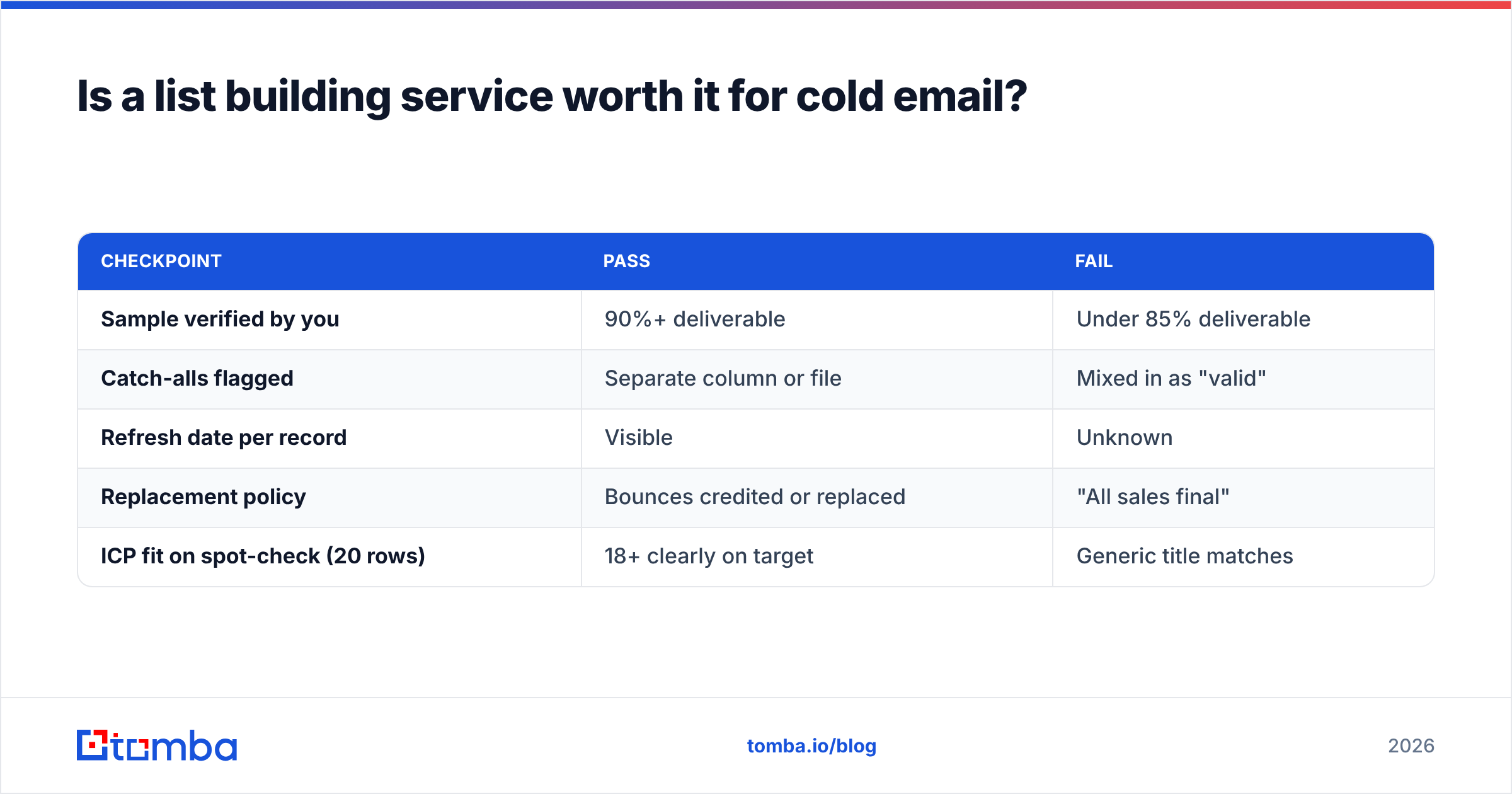
So the question isn't only whether a service is worth it. It's whether that service can deliver data clean enough to send to. Use this checklist:
| Checkpoint | Pass | Fail |
|---|---|---|
| Sample verified by you | 90%+ deliverable | Under 85% deliverable |
| Catch-alls flagged | Separate column or file | Mixed in as "valid" |
| Refresh date per record | Visible | Unknown |
| Replacement policy | Bounces credited or replaced | "All sales final" |
| ICP fit on spot-check (20 rows) | 18+ clearly on target | Generic title matches |
If a vendor passes all five, outsourcing is a reasonable call. If it fails two or more, you'll spend as much time cleaning the list as you would have spent building it.
What's the verdict on list building services?#
A list building service works best as a head start, not a permanent crutch. Freelancers are fine for small, one-off pulls. Agencies earn their fee on niche, judgment-heavy research. Established data vendors like BookYourData or Apollo are the fastest route to volume on standard segments. Teams that run outbound every week usually end up owning the process themselves, because list quality drives reply rates more than anything else in the sequence.
Whichever route you pick, keep two rules: define the ICP before anyone starts pulling contacts, and verify every address before it reaches your sending tool.
Ready to build your own verified list?#
If you'd rather control the accuracy yourself than trust someone else's spreadsheet, Tomba Email Finder lets you find professional email addresses by name, company, or domain, with confidence scores and built-in verification so your list is ready to send the same day. Start on the free tier with 25 searches a month, then move to a paid plan from $49/mo when your outbound grows. You can compare the options on the Tomba pricing page.
Related guides#
// get started
Find, verify and enrich your first contacts today
Start on the free plan with 25 searches a month, then scale when your team is ready.
Free plan · No credit card required · GDPR & CCPA
// about the author