List of External Factors That Influence a Sales Forecast (2026)
Your pipeline math can be perfect and your forecast can still miss. Here are the 12 external factors that move B2B revenue, the signals to watch for each, and how to build them into your number.
TL;DR
- Most sales forecasts are built only on internal data: pipeline stages, win rates, rep commits. External factors are why a "95% confident" number still misses by 20%.
- The 12 external factors that matter most in B2B are macroeconomics, interest rates, inflation, currency, tariffs, regulation, competitors, technology shifts, seasonality, customer-industry health, supply chains, and geopolitical or natural shocks.
- You can't control any of them. You can track a leading indicator for each one and turn it into a forecast adjustment before the quarter goes wrong.
- A good way to do this is to keep a base forecast and then apply named, documented external adjustments, so leadership can see why the number moved.
- Clean, current contact and account data makes external signals usable, because you can see which accounts are exposed to a shock and re-score them.
What are external factors in sales forecasting?#
External factors in sales forecasting are forces outside your company that change how much, how fast, or at what price your customers buy. You don't set them and you can't negotiate with them. Your forecast has to absorb them anyway.
Internal factors are the things you control: headcount, quota, pricing, pipeline coverage, rep ramp time, marketing spend. Most forecasting methods (stage-weighted pipeline, historical run-rate, rep commit roll-ups) are built almost entirely on these. That works when the outside world holds still. It stops working when rates jump, a tariff lands on your customers' main import, or a competitor cuts price by 40% mid-quarter.
Here's an analogy. Your pipeline is the boat and external factors are the weather. A well-built boat still arrives late in a storm. Forecasting well means you check the weather before you promise an arrival time.
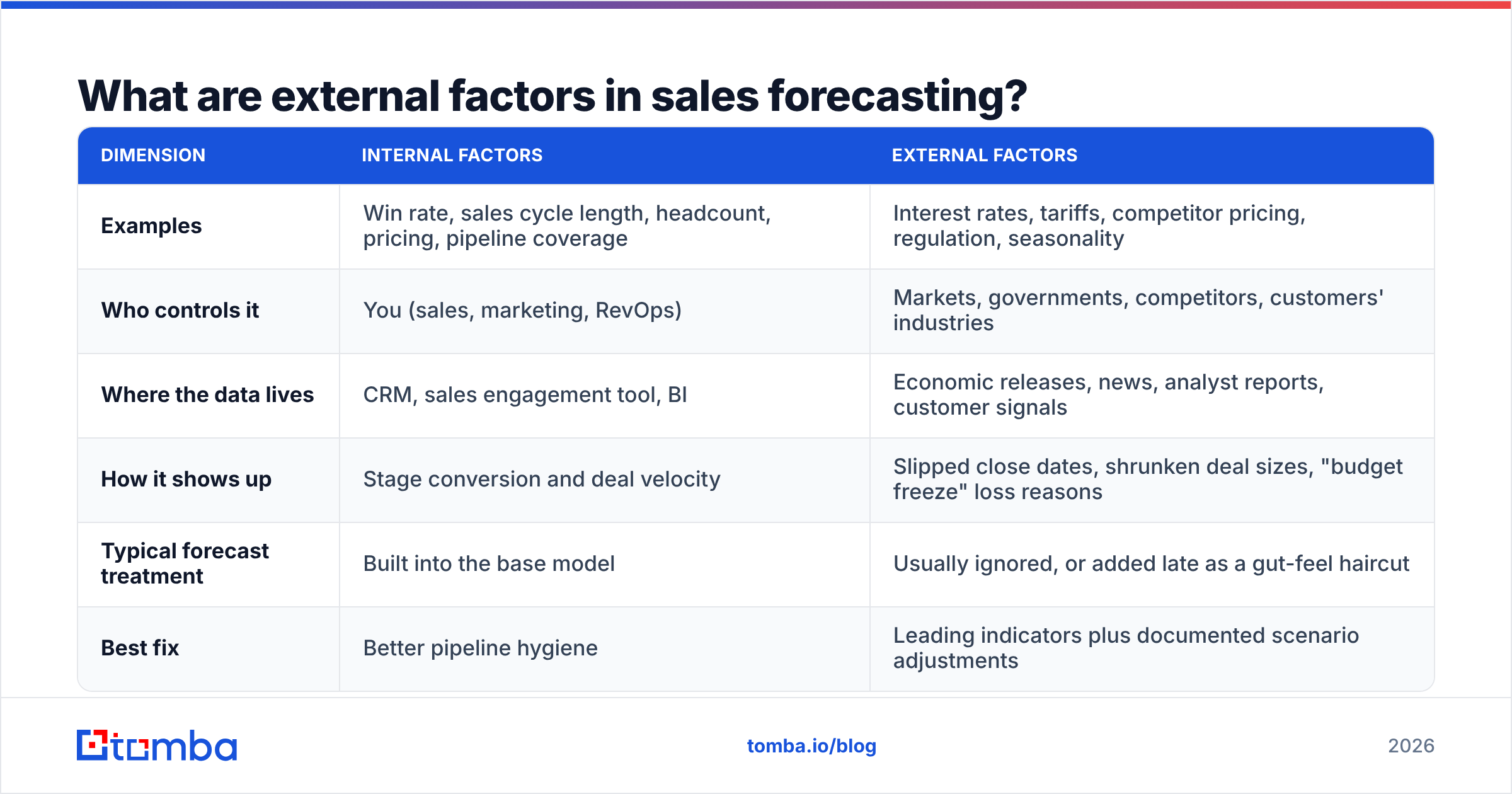
| Dimension | Internal factors | External factors |
|---|---|---|
| Examples | Win rate, sales cycle length, headcount, pricing, pipeline coverage | Interest rates, tariffs, competitor pricing, regulation, seasonality |
| Who controls it | You (sales, marketing, RevOps) | Markets, governments, competitors, customers' industries |
| Where the data lives | CRM, sales engagement tool, BI | Economic releases, news, analyst reports, customer signals |
| How it shows up | Stage conversion and deal velocity | Slipped close dates, shrunken deal sizes, "budget freeze" loss reasons |
| Typical forecast treatment | Built into the base model | Usually ignored, or added late as a gut-feel haircut |
| Best fix | Better pipeline hygiene | Leading indicators plus documented scenario adjustments |
If you want a refresher on the internal side first, HubSpot's sales forecasting guide covers the standard methods well. The rest of this post is about everything those methods leave out.
Which framework helps you organize external factors?#
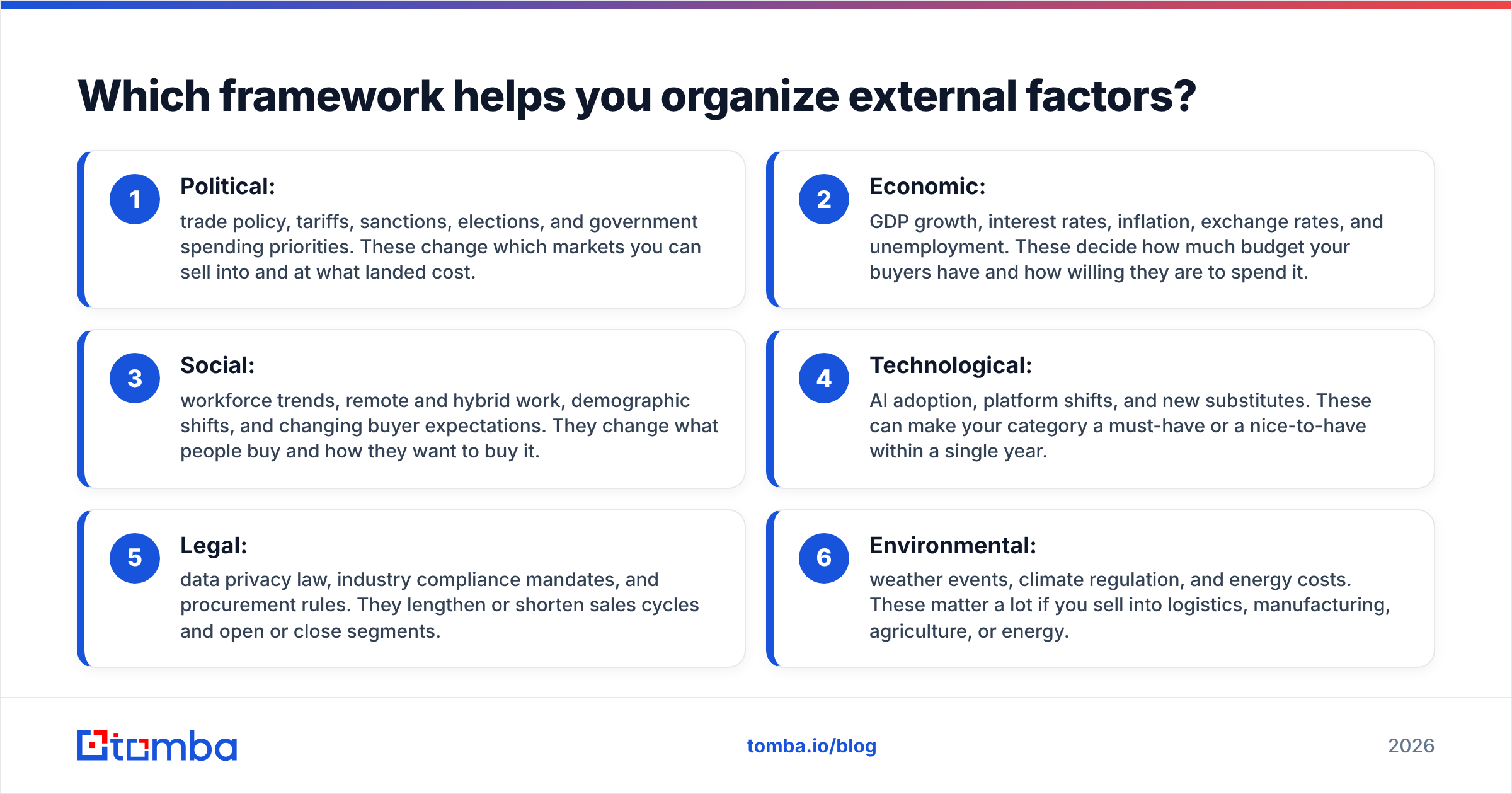
The quickest way to make sure nothing is missing is a PESTLE scan, an extension of the classic PEST analysis used in strategic planning. Every external factor below fits into one of six buckets:
- Political: trade policy, tariffs, sanctions, elections, and government spending priorities. These change which markets you can sell into and at what landed cost.
- Economic: GDP growth, interest rates, inflation, exchange rates, and unemployment. These decide how much budget your buyers have and how willing they are to spend it.
- Social: workforce trends, remote and hybrid work, demographic shifts, and changing buyer expectations. They change what people buy and how they want to buy it.
- Technological: AI adoption, platform shifts, and new substitutes. These can make your category a must-have or a nice-to-have within a single year.
- Legal: data privacy law, industry compliance mandates, and procurement rules. They lengthen or shorten sales cycles and open or close segments.
- Environmental: weather events, climate regulation, and energy costs. These matter a lot if you sell into logistics, manufacturing, agriculture, or energy.
Run this scan once a quarter before your forecast call. For each bucket, ask one question: "Did anything change here since last quarter that affects our top 20 accounts or our top 3 segments?"
What is the full list of external factors that influence a sales forecast?#
These are the 12 external factors that most often move B2B sales forecasts. For each one you get what it does to deals, the signal to watch, and how to put it into the number.
1. Macroeconomic conditions#
GDP growth, recession risk, and business confidence set the overall mood for spending. When confidence drops, deals don't always die. More often they get smaller, slip a quarter, or pick up an extra approver from finance.
Watch: GDP releases, purchasing managers' indexes (PMI), and business confidence surveys. The St. Louis Fed's FRED database is free and covers most of these. Model it: Keep a base, downside, and upside scenario. In the downside case, push expected close dates out and cut average deal size for new-logo pipeline.
2. Interest rates and credit availability#
Higher rates make capital more expensive. That hits capex-heavy purchases, multi-year contracts paid upfront, and any customer segment that relies on venture funding. Startups especially cut tooling spend fast when funding tightens.
Watch: Central bank rate decisions, venture funding volume in your customers' sectors, and the share of deals asking for monthly instead of annual billing. Model it: Separate the pipeline for funded startups from the pipeline for profitable mid-market and enterprise accounts, and apply a different conversion rate to each.
3. Inflation and input costs#
Inflation squeezes customer budgets and raises your own costs. Buyers become more price sensitive, and procurement pushes harder on renewals.
Watch: CPI and producer price index data, plus discount rates in your own closed-won deals. Model it: Track average discount by quarter. If it's rising, cut forecast ACV for late-stage deals, not only win probability.
4. Currency exchange rates#
If you sell in USD to customers who earn in EUR, GBP, or INR, a weaker local currency means a price increase for them even though your price list didn't change. If you bill in local currency, your reported revenue moves with the exchange rate.
Watch: Exchange rate moves in your top three non-USD markets. Model it: Forecast international revenue in constant currency, then show the FX effect on its own line.
5. Trade policy and tariffs#
Tariffs change landed costs, reshape supply chains, and freeze purchasing decisions while companies wait to see what happens. The waiting is often worse for your forecast than the tariff itself, because buyers stop committing.
Watch: Announced and proposed tariff changes that affect your customers' imports or exports, and "waiting on policy clarity" as a stated reason for delays in your CRM. Model it: Flag accounts in exposed industries (manufacturing, retail, automotive, electronics) and apply a slip factor to their close dates.
6. Regulation and compliance changes#
New rules can create demand, as when a compliance deadline forces buyers to purchase. They can also add months to your sales cycle through security reviews and legal redlines. Privacy regimes like GDPR, state-level US privacy laws, and AI governance rules all affect how B2B data and software get bought.
Watch: Effective dates of regulations in your key markets, and legal or security review time per deal. Model it: Add stage-duration assumptions by region. If EU enterprise deals now spend three extra weeks in legal review, your forecast should reflect that.
7. Competitor moves#
A competitor that cuts price, launches a free tier, gets acquired, or raises a large round can change win rates within one quarter. This is the external factor sales teams feel first and report last.
Watch: Win/loss reasons that mention a named competitor, competitor pricing pages, funding and M&A news, and review-site momentum on G2. Model it: Break down win rate by competitor. If your win rate against one rival drops from 45% to 30%, apply that lower rate to every open deal where they are the incumbent or shortlisted.
8. Technology shifts#
AI is the obvious example in 2026. It changes what buyers expect a tool to do, merges categories, and sometimes lets a customer replace three point solutions with one platform. Technology shifts can also help you if your product rides the wave.
Watch: How often "we're evaluating an AI alternative" or "consolidating vendors" comes up in discovery notes, and churn reasons at renewal. Model it: Apply a separate renewal-risk factor to accounts that have signaled vendor consolidation.
9. Seasonality and budget cycles#
Seasonality isn't a surprise, but it's external: your customers' fiscal years, holidays, and planning cycles set when money moves. Many B2B buyers spend unused budget in Q4 and freeze in January while new budgets get approved. Public sector buyers run on their own fiscal calendars.
Watch: Customers' fiscal year-ends (capture them in the CRM), holiday calendars in each region, and historical monthly bookings. Model it: Use at least two years of monthly history to build seasonal indexes, and apply them before layering in other adjustments.
10. Customer-industry health#
Your customers' industries have their own cycles. A layoff wave in tech, a freight downturn in logistics, or a hiring freeze in staffing will shrink deals in that segment regardless of how the wider economy is doing.
Watch: Layoff trackers, job-posting volume at target accounts, earnings calls from bellwether companies in each vertical, and headcount changes at your accounts. Model it: Forecast by vertical, not only by region or rep. Keeping account records current with firmographic data enrichment makes this much easier, because stale industry and headcount fields hide exactly the exposure you're trying to measure.
11. Supply chain disruptions#
If you sell physical products, or sell to companies that do, supply chain problems delay implementations, push back go-lives, and move revenue recognition. Even pure SaaS vendors feel this when a customer's operations team is too busy fighting shortages to run your onboarding.
Watch: Shipping and freight indexes, lead times reported by customers, and implementation delays in your onboarding data. Model it: For usage-based or implementation-gated revenue, forecast recognition dates separately from booking dates.
12. Geopolitical events and natural shocks#
Wars, sanctions, pandemics, cyberattacks on major infrastructure, and extreme weather are hard to predict. You can still plan for them. Sanctions can wipe out a region's pipeline overnight, and a hurricane season can stall deals across a whole state.
Watch: Sanctions lists, news in regions where you have concentrated pipeline, and your own concentration risk. Model it: Don't try to predict the shock. Measure how much of your forecast depends on any one country, industry, or top-10 account, and set a concentration limit.
How do these external factors compare in impact and predictability?#
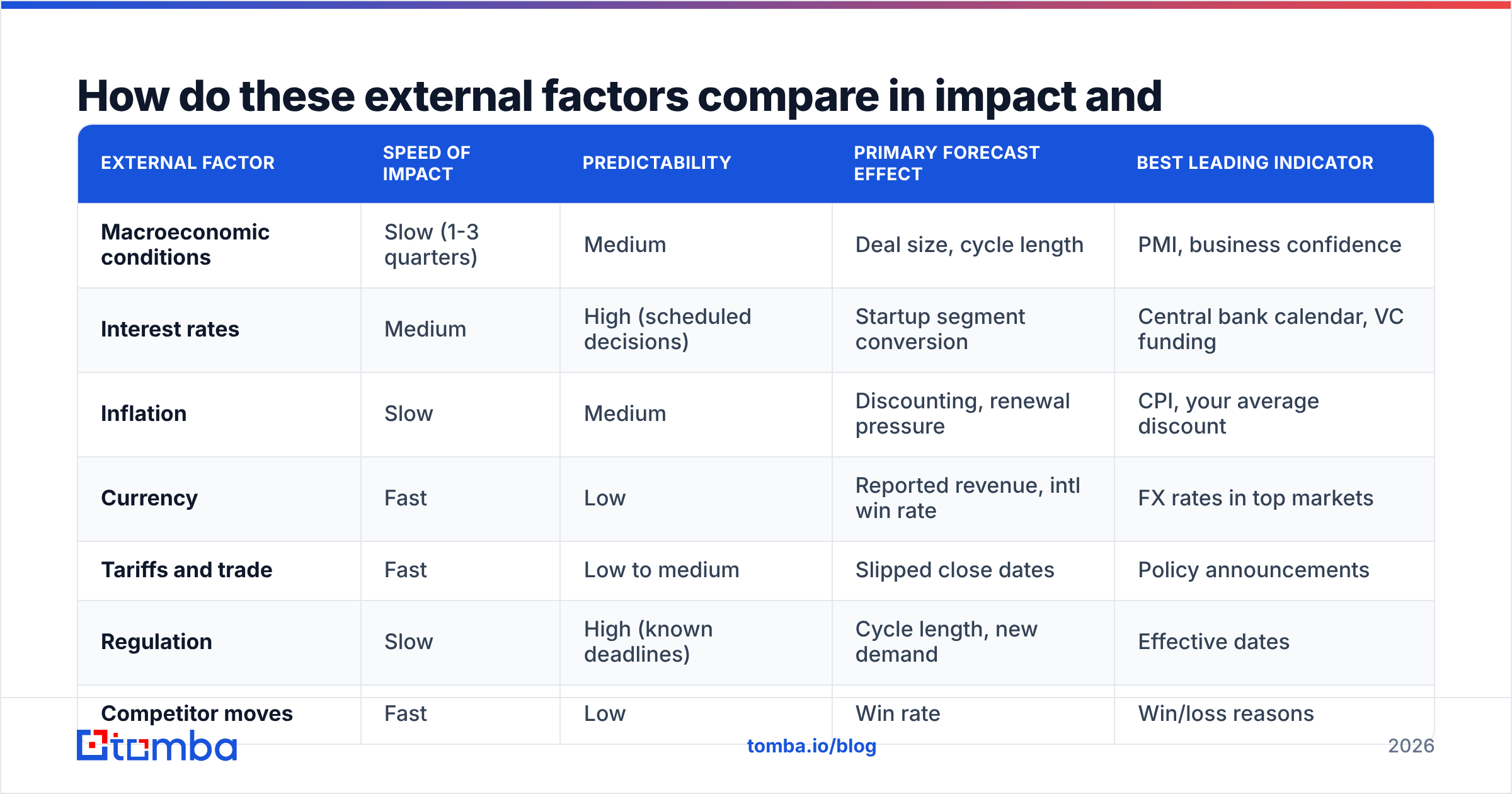
Not all 12 factors deserve the same attention. This table ranks them by how quickly they hit the forecast and how early you can see them coming:
| External factor | Speed of impact | Predictability | Primary forecast effect | Best leading indicator |
|---|---|---|---|---|
| Macroeconomic conditions | Slow (1-3 quarters) | Medium | Deal size, cycle length | PMI, business confidence |
| Interest rates | Medium | High (scheduled decisions) | Startup segment conversion | Central bank calendar, VC funding |
| Inflation | Slow | Medium | Discounting, renewal pressure | CPI, your average discount |
| Currency | Fast | Low | Reported revenue, intl win rate | FX rates in top markets |
| Tariffs and trade | Fast | Low to medium | Slipped close dates | Policy announcements |
| Regulation | Slow | High (known deadlines) | Cycle length, new demand | Effective dates |
| Competitor moves | Fast | Low | Win rate | Win/loss reasons |
| Technology shifts | Slow then sudden | Medium | Renewal and churn risk | Discovery note mentions |
| Seasonality | Predictable | High | Monthly phasing | Historical bookings |
| Customer-industry health | Medium | Medium | Segment-level volume | Layoffs, job postings |
| Supply chain | Medium | Low to medium | Revenue recognition timing | Freight indexes, lead times |
| Geopolitical and natural | Fast | Very low | Regional pipeline wipeout | Concentration risk metrics |
Seasonality, regulation, and interest rates are high-predictability factors, so there's no excuse for leaving them out. Competitor moves, currency, and geopolitical shocks are low-predictability factors. For those, scenario ranges work better than point estimates.
How do you build external factors into your forecast?#
You don't need an econometrics team. You need a repeatable process that keeps the base forecast separate from external adjustments, so everyone can see what moved the number and why.
- Build a clean base forecast. Use your normal method: stage-weighted pipeline, historical run-rate, or AI-assisted forecasting in your CRM. Salesforce's overview of sales forecasting walks through the common approaches.
- Apply seasonality first. It's the most predictable external factor, and it changes how you should read every other signal.
- Tag exposure at the account level. For each open opportunity, record industry, region, currency, funding stage, and main competitor. Without these fields you can't apply targeted adjustments.
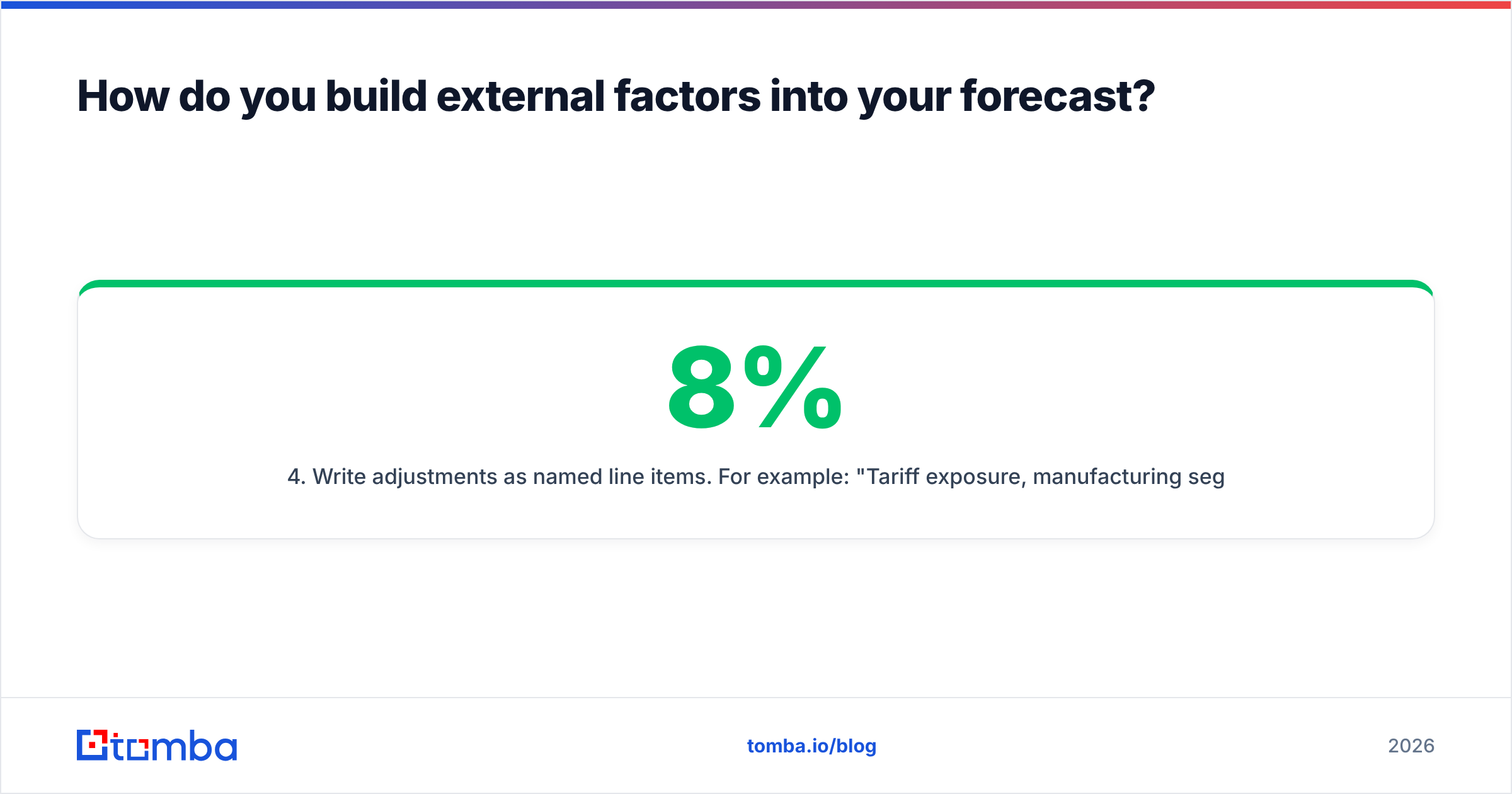
- Write adjustments as named line items. For example: "Tariff exposure, manufacturing segment: -8% on Q4 new logo" or "Competitor X price cut: win rate adjusted from 42% to 33% on 14 deals." Leadership will trust a forecast they can audit.
- Run three scenarios. Base, downside, and upside, each with its assumptions written down. Commit to base and plan resources against downside.
- Review monthly, re-baseline quarterly. Check your leading indicators every month. Rebuild the adjustments each quarter based on what actually happened.
This is usually a job for revenue operations: sales owns the commit and RevOps owns the model and its assumptions.
Why does data quality decide whether external signals are usable?#
External factors only help you if you can connect them to specific accounts and contacts. "Manufacturing is exposed to the new tariff" doesn't help much. "These 23 open opportunities are manufacturing accounts, and 9 of them lost their champion in the last 60 days" is something you can act on.
That depends on three things:
- Accurate firmographics. Industry, headcount, location, and revenue fields have to be current. When they decay, segment-level adjustments get applied to the wrong deals.
- Current contacts. Layoffs and reorganizations are external shocks too. When a champion leaves, the deal's real probability drops even if the CRM stage stays the same. Running open-opportunity contacts through an email verifier regularly is a cheap early warning: if your champion's address starts bouncing, they have probably left.
- Multi-threading. When one contact disappears, you need other stakeholders at the account. Deals with three or more engaged contacts hold up much better against external shocks than single-threaded deals.
The better your account and contact data, the faster you can turn "the market changed" into "these specific deals need new close dates."
What mistakes do teams make with external factors?#
- Adding a gut-feel haircut at the end. "Let's take 10% off, the economy feels soft" can't be audited or learned from. Name the factor and the affected deals.
- Applying one adjustment to everything. A rate hike hurts your seed-stage customers and barely touches your enterprise renewals. Segment first.
- Confusing lagging with leading indicators. Your closed-lost reasons tell you what already happened. Job postings, funding data, and policy calendars tell you what's coming.
- Ignoring positive shocks. A compliance deadline or a competitor outage can bring in demand. If you only model downside, you'll under-hire and under-stock pipeline.
- Never checking the adjustments afterward. After each quarter, compare what you adjusted for with what actually happened. That's how your adjustments get better over time.
FAQ: external factors in sales forecasting#
What is the difference between internal and external factors in a sales forecast? Internal factors are under your control: pricing, headcount, quota, pipeline coverage, and sales process. External factors come from outside the company: economic conditions, competitors, regulation, tariffs, seasonality, and customer-industry health.
Which external factor affects B2B sales forecasts the most? It depends on your segment. For startups selling to startups, interest rates and venture funding usually matter most. For enterprise vendors, macroeconomic confidence and procurement scrutiny dominate. For companies selling to manufacturers, trade policy and supply chains lead.
How often should you update external assumptions? Check leading indicators monthly and rebuild your scenario adjustments quarterly. Update right away after a major event such as a rate decision, a tariff announcement, or a competitor's pricing change.
Can AI forecasting tools account for external factors automatically? Partly. Many AI forecasting tools pick up changes in deal velocity and activity, which reflect external shocks after they start. Few of them consume economic or policy data directly, so you still need a human-owned layer of external adjustments.
Where should you start?#
Pick the three external factors from the list that most affect your top segment. Assign one leading indicator to each, and add a named adjustment line to next month's forecast. Then make sure the account and contact data underneath is accurate enough to tell you which deals are actually exposed.
When a shock hits and you have to re-thread at-risk accounts fast, Tomba Email Finder helps you find and reach the other stakeholders at those accounts by domain, name, or company, so one departed champion doesn't cost you the deal. You can start on the free tier with 25 searches a month, and paid plans start at $49/mo on Tomba pricing.
Related guides#
// get started
Find, verify and enrich your first contacts today
Start on the free plan with 25 searches a month, then scale when your team is ready.
Free plan · No credit card required · GDPR & CCPA
// about the author