List of All Email Providers in 2026: Free, Private & Business
More than 40 email providers in one list: free webmail, privacy-first services, regional giants, legacy ISP inboxes and business hosts. It also covers which ones signal a weak B2B lead and how to spot them from a domain.

TL;DR
- The list of all email providers you need to know comes down to five groups: mainstream free webmail, privacy-first services, regional providers, legacy ISP mailboxes and business email hosts. This guide covers 40+ of them.
- Gmail, Outlook.com and Yahoo Mail still account for most consumer inboxes. For B2B mail, Google Workspace and Microsoft 365 host most corporate domains.
- In B2B prospecting, a free-provider address such as @gmail.com or @hotmail.com usually means lower intent and a weaker match to the buyer. Filter these out or enrich them before they reach a sequence.
- A domain's MX record shows which business provider hosts it. That tells you about deliverability and filtering before you send anything.
- Keep a maintained free-domain blocklist, and verify every address before it goes into your CRM.
Why would you need a list of all email providers?#
Most people search for this list for one of three reasons. They're picking a new inbox, building a form that rejects personal addresses, or cleaning a lead list. This guide handles all three, with extra attention on the B2B case, because that's where a missing entry causes real problems.
Here's how it goes wrong. You run a "work emails only" signup form and block gmail.com, yahoo.com and hotmail.com. Then a student signs up with gmx.net, someone else uses qq.com, and a lead from Poland arrives on wp.pl. Each one ends up in your SDR queue as if it were a qualified account. A short blocklist catches the obvious cases, but a full provider list catches most of them.
A second reason is deliverability. When you know that a prospect's company runs on Microsoft 365 and not Google Workspace, you know which filtering stack your cold email has to get through. Google publishes its email sender guidelines, and Yahoo and Microsoft have since introduced similar requirements. Since February 2024, Google and Yahoo have required bulk senders to authenticate with SPF, DKIM and DMARC, offer one-click unsubscribe and keep spam complaint rates below 0.3%. Microsoft started enforcing comparable rules for high-volume senders to Outlook.com in 2025. For background, see our explainer on email deliverability.
What are the main types of email providers?#
Before the full list, it helps to sort providers by what an address from each one tells you. Think of it like reading an area code. The number works either way, but it tells you roughly where the caller is.
- Mainstream free webmail: Gmail, Outlook.com, Yahoo, iCloud, AOL. These are personal addresses. In B2B, they usually belong to freelancers, founders of very small businesses or people who didn't want to give a work email.
- Privacy-first providers: Proton Mail, Tuta, Mailfence, Posteo. Addresses here are often deliberately separate from the person's employer, and many users switch them off or rotate them.
- Regional providers: QQ Mail, Naver, Mail.ru, GMX, Web.de, Libero. These are mostly personal addresses in their home markets. In a few countries, small businesses use them for real work.
- Legacy ISP mailboxes: Comcast, AT&T, Verizon (now through AOL), BT. These addresses are usually old, often abandoned, and carry a high bounce risk.
- Business email hosts: Google Workspace, Microsoft 365, Zoho Workplace, IONOS, GoDaddy. You can't see them in the address because the domain belongs to the company. You can only detect them from MX records.
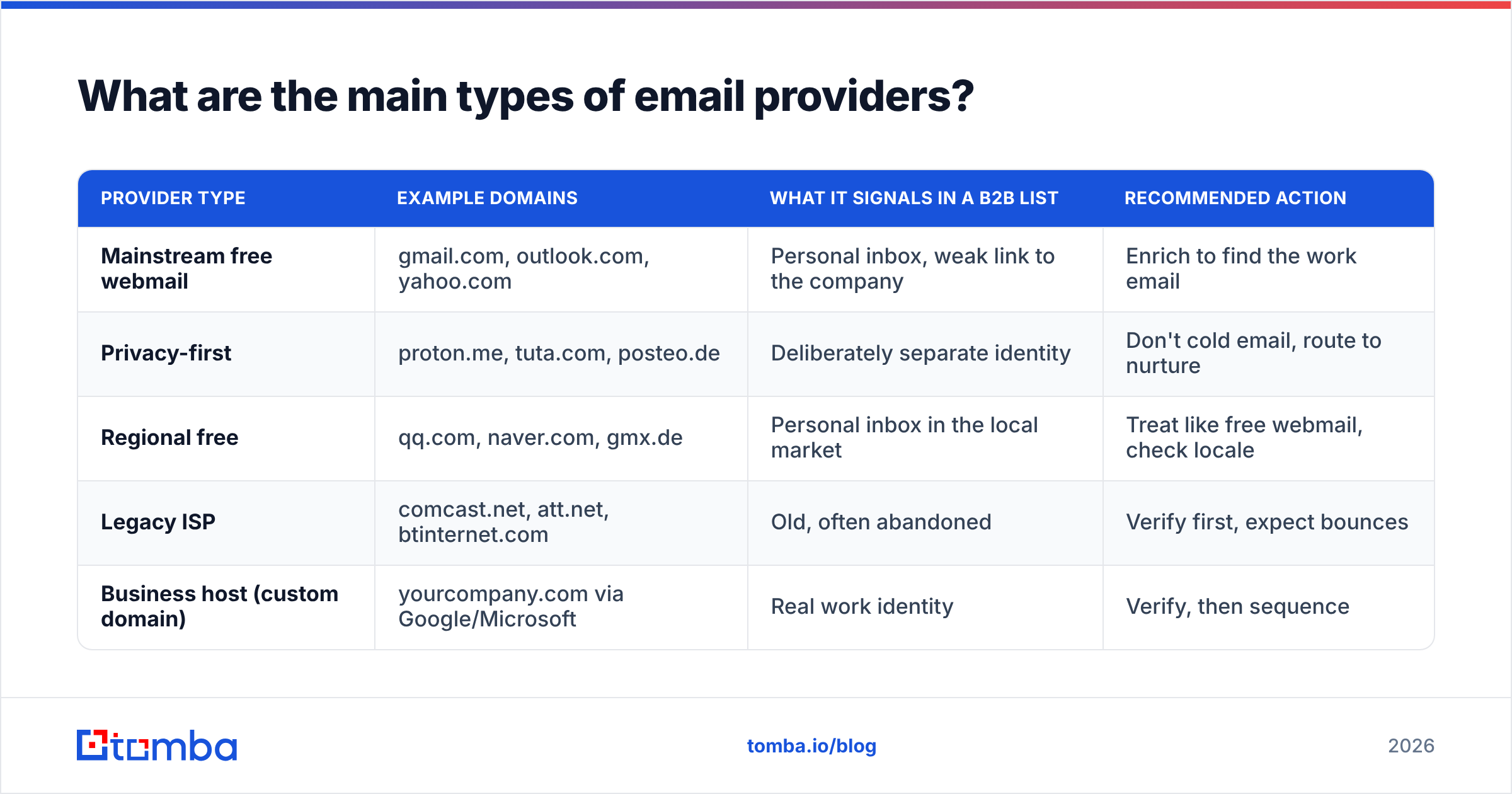
The table below turns those groups into a lead-handling rule of thumb.
| Provider type | Example domains | What it signals in a B2B list | Recommended action |
|---|---|---|---|
| Mainstream free webmail | gmail.com, outlook.com, yahoo.com | Personal inbox, weak link to the company | Enrich to find the work email |
| Privacy-first | proton.me, tuta.com, posteo.de | Deliberately separate identity | Don't cold email, route to nurture |
| Regional free | qq.com, naver.com, gmx.de | Personal inbox in the local market | Treat like free webmail, check locale |
| Legacy ISP | comcast.net, att.net, btinternet.com | Old, often abandoned | Verify first, expect bounces |
| Business host (custom domain) | yourcompany.com via Google/Microsoft | Real work identity | Verify, then sequence |
What are the biggest free email providers?#
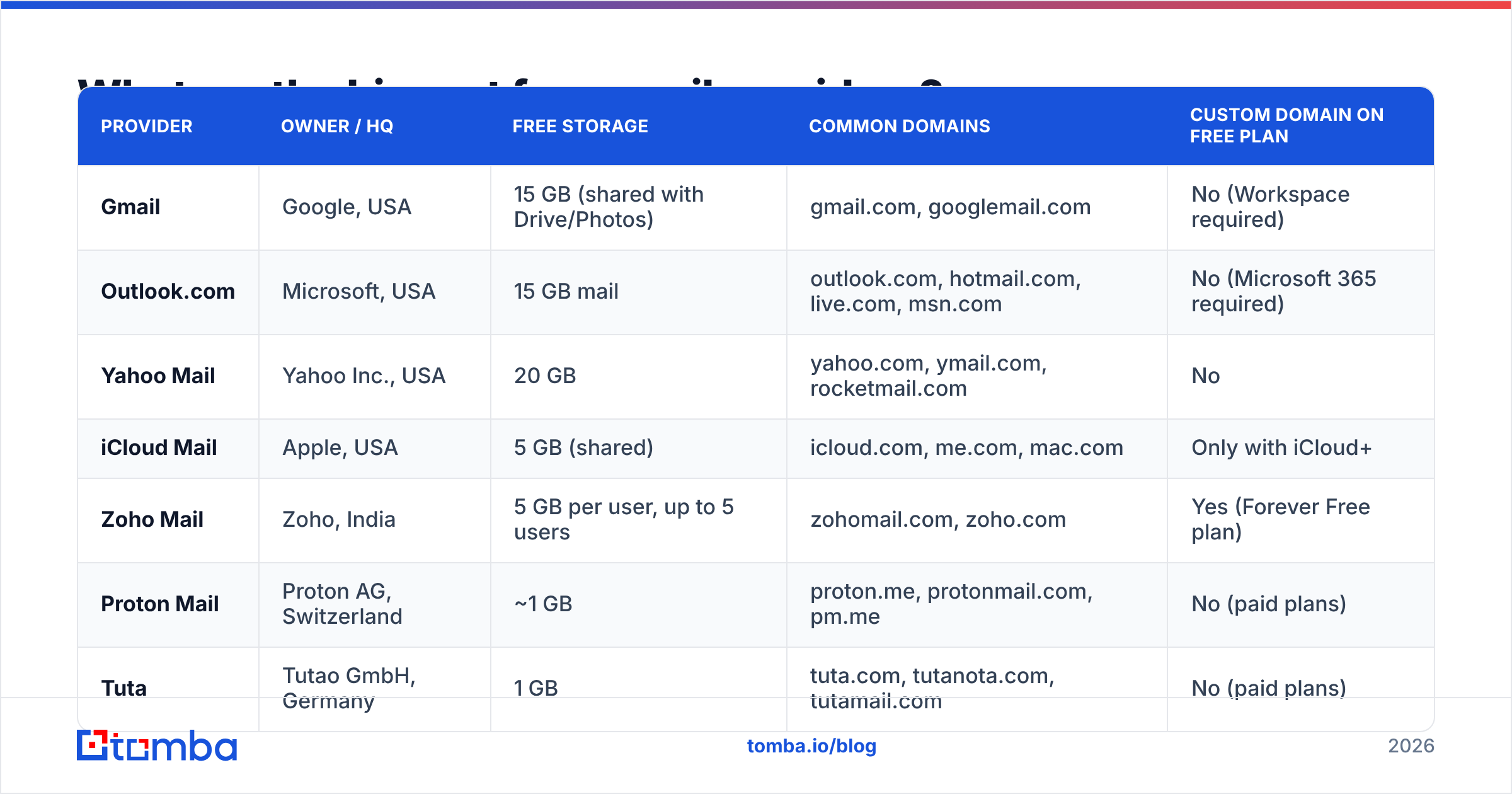
These are the addresses you'll see most often in signups, lead magnets and scraped lists. Storage figures are for the free tier as of 2026. Providers change them often, so check before you rely on a number.
| Provider | Owner / HQ | Free storage | Common domains | Custom domain on free plan |
|---|---|---|---|---|
| Gmail | Google, USA | 15 GB (shared with Drive/Photos) | gmail.com, googlemail.com | No (Workspace required) |
| Outlook.com | Microsoft, USA | 15 GB mail | outlook.com, hotmail.com, live.com, msn.com | No (Microsoft 365 required) |
| Yahoo Mail | Yahoo Inc., USA | 20 GB | yahoo.com, ymail.com, rocketmail.com | No |
| iCloud Mail | Apple, USA | 5 GB (shared) | icloud.com, me.com, mac.com | Only with iCloud+ |
| Zoho Mail | Zoho, India | 5 GB per user, up to 5 users | zohomail.com, zoho.com | Yes (Forever Free plan) |
| Proton Mail | Proton AG, Switzerland | ~1 GB | proton.me, protonmail.com, pm.me | No (paid plans) |
| Tuta | Tutao GmbH, Germany | 1 GB | tuta.com, tutanota.com, tutamail.com | No (paid plans) |
| Fastmail | Fastmail, Australia | No free plan (trial only) | fastmail.com, fastmail.fm | Yes (paid) |
Here is the full mainstream list with short notes:
- Gmail: The largest consumer inbox in the world. If you only block one domain, block this one.
- Outlook.com: This brand covers the old Hotmail, Live and MSN addresses. Block all four domains, not only outlook.com.
- Yahoo Mail: Cut free storage from 1 TB to 20 GB in 2024. It still has a large, older user base.
- iCloud Mail: Apple's "Hide My Email" relay addresses (privaterelay.appleid.com) also appear in signup data.
- AOL Mail: Owned by Yahoo Inc. Uses aol.com and aim.com, and skews toward older users.
- Zoho Mail: Unusual in that its free plan supports a custom domain, so some very small businesses run on it.
- GMX Mail: Owned by United Internet. Popular in Germany, Austria and Switzerland, and uses gmx.com, gmx.net and gmx.de.
- Mail.com: A sister brand of GMX with hundreds of vanity domains such as email.com, usa.com, engineer.com and consultant.com. It's easy to miss in a blocklist.

Which email providers focus on privacy and security?#
Privacy-focused providers encrypt mail, avoid ad-based business models, and are often based in jurisdictions with strict data laws. For a detailed comparison of features, Wikipedia keeps a comparison of webmail providers that's worth bookmarking.
- Proton Mail: End-to-end encrypted and Swiss-based. See proton.me/mail for current plans. It also sells a business tier on custom domains.
- Tuta (formerly Tutanota): Encrypted and German-based. Its domains include tuta.com, tutanota.de and keemail.me.
- Mailfence: Based in Belgium, with OpenPGP support and a free tier.
- Posteo: Based in Germany. Paid only, with a low monthly price and no free tier.
- mailbox.org: German, paid, and bundles office tools.
- Fastmail: Australian and paid. It has no ads and supports custom domains, so it's popular with small teams.
- StartMail: Dutch, paid, and offers unlimited aliases.
- HEY: From 37signals. It uses an opinionated screener workflow and is paid only.
- Runbox: Norwegian and paid, with a long track record.
In a B2B list, treat privacy addresses as deliberate signals. The person chose not to share their work identity. Cold emailing them rarely works, so route them to content nurture instead.
What are the main regional email providers by country?#
This part of the list is where most blocklists fall short. If you sell internationally, add these:
China 18. QQ Mail (qq.com, foxmail.com), owned by Tencent 19. NetEase 163 Mail (163.com) 20. NetEase 126 Mail (126.com) 21. Sina Mail (sina.com)
South Korea and Japan 22. Naver Mail (naver.com) 23. Daum Mail (daum.net, hanmail.net), owned by Kakao 24. Yahoo! Japan Mail (yahoo.co.jp)
Russia and CIS 25. Yandex Mail (yandex.ru, yandex.com, ya.ru) 26. Mail.ru (mail.ru, bk.ru, inbox.ru, list.ru)
Germany and DACH 27. Web.de (web.de) 28. T-Online (t-online.de) 29. Freenet Mail (freenet.de)
France, Italy and the rest of Europe 30. Orange (orange.fr, wanadoo.fr) 31. Free (free.fr) 32. La Poste (laposte.net) 33. Libero (libero.it) 34. Virgilio (virgilio.it) 35. Seznam (seznam.cz), Czech Republic 36. WP Poczta (wp.pl) and Onet (onet.pl), Poland
India and Latin America 37. Rediffmail (rediffmail.com) 38. UOL / BOL (uol.com.br, bol.com.br), Brazil
Keep one caveat in mind. In some of these markets, a regional free address sits on a real business card much more often than in the US. A two-person trading company in Guangzhou or a family business in Italy may run entirely on qq.com or libero.it. Before you discard these leads, check the company's website for a custom domain.
Which legacy ISP email providers still show up in lead lists?#
These addresses come with a home internet plan. They're old, often abandoned when people change ISPs, and some are now run by a different company than the one that created them.
- Xfinity / Comcast (comcast.net)
- AT&T (att.net, sbcglobal.net, bellsouth.net), mailboxes hosted through Yahoo
- Verizon (verizon.net), accounts moved to AOL
- Spectrum / Charter (charter.net, rr.com)
- Cox (cox.net)
- BT (btinternet.com), United Kingdom
In our experience cleaning purchased and scraped lists, ISP domains produce a disproportionate share of hard bounces. Run them through an email verifier before you import anything, or you'll pay for them in sender reputation.
Which business email providers host company domains?#
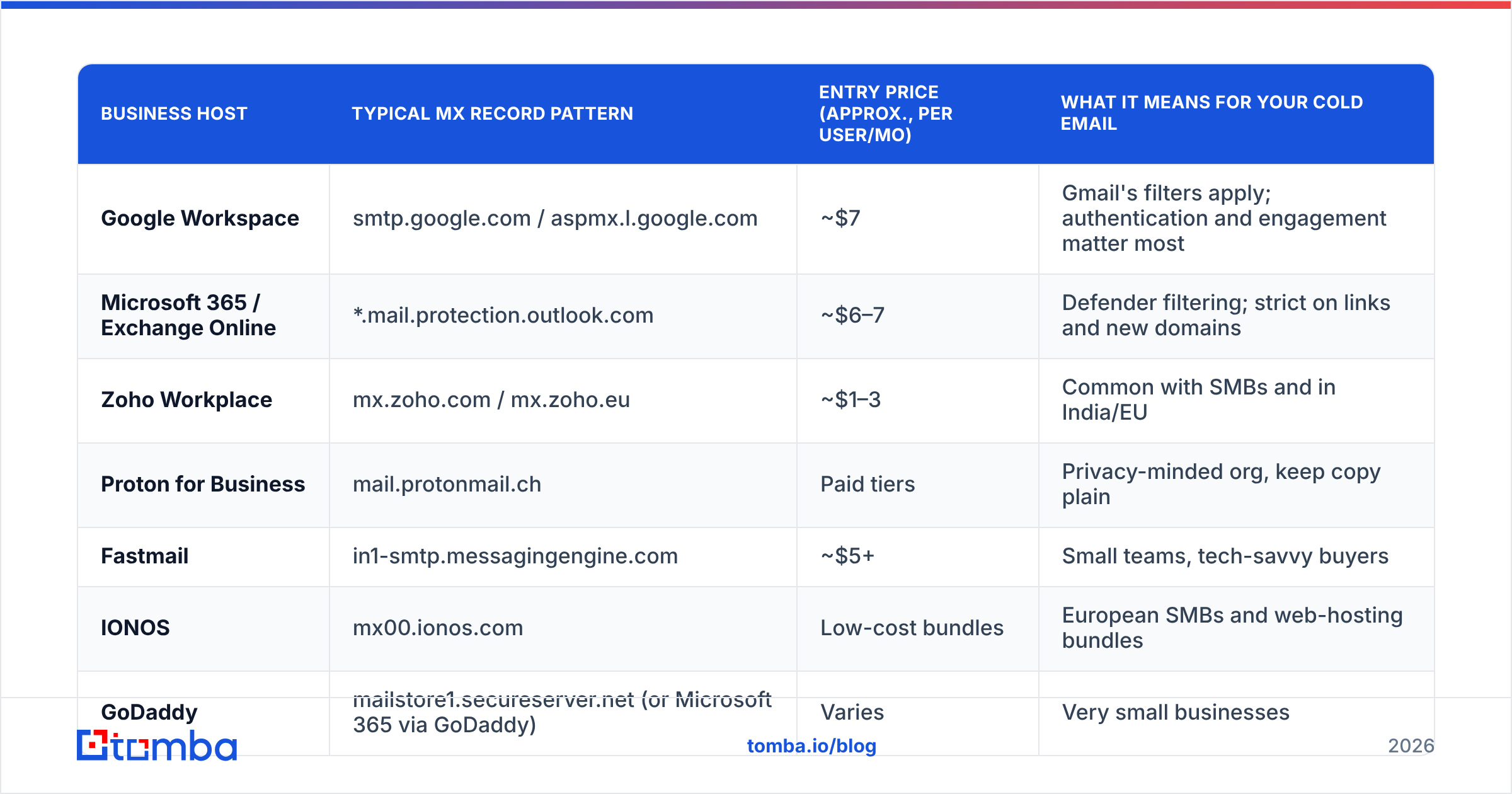
This is the part of the list that matters most for outbound. A business address like jane@acme.com doesn't show who hosts it, but the domain's MX record does. Run dig MX acme.com (or any online MX lookup) and match the result against this table.
| Business host | Typical MX record pattern | Entry price (approx., per user/mo) | What it means for your cold email |
|---|---|---|---|
| Google Workspace | smtp.google.com / aspmx.l.google.com | ~$7 | Gmail's filters apply; authentication and engagement matter most |
| Microsoft 365 / Exchange Online | *.mail.protection.outlook.com | ~$6–7 | Defender filtering; strict on links and new domains |
| Zoho Workplace | mx.zoho.com / mx.zoho.eu | ~$1–3 | Common with SMBs and in India/EU |
| Proton for Business | mail.protonmail.ch | Paid tiers | Privacy-minded org, keep copy plain |
| Fastmail | in1-smtp.messagingengine.com | ~$5+ | Small teams, tech-savvy buyers |
| IONOS | mx00.ionos.com | Low-cost bundles | European SMBs and web-hosting bundles |
| GoDaddy | mailstore1.secureserver.net (or Microsoft 365 via GoDaddy) | Varies | Very small businesses |
| Namecheap Private Email | mx1.privateemail.com | Low-cost | Solo operators and startups |
| Rackspace Email | mx1.emailsrvr.com | Varies | Legacy mid-market IT setups |
Prices change often and depend on billing term, so treat these as ballpark figures and check each vendor's pricing page.
Two practical uses follow from this table. First, segmentation: Microsoft 365 recipients and Google Workspace recipients react differently to link-heavy copy and new sending domains, so some teams split sequences by host. Second, email pattern prediction: once you know a company's host and have seen one confirmed address, the company email pattern (first.last@, f.last@ and so on) is usually consistent across the domain.
A warning about catch-all domains: many Microsoft 365 and Google Workspace tenants accept mail for any address at the SMTP level, so a basic check can't confirm whether a mailbox exists. For those, use a dedicated catch-all verifier and don't guess.
How should you use this list to clean B2B leads?#
Here is a workflow that fits into any CRM or spreadsheet:
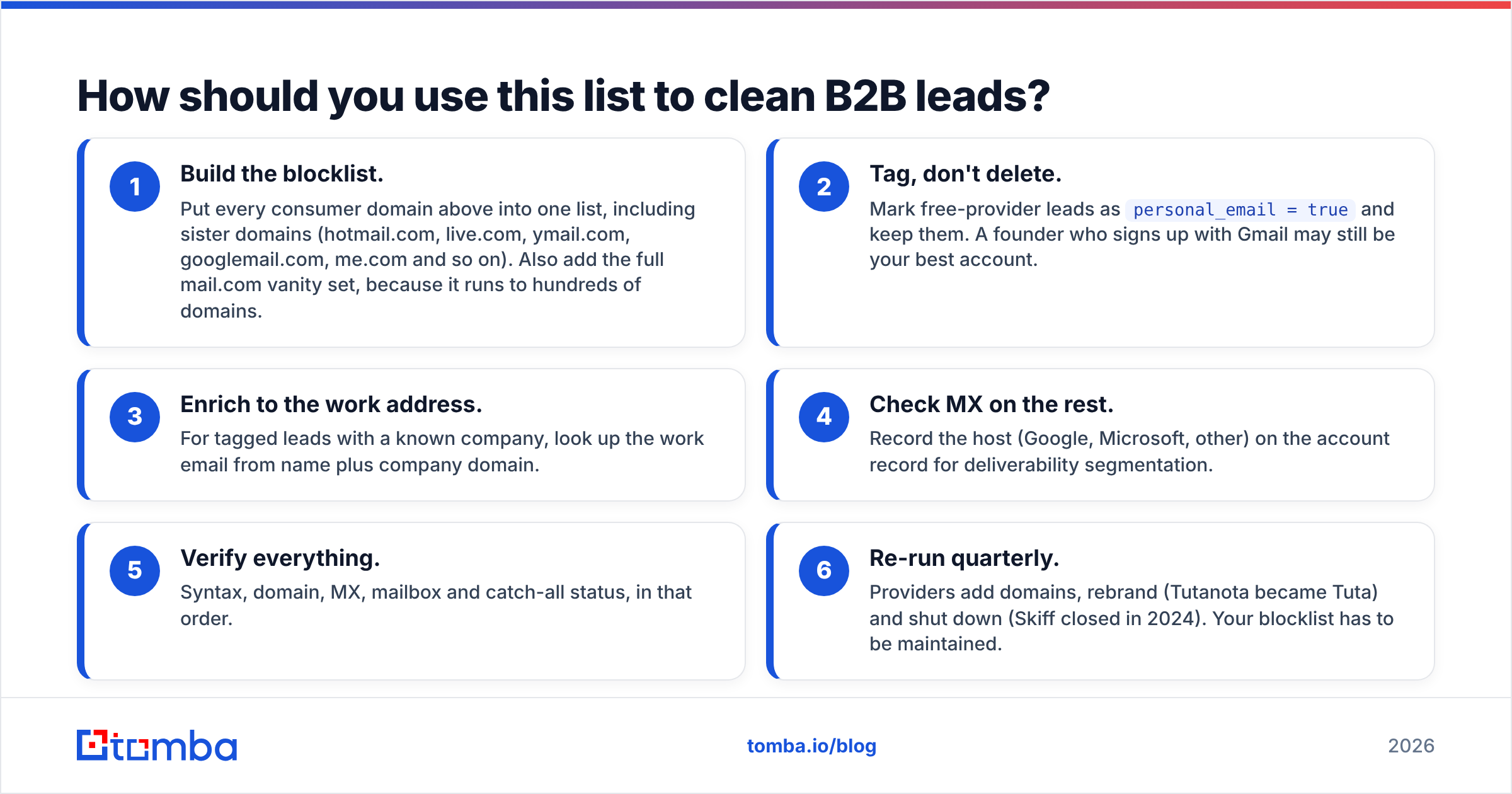
- Build the blocklist. Put every consumer domain above into one list, including sister domains (hotmail.com, live.com, ymail.com, googlemail.com, me.com and so on). Also add the full mail.com vanity set, because it runs to hundreds of domains.
- Tag, don't delete. Mark free-provider leads as
personal_email = trueand keep them. A founder who signs up with Gmail may still be your best account. - Enrich to the work address. For tagged leads with a known company, look up the work email from name plus company domain.
- Check MX on the rest. Record the host (Google, Microsoft, other) on the account record for deliverability segmentation.
- Verify everything. Syntax, domain, MX, mailbox and catch-all status, in that order.
- Re-run quarterly. Providers add domains, rebrand (Tutanota became Tuta) and shut down (Skiff closed in 2024). Your blocklist has to be maintained.
This matters for sales metrics too. Leads that come in with a verified work email usually convert better than those with a personal address. When your SDRs stop chasing @yahoo.com signups, your response rate numbers stop getting diluted by people who were never buyers.
Which email provider should you choose for yourself?#
If you're here to pick an inbox and not to filter one, here's a quick recommendation by use case:
- Most people, free: Gmail or Outlook.com. They have the best spam filtering, apps and integrations.
- Apple-first users: iCloud Mail, especially with iCloud+ for Hide My Email and a custom domain.
- Privacy: Proton Mail or Tuta for free encrypted mail. Posteo or mailbox.org if you're willing to pay a little and want a European host.
- Freelancer with a custom domain, $0 budget: Zoho Mail's Forever Free plan.
- Small business: Google Workspace or Microsoft 365. Pick based on whether your team prefers Docs/Sheets or Word/Excel.
- Cold outbound sending domains: Google Workspace or Microsoft 365 mailboxes on secondary domains, properly warmed and authenticated. Never send prospecting mail from a free consumer address.
Frequently asked questions#
How many email providers are there in total?#
Nobody has an exact count. Thousands of ISPs, hosting companies and universities run mail servers. The 44 providers above, plus the business hosts, cover the large majority of addresses you'll see in real B2B and B2C data.
Is Outlook the same as Hotmail?#
Yes. Microsoft moved Hotmail, Live and MSN mailboxes onto Outlook.com. The old addresses still work, which is why you need to block all four domains.
Can a business email be hosted on Gmail?#
Yes, through Google Workspace. The address uses the company's own domain (you@company.com), but Google's infrastructure handles the mail. You can confirm this from the MX record.
Should I block free email providers on B2B signup forms?#
It depends on your funnel. Blocking reduces junk but also turns away real founders and freelancers. Many teams accept them, tag them, and enrich them in the background.
Turn personal addresses into verified work emails#
The list above shows you who to filter out. The next step is finding the right address for the leads you keep. Tomba Email Finder takes a name plus a company domain and returns the professional address with a confidence score and verification status, so you can replace a @gmail.com signup with the person's work email before it reaches your sequence. You can start on the free tier (25 searches/month) and move up to Starter at $49/month when your list volume grows.
Related guides#
// get started
Find, verify and enrich your first contacts today
Start on the free plan with 25 searches a month, then scale when your team is ready.
Free plan · No credit card required · GDPR & CCPA
// about the author